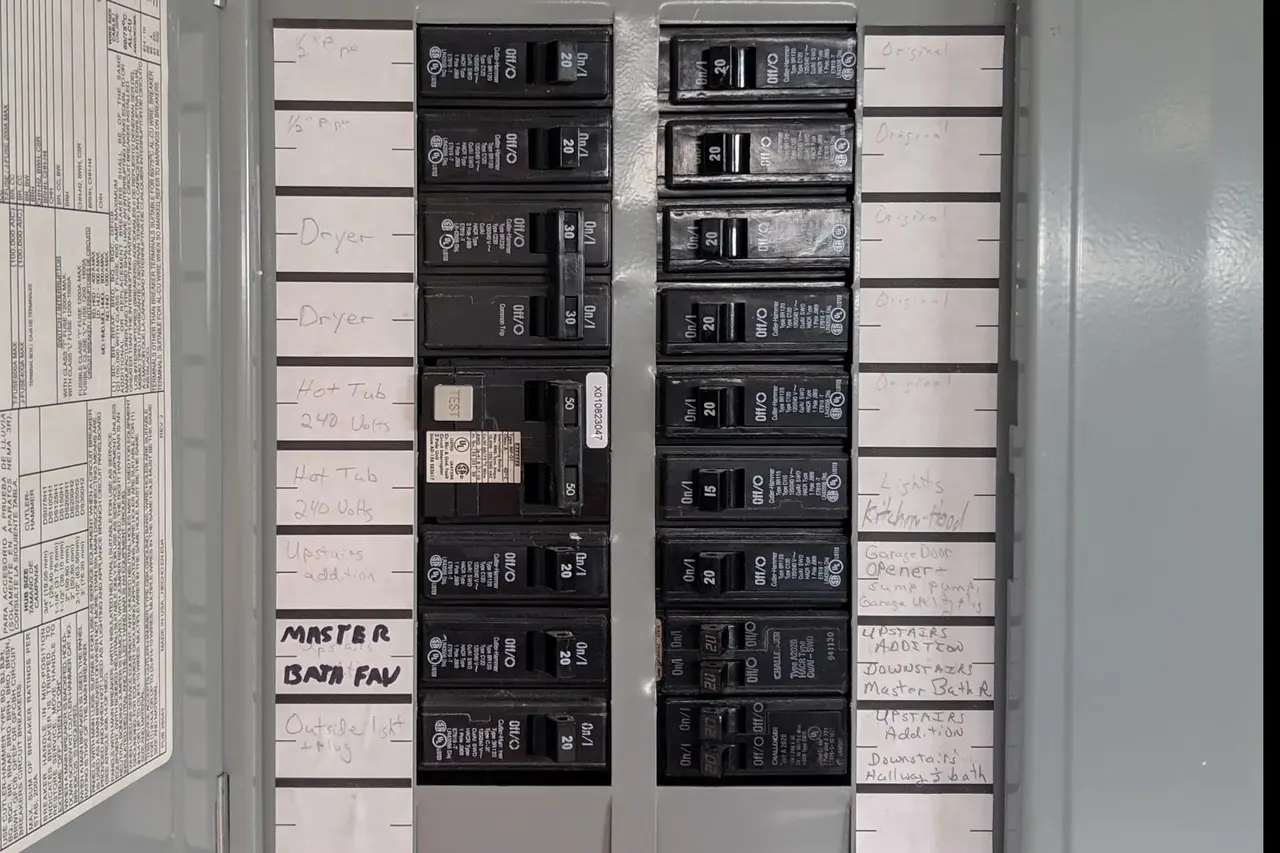
"Which breaker is the kitchen?" If you have ever stood in front of a distribution board with a row of identical switches and labels that say "Original", "1" or nothing at all, you know the problem. Before you replace a socket, change a light fitting, chase a fault or simply reset a breaker with confidence, you need to know which breaker feeds which part of the house. In many older, rented or extended houses, nobody has ever written it down.
This guide explains how residential electricians trace and map the circuits in an existing home: how to plan the job, three practical methods for finding which breaker controls an outlet or light, the traps that catch people out (shared neutrals, two circuits in one box, sub-boards, solar and backup supplies), and how to turn what you find into a clear circuit schedule and durable labels.
Scope and safety. Written for trainee and working residential electricians, and for homeowners who want to understand the process, on 230 V / 50 Hz single-phase supplies as used in most homes in Vietnam. Mapping circuits only involves switching breakers and using plug-in testers; it does not involve removing the board cover or touching conductors. Opening the board, removing accessories from walls or working on any wiring must be done by a competent, licensed electrician, following local regulations and the manufacturer's instructions. A circuit map is a guide, never proof that a circuit is dead: always prove dead with a suitable tester at the point of work before touching anything.
Why a circuit map matters
A correct map saves time and prevents accidents. With it you can:
isolate exactly the circuit you need instead of switching off the whole house, so the fridge, router and security cameras stay on;
find the cause of a fault faster, because you know which outlets and lights share a breaker;
spot problems early: one breaker feeding far too many points, a water heater sharing a socket circuit, or lights and sockets mixed on the same breaker;
give the owner, tenants and the next electrician a record they can trust.
A wrong label is worse than no label, because people believe it.
Step 1: Understand how the board is arranged
Start by looking at the board without opening its cover. Note what each device is and how they are grouped.
Main switch
Most boards have a main switch or main breaker (often called "aptomat tổng") that disconnects all the circuits behind it. In many Vietnamese homes there is also a breaker beside the electricity meter, outside the house or at the bottom of the stairs, before the indoor board. Note where it is; it is your fallback if you ever need to isolate everything.
RCD groups
An RCD (residual current device, often called "chống giáºt") or RCCB protects people against earth-leakage shocks. A single RCD often protects a group of breakers. If you switch off the RCD, every circuit in its group goes off at once. Write down which breakers sit behind which RCD; you will need it later when you interpret faults.
Circuit breakers (MCBs and RCBOs)
Each MCB normally protects one circuit. An RCBO combines a breaker and an RCD for a single circuit. Read the rating printed on each one, for example C6, B16 or C20: the letter is the tripping curve and the number is the rated current in amperes. Note also whether each breaker switches only the line conductor (single-pole) or both line and neutral (double-pole or "1P+N"); the device's markings or datasheet tell you. This matters for safety, as explained in Step 5.
Sub-boards
Multi-storey "tube" houses often have a small board on each floor, fed from one breaker in the main board. Switching off that one breaker kills a whole floor. Treat each sub-board as its own small map and record which breaker in the main board feeds it.
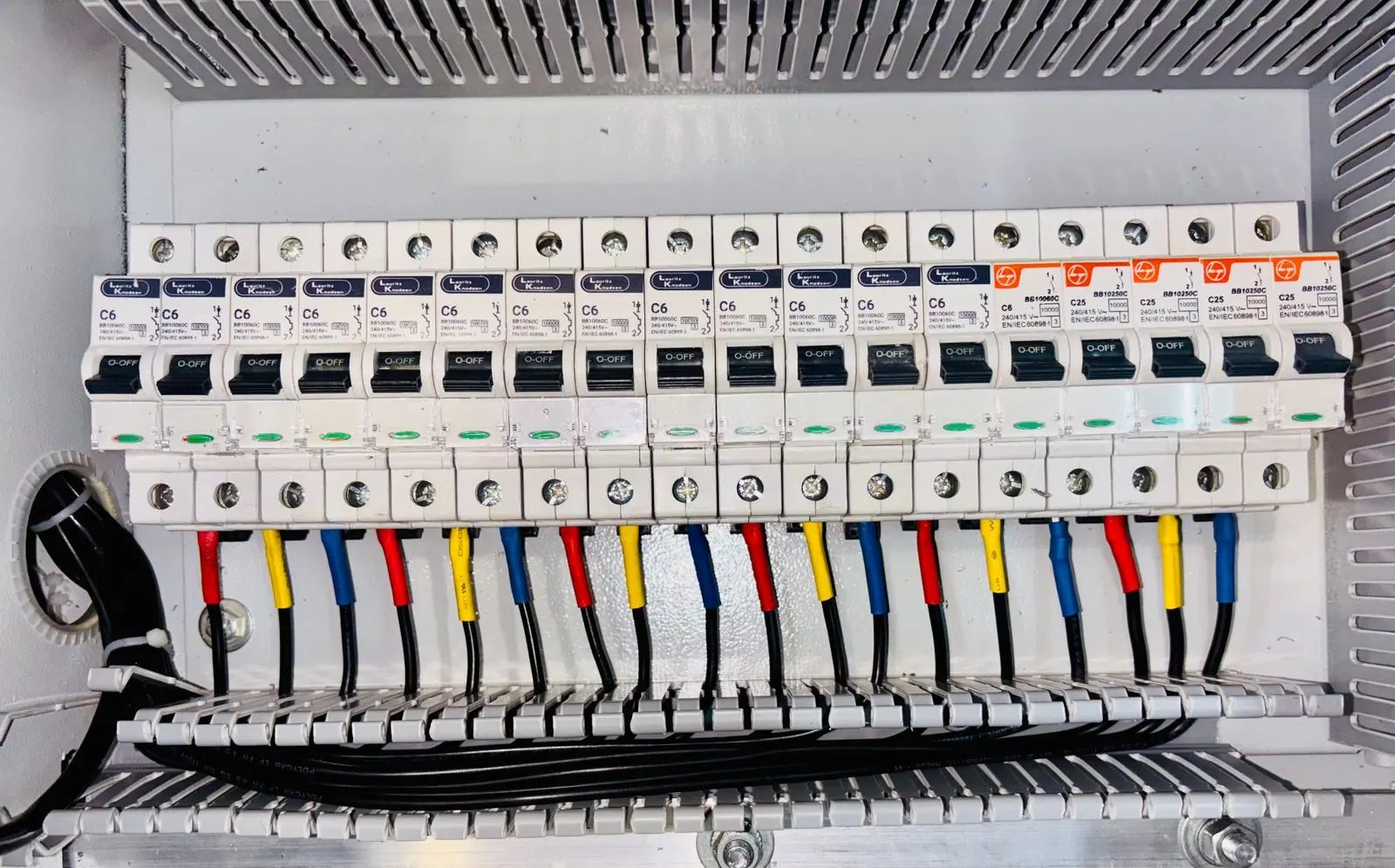
Figure 1. A row of single-pole miniature circuit breakers with colour-coded sleeves on the outgoing conductors. The breakers on the left are marked C6 and the ones on the right C25: identical-looking switches can protect very different circuits, so record the rating of each one when you map the board. This board is shown with its cover removed; mapping circuits does not require opening the board. (Photo: ranjeet ., Pexels)
Step 2: Make a list of every point to check
Before switching anything, walk through the house with a notebook or your phone and list every outlet, light and fixed appliance, room by room. A quick floor sketch for each storey makes the job much easier. Give each point a short code, for example:
K-S1, K-S2: kitchen sockets 1 and 2 (count each socket of a double outlet separately);
K-L1: kitchen ceiling light;
BR2-AC: air conditioner in bedroom 2;
WC1-WH: water heater in the ground-floor bathroom;
OUT-L1: gate light, OUT-B: doorbell.
Do not forget the points people overlook: outdoor and gate lights, the doorbell, the water pump, the extractor fan, the garage door motor, CCTV and alarm power supplies, the internet router, sockets behind furniture and the supply to any outbuilding or rooftop room.
Step 3: Prepare the house
Mapping takes anywhere from half an hour in a small apartment to several hours in a large house with many circuits. Prepare so that switching breakers off does not cause problems:
Tell everyone in the house what you are doing and roughly how long it will take. Agree a time with the customer.
Protect equipment. Ask the owner to save work and shut down computers, and to turn off air conditioners, the water heater, the pump and other large appliances at their controls first. Avoid switching breakers off and on repeatedly while a large motor or compressor is running. After switching an air conditioner's supply back on, wait a few minutes before restarting it, or follow the manufacturer's instructions.
Check for people and medical equipment. If anyone relies on powered medical equipment, plan around it before switching anything.
Prepare the points. Switch on every light at its wall switch. Plug a small lamp, a phone charger with an indicator or a plug-in socket tester into sockets you want to check. A helper with a phone can call out what goes off, which saves walking up and down stairs.

Figure 2. An inspector in a hard hat and high-visibility vest kneels in an empty room beside a wall outlet, holding a pen-type tester to it with a clipboard in the other hand. Working room by room with a written list is the core of circuit mapping. A non-contact pen tester can show that a point is live, but it cannot prove that it is dead. (Photo: RDNE Stock project, Pexels)
Step 4: Find the circuits – three practical methods
You can use one method or combine them. Whichever you use, record the results immediately; memory fails after the third breaker.
Method A: one breaker off at a time
This is the most common and most reliable method for a small or medium house.
Switch off one breaker. Write its position number (count from the left, top row first).
Go round the list (or ask your helper) and mark every point that has gone dead: lamps off, testers dark, appliance indicator lights off.
Check fixed appliances by their indicator lights or displays, not by trying to operate them.
Switch the breaker back on and confirm everything has come back.
Move to the next breaker and repeat.
Breakers that kill nothing you can find usually feed something you have not listed: a sub-board, an outbuilding, an unused circuit, or a point hidden behind furniture or in the ceiling. Mark them "unknown – investigate", never "spare".
Method B: all off, then one on at a time
When a board has many breakers and the house has many points, it can be faster to switch all the circuit breakers off (leaving the main switch and RCDs on), then switch them on one at a time and record what comes alive. This method gives a very clear picture, but it switches off everything at once, so prepare the house as in Step 3 and agree it with the customer first.
Method C: plug-in testers and a circuit breaker finder
A plug-in socket tester or a small lamp makes Method A faster for sockets: you can see at a glance which sockets are dead, and a socket tester also shows basic wiring faults such as reversed line and neutral or a missing earth while the power is on.
A circuit breaker finder is a two-part tool. The transmitter plugs into a socket (or connects to a lighting point through an adapter, if the kit includes one) and puts a signal on the circuit. You then pass the receiver along the breakers in the board; it indicates the breaker carrying the signal most strongly. This lets you find a breaker without turning anything off.
Finders are not infallible. The signal can couple onto neighbouring breakers or circuits that share a cable route, so the receiver may react to two or three breakers. Follow the instructions, adjust the sensitivity, and always confirm by switching the indicated breaker off and checking that the point really goes dead.
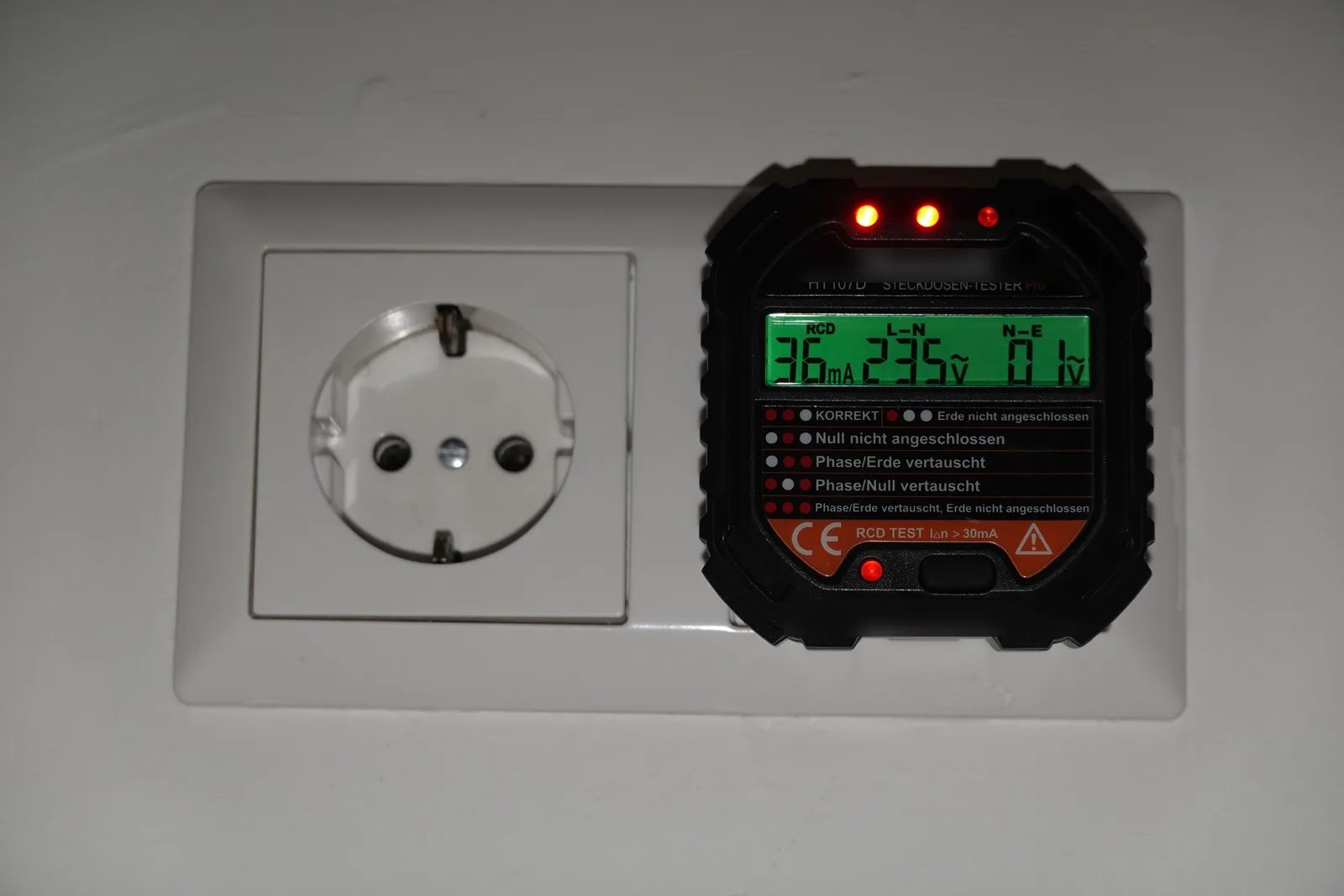
Figure 3. A plug-in socket tester in a European-type earthed socket. Its display shows about 235 V between line and neutral and 0 V between neutral and earth, and the indicator lamps and legend show whether the socket is wired correctly. A tester like this makes it quick to see which sockets go dead when a breaker is switched off, but it is not a substitute for proving dead before work. Brand name blurred. (Photo: Skatebiker, Wikimedia Commons, CC0)
Which method to choose
Method | Best for | Advantages | Limitations |
|---|---|---|---|
A: one breaker off at a time | Most houses and apartments | Reliable; only one circuit off at a time | Slow with many points; needs walking or a helper |
B: all off, then one on | Boards with many breakers, empty or prepared houses | Clear results; fast for large houses | Everything goes off; needs preparation and agreement |
C: socket tester / lamp | Checking many sockets quickly | Instant visual result; finds some wiring faults too | Sockets only (a lamp or light-fitting tester is needed for lights) |
C: circuit breaker finder | Occupied premises where power must stay on | No interruption while searching | Can point to more than one breaker; must be confirmed by switching off |
Step 5: Watch for the traps
Most mapping mistakes come from assuming that each box, socket or light is fed by exactly one breaker. In real houses, especially ones that have been altered several times, that is often not true.
Two circuits in one box
A double socket may be fed from two different circuits, or a switch box may contain a switch for a light on one circuit and a feed to a socket on another. Two-way and intermediate switching systems sometimes take power from a different circuit at the far end. If a point stays partly live after you switch off "its" breaker, assume there is a second supply and record it.
Shared or borrowed neutrals
Sometimes an installer has taken the neutral for one circuit from another circuit, for example a light fed from breaker 3 but using the neutral of breaker 5. Switching off breaker 3 kills the light, but the neutral in that box can still carry current from breaker 5's loads. This is a wiring fault, not a quirk. Clues include an RCD that trips when a particular breaker is switched on or loaded (when the two circuits are behind different RCDs), or a "dead" circuit where the neutral still shows a voltage. Record it and recommend that a licensed electrician corrects it.
Single-pole breakers and reversed polarity
A single-pole breaker only switches the line conductor. If line and neutral have been swapped somewhere, at the board or in a box, switching off the breaker may disconnect the neutral and leave the point connected to line. The light goes off and everything looks dead, but the conductors are still live. This is one of the main reasons why a map is never proof of isolation.
Fixed appliances with their own switches
Water heaters, air conditioners and pumps often have a separate double-pole switch or isolator near the appliance. Note both the breaker and the local isolator. An appliance that stays off when you expect it to be on may simply have its local switch turned off.
Other sources of supply
A grid-tied or hybrid solar system, a battery or UPS, or a generator with a changeover switch can keep parts of the installation live even with the grid breaker off. If the house has any of these, note how they are connected and isolated, and follow the system's own shutdown procedure.
Reference table: what your findings may mean
What you see | Likely meaning | What to do |
|---|---|---|
One breaker kills sockets in several rooms | Normal for a socket circuit, but check how many points it feeds | Record all points; note if the circuit looks overloaded |
Lights and sockets go off on the same breaker | Mixed circuit, common in older or altered wiring | Record it; point it out to the owner |
A breaker kills nothing you can find | Sub-board, outbuilding, hidden point or unused circuit | Mark "unknown – investigate"; never label it "spare" without checking |
One socket of a double outlet stays live | Fed from two circuits | Record both breakers; warn on the label |
RCD trips when a particular breaker is switched back on | Possible shared neutral between circuits or leakage on that circuit | Stop; record it; have it investigated by a licensed electrician |
Point goes off but tests show voltage on a conductor | Second supply, borrowed neutral or reversed polarity | Treat as live; do not work on it until the cause is found |
Breaker finder reacts on two breakers | Signal coupling between circuits | Confirm by switching each off in turn |
Water heater or AC shares a breaker with sockets | Large load on a general circuit | Recommend a dedicated circuit; have the cable and breaker checked |
Step 6: Before any work, prove dead at the point of work
Your map tells you which breaker to switch off. It does not tell you that the circuit is safe to touch. Before you work on any point:
Switch off the breaker you identified and, if possible, lock it off or tag it ("Do not switch on – work in progress"), so nobody switches it back on while you work.
Check your voltage tester or multimeter on a known live source.
At the point of work, test between line and neutral, line and earth, and neutral and earth.
Check the tester again on the known live source to confirm it still works.
Use a two-pole voltage tester or a multimeter suitable for mains work. A neon screwdriver or a non-contact pen tester can show that something is live, but neither can prove that a circuit is dead. If you find any voltage, stop: there is another supply, a shared neutral or a mapping mistake.
Step 7: Write the circuit schedule
A circuit schedule is a simple table that turns your notes into a record anyone can use. Keep one copy inside the board door and give the owner a copy, for example as a photo on their phone.
No. | Breaker (type, rating) | RCD group | What it feeds | Notes |
|---|---|---|---|---|
1 | Main switch | – | Whole house | Breaker at meter also isolates everything |
2 | RCD 30 mA | – | Breakers 3–7 | Press the test button regularly, as the maker advises |
3 | MCB C10 | RCD 1 | Lights, ground floor and stairs | Includes gate light (OUT-L1) |
4 | MCB C16 | RCD 1 | Sockets, living room and kitchen | K-S2 (right socket) also fed from 5 |
5 | MCB C20 | RCD 1 | Sockets, kitchen worktop | Rice cooker, kettle, microwave |
6 | MCB C20 | RCD 1 | Water heater, ground-floor bathroom | Local double-pole switch beside door |
7 | MCB C16 | RCD 1 | Sub-board, 1st floor | See separate schedule inside sub-board |
8 | MCB C20 | none | Air conditioner, bedroom 2 | Recommend RCD protection – discuss with owner |
Example only: the ratings in this table are for illustration, not recommendations.
Make the labels useful
Be specific. "Sockets – kitchen worktop" is useful; "Kitchen", "Plugs" or "Original" is not. The cover photo of this article shows how vague and overwritten labels creep in over the years.
Number the breakers and use the same numbers in the schedule.
Write the exceptions, such as a socket fed from two circuits or a light with a borrowed neutral, so the next person is warned.
Use durable labels: printed labels or permanent marker on the label strip, not pencil or tape that will peel off in heat and humidity.
Add the date and your name or company, so people know how current the information is.
Use the owner's language. In Vietnam, write the labels in Vietnamese; add English if foreign tenants live there.
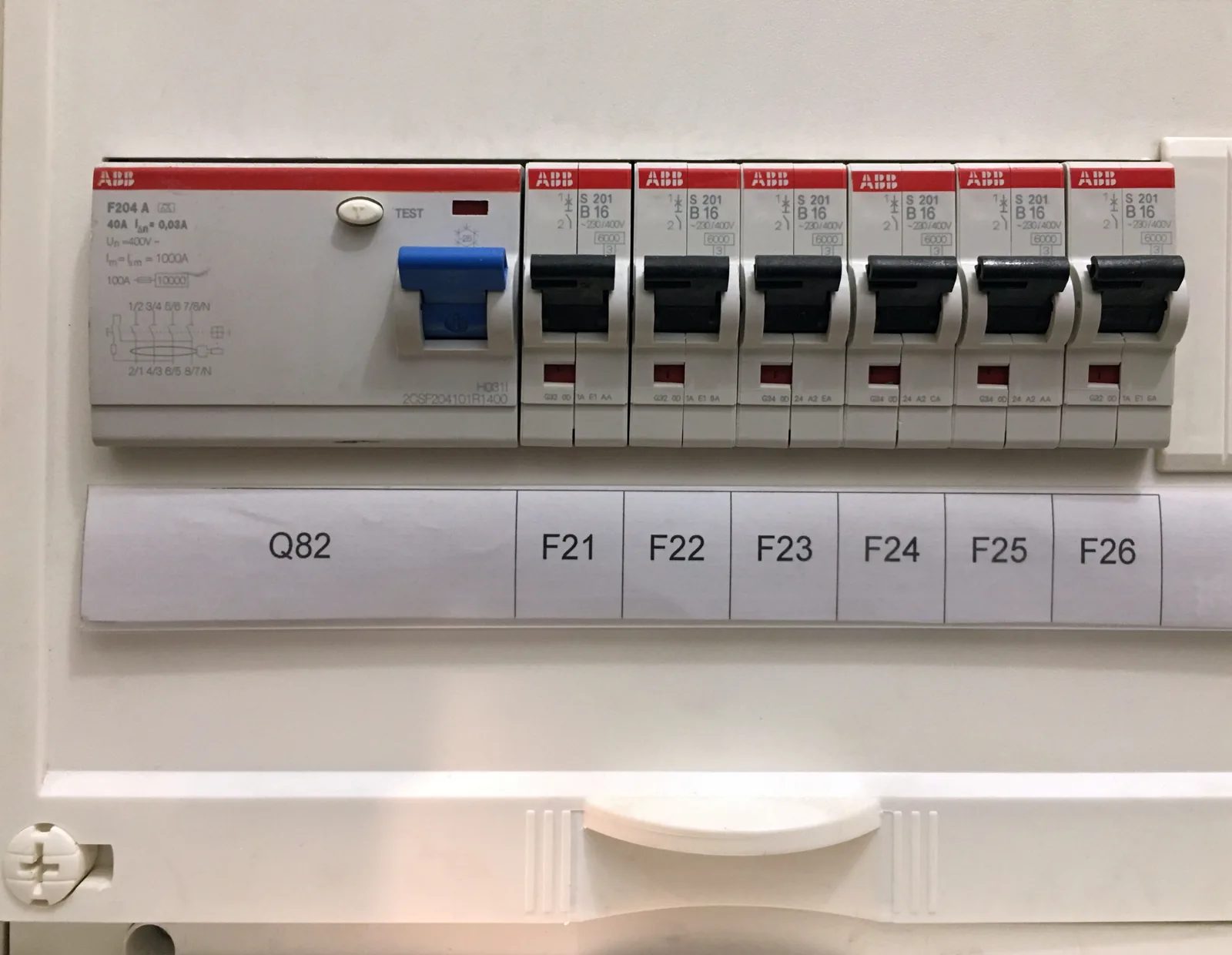
Figure 4. A four-pole 40 A, 30 mA RCD followed by six single-pole B16 circuit breakers, with a label strip underneath carrying only equipment codes (Q82, F21 to F26). Codes like these are useful only if a schedule nearby explains what each one feeds; in a home, plain descriptions on the label are clearer. (Photo: Pittigrilli, Wikimedia Commons, CC0)
Practical examples
Example 1: Unlabelled board in a rented house
A landlord asks you to map a three-storey rented house before new tenants move in. The board on the ground floor has a main switch, one RCD and eight breakers, none labelled. You list 46 points on three floor sketches, switch on all the lights, put a socket tester in the first socket of each room and use Method A with the landlord's son calling from upstairs. Breakers 1 to 6 are straightforward. Breaker 7 kills nothing on the list; looking again, you find it feeds a rooftop room nobody mentioned. Breaker 8 turns off the second-floor lights and also the right-hand socket in one bedroom: a mixed circuit. You record everything, label the board in Vietnamese, leave a schedule in the door and send the landlord photos, with a note recommending that the mixed circuit is checked.
Example 2: "The bathroom breaker is off but the light still works"
A homeowner switched off the breaker labelled "Bathroom" to change a light fitting and noticed the light still came on. Mapping shows that the label is wrong: the bathroom light is on the landing lighting circuit, and the breaker labelled "Bathroom" actually feeds the water heater. You correct the labels and remind the owner that a label is never proof that a fitting is dead.
When to call a licensed electrician or EVN
Stop mapping and arrange professional help if you find:
a board, breaker or cable that is hot, discoloured, smells of burning, crackles or buzzes;
breakers that trip, an RCD that trips repeatedly, or a breaker that will not stay on;
signs of shared neutrals, points fed from two circuits, or voltage on a circuit that should be dead;
no RCD protection on socket circuits, or large appliances sharing general circuits;
any problem with the meter, the incoming supply cable or the equipment before the meter. These normally belong to the electricity supplier; contact EVN (or your local power company) rather than touching them.
If anyone receives an electric shock, switch off the supply if it is safe to do so, do not touch the person while they are still in contact with the source, and call 115 for emergency medical help.
Working with the customer
Circuit mapping is easy to undervalue because the customer sees "just switching things on and off". Explain what they get: a reliable record that saves time on every future job, and a check that may reveal real safety problems. Quote by time based on the number of breakers and points, agree when power will be off, and hand over a clear deliverable: the labelled board, the written schedule and a short list of any defects found, with recommendations. Do not carry out repairs you found during mapping without agreeing the price and scope with the customer first.
Safety checklist
Map only by switching breakers and using plug-in testers; do not open the board or wall accessories unless you are qualified to do so.
Tell everyone in the house before switching anything off.
Turn off large appliances at their controls before switching their breakers.
Keep a torch with you.
Never label a breaker "spare" without confirming that it feeds nothing.
Confirm every breaker-finder result by switching the breaker off.
Record shared neutrals, double supplies, mixed circuits and solar or backup supplies on the schedule.
Before any work: switch off, lock off or tag, prove the tester, test dead at the point of work, re-prove the tester.
Treat any point that still shows voltage as live until the cause is found.
Stop and call a licensed electrician for hot, scorched or buzzing equipment, repeated tripping or missing RCD protection.
Contact EVN for problems at the meter or incoming supply.
Frequently Asked Questions
How can I find which breaker controls an outlet without turning the power off?
Use a circuit breaker finder: plug the transmitter into the outlet and scan the breakers with the receiver. It narrows the search without an interruption, but you still need to switch off the indicated breaker briefly to confirm the result.
Why does one breaker turn off sockets in two different rooms?
Socket circuits are usually wired as one cable route serving several sockets, often across neighbouring rooms or on the same wall. That is normal. Record every socket on the circuit so you know what will go off.
Why does the RCD trip when I switch a particular breaker back on?
It may be leakage from an appliance or wiring on that circuit, or a neutral shared between circuits. Unplug appliances on that circuit and try again; if it still trips, have a licensed electrician investigate.
Is a non-contact voltage tester enough to check that a circuit is off?
No. It is useful for a quick indication, but it can miss a live conductor and it cannot prove dead. Use a two-pole voltage tester or a suitable multimeter and test L–N, L–E and N–E.
The breaker finder points to two breakers. Which one is right?
Signals can couple between circuits. Reduce the receiver's sensitivity, scan again, then switch each candidate off in turn and check which one really kills the outlet.
Can I map my own board as a homeowner?
Switching breakers and plugging in a lamp or socket tester is something many homeowners do. Anything that involves removing the board cover, sockets or light fittings, or working on wiring, should be left to a licensed electrician.
Practice Exercises
Floor plan list. Draw a floor plan of your own home or a training house, list every outlet, light and fixed appliance, and give each a code as in Step 2.
Method choice. For each case, choose a method and explain why: (a) a small apartment with six breakers; (b) a three-storey house with 18 breakers and 60 points, empty between tenants; (c) a home office where the computer server must stay on.
Interpret the findings. A light stays on after its labelled breaker is switched off, but goes off when a different breaker is switched off. Then the RCD trips when the first breaker is switched back on with the light on. List the possible causes and what you would do next.
Write a schedule. Using the example in Step 7 as a model, write a circuit schedule for a board with a main switch, two RCDs and ten breakers, including at least two notes about exceptions.
Customer explanation. In three or four sentences, explain to a homeowner why the circuit map you made does not mean that it is safe to touch a wire after switching off a breaker.