It is evening, the fan stops and the lights go out. You look out of the window: the house next door is lit, the street lights are on and the café across the road still has its TV running. When the whole street is dark, everyone knows it is a supply outage. When only your house (or only part of it) is dark, the cause could be inside the house, on the cable between the meter and the house, or on the power company's side, and you need to know which before you start switching things.
This guide gives the checks in a safe order, from the quick look anyone can do to the measurements only a competent electrician should make. If only one socket or room is dead, see our article on an outlet that is not working when the breaker hasn't tripped; if a breaker trips every time you reset it, see our guides on why a circuit breaker keeps tripping and why an RCD keeps tripping.
Scope and safety. For trainee and working residential electricians, and for homeowners who want to understand the process, on 230 V / 50 Hz supplies as used in Vietnam: mostly single-phase, with some larger homes and shophouses on three-phase. Even when the house is dead, the incoming side of the main switch, the meter and the service cable can still be live, and with some faults the neutral can be live too. The meter, its box, its seals and the supply side of the meter belong to the power company (EVN): do not open, unseal, reconnect or climb to them. Homeowners should stay with the look-and-switch checks; anything with the board cover off is for a licensed electrician. Numbers marked for reference are examples, not rules.
First, five seconds of safety
Before touching any switch, use your senses. A power cut with any of these signs is not a "reset and see" job:
A burning smell, smoke or hot-plastic smell from the board, a socket, the meter box or an appliance.
Water on or near the board: a roof leak, a burst pipe, flooding after heavy rain.
Sparks, crackling or a bang just before the power went, or soot on the board cover.
A wire down outside: a fallen service cable, a broken line, a branch across the wires.
Someone received a shock just before the outage.
If you see any of these, do not touch the board with wet hands or while standing in water, and keep everyone away from a fallen wire (treat it as live). Switch off the main switch only if you can reach it safely and dry. Then call a licensed electrician for problems inside the house and the power company for anything at the pole or on the street. If someone has been shocked, make sure the power is off before touching them and call emergency services (115).
Step 1: Confirm it really is only your house
Look at the houses on both sides and across the street, and at the street lights.
Ask a neighbour: "Do you have power? Did your lights dip or flicker just now?"
Check whether a planned interruption has been announced for your area on the channels your local EVN office uses (website, customer app).
There are three common results:
Everyone nearby is dark: almost certainly a supply outage. Switch off sensitive appliances and wait or report it.
Some houses dark, some lit: possibly still a supply fault. Single-phase houses on a street network are shared between the three phases, so if one phase fails, only the houses on that phase lose power. Your neighbour may simply be on a different phase.
Only your house is dark: the fault is most likely between the meter and your appliances, but the meter and service cable are still possible.
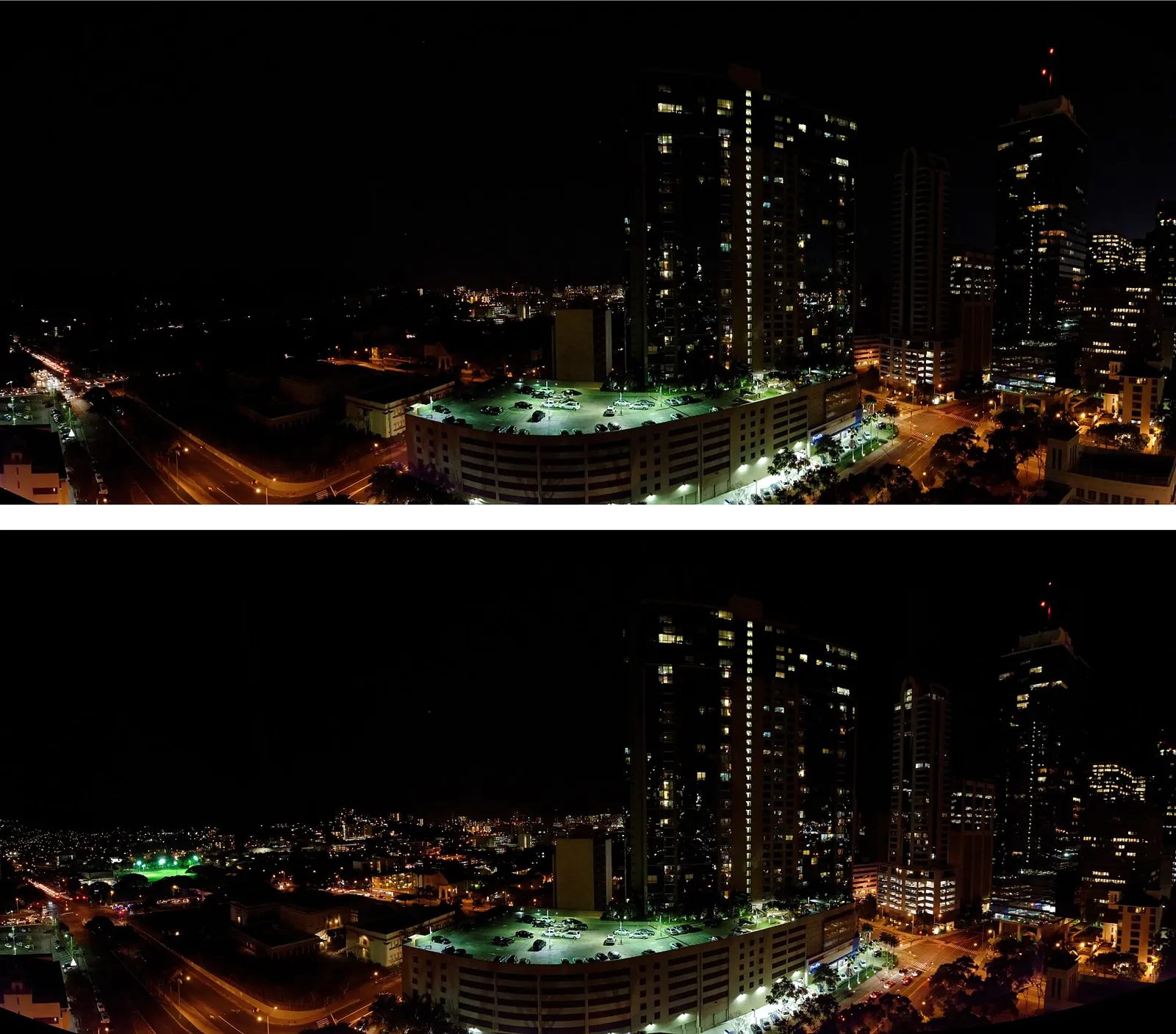
Figure 1. The same city view at night during a rolling power outage (top) and after power returned (bottom). In the top picture the area on the left is mostly dark while the tower block and streets on the right are still lit. Supply faults often affect only part of an area, so a lit neighbour does not prove the fault is in your house. (Photo: Daniel Ramirez, Wikimedia Commons, CC BY 2.0)
Step 2: Check the distribution board
Open the board door (not the inner cover that hides the wiring) and look at every device before switching anything. A typical Vietnamese home board has:
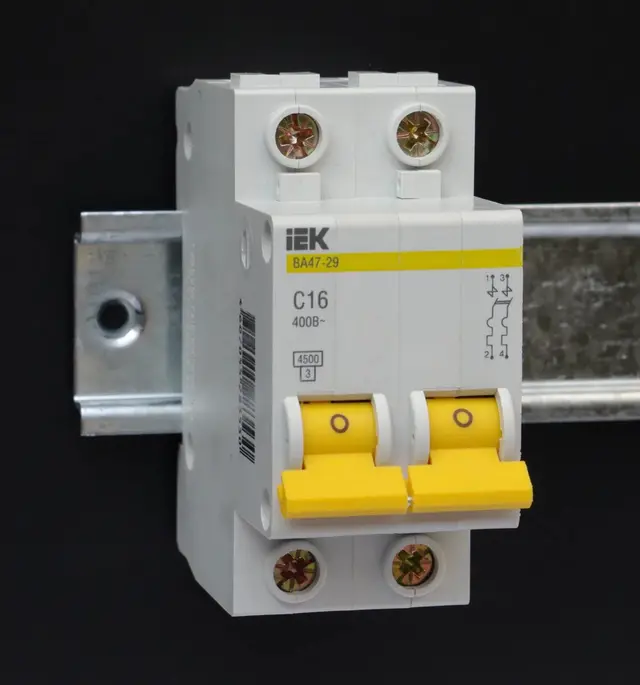
A main switch or main breaker (aptomat tổng): usually two-pole for single-phase, three- or four-pole for three-phase.
Often a main RCD: an RCCB (chống giật tổng) or RCBO protecting the whole house or a group of circuits, with a T or Test button.
A row of MCBs (aptomat nhánh), one per circuit: lights, sockets, air conditioners, water heater, pump.
In older homes, a knife switch with rewirable fuses (cầu dao, cầu chì).
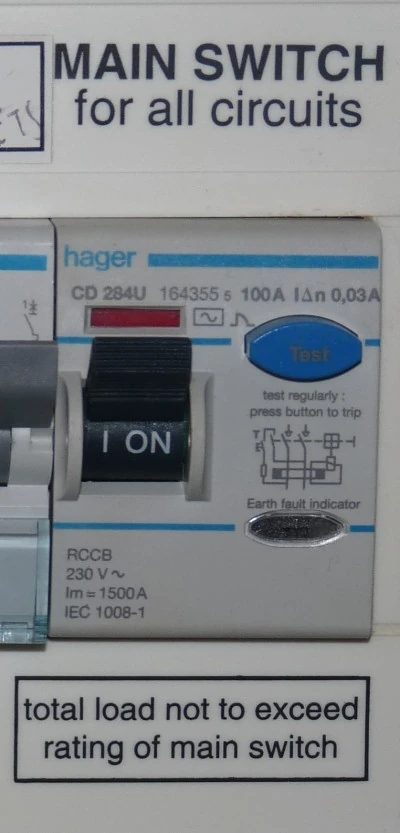
Figure 2. A residual current circuit breaker (RCCB) fitted as the main switch of a home board, labelled "MAIN SWITCH for all circuits", with its toggle ON, the blue Test button and an earth fault indicator. If a main RCD like this trips, every circuit behind it goes dead at once. (Photo: Pfnicholls, Wikimedia Commons, CC BY-SA 4.0)
What you see tells you where to go next:
Main switch or main RCD down (OFF or in the middle "tripped" position): it has done its job. Go to Step 3.
Several MCBs down, main devices on: only those circuits are off. "Half the house" dead may just be two or three MCBs tripped together.
Everything ON and the house still dead: no protective device in the house has opened. Go to Step 4.
Melted fuse wire or a blackened fuse holder: never replace it with thicker wire or a nail. Call an electrician.
Step 3: Reset in the right order to find the culprit
A tripped main device means something caused an overload, a short circuit or earth leakage. Pushing it back up again and again is the wrong move: if the fault is still there, it trips each time, and every trip on a heavy fault stresses the contacts.
The "all off, main on, one by one" method
Switch off or unplug big appliances you can reach: water heater, air conditioners, cooker, pump, iron.
Switch all the MCBs OFF.
Reset the main device. If it is in the middle "tripped" position, push it fully down first, then up firmly.
If it stays on, switch the MCBs on one at a time, a few seconds apart.
When something trips as you switch on one circuit, that circuit holds the problem. Leave it off, switch the rest back on, and note its label.
On that circuit only, connect its appliances one by one. If it trips with one appliance, suspect the appliance; if it trips with nothing connected, suspect the fixed wiring or a hard-wired appliance.
Example: a tube house loses all power during a storm and the main RCCB has tripped. With all MCBs off it resets; it trips again only when the "outdoor sockets" MCB goes on. The electrician finds rainwater in an outdoor socket box, and the rest of the house is back on in minutes.
When the main device will not stay on at all
If the main switch or main RCD trips immediately even with every MCB off, the fault is in the board itself (busbar, neutral bar, wiring between devices) or the device is faulty. Stop and call a licensed electrician; the same applies if the device is hot, smells burnt or looks damaged. Never tape or wedge a breaker ON, and never fit a larger rating to stop it tripping.
Step 4: Nothing has tripped, but the house is dead
Every switch is up and nothing works: power is not reaching the main switch, or not getting through it. The search moves outwards, towards the meter and the street, and the homeowner's part becomes "look, do not touch".
Look at the meter (look only)
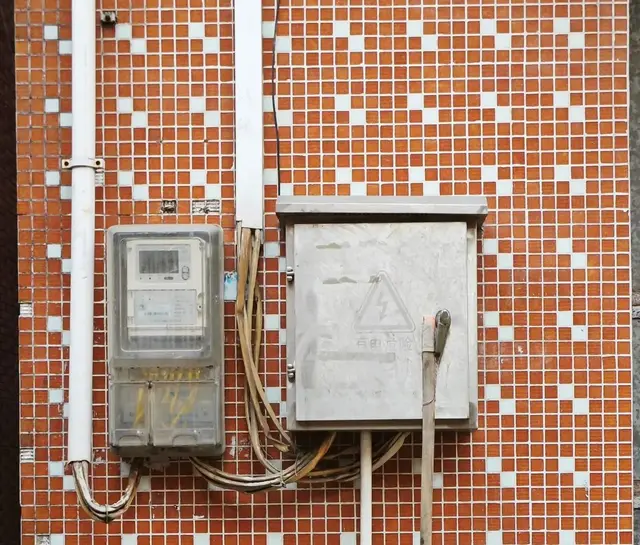
In Vietnam the meter is usually in a sealed box on the outside wall, at the gate, or grouped with other meters on a pole or in a building's meter room. Look at it, but never open the box, break a seal or touch the terminals. In a cluster, make sure you are looking at your own meter (the meter number is on your bill).
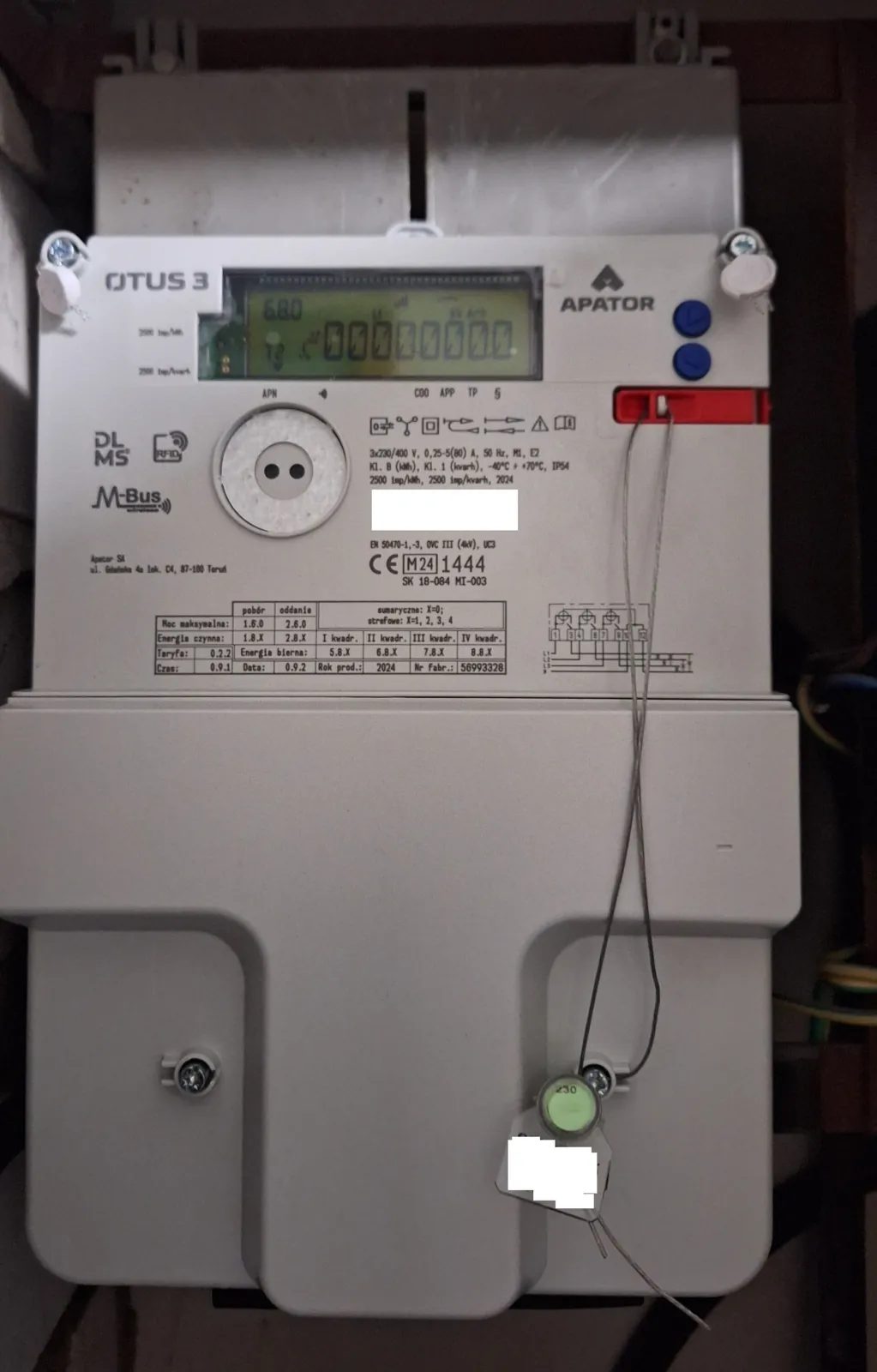
Figure 3. An electronic three-phase electricity meter with its LCD display showing a reading and two blue display buttons on the right. A seal wire runs from the meter down to a seal on the terminal cover at the bottom. The terminal cover and seal belong to the power company: only its staff may open them. (Photo: Rakoon, Wikimedia Commons, CC0; some labels were blanked out by the author)
On an electronic meter the display gives a clue, for reference only, because models differ:
Display completely blank: the meter may have no supply, pointing to the service cable, the pole connection or a supply-side fuse or breaker. Report it to the power company.
Display on: supply probably reaches the meter. The fault is more likely between the meter and your board: a breaker after the meter, the cable to the house, or the main switch terminals.
An error code or warning symbol: photograph it and pass it to the power company.
The breaker after the meter, and the neighbours on your pole
Many installations have a small breaker after the meter, in or next to the meter box, and sometimes a breaker or fuse at the pole; arrangements vary between areas. If such a breaker is outside the sealed part, clearly meant for the customer, and tripped, you may reset it once. If it trips again, or it is sealed or on the pole, leave it to the power company.
If neighbours on the same pole or meter cluster are fine but your meter display is blank, suspect your service cable or its connection: a power company job.
Half the house dead or lights acting strangely: phase loss and lost neutral
Sometimes the house is not fully dark: some lights work and others do not, lights are very dim or unusually bright, or the pump hums without turning. This needs more caution than a clean blackout.
Three-phase homes: one phase lost
In a three-phase home, circuits are spread across the phases. If one phase is lost (supply fault, blown fuse at the pole, burnt terminal at the main switch), its circuits go dead while the others work: "half the house dead" with no breaker tripped. Three-phase motors such as some pumps and compressors may hum without starting and can be damaged. Switch them off and call an electrician to measure; if the missing phase is on the supply side, the power company must restore it.
Lost neutral: the dangerous one
The neutral carries current back to the supply. If it breaks between the transformer and your board:
In a single-phase home, appliances usually stop, but the line is still live, and the house neutral can rise towards line voltage through connected appliances. A basic one-lead tester may then glow on both holes of a socket.
In a three-phase home, or with a broken shared street neutral, voltages can become unbalanced: some circuits get far less than 230 V, others far more. Lights burn very bright or very dim, and electronics can be damaged.
With bright-and-dim lights, odd appliance behaviour or a tester glowing on both socket holes, switch off the main switch (if safe and dry to reach), unplug electronics and call an electrician. Do not keep using the power "because some of it still works".
Owner's side and the power company's side
The exact boundary is set by your supply arrangement, but in general:
Power company (EVN) side: the street network and transformer, the connection at the pole, any pole-side fuse or breaker, the service cable to the meter (in most cases), and the meter with its box and seals.
Owner's side: usually from the outgoing side of the meter (or the breaker after it): the cable to the house, the main switch, the board, all circuits and appliances.
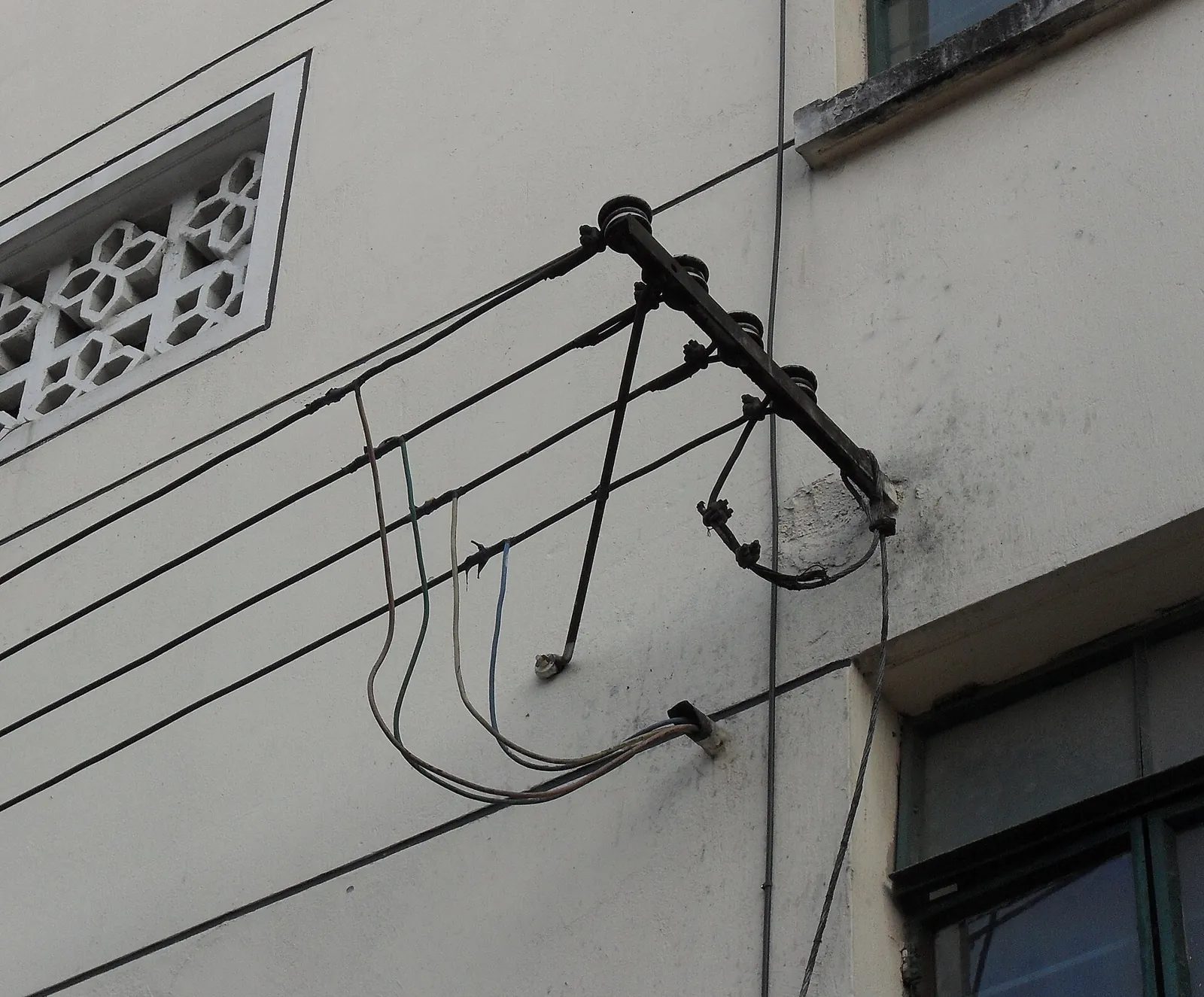
Figure 4. An overhead service connection on the wall of a building in China: conductors arrive from the left and are tied off on a black bracket with porcelain insulators, and thinner insulated wires loop down into the building. This is supply-side equipment: never climb to it or touch it, even when the house is dead. (Photo: Kristoferb, Wikimedia Commons, CC BY-SA 3.0)
Unless authorised by the power company, nobody, electricians included, should open the meter box, break a seal, touch the meter terminals, work on or rejoin the service cable, or climb the pole.
Measurements at the main switch (competent electricians only)
When the checks so far do not explain the outage, the electrician measures at the main switch. This is work near live parts: it needs training, a two-pole voltage tester or multimeter of a suitable measurement category, insulated tools and PPE. Homeowners should not do it. Prove the tester on a known live source before and after use, then measure at the incoming terminals (L–N, L–E, N–E, and on three-phase also between phases), then at the outgoing terminals with the switch on. Typical readings, for reference:
Nothing L–N and nothing L–E: no supply arriving. Report to the power company.
Nothing L–N but about 230 V L–E: line present, neutral lost upstream. Dangerous: the neutral may be live.
About 230 V in, nothing out with the switch on: faulty main switch or burnt terminal.
Very unequal phase-to-neutral voltages, or one phase missing (three-phase): neutral or phase problem.
The main switch's incoming terminals cannot be isolated from inside the house; tightening or replacing it needs upstream isolation arranged with the power company.
Reference table: symptom, likely cause, who fixes it
Symptom | Likely cause | Who fixes it |
|---|---|---|
Whole street dark | Supply outage or planned interruption | Power company |
Some houses dark, others lit | One phase lost on the street network | Power company |
Main RCD tripped; resets with MCBs off; trips on one circuit | Earth leakage on that circuit or an appliance | Owner leaves circuit off; electrician repairs |
Main breaker tripped; one circuit trips it again | Overload or short circuit on that circuit | Electrician |
Main device trips with all MCBs off | Fault in the board, or faulty device | Electrician |
Everything ON, house dead, meter display blank | No supply to meter: service cable, pole connection, supply fuse | Power company |
Everything ON, house dead, meter display on | Breaker after meter, cable to house, main switch terminal | Electrician; power company if sealed or supply side |
Half the house dead, three-phase | One phase lost | Electrician diagnoses; power company if supply side |
Lights bright and dim, appliances act oddly | Lost or loose neutral | Switch off; electrician, then power company if upstream |
Burning smell, smoke or water at the board | Overheating, arcing, water ingress | Switch off if safe; electrician urgently |
Reporting to the power company, and what to tell the customer
When the checks point to the supply side, contact your local EVN customer service hotline (the number is printed on your electricity bill and shown on the power company's website or customer app), or report through the app. Have ready the customer code (mã khách hàng) and address, what happened ("whole house dead since about 7 pm, neighbours on the left have power, meter display blank"), anything seen or heard (a bang at the pole, sparks, a storm), and confirmation that the main switch and main RCD are on. A fallen or sparking wire is an emergency: report it first.
As the electrician, tell the customer simply:
Where the fault was: "Your water heater leaks to earth and was tripping the main RCD; I've left that circuit off." Or: "Power isn't reaching your meter. That's EVN equipment, so you need to call them."
What is safe to use now and what must stay off until repaired.
Why you did not do more: "I'm not allowed to open the meter box or work on the service cable."
What to watch for: lights going bright or dim, a burning smell, a hot main switch. Note what you measured and found.
Safety checklist
Smell, look and listen before touching the board; stop on burning, water, sparks or soot.
Never touch the board with wet hands or in water; treat any fallen wire as live.
Reset in order: MCBs off, main on, MCBs one by one.
Never tape or wedge a breaker on, fit a bigger rating, or replace fuse wire with thicker wire or a nail.
Never open the meter box, break seals, touch the service cable, climb the pole or connect to a neighbour's supply.
Live measurements at the main switch: competent electricians only, with a proven tester and PPE.
Signs of lost neutral or phase loss: switch off, unplug electronics, call an electrician.
Preventing the next whole-house outage
Label every MCB, so the one-by-one reset takes a minute, not twenty.
Press the RCD test button as the manufacturer recommends; an RCD that does not trip on test needs checking.
Have an electrician inspect and re-tighten board terminals, especially the main switch, at intervals (for reference, every few years, sooner if the board runs warm).
Spread heavy loads across circuits; if the main breaker often trips on overload, ask about supply capacity.
Keep outdoor sockets, pumps and lights weatherproof; wet outdoor fittings are a common cause of RCD trips in the rainy season.
Where supply problems are common, ask an electrician about surge protection or a voltage protection device on the main board.
Keep a torch, the hotline and your customer code near the board.
Frequently Asked Questions
My neighbours have power, so the fault must be in my house, right?
Not necessarily. Houses on one street are often on different phases, and one phase can fail on its own. A blank meter display points to the supply side even when the house next door is lit.
Everything in my board is ON but nothing works. What now?
Look at the meter display without touching it. If it is blank, contact the power company. If it is on, call an electrician to check the breaker after the meter, the cable to the house and the main switch.
Can I reset the main switch myself?
Yes, if there is no burning smell, water, smoke or damage. Switch all MCBs off, reset the main device, then switch the MCBs on one by one. If it will not stay on with every MCB off, stop and call an electrician.
My tester lights up on both holes of the socket. Is that a short circuit?
Usually not. With a lost neutral, the house neutral can become live through connected appliances, so a basic tester glows on both sides. Treat it as dangerous: switch off at the main switch and call an electrician.
Can an electrician open the meter box to check it?
No. The meter, its box and its seals belong to the power company; only its authorised staff may open them.
Practice Exercises
Phone triage. A customer calls: "The house is dark, my neighbours have power." Write five questions you would ask before going out and what each answer tells you.
Reset drill. On a training board with a main RCCB and four MCBs, practise "all off, main on, one by one". Your supervisor creates a fault on one circuit; find it and explain how.
Read the readings. At the main switch incoming terminals you measure 0 V L–N and 228 V L–E. What is the likely fault, what is the risk, and what do you tell the customer? (Answer: line present, neutral lost upstream; the house neutral may be live; keep the main switch off, warn the customer, report to the power company.)
Draw the boundary. Sketch the supply to a tube house from the pole to the board. Mark the power company's parts, the owner's parts and where seals usually are.
Three-phase case. In a three-phase shophouse, the ground-floor lights work but the upstairs air conditioners and the pump do not, and nothing has tripped. List likely causes in order and your safe checks.
Customer explanation. In three sentences, explain why you have left the water heater circuit off and what the customer should do next.
A house that goes dark while the neighbours stay lit has a logical order of checks: safety, the board, a careful reset, then outwards to the meter and supply, stopping at the power company's boundary. Work in that order and measure before you guess.