Safety when installing glass starts with knowing how heavy the pane is: 10 mm glass weighs about 25 kg per square metre, so a single 1.2 × 2.4 m partition panel is already about 72 kg and must not be lifted without enough people, suction lifters, cut-resistant gloves and safety glasses. On top of that, clamp aluminium profiles and keep your hands away from the blade on the aluminium saw, wear a harness clipped to a strong anchor when fitting doors on upper floors, and know how to clean up broken glass properly. This is the first lesson for anyone new to aluminium and glass work in Vietnam: the common accidents in the workshop and on townhouse sites, how to prevent each one, and a worked example of planning people and safety gear for a glass partition job.
By the end of this lesson, you will be able to:
- Work out the weight of a glass pane from its thickness and area, and decide how many people and suction lifters you need.
- Use glass suction lifters correctly, carry and stand glass safely, and choose cut-resistant gloves, safety glasses and arm guards.
- Operate an aluminium saw and drill at a basic safe level: clamping, choosing the blade, keeping hands clear, waiting for the blade to stop.
- Wear a harness and choose an anchor point when fitting doors and glass partitions on upper floors, and cordon off the area below.
- Deal with broken glass and give basic first aid for cuts.
Learning aluminium and glass work properly? Glass handling, saw and height safety is the first step of the roadmap, before aluminium systems, measuring, fabrication and installation. See the 8-step aluminium and glass installer roadmap to learn in the right order.
Why do aluminium and glass installers get hurt?
The trade has two kinds of work: in the workshop (cutting and assembling aluminium frames) and on site (carrying glass, fitting doors, partitions and showers). Each has its own accidents, and newcomers often get hurt doing the jobs that look simplest, such as carrying a pane through a doorway.
The four main risk groups
- Cuts to hands and forearms: sharp glass edges, glass breaking while being carried, sharp aluminium swarf after cutting.
- Falling glass: panes stood up insecurely, suction lifters letting go, glass tipping onto feet or bodies.
- Saws and drills: hands close to the aluminium saw blade, swarf flying into eyes, drilling into hidden cables.
- Falls from height: fitting windows, balcony doors and facade glass on the second or third floor without a harness.
Quick identification table
| Risk | Danger signs | Basic prevention |
|---|---|---|
| Cuts | Carrying glass bare-handed, short sleeves, chipped glass edges | Cut-resistant gloves, arm guards, check edges before lifting |
| Falling glass | Glass leaned against a smooth wall, one person carrying a large pane | A-frame rack, padding, enough people, suction lifters |
| Aluminium saw | Holding the profile by hand near the blade, wrong blade | Clamp the profile, a blade for aluminium, safety glasses |
| Falls | Leaning out of a third-floor opening, standing on a plastic chair | A harness clipped to a strong anchor, proper ladders and scaffolds |
Carrying and moving glass safely
To carry glass safely, you first need to know how heavy it is. Glass has a density of about 2.5 tonnes per m³, so each m² of 1 mm glass weighs about 2.5 kg. Multiply by the thickness to get the weight per m².
Glass weight by thickness
| Glass thickness | Weight per m² (approx.) | 1.0 × 2.0 m pane |
|---|---|---|
| 5 mm | 12.5 kg | 25 kg |
| 8 mm | 20 kg | 40 kg |
| 10 mm | 25 kg | 50 kg |
| 12 mm | 30 kg | 60 kg |
For insulated and laminated glass, add up the thickness of all glass layers. Remember the figures do not include posture: carrying an upright, wide, slippery 50 kg pane is much harder than carrying a 50 kg bag of cement.
Using glass suction lifters correctly
Hand suction lifters (double or triple cups) create a vacuum so you have a firm handle on a flat glass surface (Figure 1). The rules:
- Clean and dry both the glass and the rubber pads before attaching; dust, water and oil make the cups slip.
- Press or pump fully (piston types usually have an indicator line), and check again before every lift.
- Do not use the cups on patterned, heavily frosted or curved glass unless they are designed for it.
- The total rated load of the cups must be well above the weight of the glass; cups are for gripping and holding, never for hanging a person or leaving glass hanging overnight.
- Replace cracked or hardened rubber pads; a cup that lets go mid-lift is when the glass falls.
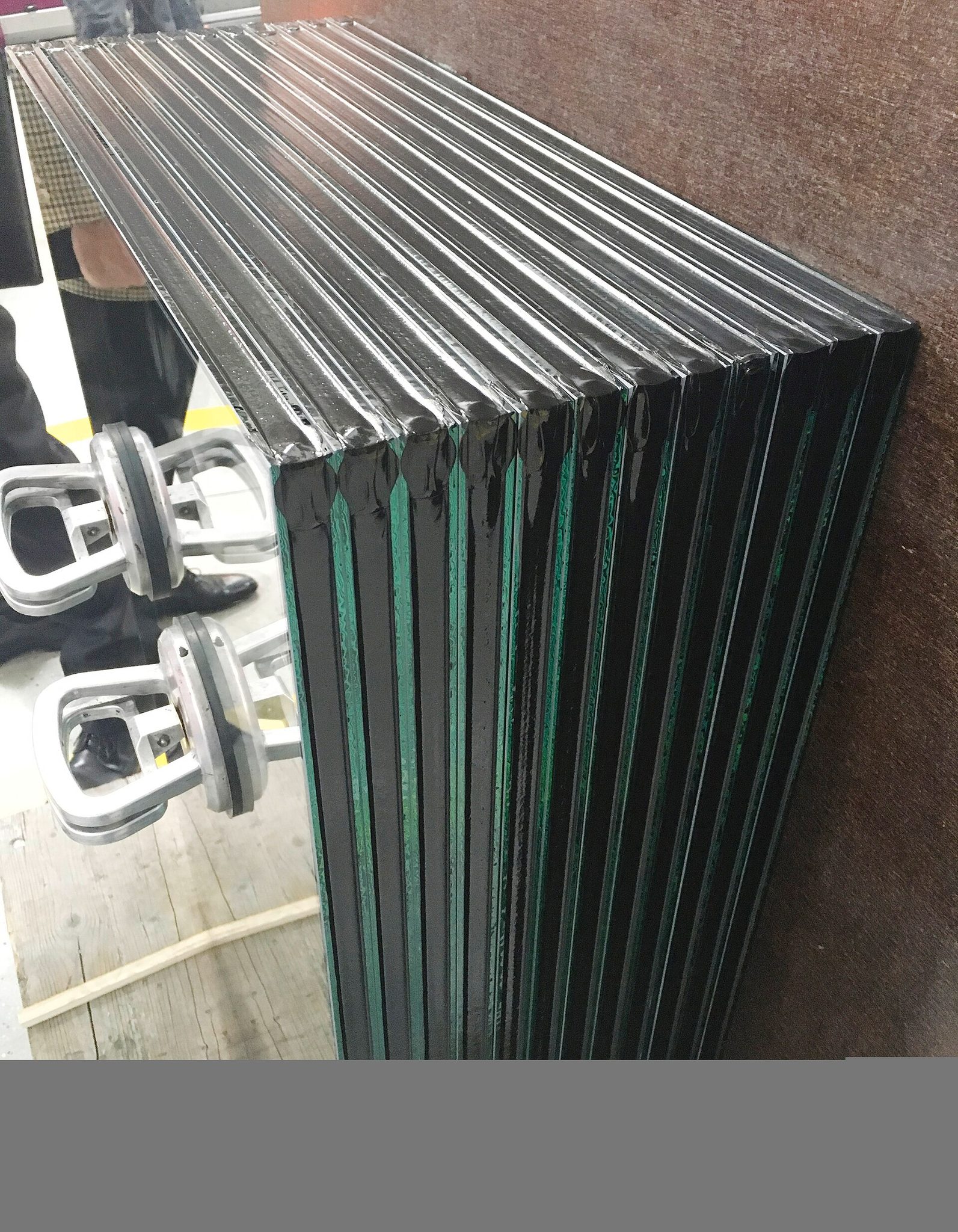
Photo: ManuelaEichhorn / Wikimedia Commons, CC BY-SA 4.0
Rules for carrying and standing glass
- Check the edges and corners before lifting: a chipped edge is a weak point, especially on tempered glass.
- Clear and measure the route first: are doors, stairs and corners wide enough? If not, plan another way beforehand, do not "try turning it".
- Always keep the pane upright when moving it, never carry a large pane flat, because the glass sags and breaks easily.
- Have enough people for the weight, with one person calling the moves and announcing direction and when to set down.
- Set glass on timber or rubber padding, never put a corner straight onto tiles or steel; lean it slightly into an A-frame rack or a padded wall and chock the bottom so it cannot slide.
Specific points about standing glass in a bathroom and drilling through wall tiles are covered in installing a glass shower enclosure.
Cut-resistant gloves, safety glasses and arm guards
Ordinary cloth or thin rubber gloves do not stop a glass edge. Use cut-resistant gloves (cut-resistant fibre with a grip-coated palm like Figure 2) with a cut rating marked on the glove or packaging. Wear cut-resistant arm guards or thick long sleeves to protect your forearms, because when glass breaks while you are holding it, the forearms and wrists get the deepest cuts. Add safety glasses and boots with toe caps and puncture-resistant soles.
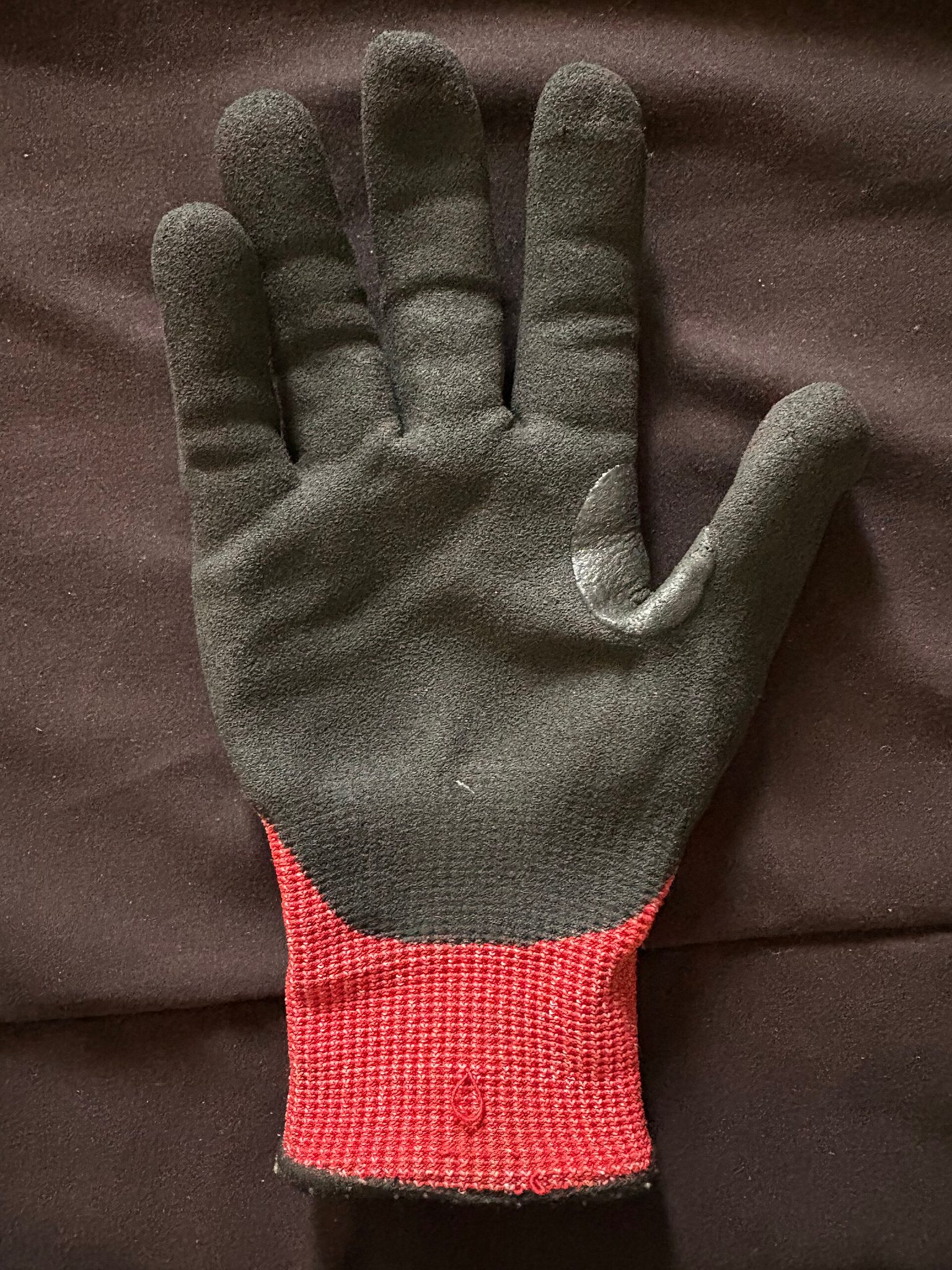
Photo: Lsmit301 / Wikimedia Commons, CC BY-SA 4.0
Aluminium saws and drills
In the workshop, the aluminium saw (a mitre saw with a carbide blade and a pull-down arm) is the most dangerous machine. On site it is the drill, the screwdriver and handheld cutters.
Aluminium saws
- Use a proper aluminium blade (a carbide blade with many teeth for non-ferrous metals), never a wood blade or a steel cutting disc.
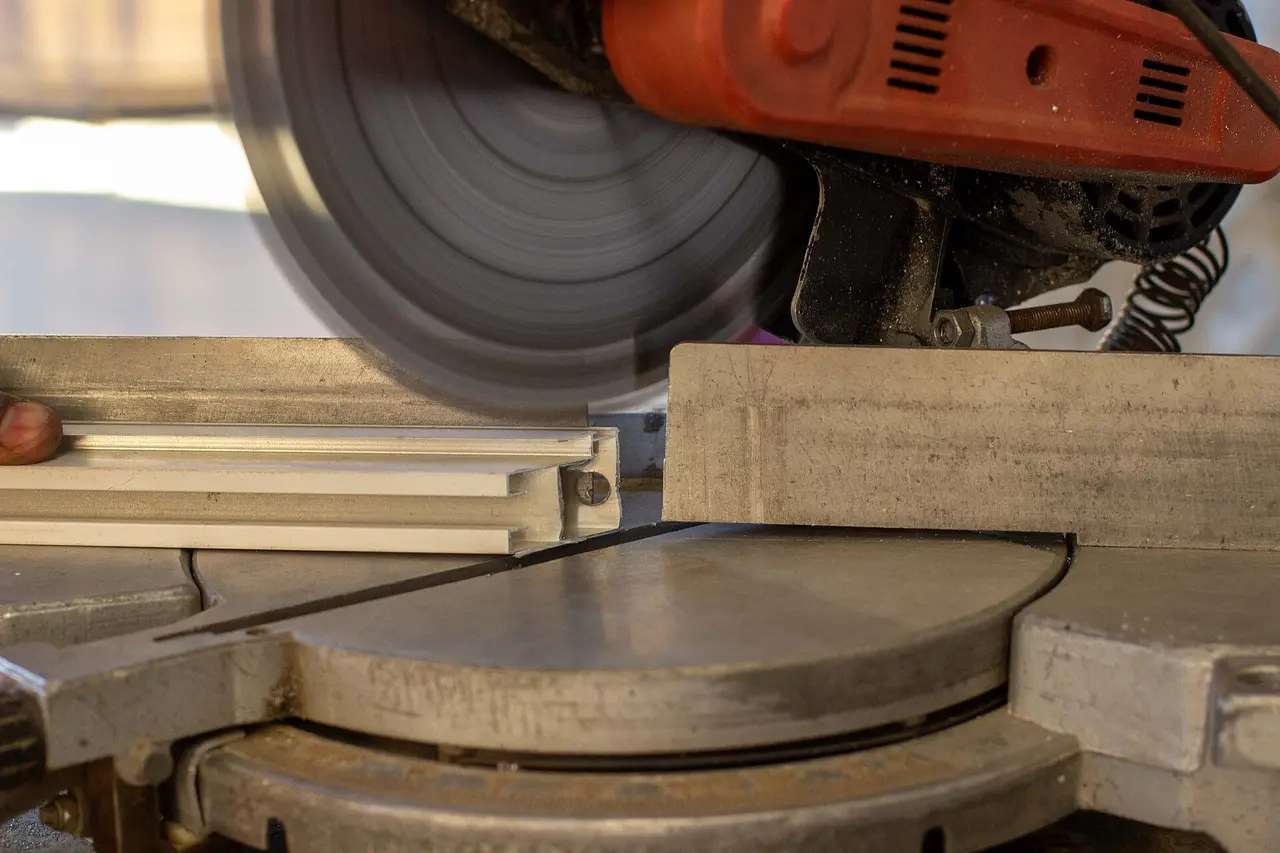
- Hold the profile tight against the fence and table and clamp it with the saw's clamp (Figure 3); a hollow profile that the blade grabs and twists will kick hard.
- Keep your hands well away from the blade path; for short pieces use a clamp or jig, never your fingertips.
- Switch on, wait for full speed, then lower the arm steadily; after the cut, hold the arm down and wait for the blade to stop before raising it and removing the piece.
- Aluminium swarf is hot and sharp: wear safety glasses, never brush swarf away with bare hands, use a brush or vacuum.
- The blade guard must work; the saw is loud, so wear ear plugs when doing a lot of cutting.
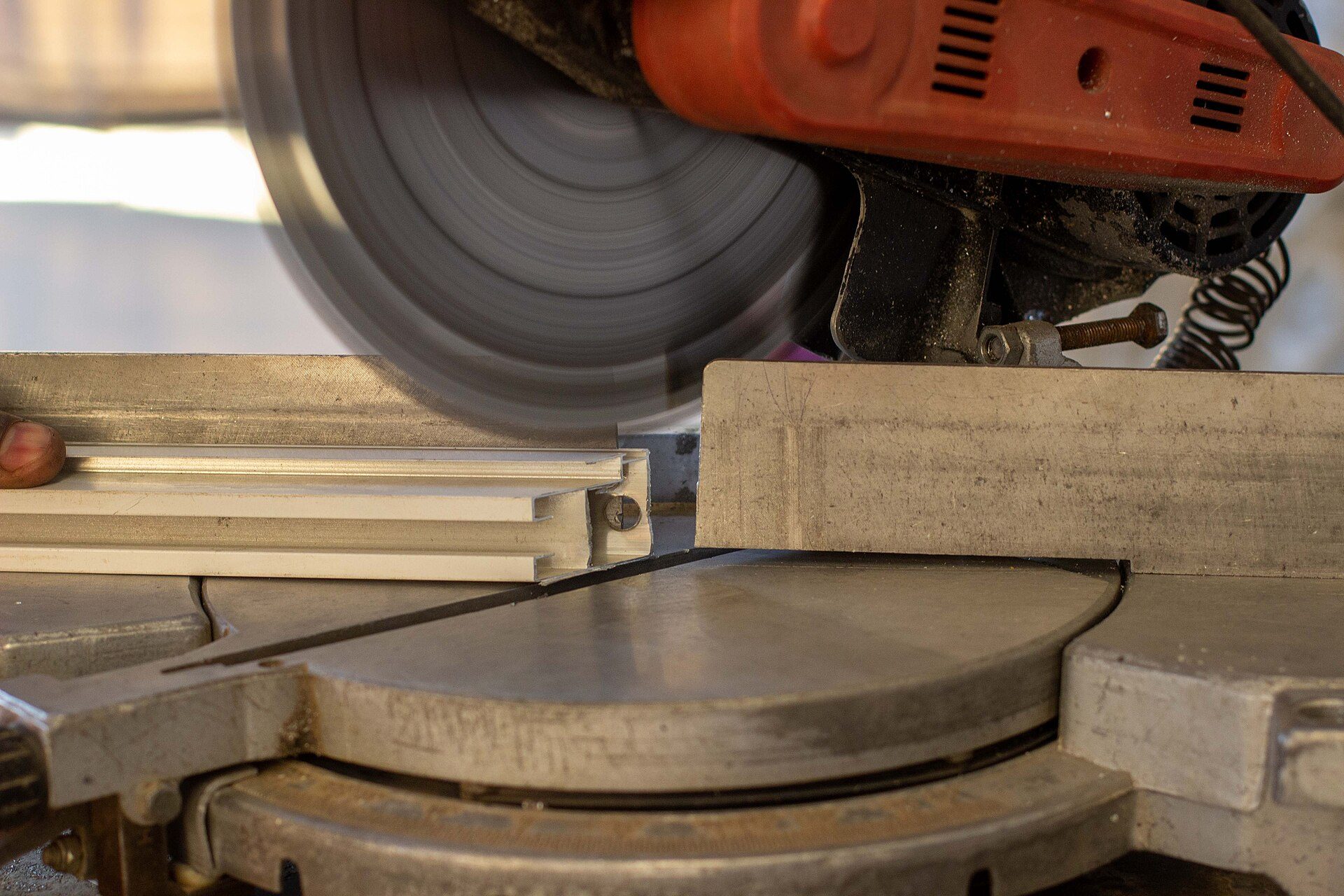
Photo: Hajjare / Wikimedia Commons, CC BY-SA 4.0
Drills and screwdrivers
- Scan for hidden cables and pipes before drilling to fix frames; avoid drilling directly above or below switches and sockets.
- Clamp aluminium frames firmly when drilling, never hold them by hand next to the bit; if the bit jams, release the trigger at once.
- Tempered glass cannot be cut, drilled or ground after tempering: all holes, notches and corner cuts must be made at the glass factory before tempering. Never try to drill tempered glass on site.
Power in the workshop and on site
Plug machines into sockets protected by a residual current device (RCD); extension cables must be intact, kept out of water and not trapped under glass or frames. Unplug before changing blades or bits. If a machine smells burnt or the casing gets unusually hot, stop using it and tell whoever is in charge.
Working at height when fitting upper-floor doors
Fitting windows and balcony doors on the second or third floor of a townhouse often means leaning out of the opening to fix screws or run silicone on the outside. This is when falls happen most, because until the frame is fixed, the opening is just a hole with nothing to hold you.
Harnesses and anchor points
- Wear a full-body harness when working at openings, balcony edges and facades without guardrails; many regulations treat about 2 m and above as work at height, so check the current Vietnamese standards for the exact figure.
- Clip onto a strong anchor inside the building: an anchor sling around a concrete column or a cast-in anchor; never the frame you are fitting, thin railings, water pipes or old window bars.
- Use a lanyard just long enough to work at the opening, not long enough to fall outside.
Ladders and scaffolds
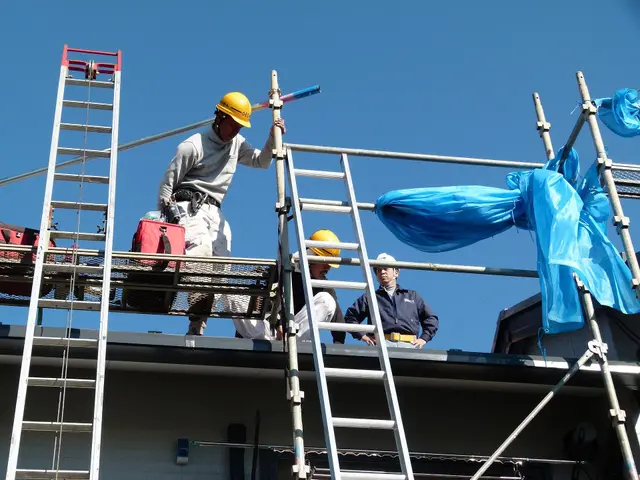
A stepladder must be fully opened and locked on both sides on level ground; never stand on the top step or lean out sideways. Ground-floor or low openings can be done from a ladder as in Figure 4; high openings and large facade doors need a scaffold with platforms and guardrails, or a powered access platform run by qualified operators. Never stand on plastic chairs or paint tins to fit doors.
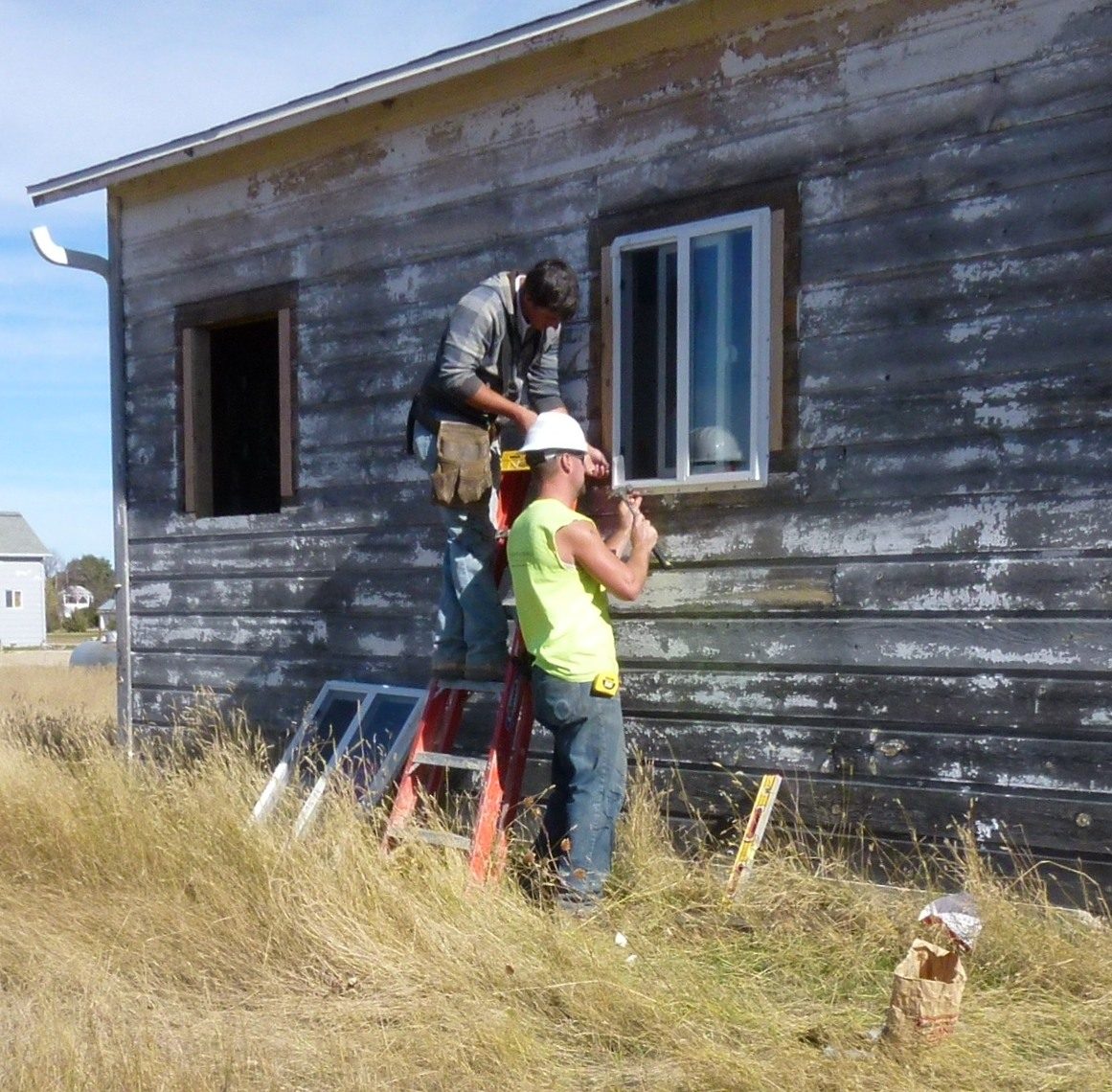
Photo: Forest Service - Northern Region / Wikimedia Commons, Public domain
The area below and the weather
Cordon off the area below the opening with tape or barriers, and post a lookout if it is a pavement or walkway. Keep small tools in a belt pouch or tethered. Do not install large panes in strong wind: a pane of glass catches the wind like a sail and can drag the person and suction lifters with it.
Dealing with broken glass
Even with care, glass can break: a knocked edge while carrying, an over-tightened clamp, or tempered glass breaking on its own because of impurities inside. Each type of glass breaks differently, and needs cleaning up differently.
How glass breaks
- Ordinary float glass: breaks into large, razor-sharp pieces that can fall like blades.
- Tempered glass: shatters completely into small, less sharp granules (Figure 5), but they fly a long way and a large broken pane can collapse all at once.
- Laminated safety glass: cracks, but the pieces stay stuck to the interlayer and the pane stays in one piece.
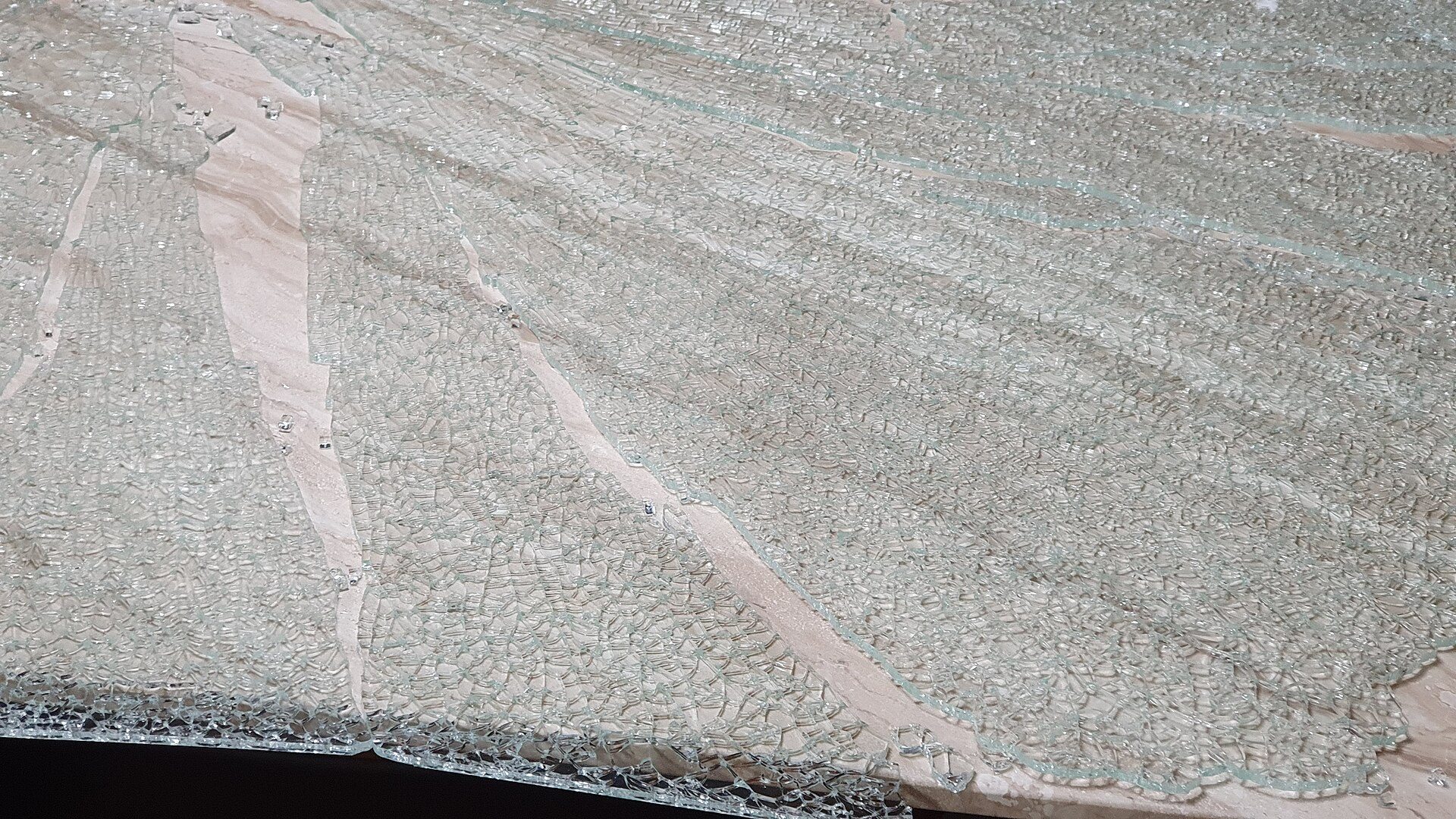
Photo: Ox1997cow / Wikimedia Commons, CC BY-SA 3.0
Cleaning up broken glass
- Stop work, warn everyone and cordon off the area; nobody in sandals or bare feet enters.
- Put on cut-resistant gloves, safety glasses and thick-soled boots before cleaning up.
- Cracked glass still in its frame: tape it criss-cross in several layers on both sides, and have two people take it down, with nobody standing below.
- Pick up large pieces with gloved hands or tongs; sweep and vacuum small pieces; use wide tape to lift tiny granules from the floor.
- Put broken glass in a rigid container or a heavy bag marked "broken glass", never a thin plastic bag that can cut the waste collector.
Why tempered glass breaks on its own and how to reduce the risk (heat soaking, safety film) is explained in detail in the shower enclosure lesson mentioned above.
First aid for cuts
Press firmly on the wound with gauze or clean cloth to stop the bleeding and raise the hand. Do not try to pull out glass lodged deep in the wound. For deep cuts, bleeding that will not stop, loss of feeling in a finger or glass inside the wound: call the emergency number 115 or go to a clinic immediately, and ask the doctor about a tetanus shot. This lesson does not replace medical advice.
Safety warning: Never carry glass bare-handed, never carry a pane too heavy for you alone, and never stand below glass being lifted or a cracked pane still in its frame. Never hold aluminium profiles by hand near the saw blade; change blades or free jammed pieces only when unplugged. When fitting doors on upper floors, do not lean out of the opening until your harness is clipped to a strong anchor. Never drill or cut tempered glass on site.
Worked example: fitting three 10 mm tempered glass panels on the second floor
Phuc's crew is fitting the second-floor glass frontage of a townhouse cafe: 3 tempered glass panels of 10 mm, each 1,200 × 2,400 mm, clamped into U-channels at floor and ceiling. The glass has already been craned up to the second-floor balcony and stands on a rubber-padded rack.
Step 1: weight and number of people
- Area of one panel: 1.2 × 2.4 = 2.88 m².
- Weight of one panel: 2.88 × 25 = 72 kg; three panels: 3 × 72 = 216 kg.
- With 4 people carrying, each takes about 72 ÷ 4 = 18 kg, each using one double suction lifter; with fewer than 4 people, this panel is not lifted.
- One person calls the lift and set-down; the outer side next to the unguarded balcony edge is worked by someone wearing a harness clipped to a column.
Step 2: safety gear for a crew of 4 (2026 reference, varies by region and brand)
| Item | Quantity × unit price | Total |
|---|---|---|
| Cut-resistant gloves | 4 pairs × 60,000 VND | 240,000 VND |
| Double-cup glass suction lifters | 4 × 350,000 VND | 1,400,000 VND |
| Full-body harnesses | 2 sets × 650,000 VND | 1,300,000 VND |
| Safety glasses | 4 × 50,000 VND | 200,000 VND |
| Cut-resistant arm guards | 4 pairs × 80,000 VND | 320,000 VND |
| Total | 3,460,000 VND | |
Check: 240,000 + 1,400,000 + 1,300,000 + 200,000 + 320,000 = 3,460,000 VND (about 135 USD). Suction lifters and harnesses last for years if looked after; gloves and arm guards are consumables. Real prices vary, for example about 200,000–800,000 VND for a double suction lifter depending on load rating and quality.
Step 3: the day's sequence
- Check the edges of each pane, the 4 suction lifters, the harnesses and the anchor point.
- Clear the route from the glass rack to the fitting position and cordon off the pavement below.
- Fit one panel at a time: lift, stand it into the padded U-channel, and one person holds it upright until the packers and clamps are in, only then letting go.
- At the end of the day, clear swarf and debris and store the suction lifters clean in their cases.
Common beginner mistakes and how to fix them
Carrying glass in cloth gloves
Sign: gloves torn at the palm, cuts on the fingers. Cause: thinking any glove will do. Fix: use cut-resistant gloves with a marked cut rating, plus arm guards.
Setting a glass corner down on a tiled floor
Sign: tempered glass shatters as it is set down or a few days later. Cause: the corner hit something hard and chipped the edge. Fix: always use timber or rubber padding; lower the glass slowly and set the long edge down first.
Holding short aluminium pieces by hand while cutting
Sign: the profile twists and jerks, and fingers pass close to the blade. Cause: the short piece does not fit the clamp, and making a jig feels like a waste of time. Fix: cut from a long length so the held part is long enough, or make a dedicated clamping jig for short pieces.
Clipping the harness to the frame just fitted
Sign: the lanyard hooked onto an aluminium frame or window bars. Cause: no anchor nearby. Fix: set up an anchor sling around a column before going upstairs, and treat the anchor point as an item on your preparation checklist.
Frequently asked questions
How much does 10 mm tempered glass weigh?
About 25 kg per m² (10 mm × 2.5 kg). A 1.2 × 2.4 m pane weighs about 72 kg and needs several people and suction lifters to carry safely.
How much weight can a glass suction lifter hold?
It depends on the type and brand; the rated load is marked on the lifter or in its manual. Only trust that figure on equipment in good condition, on clean dry glass, and use a total rated load well above the weight of the glass.
Can tempered glass be drilled on site?
No. Tempered glass shatters completely when drilled, cut or ground. Hinge holes, handle holes and corner notches must be ordered from the glass factory before tempering, which is why accurate measuring is essential.
Do aluminium and glass installers need safety training?
Yes. Working at height and operating saws and drills require suitable occupational safety training. Ask your workshop or employer about training, choose a properly licensed training provider and check the current Vietnamese regulations.
Practice tasks and self-assessment
- Work out the weight of 3 panes you are about to carry (thickness × area × 2.5 kg) and note the number of people needed for each.
- Practise with suction lifters on a training pane: clean, attach, check the indicator, lift and set down on padding.
- Cut 5 practice aluminium profiles on a saw with a clamp, supervised by a lead installer.
- On a real site, point out 2 correct and 2 wrong anchor points for a harness when fitting a second-floor door.
Self-assessment criteria
- Pass: you calculate the glass weight correctly, choose a sensible number of people and can explain why.
- Pass: the suction lifter grips firmly first time, the glass stays upright and is set on padding without the corners touching.
- Pass: all 5 profiles cut with a clamp, hands outside the blade zone, waiting for the blade to stop before raising the arm.
- Not yet: carrying glass bare-handed or in cloth gloves, holding short profiles by hand, or leaning out of an opening without being clipped on.
Once safety is second nature, move on to the next roadmap step: Aluminium systems, glass & hardware, where you learn to tell system profiles from basic ones and check wall thickness, along with tempered, laminated safety and insulated glass, hinges, multi-point locks, gaskets and silicone sealants.
Keep learning aluminium and glass work: after safety come aluminium systems and glass types, measuring openings, cutting and assembling frames, fitting doors, tempered glass partitions, shower enclosures and per-m² quoting. See the 8-step aluminium and glass installer roadmap.