For a site supervisor, construction site safety is daily work, not a sign hanging at the gate: every morning you identify the four risks behind the most serious accidents (falls from height, electric shock from temporary power, collapse of formwork or scaffolding, falling objects and crane loads), check guardrails, nets, helmets and harnesses before work starts, run a 10–15 minute toolbox talk, stop dangerous work immediately, and know the right sequence when an accident happens. New supervisors tend to pour all their energy into quantities, rebar and concrete, but a single fall can halt the whole project and cause harm that can never be undone. This is the first lesson of the construction supervisor roadmap, written for someone who has never been on a site, with a checklist you can use tomorrow morning.
By the end of this lesson, you will be able to:
- Identify the 4 major risk groups on a construction site and the warning signs of each.
- Check edge guardrails, floor openings, scaffolding, harnesses, temporary power boards and formwork props against a checklist.
- Run a 10–15 minute toolbox talk with specific content and a sign-in sheet.
- Rank safety defects by severity: stop work now, fix this shift, or reminder.
- Take the right first steps after an accident: stop work, secure the scene, give first aid, call 115, report.
Starting out as a construction site supervisor? Site safety and housekeeping is step 1 of the 8-step roadmap, before reading design drawings, inspections, quantities and scheduling. See the 8-step construction site supervisor roadmap to learn in the right order.
What a supervisor does for site safety
A construction site usually has several kinds of "supervisor": the owner's supervisor or supervision consultant, the contractor's site manager and engineers, and the contractor's safety officer. Their roles and legal responsibilities differ, but the shared principle is that anyone who sees danger must speak up.
The contractor organises, the supervisor checks
The contractor plans and carries out safety measures: edge protection, protective equipment, worker training, equipment inspection. The supervisor (especially the supervision consultant) checks that these are carried out according to the approved method statement, records findings, requires corrections and reports. A new supervisor does not build guardrails for the contractor, but must notice when one is missing.
Safety documents to read before going on site
- The approved method statements and safety plans for each work package (formwork, scaffolding, lifting, excavation).
- The list of workers who have had safety training, and cards or certificates for jobs that require them (welding, crane operation, electricians and so on).
- Valid inspection certificates for equipment with strict safety requirements, such as tower cranes and hoists.
- The site layout plan: walkways, crane zones, power boards, stores, emergency exits.
The exact list and what is mandatory vary with project size and current regulations; ask the site manager, read the contract and the latest occupational safety and health rules in Vietnam rather than relying on word of mouth.
If it is not safe, it does not happen
The most important rule to carry with you: if you see a risk of serious injury (an unprotected edge, someone standing under a crane load, a prop leaning during a pour), have that work stopped first and report afterwards. A 30-minute stoppage is always cheaper than an accident.
The four major risks on site
Most serious construction accidents fall into the four groups below. This table is your "map" for the morning inspection round.
| Risk | Warning signs | Controls | What the supervisor checks |
|---|---|---|---|
| Falls from height | Slab edges, openings or scaffolds without guardrails; people on roofs not clipped on | Temporary guardrails, opening covers, nets, full-body harnesses with anchor points | Walk every slab edge on every floor, check anchor points and how lanyards are clipped |
| Electric shock | Cables dragged through water, taped joints, open boards, no residual current protection | Boards with residual current devices, earthing, cables raised or in conduit, a designated electrician | Press the RCD test button, look at cables and plugs on hand tools |
| Formwork or scaffold collapse | Leaning props, props on broken bricks, missing bracing, early striking, materials stacked on the deck | Build to the approved method, inspect formwork before pouring, watch during the pour | Check prop bases, bracing and spacing; do not sign for the pour if formwork fails |
| Falling objects, cranes | People under loads, materials near slab edges, no catch nets | Debris netting, catch nets, toe boards, crane exclusion zones, a signaller | Check nets, exclusion zones, slings and hooks, helmet chin straps |
Falls from height: guardrails, openings, harnesses
Falls from height are the most common fatal accident in construction. The order of priority is always: prevent the fall with collective protection (guardrails, covers), and only then use personal equipment (harnesses) where collective protection is not possible.
Slab edges and floor openings
- Slab edges, stairwell edges and balconies without walls need sturdy temporary guardrails: a top rail at about 1 m, a mid rail and a toe board, as set out in the approved method.
- Openings in the floor (service holes, lift shafts) need firm covers fixed so they cannot shift, marked with a warning; large openings get guardrails on all four sides.
- A guardrail removed to bring materials up must be refitted straight afterwards; this is when accidents happen most.
Full-body harnesses
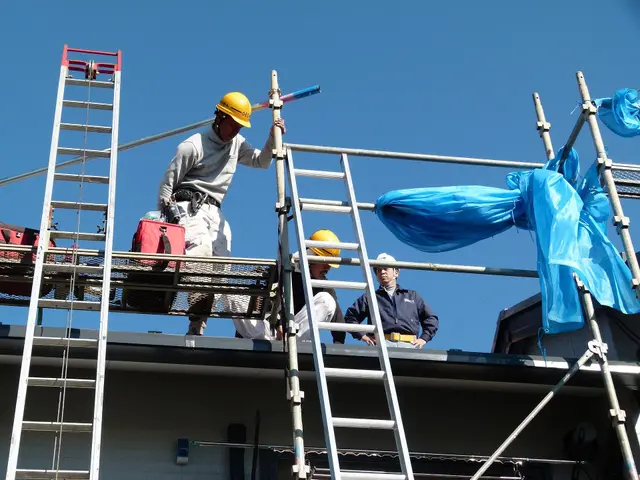
When working on roofs, at unprotected slab edges or on high scaffolding (many rules treat about 2 m and above as work at height), workers must wear a full-body harness clipped to a secure anchor point above head height (Figure 1). A harness that is worn but not clipped on, or clipped to a water pipe or a starter bar, does nothing. Check that buckles are fastened, leg straps are not loose, hooks have safety locks and webbing is not frayed.
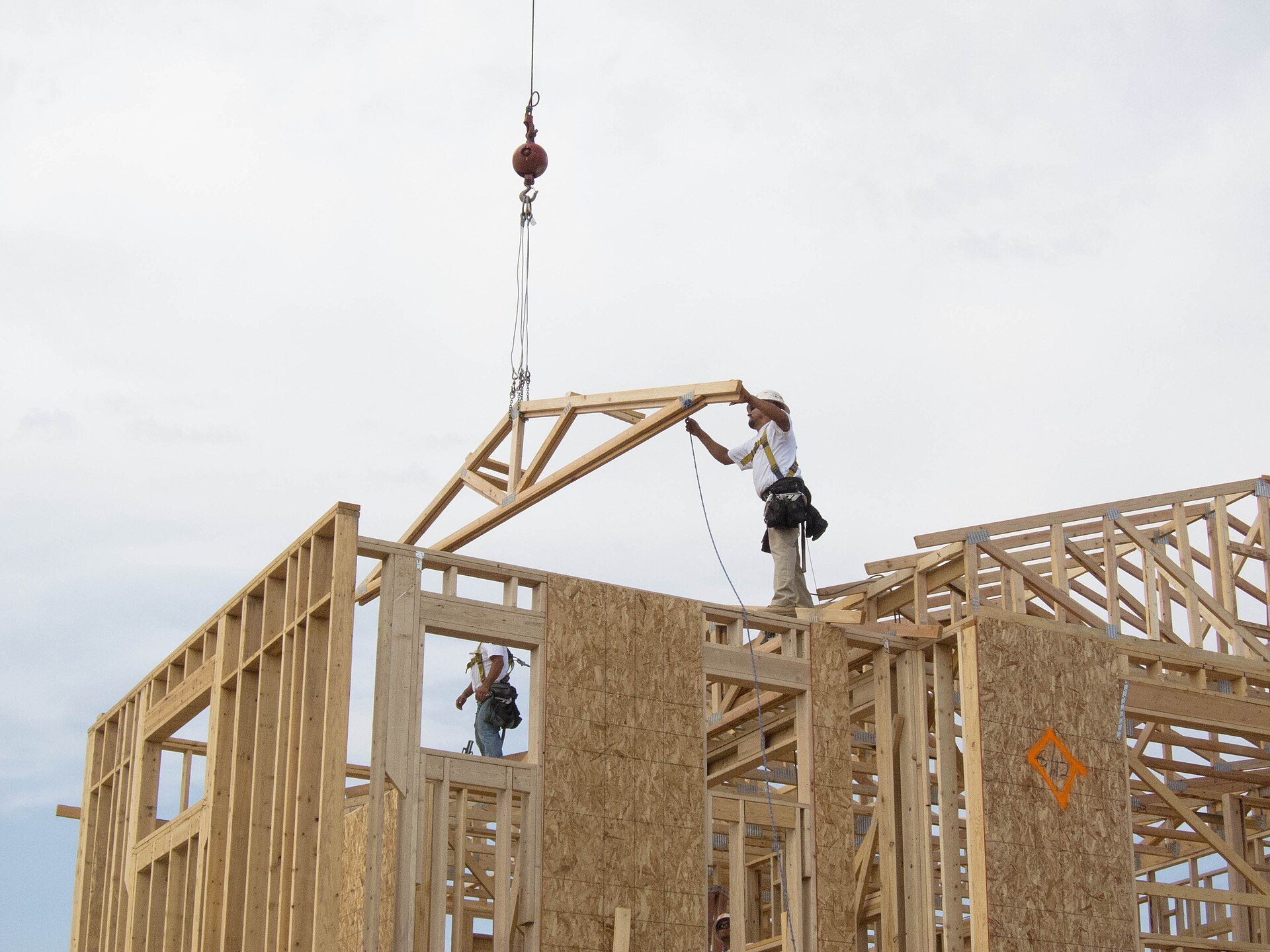
Photo: National Institute for Occupational Safety and Health (NIOSH) from USA / Wikimedia Commons, Public domain
Scaffolding and ladders
- Scaffold standards sit on firm ground with base plates, never on loose brick; enough diagonal bracing, tied to the building as the method requires.
- Working platforms fully boarded, planks sound and secured; guardrails and toe boards fitted; a ladder for access, no climbing up the frame.
- A-frame ladders fully opened and locked, never standing on the top step; leaning ladders set at a stable angle with the top extending far enough to hold when stepping off.
A common unsafe scene on house builds
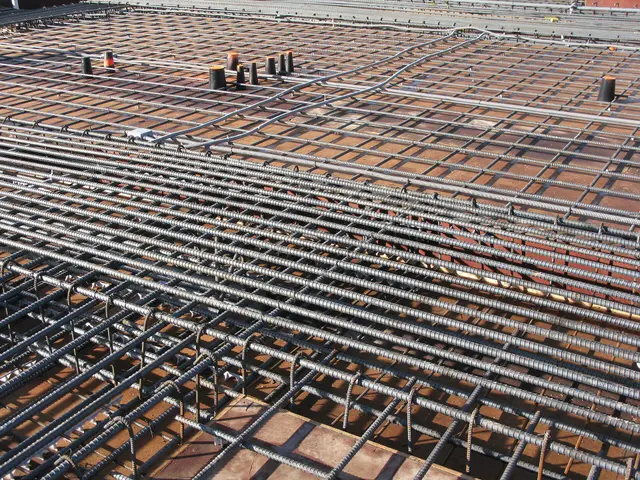
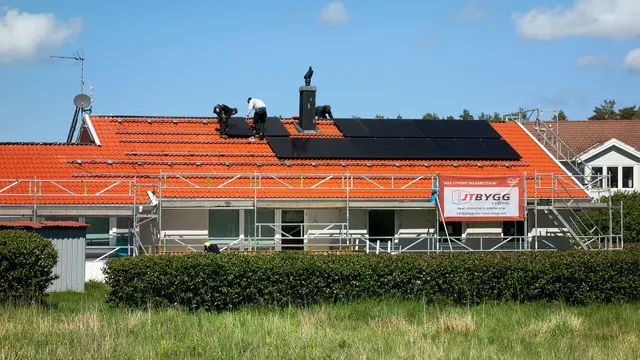
On private house builds, the scene in Figure 2 is very common: someone walking on a roof slab with no guardrail, in flip-flops, with no harness, among upward-pointing starter bars. When a supervisor sees this, the worker comes down immediately, a guardrail or anchored harness is provided and the bar ends are capped before work continues.
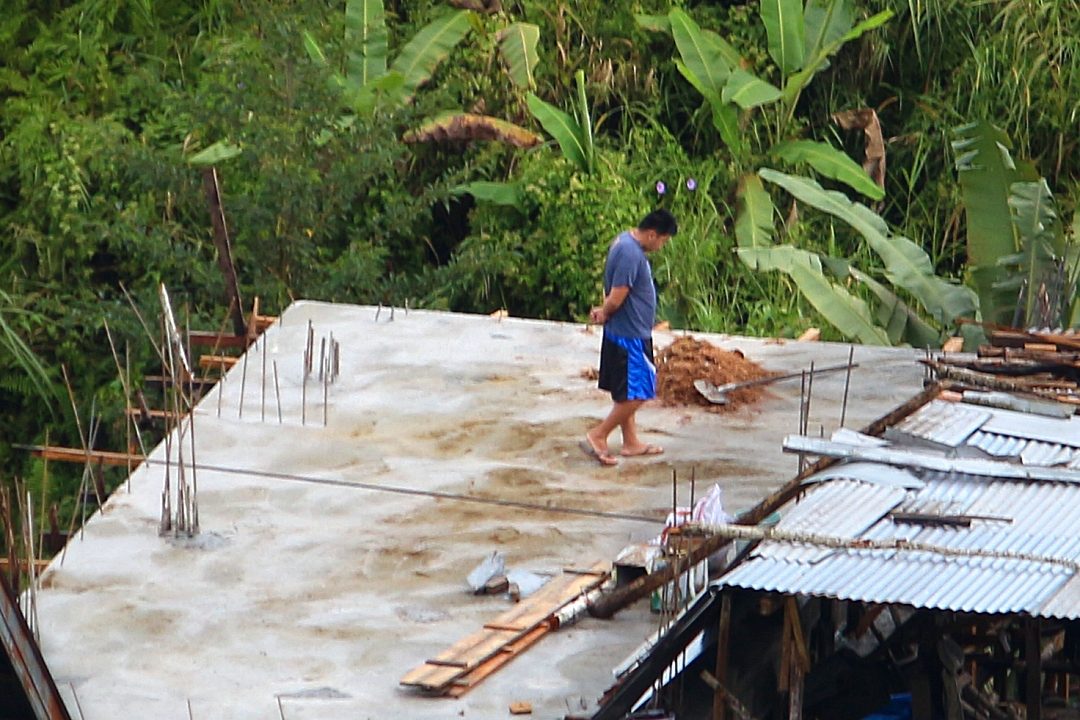
Photo: Marek Ślusarczyk ( Tupungato ) Photo portfolio / Wikimedia Commons, CC BY 3.0
Temporary power on site
Temporary power is installed in a hurry, in wet conditions, with many hand tools and cables run over by vehicles and materials: that is why electric shock remains a major site risk.
Power boards and residual current devices
Main and sub-distribution boards have doors, locks and warning signs; every circuit feeding hand tools has a residual current device (RCD), and metal cabinets and equipment are earthed. During your round, press the "Test" button on the RCD: the breaker must trip.
Cables and sockets
- Cables raised overhead or run in protective conduit where they cross vehicle routes, never through puddles.
- No joints made by twisting wires and wrapping tape; use junction boxes and weatherproof industrial sockets.
- Saws, drills and welders with intact cables and plugs, and uncracked casings.
Who may touch the board
Only the electrician assigned by the contractor connects or repairs boards. In heavy rain, or if water floods the board area, have that area isolated and stop using hand tools outdoors.
Formwork, props and the concrete pour
Formwork collapses usually happen during the pour, when the load is greatest and the most people are on and under the slab.
Before the pour
- Props of the right type at the right spacing per the method; prop bases on sole plates or firm ground, not on freshly backfilled soil or broken bricks.
- Enough horizontal and diagonal bracing; props not bent or spliced at random.
- Formwork inspected together with the rebar (see the lesson on rebar inspection before pouring), with no materials heaped on the deck waiting for the pour.
During the pour
Do not dump concrete in one spot; assign an experienced person to watch the props below, and stop the pour at once if a prop bends, the formwork sags or there are cracking noises. Cordon off the area directly under the slab being poured, with no one passing through.
Striking formwork
Remove formwork and props only when the concrete has reached the strength set by the design and method, on the engineer's instruction; striking early to reuse the boards is a classic cause of slab collapse.
Falling objects, cranes and site housekeeping
A single bar or brick dropped from the fifth floor can seriously injure someone below. Falling objects and housekeeping go together: a messy site means things fall easily and people trip.
Debris netting and exclusion zones
The outside of the scaffold is wrapped in netting (Figure 3) to hold small objects and dust; on some floors, catch nets or catch platforms project outwards as the method requires. Walkways beneath work at height get a covered route or an exclusion zone. During lifts, cordon off the crane's working radius, have a signaller, and let nobody stand or walk under the load; check slings and hooks with safety latches.
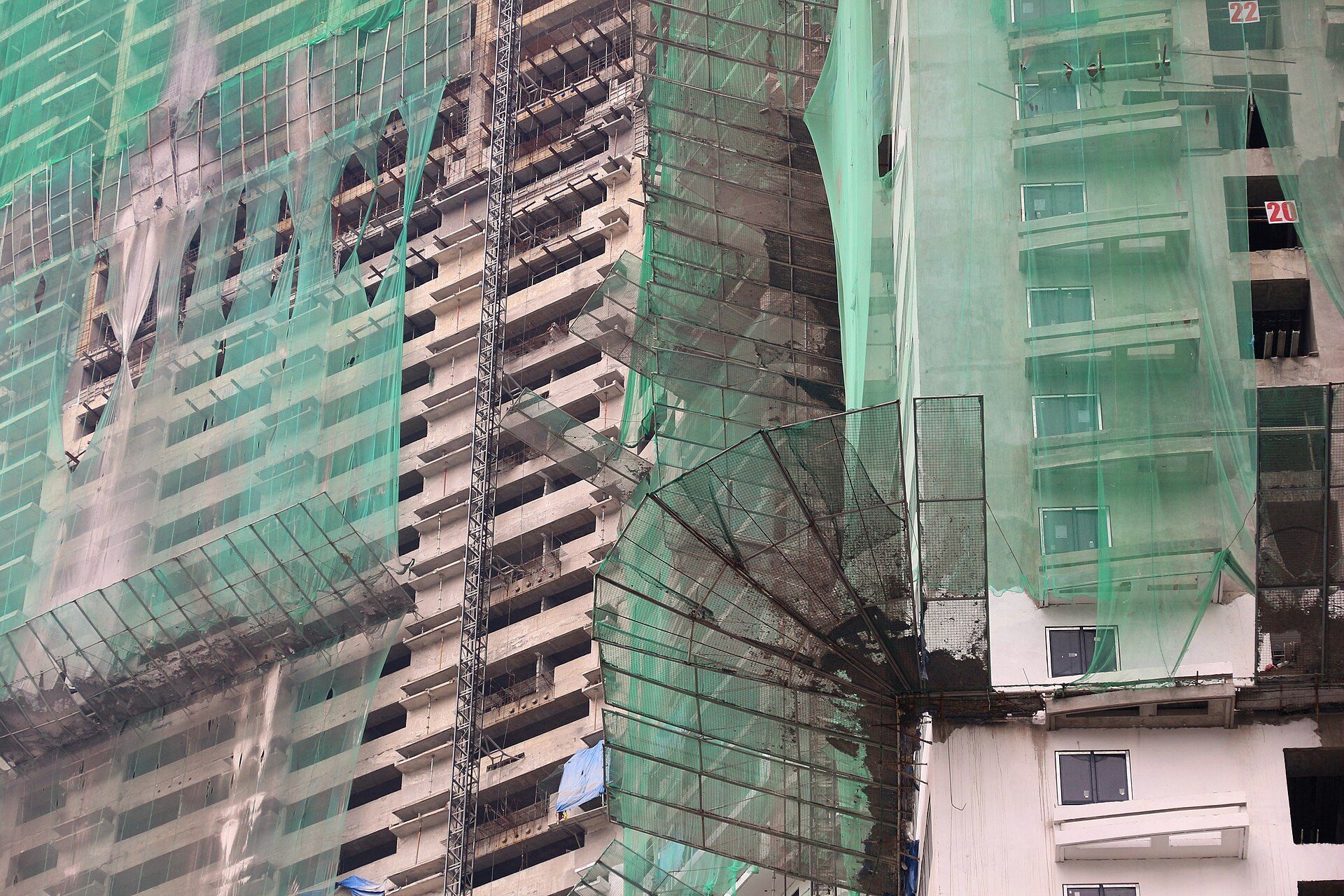
Photo: Marek Ślusarczyk ( Tupungato ) Photo portfolio / Wikimedia Commons, CC BY 3.0
Daily housekeeping
- Walkways clear, no boards with nails sticking up, no cables stretched across.
- Materials stacked neatly and away from slab edges; waste gathered at the designated point and brought down by chute or crane, never thrown from height.
- Enough lighting on stairs and in basements; no standing water near power boards.
- Drinking water, toilets and a shaded rest area; on hot days, arrange working and rest hours sensibly.
Helmets with chin straps fastened
A helmet without its chin strap fastened falls off when a person falls or bends over, exactly when it is needed most. On your round, looking at chin straps matters as much as looking at helmets.
The 10–15 minute toolbox talk
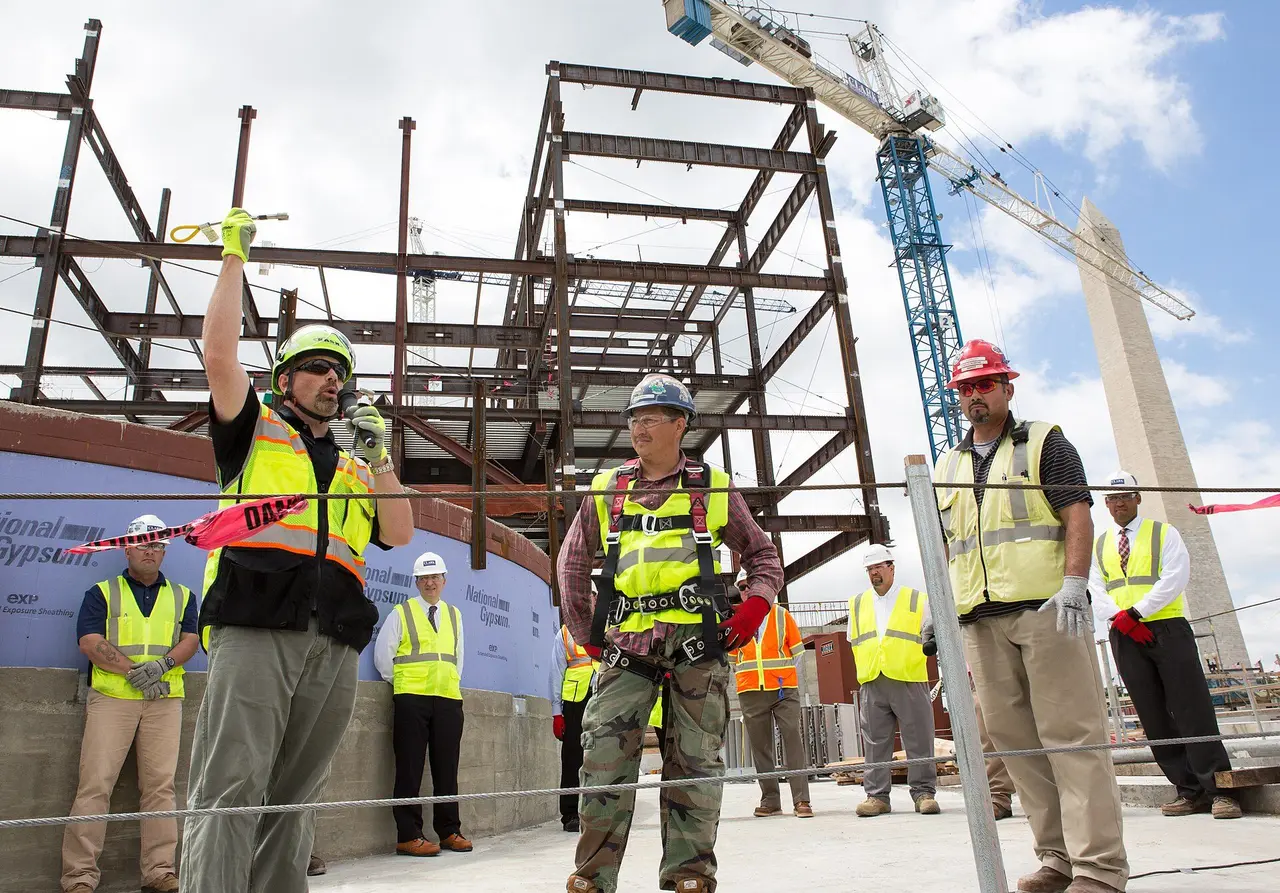
A toolbox talk is a short briefing on site before work starts, like the scene in Figure 4, where one worker shows the whole crew how to wear a harness properly.
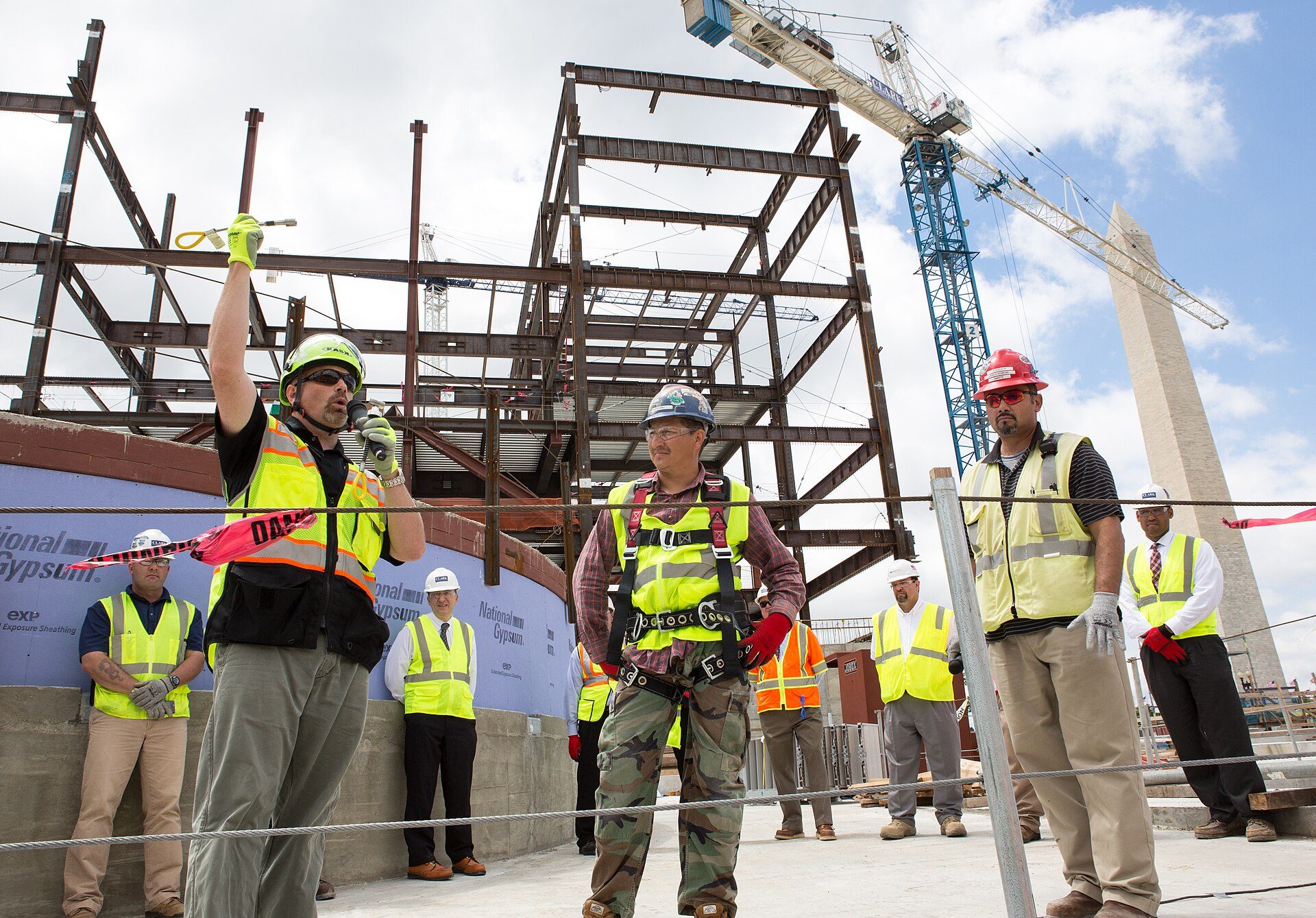
Photo: US Department of Labor / Wikimedia Commons, Public domain
Running the talk
- Gather on time at the area where work will happen and take attendance by crew.
- Say clearly what today's work is: which slab is being poured, what is being lifted, who is working at height.
- Name the 2–3 main hazards of today's work and the controls (for example: the level 4 guardrail comes off to land rebar — who refits it and when).
- Quick PPE check: helmets strapped, boots, harnesses for those working at height.
- Mention yesterday's incident or defect if there was one; ask workers whether they have noticed anything dangerous.
- Everyone signs the attendance sheet.
Short, specific, with examples
Do not read out the site rules word for word. One topic per talk, pointing at real spots on site. Anyone new that day gets an extra briefing on walkways, exits and no-go areas.
Safety warning: Do not allow work at height without guardrails or a harness clipped to a secure anchor. Never stand or walk under a crane load or under a slab being poured. Do not connect or repair a power board unless you are the assigned electrician; if you see exposed wires or an open board, have the power cut. Do not walk on formwork or slabs not yet confirmed as adequately propped. If someone is injured: call 115 (the emergency medical number in Vietnam), give first aid only within your training, and do not move someone who fell from height with a suspected spinal injury unless the scene is still dangerous (fire, further collapse, live power).
What to do when an accident happens
Nobody wants to face it, but a supervisor must know the sequence before it happens. Panic and the wrong order can put more people at risk.
The first minutes
- Stop work in the area and keep others from rushing in while the scene is still unsafe.
- Remove the ongoing danger: isolate power in an electric shock (do not touch the casualty with bare hands until it is off), stop the crane, add temporary props if more collapse is possible.
- Call 115 with the address, floor and condition; send someone to the gate to meet the ambulance.
- A trained first aider gives first aid; someone who fell from height is kept still, head not lifted, not carried unless necessary.
- Report immediately to the site manager and the person responsible for safety.
After the casualty has been taken away
Preserve the scene, take photos, and note witnesses' names, the time and the work in progress. Accident reporting and investigation have their own deadlines and receiving authorities; the site manager and owner act under current regulations. The supervisor contributes accurate records and proposes measures to prevent a repeat.
Worked example: the Monday morning safety round
A 5-storey townhouse in Thu Duc is fixing formwork and rebar for the level 4 slab, with the pour planned for Thursday. You are the owner's supervisor, doing a safety round at 7 a.m. with a 20-item checklist across 6 areas: gate and walkways, power boards, external scaffolding, level 4 deck, level 3 under the props, and the material lifting area.
Time
About 8 minutes per area: 6 × 8 = 48 minutes. Add a 12-minute toolbox talk for a total of 48 + 12 = 60 minutes, finishing at 8 a.m.
Findings and actions
| Defect found | Area | Severity | Action | Deadline |
|---|---|---|---|---|
| 6 m of guardrail missing at the rear edge of level 4 | Level 4 deck | Serious | Stop work near the edge, install guardrail | Before work continues |
| 3 props on level 3 standing on broken bricks | Level 3 | Serious | Replace with sole plates, re-set props | Before formwork inspection |
| RCD on circuit 2 does not trip on test | Power board | Fix this shift | Isolate circuit 2, electrician replaces the device | This morning |
| 2 m tear in the front debris netting | Scaffolding | Fix this shift | Patch or replace the netting | Today |
| Boards with nails on the ground-floor walkway | Walkway | Fix this shift | Clear boards, pull or bend over the nails | This morning |
| 2 workers with helmet chin straps unfastened | Level 4 deck | Reminder | Remind on the spot, repeat in the toolbox talk | Now |
Summary: 20 items, 6 defects, 14 passed, a pass rate of 14 / 20 = 70%. Of the 6 defects, 2 are serious (related work stopped), 3 are fixed this shift and 1 is a reminder: 2 + 3 + 1 = 6. You record this in the site supervision diary, take before-and-after photos and send them to the contractor. In the afternoon you re-check the 5 defects that need fixing; the prop defect must be fixed before Wednesday's formwork inspection, otherwise you do not sign for the pour.
Common mistakes by new supervisors
Checking paperwork but not the site
Sign: the safety file is fully signed, but the slab edge has no guardrail. Cause: not wanting to climb the floors, trusting the records. Fix: walk the site at least once a day with the checklist, taking date-stamped photos.
Seeing defects but only mentioning them
Sign: the same defect recurs all week. Cause: no record, no deadline. Fix: write it in the diary with the responsible person and deadline, and re-check on time.
Not wearing PPE yourself
Sign: the supervisor wears trainers and carries the helmet in hand. Cause: thinking "I'm only looking". Fix: the supervisor sets the example — strapped helmet, safety boots and high-visibility vest every time you pass the gate.
Frequently asked questions
What does construction site safety cover?
Safety measures for each type of work (work at height, electricity, formwork, lifting, excavation), personal protective equipment, worker training, equipment inspection, site housekeeping and incident procedures. This lesson focuses on the supervisor's daily checks.
Can a supervisor stop work when it is unsafe?
As a principle, when a supervisor finds a risk of an accident, they are responsible for requiring the dangerous work to stop and reporting it. The exact scope of authority depends on the contract and current regulations, so read your supervision contract carefully.
At what height must a harness be worn?
Many rules treat about 2 m and above as work at height, but open edges, openings or a fall onto sharp objects are dangerous at lower heights too. Prefer guardrails and covers; use harnesses where collective protection is not possible. Check the current Vietnamese technical regulations for the exact figure.
Where can I get certified safety training?
Licensed occupational safety and health training providers run courses and issue certificates by worker category. Ask the HR department or site manager of your company, and check that the provider holds a valid licence.
Practice tasks and self-assessment
- Write your own 20-item checklist for a site you can observe (a house being built in your neighbourhood will do), grouped by the 4 major risks plus housekeeping.
- Do one round (from outside the boundary — never enter someone else's site without permission), note the defects you can see and rank their severity.
- Prepare a 10-minute toolbox talk for a slab pour day.
- Learn the 5-step accident sequence and repeat it without notes.
Self-assessment criteria
- Pass: checklist items are specific and checkable (for example "press RCD test on circuits 1 and 2"), not vague like "electrics safe".
- Pass: every defect has a severity, action and deadline; the counts by severity add up.
- Pass: the toolbox talk covers today's work, 2–3 hazards, controls and a PPE check.
- Not yet: a fall-from-height defect without a work stop, or props on broken bricks ranked as a "reminder".
With safety in hand, move on to the next step of the roadmap: Reading architectural, structural & MEP drawings, where you learn to read plans, sections, rebar details and electrical and plumbing drawings so you know what you are inspecting against.
Keep learning construction supervision: after safety come reading design documents, inspecting each stage, managing quantities and schedules, and as-built records. See the 8-step construction site supervisor roadmap.