An effective short-video hook answers the viewer's question "what's in this for me?" within the first 3 seconds — with an eye-catching opening image, a line of on-screen text and a first spoken sentence that all say the same thing. On TikTok, Reels or YouTube Shorts, viewers decide to scroll past in a split second; however good the content is, if the first 3 seconds are flat, nobody sees the rest. This lesson gives you 10 hook templates that work across many niches, shows how to combine image, text and voice, and explains how to measure which hook actually keeps people watching.
By the end of this lesson, you will be able to:
- Explain what a hook is and why the first 3 seconds decide the views of the whole video.
- Write hooks with 10 templates: question, result first, mistake, number, before–after and 5 more.
- Combine the 3 layers of a hook: opening image, on-screen text and first spoken line.
- Avoid misleading clickbait and content that breaks community guidelines.
- Measure 3-second retention and completion rate to pick the better hook using data.
Want to become a content creator properly? Ideas, hooks and short scripts are step 2 of the roadmap — after choosing a niche and learning the platform rules. See the 8-step content creator roadmap (in Vietnamese) to learn in the right order.
What is a hook and why do the first 3 seconds matter?
A hook is the opening of a video, usually 1–3 seconds long, with a single job: make the viewer stop their thumb and keep watching. A hook is not a greeting, not a channel logo and not a self-introduction.
The algorithm reads viewer behaviour
Short-video platforms usually show a new video to a small group of viewers first. If most of them scroll past immediately, the video is treated as "not engaging" and gets pushed less. If many stay, watch to the end, rewatch and comment, the video is shown to a bigger group. Exactly how each platform calculates this is not fully published and changes often, but the principle holds: keeping viewers at the start is the condition for any chance later on.
The hook is a promise; the body pays it back
A good hook promises a specific value: a result, a solution, a surprise. The body of the video must deliver exactly what was promised. A hook that overpromises without delivery makes viewers leave halfway, comment negatively and erodes the channel's credibility — which is worse than a dull hook.
Three questions viewers ask themselves in 3 seconds
- What is this? — the opening frame must make the topic clear.
- Is it relevant to me? — touch the viewer's real problem or desire.
- What do I get if I keep watching? — leave a curiosity gap that needs filling.
The three layers of a hook: image, text, voice
Many people write only the first spoken line and forget that most viewers scroll with the sound off or before they have heard anything. A strong hook has all three layers saying the same idea and reinforcing each other.
Layer 1: the opening image
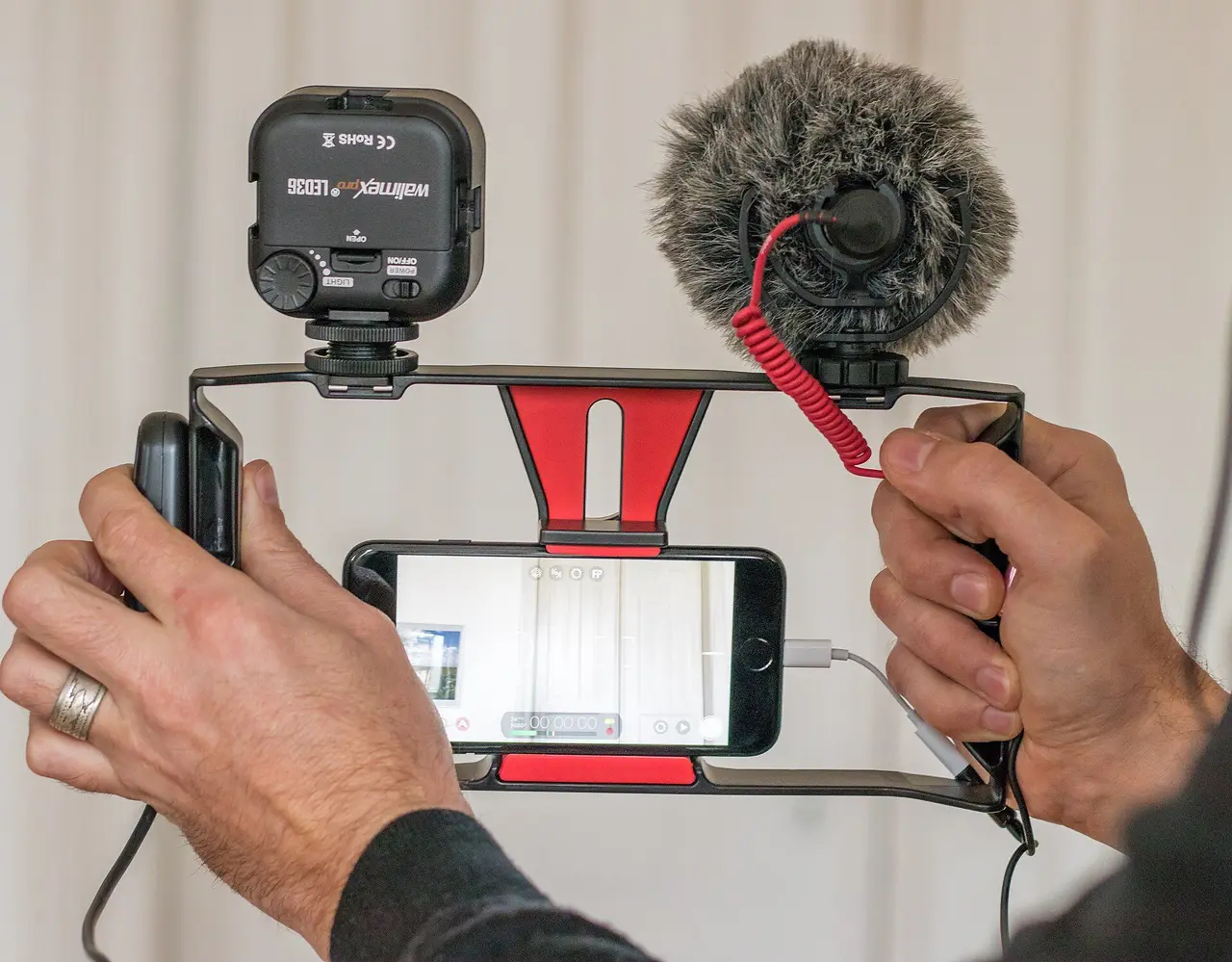
The first frame needs movement or an unusual detail: hands at work, the final result, a close-up of the problem (a stain, a burnt dish, a wobbling fan). Avoid opening on a static scene, a silent face or a black screen. A sharp, well-lit image is the bare minimum — professional mobile shooters often mount the phone on a rig with an LED light and a microphone (Figure 1).
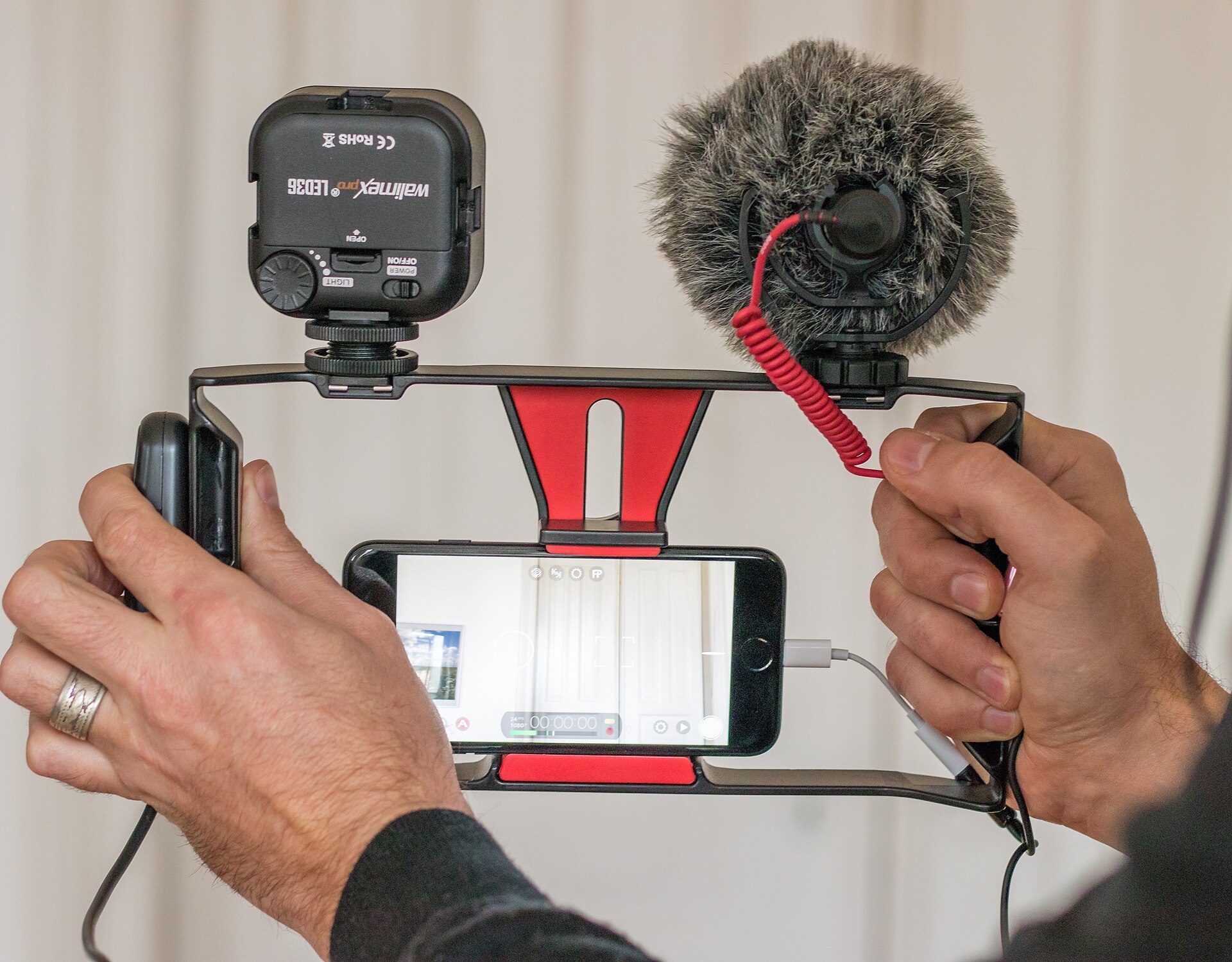
Photo: User:Matthias Süßen / Wikimedia Commons, CC BY-SA 4.0
Layer 2: on-screen text
On-screen text (a text hook) lets viewers with the sound off understand the video. Keep it short, about 5–10 words, large, high-contrast against the background, and placed in the middle of the frame so the app's buttons, channel name and caption do not cover it. The text does not need to repeat the spoken line word for word; it can be a shortened version: the voice says "Does your fan buzz every night?", the text says "Buzzing fan? Fixed in 5 minutes".
Layer 3: the first spoken line
The first spoken line should take under about 2 seconds and get straight to the point. Drop "Hello everyone, today I'm going to…" — move the greeting after the hook or cut it entirely. Speak with natural energy, look into the lens, and make sure there is enough light to see your face and hands clearly; even light from a ring light or a window makes the opening frame look much cleaner (Figure 2).
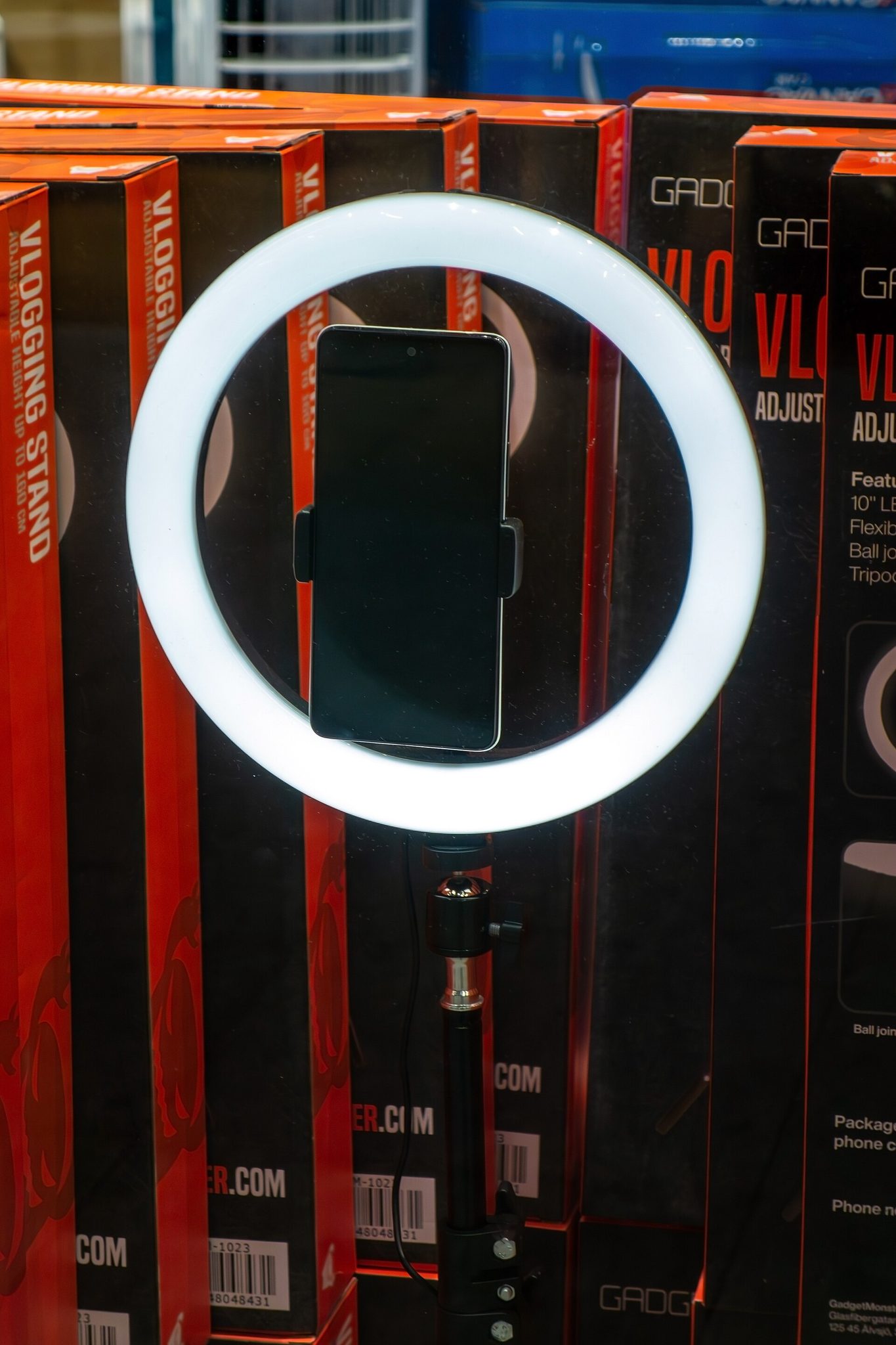
Photo: W.carter / Wikimedia Commons, CC BY-SA 4.0
10 hook templates with examples from several niches
A hook template is a sentence frame that many channels have used successfully; you plug in your own niche. No template wins every time — test and measure (see the measurement section below). The examples are translated from Vietnamese.
| # | Hook template | Formula | Example | Niche |
|---|---|---|---|---|
| 1 | A question about the pain point | Are you struggling with [problem]? | "Braised pork for ages and the sauce still won't turn caramel brown?" | Cooking |
| 2 | Result first | Show the finished result, then the process | "I did these nails at home in 25 minutes." | Beauty |
| 3 | Common mistake | Don't [thing many people get wrong] | "Don't put cooking oil on your fan shaft — here's why." | Repairs |
| 4 | A specific number | [Number] ways / steps / mistakes to [result] | "3 steps to fluffy fried rice that isn't sticky." | Cooking |
| 5 | Before – after | Put two states side by side | "These white sneakers: before and after 10 minutes." | Cleaning |
| 6 | Against common advice | Everyone says [A], but… | "Everyone says pile on more powder, but a thin base lasts longer." | Beauty |
| 7 | Experiment | I tried [unusual thing] | "I tried making crème caramel in a rice cooker." | Cooking |
| 8 | Call out the viewer | If you are [group], … | "If you've just opened a motorbike repair shop, remember this one thing." | Repairs, trades |
| 9 | A story with conflict | Situation + surprise | "Three shops sent this rice cooker back — the fault was where nobody looked." | Repairs |
| 10 | Comparison | What's the difference between [A] and [B]? | "Nail polish at 50,000 vs 250,000 VND — what's the difference?" | Beauty |
Choose a template by video type
Tutorials suit templates 1, 3 and 4. Transformation videos (cleaning, nails, repairs) suit templates 2 and 5 because the images tell the story. Trade-experience videos suit templates 6, 8 and 9. Product reviews suit templates 7 and 10 — but if a brand paid you or gave you the product, you must label the content as advertising, as required by the platform and by Vietnamese law.
Turn one template into many hooks
For each idea, write 3–5 hooks using different templates, then choose. For the idea "how to clean a top-loading washing machine": template 1 "Does your washing machine smell even right after a wash?"; template 3 "Don't just wipe the drum — the dirtiest part is here"; template 5 a close-up of the drum before and after cleaning. Write many, pick one, and keep the rest to test in later videos.
A process for writing the hook of one video
Write the hook after you know what value the video delivers, not before. A 6-step process:
- Write one sentence summarising the video's value: "Viewers will learn to stop a fan buzzing with a screwdriver and machine oil."
- Define the viewer and their pain or desire (from comments, audience questions, messages).
- Write 3–5 hooks with different templates from the table.
- Choose an opening image for each hook: which shot shows the hook's idea fastest?
- Shorten it into 5–10 words of on-screen text.
- Read the first spoken line aloud and time it: if it runs longer than about 2 seconds, cut it.
Shoot several versions of the opening
When filming, shoot 2–3 different openings for the same video and keep the body identical. Fix the phone on a tripod with a phone clamp (Figure 3) so every version has the same framing and lighting — when you compare, only the hook differs.
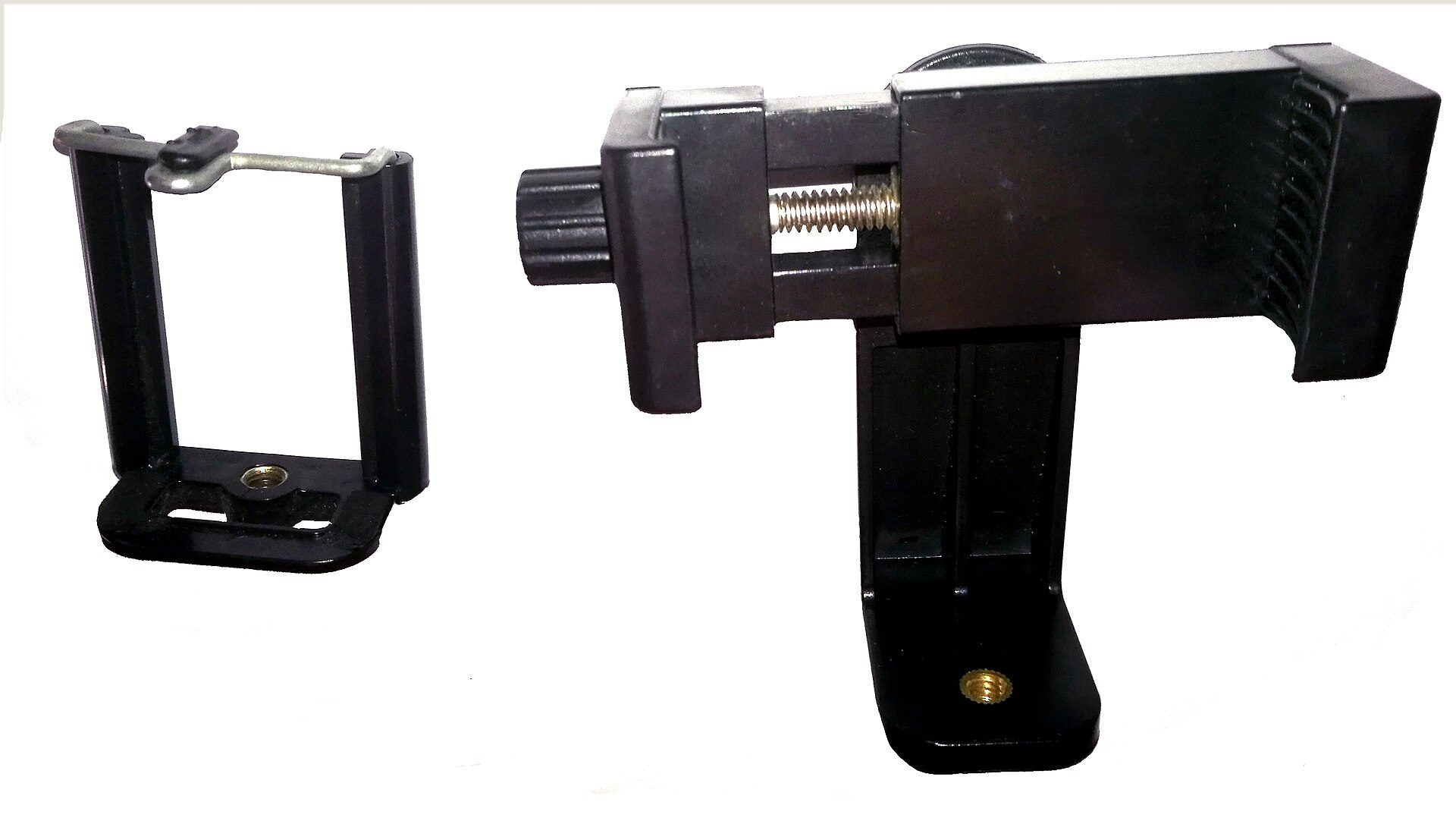
Photo: Draco flavus / Wikimedia Commons, CC BY-SA 3.0
Check the hook before posting
- Watch the first 3 seconds muted: from image and text alone, can you tell what the video is about?
- Listen to the first 3 seconds with your eyes closed: from the voice alone, do you want to keep listening?
- Does the body deliver exactly what the hook promised?
Avoid misleading clickbait and community guideline violations
A hook that sparks curiosity is good; a hook that deceives the viewer is bad. The line is whether the body delivers what was promised and whether it is true.
Hooks to avoid
- Promising results that are not real: "Whiter skin in 3 days", "Earn 50 million a month doing nothing". In beauty, health and finance these are both false and likely to break advertising rules.
- Opening images that are not in the video: shocking footage or someone else's footage used as bait.
- Fear and insults: shaming a group of people, fake news, violent or gory images.
- Encouraging dangerous behaviour: dangerous challenges, electrical work, gas or hot oil shown without a warning.
Consequences for the channel
Videos that violate community guidelines can be removed, have their distribution restricted, and earn the channel warnings or feature bans. Even without a penalty, a clickbait hook leads to a low completion rate and negative comments — two signals that drag a channel down. Each platform's rules change over time; read the current community guidelines of the platform you post on.
Safety warning when filming: in the repair niche, always unplug the appliance and show viewers this step before opening anything electrical; say clearly which jobs need a qualified technician. In cooking, film hot oil, pressure cookers and gas stoves from a safe distance, and never stage an "accident" for a hook. In beauty, do not recommend medicines, chemicals or procedures that need a doctor. No hook is worth a viewer copying it and getting hurt.
Measure the hook with 3-second retention and completion rate
A feeling that "this hook is good" is less reliable than data. Two metrics to track:
The two metrics and how to calculate them
- 3-second retention = views still watching at second 3 ÷ total views. It measures the hook's strength.
- Completion rate = views that reach the end ÷ total views. It shows whether the hook promised honestly and the body held attention.
The names and locations of these metrics differ between TikTok Analytics, YouTube Studio and Meta Business Suite and change with updates; usually you will find a second-by-second audience retention chart and a completion rate for each video. Reading analytics in depth is covered in the "Channel growth & analytics" step.
Worked example: a repair channel tests two hooks
Mr Tuan in Bien Hoa runs a channel about household appliance repairs. For his 45-second video on a "buzzing stand fan", he shot two different openings with an identical body, posted them a week apart in the same 8 pm slot, and recorded the figures when each reached 2,000 views.
- Hook A (greeting): the first frame is Mr Tuan's face saying "Hello everyone, today I'll show you how to fix a fan…".
- Hook B (result first + before–after): the first frame is a close-up of the fan wobbling and buzzing, cutting to the fan running quietly; text "Buzzing fan? Fixed in 5 minutes"; voice "If your fan sounds like this, don't rush out to buy a new one."
| Version | Views | Still watching at 3s | 3-second retention | Watched to end | Completion rate |
|---|---|---|---|---|---|
| Hook A | 2,000 | 860 | 43% | 140 | 7% |
| Hook B | 2,000 | 1,300 | 65% | 260 | 13% |
| Total | 4,000 | 2,160 | 54% | 400 | 10% |
Check the maths: 860 ÷ 2,000 = 43%; 1,300 ÷ 2,000 = 65%; 140 ÷ 2,000 = 7%; 260 ÷ 2,000 = 13%. Combining both versions: 860 + 1,300 = 2,160, divided by 4,000 = 54%; 140 + 260 = 400, divided by 4,000 = 10%. Hook B's 3-second retention is 22 percentage points higher and its completion rate is almost double, so Mr Tuan makes "result first + before–after" his default template for the fan-repair series.
Read the results correctly
These are hypothetical figures to illustrate the calculation, not a general benchmark — every niche and channel has its own averages. Comparing two hooks only makes sense when the body, length and posting time are the same and each version has enough views (with a few hundred views, differences can be random). If 3-second retention is high but completion is low, the hook is overpromising or the body is slow; if both are low, switch to a completely different template.
Common mistakes when writing hooks
Opening with a greeting and introduction
Symptom: the retention chart drops sharply in the first second. Cause: the first 3 seconds offer the viewer nothing. Fix: put the problem or the result first; move the greeting later or drop it.
Hook and body don't match
Symptom: good 3-second retention but a steep drop at seconds 5–10, and "clickbait" comments. Cause: the hook promised something the video does not deliver. Fix: write the hook after the content is final and check the promise against the body.
On-screen text too long or covered
Symptom: viewers with the sound off do not understand the video. Cause: two or three lines of text placed near the bottom edge, hidden by the caption. Fix: 5–10 words in the middle of the frame, previewed on a phone before posting.
Muffled or quiet sound in the first second
Symptom: a spoken hook that viewers cannot hear clearly. Cause: the phone's microphone is too far away, or the room echoes. Fix: use a lavalier or on-camera microphone, and film in a room with curtains and soft furnishings to reduce echo (Figure 4).
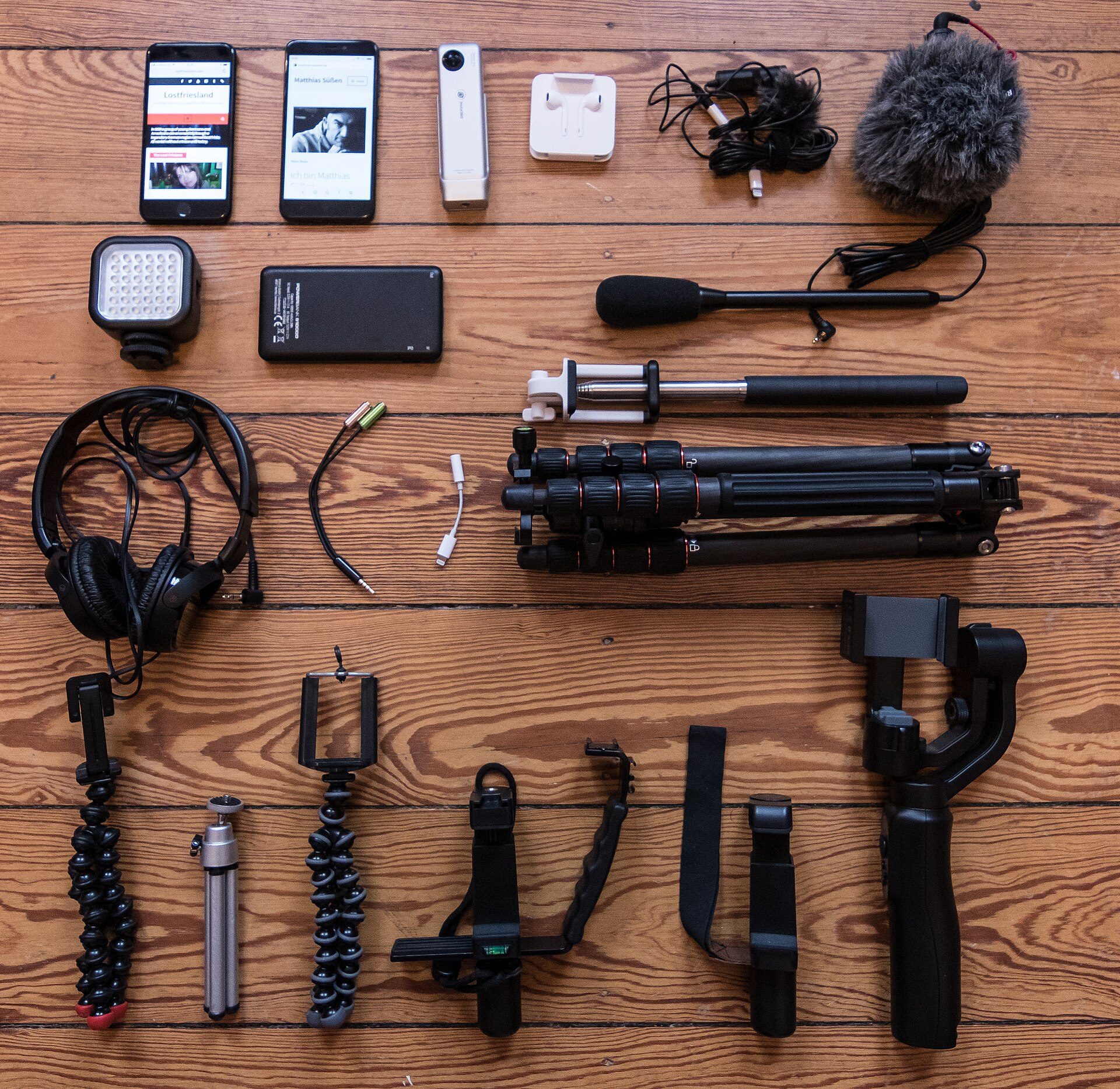
Photo: User:Matthias Süßen / Wikimedia Commons, CC BY-SA 4.0
Exercise: write 20 hooks
Choose 2 niches you know well (for example cooking and repairs, or beauty and cleaning). For each niche, write 1 hook for each of the 10 templates in the table: 2 niches × 10 templates = 20 hooks.
How to do it
- Write a value summary for 2 video ideas (one per niche).
- Write 10 hooks for each idea, recording all 3 layers for every hook: opening image, on-screen text, first spoken line.
- Read each spoken line aloud and time it.
- Choose the 2 best hooks per niche, film the openings, and ask 3 friends to watch them muted and tell you what the video is about.
Self-assessment criteria
- Pass: all 20 hooks written, each with all 3 layers; the first spoken line takes under about 2 seconds; on-screen text is 5–10 words.
- Pass: no hook makes a false promise or encourages dangerous behaviour.
- Pass: at least 2 of 3 muted viewers correctly name the video's topic.
- Not yet: hooks open with a greeting, on-screen text runs over 2 lines, or the hook and body do not match.
Frequently asked questions
How many seconds should a hook be?
The critical part is the first 1–3 seconds. The first spoken line should take under about 2 seconds; after that the video must get into the content straight away rather than stretching the opening.
Should I use trending music as a hook?
Music sets the mood but cannot replace a strong image and a promise of value. Use only music from the platform's licensed library, especially in videos made with a brand.
Does using the same template all the time get boring?
Yes. Regular viewers will notice. Rotate your channel's 3–4 best-performing templates and test one new template a week, guided by retention data.
Are hooks for sponsored videos different?
The principles are the same, but you must label the content as advertising, never exaggerate what the product does, and check the contract for the wording you are allowed to use.
How do I measure hooks when my videos get few views?
Combine the figures of several videos that use the same template, or wait until each video reaches a few hundred to a few thousand views. Log the figures for every video in a spreadsheet to see the trend.
Once you can write strong hooks, you are ready for the next step of the roadmap: Phone shooting: framing, light, sound — so your opening image is bright and sharp and your first spoken line is heard word for word. See the 8-step content creator roadmap (in Vietnamese).