The first question almost everyone asks before entering the spa trade is: how long until I can work, and how much will it cost? Some adverts promise a "2-week crash course", others say you need two years; fees range from nothing to tens of millions of Vietnamese dong. This lesson helps you see each training route clearly, understand what you actually need to learn, and draw up a plan that fits your budget.
By the end of this lesson, you will be able to:
- Answer "how long does spa training take" in terms of three milestones: supervised apprentice, working independently, and senior therapist.
- Compare 4 ways of training by duration, 2026 reference fees and the paperwork you receive.
- List the 5 core skill groups and the minimum practice hours for each.
- Work out the total cost and income of a 12-month learning plan for yourself.
- Recognise 4 signs of a course that is not worth the money before you pay.
Want to start now, with guidance? NAMBIN's Spa Therapist Level 1 – Apprentice course teaches exactly the foundations spas check when taking on an apprentice: skin structure, contraindications, infection control, preparing the room and towels, the 5 groups of massage strokes and basic facial care — with a mandatory safety test that requires a 100% score.
Quick answer: how long does spa training take?
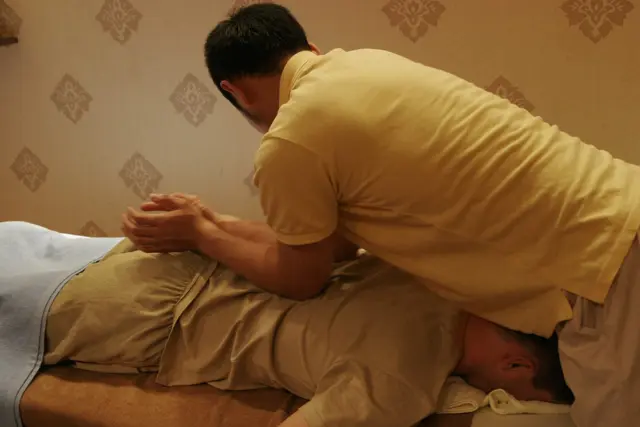
In the spa trade, "finishing your training" is not a single date but three milestones in a row. Each one answers a different question: are you safe enough to touch a client, can you work alone, and are you good enough to take on difficult cases? Thinking in milestones stops you being fooled by "job-ready in 2 weeks" courses, and stops you losing heart because you think you must study for two years before earning anything.
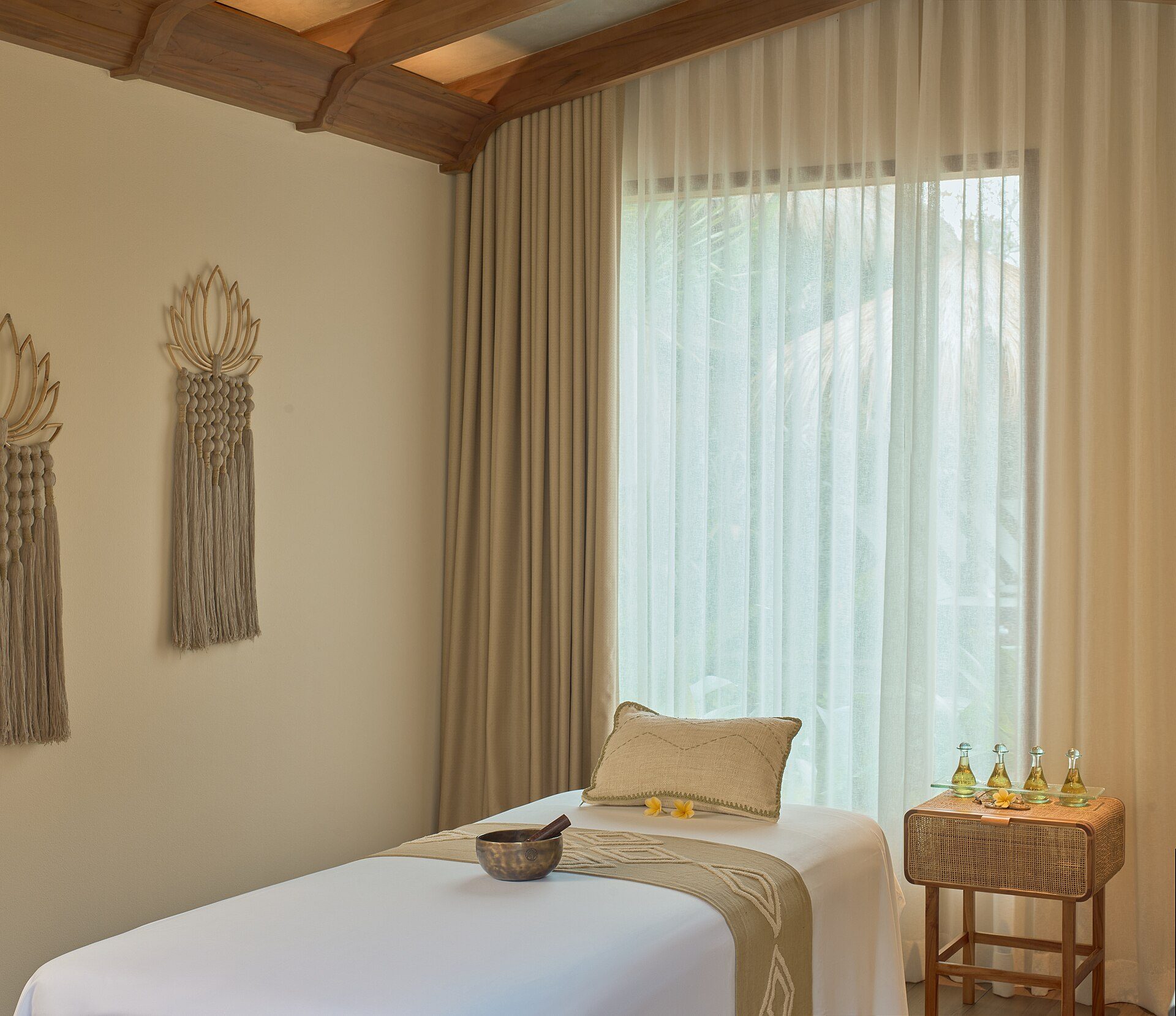
Photo: Paradisus Bali / Wikimedia Commons, CC BY-SA 4.0
Milestone 1: supervised apprentice — about 1–3 months
This is the time to master the safety foundations: how healthy skin differs from problem skin, when you must not treat (contraindications — health conditions that make a service potentially harmful), hand washing, disinfecting tools, draping towels and the basic massage strokes. At the end of this milestone, you assist a senior therapist and do part of a service with someone standing beside you. Studying intensively at around 20 practice hours a week, most learners reach this point after 9–13 weeks.
Milestone 2: working independently on basic services — about 3–6 months
You carry out a full 60-minute body massage or a basic facial from greeting the client to seeing them out, on time and following the hygiene procedure. What decides this is not the number of months but the number of assessed sessions: many spas only let you see clients alone once you have done about 40–60 supervised sessions without any hygiene or safety fault.
Milestone 3: senior therapist — usually after 1.5–3 years
A senior therapist takes the difficult cases: sensitive clients, clients with many health notes, regulars who ask for them by name; and they are asked to mentor newcomers. This milestone needs real working time and cannot be rushed in a classroom. The lesson on spa certificates and career path describes in detail the conditions for each step up.
4 ways to train: duration and 2026 reference fees
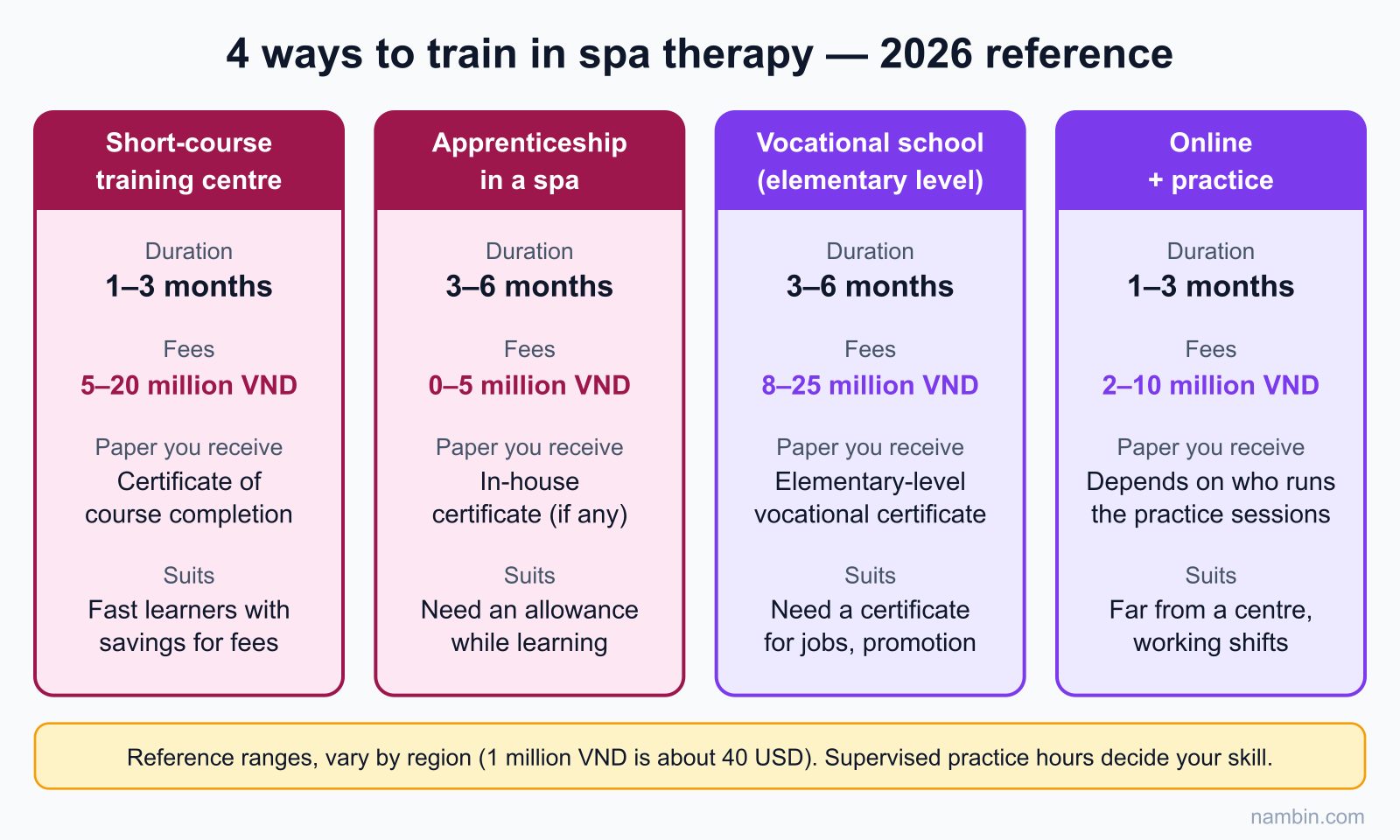
In Vietnam there are four common ways to learn the spa trade. None is best for everyone; choose by three things: how much money you have, how soon you need an income, and whether you need a vocational certificate straight away. Figure 2 summarises the four routes; the table after it adds the share of practical training.
Short-course training centres
All-in-one courses last about 1–3 months, with reference fees of 5–20 million VND (roughly 200–800 US dollars; 1 million VND is about 40 USD) depending on how many services are taught. The advantages are speed, a set curriculum and small classes. The drawbacks: what you receive is usually a certificate of course completion, not a vocational certificate, and the number of hours practising on real people varies hugely between centres. Ask clearly "how many practice hours are assessed by a teacher?" before you pay.
Apprenticeship in a spa (mentoring)
You join a spa as an apprentice and a senior therapist mentors you for 3–6 months. Many places charge no fee; some charge 1–5 million VND or deduct it gradually from your pay, and in return usually ask you to commit to working for 6–12 months after training. You get an allowance immediately and learn the real job, but the foundations (skin, contraindications) are easily taught superficially when the spa is busy. Read the commitment carefully: the penalty for leaving early, the probation period, and whether the training content is written down.
Vocational schools and training institutions
The elementary level ("so cap") lasts about 3–6 months, with reference fees of 8–25 million VND, a final exam and a vocational certificate — the paper that well-run spas usually ask for. Some schools offer an intermediate-level beauty care programme of about 1.5–2 years, suited to young people who want a thorough education alongside general studies. Many schools run evening and weekend classes for people already working.
Online learning combined with practice
Theory (skin anatomy, hygiene, procedures, consultation) is studied online at your own pace, then practised at a partner facility or at the spa where you are apprenticed. Reference cost is 2–10 million VND, taking 1–3 months for the foundations. Online only is not enough: hand pressure, posture and draping need someone watching and correcting you in person. This route suits people far from a training centre or working shifts.
| Route | Duration | Reference fees 2026 | Typical share of practice | Paperwork |
|---|---|---|---|---|
| Short-course centre | 1–3 months | 5–20 million VND | 50–70% | Certificate of course completion |
| Apprenticeship in a spa | 3–6 months | 0–5 million VND, possibly with a work commitment | 80–90% | In-house certificate (if any) |
| Vocational school, elementary level | 3–6 months | 8–25 million VND | 60–70% | Elementary vocational certificate |
| Online + practice | 1–3 months for foundations | 2–10 million VND | Depends on practice venue | Depends on the organiser |
These figures are reference ranges for 2026 in large cities; in the provinces they are usually lower. They are not the price list of any particular institution. The best value for many people is a combination: learn the foundations systematically, apprentice to build real hand skills, then sit the vocational certificate once you are working.
What do you need to learn in spa training?
Whichever route you choose, you must cover five core skill groups. A course missing any of them has a gap, and the gap is usually in safety — the part clients never praise but which causes incidents when it is missing. The table below gives reference minimum hours to reach the supervised-apprentice milestone.
| Skill group | What you learn | Reference minimum hours |
|---|---|---|
| Skin and body | Skin structure, skin types, the skin barrier, contraindications | 30–40 hours |
| Hygiene, disinfection | Hand washing, disinfecting tools, clean vs dirty towels, turning a room round between clients | 15–20 hours |
| Body massage | Posture, the 5 stroke groups, pressure, draping, the 60-minute routine | 80–120 hours |
| Basic facial care | Make-up removal, cleansing, steaming, masks, moisturising | 40–60 hours |
| Consultation, health forms | Taking a history, filling in forms, explaining services, refusing at the right moment | 15–20 hours |
| Total | 180–260 hours |
At 20 hours a week (4 hours a day, 5 days), 180–260 hours comes to about 9–13 weeks — matching the 1–3 month milestone above. Any course promising you will be "job-ready" after 30–40 hours is cutting out most of this workload.
Skin and body: knowing when not to treat
You don't need to study like a doctor, but you must know how many layers the skin has, why over-exfoliating makes skin red and sore, and which conditions mean you stop: open wounds, inflamed or infected skin, fever, uncontrolled high blood pressure, and pregnancy for some services. Example: a 45-year-old client with oily skin wants her acne "squeezed clean", but she has red, swollen inflamed spots — a well-trained learner knows that is a job for a dermatologist, not something to squeeze and be done with.
Massage: pressure comes from the body, not the fingers
Massage takes the most hours because your hands need hundreds of repetitions to become even. The three things an assessor looks at first: your posture (straight back, using your body weight instead of squeezing with your thumbs), an even rhythm, and towels fully covering the areas you are not working on. Learning the wrong posture from the start is the leading reason therapists develop wrist pain after a year or two.
Basic facial care
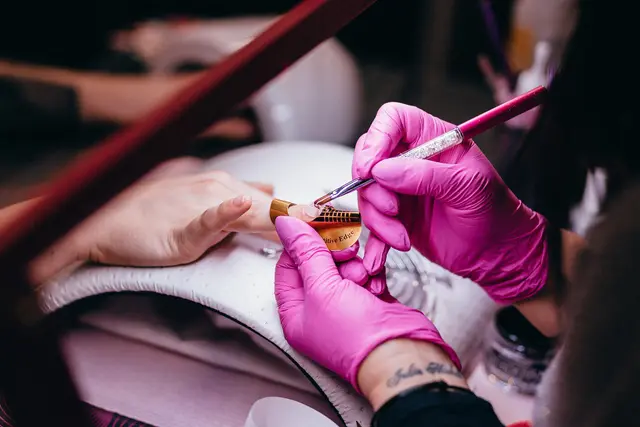
The basic routine is make-up removal, cleansing, surface exfoliation, steaming, a mask and moisturising (see Figure 3). The hard part is not the order of the steps but reading the skin's reaction: if it turns unusually red or the client says it stings, stop, rinse it off and note it on the form. Extractions, machines and peels belong to a later level, once your foundations are solid.
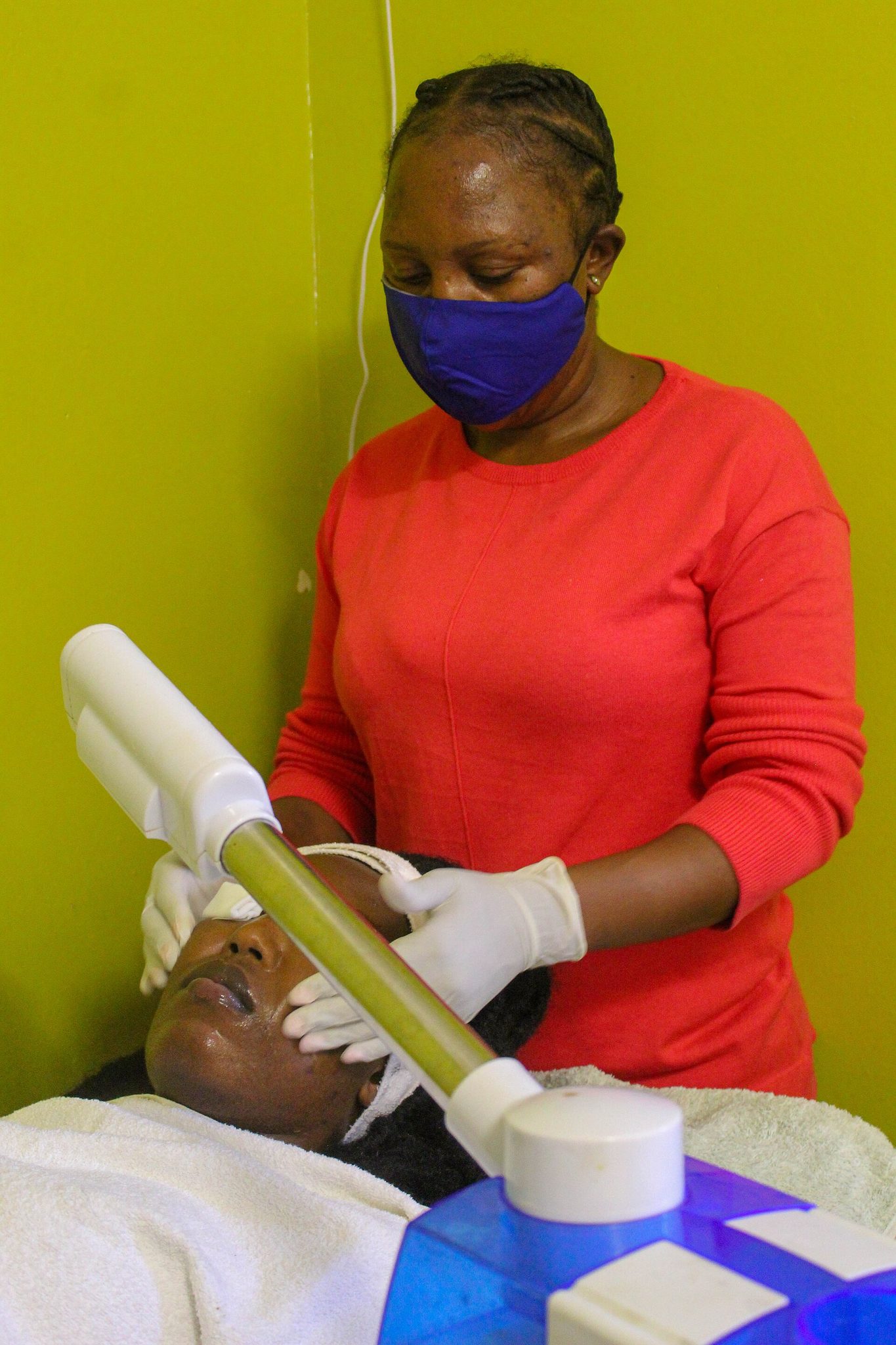
Photo: Kolobetsoo / Wikimedia Commons, CC BY-SA 4.0
Hygiene, disinfection and consultation
Washing your hands properly in 6 steps before and after every client (Figure 4), disinfecting tools and keeping clean and dirty towels apart are the first things a spa checks when taking on an apprentice. Consultation at the basic level means knowing how to ask questions and fill in a health form, explaining a service in plain words, and being able to say "I can't offer this service; you should see a doctor." These two groups take the fewest hours but are the easiest to skip.
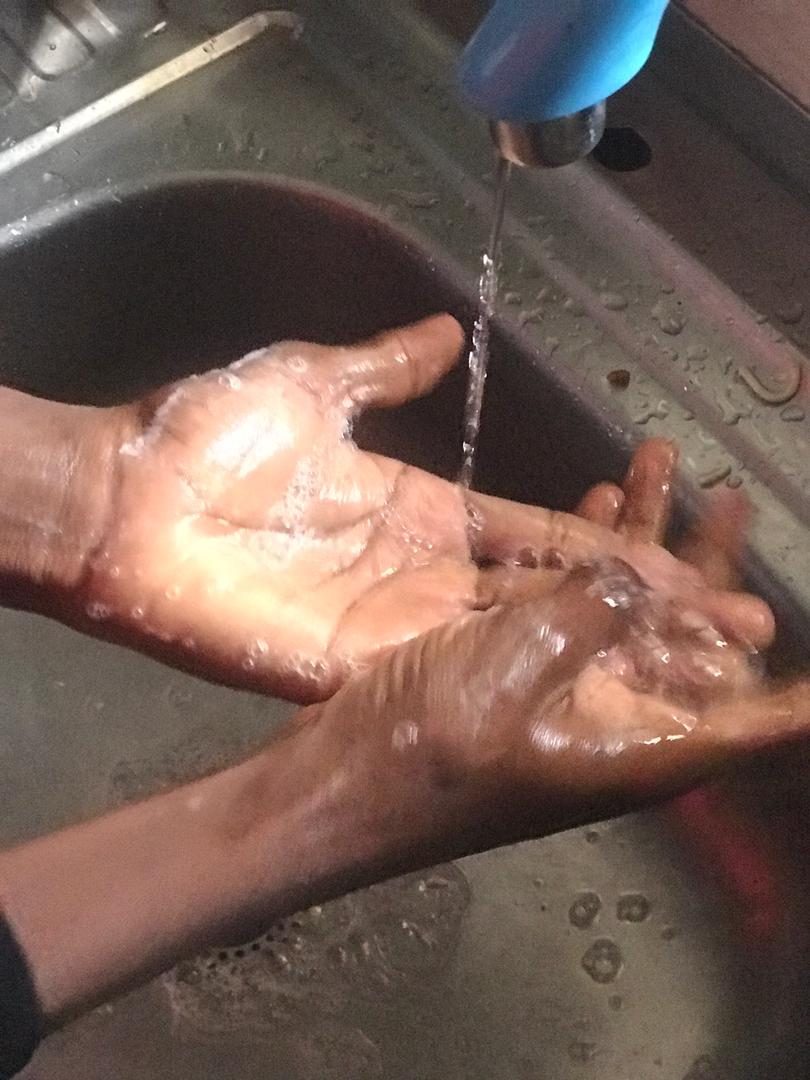
Photo: Justmee3001 / Wikimedia Commons, CC BY-SA 4.0
Safety warning: avoid courses that promise to teach injections, deep microneedling, cosmetic tattooing or "treating melasma and acne" to beginners in a few days. These are invasive procedures that belong to doctors and licensed medical facilities; even after such a course you are not allowed to perform them, and if a client has complications, the person who did the procedure may face legal liability. When learning disinfection, wear gloves, read chemical labels, dilute to the correct strength, and never mix cleaning products.
Spa vocational certificates: which one, and when?
You will come across three kinds of paper: a vocational certificate issued after an exam by a licensed vocational education institution; a certificate of course completion from a training centre or a cosmetics brand; and international certificates. Well-run spas usually ask for a vocational certificate when hiring permanent therapists; many still take apprentices without one and train them in-house.
Certificate before or after starting work?
If you have the money and time, studying at a vocational school first makes job hunting easier. If you need an income soon, apprentice first and take the elementary certificate in evening classes during your first year: you learn faster because your hands already know the work, and you won't get stuck when you want to move up or change workplace. What to avoid is letting two or three years go by with no paper at all to prove your skills.
Checking the institution that issues the certificate
Ask to see its licence for vocational education activities, check that the programme has both a theory and a practical exam, and whether it includes an internship at a spa. A detailed comparison of certificate types, including international ones, is in the lesson Spa certificates and career path: from therapist to running a small spa.
NAMBIN's 4-level path: from apprentice to senior therapist and beyond
The Spa Therapist roadmap on NAMBIN divides the trade into four levels, each a course with its own test. Unlike short courses that only teach you to the point of "knowing how", the roadmap follows the milestones from the start of this lesson: apprentice, senior therapist, specialist, manager. Figure 5 shows the typical timing for each level.
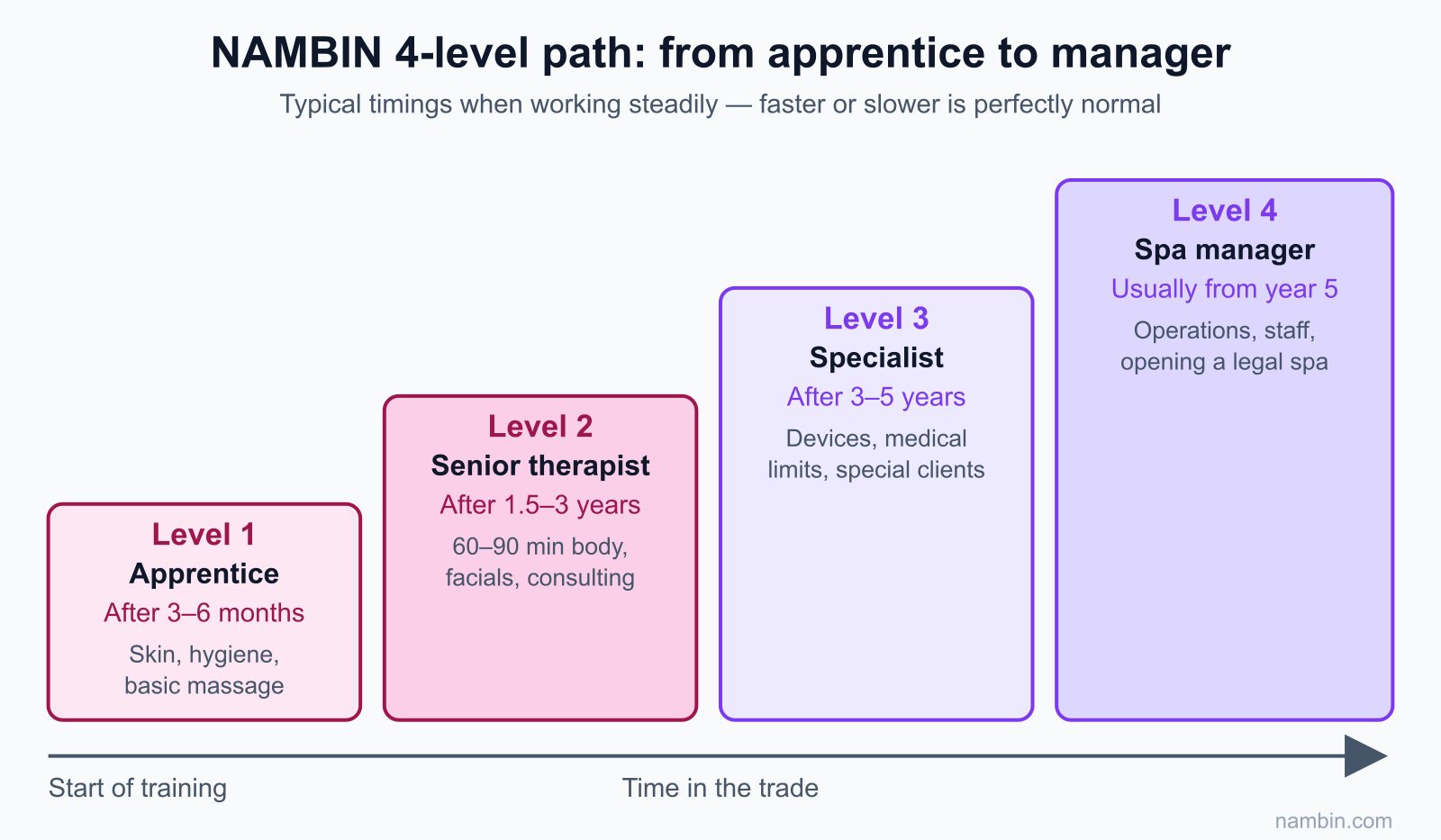
Level 1 – Apprentice (reached after 3–6 months)
Safety and hygiene (a mandatory test requiring 100%), professional conduct and room preparation, applied anatomy, the 5 groups of massage strokes, therapeutic hair washing and foundation facial care. This level corresponds to milestones 1 and 2 above — enough for a spa to trust you to work under supervision and then see clients for basic services.
Level 2 – Senior therapist (usually after 1.5–3 years)
Full 60–90 minute body massage, hot stones, aromatherapy oils, foot massage, body scrubs, wraps and steam; skin analysis, reading cosmetic ingredient lists, acne-prone skin care; consultation, consent forms and delivering full treatment courses. You can learn the theory in a few months, but the senior therapist title comes from hours of real work and returning clients.
Levels 3 and 4 – specialist and manager
Level 3 covers spa devices, the boundary with medical aesthetics, special-needs clients and multi-session treatment plans. Level 4 is for people who want to manage or open a spa: legal procedures, premises, pricing, staffing and finance. Income rises with each level; the lesson on spa therapist pay by level and region (in Vietnamese) has a detailed reference table.
| Level | Typical milestone | What you can do | Where to learn effectively |
|---|---|---|---|
| Level 1 – Apprentice | 3–6 months | Assist, then see clients for basic services | Systematic foundations + assessed apprenticeship |
| Level 2 – Senior therapist | 1.5–3 years | Difficult cases, full treatment courses, mentoring newcomers | Real work + elementary vocational certificate |
| Level 3 – Specialist | 3–5 years | Devices, special clients, multi-session plans | Proper device training at your workplace |
| Level 4 – Spa manager | from year 5 | Running shifts, staff, opening a small spa | Shift-leader experience + management and finance study |
Worked example: Ha, 20, plans 11 months of training
Ha has just left a job as a sales assistant, has about 18 million VND in savings and needs an income within 3 months. She compares two options (all figures are illustrative, 2026 reference).
Option A: a 3-month short course
- All-in course fee: 15 million VND.
- Tools and uniform: 1.5 million; travel for 3 months × 0.5 million = 1.5 million.
- Total spending: 15 + 1.5 + 1.5 = 18 million VND — all her savings, with no income for 3 months.
- Result: a certificate of course completion; she still has to apprentice at a spa for a few more months before seeing clients alone.
Option B: online + apprenticeship + evening certificate
- Months 1–2: study the theory online and practise strokes on family members. Online course with practice sessions: 4 million; towels, oil and bolsters for practice at home: 1.5 million.
- Months 3–6: apprentice at a spa with 6 treatment rooms, allowance of 4 million/month × 4 = 16 million; travel 4 × 0.5 = 2 million. By the end of month 6, Ha has done 50 supervised sessions and is allowed to see clients for basic body massage.
- Months 7–11: study for the elementary vocational certificate in the evenings at a licensed school, fee 10 million.
- Total spending: 4 + 1.5 + 2 + 10 = 17.5 million VND, spread over 11 months.
- Total allowance during the apprenticeship: 16 million. Net cost: 17.5 − 16 = 1.5 million VND, not counting her income from month 7 once she is a working therapist.
Ha's conclusion
The two options cost almost the same (18 and 17.5 million), but option B takes longer while nearly paying for itself, and by the end of month 11 Ha has both a vocational certificate and 9 months of real spa work (4 months as an apprentice, 5 months seeing clients). Option A suits people who already have the money and want to study full-time before job hunting. What both share: an assessed apprenticeship — there is no shortcut for that part.
Common mistakes when choosing where to train
Choosing the cheapest or fastest course
Sign: a 1–2 week course, "learn it and you can do every service". Cause: comparing by price and number of days, not by practice hours. Fix: convert everything into assessed practice hours; under about 180 hours for the foundations is not enough.
Signing an apprenticeship commitment without reading it
Sign: a high penalty for leaving early, no training content written down. Cause: being afraid to ask in case you lose the place. Fix: ask clearly about the commitment period, the allowance and the content for each month, and ask for a signed copy to keep.
Studying only online, with nobody correcting your hands
Sign: you have memorised the order of the strokes from videos, but your first client complains about the pressure and your wrists ache after 30 minutes. Cause: nobody watched your posture. Fix: at least one practice session a week assessed by a senior therapist; film yourself to compare.
Learning devices and advanced services before the foundations
Sign: you can operate a machine but cannot say when it is contraindicated. Cause: chasing "trendy" services. Fix: complete and pass Level 1, work solidly on basic services for 12–18 months, then learn devices.
Frequently asked questions
How long does spa training take before I earn a wage?
As an apprentice in a spa, you get an allowance from the first month. If you study at a centre, it is usually 1–3 months of study plus a few weeks to a few months of apprenticeship before seeing clients independently. Becoming a senior therapist usually takes 1.5–3 years of real work.
How much should spa training cost?
2026 reference: spa apprenticeship 0–5 million VND, online plus practice 2–10 million, short-course centre 5–20 million, elementary vocational certificate 8–25 million VND. Don't compare prices; compare assessed practice hours and the paperwork you receive.
Can I learn spa therapy online?
Yes, for the theory: skin, hygiene, procedures, consultation. Hand skills must be practised in person with someone correcting you. Online study combined with an apprenticeship is an economical route that still gives enough quality.
I have no special talent and I'm older — can I still learn?
Yes. The spa trade needs care, stamina and a service attitude more than talent. People changing careers at 30–40 often keep clients well thanks to their mature communication; just pay attention to posture and stretching to protect your health.
Is a certificate compulsory to work in a spa?
Many spas still take apprentices without a certificate, but well-run places usually prefer people with a vocational certificate, and it is harder to move up without one. Aim to get your certificate during your first year of work.
Exercise: draw up your own learning plan
- Write down how much money you can put towards training and how many months you can manage without an income.
- Choose 2 routes from the comparison table and calculate total costs and income, as in Ha's example.
- Call at least 2 training providers and ask: total assessed practice hours, the paperwork you receive, and whether there is an internship at a spa.
- Tick off the five skill groups in the hours table and write down where you will learn each one.
- Set milestones: which month you start apprenticing, which month you see clients alone, which month you sit the certificate.
Self-assessment criteria
- Pass: your plan has total costs in actual numbers that add up; at least 180 practice hours for the foundations; and a certificate exam date within the first 12 months.
- Pass: you can name at least 3 situations where you must refuse a client or refer them to a doctor.
- Not yet: the plan only says "do a crash course and start work", has no practice hours, or includes a course teaching invasive procedures.
The next step on the roadmap is Hygiene and disinfection of tools and treatment rooms — the first thing a spa checks when you apply to apprentice. If you want to learn the full foundations with guidance and a safety test, start with the Spa Therapist Level 1 – Apprentice course.