A new therapist has her first facial client of the day: oily skin and blackheads across the nose. She switches the facial steamer on, swings the nozzle straight towards the client's face and turns away to fetch a towel. A few seconds later the machine coughs and spits a few drops of hot water onto the client's cheek. The drops are small and the skin only turns a little pink, but the client is startled and the relaxing mood of the treatment is gone.
This is common and almost always avoidable: the tank was filled above the MAX line, the steamer had not finished warming up, and the therapist looked away while it was running. A facial steamer is an electric appliance that boils water close to a client's face. Used carelessly it can cause steam burns, redness or breathing irritation, and on some skin it does more harm than good.
This guide covers only the steaming step of a facial: deciding whether to steam at all, preparing the machine and the client, choosing distance and time, the ozone switch, preventing burns and spitting, and cleaning and descaling the steamer.
Scope of this guide. This is about using a facial steamer in a cosmetic spa facial, not treating skin conditions. A spa therapist does not diagnose. All distances and times in this article are for reference only. Your steamer's instruction manual, your spa's written protocol and local health and safety rules always come first. Practise on colleagues under the supervision of an experienced therapist before steaming clients.
What a facial steamer is and how it works
A typical professional facial steamer stands on a wheeled base. It has a water tank (usually glass or plastic) with MIN and MAX lines, a heating element at the bottom of the tank, an adjustable arm and nozzle, a steam switch and, on many models, an ozone switch marked "O3" or "Ozone". Some models add a timer, a low-water warning, automatic cut-off or a separate aromatherapy pad.
The element boils the water and steam leaves through the nozzle; it is hottest right at the nozzle and cools as it mixes with room air, which is why distance matters. Models differ in power and warm-up time, so read the manual of each new steamer from start to finish before using it.
Why steam in a facial, and when to skip it
What steaming is for
Gentle warm steam warms and moistens the skin surface. This softens the outer layer of skin and surface oil, so exfoliation and extraction that follow are often more comfortable. Many clients also simply find it relaxing.
You will often hear that steam "opens the pores". Pores do not open and close like doors, so avoid that phrase with clients. Also avoid promises that steaming will "detox" the skin, "kill bacteria" or "cure acne". Describe it honestly: steam warms and softens the skin to prepare it for the next steps.
Steaming is not a compulsory step. For some skin types, skipping it or replacing it with a comfortably warm towel is the safer choice.
Where steaming fits in the facial
Depending on your spa's protocol, steaming usually comes:
After cleansing (makeup removal and a second cleanse). Never steam over makeup or sunscreen.
Before or during an enzyme exfoliant, but only if the product instructions say it may be used with steam.
Before extractions, to soften blackheads.
Do not steam over an acid peel or strong active product unless the product manufacturer specifically says so. Heat can make the skin react more strongly.
Screening the client before you steam
Before the first facial, go through your spa's client health form and look at the skin under good light. Ask whether the client:
flushes easily in heat, or has been told by a doctor that she has rosacea or visible broken capillaries;
has recently had a chemical peel, laser, IPL, microneedling or another clinic procedure, or has sunburn;
uses any prescription skin creams or medicines (for example retinoids prescribed for acne);
has asthma or another breathing or lung condition;
has a heart condition or high blood pressure, feels faint in hot rooms, or is pregnant;
wears contact lenses.
Reference table: steam, adjust or skip
Client or skin situation | Usual approach (for reference) |
|---|---|
Oily or congested skin, blackheads, no inflammation | Steam normally, within the times in the distance table below |
Dry, thin or mature skin | Steam from further away and for less time, or use a warm towel instead |
Sensitive, easily irritated skin | Often skip hot steam, or steam very briefly from well back while watching closely |
Rosacea, broken capillaries, face flushes easily | Do not use hot steam |
Strongly inflamed, painful spots, eczema, sunburn, broken or weeping skin, suspected skin infection | Do not steam; do not treat the area; suggest the client sees a doctor |
Recent peel, laser, IPL, microneedling or prescription retinoid use | Do not steam until the treating clinic or doctor says it is fine |
Asthma or breathing problems | Steam only if the client is comfortable; never use ozone |
Pregnancy, heart condition, high blood pressure, faints in heat | Many spas skip steaming or keep it short and gentle; follow your spa's protocol and ask the client to check with her doctor if unsure |
This table is a general guide, not a medical standard. When in doubt, leave steaming out, note it on the client card and suggest the client asks her doctor.
Preparing the steamer before your shift
The water
Use the type of water the manufacturer specifies, most often distilled or demineralised water. Hard tap water or well water leaves limescale on the heating element, which can reduce steam output and make the machine more likely to boil over or spit.
Fill between the MIN and MAX lines, with the machine unplugged. An overfilled tank can bubble over into the arm and spit hot water from the nozzle.
Put nothing else in the tank: no essential oils, herbs, salt or fragrance, unless the model has a separate pad or tray designed for that.
Empty and refill with fresh water as the manual instructs rather than leaving water sitting in the tank for days.
Electrical and position checks
The steamer combines water and electricity next to a client's head, so check it at the start of every shift:
The cable and plug are undamaged: no cracks, exposed wires or scorch marks. The plug fits firmly into the socket.
Plug it directly into a wall socket, or as your spa's electrical safety rules allow. Avoid chains of extension leads and adapters.
Your hands are dry when you plug in, unplug and use the switches. Unplug by holding the plug, never by pulling the cable.
The cable does not cross a walkway and is not trapped under the wheels.
The base is stable, on a level floor, with the wheels locked if it has wheel locks, and not in a spot where you or the client could knock it over.
If the cable is damaged, the machine smells of burning, or it trips the power, stop using it, label it out of use and report it. Do not attempt repairs yourself.
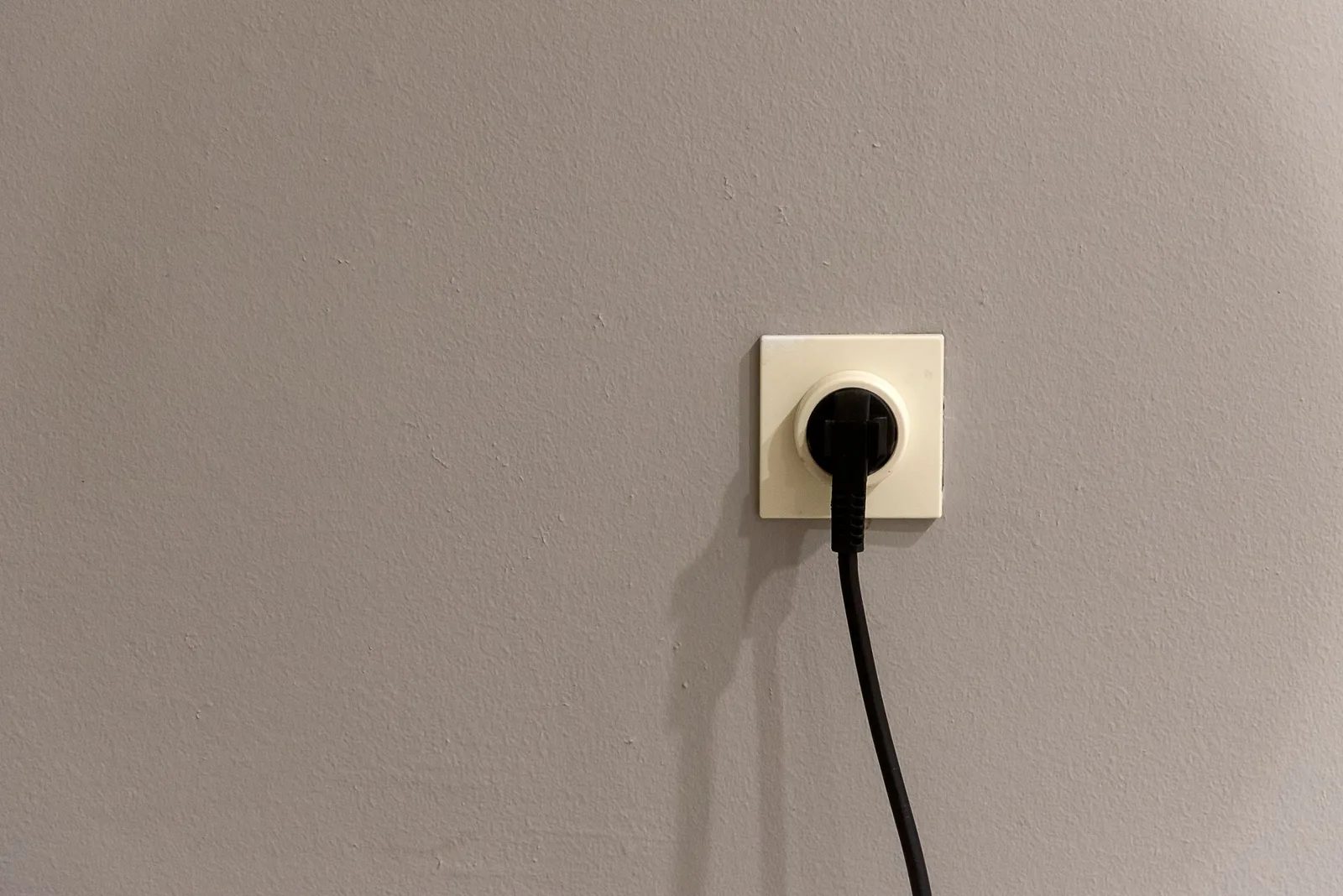
Figure 1. A black plug pushed fully into a white wall socket on a plain grey wall, with its cable hanging straight down. Plug the steamer firmly into the socket with dry hands, check the cable is undamaged, and keep it out of the way of feet and wheels. (Photo: Jan van der Wolf, Pexels, Pexels License)
Warming up
Switch the steamer on for the warm-up time given in the manual, with the nozzle turned away from the couch and from anyone in the room, pointing into open space. When the water first starts to boil, many machines spit a few drops or give uneven, gurgling steam. Only turn the nozzle towards the client once the steam is coming out as a smooth, even, continuous mist.
Preparing the client
Settle the client comfortably on the couch, usually lying flat or slightly reclined, with hair covered by a headband or disposable cap and a towel across the neck and chest.
Remove makeup and cleanse the skin, then pat it dry.
If she wears contact lenses, warm steam can make the eyes feel dry or uncomfortable; many spas ask clients to remove them first and store them in their own case.
Protect the eyes with damp cotton pads or clean eye pads according to your spa's protocol, especially if the machine has an ozone function.
Explain what will happen: "You'll feel warm mist for a few minutes. If it feels too hot or stuffy at any point, just tell me and I'll move it back."
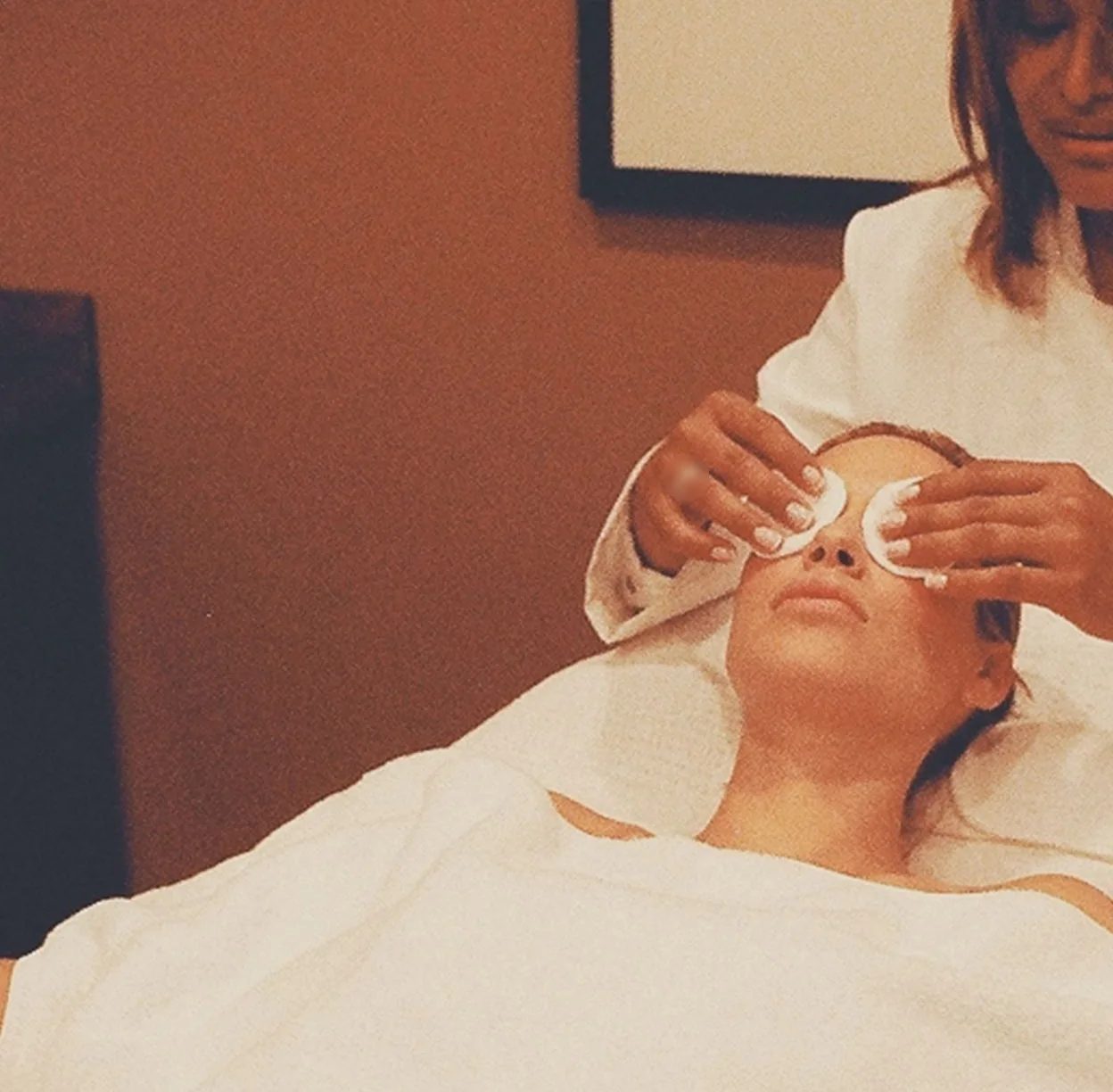
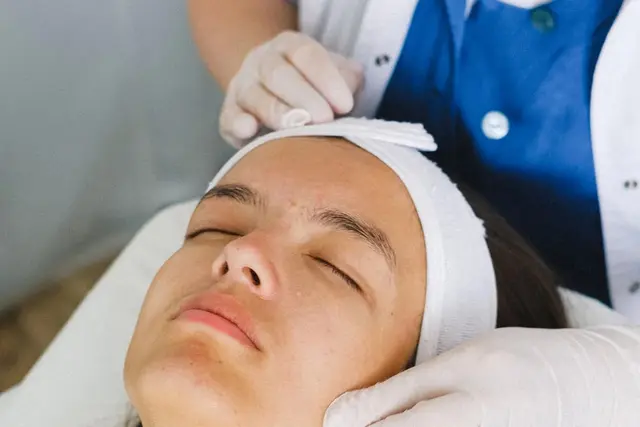
Figure 2. In a warmly lit treatment room, a therapist in a white coat presses a round cotton pad over each of the client's closed eyes. The client lies on a slightly raised couch with her body covered by a white towel and a beige blanket. Covering the eyes and draping the client come before the steamer nozzle is brought near the face. (Photo: Dave Garcia, Pexels, Pexels License; small detail on the therapist's hand blurred)
Distance and steaming time by skin type
General principles
The steam reaching the face should feel pleasantly warm, never hot or stinging. Before you turn it to the client, hold the back of your hand or the inside of your wrist at the place where her face will be for a few seconds.
Angle the nozzle so the mist drifts across the face at a slant, not straight up the nose and into the mouth, which can feel stifling.
Start further away, ask how it feels, then adjust. Look at the skin every minute or so.
Use a timer. Longer is not better.
Reference table: distance and time
The figures below are for reference only. They reflect ranges often given in training material, but steamers differ in power and steam temperature. If your manual says something different, follow the manual.
Skin type or condition | Nozzle-to-face distance (for reference) | Time (for reference) | Notes |
|---|---|---|---|
Oily, congested, blackheads, no inflammation | About 30–40 cm | About 7–10 minutes | Still stop early if the skin becomes very red |
Normal or combination | About 30–40 cm | About 5–8 minutes | You can direct a little more mist towards the T-zone |
Dry or dehydrated | Further, about 40 cm or more | About 3–5 minutes | Or replace with a comfortably warm towel |
Thin, mature or sensitive | Further away | Very short, or skip | Watch closely; many spas skip hot steam |
Rosacea, broken capillaries, inflamed or broken skin | Do not steam | – | See the screening table above |
Signs that you must stop at once
Turn the nozzle away and switch off the steam if the client:
says it is hot or stinging, or her skin turns red quickly or in patches;
feels stuffy or short of breath, coughs or has a scratchy throat, especially with ozone on;
feels dizzy, sick or faint, has a racing heart, sweats heavily or looks pale.
Let her rest in a comfortable position in a well-ventilated room. If the symptoms do not settle quickly, or get worse, inform your manager and get medical help according to your spa's procedure.
Example: two clients, two approaches
Client A has oily skin with blackheads on the nose, no inflamed spots and nothing of note on her health form. The therapist tests the steam on the back of her hand, sets the nozzle at about 35 cm with the mist drifting across the face, sets a timer for 8 minutes, then moves on to extractions.
Client B is in her late fifties, with thin skin and cheeks that flush in the heat, and she takes medicine for blood pressure. The therapist does not use hot steam. Instead she uses a comfortably warm (not hot) towel pressed lightly on the face for a short time, keeps the rest of the facial gentle, and notes "no steam" on the client card.
The ozone switch: on or off?
Many steamers have an ozone lamp. When it is switched on, the machine adds a small amount of ozone gas to the steam. Ozone is often marketed as "antibacterial", but it is also a respiratory irritant: breathing it in can cause coughing, a sore throat or chest tightness, and it is particularly unsuitable for people with asthma or lung disease. You breathe it in too, many times a day.
Follow the manufacturer's instructions on whether, when and for how long to use ozone. Many manuals say to switch ozone on only after the steam is flowing evenly, and to switch it off before the steam.
Never use ozone for clients with asthma, lung disease or breathing difficulties. For pregnant clients, older clients and those with heart conditions, many spas choose not to use it at all.
Keep the room ventilated and do not run ozone for the whole steaming time, or as a matter of habit with every client.
If you are unsure, leave it off. Steaming works perfectly well without ozone.
The steaming procedure step by step
Step 1: Check the machine and warm it up with the nozzle turned away
Do the water, cable and position checks described above, then switch on with the nozzle pointing into open space. Prepare the client while the machine warms up.
Step 2: Test the steam and bring the nozzle into position
Test the mist with the back of your hand at the place where the client's face will be. Only when no drops are coming out, angle the nozzle so the mist drifts across the face at the distance chosen for her skin type. Ask: "How does that warmth feel?" Switch on ozone only if the client is suitable and the manual allows it.
Step 3: Stay with the client the whole time
Never leave the room while the steamer is blowing onto a client's face. Watch her skin, her breathing, her expression and the mist itself. If you need to fetch something, turn the nozzle away first. Stop when the timer goes off.
Step 4: Finish steaming safely
First turn the nozzle away from the client's face, then switch off ozone (if used), then the steam, in the order the manual gives. Never swing the arm or nozzle across the top of the client's face.
Step 5: Move to the next step and record
Blot the skin gently with a clean, soft towel or tissue and carry on with the next stage of the facial, finishing with moisturiser and, for daytime, sun protection as your protocol states. On the client card, record the distance, time, whether ozone was used and how the skin responded.
Preventing steam burns and hot-water spitting
Steam leaving the nozzle is very hot. Burns usually happen when the nozzle is too close, the client turns her face towards the nozzle, or the machine spits hot water.
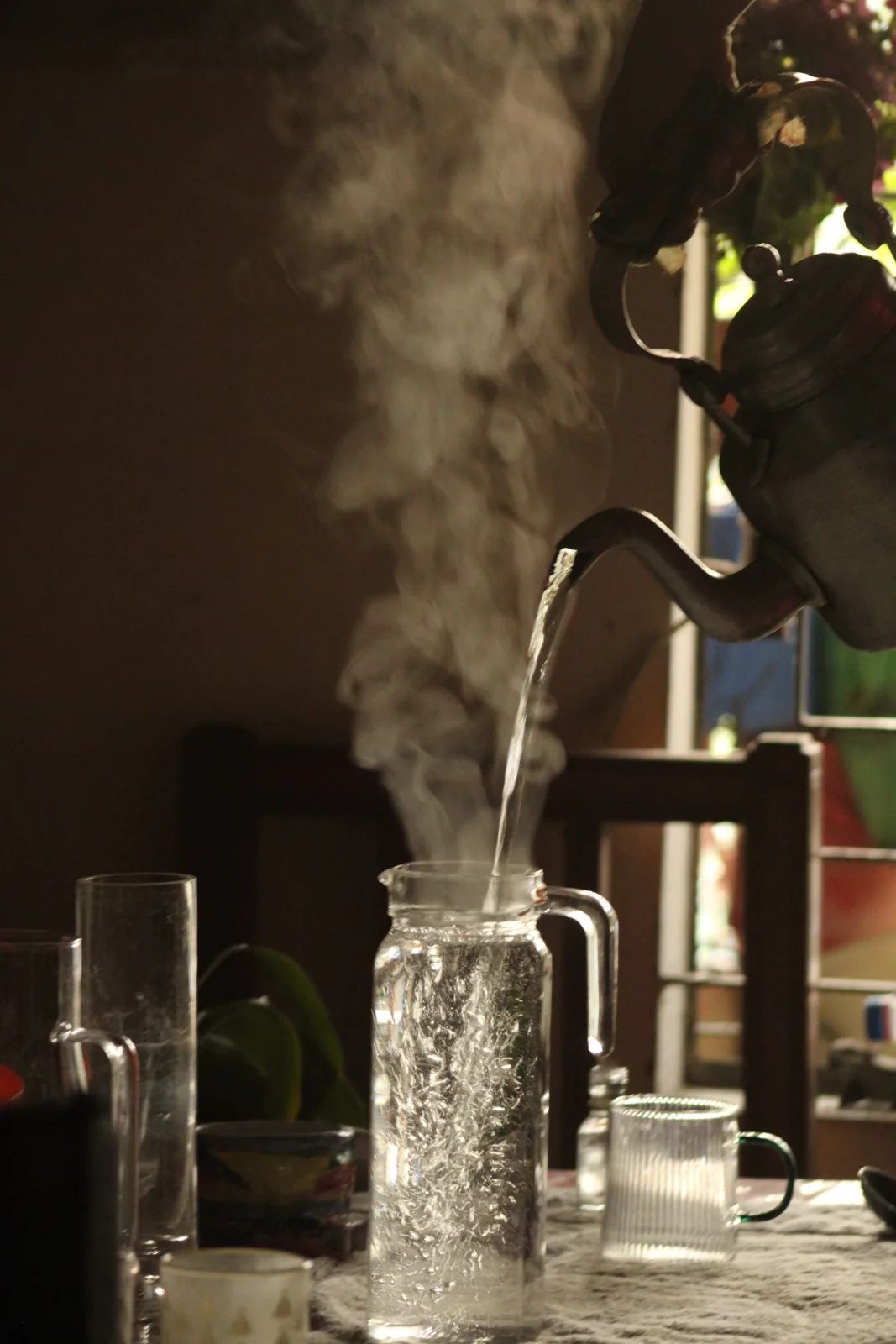
Figure 3. A thick plume of steam rises as just-boiled water is poured from a metal kettle into a clear glass jug on a table. It is not a facial steamer, but your steamer boils water in the same way: steam this hot must never reach the client's skin directly, so warm up with the nozzle turned away and test the mist on your own hand first. (Photo: Jahra Tasfia Reza, Pexels, Pexels License)
Reference table: common problems
Problem | Common causes | What to do and how to prevent it |
|---|---|---|
Nozzle spits drops or jets of hot water | Tank above MAX; nozzle turned to the client before full warm-up; limescale; additives in the water; machine tilted | Turn the nozzle away and switch off. Refill to the correct level with the correct water, warm up fully first, descale as the manual says, stand the machine level |
Weak or uneven steam | Limescale on the element; water too low; not fully warmed up | Check the water level, wait for full warm-up, descale; if no better, report it for servicing |
Burning smell or sharp chemical smell | Tank run dry; descaler not rinsed out; electrical fault | Switch off and unplug at once. Do not use it on clients until it has been checked |
Client feels stuffy or coughs | Mist aimed at the nose and mouth; ozone on; poorly ventilated room | Turn the nozzle away, switch off ozone, ventilate the room; stop steaming if it continues |
If a client is burned by steam or hot water
Turn the nozzle away and switch the machine off immediately.
Cool the area under cool, clean running water, or with cool water as your spa's first-aid procedure describes. Do not put ice directly on the skin.
Do not apply toothpaste, oils, butter or home remedies, and do not burst any blisters.
If the burn blisters, covers more than a small area, is near the eye, or is very painful, advise the client to get medical attention straight away. If hot water or steam has gone into the eye, rinse it with plenty of clean water and get medical help.
Inform your manager and complete an incident record, as your spa requires.
Cleaning and descaling the steamer
At the end of each day
Switch off, unplug, and wait until the machine has completely cooled.
Empty the remaining water as the manual describes. Do not leave water standing in the tank for days.
Wipe the body, arm and nozzle dry with a clean cloth. Do not spray water or cleaning products onto electrical parts, and never immerse the machine in water.
Coil the cable loosely and store the steamer where it cannot be knocked over.
Descaling
Even with distilled water, limescale can slowly build up over time. Descale on the schedule given in the manual.
Use only a descaling solution the manufacturer approves, at the stated dilution and for the stated soaking time.
Do not scrape limescale off with a knife or sharp metal tool; you can scratch or damage the element.
Afterwards, rinse the tank several times with clean water, then run the machine with fresh water and the nozzle turned away before using it on a client. There should be no smell of descaler left.
Write the date in the equipment log.
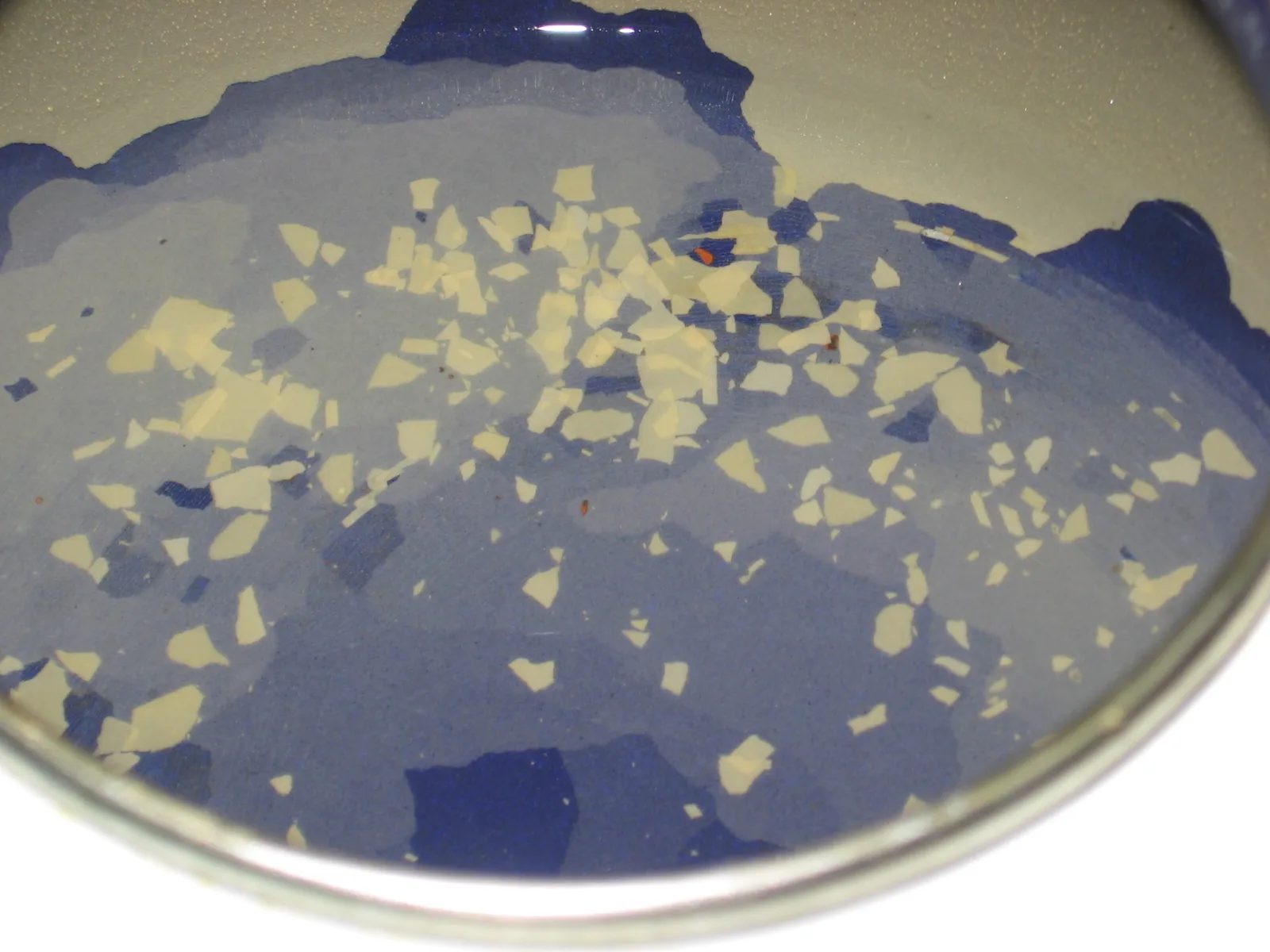
Figure 4. Looking down into a household water kettle: flakes of off-white limescale are scattered over the blue-grey bottom. It is not a facial steamer, but the heating element of a steamer can scale up in the same way when the wrong water is used or descaling is skipped, leading to weaker steam and more spitting. (Photo: Julo, Wikimedia Commons, public domain)
Safety and hygiene checklist
Screening done: flushing, rosacea or broken capillaries, recent peel, laser, IPL or microneedling, sunburn, prescription skin products, asthma, heart condition or blood pressure, pregnancy, contact lenses; answers recorded.
Cable and plug undamaged; plugged into a wall socket with dry hands; base stable and cable out of the walkway.
Correct type of water, between MIN and MAX; nothing added to the tank.
Machine warmed up with the nozzle turned away; even mist with no spitting before it faces the client.
Client's hair covered, skin cleansed, eyes protected, contact lenses out if your protocol requires.
Steam tested on your own hand; distance and time suited to the skin type; timer set.
Ozone used only for suitable clients and according to the manual, with the room ventilated.
Therapist stays in the room throughout; nozzle turned away first when finishing.
Machine emptied, wiped and stored at the end of the day; descaling done on schedule and logged.
Distance, time, ozone use and skin response written on the client card.
Frequently Asked Questions
How long should you steam a client's face?
There is no single figure for every machine and every skin. Many training materials suggest roughly 5–10 minutes for normal and oily skin and less for dry or thin skin (for reference). Follow your steamer's manual and stop early if the skin becomes very red or the client is uncomfortable.
How far away should the facial steamer be?
Many manuals and training materials suggest around 30–40 cm (for reference), and further back for dry, thin or sensitive skin. The most important check is testing the mist on your own hand at the exact place where the client's face will be.
Should I use the ozone setting?
Only for suitable clients and exactly as the manufacturer instructs. Ozone irritates the airways, so never use it for clients with asthma or lung problems, keep the room ventilated and do not switch it on by default for every facial.
What water should go in a facial steamer? Can I add essential oils?
Use the water the manufacturer specifies, usually distilled or demineralised water. Do not add essential oils, herbs or other products to the tank unless the model has a separate pad or tray designed for them.
Why does my facial steamer spit hot water?
The usual causes are a tank filled above MAX, turning the nozzle to the client before the machine has fully warmed up, limescale, additives in the water or a machine standing at an angle. Correct these; if it still spits, stop using it and have it checked.
Can I steam a client who has acne?
Mild congestion such as blackheads is usually fine to steam within the reference times. Strongly inflamed, painful or widespread spots should not be steamed or treated in the spa; suggest the client sees a doctor or dermatologist.
Practice Exercises
Read the manual: Using the manual for your spa's steamer, write down the type of water, the fill level, the warm-up time, the recommended distance, the instructions for ozone and the descaling method and schedule.
Warm-up drill: Under supervision, fill and warm up the steamer with the nozzle facing away. Note how long it takes until the mist is smooth and even and whether it spits at the start. Test the mist on the back of your hand at 30 cm and at 40 cm and describe the difference.
Screening cases: Mark each client "steam normally", "adjust" or "do not steam" and give your reason: (a) oily skin with blackheads, no health issues; (b) cheeks that flush bright red in the heat; (c) laser treatment on the face last week; (d) asthma, wants ozone "because it kills bacteria"; (e) dry, dehydrated skin, no other issues.
Client script: Practise with a colleague explaining in under 30 seconds what steaming does and how to tell you if it gets too hot, without saying "opens the pores" or "detox".