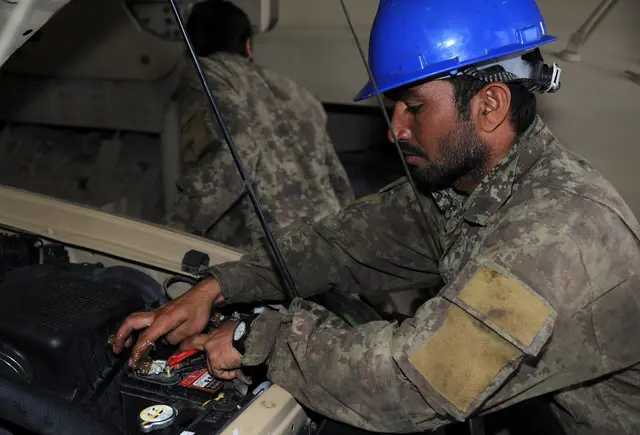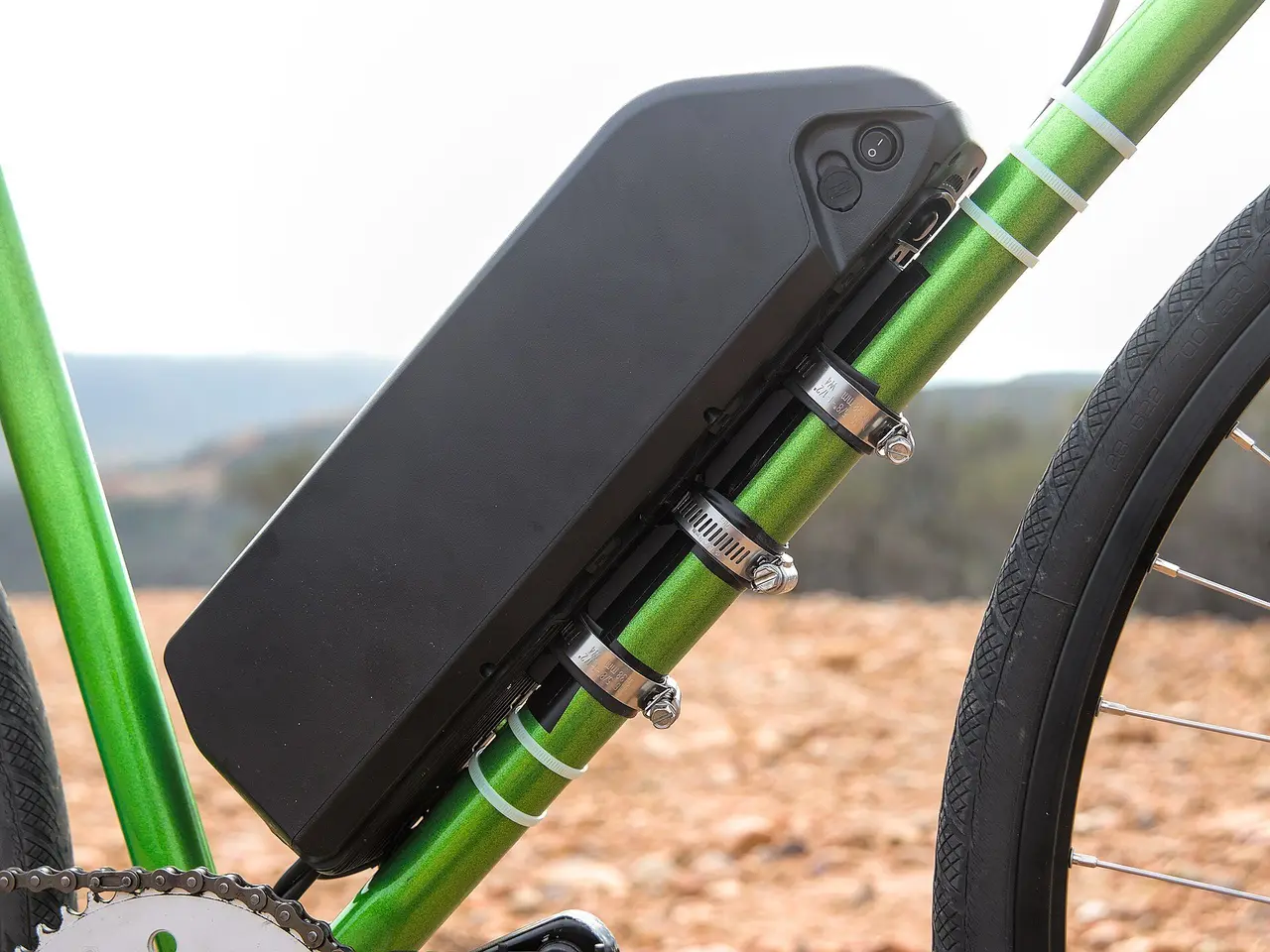
Lithium battery safety on electric scooters and e-bikes starts with one rule: a pack that is swollen, dented, has been flooded or has just taken a hard knock is never charged and never opened; it goes straight to a quarantine spot such as a metal bin with sand, away from anything that can burn. Most e-bike fires start with a battery that is short-circuited, overcharged or left charging overnight while already faulty, and the repair technician is the person who handles the riskiest packs every day. This first lesson of the roadmap covers how to receive and sort batteries, set up a safety corner in a small shop, choose extinguishers, use insulated gloves and tools, and send old lead-acid batteries to the right collection point.
By the end of this lesson, you will be able to:
- Explain why a lithium battery can catch fire on its own (thermal runaway) and spot the six danger signs when a customer brings a bike in.
- Sort incoming batteries into green, amber and red, and know what you may and may not do at each level.
- Lay out a charging area, a quarantine area and a battery bench in a small shop, with the right extinguishers and sand.
- Use gloves, goggles, insulated tools and terminal tape so you never short a 48–72V pack.
- Deal with spilled lead-acid battery acid, then store and hand over old batteries to a licensed collector.
Just starting e-bike repair? Battery safety is step 1 of the 8-step roadmap, before DC electrics, motors and controllers. See the e-bike and e-scooter technician roadmap to learn in the right order.
Why can an e-bike battery catch fire?
Electric scooters and e-bikes in Vietnam use two kinds of battery: lead-acid (heavy blocks, usually four to six 12V batteries in series for 48–72V) and lithium (many small cells built into one pack, much lighter, with a BMS protection board). Lithium packs hold far more energy per kilogram and contain a flammable electrolyte, so a damaged lithium pack is more dangerous than a lead-acid one.
What thermal runaway is
Thermal runaway happens when a lithium cell gets hot enough that its internal reactions produce more heat, the heat speeds up the reactions, and the cell cannot stop itself. The cell swells, vents white or grey smoke with a sweet, acrid smell, then throws out jets of flame. Heat spreads to the next cell, so a pack with dozens of cells can burn for a long time and flare up again even after the outside flames are out.
Four common causes
- Short circuits: a screwdriver or spanner touching both terminals, a bare wire touching the case, water getting into the battery box. The short-circuit current of a 60V pack can turn a steel bar red-hot in seconds.
- Wrong charging: a charger of the wrong voltage, a modified fast charger, or a failed BMS that does not cut off when full.
- Mechanical damage: a fall, an impact, a pack dropped during removal, or a dented case that deforms the cells inside and causes an internal short.
- Flooding and heat: riding through deep water that floods the battery box, or leaving the pack in strong sun or near a heat source.
Comparing the risks: lithium and lead-acid
| Feature | Lithium pack | Lead-acid battery |
|---|---|---|
| Main hazard | Thermal runaway, violent fire, toxic smoke | Corrosive acid, hydrogen gas while charging, toxic lead |
| Danger signs | Swelling, dents, unusual heat, sweet acrid smell, venting smoke | Cracked case, leaking liquid, white-green crust on terminals, bulging case |
| If shorted | The pack may catch fire | Big sparks, burnt wiring, possible hydrogen explosion |
| Collection | Battery collection service, brand dealer | Battery trade-in dealer, licensed hazardous waste collector |
Receiving a bike and sorting batteries: green, amber, red
The most important habit of an e-bike technician is to look at the battery before doing anything else. For every bike that comes in, spend 2–3 minutes checking the battery, write the result in a log book and put a coloured label on it. The log is also your record of the battery's condition when you received it.
Check with eyes, nose and hand
- Ask the customer: has the bike fallen, been through floodwater, been charged with another charger, or had its battery replaced elsewhere?
- Look at the case: swelling, cracks, dents, scorch marks, dried water marks or mud in the seams.
- Smell: a sweet acrid smell or a smell of burnt plastic means a cell has already vented gas.
- Hold the back of your hand near the case (do not press your palm on it at once): a resting pack that feels clearly warm is abnormal.
- Look at plugs and terminals: melted plastic, black burn marks, looseness, salty crust.
Incoming battery sorting table
| Level | Signs | Allowed | Not allowed |
|---|---|---|---|
| Green | Case intact, no smell, normal temperature, never flooded | Measure voltage, charge in the supervised charging area, remove and refit normally | Charging overnight while the shop is closed |
| Amber | Has been flooded or dropped, scorched plug, takes very long to charge | Keep separate, dry the outside, measure each group once you have learned the battery step | Charging straight away, opening the pack without supervision |
| Red | Swollen, dented, unusually hot, smelling, smoking, leaking | Move to the outdoor quarantine area, tell the senior technician and the customer | Charging, opening, piercing, crushing, storing indoors |
Log book and labels
Each battery gets one line in the log: date received, number plate or customer name, battery type, nominal voltage, green/amber/red level, and who checked it. Stick the coloured label on the case. Apprentices only work on green batteries; amber and red ones need a decision from the senior technician.
Setting up a battery safety corner in the shop
A small e-bike shop in Vietnam is often the front room of a narrow tube house 4–5 m wide, with the family living behind and above. So where you put batteries and chargers must take the whole family's escape route into account, not just the shop's.
Charging area
- Near the door to outside, never blocking the exit, never under the stairs.
- At least 1–2 m from anything flammable (cardboard, foam, petrol cans, oily rags); concrete or tiled floor, no mats.
- A dedicated socket protected by an RCD (earth-leakage breaker), no daisy-chained power strips, no coiled extension leads under load.
- A smoke alarm above it and an extinguisher within 2–3 steps.
- No charging when the shop is closed and nobody is watching.
Quarantine area for faulty batteries
Red batteries go outdoors or on a ventilated porch, in a metal bin with a loosely fitted lid and dry sand underneath and around them. Keep the bin away from wooden walls, foam-backed metal roofing and other vehicles. Sand buckets like those in Figure 2 can smother a small smoking battery and also soak up spilled oil or acid.
Battery bench
Cover the bench with an insulating rubber mat and keep loose screws and metal filings off it. Put removed screws in a separate tray, never on top of the battery lid.
Extinguishers, sand and what to do when a battery smokes
No extinguisher will completely put out a lithium pack in thermal runaway, because the reaction is happening inside the cells. Your goals are to knock down flames on surrounding materials, cool things down, isolate the battery and get people away.
Choosing extinguishers and supplies
Small shops usually have a dry powder extinguisher (for many kinds of fire, including solids, liquids and electrical) and a CO2 extinguisher (clean, good for electrical equipment), like the two in Figure 1. Large amounts of water help cool a pack once the fire brigade has the fire under control; a technician should never spray water at a live socket. Dry sand is for covering and isolating small batteries. Ask your local fire police (the fire prevention and rescue authority in Vietnam) what type and number of extinguishers suit your shop's size.
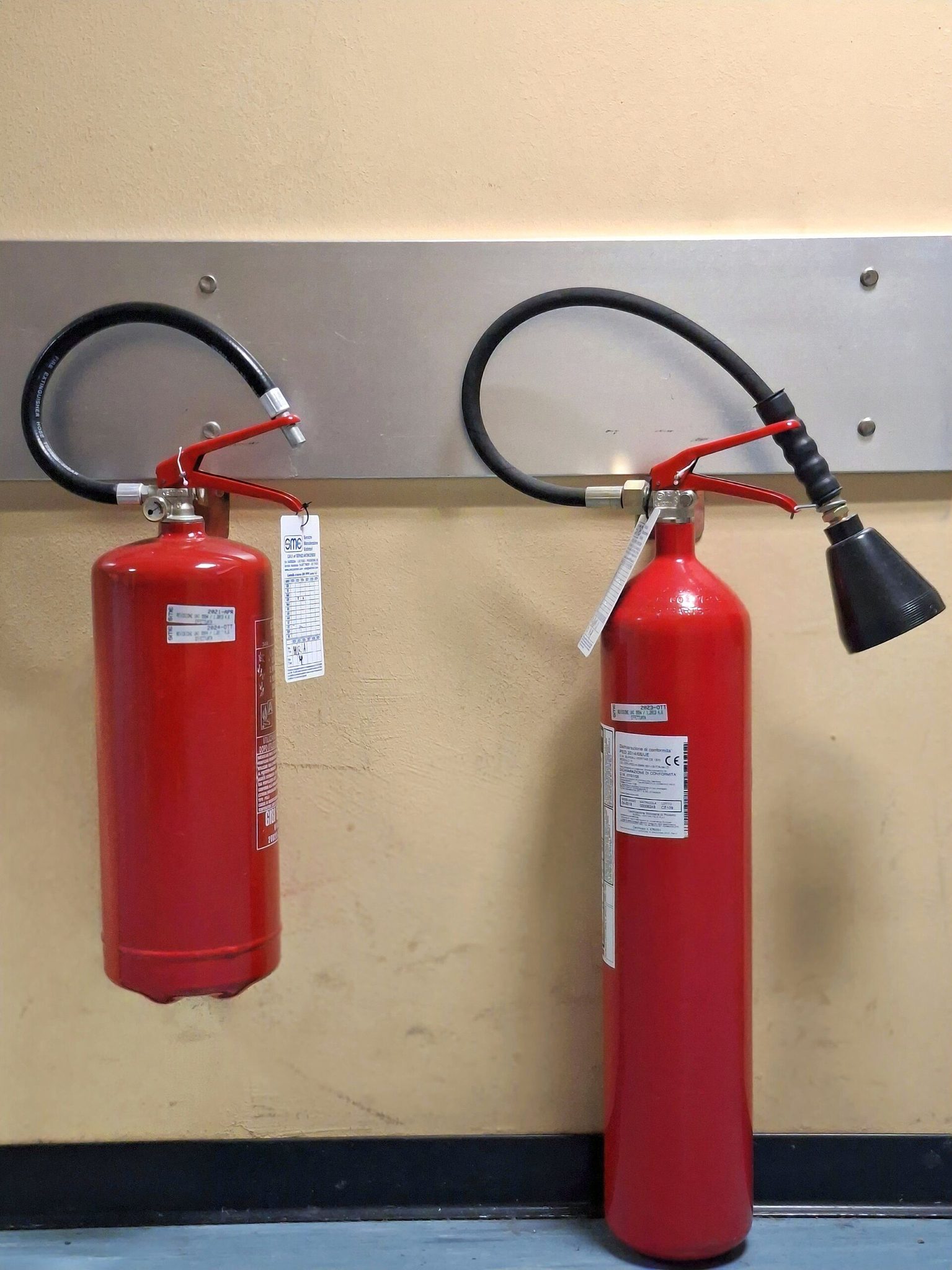
Photo: Anna.Massini / Wikimedia Commons, CC BY 4.0
Five steps when a battery starts smoking
- Shout a warning and get everyone out of the shop and the house, especially people upstairs.
- Cut the power to the charger or the charging-area breaker if you can do it without walking through smoke.
- Call 114 (the fire emergency number in Vietnam) if there are flames, thick smoke or a large pack; say clearly that it is an e-bike battery fire.
- Only if the fire is small and your way out is clear: use the extinguisher on burning materials around it, stand upwind, 2–3 m away. Do not lean in to sniff it, and do not push a burning bike with bare hands.
- After the flames are out, the pack can still flare up again: leave it outdoors, cover it with sand, watch it for at least a few hours, and hand it to the authorities or a collection service.
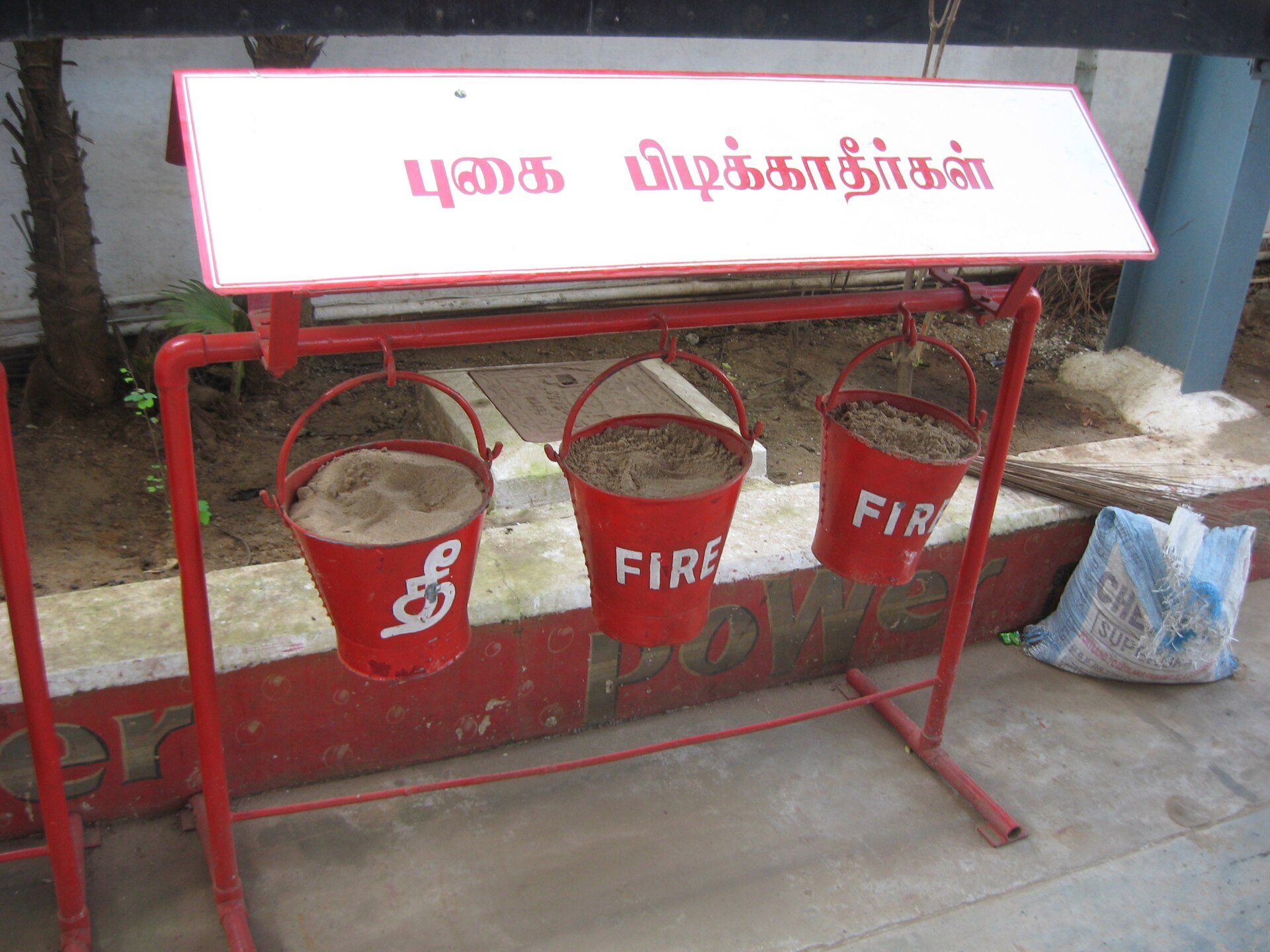
Photo: Tracy Hunter / Wikimedia Commons, CC BY 2.0
After an incident
Open the doors and let the smoke clear before going back in. Lithium battery smoke contains toxic and irritating gases; anyone who coughs a lot, feels short of breath or dizzy must get to fresh air and see a doctor, and severe breathing difficulty means calling 115 (ambulance). Record what happened and replace any extinguisher you used.
Protective equipment and insulated tools
A 48–72V DC e-bike pack is not "high voltage", but its short-circuit current is huge. The main danger is not electric shock but an arc that burns your hand, melts tools and sets the pack on fire.
Gloves and goggles
- Low-voltage insulating gloves: wear them when unplugging or connecting the main power plug and when measuring pack voltage. Check for holes by rolling the cuff to trap air and squeezing.
- Chemical-resistant gloves (thick nitrile): for wiping battery acid or liquid leaking from a pack.
- Safety goggles with side shields: required when working on lead-acid batteries and when removing a battery box cover.
Insulated tools and tape
Use screwdrivers and pliers with fully moulded insulated shafts and handles (Figure 3), not bare steel tools or tools wrapped in tape as a quick fix. Before removing anything, put insulating tape on each exposed terminal; remove the negative terminal first and refit it last. A spanner dropped across two terminals is enough to cause an arc.
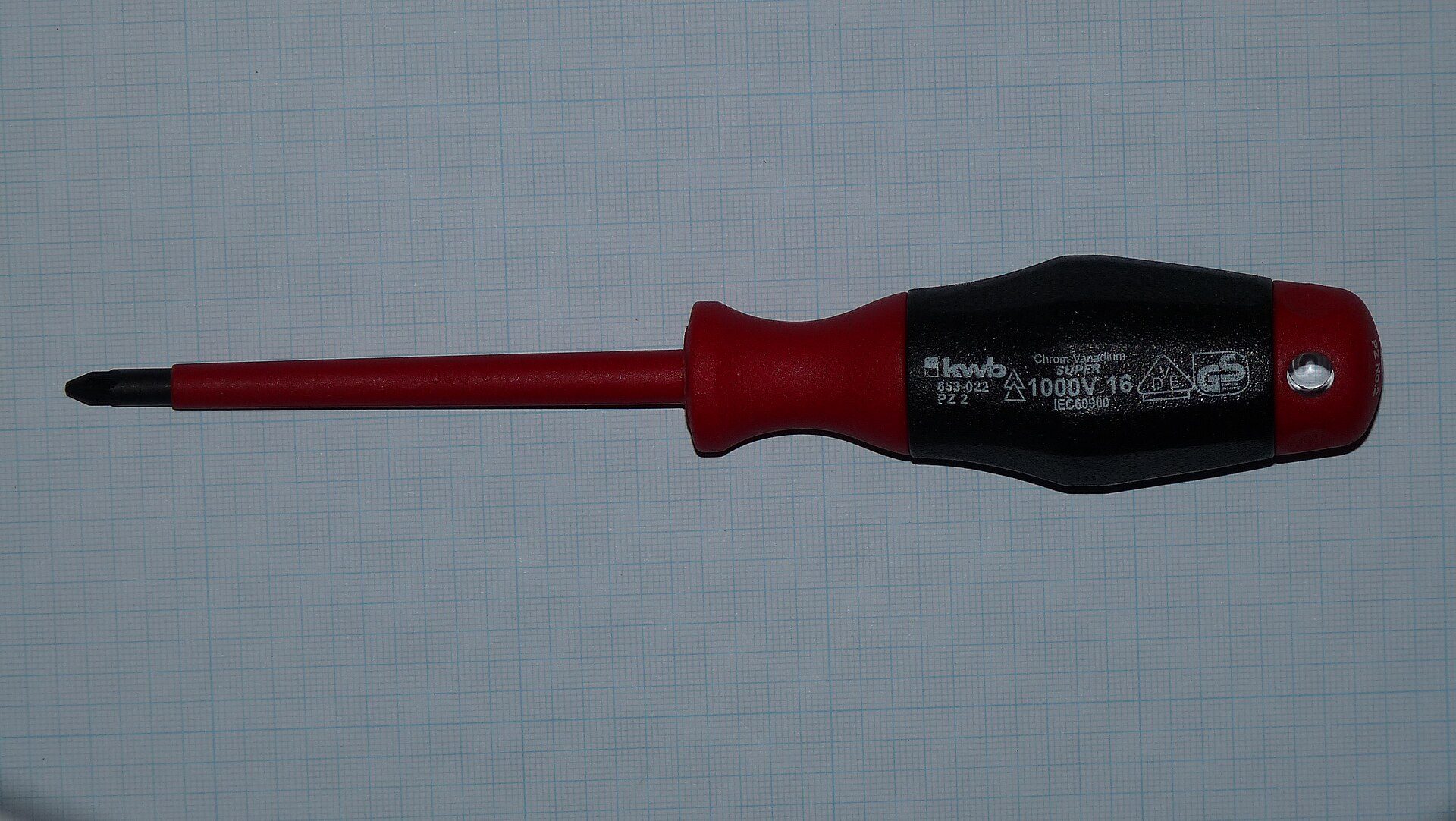
Photo: Dmitry G / Wikimedia Commons, CC BY-SA 3.0
Three anti-short habits
- Take off rings, metal watches and chains before working on batteries.
- Only one terminal is exposed at a time; the other always has tape or a cover on it.
- Turn off the ignition and unplug the main power connector before removing the controller or cutting and joining wires.
Lead-acid batteries: acid, hydrogen and collection
Many low-cost e-bikes and electric scooters still use lead-acid batteries. Their risks differ from lithium: sulphuric acid burns skin and eyes, hydrogen given off while charging can explode if it meets a spark, and the lead inside is a toxic metal.
Acid spills
Put on chemical gloves and goggles before touching a leaking battery. Sprinkle a neutraliser such as baking soda (sodium bicarbonate) on the acid until it stops fizzing, soak it up with sand or rags, and put it in a separate bag marked as acid waste. Do not wash it down the drain. Acid on skin: rinse with plenty of clean water for several minutes; acid in the eyes: rinse with running water for at least 15 minutes and see a doctor immediately.
Hydrogen while charging
Charge lead-acid batteries in a ventilated place, with no smoking, grinding or welding nearby. When connecting the clamps, plug the charger into the mains last; when disconnecting, unplug it first and remove the clamps afterwards, so no spark happens right at the battery vents.
Storing and handing over old batteries
Old lead-acid batteries and used lithium packs count as hazardous waste under Vietnam's environmental protection rules; do not sell them to people who smash the cases for the lead, and do not put them in general rubbish. Store old lead-acid batteries upright on a pallet or a plastic spill tray, terminals taped, as in Figure 4. Hand them to a battery trade-in dealer or a licensed collector and keep the handover slip. Detailed rules on storage and registering as a waste generator can change: ask your local natural resources and environment office and read the current regulations.
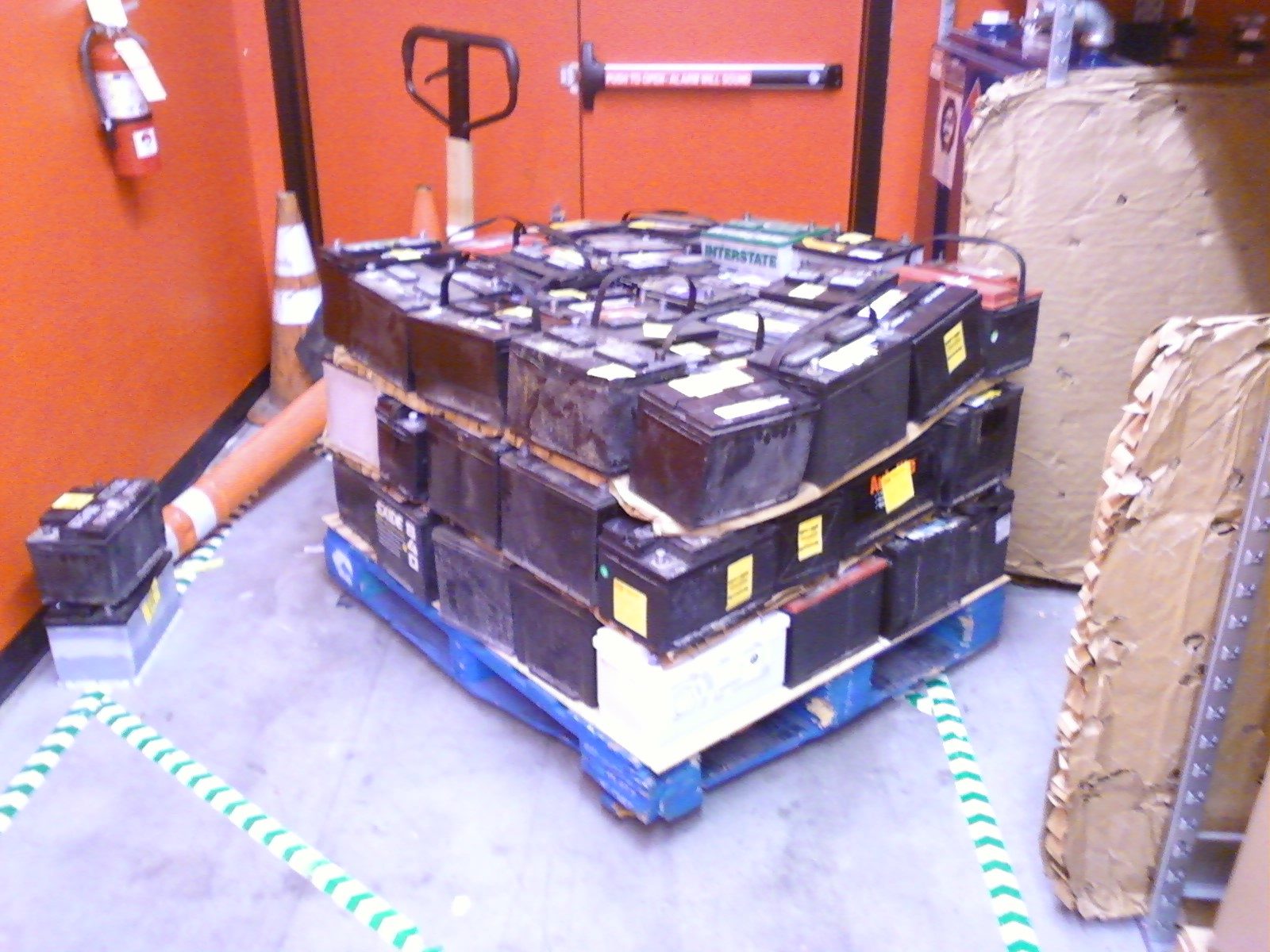
Photo: Lack Thereof at English Wikipedia / Wikimedia Commons, CC0
Safety warning: Never charge, open, crush or pierce a lithium pack that is swollen, dented, hot, smelling or has been flooded; move it straight to an outdoor quarantine area with sand. Never charge a faulty or unchecked pack overnight, not even "just to test it". Always wear goggles on lead-acid batteries, insulating gloves when connecting power, use insulated tools and remove metal jewellery. When a battery smokes: get people out, cut the power if it is safe, call 114; call 115 if anyone has trouble breathing from the smoke. Apprentices do not open lithium packs on their own until they have studied the lithium and BMS step and have a senior technician alongside.
Advising customers on safe charging at handover
Customers trust their technician most on battery questions. Every time you hand a bike back, spend one minute on the five points below. For charging habits that make a battery last longer, see the lesson e-bike and e-scooter battery wear: test, repair or replace.
Five short tips
- Use the right charger for the bike, never a modified or unknown fast charger.
- Do not charge in the only exit, under the stairs or in a shared corridor; do not charge after the whole family has gone to sleep.
- Unplug when full; charge when the pack has cooled down, not straight after a long ride in the sun.
- After riding through floodwater or a hard fall: do not charge, bring the bike to the shop.
- A swollen pack, a strange smell or unusual heat while charging: stop using it and bring it in.
Write it on the handover slip
If an amber or red battery goes home with the customer anyway, write its condition and the advice you gave on the slip and ask the customer to sign.
Worked example: a battery safety corner for a 30 m² shop
Mr Hung opens an e-bike repair shop in the front of a tube house measuring 4 × 7.5 m = 30 m², with his family living upstairs. The shop takes in about 6–10 bikes a day and often charges 2–3 packs at once. This is how he sets up his safety corner.
Layout
- Charging area: the left corner next to the roller shutter, 4 m from the stairs, with one socket on an RCD and a smoke alarm above.
- Quarantine area: a metal bin with sand out on the porch to the right, about 3 m from the charging area.
- Extinguishers: one powder unit by the charging area, one powder and one CO2 unit near the battery bench in the middle of the shop.
- Battery bench: insulating rubber mat, screw tray, insulated tools.
Equipment cost (2026 reference prices, varying by region and product)
| Item | Quantity × unit price | Amount |
|---|---|---|
| Dry powder extinguisher, 4 kg | 2 × 300,000 VND | 600,000 VND |
| CO2 extinguisher, 3 kg | 1 × 650,000 VND | 650,000 VND |
| Metal bin with lid + dry sand | 1 × 500,000 VND | 500,000 VND |
| Sand bucket + small shovel | 2 × 100,000 VND | 200,000 VND |
| Low-voltage insulating gloves | 1 pair × 350,000 VND | 350,000 VND |
| Safety goggles | 2 × 60,000 VND | 120,000 VND |
| Insulated screwdriver and pliers set | 1 × 450,000 VND | 450,000 VND |
| Insulating tape, colour labels, log book | 1 × 100,000 VND | 100,000 VND |
| Standalone smoke alarm | 2 × 250,000 VND | 500,000 VND |
| Charging socket on an RCD (materials) | 1 × 800,000 VND | 800,000 VND |
| Total | 4,270,000 VND | |
Check: 600,000 + 650,000 + 500,000 + 200,000 + 350,000 + 120,000 + 450,000 + 100,000 + 500,000 + 800,000 = 4,270,000 VND (about 165 USD). The wiring and the RCD must be installed by a qualified electrician. The total is small compared with the price of a replacement lithium pack, let alone the damage from a house fire.
Common beginner mistakes
Test-charging a faulty pack "just to see"
Sign: the customer says the battery is weak and the technician plugs it in straight away to see if it charges. Cause: no habit of sorting batteries first. Fix: always do the eyes-nose-hand check and label the pack before charging; amber and red packs are not charged.
Leaving tools on top of the battery
Sign: spanners and screwdrivers parked on an open battery box. Cause: a cramped bench, no tray. Fix: a separate tool tray, tape the terminals before opening, clear the bench before battery work.
Storing dead batteries with spare parts
Sign: removed batteries piled up in a storeroom corner next to cardboard boxes and oil cans. Cause: thinking a "flat" battery is safe. Fix: a used battery still holds energy; tape the terminals, keep it in the quarantine area and send batteries for collection regularly.
Frequently asked questions
Is it dangerous to charge an e-bike overnight?
With a healthy pack, the correct charger and a working BMS the risk is low, but not zero. A faulty pack, a flooded pack or the wrong charger raises the risk a lot, and at night nobody notices early. The safe advice is to charge while someone is awake, somewhere that does not block the exit, and never to charge a faulty pack overnight.
Can I keep using a swollen e-bike battery?
No. Swelling means the cells have produced gas inside; further charging or discharging can lead to thermal runaway. Stop using it, move it to quarantine and let a qualified technician decide whether to replace cells or the whole pack.
What puts out a lithium battery fire?
Powder and CO2 extinguishers knock down flames on surrounding materials; dry sand can cover a small pack; large amounts of water help cool it. A pack in thermal runaway can reignite, so the priority is getting people away and calling 114. Ask the local fire authority what equipment your shop needs.
Where can I take old e-bike batteries?
Take them to a battery dealer with a trade-in scheme or to a licensed hazardous waste collector. Do not break the case open, and do not pour acid onto the ground or into drains.
Practice tasks and self-assessment
- Draw a floor plan of the shop where you are learning (or your home) and mark the charging area, quarantine area, extinguishers and exits.
- Check five different bike batteries using the eyes-nose-hand sequence, log them and label them green, amber or red.
- Read the instructions on the extinguisher where you work, check the pressure gauge and the inspection date.
- Practise unplugging and reconnecting the main power plug on a bike with a green battery: ignition off, terminals taped, insulated tools, gloves on.
Self-assessment criteria
- Pass: you can name the six danger signs and what must never be done with a red battery.
- Pass: your plan has a charging area that does not block the exit, an extinguisher within 2–3 steps and an outdoor quarantine area.
- Pass: you unplug and reconnect the main power without two terminals ever exposed at once, and without metal jewellery.
- Not yet: you charge an unsorted battery, leave tools on the battery lid, or do not know where the extinguisher is.
As you work on more bikes you will meet "bike won't move" cases caused by the battery, plugs or fuses; the lesson e-bike won't move: check battery, fuse, throttle, brake, controller gives a safe checking order for them. With safety in hand, move on to the next step of the roadmap: DC electrics & e-scooter layout, where you learn voltage, current, measuring with a multimeter and how power flows from the battery to the motor.
Keep learning e-bike repair: after battery safety come DC electrics, BLDC motors, controllers, lithium packs and BMS boards, brakes, tyres and brand diagnostics. See the 8-step e-bike and e-scooter technician roadmap.