In Vietnam, a commercial truck driver may not drive continuously for more than 4 hours, and total driving time may not exceed 10 hours a day or 48 hours a week, under the 2024 Law on Road Traffic Order and Safety; the journey tracking device on the truck records these numbers. These are legal maximums, not a "safe" level for your body: a driver short on sleep can nod off in the second hour. This lesson follows the licence-class step and shows you how to plan a trip within the hours, what the tracker and camera record, and how to stay healthy enough to do this job for years. The details (what counts as a valid break, how a "day" is counted, which vehicles must carry a driver camera) sit in implementing regulations and may change, so check the current rules and ask your transport company.
By the end of this lesson, you will be able to:
- State the three driving-time limits (continuous, daily, weekly) and add up the driving time of a trip yourself.
- Plan a night trip of about 450 km with rest stops, every leg under 4 hours and the total under 10 hours.
- Log in to the journey tracking device, read its warnings and explain why you must never cover the camera or cut the power.
- Prepare your driver health certificate, track blood pressure and weight, and recognise dangerous signs of drowsiness.
- Do 5 exercises against back and neck pain at a rest stop in about 5 minutes.
Learning to be a truck driver? Driving hours, tracking devices and health are step 2 of the roadmap, right after licence classes and traffic law. See the 8-step truck driver roadmap to learn in the right order.
Driving-time limits for truck drivers
In What can a class C licence drive in Vietnam? Truck classes C and C1, you learned which licence class you need. Once you hold it, the next question when you take a job is: how long may you drive? For drivers of commercial vehicles, the law sets three ceilings at the same time, and you must stay under all three.
Three numbers to memorise
| Limit | Maximum (2024 law) | What it means in practice |
|---|---|---|
| Continuous driving | No more than 4 hours | After at most 4 hours at the wheel you must stop and rest before driving again |
| Driving time per day | No more than 10 hours | Add up every driving leg of the day; rest time does not count |
| Driving time per week | No more than 48 hours | Six days in a row at almost 10 hours a day breaks the weekly limit |
The table summarises the general principle. The minimum rest between two continuous driving periods, how "one day" is counted (calendar day or 24 hours from the start of work), and how the rules apply when two drivers share a truck are all set by implementing regulations. Ask your company's dispatch office, because they have to configure these thresholds in the tracking software.
Driving time versus working time
Driving time is when you are actually at the wheel. Working time is wider: it also covers pre-trip checks, waiting for loading and doing delivery paperwork. A day with 8 hours of driving and another 4 hours waiting at a warehouse means 12 hours on the job. Traffic law limits driving time, while working hours and overtime also fall under labour law. When comparing job offers, ask how the company pays for and gives rest after waiting time.
Why the limit is 4 hours and not longer
Long-haul truck driving is monotonous: straight roads, a steady engine note, a warm cab. After a few hours, concentration and reaction time drop, often without the driver noticing. Four hours is what the law accepts; many experienced drivers split their legs into 2 to 3 hours, especially at night. Stopping a few minutes early costs far less than one moment of falling asleep.

Photo: Shashidhara halady / Wikimedia Commons, CC BY-SA 4.0
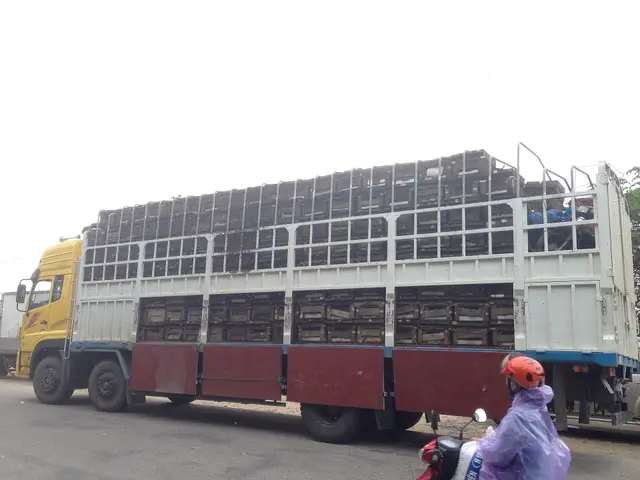
Parking big enough for trucks (Figure 1) is not available everywhere. In Vietnam, drivers usually stop at expressway service areas, petrol stations with large yards, or familiar rice shops along national highways. Mark these spots on your own map, about 2 to 3 hours of driving apart.
What do the tracking device and camera record?
The journey tracking device (drivers often call it the "black box" or "GPS") is fixed to the vehicle. It records position, speed and driving time and sends the data to the provider's server and on to the authorities. Commercial vehicles in Vietnam must have one. Many vehicle types must also carry a camera that records the driver; the list of vehicles that need it was widened under the new law, so check the current rules or ask your company whether your truck is included.
What the black box records
- Journey: position, route travelled and distance.
- Speed: speed over time and every time you exceeded the limit for that stretch of road.
- Driving time: how long you drove continuously and total driving hours in the day for each driver.
- Stops: number, time and length of every stop.
- Driver: who is at the wheel, through a card login or whatever identification the device uses.
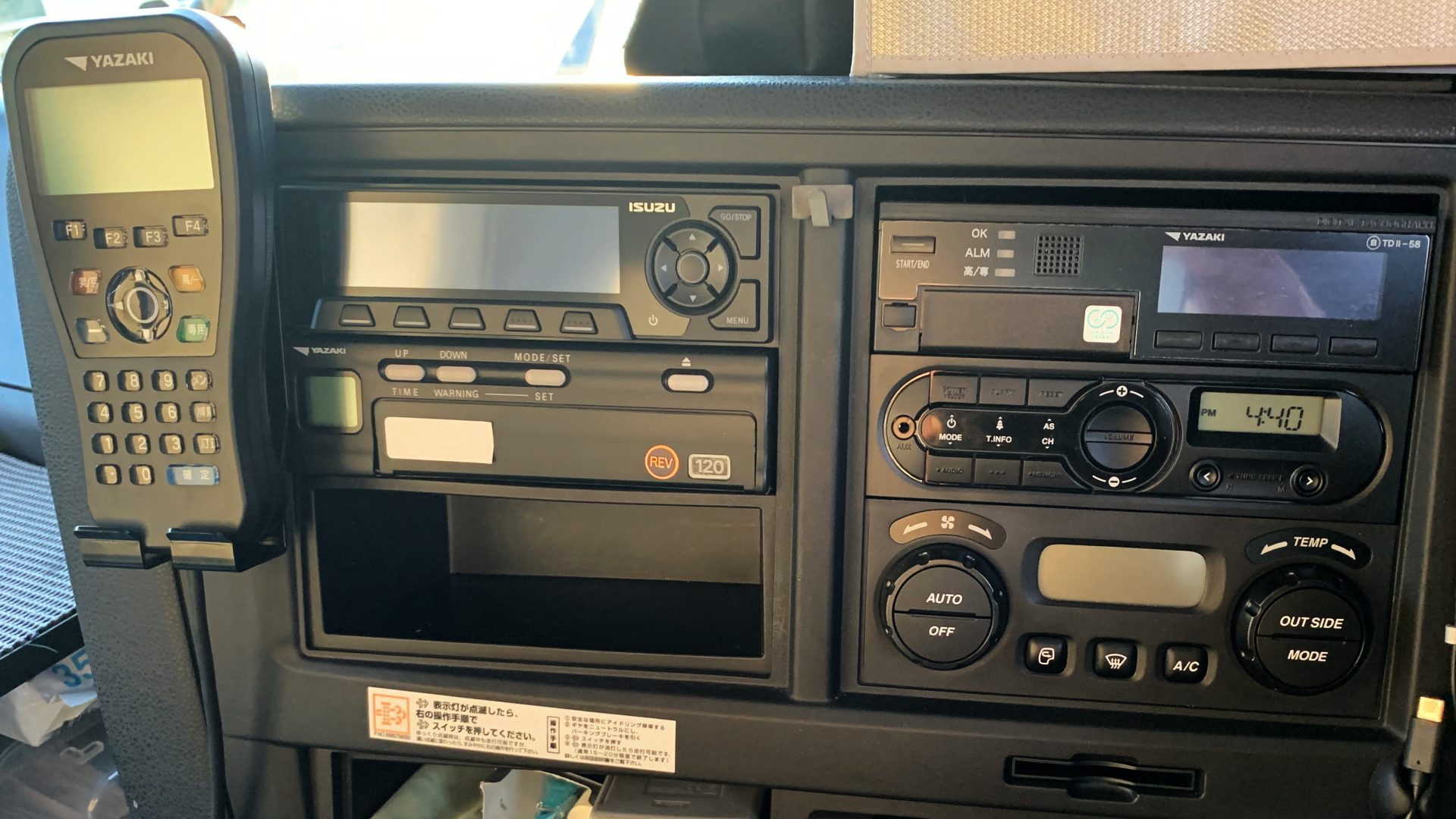
Photo: Project Kei / Wikimedia Commons, CC BY-SA 4.0
Logging in and out correctly
Driving time is recorded against whoever is logged in. If two drivers swap and forget to change the login, all the hours pile onto one person, the software flags an over-hours violation and your record shows a fault even though you actually rested. The right habit (see Figure 2 to recognise the reader):
- Before moving off: log in, and check the screen or listen for the beep to confirm the device recognised you.
- Check the GPS and connection lights; report to dispatch straight away if the device shows an error.
- When swapping drivers: the outgoing driver logs out, the incoming driver logs in, then you drive.
- End of shift: log out and record the finish time in the logbook or app if the company asks.
The in-cab camera and privacy
A camera facing the driver records phone use, smoking, dozing and not wearing a seatbelt. Some systems also sound an alert when they detect your eyes closing for too long or looking down. The cab is where you eat and sleep on long runs, so ask the company what the camera records, who can view it and how long it is kept. But you must not cover, turn or disconnect the camera yourself.
Warning: Cutting the power, covering the antenna, using a jammer, swiping someone else's card or covering the camera to hide driving time or speed breaks the law, and both the driver and the vehicle owner can be penalised. More importantly, faking your hours means you are driving when your body is already too tired. If the device is faulty, report it to dispatch and follow company instructions; do not repair it yourself.
Planning a night trip: a worked example
Tuan takes a night load from a warehouse in Binh Duong to Nha Trang. The planned distance is 456 km, and the average speed for the whole journey (including towns and climbs) is estimated at 48 km/h. He leaves at 20:00 and the customer needs the goods before 7:00. He plans the schedule below before setting off, instead of waiting until he is sleepy to look for a place to stop.
The schedule
| Part | Time | Activity | Duration | Distance |
|---|---|---|---|---|
| Leg 1 | 20:00–23:30 | Driving | 3 h 30 min | 168 km |
| Break 1 | 23:30–00:00 | Light meal, walk, stretch | 30 min | 0 |
| Leg 2 | 00:00–03:45 | Driving | 3 h 45 min | 180 km |
| Break 2 | 03:45–04:30 | 20-minute nap, wash face, move around | 45 min | 0 |
| Leg 3 | 04:30–06:45 | Driving | 2 h 15 min | 108 km |
Checking the numbers
- Distance: 168 + 180 + 108 = 456 km. Each leg: 3.5 × 48 = 168; 3.75 × 48 = 180; 2.25 × 48 = 108.
- Longest continuous drive: leg 2, 3 h 45 min, under 4 hours.
- Total driving: 3 h 30 + 3 h 45 + 2 h 15 = 9 h 30 min, under 10 hours.
- Total trip time: 9 h 30 driving + 1 h 15 rest (30 + 45 min) = 10 h 45 min, exactly from 20:00 to 06:45.
Checking the week
If Tuan does 5 trips like this in a week: 5 × 9 h 30 = 47 h 30 min, just under 48 hours. If dispatch adds a short run with 2 hours of driving at the weekend, the total becomes 49 h 30 min, over the weekly limit. He must then ask for another driver to take it rather than accept it to "make up the trips". Real driving time is usually longer than planned because of traffic and lights; leave 15 to 30 minutes of slack per leg instead of planning right up to 4 hours.
Leg 2 runs through roughly 2 to 5 a.m., when the body clock makes people sleepiest. That is why the plan puts the longest break right after this leg and includes a short nap.
Eating, sleeping and fighting drowsiness on night runs
Falling asleep at the wheel is the long-haul driver's worst enemy. Coffee, energy drinks, loud music or an open window only keep you alert for a short time; they cannot replace sleep.
Sleep before the trip
- Adults usually need about 7 to 9 hours of sleep a day (general guidance). On night runs, sleep during the day in a dark, quiet room with phone notifications off.
- Before a night run, take an extra 1 to 2 hour afternoon nap if you can.
- Avoid a pattern of "loading by day, driving by night" for many days in a row; your body cannot catch up.
Signs of drowsiness that mean stop now
Constant yawning, heavy eyelids, not remembering the last few kilometres, drifting out of the lane, missing signs or turnings, your head nodding and jerking up. At the first sign, find a safe place, stop and switch on the hazard lights. A nap of about 15 to 20 minutes improves alertness without leaving you groggy for long. Some drivers drink a coffee just before napping; coffee usually starts working after about 20 to 30 minutes, just as you wake. If you are still sleepy after resting, sleep properly and tell dispatch the delivery will be late.
Eating on the road
- Eat a moderate night meal, favouring rice, vegetables and boiled meat or fish; avoid a very heavy or greasy meal right before a driving leg, as it makes you drowsy.
- Carry plain water and drink steadily through the shift. Not drinking to avoid toilet stops causes fatigue and harms the kidneys over time.
- Limit energy drinks and cigarettes; never use stimulants to drive longer.
- No alcohol before or during a trip. After a drinking session the night before, your breath can still contain alcohol in the morning.
Safety warning: Do not drive when sleepy, exhausted, feverish or after taking medicine that causes drowsiness (some cold medicines, allergy medicines and sedatives). Read the leaflet or ask a pharmacist before taking anything on a driving day. Skipping a run is better than causing a crash: a heavy truck out of control can take many lives.
Driving posture and exercises against back pain
Back, neck and shoulder pain are common occupational problems for drivers: sitting in one position for hours, constant vibration and lifting goods when helping to load. Prevention starts with how you sit, then exercise.
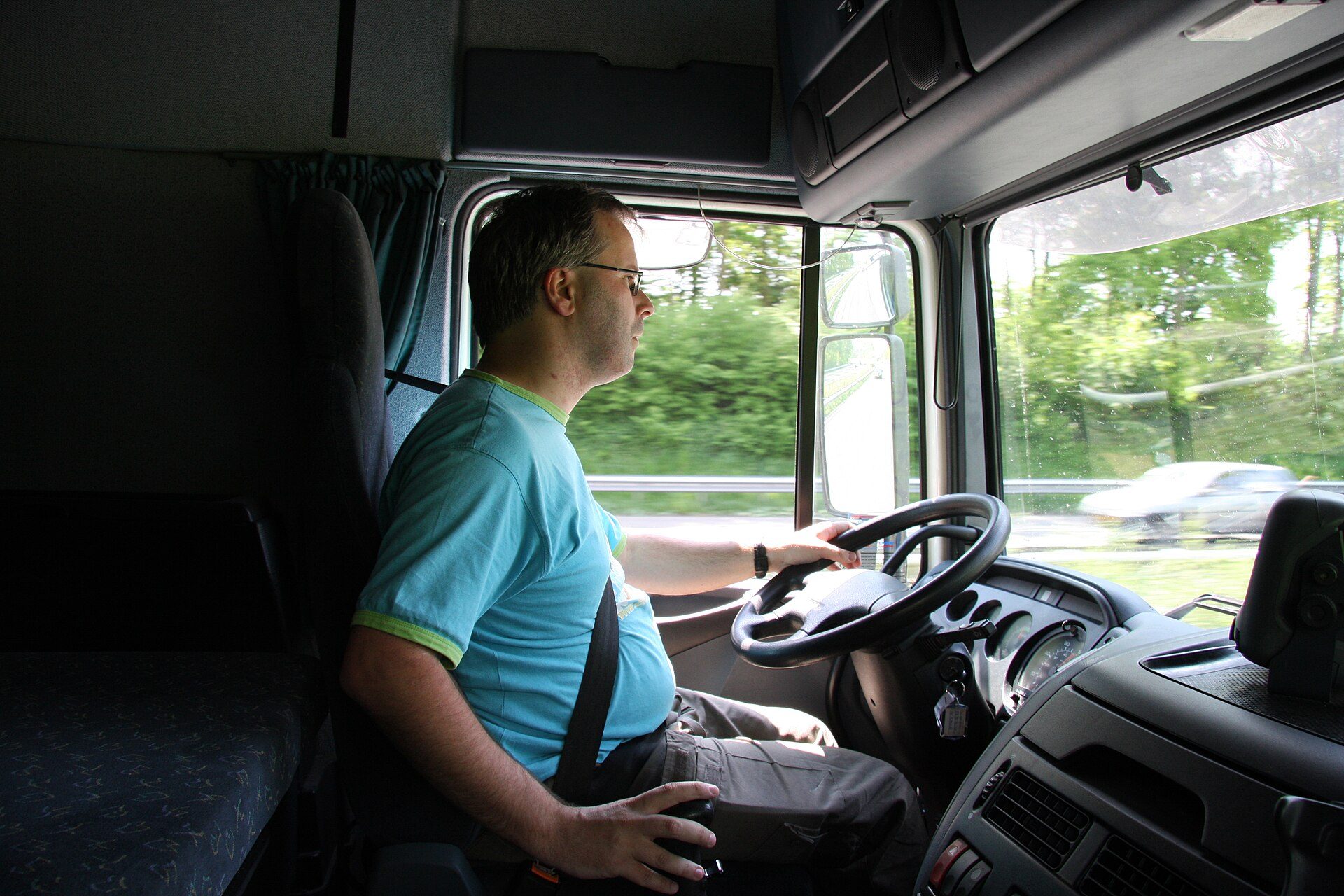
Photo: Veronica538 / Wikimedia Commons, CC BY-SA 3.0
Adjust the seat before you drive
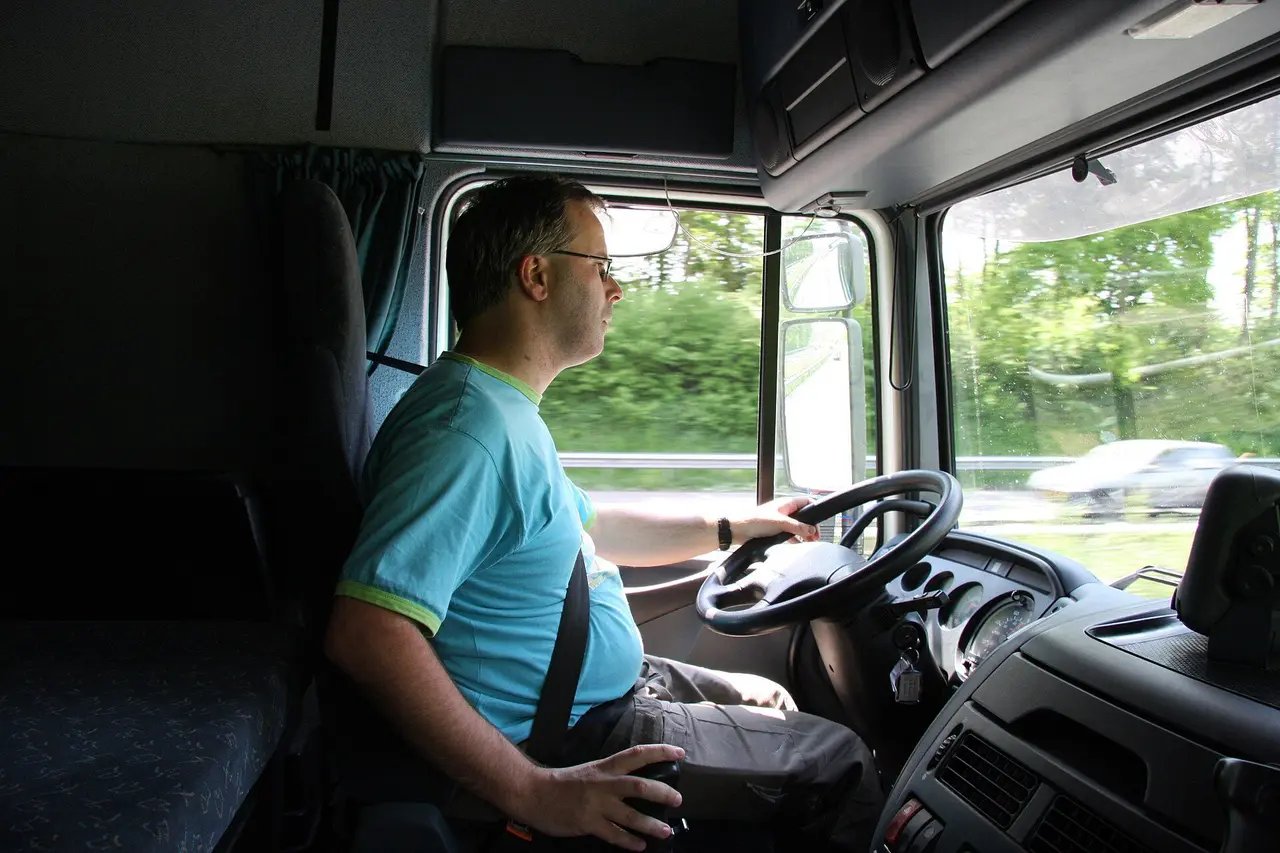
- Keep your back and hips against the backrest, seatbelt across the shoulder as in Figure 3; if the seat has lumbar support, set it to fit the curve of your lower back.
- You should be able to press the pedals fully with your knees still slightly bent, not with straight legs.
- Hold the wheel with elbows slightly bent and shoulders not pulled forward.
- Set the mirrors for your correct sitting position so you do not need to crane your neck.
- Do not keep a thick wallet in your back pocket on long drives; it tilts your hips.
Five exercises in 5 minutes at a stop

Photo: Shixart1985 / Wikimedia Commons, CC BY 2.0
- Walk around the truck for 1 to 2 minutes: it gets the blood moving and lets you glance at the tyres, lights and load straps again.
- Standing back bend: hands on hips, lean back slowly a little, hold 2 to 3 seconds, repeat 8 to 10 times.
- Shoulder and upper back stretch: as in Figure 4, hold 15 to 20 seconds each side.
- Neck side bend: tilt your ear towards your shoulder, hold 15 seconds each side; roll your shoulders backwards 10 times.
- Hamstring stretch: put your heel on the cab step with the leg straight, lean forward gently until you feel the back of the thigh stretch, hold 20 seconds each side.
Move gently, without jerking, and never push into pain. When helping to load: bend your knees, keep your back straight, hold the load close and do not twist while lifting.
Getting in and out of the cab
Many driver injuries happen not while driving but when jumping down from the cab or the truck bed. Always face the truck, hold the grab handles and use the steps (keep three points of contact), especially in rain or when your legs are stiff after a long leg.
Health checks for truck drivers
Your health is what lets you keep your licence and your job. You need a driver health certificate when you train for, sit and renew a licence. Current law also requires drivers of commercial vehicles to have periodic health checks; how often and what is checked follow Ministry of Health guidance, so ask your company and a medical facility licensed to examine drivers. Under labour law, employers must organise periodic health checks for workers, usually at least once a year.
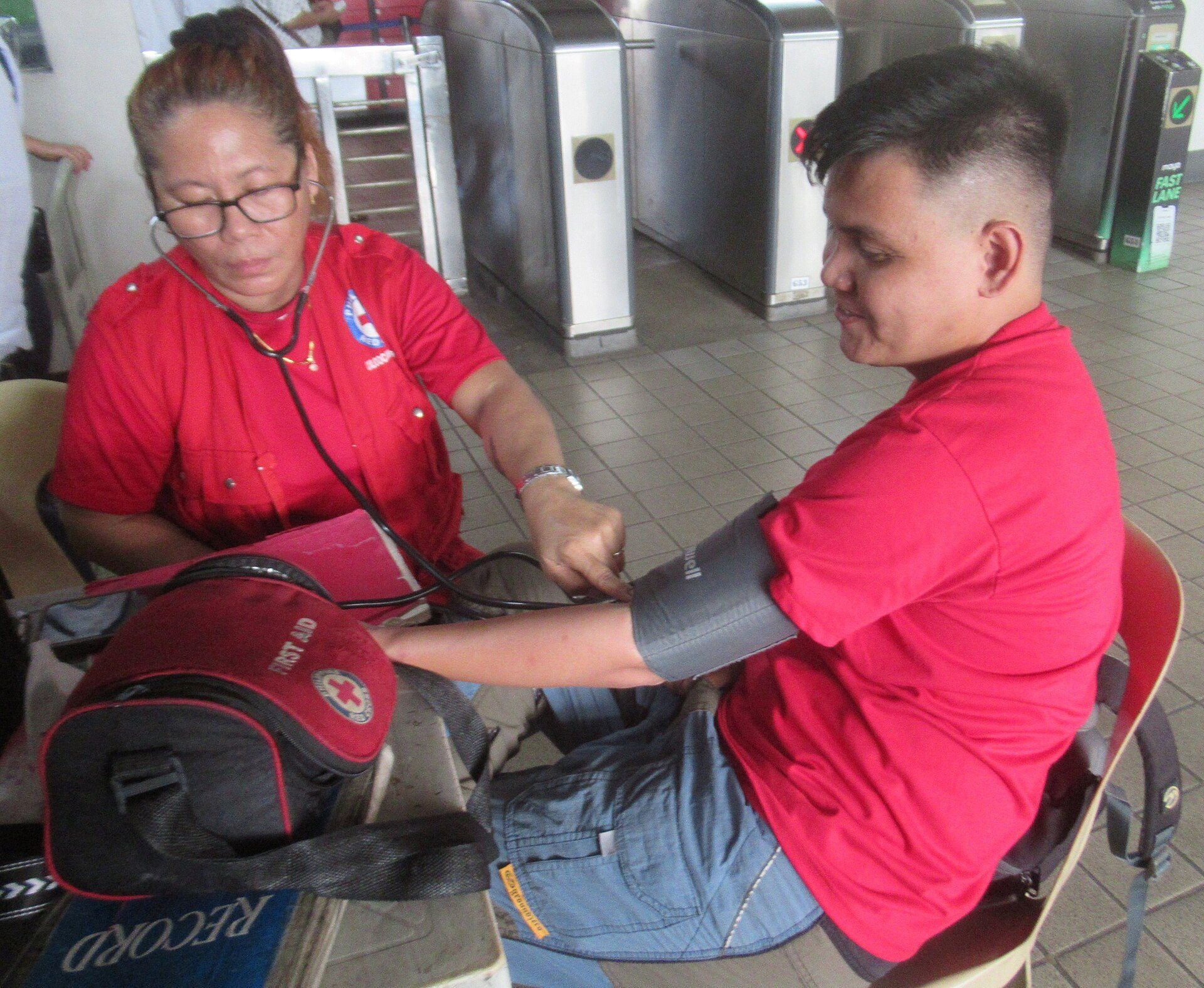
Photo: CNEcija12345 / Wikimedia Commons, CC BY-SA 4.0
Numbers worth tracking yourself
| Measure | How to track | When to see a doctor |
|---|---|---|
| Blood pressure | Measure at rest, keep a log (Figure 5) | Usually 140/90 mmHg or higher on repeated readings |
| Weight, waist | Weigh monthly, measure your waist | Fast weight gain, growing belly, heavy snoring |
| Eyesight | Read distant signs, notice glare when driving at night | Blurred vision, more dazzle from headlights than before |
| Sleep | Ask your partner whether you stop breathing or snore loudly | Still sleepy in the day after enough sleep |
These thresholds follow general guidance and do not replace a doctor's diagnosis. Sleep apnoea (loud snoring, pauses in breathing, waking up tired) makes drivers sleepy in the daytime even after a full night; if you suspect it, see a specialist.
When to see a doctor or call 115
- Call 115 (Vietnam's emergency ambulance number) at once and stop the truck: chest pain, breathlessness, a drooping face, weakness or numbness on one side, slurred speech, fainting.
- See a doctor soon: back pain spreading down the leg, numb or weak legs, bladder or bowel problems; back pain with fever or after a collision; pain lasting several weeks without improving.
- Get checked when: blood pressure stays high on repeated readings, unusual thirst and frequent urination, eyesight getting worse.
- On long-term medication: ask your doctor whether it affects driving.
Common mistakes with driving hours and health
"Only 30 km to go, just push on"
Sign: driving more than 4 hours straight to get home early. Cause: no rest stops planned in advance. Fix: split the trip into legs as in the example, with stops 2 to 3 hours apart.
Forgetting to switch the login when drivers swap
Sign: the software shows one person driving 12 hours in a day. Cause: the second driver did not log in. Fix: make the login part of the swap routine, with the outgoing driver reminding the incoming one.
Using coffee and energy drinks instead of sleep
Sign: racing heart, still yawning, heavy eyes. Cause: sleep debt built up over several days. Fix: catch up on sleep during the day and take a 15 to 20 minute nap at the first sign of drowsiness.
Putting up with back pain
Sign: pain getting worse after every trip, legs starting to go numb. Cause: wrong seat setting, no movement, poor lifting technique. Fix: adjust the seat, do the 5 exercises at every stop and see a doctor if you have the signs listed above.
Frequently asked questions
How many hours can a truck driver drive continuously in Vietnam?
Under the 2024 Law on Road Traffic Order and Safety, drivers of commercial vehicles may not drive continuously for more than 4 hours. The minimum rest between driving periods is set by implementing regulations; check the current version.
What are a truck driver's daily working hours?
Driving time may not exceed 10 hours a day and 48 hours a week. Waiting for loading and doing paperwork is not driving time but is still working time under labour law.
Does the journey tracking device record driving time?
Yes. It records continuous driving time, total daily driving hours, speed, position and the logged-in driver, and sends the data to the management system.
Do truck drivers need periodic health checks?
Yes. Besides the health certificate for training and renewing a licence, drivers of commercial vehicles must have periodic checks; frequency and content follow current Ministry of Health guidance.
How do you stay awake on night runs?
Catch up on sleep during the day, plan a stop every 2 to 3 hours, eat moderately, and at the first sign of drowsiness stop for a 15 to 20 minute nap rather than relying on coffee.
Practice exercises and self-assessment
- Plan a real or hypothetical trip of more than 300 km: legs, breaks, total driving time, and check the sums as in Tuan's example.
- Ask a driver or the dispatch office: which tracking device the trucks use, how drivers log in and what violations the software flags.
- Do all 5 stretches at a stop and time yourself to see if it takes about 5 minutes.
- Measure your blood pressure and weight, log them, and book your next health check.
Self-assessment criteria
- Pass: you state the 4-hour, 10-hour and 48-hour limits correctly, and your own plan has no leg over 4 hours and driving totals that add up.
- Pass: you describe the login and driver-swap routine correctly and explain why you must never cover the camera or cut power to the black box.
- Pass: you can list at least 4 drowsiness signs that mean stopping and 3 back pain signs that mean seeing a doctor.
- Not yet: you plan to drive "in one go" for more than 4 hours, or treat coffee as a substitute for sleep.
With your schedule and health in order, the next step on the roadmap is Pre-trip checks & basic maintenance: a walk-around check of tyres, air brakes, oil, coolant, lights and mirrors, so the truck is as fit as its driver before every trip.
Keep learning truck driving: after driving hours and health come pre-trip checks, reversing into docks, loading and securing goods. See the 8-step truck driver roadmap.