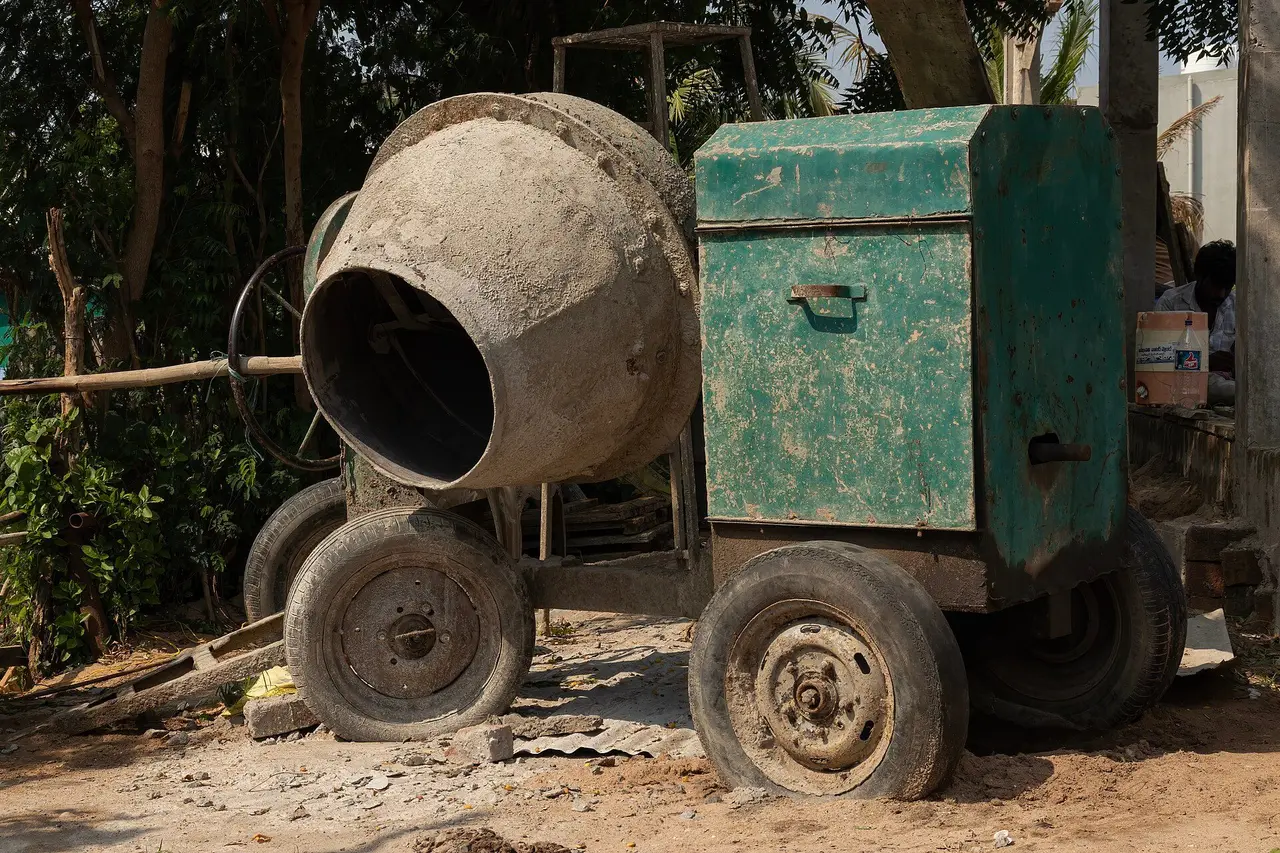
The grade 250 (M250) concrete mix commonly used on Vietnamese house builds, with PCB40 cement and 10–20 mm crushed stone, is about 350 kg of cement, 0.48 m³ of coarse sand, 0.88 m³ of stone and 185 litres of water per cubic metre of concrete. Per 50 kg bag of cement that works out to about 68 litres of sand, 126 litres of stone and 26 litres of water, or roughly 1 bag : 3.5 buckets of sand : 6.5 buckets of stone : 1.3 buckets of water if you use 20-litre buckets. This is a reference mix for small jobs; load-bearing footings, columns, beams and slabs must follow the mix in the design documents or the engineer's instructions, with lab testing where required. This lesson explains where those numbers come from, how to batch accurately with buckets on site, a worked example for a 2 m³ yard slab where every batch adds up, how to cure the concrete, and the mistakes that make it weak.
By the end of this lesson, you will be able to:
- Explain what "grade 250" means and why the water-to-cement ratio controls strength.
- Look up the per-cubic-metre mix for grade 250 concrete with PCB40 and PCB30 cement and convert it to each 50 kg bag.
- Measure your own bucket and convert the mix into buckets of sand, stone and water per batch.
- Work out materials and batches for a real job, check slump, and cure for at least 7 days.
- Recognise six common mistakes that make concrete honeycombed, cracked or weak, and avoid them.
Learning to be a mason? Mixing mortar and concrete to grade is step 3 of the roadmap — after scaffold safety and building materials. See the 8-step mason roadmap to know what to learn first and what comes next.
What is grade 250 concrete?
Concrete is a mix of cement, sand, stone and water. Cement and water form a paste that coats the sand and stone, sets, and slowly hardens into a solid mass. In Vietnam, "mac" (grade) is the everyday site term for the compressive strength of concrete.
What the number 250 means
Grade 250 means a 150 mm concrete cube, cured under standard conditions for 28 days, withstands about 250 kgf/cm² (roughly 25 MPa) in compression. Newer Vietnamese design documents often use strength classes marked "B", and grade 250 is usually treated as close to class B20. When a drawing says B20 or grade 250, ask the engineer for the actual mix rather than guessing.
Where grade 250 is used in houses
In townhouses and single-storey homes, grade 250 is typical for footings, ground beams, columns, beams, slabs and stairs; grade 200 for lintels, entrance steps and yards; grade 150 or 100 for blinding under footings. The design sets the grade of each element, not the mason.
Why the water-to-cement ratio matters most
Cement needs only part of the water to react; the extra water makes concrete easier to place but leaves voids when it evaporates. The reference mix below has a water-to-cement ratio of about 185 ÷ 350 ≈ 0.53. Throwing in a few extra buckets of water "to make it easier to vibrate" pushes that ratio up, and the concrete may no longer reach grade 250 even with the full amount of cement.
Materials for grade 250 concrete
Clean, correct materials matter as much as the ratio. Figure 1 shows a familiar sight in Hanoi — cement bags must be kept out of the rain and used while still powdery.

Photo: Adam Jones from Kelowna, BC, Canada / Wikimedia Commons, CC BY-SA 2.0

PCB40 or PCB30 cement
PCB40 (blended Portland cement, 40 MPa class) is stronger than PCB30, so the same grade 250 needs less of it. Check the production date on the bag and use it within about 2–3 months; store bags off the ground under a tarpaulin. A bag with hard lumps that do not crumble when squeezed should be rejected for structural concrete.
Coarse sand and 10–20 mm stone
Concrete uses coarse yellow sand (concrete sand), not the fine dark sand used for plastering. Squeeze a handful of damp sand and open your hand: lots of mud or clay on your palm means dirty sand that needs screening or washing. The stone known locally as "1x2" is crushed stone of roughly 10–20 mm, free of dust, soil, rubbish and soft crumbly pieces.
Mixing water
Use clean drinkable or mains water. Do not use muddy pond water, salty water or water with oil, which slow setting and rust the reinforcement.
Safety warning: wet cement is strongly alkaline; left on the skin it causes blistering burns, and in the eyes it causes injury. Wear rubber gloves, boots and safety glasses when mixing and placing; if it gets in your eyes, rinse immediately with plenty of clean water for at least 15 minutes and see a doctor. The mixer must be connected through a residual-current breaker, with cables kept out of puddles; never put a hand or shovel into a turning drum; switch off and unplug before cleaning. For 50 kg bags, squat, keep your back straight and lift with your legs, or carry with two people.
Mix table for 1 m³ of grade 250 concrete
The table below is a commonly used reference mix for grade 250 concrete with 10–20 mm stone and a slump of about 6–8 cm, rounded from mix-proportion tables widely used in Vietnam. The design documents or a laboratory mix sheet always take priority.
| Material per 1 m³ | PCB40 cement | PCB30 cement |
|---|---|---|
| Cement | ~350 kg (7 bags) | ~415 kg (8.3 bags) |
| Coarse sand | ~0.475 m³ | ~0.46 m³ |
| 10–20 mm stone | ~0.881 m³ | ~0.89 m³ |
| Water | ~185 litres | ~190 litres |
Why the volumes add up to more than 1 m³
0.475 + 0.881 ≈ 1.36 m³ of sand and stone produces only 1 m³ of concrete, because the sand and cement paste fill the gaps between the stones. This is not an error; do not cut materials to make it "exactly 1 m³".
Per 50 kg bag (PCB40)
One cubic metre uses 7 bags, so each bag makes 1/7 m³ ≈ 0.143 m³ of concrete. Dividing evenly: sand 0.475 m³ ÷ 7 ≈ 68 litres; stone 0.881 m³ ÷ 7 ≈ 126 litres; water 185 ÷ 7 ≈ 26 litres. Easy to remember: 1 bag of cement : 68 L sand : 126 L stone : 26 L water.
Wet sand versus dry sand
Damp sand "bulks up", so the same bucket holds fewer grains than dry sand, and soaking-wet sand also brings water into the batch. After rain, keep the same number of sand buckets but add water gradually and check the slump, rather than pouring in the full 26 litres at once.
Batching with buckets on site
On small jobs, masons measure with buckets or paint tins instead of scales. The right way is to measure your real bucket volume first, then convert litres into buckets.
Measure your bucket
- Fill the bucket to the brim using a 1.5-litre bottle or a 5-litre can and count the total litres.
- Paint a line at the full mark and strike off level when batching (no heaped buckets).
- Use the same bucket all day, and keep a separate marked bucket for water.
Conversion to 20-litre buckets (PCB40)
| Per batch of one 50 kg bag | Litres | 20-litre buckets (struck level) |
|---|---|---|
| Coarse sand | ~68–70 | 3.5 |
| 10–20 mm stone | ~126–130 | 6.5 |
| Water (dry sand) | ~26 | 1.3 (start with 1, add gradually) |
If your bucket holds 18 litres, divide again: sand 70 ÷ 18 ≈ 3.9 buckets, stone 130 ÷ 18 ≈ 7.2 buckets. Many sites use the saying "1 bag, 4 tins of sand, 7 tins of stone" with 18-litre tins — close enough, but only if the tin really holds 18 litres.
Mixing with a drum mixer
A 250-litre drum mixer (Figure 2) handles one bag per batch. A common loading order:
- Put about two thirds of the water into the turning drum.
- Add the stone first so it scours the drum walls.
- Add the cement, then the sand.
- Add the remaining water slowly until the mix is workable, and keep mixing for at least 2 minutes after all materials are in.
- Discharge onto a clean metal sheet or wheelbarrow and check for an even colour with no streaks of dry sand.
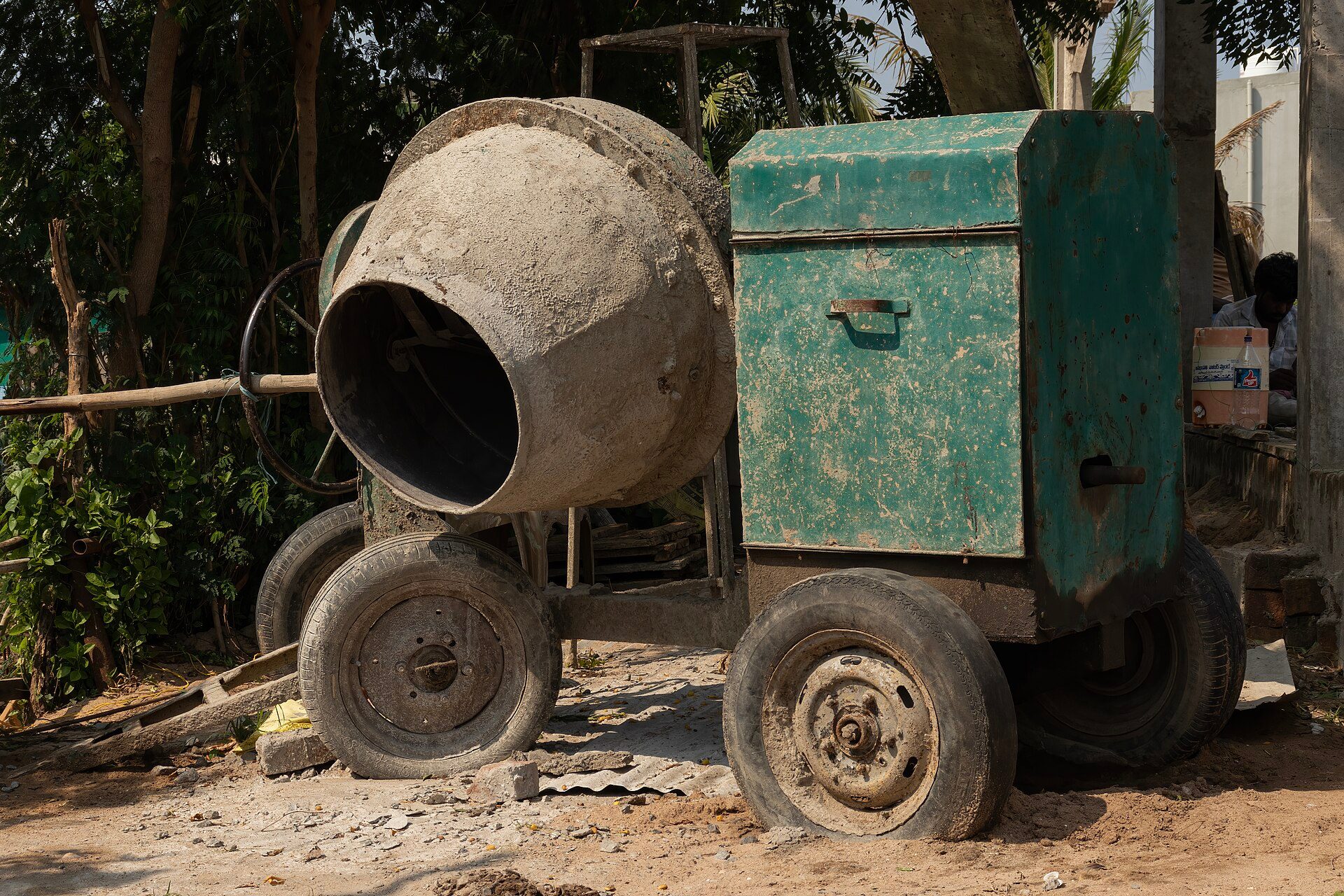
Photo: iMahesh / Wikimedia Commons, CC BY-SA 4.0

Hand mixing for small amounts
Below about 0.3 m³ you can mix by hand on a flat metal sheet: dry-mix sand and cement to an even colour, add the stone and turn it over, make a crater in the middle and add water in parts, turning at least three times until uniform. Hand mixing is harder to keep even than machine mixing, so use it only for non-structural work.
Worked example: pouring a 2 m³ yard slab
Binh is hired to pour a back yard behind a Vietnamese tube house, 5 m × 4 m and 10 cm thick. The owner wants grade 250, using PCB40 cement, 10–20 mm stone, a 250-litre mixer hired by the day and 20-litre buckets. Figure 3 shows sand and stone stockpiled next to a mixer on a site.
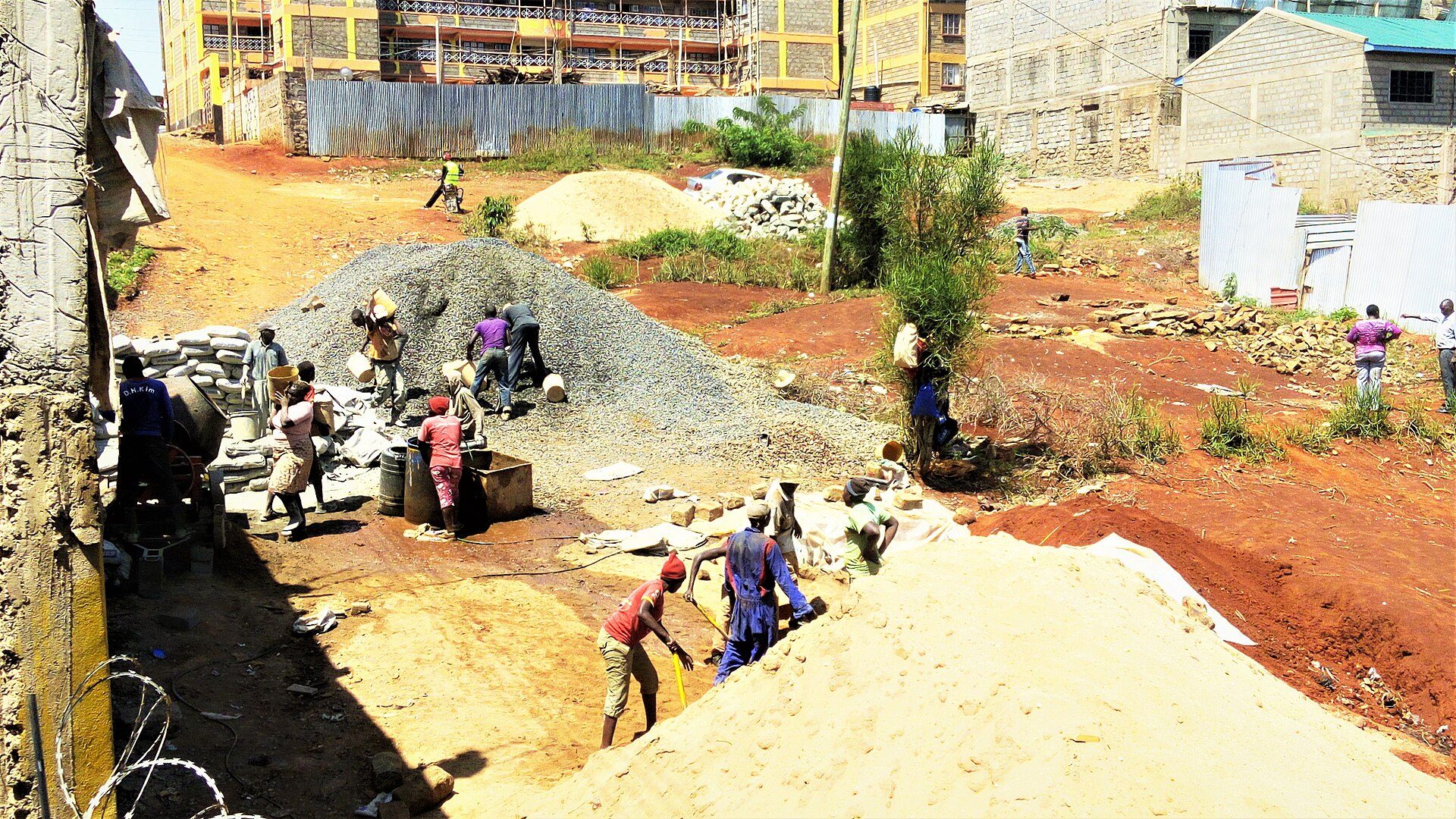
Photo: Mugambi Muriuki / Wikimedia Commons, CC BY-SA 4.0

Step 1: volume
Volume: 5 × 4 × 0.1 = 2.0 m³. Add about 5% for spillage and an uneven sub-base: 2.0 × 1.05 = 2.1 m³.
Step 2: batches and materials
Each one-bag batch gives about 0.143 m³, so 2.1 ÷ 0.143 ≈ 14.7 batches, rounded up to 15 batches = 15 bags of cement. Using the bucket table above:
| Material | Per batch | × 15 batches | To buy (rounded) |
|---|---|---|---|
| PCB40 cement | 1 bag, 50 kg | 15 bags = 750 kg | 15 bags |
| Coarse sand | 3.5 buckets = 70 L | 1,050 L = 1.05 m³ | 1.1 m³ |
| 10–20 mm stone | 6.5 buckets = 130 L | 1,950 L = 1.95 m³ | 2.0 m³ |
| Water | ~26 L | ~390 L | A full 500 L tank |
Cross-check with the 1 m³ table: 2.1 m³ × 350 kg = 735 kg of cement, so 15 bags (750 kg) is enough with 15 kg to spare; 2.1 × 0.475 ≈ 1.0 m³ of sand and 2.1 × 0.881 ≈ 1.85 m³ of stone, so buying 1.1 m³ of sand and 2.0 m³ of stone also covers the rounded-up bucket measures.
Step 3: reference material cost
| Item | Quantity × unit price | Amount |
|---|---|---|
| PCB40 cement | 15 bags × 90,000 VND | 1,350,000 VND |
| Coarse sand | 1.1 m³ × 450,000 VND | 495,000 VND |
| 10–20 mm stone | 2.0 m³ × 420,000 VND | 840,000 VND |
| Mixer hire | 1 day × 300,000 VND | 300,000 VND |
| Total | 2,985,000 VND | |
Adding up: 1,350,000 + 495,000 + 840,000 + 300,000 = 2,985,000 VND (about 120 USD), excluding labour, reinforcement (if any) and delivery. These are 2026 reference prices in Vietnam and vary by region and supplier: PCB40 cement about 80,000–110,000 VND per bag, coarse sand 350,000–550,000 VND/m³, 10–20 mm stone 350,000–500,000 VND/m³.
Step 4: timing on the day
Each batch — measuring, mixing, discharging — takes about 10 minutes, so 15 batches take about 2.5 hours with a crew of 3–4. Each batch should be placed and compacted within about an hour of mixing; in hot sun, work early in the morning or late afternoon.
Slump testing, placing, compacting and curing
Mixing to the right ratio is only half the job; poor placing, compacting or curing still leaves weak concrete.
Slump test with a cone
Slump shows how wet or stiff the concrete is. Fill the test cone (30 cm high) in three layers, rod each layer 25 times with a steel rod, strike off the top, lift the cone straight up and measure how far the concrete drops (Figure 4). Slabs and yards compacted with a poker vibrator usually need about 6–8 cm; a slump of 12–15 cm in a hand-mixed batch usually means too much water.
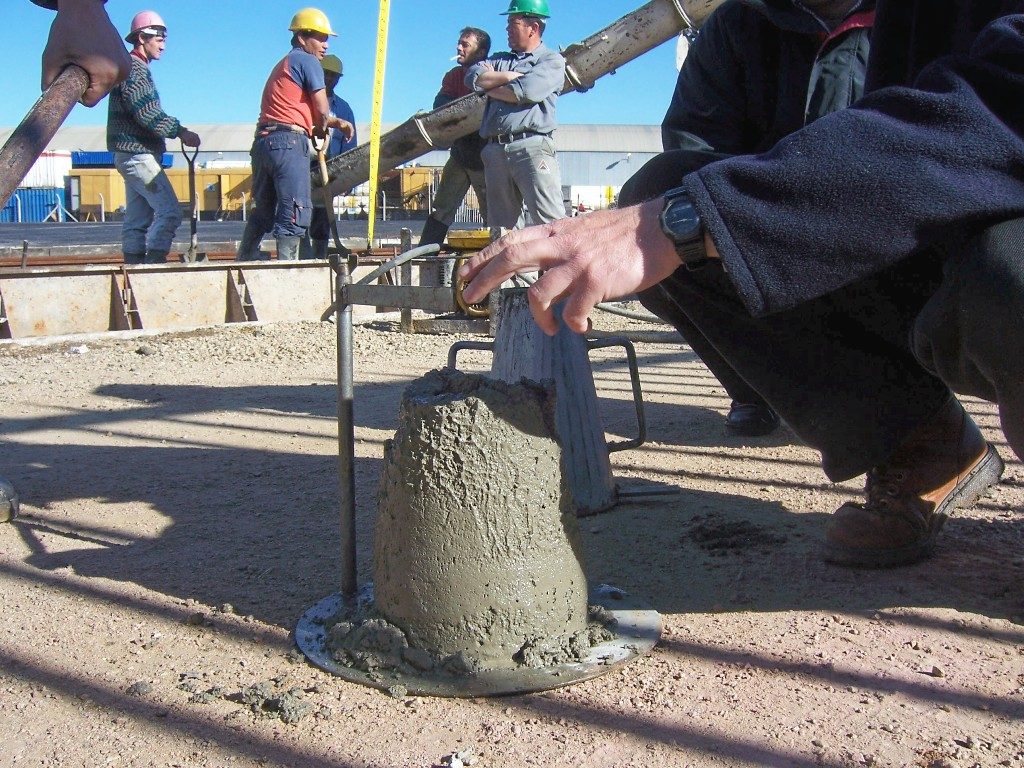
Photo: No machine-readable author provided. Tano4595 assumed (based on copyright claims). / Wikimedia Commons, CC BY-SA 2.5

Placing and compacting
Place concrete from a low height; a free drop of more than about 1.5 m causes segregation (stone separating from mortar). Insert the poker vibrator vertically, withdraw it slowly, and vibrate until cement paste shows at the surface and large air bubbles stop; vibrating too long in one spot also causes segregation. For yards and thin slabs, strike off with a screed board along level marks and then float the surface (Figure 5).
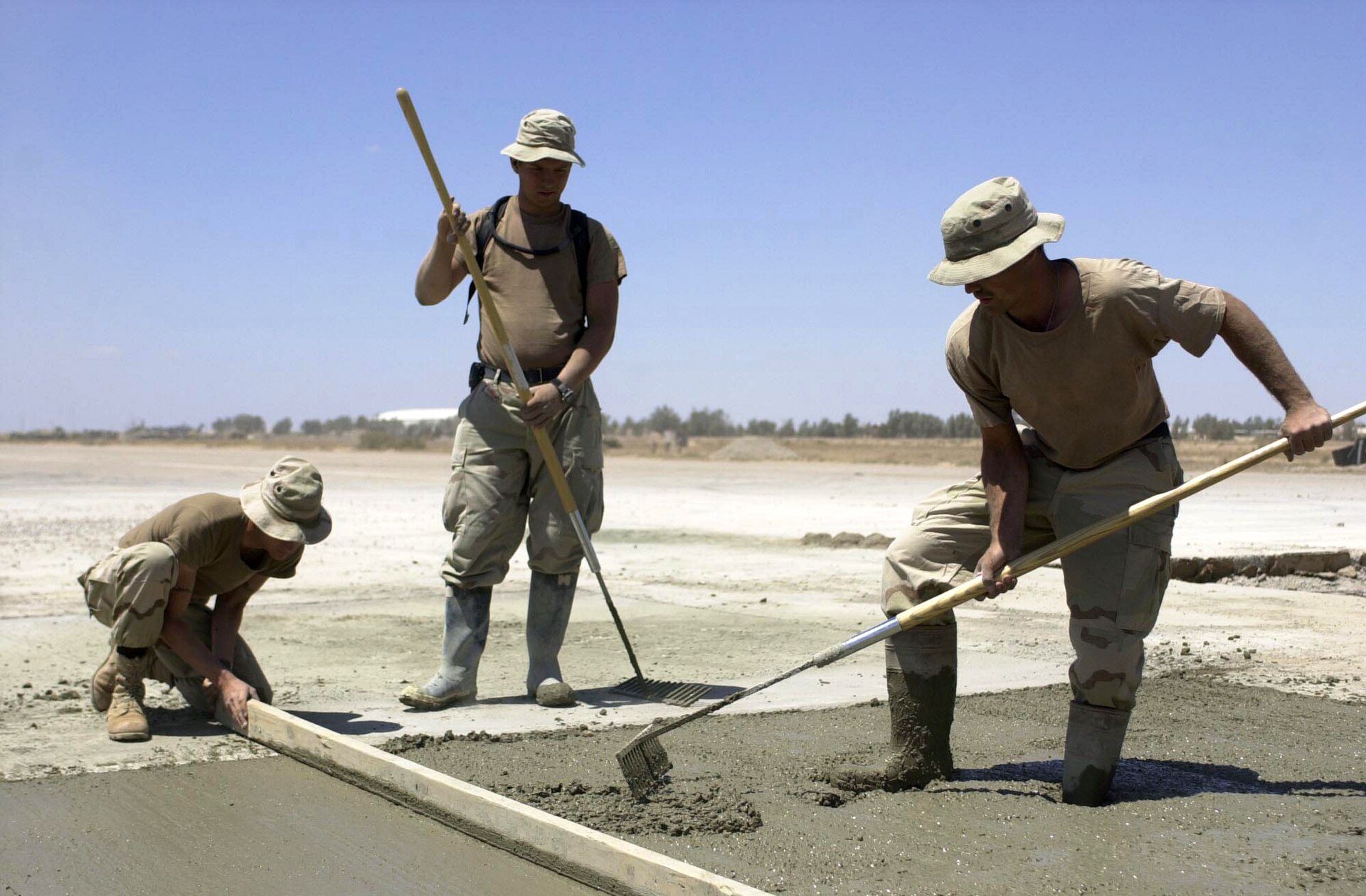
Photo: U.S. Navy photo by Photographer’s Mate 2nd Class Jacob Johnson. / Wikimedia Commons, Public domain

Cure for at least 7 days
Concrete needs water for the cement to keep reacting. Once the surface has stiffened (a finger press leaves no dent, usually after a few hours), cover it with wet hessian sacks or a tarpaulin and keep it moist for at least 7 days; on hot days water it several times on the first day. Keep foot traffic and stacked materials off the slab for the first 1–2 days. When to strip slab and beam soffit formwork is the engineer's call.
Taking samples for acceptance
For structural or supervised work, cast 150 mm test cubes, cure them and have them crushed at a laboratory as the documents require. That is the only way to know for sure whether the concrete reached grade 250.
Common mistakes when mixing grade 250 concrete
| Mistake | Sign | Cause | How to avoid it |
|---|---|---|---|
| Adding water to make it flow | Watery surface, crazing cracks, dusty surface | Higher water-to-cement ratio | Measure water in a marked bucket and check slump; if you need more flow, ask the engineer about admixtures |
| Measuring by shovel | Some batches dry, some wet, uneven colour | Every shovelful differs | Batch with level-struck buckets |
| Dirty sand or stone | Weak, dusty concrete | Mud and clay coat the grains and stop bonding | Do the squeeze test, wash stone before mixing |
| Mixing too briefly | Streaks of dry sand, cement lumps | Discharged too early | Mix at least 2 minutes after all materials are in |
| Placing too late | Stiff, hard to compact, honeycombed | Setting has started | Place within about an hour; never add water to "revive" it |
| No curing | Surface cracks, dusting, low strength | Early water loss | Cover and keep moist for at least 7 days |
When ready-mixed concrete is better
For several cubic metres or more on structural slabs and beams, or where a pump truck can reach the lane, ready-mixed concrete from a batching plant is usually more consistent than site mixing, and comes with a mix sheet and samples. The mason still has to check slump and cure the concrete.
Frequently asked questions
How many bags of cement for 1 m³ of grade 250 concrete?
As a reference, about 7 bags of PCB40 (350 kg) or about 8.3 bags of PCB30 (415 kg) with 10–20 mm stone. The real mix follows the design documents.
Is a 1 : 2 : 4 ratio the same as grade 250?
A volume ratio of 1 cement : 2 sand : 4 stone is a general rule of thumb, not tied to a specific grade, because it depends on the cement type, sand moisture and water content. With PCB40, the mix in this lesson is about 1 : 1.9 : 3.6 by volume (a 50 kg bag takes up about 35 litres).
Can hand-mixed concrete reach grade 250?
It can come close if measured accurately and mixed thoroughly, but it is harder to keep uniform than machine mixing. Structural elements should be machine-mixed or use ready-mixed concrete.
How long until concrete gains strength?
After about 7 days of good curing, concrete usually has most of its strength; the grade is assessed at 28 days. When to load it or strip formwork is up to the engineer.
Can you pour concrete in the rain?
Stop in heavy rain, because rainwater dilutes the surface. If light rain starts mid-pour, cover with a tarpaulin, reduce mixing water and tell the engineer if the surface gets washed.
Practice and self-assessment
- Measure the bucket you normally use and recalculate the buckets of sand, stone and water per bag of PCB40.
- Work out materials for solid entrance steps 3 m × 0.9 m × 0.45 m using the grade 250 mix, adding 5% waste.
- Mix a small half-bag batch, do a slump test and record how much water you used.
Self-assessment criteria
- Pass: your bucket counts for sand and stone differ by no more than 0.2 bucket from litres ÷ bucket volume; the steps exercise comes to about 1.28 m³ and 9 bags of PCB40.
- Pass: your trial batch has a slump of 6–8 cm without using more than about 26 litres of water per bag.
- Not yet: you measure by shovel, add water after the concrete has stiffened, or mix without gloves and glasses.
Once you can mix to grade, move on to the next step of the roadmap: Building straight, plumb, level walls — stringing lines, setting corner profiles and laying bricks in staggered bond with even 10–12 mm mortar joints.
Keep learning masonry: after mortar and concrete come walls, plastering, floor screeds, small slab pours and quantity take-offs for quoting. See the 8-step mason roadmap to track your progress.