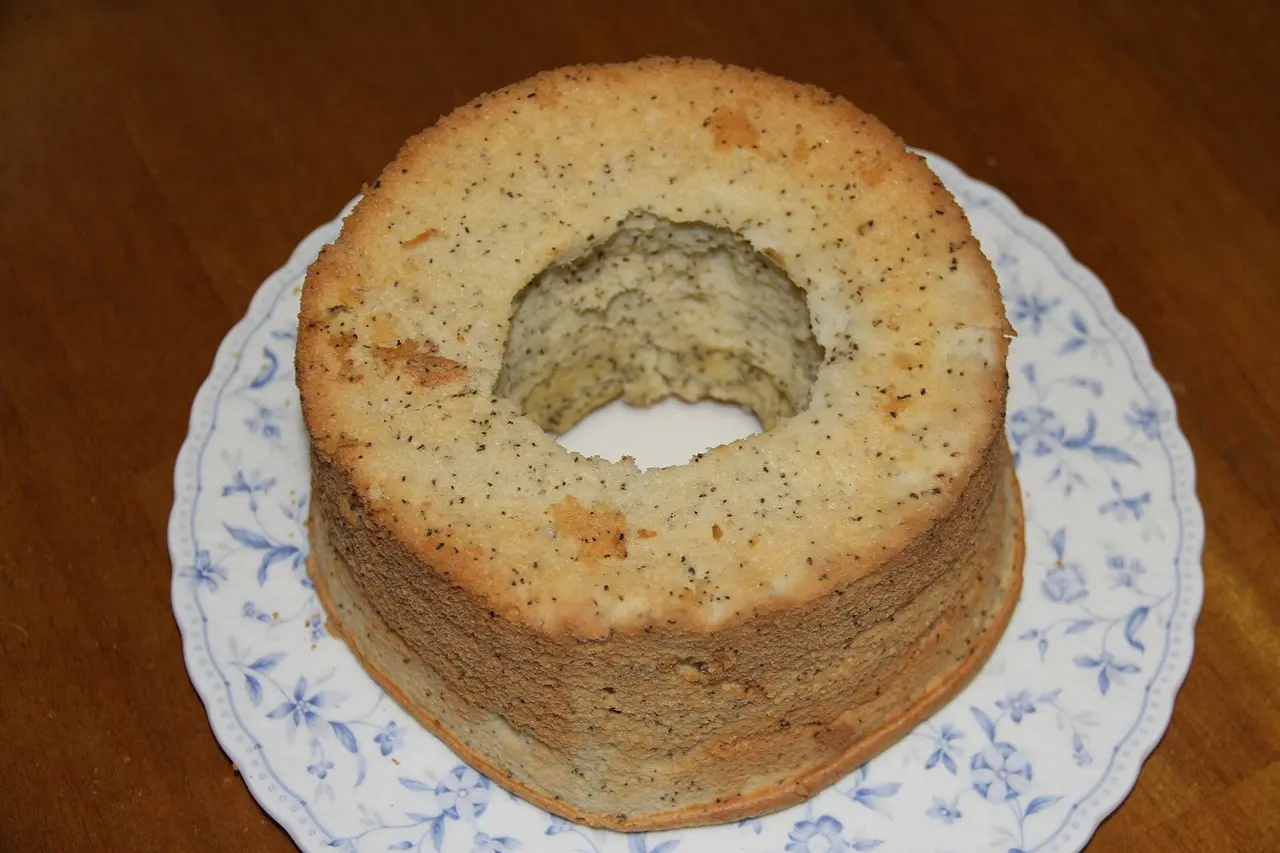
A sponge cake sinks almost always because the air bubbles in the batter burst, or because the cake's structure did not set in time: egg whites under-whipped or over-whipped, batter folded too hard, the oven at the wrong temperature, the oven door opened too early, the cake underbaked, a chiffon not cooled upside down, a non-stick pan used for chiffon, or ingredients measured wrongly. The shape of the collapse — a sunken middle, a hollow bottom, a pinched waist or an overall slump — lets you narrow down the cause before you bake the next batch. This lesson walks through the 10 causes that come up most often in bakeries and home kitchens in Vietnam, with a quick lookup table, a 20 cm chiffon recipe in grams and a worked cost calculation for one cake.
By the end of this lesson, you will be able to:
- Look at the shape of a collapsed cake (sunken middle, hollow bottom, pinched waist, wet crumb) and name the one or two most likely causes.
- Whip egg whites to firm peaks and fold in flour so the batter does not turn runny.
- Check your oven's real temperature with an oven thermometer and correct the offset before baking.
- Bake a 20 cm chiffon cake from a gram-based recipe, check doneness and cool it upside down correctly.
- Work out the cost of one cake, including the hidden cost of failed cakes.
Learning to bake properly? Sponge, genoise and chiffon cakes are step 3 of the roadmap — after hygiene and weighing, and yeasted bread. See the 8-step baker roadmap to learn in the right order.
Why does a sponge cake rise and then sink?
To fix a sinking cake, you need to understand what holds it up in the first place. Sponge, genoise and chiffon cakes rely very little on chemical raising agents; they rise mainly thanks to millions of tiny air bubbles trapped by whipped eggs.
Air bubbles are temporary scaffolding
When you whip eggs, the proteins in the whites unfold and wrap around air bubbles, forming thin films. Sugar makes those films more elastic and stable. In the oven, the air in the bubbles heats up and expands, and steam pushes the cake up further. At this point the cake is standing only on its bubbles — a very fragile frame.
The frame must set before the bubbles shrink
Once the crumb reaches roughly 70–80°C or more, the egg proteins coagulate and the starch in the flour gelatinizes. Together they turn soft bubbles into a firm, spongy structure. If the bubbles burst or shrink before that structure sets — because the oven is too cool, the door is opened, or the cake comes out too early — the cake collapses. If the foam was weak from the start, there is nothing to hold the cake up at all.
Three moments when cakes usually sink
- In the oven, while rising: usually weak foam, an oven so hot the cake shoots up and then falls, or the door opened early.
- Right after leaving the oven: usually an underbaked, wet crumb.
- While cooling: usually a chiffon not cooled upside down, or a non-stick pan that lets the cake slide off the sides.
Quick lookup: symptom → cause → fix
The table below groups the 10 most common causes. Read the symptom column first, then go to the detailed explanation in the sections that follow.
| # | Symptom | Cause | Fix |
|---|---|---|---|
| 1 | Little rise, dense crumb, thick wet layer at the bottom | Egg whites under-whipped, weak foam | Whip to firm peaks: lift the whisk and the peak stands upright |
| 2 | Rises high then collapses, big holes, white streaks in the crumb | Egg whites over-whipped, dry and lumpy | Stop as soon as peaks are firm and still glossy; finish on low speed |
| 3 | Runny batter, short cake, rubbery bottom | Folded too hard or too long, bubbles burst | Fold with a flat spatula in 3 additions, stop when streaks just disappear |
| 4 | Deep cracks on top, shoots up then sinks in the middle | Oven too hot | Measure with an oven thermometer and lower the setting |
| 5 | Short, pale, slow to bake | Oven too cool or not preheated enough | Preheat 15–20 minutes, check with a thermometer |
| 6 | One section caves in while rising | Door opened early, cold air rushes in | Keep the door shut for the first two-thirds of the bake |
| 7 | Shrinks soon after leaving the oven, wet sticky crumb | Underbaked | Skewer test and press the top; bake 5 more minutes |
| 8 | Chiffon pinched at the waist after cooling | Not cooled upside down | Invert immediately out of the oven, leave until fully cool |
| 9 | Chiffon slides off the pan sides, hollow bottom | Non-stick pan, or greased pan | Use a plain aluminium pan, no grease, no paper on the sides |
| 10 | Problems come and go between batches | Wrong measurements, using cups | Weigh every ingredient on a 0.1 g digital scale, eggs included |
Mistakes when whipping eggs and folding
This is the root group: most sunken cakes made by beginners start here. Whip the eggs perfectly and then fold carelessly, and all that whipping is wasted.
Mistake 1: under-whipped egg whites
Egg whites go through stages: large frothy bubbles, fine foam, soft peaks (lift the whisk and the peak curls over), then firm peaks (the peak stands straight, bending only slightly at the tip). For chiffon, stop at firm peaks that are still smooth and glossy. Stop at soft peaks and the foam is not strong enough to carry the yolks, oil and flour — the cake rises little and has a wet layer at the bottom. Figure 1 shows whites already whipped stiff in a bowl, with the yolks waiting to be whipped separately.
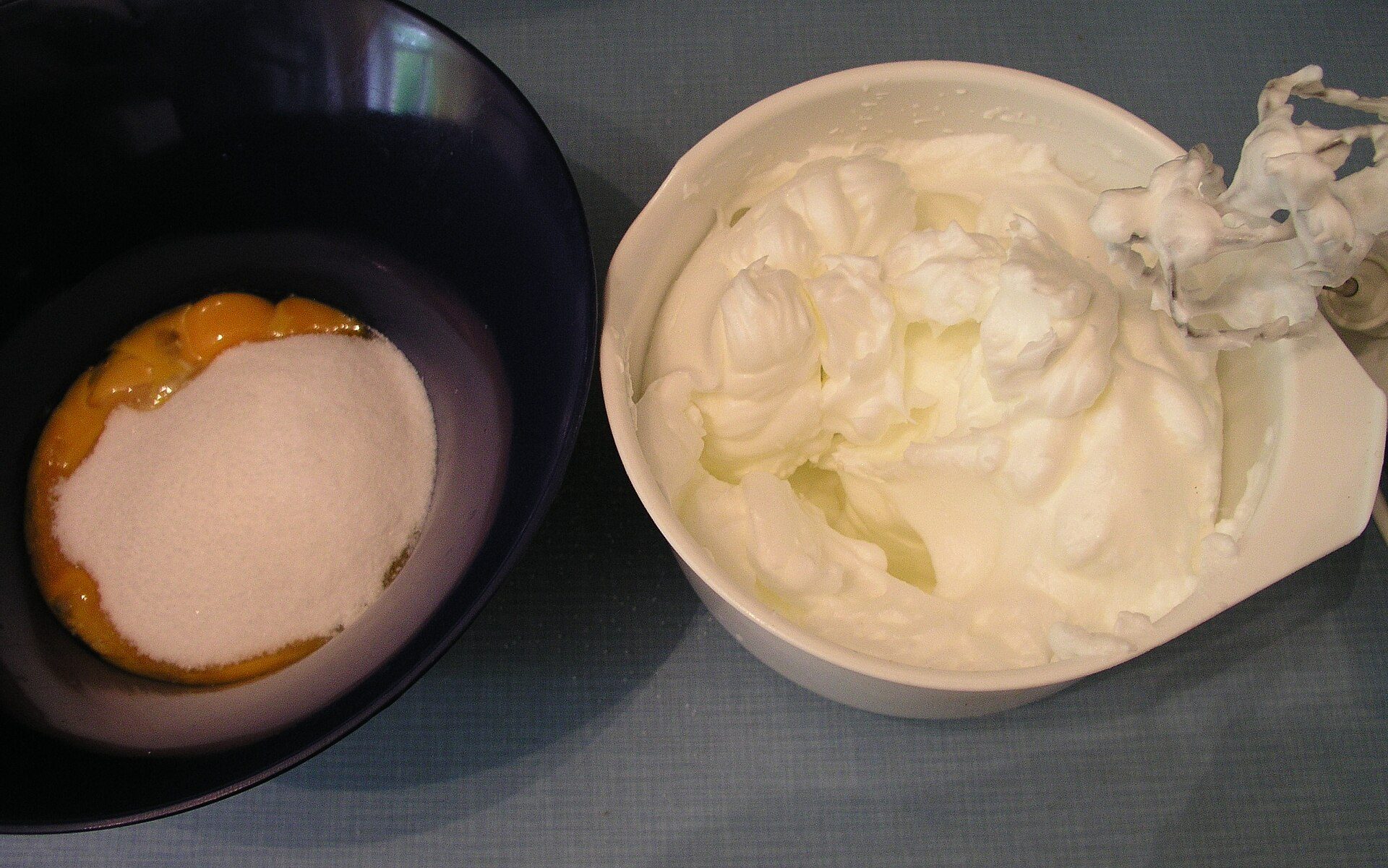
Photo: Nillerdk / Wikimedia Commons, CC BY 3.0
A baker's tip: add the sugar to the whites in 3 additions once the foam is fine; a few drops of lime juice make the foam more stable. Use a stainless steel or glass bowl free of grease, and crack eggs one at a time over a small bowl — a single drop of yolk or a smear of oil is enough to stop whites from whipping.
Mistake 2: over-whipped egg whites
Whipped past firm peaks, the whites lose their shine, look dry like cotton wool, form lumps and start weeping liquid at the bottom of the bowl. This foam is hard to fold in: you have to stir more to break it up, and that extra stirring bursts the bubbles. In the oven the dry clumps expand unevenly, the cake shoots up and falls, and the crumb ends up with big holes and white streaks. To avoid it, whip on high speed until you are close to firm peaks, then drop to low speed for 30–60 seconds to even out the bubbles, and stop.
Mistake 3: folding too hard and bursting the bubbles
Proper folding means cutting a flat spatula straight down through the middle of the bowl, scraping along the bottom, lifting and turning the batter over, rotating the bowl a little and repeating. Do not stir in circles and do not beat. The standard order for chiffon: mix one-third of the whites into the yolk mixture to lighten it, then pour that mixture back into the remaining whites and fold until the white streaks just disappear. Correct batter is thick and smooth, falls in ribbons and holds its shape for a moment. If it pours like milk, many bubbles have already burst.
Oven mistakes
The same recipe gives two different results in two different ovens. The dial on the oven is only the temperature you want, not the real temperature inside.
Mistakes 4 and 5: oven too hot or too cool
Home ovens, especially 25–45 litre countertop ovens common in Vietnamese kitchens, are often 10–30°C off the dial, and some are worse. Too hot: the top sets early while the inside is still rising, the top cracks deeply, and the cake shoots up and then sinks in the middle. Too cool: the bubbles shrink before the frame sets, and the cake is short and pale. The only way to know is to place an oven thermometer (Figure 2) in the middle of the rack, preheat for 15–20 minutes and read it.
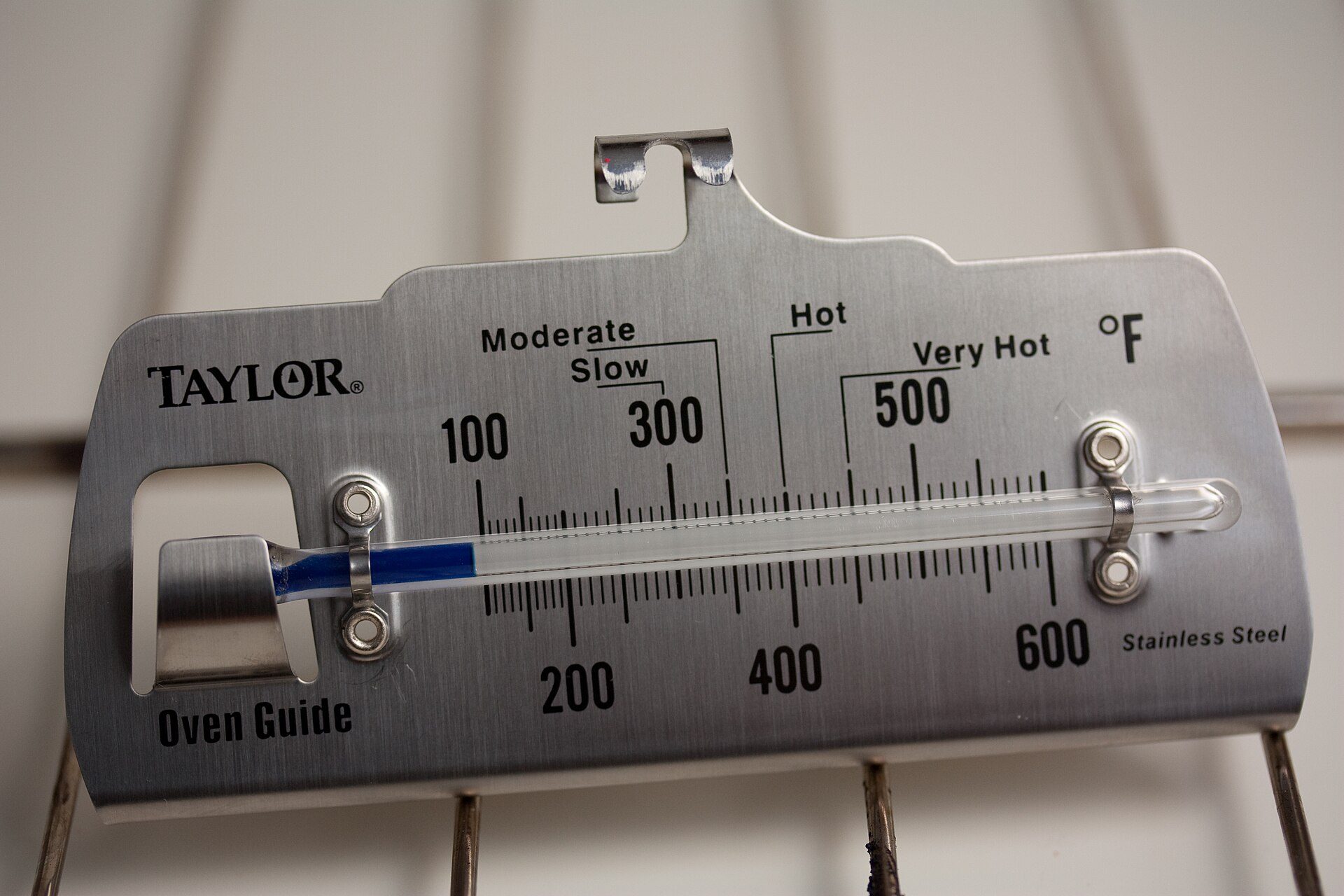
Photo: Veganbaking.net from USA / Wikimedia Commons, CC BY-SA 2.0
If you set 160°C and the thermometer reads 180°C, next time turn the dial down to about 140°C and check again until it matches. Fan (convection) ovens run hotter and drier: many bakers switch the fan off for chiffon, or lower the temperature by about another 10°C.
Mistake 6: opening the oven door too early
Every time the door opens, the temperature inside drops sharply and cold air rushes in just when the cake's frame is still soft. Part of the cake may cave in, or the whole cake may slump. The rule: keep the door shut for roughly the first two-thirds of the baking time. If you want to look, switch on the oven light and watch through the glass (see Figure 3 — cakes rising mid-bake; watching through the door is enough).
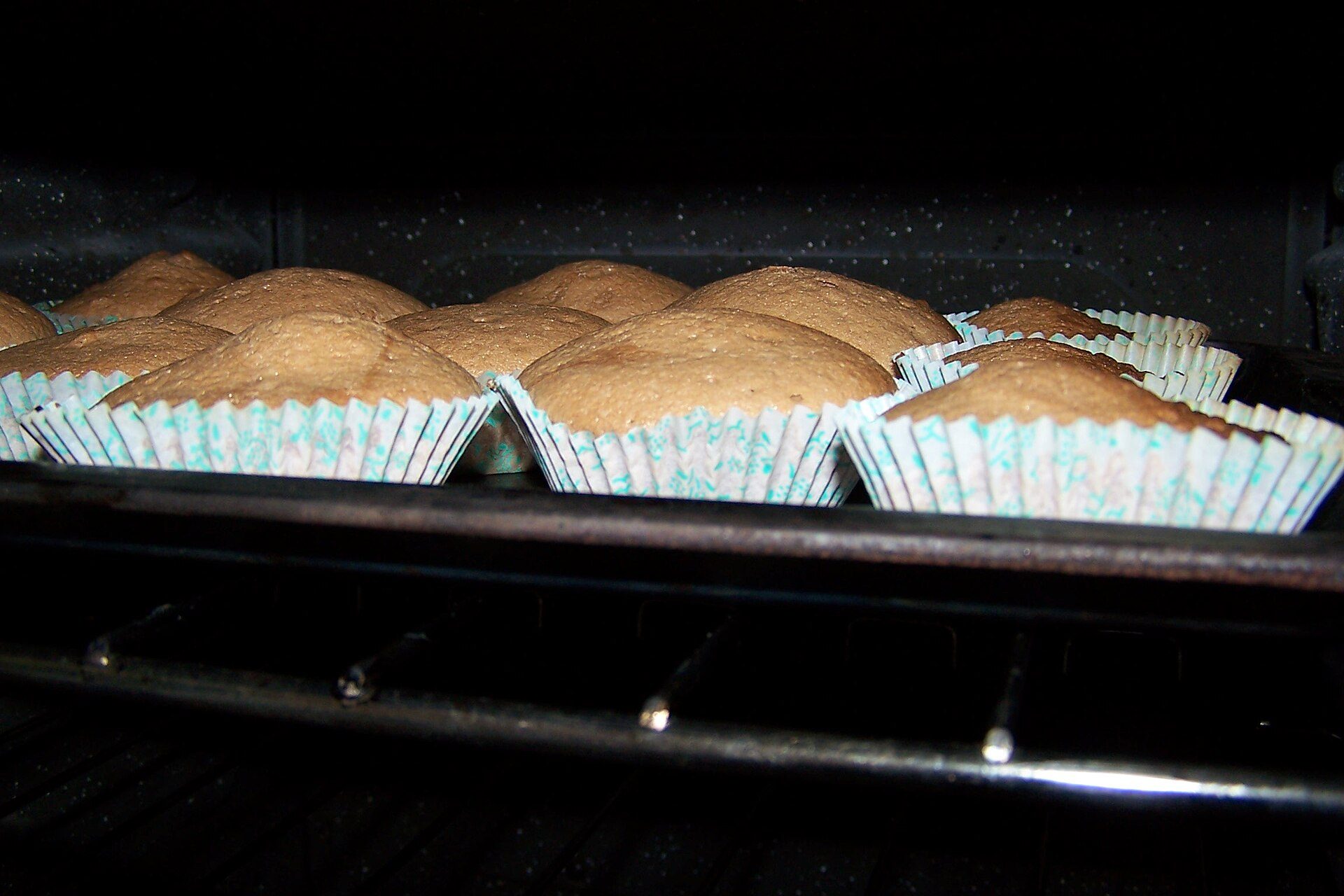
Photo: User:Lcarsdata / Wikimedia Commons, CC BY-SA 3.0
Mistake 7: underbaking
A golden top does not mean the inside is done. A wet crumb means the proteins and starch have not fully set; once out of the oven the steam condenses and the cake shrinks. Check three ways at once: push a bamboo skewer into the thickest part and it should come out clean or with only a few dry crumbs; press the top lightly and it should spring back without leaving a dent; listen close to the top and there should be no more faint sizzling of bubbles. If it fails, bake 5 more minutes and test again.
Mistakes with the pan, cooling and measuring
Chiffon is a very light cake with plenty of oil and liquid, so it needs particular conditions that ordinary sponge or genoise do not demand as strictly.
Mistake 8: not cooling chiffon upside down
Fresh out of the oven, chiffon is still soft and heavy with steam. Left upright, its own weight presses down, compresses the crumb and pinches the cake at the waist. Invert the pan as soon as it leaves the oven — a tube pan with a central funnel can sit upside down on the neck of a sturdy glass bottle — so gravity stretches the cake and keeps the crumb open. Leave it like that until completely cool, usually 1.5–2 hours, before unmoulding.
Mistake 9: non-stick or greased pans
Chiffon needs to grip the pan sides to "climb" as it rises and to hang when inverted. A non-stick pan, or a pan greased and floured, makes the cake slip: it cannot climb high in the oven, and when inverted it slides off the sides and drops, leaving a hollow bottom. Use a plain aluminium pan with no coating and no grease (see Figure 4 for a tube pan with a central funnel). Genoise and butter sponges are the opposite: you can grease the pan and line the base with paper.
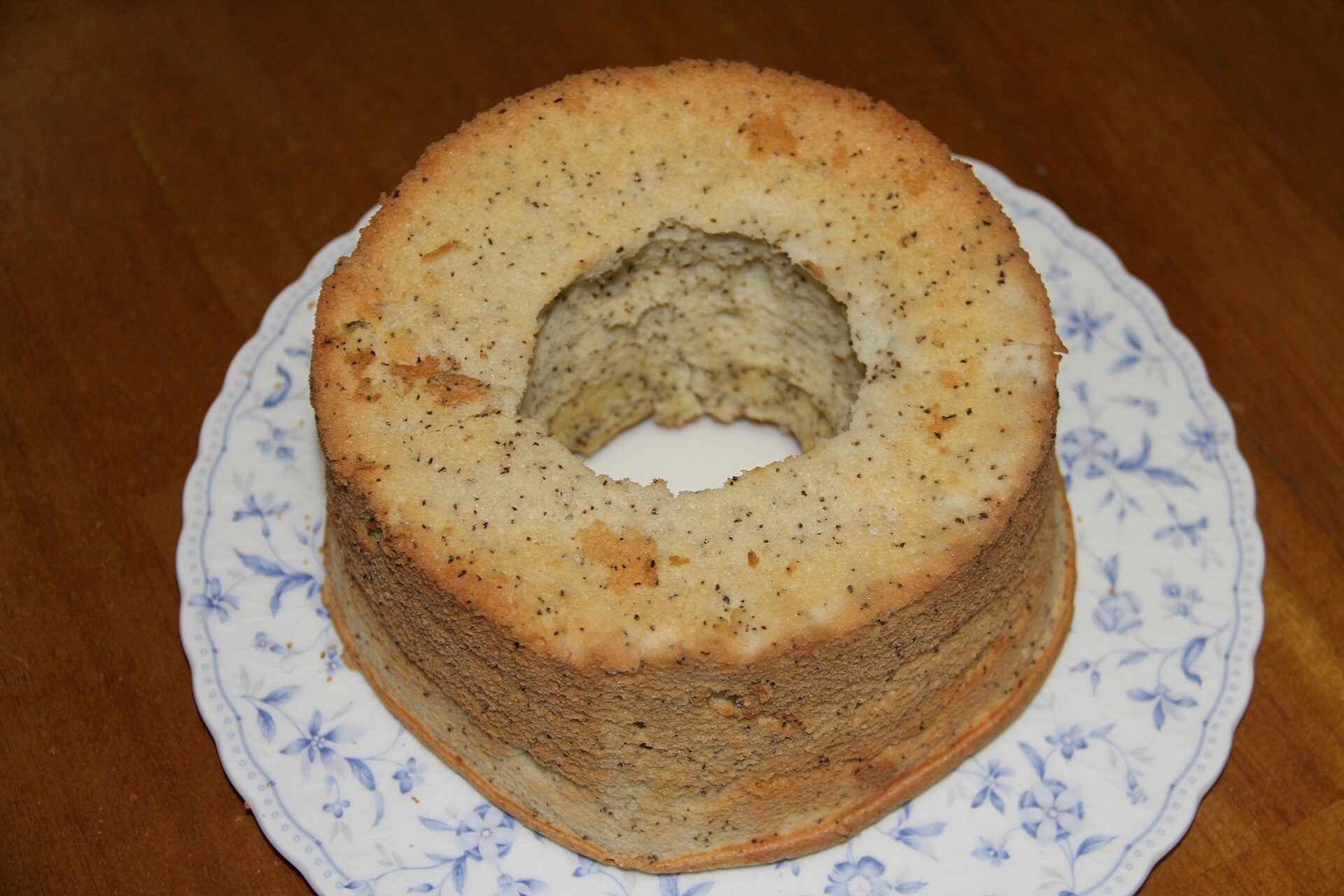
Photo: Roozitaa / Wikimedia Commons, CC BY-SA 3.0
Mistake 10: measuring wrongly
A "cup" of flour can weigh anywhere from about 110 g to more than 150 g depending on how it is scooped and packed. "Four eggs" can differ by 30–40 g. Extra sugar or liquid makes the batter too heavy for the foam to hold; too little flour makes a weak frame. Use a digital scale reading to 0.1 g or 1 g (Figure 5) for every ingredient, including the separated yolks and whites.
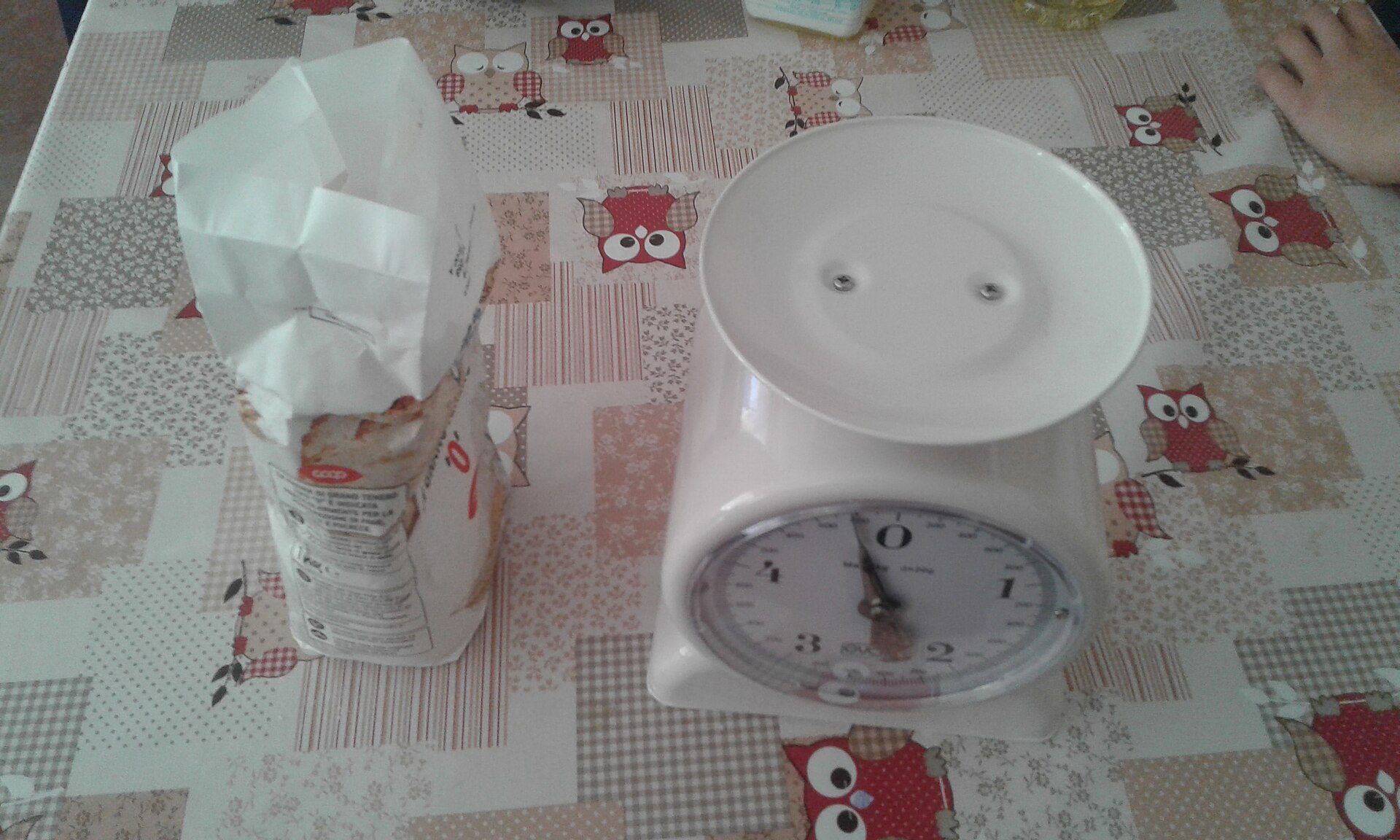
Photo: Cristian.giovanetti / Wikimedia Commons, CC BY-SA 4.0
A 20 cm chiffon recipe in grams
This is a basic vanilla chiffon for a 20 cm tube pan (with a central funnel). Eggs are listed by separated weight, not by count. The temperature and time are a starting point only: every oven is different, so use an oven thermometer to adjust.
| Ingredient | Weight | Notes |
|---|---|---|
| Egg yolks | 90 g | About 5 medium eggs |
| Egg whites | 160 g | From the same 5 eggs, no yolk |
| Sugar (yolk part) | 15 g | Whisked with the yolks |
| Sugar (white part) | 60 g | Added in 3 additions |
| Cake flour (sold in Vietnam as "flour no. 8") | 85 g | Sift 1–2 times |
| Unsweetened fresh milk | 65 g | Water also works |
| Neutral oil | 45 g | Soybean, sunflower… |
| Lime juice | 3 g | Or 1 g cream of tartar |
| Salt, vanilla | 1 g + 2 g | Liquid or powder vanilla |
Method
- Preheat the oven for 15–20 minutes with an oven thermometer on the middle rack. Starting target: a real 160°C, top and bottom heat, no fan.
- Whisk the yolks with 15 g sugar and the salt until dissolved, add the oil, milk and vanilla and mix well. Sift in the flour and stir just until smooth.
- Whip the whites to a fine foam, add the lime juice, then add the 60 g sugar in 3 additions. Whip to firm, glossy peaks.
- Mix one-third of the whites into the yolk mixture, then pour everything into the remaining whites and fold until no streaks remain.
- Pour into an ungreased plain aluminium pan, run a skewer through the batter in a few circles to break large bubbles, and tap the pan gently once or twice.
- Bake for about 45–55 minutes at 160°C as a starting point. If the top cracks too deeply, lower by 10°C next time; if the cake is pale and slow to bake, raise by 10°C.
- Skewer test and press the top. When done, invert immediately, cool completely for 1.5–2 hours, then release the sides with a thin knife.
Why use cake flour
Cake flour ("no. 8" in Vietnamese shops) is low in protein, forms little gluten and gives a soft, fine crumb. All-purpose flour ("no. 11") still works but the cake is chewier; bread flour ("no. 13") gives a firm crumb that shrinks easily.
Safety and hygiene warning: raw eggs can carry Salmonella. Choose clean, uncracked eggs within their date; keep them refrigerated and only wash the shells right before cracking (washed eggs left to sit let bacteria pass through the shell more easily). Wash your hands with soap after handling eggshells and do not taste raw batter. An oven and pans at 150–180°C cause deep burns within seconds of contact: always use dry heat-resistant mitts (wet mitts conduct heat very quickly), lean back when opening the oven door to avoid the blast of hot air, and set hot pans on a metal rack. When inverting chiffon on a bottle, use a thick glass bottle on a flat surface, away from the edge of the table and out of children's reach. Unplug the oven after use.
Worked example: Hanh's three chiffon cakes with hollow bottoms
Hanh takes chiffon cake orders through Zalo (a popular Vietnamese messaging app) and has just bought a 35 litre countertop oven. Three cakes in a row rose high, cracked deeply on top, and 10 minutes after leaving the oven their bottoms caved in and they slid out of the pan. She used the recipe above but measured flour with a cup, and her pan was a black non-stick one.
Narrowing down the cause
- Deep cracks, shooting up → suspect an oven that is too hot (mistake 4). With an oven thermometer inside and the dial at 160°C, after 20 minutes it reads 185°C. The oven runs +25°C.
- Cake slides out, hollow bottom → non-stick pan (mistake 9). A dark pan also absorbs more heat, so the sides set faster.
- Cup measuring → weighing her "1 cup of flour" gives 128 g, while the recipe needs 85 g; she had used "2/3 cup" ≈ 85 g, so this time it was roughly right (mistake 10 is not the main culprit, but still needs fixing).
Fixes and result
Hanh turned the dial down to about 135°C until the thermometer read 160°C, switched to a plain 20 cm aluminium pan and weighed everything in grams. The fourth cake baked for 50 minutes, the skewer came out clean, and after 2 hours upside down the cake was evenly tall, with no pinched waist and a flat bottom. She stuck a note on the oven: "160 = dial 135".
Costing one 20 cm chiffon cake
Ingredient prices are 2026 references for Vietnam and vary by region and supplier (the total of 40,900 VND is roughly 1.6 USD):
| Item | Calculation | Cost |
|---|---|---|
| Eggs | 5 × 3,500 VND | 17,500 VND |
| Cake flour | 85 g × 40 VND/g (40,000 VND/kg) | 3,400 VND |
| Sugar | 75 g × 24 VND/g (24,000 VND/kg) | 1,800 VND |
| Unsweetened fresh milk | 65 g × 30 VND/g (about 30,000 VND/litre) | 1,950 VND |
| Cooking oil | 45 g × 50 VND/g (about 50,000 VND/litre) | 2,250 VND |
| Lime, salt, vanilla | estimate | 1,500 VND |
| Oven electricity | 1.5 kWh × 3,000 VND | 4,500 VND |
| Box, cake board, bag | 1 set | 8,000 VND |
| Total cost per cake | 40,900 VND |
Check: 17,500 + 3,400 + 1,800 + 1,950 + 2,250 + 1,500 + 4,500 + 8,000 = 40,900 VND. Hanh's three failed cakes cost 3 × 40,900 = 122,700 VND, before counting her time. If one cake in four fails, the real cost of each cake sold is 40,900 × 4 ÷ 3 ≈ 54,500 VND. An undecorated 20 cm chiffon typically sells for about 80,000–150,000 VND (2026 reference, varies by region), so cutting the failure rate is the fastest way to raise your margin.
Frequently asked questions
Can I still eat a sponge cake that sank?
Yes, if it is fully baked: the crumb is denser but safe. If the inside is still wet and sticky like raw batter, do not eat it, because the eggs are not cooked enough. A sunken but baked cake can be cubed for trifle or cake cups, or dried into crumbs for toppings.
Why does my chiffon cake have a hollow bottom?
Three common causes: too much bottom heat makes the base shoot up and then shrink; the cake slides out because the pan is non-stick or greased; or the bottom is underbaked. Check the real temperature with an oven thermometer, use a plain aluminium pan, and bake on the middle rack or one level lower depending on your oven.
Should I add baking powder to sponge cake?
Classic chiffon and genoise can do without it. Some recipes add about 2–4 g of baking powder for a 20 cm pan as "insurance" for beginners. Too much makes the cake shoot up, taste bitter and fall faster, so do not add more baking powder to cover up poor egg whipping.
The cake looked great in the oven but sank once out. Why?
Usually it was underbaked or, for chiffon, not inverted. Bake 5 more minutes, then do the skewer test and press the top before taking it out.
Practice exercises and self-assessment
- Measure your oven's real temperature at 150°C, 160°C and 170°C; record the offsets in a table and stick it next to the oven.
- Whip 3 small bowls of egg whites and stop at 3 stages: soft peaks, firm peaks, over-whipped. Photograph each bowl to compare.
- Bake one 20 cm chiffon from the gram recipe above, recording the real temperature, baking time and the cake's height after cooling.
- Cut the cake in half, photograph the cross-section and check it against the quick lookup table to grade any faults.
- Build a cost table for one cake using real prices where you shop; recalculate assuming a failure rate of 1 in 5.
Self-assessment criteria
- Pass: the cake is evenly tall, with no pinched waist and no hollow bottom; the crumb is open and fine with no wet layer; the skewer comes out clean.
- Pass: you correctly tell soft peaks, firm peaks and over-whipped whites apart in your own photos.
- Pass: your cost table includes ingredients, electricity and packaging, and the sum matches the total.
- Not yet: you bake without knowing your oven's real temperature, measure flour by cup, or open the oven before two-thirds of the baking time.
Once you can bake chiffon and sponge bases that do not sink, you are ready for the next step in the roadmap: Buttercream, whipped cream & frosting — whipping cream to the right stage, getting smooth sides and keeping frosting from melting in hot, humid weather. See the 8-step baker roadmap.