Bleaching hair the right way means mixing lightener with the lowest developer strength that will do the job (usually 6% next to the scalp), doing a skin allergy test 48 hours ahead and a strand test before you apply, and then lifting the hair in stages, a few levels at a time, instead of trying to go very light in one go. Broken hair, a burning scalp and patchy brassy orange results usually come from developer that is too strong, processing for too long or applying to the roots first, not from a poor lightener. This lesson is written the way a senior stylist coaches a junior: reading the starting level, choosing developer, mixing and applying, through to aftercare, with a worked example whose timings and product costs add up.
By the end of this lesson, you will be able to:
- Identify a client's current level (1–10), the target level and a realistic number of bleaching sessions.
- Choose 3%, 6%, 9% or 12% developer by where it goes and the condition of the hair, and mix to the maker's ratio.
- Carry out a 48-hour allergy test, a strand test and an elasticity test, and record the results on the client card.
- Apply lightener in the right order (mid-lengths, ends, then roots), check every 10 minutes and rinse at the right moment.
- Neutralise yellow and orange with a toner, give the client aftercare advice and know when to stop.
Learning hairdressing properly? Bleaching and colouring are step 6 of the roadmap, after chemical safety, hair diagnosis, shampooing and blow-drying, cutting, and perming and straightening. See the 8-step hairdresser roadmap to learn in the right order.
What is bleaching, and why does hair break when it goes wrong?
Bleaching uses an oxidising agent to destroy the natural pigment (melanin) so the hair becomes lighter. The mix is a lightener powder (persulfate salts plus an alkaline agent) and a developer (hydrogen peroxide; Vietnamese salons call it "oxy"). The alkali opens the cuticle and the peroxide goes into the cortex and breaks down the pigment.
What hair loses with each bleach
While it breaks down pigment, the mix also breaks some of the bonds in the keratin. Bleached hair is more porous: it absorbs water quickly, dries quickly and tangles easily. Over-processed hair stretches like an elastic band when wet and then snaps.
Why Vietnamese hair turns orange
Most Vietnamese hair is dark (levels 1–4) with a lot of red and orange pigment. During bleaching the dark pigment goes first and the warm pigment stays longer, so the hair passes through red, orange and yellow-orange before it reaches yellow. Going from black to light blonde almost always takes two sessions or more.
Hair levels and the warm tones exposed by bleaching
The common level scale runs from 1 (black) to 10 (very light blonde). Every brand has its own shade chart, so treat the table below as a reference only.
| Level | Common name | Undertone exposed when lifted to this level | Neutralising colour (toner) |
|---|---|---|---|
| 1–2 | Black, darkest brown | Deep red | Too dark for light shades |
| 3–4 | Dark brown, medium brown | Red, red-orange | Green, blue |
| 5–6 | Light brown, dark blonde | Orange-red, orange | Blue |
| 7 | Medium blonde | Yellow-orange | Blue-violet |
| 8 | Light blonde | Yellow | Violet |
| 9–10 | Very light blonde, platinum | Pale yellow, very pale yellow | Pale violet, silver |
How to read a client's level
Read the level in natural white light, on dry hair, about 2–3 cm from the scalp (new growth shows the true natural level). Compare it with the shade chart; do not judge from the ends, which are often sun-lightened.
The neutralising rule
Opposite colours on the colour wheel cancel each other out: violet cancels yellow, blue cancels orange, green cancels red. So you must lift the hair to the level that the toner can actually neutralise. Strong orange at level 6 under a violet toner meant for level 9 will barely change.
Choosing 3%, 6%, 9% or 12% developer
Developer strength is written as a percentage or in "volume": 3% = 10 vol, 6% = 20 vol, 9% = 30 vol, 12% = 40 vol. The higher the strength, the faster the lift, but the more damage to the hair and the greater the risk of a burning scalp. The final lift depends on the lightener, the processing time and the hair condition, not just the percentage.
| Developer | Use it for | On the scalp? | Notes |
|---|---|---|---|
| 3% (10 vol) | Mixing toner, glossing, a very slight extra lift on bleached hair | Yes | Gentlest, slowest |
| 6% (20 vol) | Global bleach, regrowth, fine hair, chemically treated hair | Yes, the safest choice for roots | The default for beginners |
| 9% (30 vol) | Thick, dark, resistant hair, lengths kept away from the scalp, foil work | Limited, only if the maker allows | Check more often, easy to overdo |
| 12% (40 vol) | Special techniques in foils, never touching the scalp | No | Not for beginners |
Why "low strength, longer time" is safer
A lower strength processed for longer usually gives a more even result with less bond damage than a high strength processed briefly. High strength reacts fast, so it is hard to control, and the first sections applied come out clearly lighter than the last.
Mixing ratio
A common ratio is 1 part powder to 1.5–2 parts developer by weight, but every brand states its own, so read the box. Use digital scales. The mix is right when it is smooth like thick yoghurt and does not run down the client's face. Use it straight away and never keep leftovers.
Allergy test, strand test and elasticity test before bleaching
These three tests prevent most serious failures. Record everything on the client card: date, products, ratio, timing and result.
The 48-hour allergy test
Hair dyes and toners used after bleaching often contain common allergens such as PPD, and lightener can also irritate the skin. Test behind the ear or on the inner elbow exactly as the product instructions say, and ask the client to come back after 48 hours. Any redness, itching, burning, rash or swelling means no service. The full routine is in the lesson on how long it takes to learn hairdressing and chemical safety.
The strand test
- Take a small section about 1 cm wide from the nape, where it will not show.
- Mix a little lightener at the planned ratio, apply it to the strand and wrap it in foil.
- Every 10 minutes wipe a small area, compare it with the shade chart and note the level.
- Stop when it reaches the session target or shows signs of weakness; record the total time.
- Rinse, dry and check the colour and strength again.
The strand test tells you how fast the hair lifts and whether there is any strange reaction. Hair previously coloured with henna or dyes containing metallic salts can heat up, give off a little smoke or change colour oddly; if that happens, do not bleach.
The elasticity test
Take one wet hair and gently pull both ends. Healthy hair stretches a little and springs back. Hair that stretches a long way, feels gummy and does not return is already weak: treat it, bleach very gently with a bond-protecting treatment, or decline. Check the scalp too: if it is scratched, has inflamed spots or heavy flaking, or has just been shaved or exfoliated, rebook for another day.
Step-by-step bleaching routine
Tools: a bowl and tint brush kept for lightener, digital scales, sectioning clips, a tail comb, foil, a chemical-resistant gown, towels, a timer, nitrile gloves, barrier cream for the hairline, and a bond-protecting treatment if the salon has one. Before you apply, look at the strand test result to know the expected time.
Preparing the client
- Ask the client not to wash their hair for 24–48 hours beforehand so the natural oils protect the scalp.
- Apply barrier cream around the hairline, ears and nape; drape a towel and gown closed at the neck.
- Section the hair into four with one line over the crown and one from ear to ear, and clip it away.
Application order: mid-lengths and ends first, roots last
On virgin hair, apply to the mid-lengths and ends first, staying about 1–2 cm away from the scalp. Heat from the scalp makes the roots lift much faster, so if you start at the roots they turn pale yellow while the lengths are still orange, a fault known as "hot roots". Take thin sections of 0.5–1 cm and cover both sides of each section as in Figure 1, working fast and in a fixed order so every section processes for about the same time.
Once the lengths have lifted about 1–2 levels (usually after 10–20 minutes, depending on the strand test), apply to the remaining root area. On previously bleached hair, apply to the regrowth only and never overlap onto the lightened part.
Checking during processing
- Start the timer as soon as the first section is done.
- Every 10 minutes wipe a small area in different zones (nape, crown, sides) to compare levels.
- Ask the client how the scalp feels; mild tingling can happen, burning means rinse immediately.
- Never exceed the maximum time on the box (often about 45–50 minutes), even if the target is not reached.
- Do not use a steamer, hot dryer or tight cap to speed things up unless the maker clearly says so.
Rinsing and conditioning
Rinse with plenty of lukewarm water, working the hair loose with your fingers rather than rubbing hard. Shampoo with a post-chemical shampoo following the salon's routine, apply conditioner or step 2 of the bond treatment, then dry on low heat to read the true level.
Highlights and root touch-ups
Lightening individual strands (highlights) or only the regrowth damages the hair less than a full-head bleach.
Highlights with a cap or foils
On short hair, many salons use a perforated rubber cap: the stylist pulls small strands through the holes with a hook as in Figure 2, then applies lightener only to the hair outside the cap. Longer hair usually goes into foils: take a thin section, weave out fine strands, lay them on foil, apply the lightener and fold the foil shut.
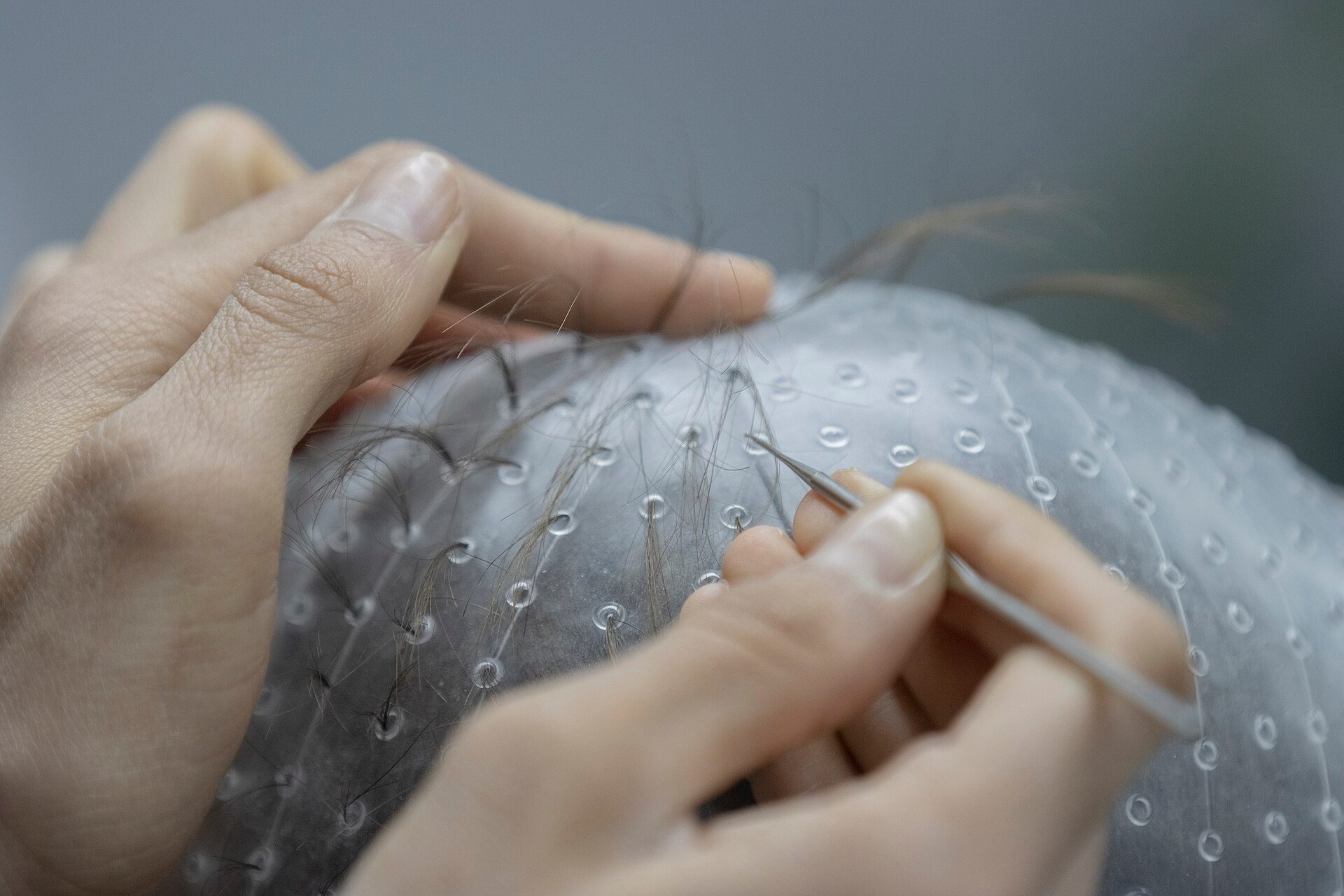
Photo: Mostafameraji / Wikimedia Commons, CC0
Root touch-up
Once 2–3 cm of new growth has come through, apply to the new growth only and stop exactly at the line of previously lightened hair. Use 6% developer and thin sections; overlapping onto old bleach again and again makes the hair snap along one line.
Chemical safety when bleaching
Lightener is a fine powder that becomes airborne when you scoop and mix it. The persulfates in it can irritate the skin, eyes and airways, and stylists exposed for years can develop occupational respiratory allergy. Use only products with a clear origin, Vietnamese-language labelling and a valid date, and always read the instructions.
Safety warning: Mix lightener in a ventilated spot, scoop gently, and wear a mask and nitrile gloves like the trainees in Figure 3. Do not mix lightener with other types or brands of product unless the instructions allow it, and do not seal a bowl of mixed lightener. Product in the eye: rinse at once with clean running water for about 15 minutes, then take the client to an eye doctor. Client feels burning during processing: rinse with cool water immediately; do not "hold on a few more minutes". Blistering or weeping on the scalp after bleaching is a chemical burn and needs a dermatologist. Swelling of the face or lips, difficulty breathing or fainting: call emergency services (115 in Vietnam) immediately.
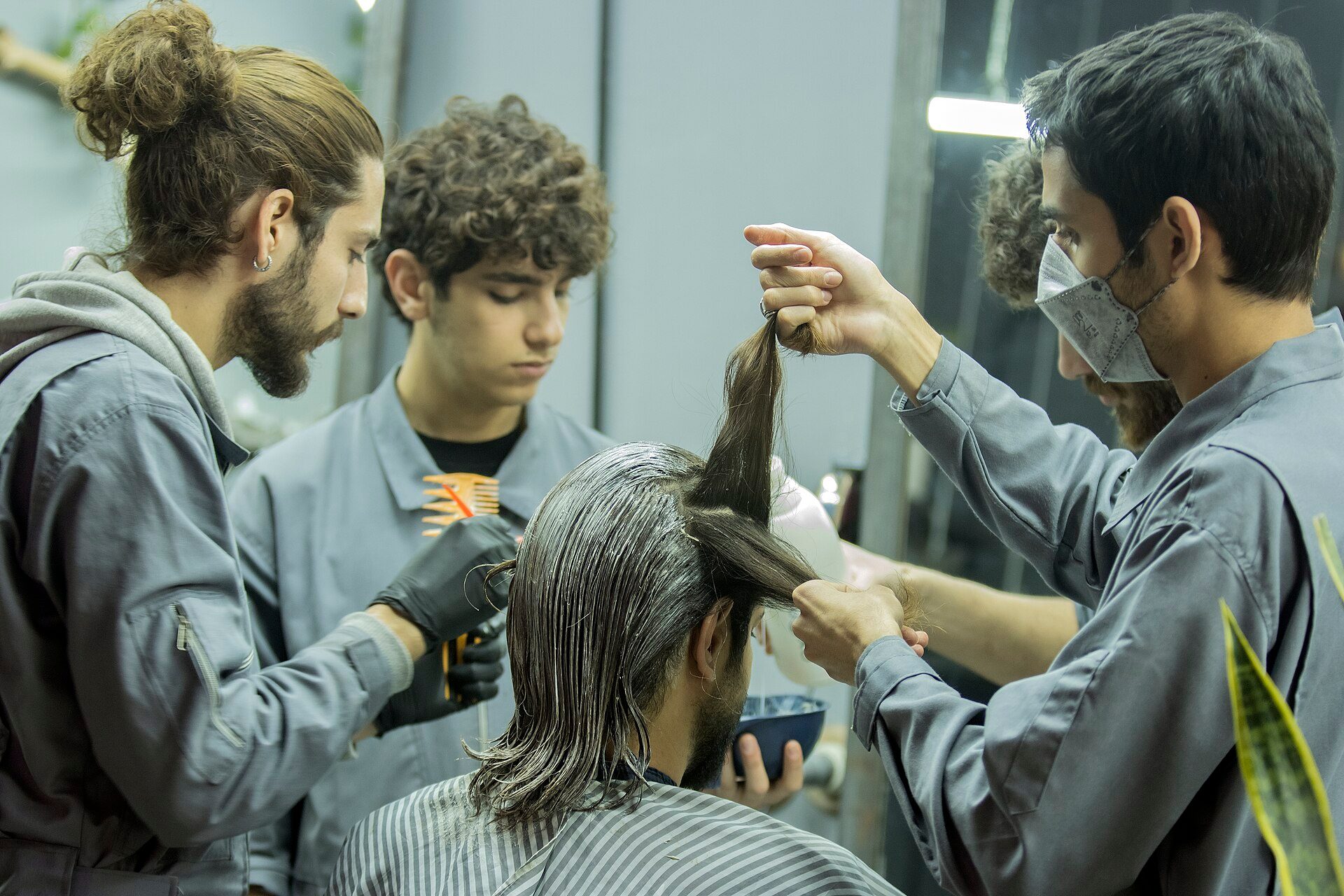
Photo: Mostafameraji / Wikimedia Commons, CC0
When to refuse to bleach
- A positive allergy test, or a history of severe reaction to hair dye.
- An inflamed, scratched or wounded scalp, or a scalp condition not cleared by a doctor.
- A failed elasticity test, or hair that was recently permed, relaxed or straightened (waiting time per the maker).
- A strand test that heats up, smokes or changes colour oddly.
When to tell the client to see a doctor
Itching, redness or burning that lasts more than a day after bleaching, blistering or weeping on the scalp, hair falling out in patches, or a rash spreading to the face or neck: advise the client to see a dermatologist and take the product names with them.
Worked example: a 26-year-old client from level 3 to level 9
Ha, 26, has natural level 3 hair (dark brown), never coloured, shoulder length, medium texture and medium density. She wants a smoky grey, which needs a level 9 base. Her allergy test is negative after 48 hours. A strand test at the nape with 6% developer reaches level 7 after 40 minutes and the hair is still elastic.
Plan: two sessions 14 days apart
From level 3 to level 9 is 6 levels. Doing it in one session would need high-strength developer and over-processing, so the plan is: session 1 to level 7 (matching the strand test), session 2 fourteen days later to level 9, then a grey toner.
Session 1 timing
| Task | Time |
|---|---|
| Consultation, scalp check, review test results | 20 min |
| Section, apply to lengths and ends (35 g powder + 70 g 6% developer) | 20 min |
| Wait for lengths to lift 1–2 levels | 15 min |
| Apply to roots (15 g powder + 30 g 6% developer) | 10 min |
| Process, checking every 10 minutes until an even level 7 | 25 min |
| Rinse, shampoo, condition | 20 min |
| Dry, read the level, fill in the card | 15 min |
| Total | 125 min |
Check: 20 + 20 + 15 + 10 + 25 + 20 + 15 = 125 minutes, about 2 hours 5 minutes. Total mix: 35 + 15 = 50 g of powder and 70 + 30 = 100 g of developer, a 1:2 ratio.
Product cost for both sessions (2026 reference, varies by brand and area)
| Item | Session 1 | Session 2 |
|---|---|---|
| Lightener (about 600 VND/g) | 50 g = 30,000 VND | 40 g = 24,000 VND |
| 6% developer (about 100 VND/g) | 100 g = 10,000 VND | 80 g = 8,000 VND |
| Bond-protecting treatment | 25,000 VND | 25,000 VND |
| Grey toner 30 g + 3% developer 60 g | 0 VND | 45,000 + 6,000 = 51,000 VND |
| In-salon repair mask | 20,000 VND | 20,000 VND |
| Gloves, foil, paper towels | 15,000 VND | 15,000 VND |
| Total | 100,000 VND | 143,000 VND |
Check: session 1 is 30,000 + 10,000 + 25,000 + 0 + 20,000 + 15,000 = 100,000 VND; session 2 is 24,000 + 8,000 + 25,000 + 51,000 + 20,000 + 15,000 = 143,000 VND. Products total 243,000 VND (about 9 USD). The salon price adds labour, equipment and rent; as a 2026 reference in Vietnam, bleaching plus colour for shoulder-length hair is often about 800,000 to 2,500,000 VND for the whole course, depending on the salon and area.
Toning and caring for bleached hair
Freshly bleached hair is at its weakest point in the whole process; the first two weeks decide whether it stays glossy or turns dry and straw-like.
Toning on the right base
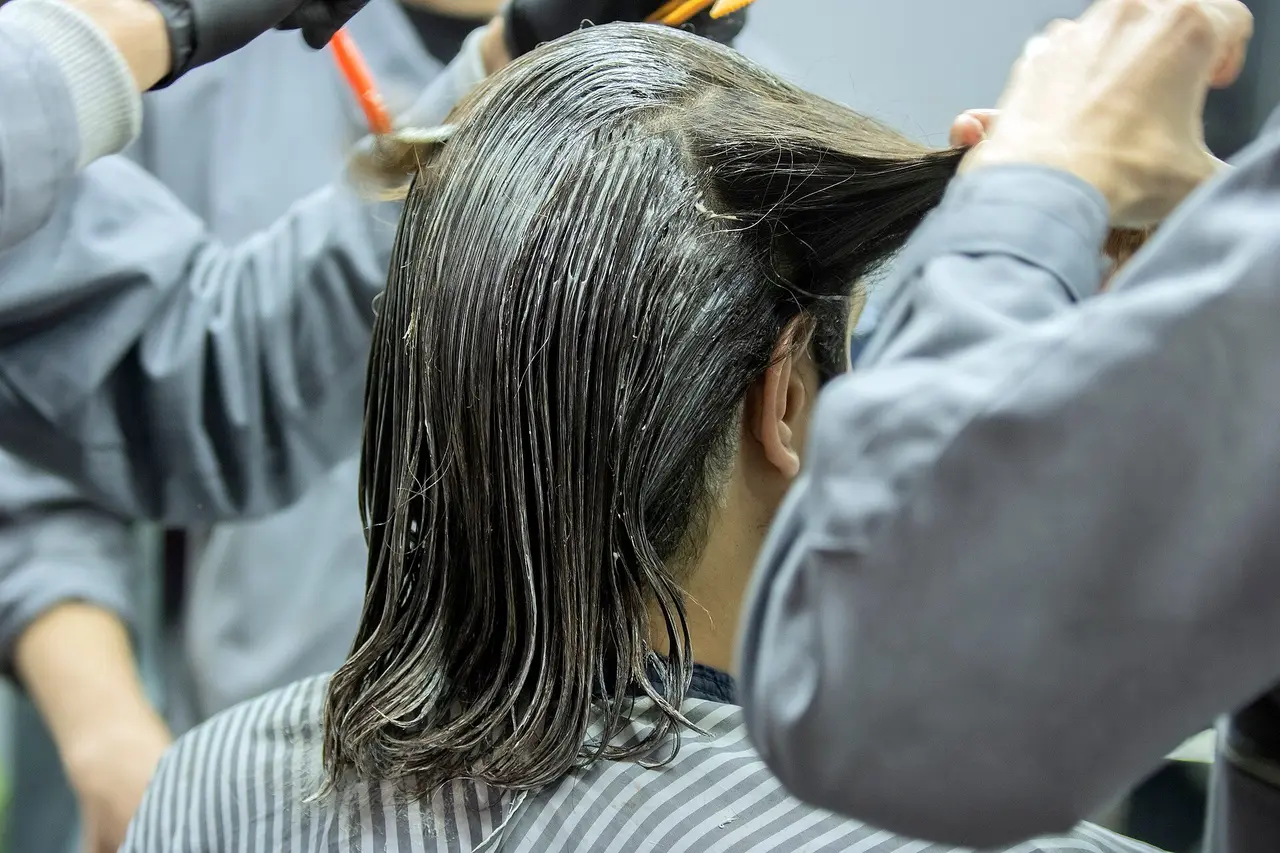
Toner is usually mixed with 3% or 6% developer as the maker specifies, applied to the lightened hair and left for the time on the box. Figure 4 shows hair lifted to a light blonde base being coloured with violet; on such a pale base violet shows up strongly, so apply it fast and evenly to avoid patches. Toners and semi-permanent colours fade with each wash, so the client should come back to refresh them after about 4–6 weeks.
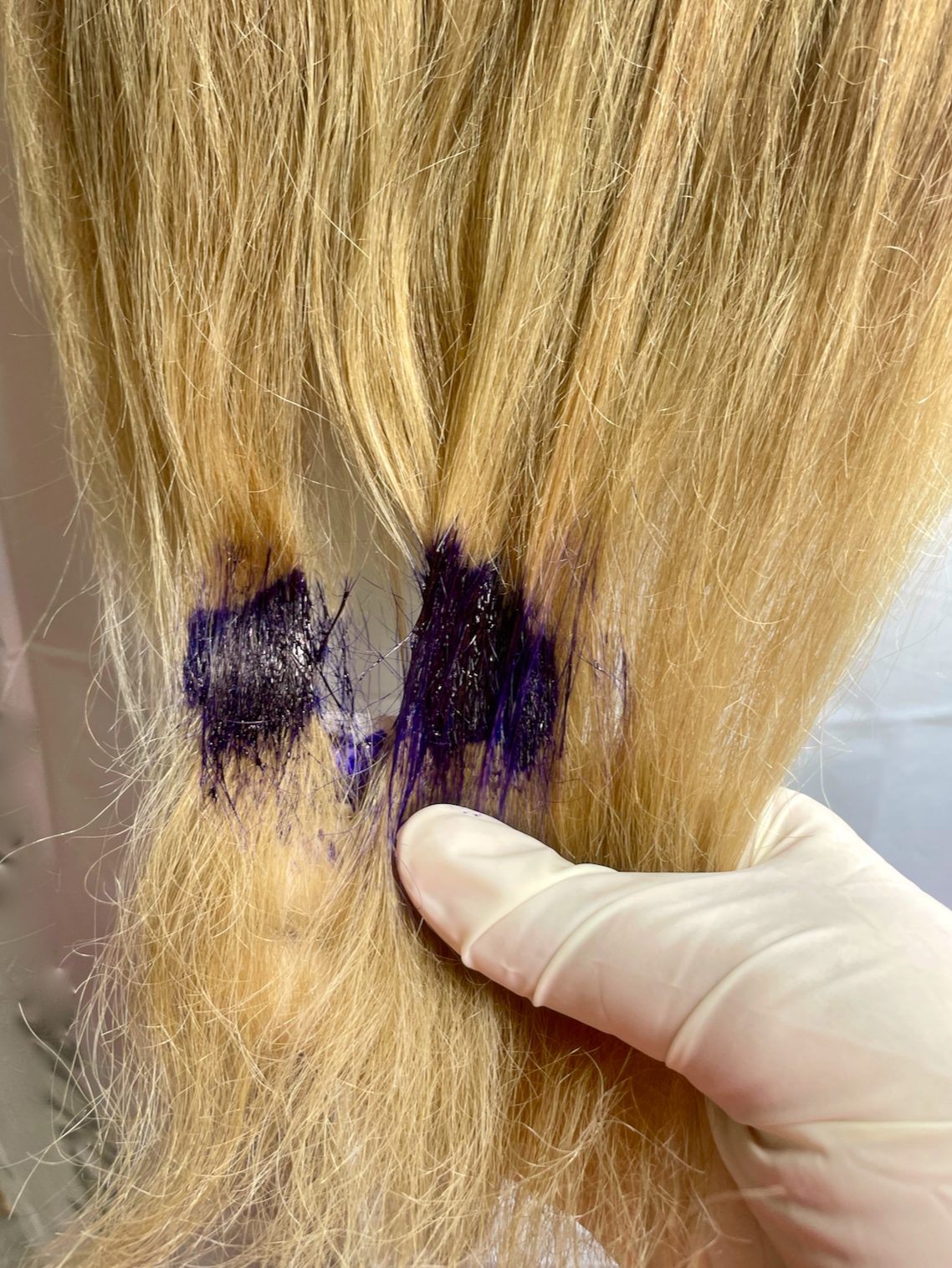
Photo: WhatamIdoing / Wikimedia Commons, CC BY-SA 4.0
Advice for the first two weeks
- Wait 48–72 hours before the next wash; use cool water and a gentle shampoo for chemically treated hair.
- Condition at every wash and use a repair mask once or twice a week.
- Blow-dry on low heat and limit straighteners and curling tongs; if used, apply a heat protectant.
- Wait at least 10–14 days before the next bleach, and only bleach again if the elasticity test still passes.
Common bleaching mistakes and how to fix them
Hot roots, dark lengths
Sign: pale yellow roots while the lengths and ends are still orange. Cause: roots applied first or together with the lengths. Fix: at the next session lighten the lengths and ends only, leaving the roots out.
Broken, over-processed hair
Sign: wet hair stretches a long way, snaps when combed, ends feel like straw. Cause: developer too strong, processing too long, overlapping onto bleached hair, or repeated bleaching without a break. Fix: stop all chemical services, use intensive repair treatments and cut off the damaged part; be honest with the client instead of promising to save it all.
Burning or red scalp
Sign: the client complains of strong burning during processing. Cause: strong developer on the scalp, washing just before bleaching, a scratched scalp, or processing under a steamer. Fix: rinse with cool water immediately and advise a doctor if blisters appear; next time use 6% at the roots.
Frequently asked questions
What developer strength should I use to bleach hair?
Use 6% next to the scalp. Thick, dark lengths can take 9% if the maker allows it and it does not touch the scalp. 3% is for mixing toner. Beginners should not use 12%.
How many bleaching sessions to get light blonde?
Vietnamese hair at levels 2–4 usually needs two sessions or more to reach levels 8–9, about 10–14 days apart. The real number depends on the strand test and how healthy the hair is.
Does bleaching damage the scalp?
It can cause tingling, dryness, irritation and chemical burns if done badly. Not washing for 24–48 hours beforehand, using 6% at the roots, avoiding heat and rinsing as soon as it burns all reduce the risk considerably.
How soon after bleaching can hair be coloured?
Toner is usually applied in the same session after rinsing and drying. Permanent colour or another bleach should wait about 10–14 days, depending on the hair and the maker's instructions.
Practice tasks and self-assessment
- Strand test three swatches of real human hair (bought or cut-off hair), one each with 3%, 6% and 9% developer; record the level after 10, 20, 30 and 40 minutes.
- Bleach a full head on a real-hair mannequin from a dark level to level 7, applying in the order lengths, ends, roots.
- Prepare a client card and product sheet for a client with waist-length level 4 hair who wants level 8, following the worked example.
Self-assessment criteria
- Pass: your level reading matches the shade chart within 1 level.
- Pass: the mannequin is an even level from root to tip, with no hot roots, and wet hair is still elastic.
- Pass: the client card records the allergy test, strand test, mixing ratio and timing for each zone, and the product sums add up.
- Not yet: skipping the allergy test, using more than 6% on the scalp, processing past the maker's time limit, or overlapping onto bleached hair.
Once bleaching and colouring feel secure, move on to the next roadmap step: Project: a portfolio of 15 cuts, perms and colours, where you complete full services on models, take before-and-after photos and keep proper records for your job applications.
Keep learning hairdressing: after bleaching and colouring come the portfolio project, the skills check, pricing and keeping clients. See the 8-step hairdresser roadmap.