Learning nails in Vietnam takes about 1–2 months to handle basic manicures and gel polish, 3–6 months to offer all the popular services such as tips, hard gel and simple nail art, and usually 1–2 years of real work to become a skilled technician whom clients ask for by name. Adverts promising "job-ready in 7 days" or "guaranteed pass, guaranteed job, 20 million a month" lead many people to pay up and then feel let down. This lesson helps you see each milestone clearly, compare the tuition of different training options, understand realistic nail technician pay in 2026 and prepare for a skills test before taking clients.
By the end of this lesson, you will be able to:
- Answer "how long does it take to learn nails" with 3 milestones: basics, all popular services, skilled technician.
- Compare 5 ways of training by duration, reference tuition for 2026 and the conditions attached.
- Calculate the practice hours needed for the 8 roadmap steps and build a learning plan for yourself.
- Estimate income by skill level and understand base pay plus commission.
- Prepare a skills test, a service price list and a guarantee policy before taking clients.
Want a clear path from day one? NAMBIN splits the nail trade into 8 steps, from hygiene and tool disinfection to a skills test and taking clients. See the 8-step nail technician roadmap to see where you are and what to learn next.
Quick answer: how long does it take to learn nails?
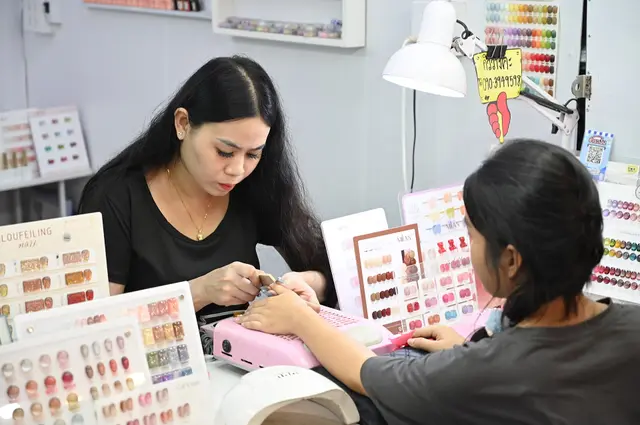
"Finishing" nail training is not a single date but three milestones in a row. Each answers one question: are you clean, safe and neat at a basic level; can you serve most clients who walk into a salon; and are you fast and skilful enough that clients come back for you personally? Figure 1 shows a manicure class in 1945 — the tools have changed a lot since then, but the way people learn has not: sitting opposite a model and repeating each movement under an instructor's eye. (Prices in this lesson are in Vietnamese dong; 1 million VND is roughly 40 US dollars.)

Photo: Mailer, John F / Wikimedia Commons, Public domain
Milestone 1: the basics — about 1–2 months
You disinfect tools using the correct routine, push and trim cuticles without drawing blood, shape nails evenly, apply regular polish and gel polish close to the sidewalls, and remove gel without damaging the nail. At the end of this milestone, you can assist in a salon with plain gel polish and basic manicures. With about 20 hours of practice a week, many people reach this milestone in 5–8 weeks.
Milestone 2: all popular services — about 3–6 months
You add tips, hard gel, acrylic, simple nail art, chrome powder, rhinestones and pedicures. What decides this is not the number of months but the number of sets you have done and whether you followed up on how they lasted after 2–3 weeks. Many salons only give extension clients to new technicians after seeing them do a few dozen sets with no lifting at the cuticle and no burning under the lamp.
Milestone 3: skilled technician — usually after 1–2 years
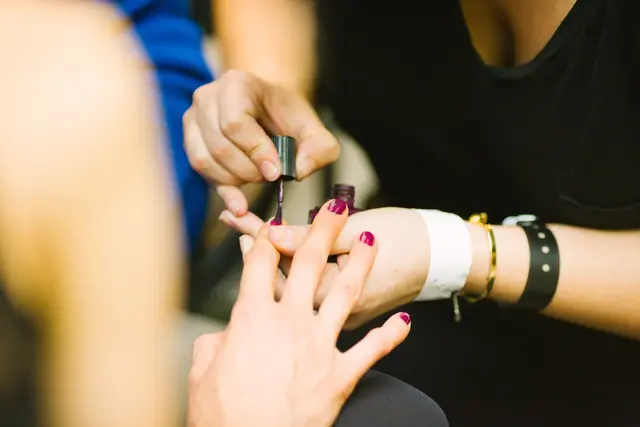
A skilled technician works quickly but still cleanly, can copy a design from a client's photo, builds difficult shapes, repairs broken nails and has regular clients. This milestone comes from time spent working, not something a class can speed up. Figure 2 shows a technician painting a design on a client's nails at the station — the kind of work that needs months of practice before the lines are steady.
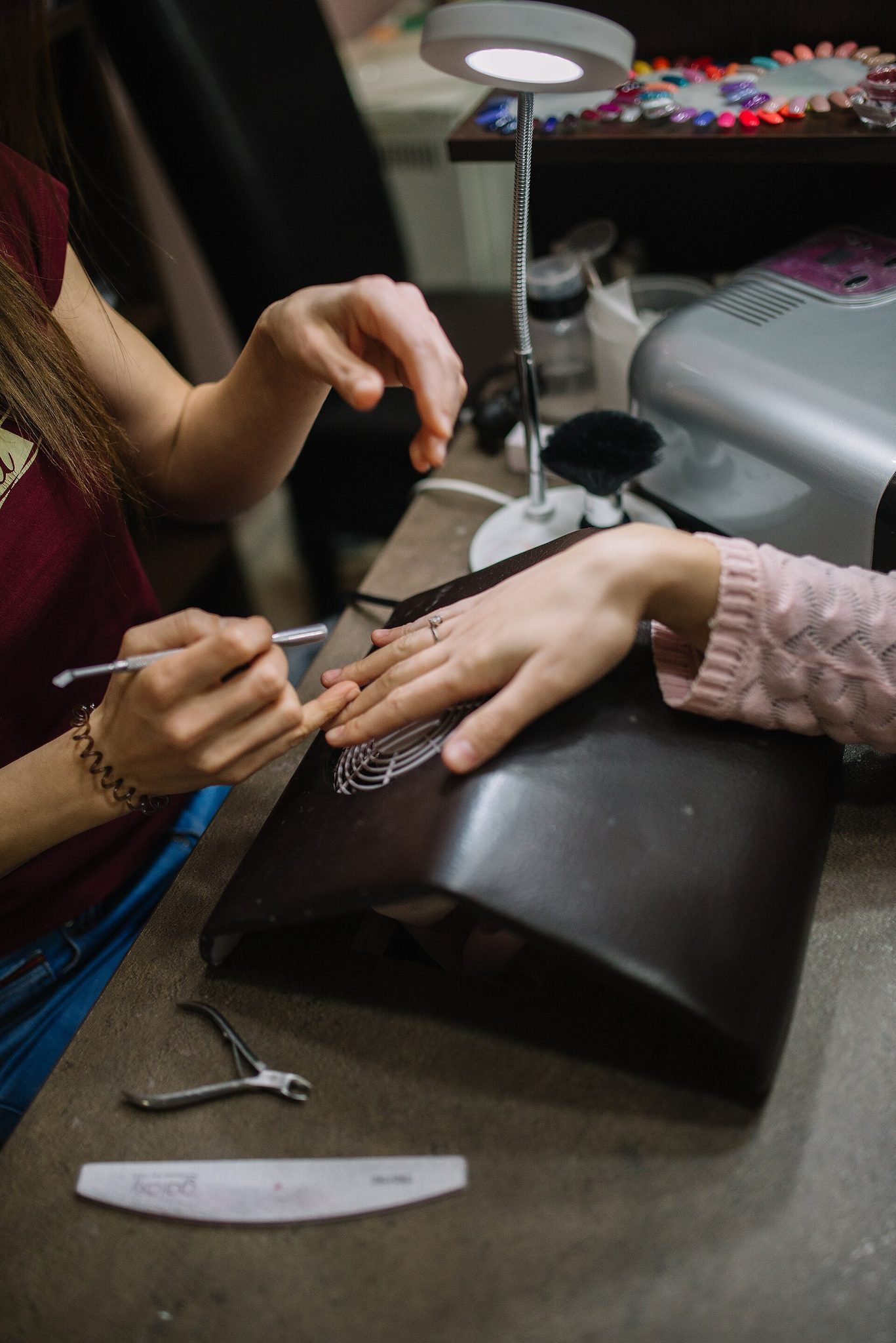
Photo: Shixart1985 / Wikimedia Commons, CC BY 2.0
5 ways to learn nails and reference tuition for 2026
In Vietnam there are five common ways to learn nails. None is best for everyone; choose based on three things: how much money you have, how soon you need an income, and whether you want to work in a salon or open your own nail station.
| Option | Duration | Reference tuition, 2026 | Suitable for |
|---|---|---|---|
| Basic course at a training centre | 1–2 months | 3–8 million VND | Beginners who want a foundation quickly |
| All-inclusive professional course | 2–4 months | 8–20 million VND | People with savings who want to study full-time |
| Apprenticeship in a salon | 3–6 months | 0–5 million VND, sometimes with a work commitment | People who need an early income |
| Advanced courses (extensions, nail art) | 1–4 weeks per course | 2–8 million VND | Working technicians who want to charge more |
| Online learning plus self-practice | Self-paced | 0.5–3 million VND | Theory and design ideas; you still need someone to correct your hand |
These figures are reference ranges for 2026 in large cities; the provinces are usually cheaper. They are not the price list of any particular school. Before you pay, ask: how many hours of practice on real hands in total, does someone grade your work, are tools included in the fee, and is proper disinfection taught?
Training centres: basic and all-inclusive courses
The advantages are a curriculum, small classes and practice models. The drawbacks: the paper you receive is usually a certificate of course completion, and the number of hours on real hands varies a lot between centres. A 2–4 month all-inclusive course sounds attractive, but if most of the time is spent on practice tips, you will still need time apprenticing in a salon.
Apprenticing in a salon
You join a salon as an assistant and a senior technician mentors you. Many places charge nothing; some charge a little or deduct it from your wages over time, usually with a commitment to work for 6–12 months. You get an allowance early and learn real work, but in a busy salon the foundations (disinfection, nail anatomy, refusing clients with nail conditions) are easily taught too quickly. Read the commitment carefully: the penalty if you leave early, what you will learn each month, and how much the allowance is.
Advanced courses and online learning
Advanced courses in extensions, nail art, ombre, cat-eye and chrome should only be taken once your gel polish is solid, because every one of those techniques sits on top of surface preparation. Online learning is useful for theory and design ideas, but hand pressure, brush angle and cuticle cutting must be watched and corrected in person.
What you need to learn: 8 steps and practice hours
Whichever option you choose, you must go through all 8 steps of the trade. Any course that skips a step leaves a gap, and the gap is often in step 1 — hygiene and disinfection — which clients never praise but which causes incidents when it is missing. The table below gives reference minimum practice hours to reach milestone 2.
| Step | Main content | Reference practice hours |
|---|---|---|
| 1. Hygiene, disinfection and chemical safety | 4-step tool routine, ventilation, refusing clients with nail conditions | 10–15 hours |
| 2. Nail anatomy, nail shapes and consultation | Nail plate, surrounding skin, shapes, asking about allergies | 10–15 hours |
| 3. Cuticle work, shaping and nail care | Pushing and trimming cuticles without bleeding, even filing on both sides | 30–40 hours |
| 4. Clean, long-lasting gel polish | Base, colour, top, curing, capping, removal | 40–60 hours |
| 5. Acrylic, hard gel and tips | Load-bearing structure, safe e-file use | 60–80 hours |
| 6. Nail art, ombre, chrome and rhinestones | Fine lines, flowers, gradients, secure stones | 40–60 hours |
| 7. Project: 20 sets on practice clients | Complete sets, timing, tracking how long they last | 40–60 hours |
| 8. Skills test, price list and taking clients | Timed test, price list, booking channels | 10 hours |
| Total | 240–340 hours |
At 20 practice hours a week, 240–340 hours is about 12–17 weeks, or 3–4 months — matching milestone 2 above. Any course that promises extensions, nail art and pedicures in 30–40 hours is leaving out most of this workload.
The first three steps: safe foundations and clean hands
Steps 1–3 are the least glamorous but decide whether a salon takes you on. Well-run salons usually have newcomers process tools and trim cuticles under supervision before giving them polish work. Learning these steps well also teaches you when to refuse a client whose nail looks fungal or whose skin around the nail is red and swollen.
Steps 4–6: the skills that earn money
Gel polish is the most requested service; extensions and nail art command higher prices. The order matters: if your gel polish still lifts, your extensions will also lift at the cuticle, because both rely on surface preparation and correct curing.
Steps 7–8: proving your skill
The 20-set project is when you record the time for each set, take photos and ask your practice clients after 2–3 weeks whether the nails have lasted. These photos become your portfolio for job applications or your social media page. Step 8 is the final combined test, covered in detail at the end of this lesson.
Nail technician pay in 2026: how much, and how is it calculated?
A nail technician's income depends on three things: skill (whether you can do higher-priced services), how many clients the salon has, and how pay is calculated. The figures below are reference ranges for 2026; they vary by region and salon and are not guaranteed.
| Level | Can do | Reference income, 2026 |
|---|---|---|
| Apprentice | Helps with disinfection, cuticles, plain polish under supervision | Allowance of about 3–5 million VND/month |
| Junior technician | Gel polish, manicures and pedicures, tips | About 6–9 million VND/month |
| Experienced technician | Hard gel, acrylic, nail art from photos, regular clients | About 10–15 million VND/month |
| Skilled technician or small salon owner | Difficult designs, special shapes, managing clients | About 12–25 million VND/month |
Base pay plus commission
Many salons pay a low base wage plus a percentage commission on the service revenue you generate; some pay no base at all but a higher percentage. The rates differ everywhere, so ask in concrete numbers: "For a 150,000 VND gel set, how much do I get?". Also ask about client tips, meal and lodging allowances, and days off per month when you accept a job.
Why income varies so much within the same trade
A technician who only does plain gel polish is held back by low service prices. A technician who can do extensions and nail art earns several times more per client. Location matters too: salons in busy neighbourhoods and shopping malls have far more clients than those on quiet streets. Figure 3 shows a lane in Hanoi lined with nail salons — a familiar sight in many residential areas, showing both strong demand and fierce competition.

Photo: Gispenni / Wikimedia Commons, CC BY-SA 4.0
Working as a nail technician abroad
Many people learn nails hoping to work abroad, where there are many Vietnamese-run nail salons. Each country has its own rules on licensing, required training hours and work visas; a certificate earned in Vietnam is usually not recognised automatically. Get information from that country's official sources and be wary of services promising "visa and job guaranteed" for high fees.
Worked example: Ngoc, 21, plans 7 months of nail training
Ngoc has just quit her job as a cafe server, has 10 million VND in savings and wants to be earning within 3 months. She compares two options; all figures are illustrative, reference 2026.
Option A: a 3-month all-inclusive professional course
- Tuition: 12 million VND.
- Her own practice kit: 3.5 million VND; travel for 3 months × 0.5 million = 1.5 million VND.
- Total spending: 12 + 3.5 + 1.5 = 17 million VND — 7 million more than her savings, with no income for 3 months.
- Result: a certificate of course completion, but she still needs time in a salon before handling extension clients alone.
Option B: basic course + apprenticeship + advanced extensions course
- Months 1–2: basic course (disinfection, cuticles, gel polish) 5 million; home practice kit 2 million.
- Months 3–6: apprenticeship at a 5-station salon, allowance 4 million/month × 4 = 16 million VND. By the end of month 6, Ngoc has done about 60 gel polish clients and is allowed to take clients alone.
- Month 7: advanced hard gel and acrylic course, 5 million VND, in the evenings.
- Travel for 7 months × 0.5 million = 3.5 million VND.
- Total spending: 5 + 2 + 5 + 3.5 = 15.5 million VND; total allowance 16 million. Net cost: 15.5 − 16 = −0.5 million, meaning Ngoc is about 500,000 VND ahead after 7 months.
Ngoc's conclusion
Option B takes 4 months longer but almost pays for itself, needs no loan, and after 7 months Ngoc has both real client experience and extension skills. Option A suits someone with savings who wants to study intensively first. What both have in common: you must go through a period of working on real clients with someone grading you — there is no shortcut.
Skills test, price list and taking clients (step 8)
The final step of the roadmap is proving to yourself that you are ready for clients: correct, fast enough, clean, and with clear ways of working with clients. Whether you join a salon or open a home nail station, you need all three parts below.
A self-set practical test
- Disinfect 1 set of tools through the full routine, with someone checking each step.
- Manicure and plain gel polish on 10 nails in about 60–75 minutes, without touching the skin or drawing blood.
- Tips or hard gel on 10 nails in about 90–120 minutes, with an even shape on both hands.
- Follow-up after 14 days: no lifting, no gaps at the cuticle, no pain or burning for the client.
Reference service prices for 2026
In everyday to mid-range salons, plain gel polish costs about 80,000–200,000 VND, tips about 150,000–350,000 VND, hard gel or acrylic about 250,000–500,000 VND, nail art an extra 10,000–50,000 VND per nail depending on difficulty, and a pedicure about 80,000–200,000 VND. These are reference ranges that vary by area; survey 3–5 salons near where you work before setting prices. State your lifting guarantee clearly on your price list (many salons guarantee gel polish for 3–7 days).
Booking channels and your first clients
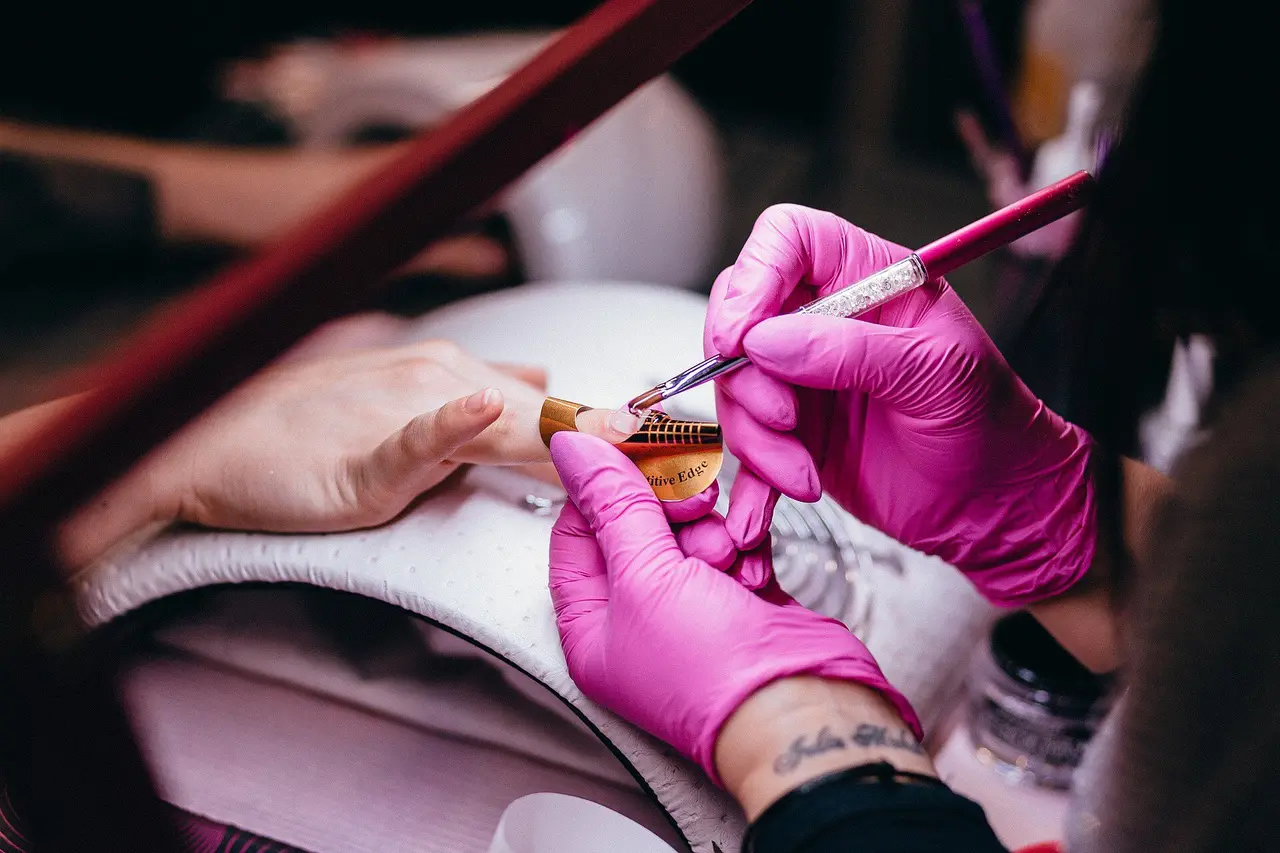
A phone number on Zalo (Vietnam's most popular messaging app) dedicated to bookings and a social media page showing the 20 sets from step 7 are enough to start. Take photos in natural light, from the same angle, with the design name and price. Your first clients are usually referrals from people you know; do an excellent job and remind them to share photos.

Photo: Sarah_Ackerman / Wikimedia Commons, CC BY 2.0
Safety warning for learning and working in nails: nail work means daily exposure to acetone (highly flammable), disinfectants, acrylic monomer and nail dust. Choose a training place with good ventilation that teaches you to wear gloves and a mask and to store chemicals away from flames. Uncured gel on the skin can cause a lasting allergy; wipe away flooding before curing. Do not work on clients with suspected nail fungus, red and swollen skin around the nail or open wounds — advise them to see a dermatologist.
Common mistakes when choosing where to learn
Choosing the fastest, cheapest course
Symptom: "job-ready in 7 days, every service covered". Cause: comparing by price and number of days instead of practice hours. Fix: convert everything into hours of practice on real hands with someone grading you; under about 240 hours for all 8 steps is not enough.
Learning extensions and nail art before gel polish is solid
Symptom: beautiful designs, but clients' nails lift within a week. Cause: chasing trending designs online. Fix: only take advanced courses once gel polish on 10 nails lasts 14 days without lifting.
Skipping disinfection
Symptom: the school uses one set of nippers for the whole class and only sprays alcohol. Cause: the school wants to save money. Fix: ask about their disinfection routine before enrolling; if the teacher does it wrong, you will learn it wrong.
Signing an apprenticeship commitment without reading it
Symptom: a high penalty for leaving early and no description of what you will learn. Cause: being too shy to ask for fear of losing the place. Fix: ask clearly about the commitment period, allowance and monthly learning content, and keep a signed copy.
Frequently asked questions
How soon after starting can I earn a wage?
As a salon apprentice, you receive an allowance from the first month. If you study at a centre, you usually take 1–2 months of basics, then a few weeks to a few months in a salon before handling clients on your own.
What is a reasonable price to pay for nail training?
Reference for 2026: basic courses 3–8 million, all-inclusive courses 8–20 million, apprenticeships 0–5 million, advanced courses 2–8 million VND each. Do not compare on price; compare the hours of graded practice and what is actually taught.
Can I learn nails if I am not artistic?
Yes. Most salon revenue comes from gel polish, tips and extensions — which need care and patience more than artistic talent. Simple nail art can be learned by practising lines every day.
Do I need a certificate to work in nails?
Many salons hire people without certificates and train them in-house, but a certificate and a portfolio of your work make job hunting easier. If you plan to work abroad, research that country's licensing requirements.
How much capital do I need to open a home nail station?
Reference for 2026: a small nail station needs about 10–30 million VND (roughly 400–1,200 USD) for a table and chairs, lamp, steriliser, tools, polish and initial supplies, depending on quality. It is wise to work in a salon for at least a few months first to build skill and regular clients.
Exercise: build your own nail learning plan
- Write down how much money you can spend on training and how many months you can manage without income.
- Choose 2 options from the table and calculate total spending and income as in Ngoc's example.
- Call at least 2 training providers and ask: total hours of practice on real hands, whether tools are included in the fee, and how they disinfect.
- Mark the 8 steps in the practice-hours table, noting where you will learn each step and the month you expect to finish.
- Survey the prices of 3 salons near you and draft your first price list.
Self-assessment criteria
- Pass: your plan states total costs in numbers that add up correctly; it includes at least 240 practice hours for all 8 steps; it has a date for your own skills test.
- Pass: your draft price list includes a lifting guarantee and prices within the range of the salons you surveyed.
- Not yet: your plan just says "take a crash course, then start work", has no practice hours, or leaves out disinfection.
This is the final step of the roadmap. Once you are taking clients, regularly revisit the two foundation lessons on disinfecting nail tools and fixing lifting gel polish, keep a guarantee log so you can correct your own mistakes, and then grow further with new designs, advanced extensions or management skills if you want to open a salon. Review the whole 8-step nail technician roadmap to choose your next advanced skill.