Skin type and skin concern are two different things: skin type (oily, dry, combination, normal) is a fairly stable base that decides the texture of the products you suggest, while a skin concern (sensitivity, acne, dark marks, melasma, ageing) is a condition that changes over time, and some concerns are beyond what cosmetics can handle, so the customer should see a dermatologist. A good counter advisor is not the one who sells the most items, but the one who reads the skin base correctly, says honestly how far cosmetics can go, and knows when to stop selling. This lesson is written the way a counter manager coaches a new advisor, with a worked example of three customers in one afternoon shift.
By the end of this lesson, you will be able to:
- Tell skin type apart from skin concern and explain to customers why you need both.
- Identify the 4 skin types with 5 counter questions, even when the customer is wearing makeup.
- Say what cosmetics can and cannot do for acne, dark marks, melasma, ageing and sensitive skin.
- Place each customer in one of three levels, green, amber or red, and know when to recommend a dermatologist.
- Phrase a referral naturally, without diagnosing and without making the customer feel turned away.
Want to learn the beauty advisor trade properly? This is step 2 of the path, after genuine products and advisor ethics. See the 8-step beauty advisor learning path to study in the right order.
How are skin type and skin concern different?
Customers often describe themselves as "oily, acne-prone" or "dry with melasma": that mixes two layers of information. Separating them is your first job.
Skin type is the base
Skin type reflects the skin's natural oil and moisture levels, largely driven by constitution, age and hormones. It changes slowly, with the seasons or over the years. Skin type answers the question "which texture?": a light gel, a lotion, a rich cream or a balm. An oily-skinned customer using a very heavy cream will feel congested and greasy even if the ingredients are good.
A skin concern is a condition
A skin concern is what the customer wants to improve: breakouts, dark marks, patches of pigmentation, wrinkles, redness and stinging. It can appear on any skin type. Dry skin can still break out, and oily skin can still be dehydrated and flaky. A concern answers "which active ingredient?", which you will study in the next step, and, more importantly, "is this still a job for cosmetics at all?".
A counter advisor is not a spa therapist
A spa therapist can cleanse the face and examine it under a magnifying lamp; you stand at a counter, the customer is wearing makeup, and you have 5 to 10 minutes. Your main tools are questions and observation. For a full spa skin analysis, read how to identify skin type with a magnifying lamp from the skincare specialist path.
The 4 basic skin types: recognising them at the counter
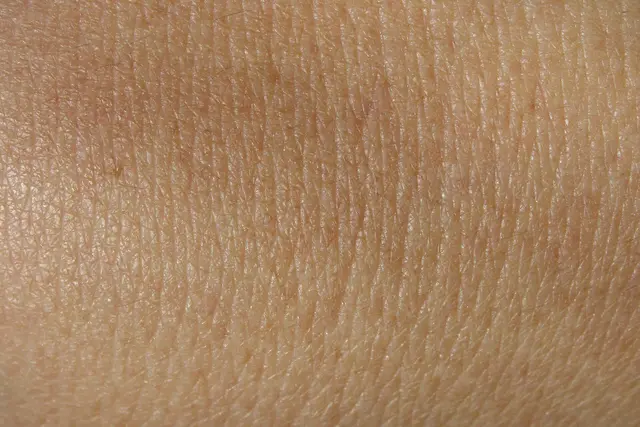
Most skincare references use 4 types: oily, dry, combination and normal. Many also count "sensitive" as a fifth type; in this lesson we treat it as a tendency that can come with any type, because it is handled very differently (see its own section below). Healthy skin has a fine, even network of small lines, as in Figure 1; on dry skin these lines look sharper and rougher, while oily skin looks shiny with larger pores.
Photo: Klafubra at German Wikipedia / Wikimedia Commons, CC BY-SA 3.0
| Skin type | What customers say | What you can observe | Textures that usually suit | Avoid suggesting |
|---|---|---|---|---|
| Oily | Shiny all over after 1 to 2 hours, foundation slides off | Large pores on nose, cheeks, forehead; shine even after powder | Gels, light lotions, fluid or gel sunscreen | Rich creams, face oils; harsh cleansers that leave skin tight |
| Dry | Tight after washing, flaking, powder looks patchy | Small pores, light flaking on cheeks and around the nose | Medium-weight creams, gentle low-foam cleansers | Toners high in drying alcohol, heavy exfoliation |
| Combination | Shiny forehead and nose; cheeks normal or dry | Shiny T-zone, pores clearly larger than on the cheeks | A light lotion for the whole face, plus cream on dry areas if needed | One heavy cream for the whole face |
| Normal | Rarely uncomfortable, little shine or tightness | Even surface, small to medium pores | Most textures, keep it simple | Upselling many unnecessary steps |
Skin type shifts with season and age
Many customers in northern Vietnam have combination skin in summer but dry, flaky cheeks in the dry winter; women over 40 often notice their skin getting drier. With regular customers, ask again whenever the season changes.
Five questions to identify skin type when the customer wears makeup
Once foundation is on, your eyes can barely read the real skin. Instead, ask in a fixed order so nothing is missed.
The five questions in order
- "About an hour after washing your face, with nothing on it, how does your skin feel?" Shiny all over suggests oily; shiny only on forehead and nose suggests combination; tight and dry suggests dry.
- "By midday, does your foundation slide off, look patchy, or stay fine?" Sliding in the T-zone points to oily or combination; patchy and flaking points to dry.
- "Does your skin often turn red, sting or itch when you change products?" This looks for a sensitive tendency.
- "What are you using now, including any skin creams or tablets from a doctor?" Crucial: if the customer is on prescription treatment, any active ingredient suggestion must wait for the doctor's advice.
- "What do you most want to improve, and since when?" The last question opens up the skin concern and gives you the facts to set the green, amber or red level later.
The bare-skin test at home
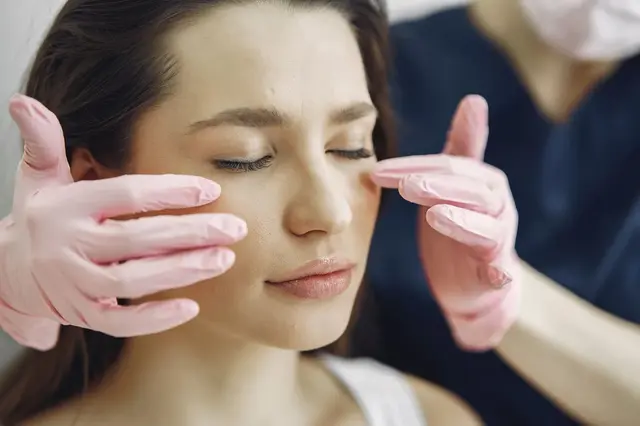
If the customer is unsure, suggest a self-test: in the evening, wash with a gentle cleanser, pat dry, apply nothing, wait 1 to 2 hours, then check in a mirror in daylight and press blotting paper on the forehead, nose and cheeks. Gentle cleansing as in Figure 2 is the first step. When the customer messages back the result, your advice becomes more accurate.

Photo: Shixart1985 / Wikimedia Commons, CC BY 2.0
Sensitive skin and the skin barrier
Sensitive skin reacts easily: stinging, burning, redness or itching with products other people use without trouble. It can be constitutional, or the result of poor care that damages the skin barrier (the outermost layer that holds in water and keeps out irritants).
Signs a customer has sensitive skin
- Even an ordinary moisturiser stings for a few minutes.
- The skin flushes in hot weather, after spicy food or after hot water.
- A history of rashes from perfume or fragranced cosmetics.
- Thin skin with visible small blood vessels on the cheeks.
Common causes seen at the counter
The three most common causes are exfoliating too often, layering several strong actives copied from online videos, and past use of "kem tron" (unlabelled mixed whitening creams sold in Vietnam). Thin, red skin with visible vessels after such creams is a matter for a doctor, not for a "repair" cosmetic.
How to advise sensitive skin
The rule is fewer but safer: fewer products, fewer ingredients, no fragrance, and introduce one new product at a time, 1 to 2 weeks apart. Before using something new, suggest testing a small amount, as in Figure 3, behind the ear or on the inner forearm for several days in a row. If it reacts, stop and note the product name.

Photo: Shawn Campbell / Wikimedia Commons, CC BY 2.0
Acne, dark marks, melasma, ageing: what can cosmetics do?
For each concern, know three things: what cosmetics can support, where the limits are, and which signs mean the case has gone beyond a cosmetics counter. The descriptions below are for recognising and referring, not for diagnosing.
Acne
Scattered blackheads and whiteheads, with an occasional small red spot, is a mild level; proper cleansing, a non-clogging moisturiser and sunscreen usually help the skin look better. Cosmetics for acne-prone skin usually need about 4 to 8 weeks of regular use before you can judge them, so never promise "spots gone in a week". Many inflamed spots, nodules or cysts (large, painful, deep lumps), or acne that is already leaving pitted scars need a doctor, because waiting can leave permanent scars.
Post-acne marks and scars
A dark mark is the darker patch left after a spot heals; it usually fades over several months if the customer stops squeezing spots and uses sunscreen consistently. A pitted scar is where tissue has been lost; topical cosmetics cannot fill it, and a dermatologist should assess it.
Melasma and freckles
According to common medical descriptions, melasma usually appears as brown patches, fairly symmetrical on both cheeks, the forehead and the upper lip, more common in women, linked to sun and hormones, and long-lasting with a tendency to return. Freckles are small scattered spots that darken in the sun. Both need daily sunscreen (Figure 4). A dark patch should be seen by a doctor before anyone calls it "melasma", because some other pigmented spots look similar but need very different handling. The counter does not sell a "melasma cure".
Ageing
Fine lines, reduced elasticity and sun spots are ordinary signs of ageing. Daily sunscreen and moisturiser are the foundation. Set expectations clearly: cosmetics help skin look smoother, they do not erase deep wrinkles or lift sagging skin.
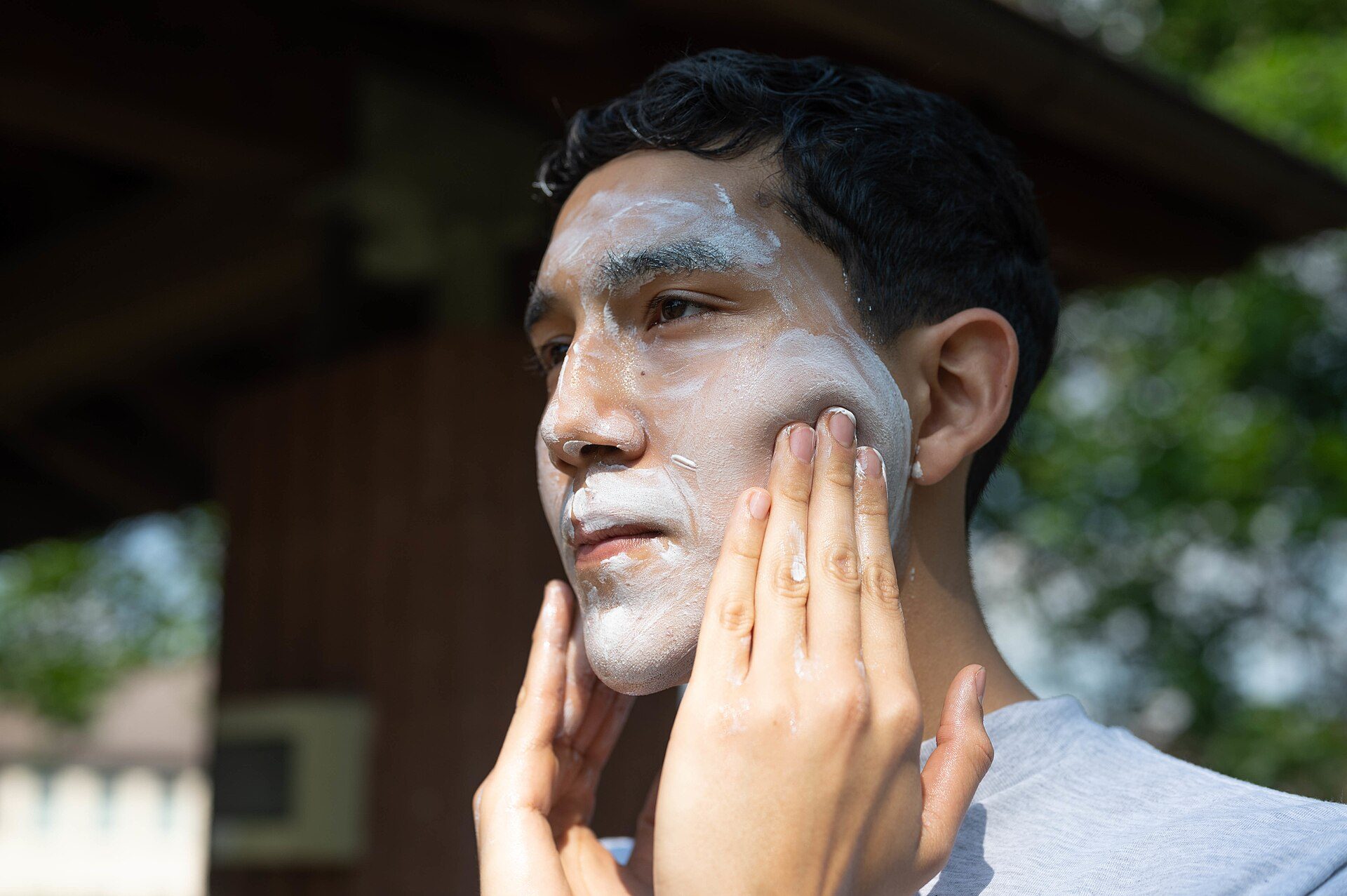
Photo: U.S. Air Force photo by Senior Airman Taylor Slater / Wikimedia Commons, Public domain
| Concern | What cosmetics can support | Limits to state honestly | Signs to refer |
|---|---|---|---|
| Acne | Blackheads, whiteheads, mild scattered inflamed spots | Needs 4 to 8 weeks; no "permanent cure" | Many inflamed spots, nodules, cysts, scarring; sudden acne in adults |
| Post-acne marks | More even-looking tone over time | Fades over months, depends on sunscreen | Spreading or long-lasting marks, or pitted scars |
| Melasma, freckles | Sunscreen, brighter and more even-looking skin | Melasma is long-lasting and returns easily | Dark patches never seen by a doctor; fast spreading |
| Ageing | Moisturiser, sunscreen, smoother-looking skin | No erasing deep lines, no lifting | New spots or moles changing in shape or colour |
| Sensitive skin | Gentle cleansing, moisturising, short ingredient lists | No promise of "never irritating" | Redness, itching, scaling for weeks; thin red skin after mixed creams |
When is a doctor needed? The green, amber, red system
Long lists are easy to forget when the counter is busy. Place each customer into one of three levels right after the five questions, then act on that level.
Green: advise as normal
Healthy skin or mild, stable concerns: shine, tightness, a few whiteheads, fine lines. Advise by skin type and budget, and schedule a follow-up message after 2 to 4 weeks.
Amber: basics only, monitor, refer if no improvement
A clearer concern but no warning signs: moderate inflamed acne, many dark marks, a long-standing dark patch, skin that often reddens when products change. Suggest only a gentle basic set (cleanser, moisturiser, sunscreen), do not add strong actives, and say clearly: if there is no improvement after about 6 to 8 weeks of regular use, or it gets worse at any point, see a dermatologist.
Red: stop selling actives, refer early
If you see any sign below, do not sell "problem-solving" products; at most suggest a basic cleanser or moisturiser if the customer needs one, and recommend seeing a dermatologist soon (Figure 5). The list follows general medical guidance:
- Dense inflamed acne, nodules, cysts, or acne that is leaving scars.
- A mole or pigmented spot that changes: halves that do not match, ragged edges, several colours in one spot, fast growth, itching or bleeding.
- A sore or raw patch on the skin that has not healed after about 4 weeks.
- Red, itchy, scaling or weeping skin for several weeks; suspected eczema, fungal infection or psoriasis.
- Swollen, hot, painful skin with pus, especially with fever.
- Thin red skin, visible vessels and tiny bumps after a period of using mixed creams.
- An adult woman who suddenly gets a lot of acne along with irregular periods or excess hair growth: a doctor should look for the cause.
- A customer on prescription skin treatment, pregnant or breastfeeding, who wants strong actives.
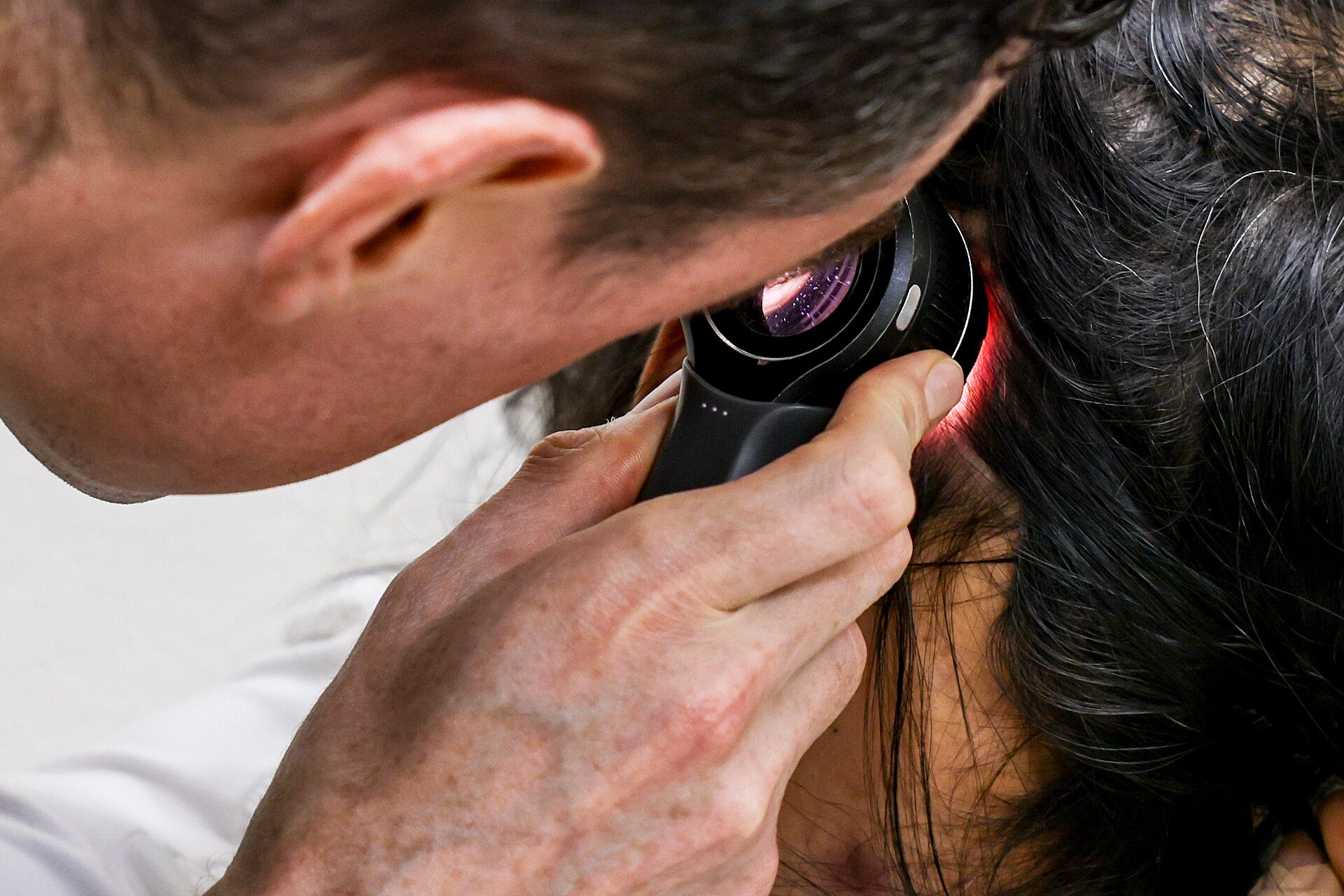
Photo: U.S. Marine Corps photo by Sgt. Samuel Qin / Wikimedia Commons, Public domain
Health note: Beauty advisors do not diagnose skin disease, do not prescribe and do not replace a doctor. Swelling of the face, lips or tongue, difficulty breathing, or a rash spreading quickly after applying a product is an emergency: call 115 (Vietnam's ambulance number) or take the customer to the nearest medical facility immediately. Burning, blistering or weeping skin after using a cosmetic: stop using it, rinse with cool water and see a doctor. This lesson is general knowledge for recognising and referring, not treatment advice.
How to refer without offending the customer
Customers can feel politely turned away. Speak in three parts: acknowledge, explain why, and say what you can still do. For example: "I can see a few large, painful spots on your chin. Cosmetics can't treat this kind, and leaving it can cause scars. I'd suggest seeing a dermatologist first. Once the doctor gives you a plan, bring it here and I'll pick a cleanser, moisturiser and sunscreen that won't clash with your treatment." Do not say "you have folliculitis" or "this is vascular melasma", because that is a diagnosis.
Use descriptive words, not diagnostic ones
When you write in your customer log, record what you see and what the customer says: "large red spots on the chin, customer says painful, for 2 months". This lets you continue next time without "talking like a doctor". If a customer reacts to a product bought at your counter, follow the procedure from the lesson on spotting fake cosmetics and advisor ethics.
Worked example: three customers in one afternoon shift
A derma-cosmetics counter inside a pharmacy, shift from 2 pm to 6 pm. Prices are 2026 reference prices for mid-range products in Vietnam, varying by brand and region.
Customer A: Thu, 27, green
Thu says her forehead and nose get shiny after an hour, her cheeks are normal, she has blackheads on her nose, takes no medication, and her budget is about 600,000 VND. You classify: combination skin, mild concern, green. You suggest three items: a gentle cleanser at 165,000 VND, a gel moisturiser at 185,000 VND and a fluid sunscreen at 240,000 VND. Total 165,000 + 185,000 + 240,000 = 590,000 VND (about 23 USD), within budget. You schedule a follow-up message after 2 weeks.
Customer B: Hoa, 41, amber moving to red
Hoa wants a "melasma cream" at 1,200,000 VND and a serum at 850,000 VND, 2,050,000 VND in total. She has had brown patches on both cheeks for about 2 years, has never seen a doctor and has already tried 3 creams herself. You do not sell the cream or the serum, explain that a doctor needs to identify the condition correctly, sell only a sunscreen at 240,000 VND, and invite her back after her appointment.
Customer C: Khoa, 19, red
Khoa has many inflamed spots on his cheeks and chin, a few large painful ones, has tried 4 acne products in 2 months, and his skin is starting to sting and redden. This is red. You advise him to stop layering products and see a dermatologist soon. He wants something to use in the meantime, so you suggest only a gentle cleanser at 165,000 VND.
| Customer | Skin type | Main concern | Level | Sold | Next step |
|---|---|---|---|---|---|
| Thu, 27 | Combination | Blackheads on the nose | Green | 590,000 VND | Message after 2 weeks |
| Hoa, 41 | Normal, slightly dry | Brown patches on cheeks, never examined | Amber to red | 240,000 VND | Return after seeing a doctor |
| Khoa, 19 | Oily | Inflamed acne, large painful spots | Red | 165,000 VND | Return after seeing a doctor |
| Shift total | 995,000 VND | ||||
Check: 590,000 + 240,000 + 165,000 = 995,000 VND. Selling what Hoa asked for would have brought 2,050,000 VND, but if her skin did not improve or reacted, the shop would lose both the customer and its reputation. Customers who get honest advice tend to come back because they trust you.
Common mistakes when advising on skin type and concerns
Labelling every shiny face "oily"
Sign: the customer is shiny but complains of tightness and stinging. Cause: you only looked and skipped questions 1 and 3. Fix: always ask how the skin feels after washing; if it is tight and stinging, think of a weakened barrier and suggest gentle cleansing and moisturising first.
Naming a disease for the customer
Sign: you say "you have melasma" or "you have atopic dermatitis". Cause: wanting to sound professional. Fix: describe what you can see and recommend that a doctor confirm it.
Selling an "acne kit" to a customer with severe acne
Sign: a customer with nodules buys 4 or 5 active products and returns 2 weeks later with red, stinging skin. Cause: chasing sales and ignoring the red level. Fix: apply the three levels; at red, do not sell problem-solving products.
Frequently asked questions
How many facial skin types are there?
The most common system has 4: oily, dry, combination and normal. Many also count sensitive skin as a fifth; in practice it can come with any type. Skin type can change with season and age.
Does oily, acne-prone skin need moisturiser?
Yes. Oily skin can still be dehydrated, especially after harsh cleansers. Choose a gel or light lotion, labelled non-comedogenic where possible.
What is the difference between melasma and freckles?
In general descriptions, melasma is usually brown patches, fairly symmetrical on the cheeks and forehead; freckles are small scattered spots that darken in the sun. Both need sunscreen, but a dermatologist should identify them before you choose a care plan.
When should acne be seen by a dermatologist?
When there are many inflamed spots, nodules or cysts, when acne leaves scars, when it does not improve after about 6 to 8 weeks of proper care, or when an adult suddenly develops a lot of acne together with hormonal changes. At that point cosmetics cannot replace treatment.
Practice exercises and self-assessment
- Ask the five questions to 5 people you know, and record the likely skin type, main concern and green, amber or red level for each.
- Ask 2 people to do the bare-skin test at home and compare the result with your guess.
- Role-play with a colleague: one plays a customer with cystic acne who wants a 5-item kit, the other gives a three-part referral.
Self-assessment criteria
- Pass: you ask all five questions in order in under 5 minutes and record skin type and concern separately.
- Pass: you place every case showing a referral sign at red.
- Pass: your referral has all three parts, uses no diagnostic terms and promises no results.
- Not yet: you name a disease, sell problem-solving products to a red-level customer, or forget to ask what medication the customer uses.
Once you can separate skin type from skin concern and know when to stop, move on to the next step of the path: Key ingredients & reading INCI lists. There you learn to recognise cleansers, humectants, BHA, AHA, retinol and niacinamide on a label so you can choose the right products for green and amber customers; read ahead with how to read cosmetic ingredients from an INCI list.
Keep learning the beauty advisor trade: after skin types come ingredients and INCI lists, routines by budget, makeup demos, selling skills and a 30-customer project. See the 8-step beauty advisor learning path.