The core Asian seasonings every Chinese, Japanese or Korean kitchen assistant must know are soy sauce, oyster sauce, miso, mirin, gochujang and gochugaru, together with two base stocks, Japanese dashi and Chinese bone stock, and two main knives, the Chinese cleaver and the yanagiba. Get the stock and the storage of seasonings right and almost any dish is easy to bring into balance; bitter dashi or oyster sauce left out of the fridge for a week cannot be rescued even by a good chef. This lesson follows the food safety and raw seafood step and is written the way a head chef coaches a kitchen assistant, with a worked example that prepares stock and seasonings for a 40-cover dinner service.
By the end of this lesson, you will be able to:
- Tell a slicing cleaver from a bone cleaver, hold a cleaver correctly and slice with a yanagiba in one pulling stroke.
- Make clear, non-bitter kombu and katsuobushi dashi to a ratio per litre of water.
- Simmer Chinese bone stock in both clear and milky styles, cool it fast and store it safely.
- Explain the role, use and storage after opening of 7 core seasonings across the three cuisines.
- Calculate ingredients and food cost of stock and miso soup for a 40-cover shift, with figures that add up.
Learning Asian cooking properly? Knives, stocks and core seasonings are step 2 of the roadmap, after food safety and raw seafood handling. See the 8-step Asian cuisine cook roadmap (Chinese, Japanese, Korean) to learn in the right order.
What is the foundation of an Asian kitchen?
The "foundation" is everything you prepare before opening and reuse across dozens of dishes: the knife, the stockpot, the seasoning tray. New kitchen assistants are usually given exactly these jobs first. Use dark soy instead of light soy, or stock as weak as plain water, and the dish comes out the wrong colour and flavour even if every movement was right.
Three cuisines, three flavour profiles
- Chinese: rich salty-sweet, fragrant with oil and fire; built on bone stock, light soy, dark soy, oyster sauce, Shaoxing wine and sesame oil.
- Japanese: clean umami, little oil; built on dashi, shoyu (Japanese soy sauce), mirin, miso and rice vinegar.
- Korean: spicy, salty, clearly fermented; built on gochujang (chilli paste), gochugaru (chilli flakes), doenjang (soybean paste), ganjang (Korean soy sauce), sesame oil and garlic.
Umami is the savoury "meaty" taste found in kombu seaweed, dried bonito, shiitake, simmered bones and fermented foods; that is why dashi needs only two ingredients and still tastes deep.
The Chinese cleaver: one knife for many jobs
The Chinese cleaver is a rectangular knife with a blade about 18–23 cm long and 9–11 cm tall. A Chinese cook does almost all prep with one cleaver: slicing, mincing, crushing and scooping ingredients.
Slicing cleaver and bone cleaver
Not every square-bladed knife is meant for chopping. A slicing cleaver is thin, light and sharp, for meat, vegetables and ginger. A chopping cleaver is thick and heavy with a wide edge angle, for chicken bones and ribs. See Figure 1: on top is a thin-bladed Chinese cleaver, below is a much thicker North American cleaver.
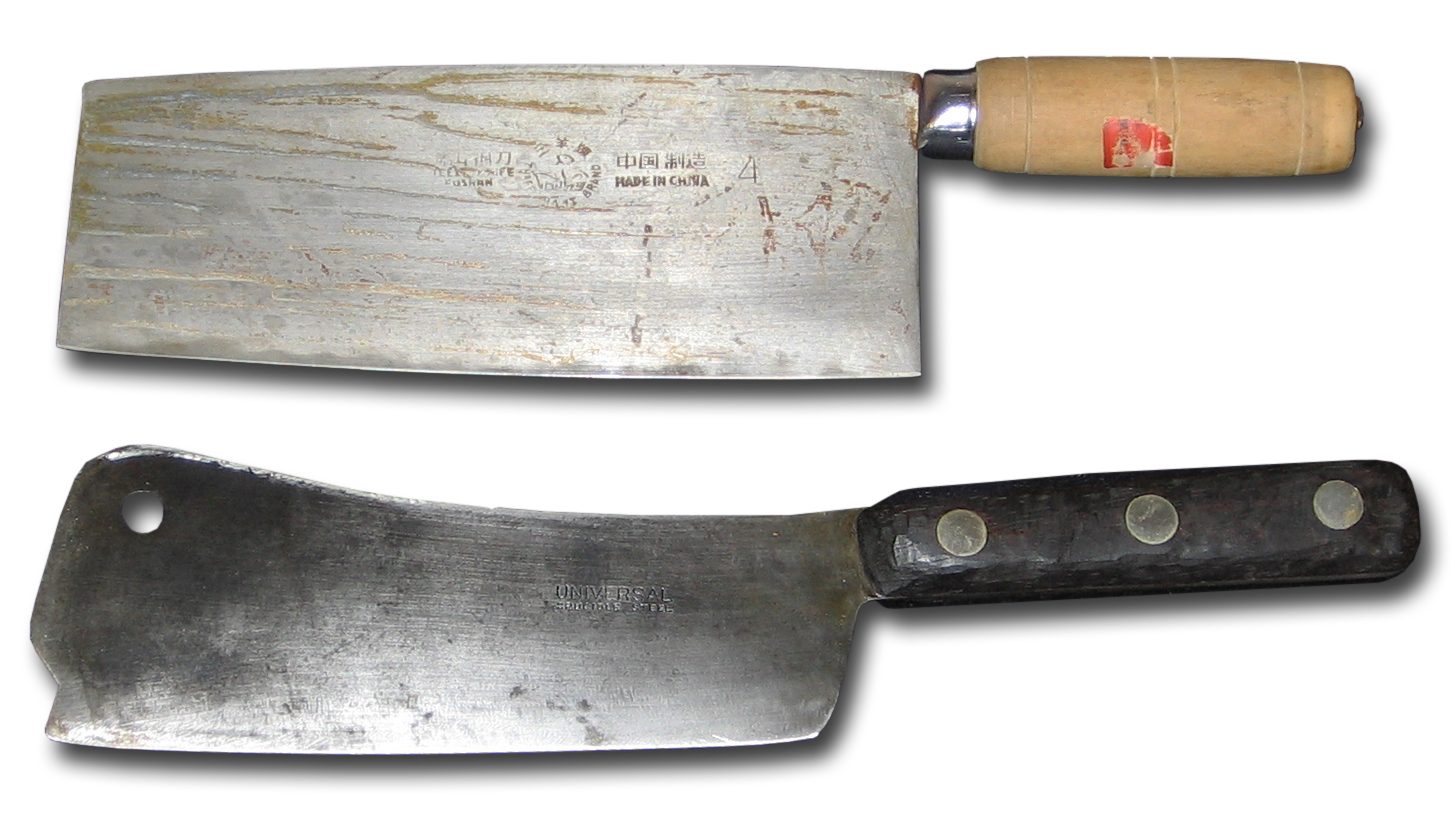
Photo: David R. Ingham in der Wikipedia auf Englisch / Wikimedia Commons, CC BY-SA 4.0
Grip and core techniques
- Grip: pinch both sides of the blade just in front of the handle with thumb and index finger; the other three fingers hold the handle.
- Guiding hand: curl your fingertips in (the "claw"), with your knuckles resting against the flat of the blade as a guide.
- Slicing: push the blade forward and down, do not chop straight down. Cut pork loin across the grain about 2–3 mm thick for stir-fries.
- Crushing: lay garlic or ginger under the flat of the blade, edge facing away from you, and press hard with the heel of your hand.
- Scooping: slide the cut ingredients onto the flat of the blade and carry them to the bowl.
What not to do with a slicing cleaver
Do not chop large bones, marrow bones or frozen fish with a slicing cleaver; the thin edge will chip or bend. Do not use glass, stone or stainless steel boards, which dull the edge; use wood or food-grade plastic.
The yanagiba: a single-bevel sashimi knife
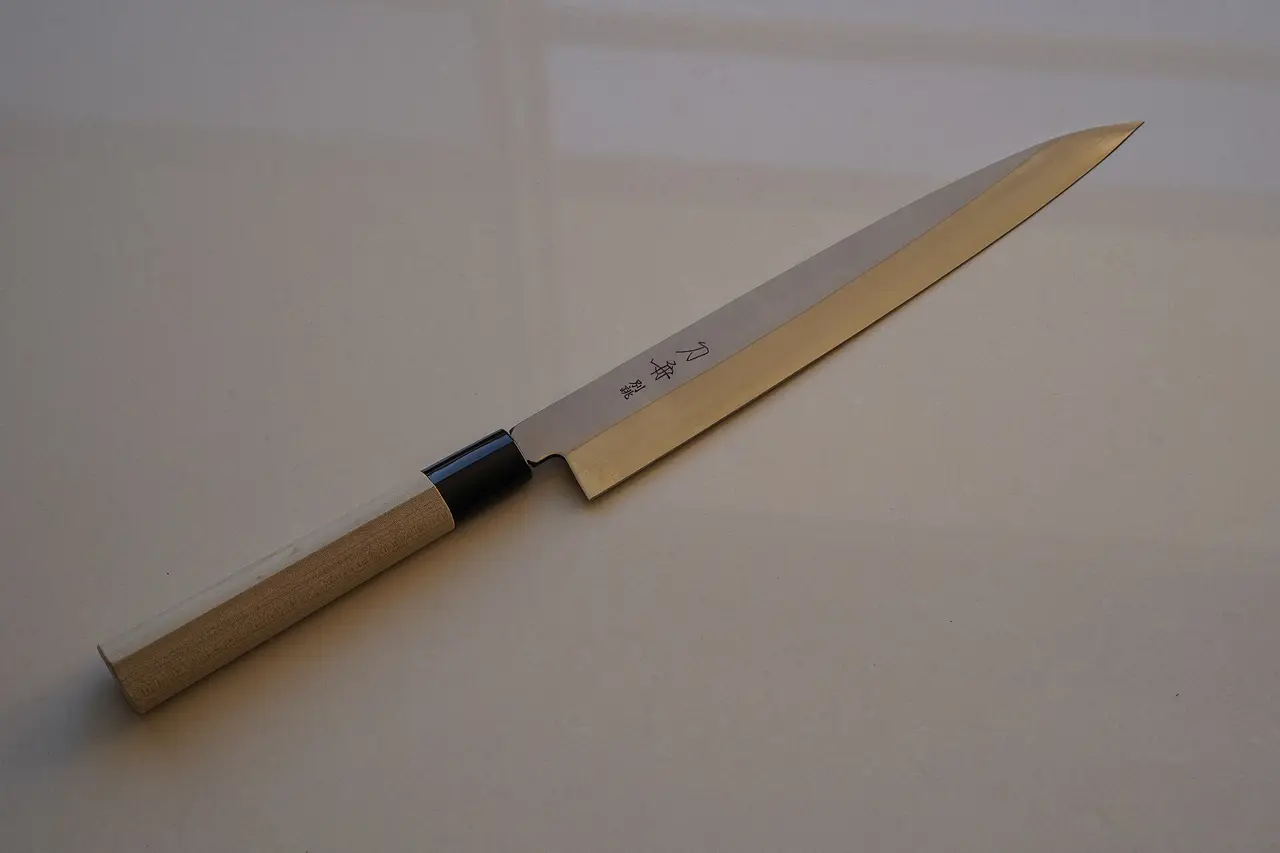
The yanagiba ("willow blade") is a long, narrow Japanese knife for sashimi and sushi fish. The blade is usually about 240–300 mm long so you can cut a whole slice of fish in one pulling stroke, leaving a glossy face.
Single-bevel construction
Unlike Western knives sharpened on both sides, a yanagiba is bevelled on one side only (the front); the back is almost flat with a slight hollow in the middle. This makes the edge very sharp and lets the slice fall cleanly off the blade. Most off-the-shelf yanagiba are made for right-handers; left-handers need to order a separate version. See Figure 2.
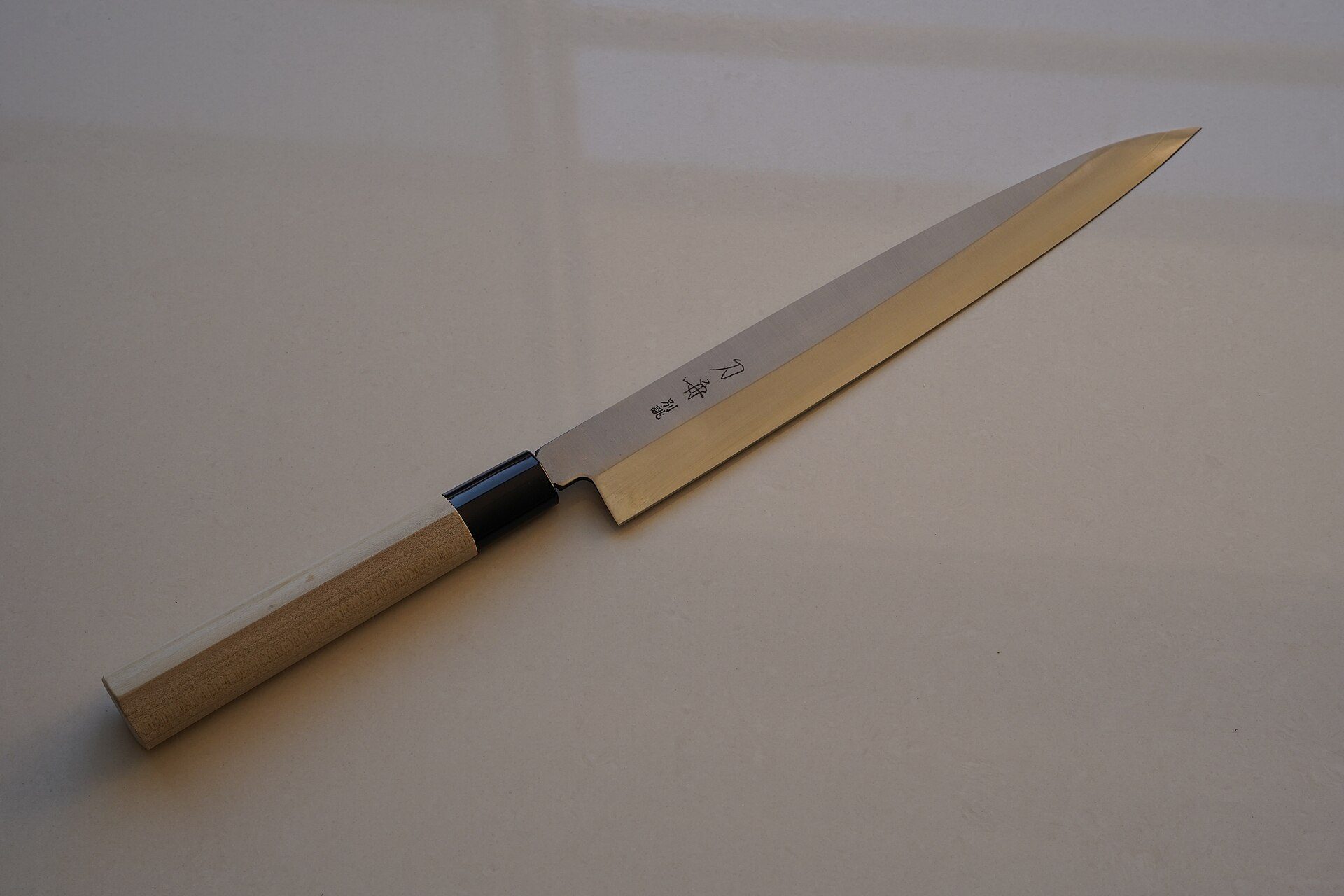
Photo: Benlisquare / Wikimedia Commons, CC BY-SA 4.0
One pulling stroke, no sawing
- Place the heel of the blade (the part near the handle) on the fish and tilt the knife to the angle you want.
- Pull the knife toward you in one long stroke using almost the full length of the blade, with light pressure, letting the weight of the knife do the work.
- Do not saw back and forth or press hard: sawing leaves the fish ragged and wet.
Fish for sashimi must meet the sourcing, freezing and temperature rules in Safe sashimi fish: choosing fish and freezing to kill parasites.
Keeping a Japanese knife sharp and lasting
- Wash by hand with warm water and dish soap and dry at once; never put it in the dishwasher or leave it soaking.
- Carbon steel rusts easily: dry after every use and wipe on a very thin film of cooking oil at the end of the shift.
- Sharpen on water stones, keeping the maker's bevel angle; never use a grinding wheel.
- Never use a yanagiba to cut through bone or frozen food; take chips to a Japanese knife sharpener.
Safety warning: A heavy cleaver and a yanagiba are both very sharp. Always lay knives flat on the board with the edge facing inward, and never leave a knife hidden in the sink. Carry a knife close to your body with the tip pointing down, and call "knife behind" when passing a colleague. If a knife falls, step back; do not try to catch it. For a cut: press firmly with clean gauze and raise the hand; go to a medical facility at once if the cut is deep, still bleeding after about 10 minutes of pressure, or a finger feels numb. A full pot of boiling stock weighs tens of kilos: lift it with two people or ladle some out first, wear heat-resistant gloves and keep the floor dry.
Japanese dashi stock
Dashi is the base stock of the Japanese kitchen, made from kombu seaweed and dried, shaved bonito called katsuobushi. Miso soup, tempura dipping sauce and udon broth all start from dashi.
Kombu and katsuobushi
Kombu is thick dried kelp with a white powder on the surface; that powder carries flavour, so only wipe it lightly with a damp cloth, do not wash it. Katsuobushi is skipjack tuna that has been cooked, smoked and dried hard as wood, then shaved into thin flakes (Figure 3). Restaurants usually buy pre-shaved, packed flakes.
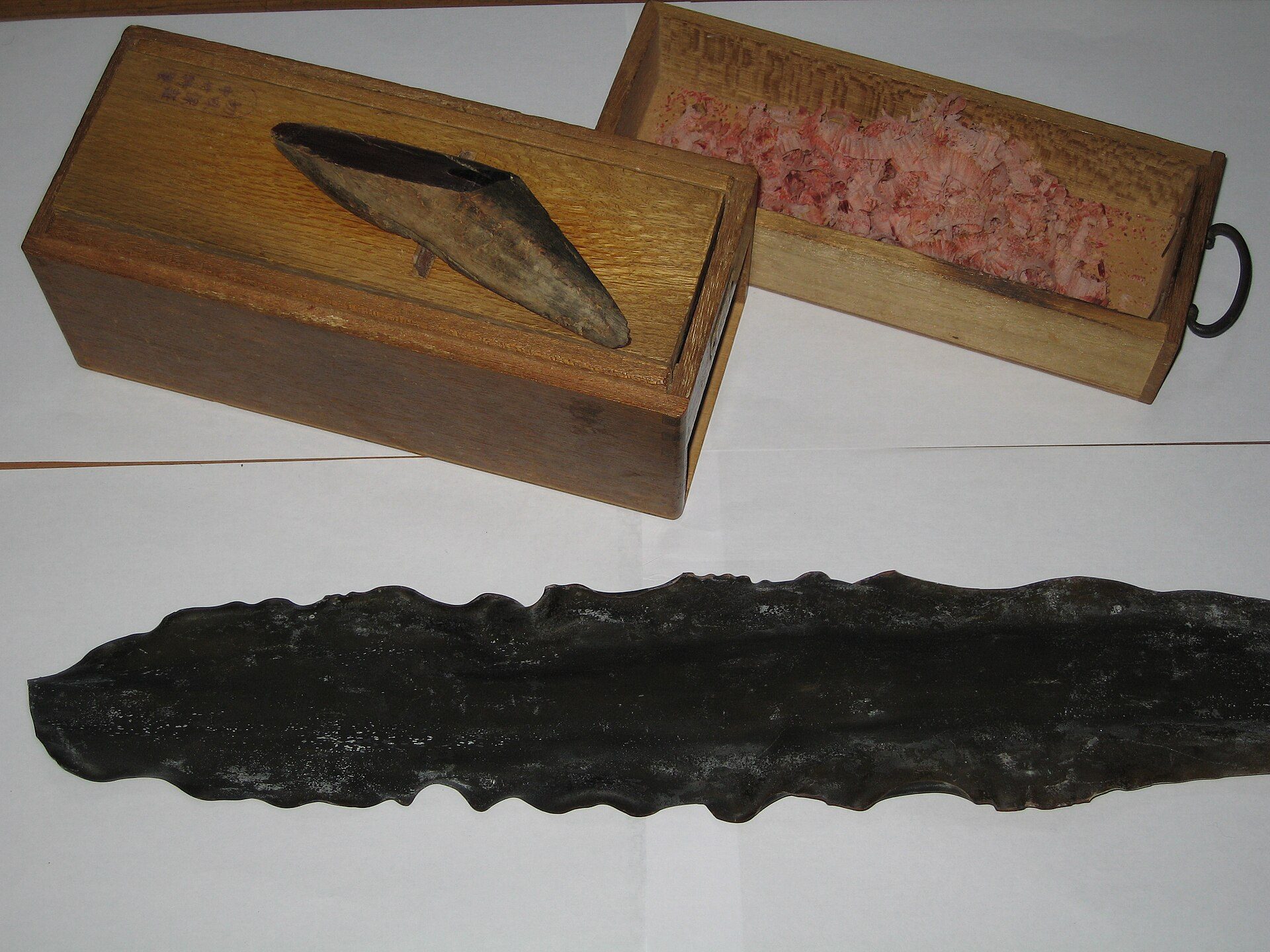
Photo: サフィル / Wikimedia Commons, CC BY-SA 4.0
Ichiban dashi for 1 litre of water
- Wipe 10 g of kombu and soak it in 1 litre of cold water for at least 30 minutes (or overnight in the fridge).
- Heat on low to medium. When small bubbles form on the bottom, just before boiling, lift out the kombu. Boiling kombu for long makes the stock slimy and seaweedy.
- Bring the water to the boil, turn off the heat, add 20 g of katsuobushi and leave for about 1–2 minutes until the flakes sink.
- Strain through a sieve lined with cloth or filter paper. Do not squeeze or press the flakes: pressing makes the stock cloudy and bitter.
- Good dashi: clear amber colour, a light smoky fish aroma, and a deep taste even before salting.
The ratio of 10 g kombu and 20 g katsuobushi per litre is a reference point; many kitchens use 10–30 g of katsuobushi depending on the dish. The spent ingredients can be simmered again in half the water to make niban dashi (second dashi) for simmered dishes.
Vegetarian dashi and instant dashi
For vegetarian guests or those allergic to fish, make dashi from kombu and dried shiitake soaked in cold water for a few hours. Instant dashi granules usually already contain salt and MSG, so cut back on salt when seasoning.
Chinese bone stock
The Chinese kitchen uses bone stock for soups, braises and stir-fry sauces; the two main styles differ in how the heat is controlled.
Clear stock and milky stock
| Point | Clear stock (qing tang) | Milky stock (bai tang) |
|---|---|---|
| Ingredients | Chicken, pork bones, ham or lean pork | Marrow bones, pork trotters, chicken bones with cartilage |
| Heat | Barely simmering, surface almost still | Constant rolling boil |
| Simmering time | About 3–4 hours | About 4–6 hours |
| Result | Clear, pale gold, clean taste | Milk-white, rich, lightly thick as fat and collagen emulsify into the liquid |
| Used for | Wonton soup, stir-fry sauces, steamed dishes | Hot pot, noodle soups, rich soups |
A hard boil breaks fat and gelatin into tiny suspended droplets, so the stock turns milky; for clear stock keep the heat low and skim steadily.
Making clear stock
- Blanch the bones: put them in cold water, boil 5–10 minutes, discard the water and rinse off scum and blood.
- Put the clean bones in the pot and cover with cold water of about twice the bone weight (for example 6 kg of bones with about 12 litres of water).
- Add crushed ginger, spring onion and a splash of cooking wine. Bring to a simmer, lower the heat and skim during the first 30 minutes.
- Simmer without a tight lid. Do not stir and do not salt (a base stock is seasoned in each dish).
- Strain through a fine sieve, skim off some of the fat and start cooling immediately.
Managing a large pot works much the same as in How to make pho beef broth from the Vietnamese cook roadmap.
Cooling and storing stock
Stock lets bacteria multiply very fast in the range of roughly 5–60°C. Leaving a 20-litre pot to cool on its own overnight is a dangerous mistake. Many international food safety guidelines use a two-stage cooling target: from about 57°C down to 21°C within 2 hours, then down to 5°C within the following 4 hours.
- Divide the stock into shallow pots or stainless trays (no deeper than about 10 cm).
- Set the pots in an ice bath and stir regularly; check with a probe thermometer and log the times.
- Cover, label with the date and time cooked, and refrigerate at 0–4°C; use within about 3 days. Frozen at −18°C, it is best used within about 2–3 months.
- When reusing, bring every portion you take out to a full boil, and never top up a new pot with old stock.
Seven core seasonings and how to use them
These seven appear most often on Chinese, Japanese and Korean restaurant menus in Vietnam.
Soy sauce: a different style in each cuisine
Soy sauce is fermented from soybeans, usually with wheat. The Chinese kitchen uses two kinds: light soy for salt and flavour, and dark soy, thick and dark, mainly for colour in braises and fried rice. Japanese shoyu comes as dark-coloured koikuchi for everyday use and light-coloured but saltier usukuchi. Korean kitchens use ganjang; guk-ganjang (soup soy sauce) is pale and saltier.
Oyster sauce
Oyster sauce is a thick brown sauce cooked from oyster extract with sugar, salt and starch. Add it at the end, because the sugar burns easily. It contains oyster, so guests with shellfish allergies must be told.
Miso
Miso is soybean paste fermented with salt and koji (usually from rice or barley). White miso (shiro) is fermented briefly, sweet and pale; red miso (aka) is fermented longer, salty and strong; mixed miso (awase) sits in between. Figure 4 shows three kinds of miso, from yellow to dark brown, on display at a shop in Nishiki Market, Kyoto. For miso soup, dissolve the miso in a little dashi and add it to a pot that is off the heat or on very low heat; boiling it kills the aroma.
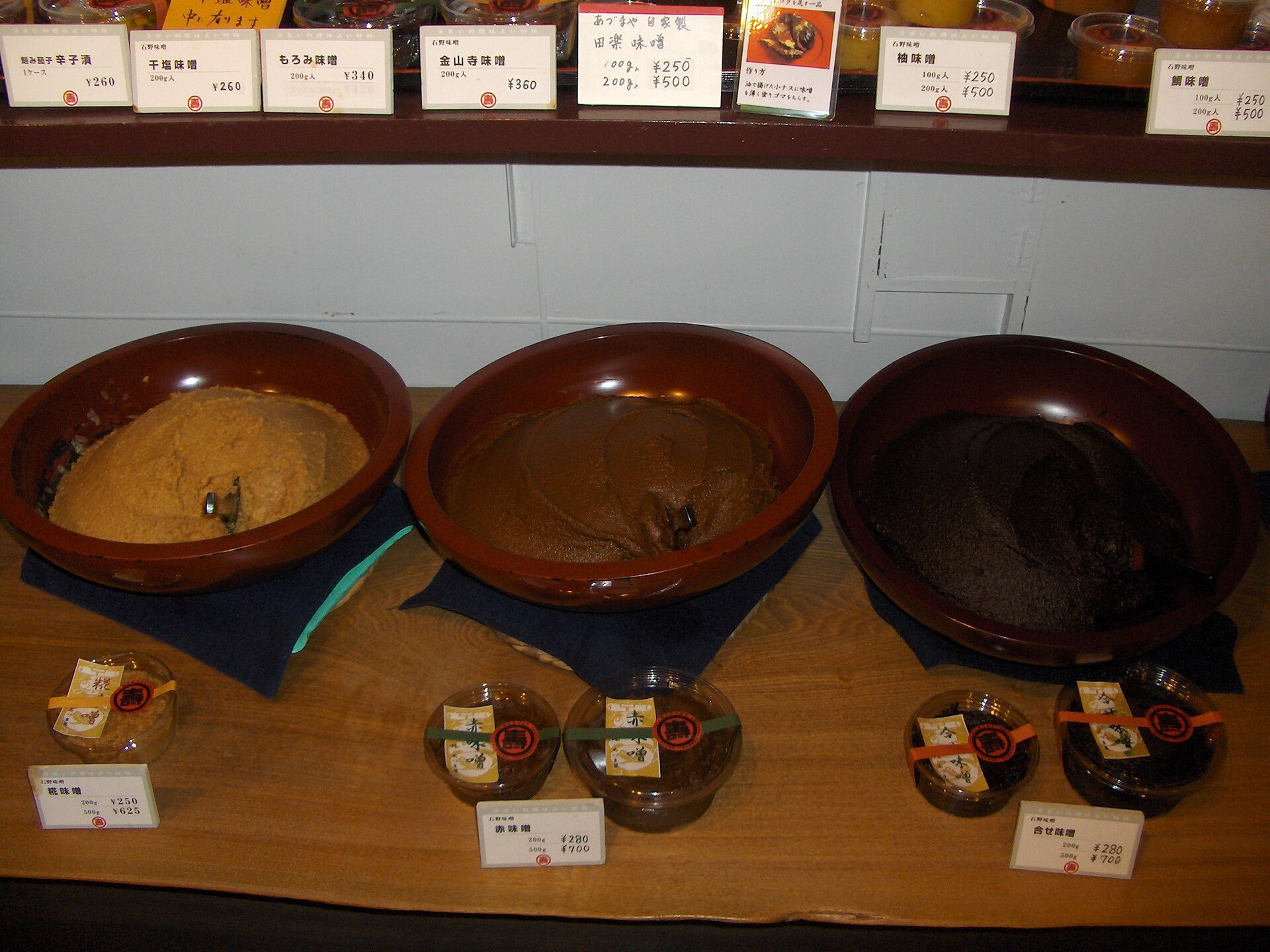
Photo: wilbanks from Shop of boiled beans, side dishes and miso, Adzumaya Food Shop in Nishiki Ichiba, Kyoto / Wikimedia Commons, CC BY-SA 2.0
Mirin
Mirin is a sweet rice wine for cooking that adds gentle sweetness and gloss to teriyaki sauce, dipping sauces and Japanese simmered dishes. Hon mirin (true mirin) is about 14% alcohol, so it is usually heated to cook off some alcohol. The common "mirin-style seasoning" has very little alcohol and more sugar.
Gochujang and gochugaru
Gochujang is a fermented Korean chilli paste made from chilli powder, glutinous rice, fermented soybean powder and salt; it is spicy, sweet, salty and slightly sour, and goes into tteokbokki, bibimbap and grilled meat sauces. Gochugaru is Korean chilli powder, bright red, moderately hot and lightly smoky (Figure 5). Coarse flakes are for kimchi; fine powder is for making gochujang and sauces. Hot Vietnamese chilli powder is not a substitute: the kimchi becomes harshly hot but lacks colour.
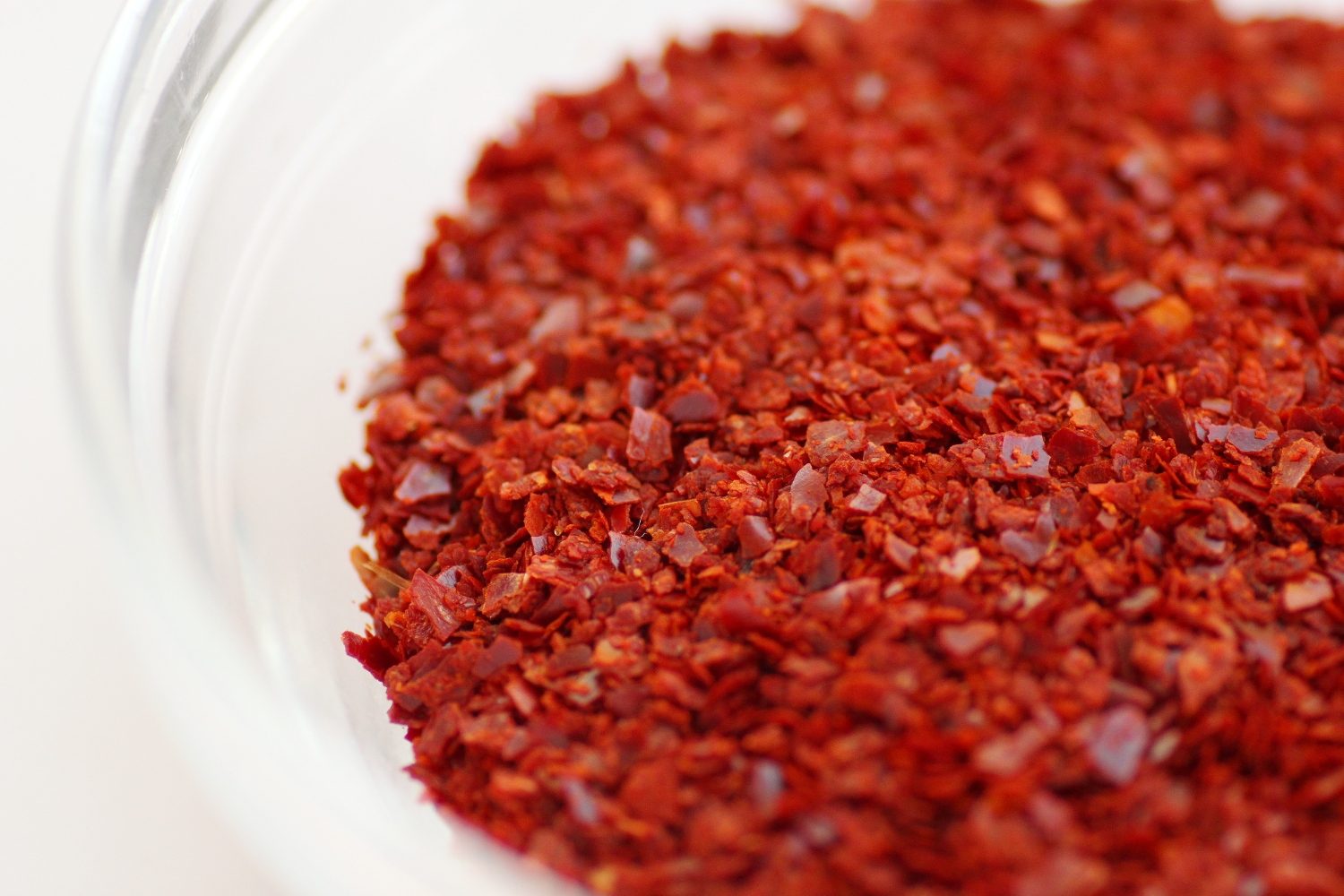
Photo: Stacy Spensley / Wikimedia Commons, CC BY 2.0
Quick reference for 7 core seasonings
| Seasoning | Cuisine | Main role | Storage after opening (reference) |
|---|---|---|---|
| Light soy / shoyu | Chinese, Japanese, Korean | Salt, umami | Tightly closed, cool and dark; the fridge keeps the aroma longer |
| Dark soy | Chinese | Colour, slight sweetness | Tightly closed, cool and dark |
| Oyster sauce | Chinese | Umami, body, gloss | Fridge at 0–4°C |
| Miso | Japanese | Salty, fermented umami | Fridge, cling film pressed onto the surface |
| Mirin | Japanese | Sweetness, gloss, masks odours | Hon mirin: cool and dark; low-alcohol type: fridge |
| Gochujang | Korean | Spicy, sweet, fermented | Fridge, use a clean dry spoon |
| Gochugaru | Korean | Medium heat, red colour | Sealed bag, fridge or freezer to keep the colour |
The storage column reflects common practice; always follow the instructions and best-before date on the label of the product you buy.
Storing seasonings and dry goods in a restaurant kitchen
High-salt fermented seasonings do not spoil quickly, but they still lose aroma, change colour and can go mouldy if scooped with a wet spoon or kept somewhere hot and humid.
Label opening dates and rotate stock
- Label every bottle, jar and bag with the date it was opened.
- Follow first in, first out: new bottles at the back, opened bottles at the front.
- Decant seasonings into small bottles for each shift and keep large bottles in cool storage; never pour leftovers from a small bottle back into a large one.
- Keep kombu, katsuobushi and shiitake in airtight boxes with desiccant, out of sunlight; use opened katsuobushi soon because it loses aroma fast.
Signs a seasoning has gone off
Throw a seasoning out if you see white or green mould, bubbling, a bulging lid, or a sour or unusual smell. Some changes are not spoilage: the surface of miso darkens when exposed to air, and true mirin kept cold can crystallise sugar. If in doubt, throw it out.
Core seasonings and allergies
Many core seasonings contain common allergens: soy sauce and miso contain soy (often wheat too), oyster sauce contains oyster, dashi contains fish, sesame oil contains sesame. Record them in each dish's recipe sheet so front-of-house can answer guests correctly (the allergy procedure is in the food safety step). If a guest has trouble breathing, swollen lips or feels faint after eating, call emergency services (115 in Vietnam) at once; do not handle it in the kitchen.
Worked example: foundations for a 40-cover dinner shift
A small Asian food counter serves 40 covers at dinner: each cover includes a 150 ml bowl of miso soup, and the stir-fries and noodle soups share one pot of Chinese bone stock. The head chef asks the kitchen assistant to prepare dashi, miso and 8 litres of clear stock starting at 14:00.
Dashi and miso quantities
- Miso soup: 40 bowls × 150 ml = 6,000 ml = 6 litres of dashi.
- Kombu: 6 litres × 10 g = 60 g. Katsuobushi: 6 litres × 20 g = 120 g.
- Mixed miso: about 15 g per bowl (adjust to the saltiness of your miso), 40 × 15 = 600 g.
Bone stock quantities
- Pork marrow bones 4 kg + chicken frames 2 kg = 6 kg of bones, about 12 litres of water.
- Simmer gently for about 4 hours; after evaporation and absorption you strain about 8 litres.
Food cost (2026 reference, varies by region and supplier)
| Ingredient | Quantity × unit price | Amount |
|---|---|---|
| Kombu | 60 g × 700,000 VND/kg | 42,000 VND |
| Pre-shaved katsuobushi | 120 g × 1,000,000 VND/kg | 120,000 VND |
| Mixed miso | 600 g × 200,000 VND/kg | 120,000 VND |
| Pork marrow bones | 4 kg × 80,000 VND/kg | 320,000 VND |
| Chicken frames | 2 kg × 50,000 VND/kg | 100,000 VND |
| Ginger, spring onion, cooking wine | Lump sum | 30,000 VND |
| Total | 732,000 VND | |
Check: 42,000 + 120,000 + 120,000 + 320,000 + 100,000 + 30,000 = 732,000 VND (about US$28). The miso soup part (kombu, katsuobushi, miso) is 42,000 + 120,000 + 120,000 = 282,000 VND, divided by 40 bowls ≈ 7,050 VND per bowl, before tofu, wakame and spring onion. The bone stock part is 320,000 + 100,000 + 30,000 = 450,000 VND for 8 litres, or 56,250 VND per litre. Imported ingredient prices vary widely (kombu, for example, runs about 400,000–900,000 VND/kg in Vietnam), so update the figures from real invoices.
Schedule: 14:00 soak the kombu and blanch the bones; 14:30 start simmering the bones; 16:30 make the dashi; 18:30 strain the stock, hold the portion needed for service above 60°C and cool the rest in an ice bath.
Common mistakes and how to fix them
Bitter, slimy or fishy dashi
Signs: cloudy, slimy stock with a bitter finish. Causes: boiling the kombu for long, steeping the katsuobushi too long, squeezing the flakes when straining. Fix: lift out the kombu before the boil, steep the flakes 1–2 minutes and strain at once, letting the stock drain through the sieve on its own.
Clear stock turns cloudy
Signs: the stock goes milky when you wanted it clear. Causes: skipping blanching, boiling hard, stirring the pot, or a tight lid making it boil over. Fix: blanch thoroughly, keep a bare simmer and skim steadily; if a pot has already gone cloudy, use it for dishes that want a rich stock such as hot pot rather than trying to clear it.
Dark, oversalted stir-fries
Causes: using dark soy in place of light soy, or adding oyster sauce too early so the sugar burns. Fix: label the bottles in large letters "LIGHT" and "DARK", keep them in fixed spots, and add oyster sauce at the end.
Frequently asked questions
What is dashi and how do I make it quickly?
Dashi is the Japanese base stock made from kombu and katsuobushi. The quickest way: soak 10 g of kombu in 1 litre of water for 30 minutes, heat until almost boiling and lift out the kombu, bring to the boil and turn off the heat, add 20 g of katsuobushi, wait 1–2 minutes and strain.
What is the difference between light and dark soy sauce?
Light soy is thin and salty and is used for seasoning. Dark soy is thick, dark and less salty, used mainly for colour. When a Chinese recipe just says "soy sauce", it usually means light soy.
How long does Korean gochujang keep after opening?
Keep gochujang in the fridge and scoop it with a clean dry spoon; it usually keeps for several months, but always check the date on the label. Throw it out if you see mould, bubbling or an unusual sour smell.
What can I use if I have no mirin?
As a stopgap, use sake with sugar (about 3 parts sake to 1 part sugar), warmed until the sugar dissolves; the taste is close but not the same.
Practice and self-assessment
- Make 1 litre of dashi to the ratio in this lesson, noting when you lifted the kombu and how long the flakes steeped.
- Simmer 2 litres of clear stock from 1 kg of bones, cool it in an ice bath and log the temperature after 2 hours.
- Use a cleaver to slice 200 g of pork loin 2–3 mm thick across the grain, crush 5 garlic cloves and scoop them into a bowl.
- Make a table of the 7 core seasonings in your kitchen: opening date, storage place and allergens.
Self-assessment criteria
- Pass: the dashi is clear amber, not slimy or bitter; the kombu came out before the boil.
- Pass: the stock dropped below 21°C within 2 hours, with temperatures and times logged.
- Pass: the slices are even, and your guiding hand kept the claw position throughout.
- Pass: you can say which seasonings must be refrigerated after opening and which contain soy, oyster or fish.
- Not yet: squeezing the dashi flakes, leaving a stockpot to cool overnight in the kitchen, or chopping bone with a slicing cleaver.
With a steady knife hand, a proper stockpot and a well-organised seasoning tray, move on to the next roadmap step: High-heat wok cooking & basic Chinese dishes, where you use this same bone stock, soy sauce and oyster sauce for sweet and sour sauce and Yangzhou fried rice, and learn wok hei on a jet burner.
Keep learning Asian cooking: after knives, stocks and core seasonings come high-heat wok cooking, dim sum, Japanese dishes, Korean dishes, a 30-serving counter project and the skills test. See the 8-step Asian cuisine cook roadmap (Chinese, Japanese, Korean).