A basic facial is the service customers choose most often on their first visit to a spa. Done well, the customer's skin feels clean and softer right after the first session; done in the wrong order or too roughly, the skin turns red and stings, and you lose a potential regular. This lesson walks through the 8-step routine of about 60 minutes, the reason behind each step, how to adapt it to each skin type, and a worked example from the moment the customer lies down to the moment you fill in the record card.
By the end of this lesson, you will be able to: examine the skin and correctly record skin type and skin condition; perform all 8 steps on time under the supervision of your trainer; know when to skip exfoliation and steaming; recognize signs of irritation so you can stop in time; and fill in the record card fully for the next visit.
Understand the skin before you touch it
In the foundation step you learned that skin is made of the epidermis, dermis and hypodermis. In a basic facial you mainly work on the outermost layer of the epidermis — the stratum corneum (horny layer). Every action in the treatment aims to cleanse, soften and moisturize this layer without damaging it.
The skin barrier
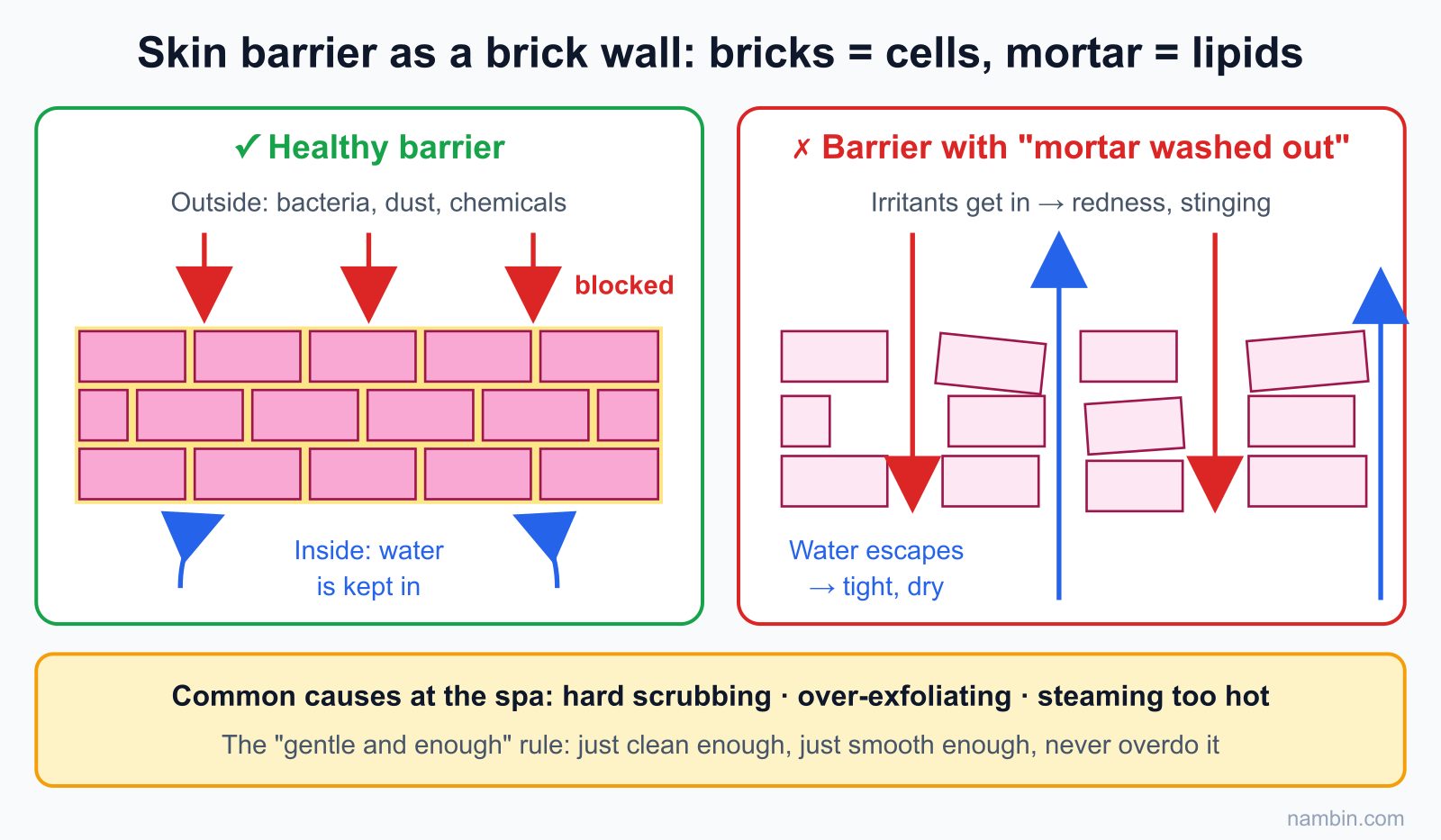
The stratum corneum is like a brick wall: the dead skin cells are the bricks and the lipids (natural fats) are the mortar, keeping water in and keeping bacteria and chemicals out. When you scrub hard, over-exfoliate or steam too hot, the "mortar" is washed away: the skin loses water, turns red and stings when products are applied. So the number one rule of a basic facial is gentle and enough: cleanse just enough to be clean, exfoliate just enough to be smooth, and never try to "do a lot so it is worth the money".
Common skin types and skin conditions
Skin type is a relatively stable characteristic: oily, dry, combination, normal. Skin condition is what is happening now and can change: dehydrated, sensitive, acne, dullness or pigmentation, redness from broken capillaries. One customer can be both oily and dehydrated — the T-zone is shiny, but the skin feels tight to the touch and there are small flakes on the sides of the nose. If you only see "oily skin" and use strong oil-control products everywhere, the skin becomes even more dehydrated. Always record both skin type and skin condition on the card.
Why the order of the steps matters
The 8 steps follow a logic: cleanse → assess → soften → treat → nourish → protect. You must remove make-up and cleanse first to assess the skin accurately, because foundation and dust hide spots and pigmentation. Exfoliation comes before steaming so that grains or enzymes are not "cooked" too long on skin that has already opened up. Massage comes after the skin is clean and soft so your hands glide easily; mask and moisturizer come last so the active ingredients stay on clean skin. Massaging before cleansing only pushes dust and make-up into the pores.
Before you start
Health form and contraindications
- Go through the health form: allergies, acne medication or retinoid products, recent peel or laser, pregnancy.
- Also ask about: recent injections or cosmetic procedures on the face, an active cold sore (herpes) on the lips, any skin area under prescription treatment, recent sunburn.
- Note the products the customer uses at home, especially those with exfoliating acids or retinoids — that is your signal to skip exfoliation.
Contraindications — do not perform the treatment on skin with: open wounds, infection, an active cold sore outbreak, fungal infection, widespread dermatitis, blistering sunburn, or areas recently treated with laser, peels or cosmetic injections within the period the doctor said to avoid. If the customer takes oral acne medication or applies a retinoid: no exfoliation, no hot steam — only gentle cleansing and moisturizing. When in doubt, postpone the session and suggest the customer asks a dermatologist first — that is the right decision, not a lost customer.
Tools and supplies to prepare
- Make-up remover pads, cotton rounds, cotton buds, a bowl of warm water, a mask brush, and a spatula or scoop for taking product, used for one customer only (never dip your fingers into the jar).
- A skin-analysis lamp or a desk lamp with a magnifier, a facial steamer (if the spa has one), 3–4 small face towels, a headband and a chest towel.
- Products lined up in order of use on your dominant-hand side: make-up remover → cleanser → exfoliant → massage cream → mask → toner → serum → moisturizer → sunscreen. Setting them out beforehand means you never have to take your hands off the customer halfway through.
Preparing the customer and your working posture
- Wrap the customer's hair neatly with a headband and cover the chest with a towel.
- Raise the head of the bed slightly and place a bolster under the customer's knees so the lower back relaxes; ask whether they would like a light blanket.
- Sit at the top of the customer's head, with the stool high enough that your forearms are nearly parallel to the bed and your shoulders relaxed. If you sit too low, you have to lift your shoulders, and after a few customers your neck will ache.
- Wash or sanitize your hands before touching the customer's face, even if you just washed them in the next room.
The 8-step routine
This is the standard frame for a session of about 60 minutes. The times in brackets are for reference; for sensitive skin, shorten the treating steps and lengthen the soothing steps.
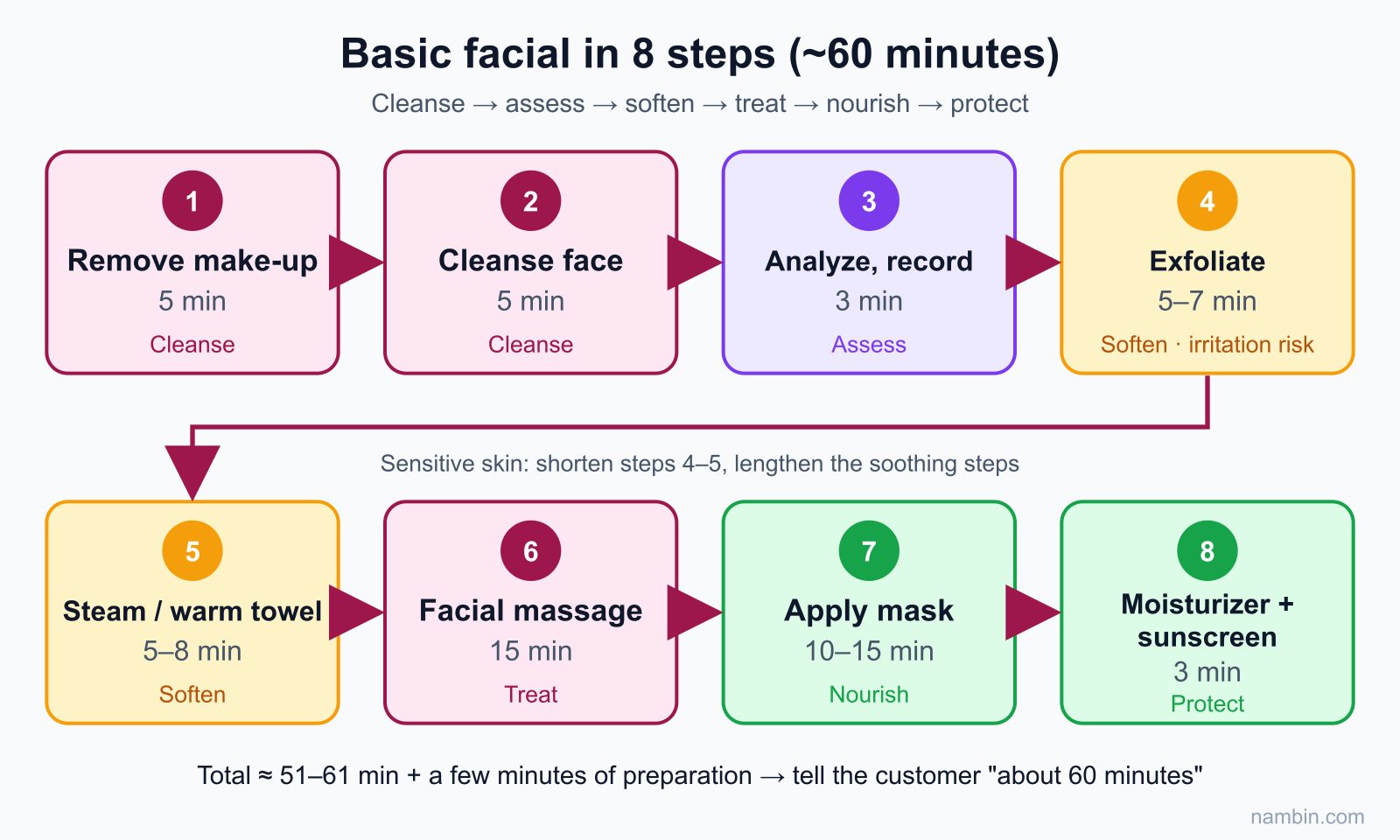
- Make-up removal (5 minutes): use a cleansing oil or micellar water, wiping gently from the inside outward, especially around the eyes and lips. Never rub the eye area.
- Cleansing (5 minutes): a cleanser suited to the skin type, massaged gently in circles for about 1 minute, then removed with damp cotton or a warm towel.
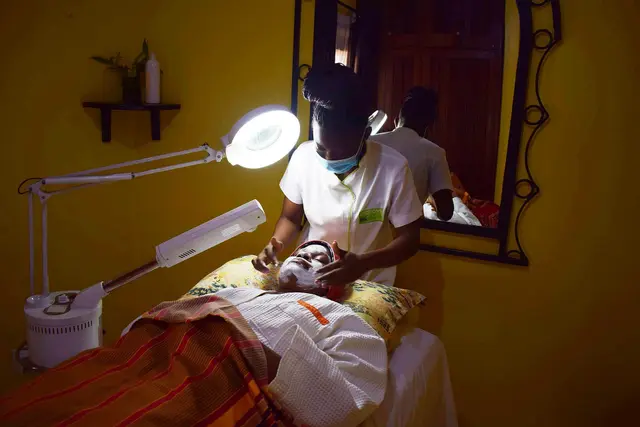
- Skin analysis (3 minutes): using a lamp or good light, identify the skin type, oily areas, dry areas, spots and pigmentation. Record them on the card.
- Exfoliation (5–7 minutes): choose the right form — a mild gel or enzyme for sensitive skin, fine grains for oily skin. Avoid the eye area and inflamed skin.
- Steam or warm towel (5–8 minutes): softens the stratum corneum. Keep the steamer at a safe distance; reduce or skip this step for sensitive skin or broken capillaries.
- Facial massage (15 minutes): stroking, light circles and gentle pressure, working upward from the chin and outward from the center; the pressure is much lighter than in a body massage.
- Mask (10–15 minutes): choose according to need: hydrating, soothing or oil-control. While waiting, you can massage the customer's hands and shoulders.
- Moisturizer and sunscreen (3 minutes): toner, serum and moisturizer suited to the skin type; in the daytime, always finish with sunscreen.
Steps 1–2: double cleansing
Double cleansing has a reason: the make-up remover dissolves oily substances (foundation, sunscreen, lipstick), while the cleanser washes away dust, sweat and any remover left behind. For the eyes, place a pad soaked in remover on the eyelid and hold it still for 10–15 seconds so the mascara dissolves, then wipe in one stroke from the inside outward; use a fresh pad for each eye. For the lips, wipe from the corners toward the middle. When cleansing, a pea-sized amount of cleanser is enough; lather it in your palm and massage in circles from the chin up to the forehead. Remove it with a warm towel using a press-and-lift motion, never dragging the towel across the face. Check: wipe a damp cotton round on the chin and along the hairline — if the cotton picks up color, the skin is not yet clean.
Step 3: skin analysis and recording
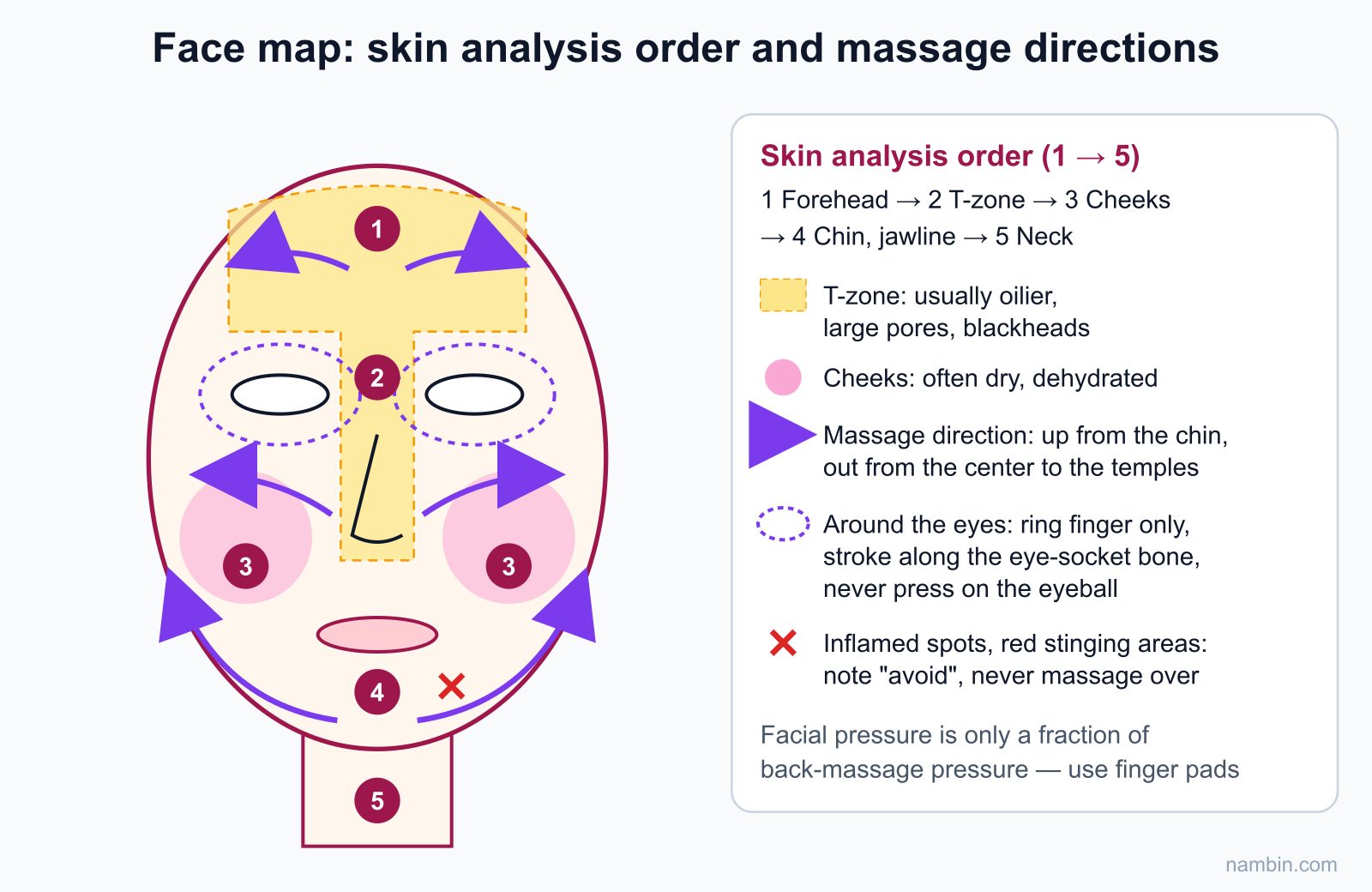
Analyze the skin after cleansing, and wait a few minutes for it to return to its normal state. Follow a fixed order: forehead → T-zone → both cheeks → chin and jawline → neck. Look at four things: oiliness (where the oil concentrates), pores (large, small, clogged), dry areas (flaking, rough), and anything unusual (inflamed spots, redness, pigmentation, odd marks). Write a short note on the card, for example "oily T-zone, slightly dry cheeks, 3 blackheads on nose, 1 inflamed spot left chin — avoid". If you see a mole that has changed color, a sore that is slow to heal or an unusual patch of skin, do not comment or diagnose; note it and tactfully suggest the customer sees a dermatologist.
Steps 4–5: exfoliation and softening
This is the step most likely to cause irritation. Fine grains: circle very lightly with your middle and ring fingers for 1–2 minutes, avoiding the eyes and lips. Gel or enzyme: apply a thin layer and leave it for exactly the time in the instructions, never longer. Then steam: the steamer is usually placed about 30–40 cm from the face, with the vapor angled down toward the chest rather than straight at the face; cover the eyes with damp cotton pads. For sensitive skin, replace steam with a warm towel: wring it well, test it on your wrist until it feels pleasantly warm, and place it on the face for 1–2 minutes, leaving the nose free to breathe. Always ask "Is that too hot?" as soon as you start.
Step 6: facial massage
Facial massage mainly uses the pads of your fingers, with only a fraction of the pressure you use on the back. A suggested sequence: open strokes over the whole face from the chin up to the forehead and out to the temples (3–5 times) → small circles along the jawline up to the cheekbones → strokes from the sides of the nose out across the cheeks → gentle strokes across the forehead from the center outward → light holding pressure on the temples for a few seconds → a finishing stroke from the forehead down to the neck. Keep at least one hand in contact with the customer for the full 15 minutes, with continuous movement as in the body massage lesson. Around the eyes, use only your ring finger, stroking very lightly along the bony rim of the eye socket, never pressing on the eyeball. Do not massage over inflamed spots or red, stinging areas.
Steps 7–8: mask, moisturizing and protection
Use a brush to apply the mask in an even layer, leaving out the eyes, nostrils and lips. Apply an oil-control clay mask only to the T-zone if the customer's cheeks are dry; do not leave it to dry and crack for too long, or it will draw water out of the skin. Remove the mask with a damp warm towel, pressing and lifting gently. Moisturizing follows the rule thin first, thick last: toner → serum → moisturizer → sunscreen. Pat lightly to help absorption, never rub. To finish, raise the head of the bed slowly, show the customer their skin in the mirror and ask how it feels.
Choosing products by skin type
| Skin type | Prefer | Avoid |
|---|---|---|
| Oily | Thorough cleansing, oil-control mask, light gel moisturizer | Hard scrubbing, heavy creams that clog pores |
| Dry | Mild cleanser, hydrating mask, rich moisturizer | Coarse-grain exfoliants, long steaming |
| Combination | Treat the T-zone and the cheeks separately | One "strong" product for the whole face |
| Sensitive | Products with few ingredients, soothing, gentle handling | Scrubs, high heat, new untested products |
| Normal | Maintain: gentle cleansing, hydration, sunscreen | Trying many actives at once just because "the skin is healthy" |
Reading product labels at a basic level
A label listing AHA, BHA or other acids means a chemical exfoliant — do not add it after you have already exfoliated with grains. Fragrance or alcohol near the top of the ingredient list easily stings sensitive skin. Check the period-after-opening symbol printed on the packaging. Use only the products the spa provides; never bring in outside products.
Patch testing
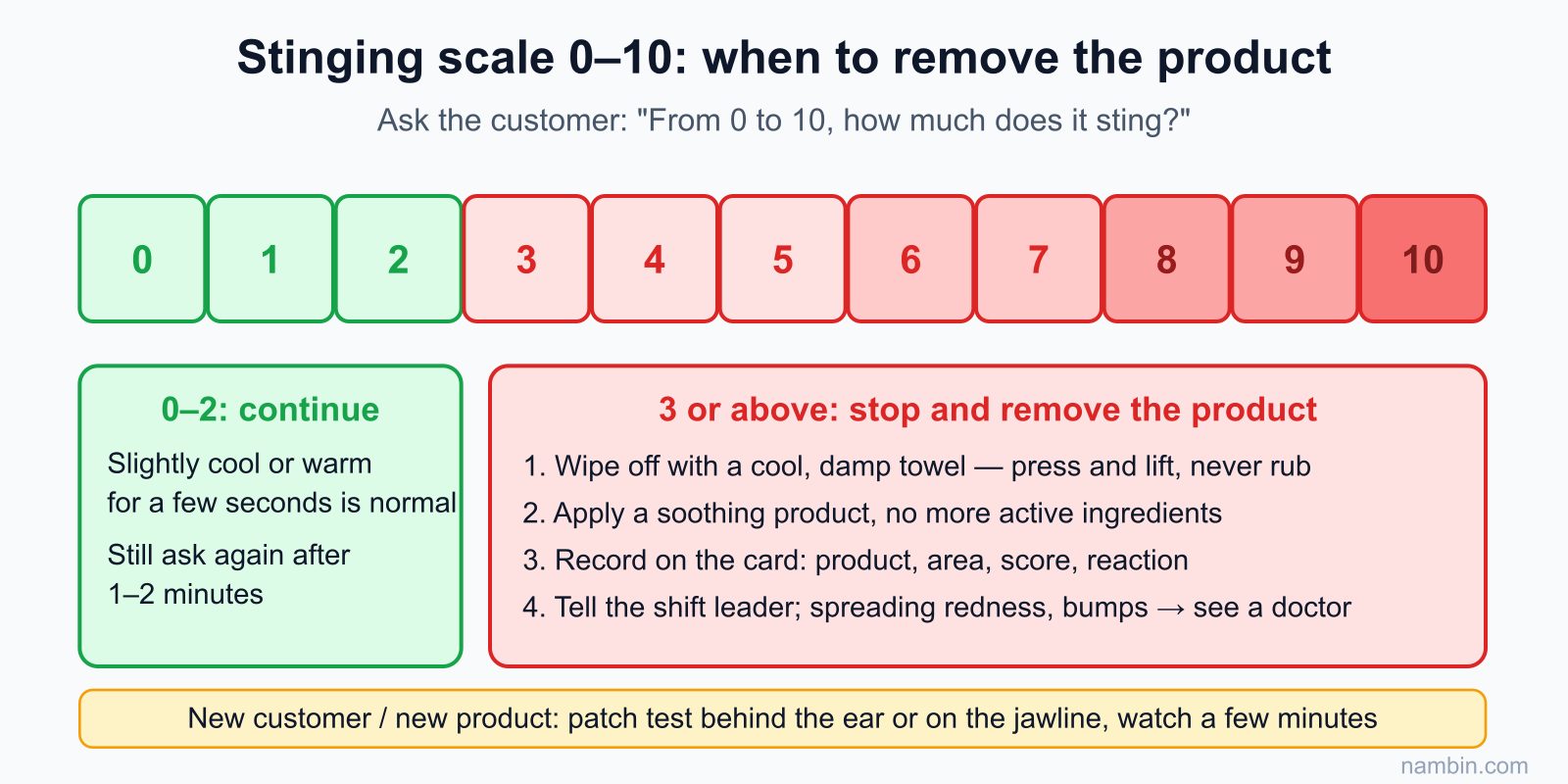
Patch test: for a first-time customer or a new product, apply a small amount behind the ear or on the jawline and watch for a few minutes. If there is redness, itching or strong stinging — wash it off immediately, apply a soothing product and note it on the customer's card.
A slight cooling or warming feeling for a few seconds is normal with some masks; stinging that keeps increasing, spreading redness or raised bumps are signs to stop. Ask the customer with an easy scale: "From 0 to 10, how much does it sting?" — 3 or above means you remove the product.
Worked example: a 32-year-old customer with oily-leaning combination skin using an acne cream
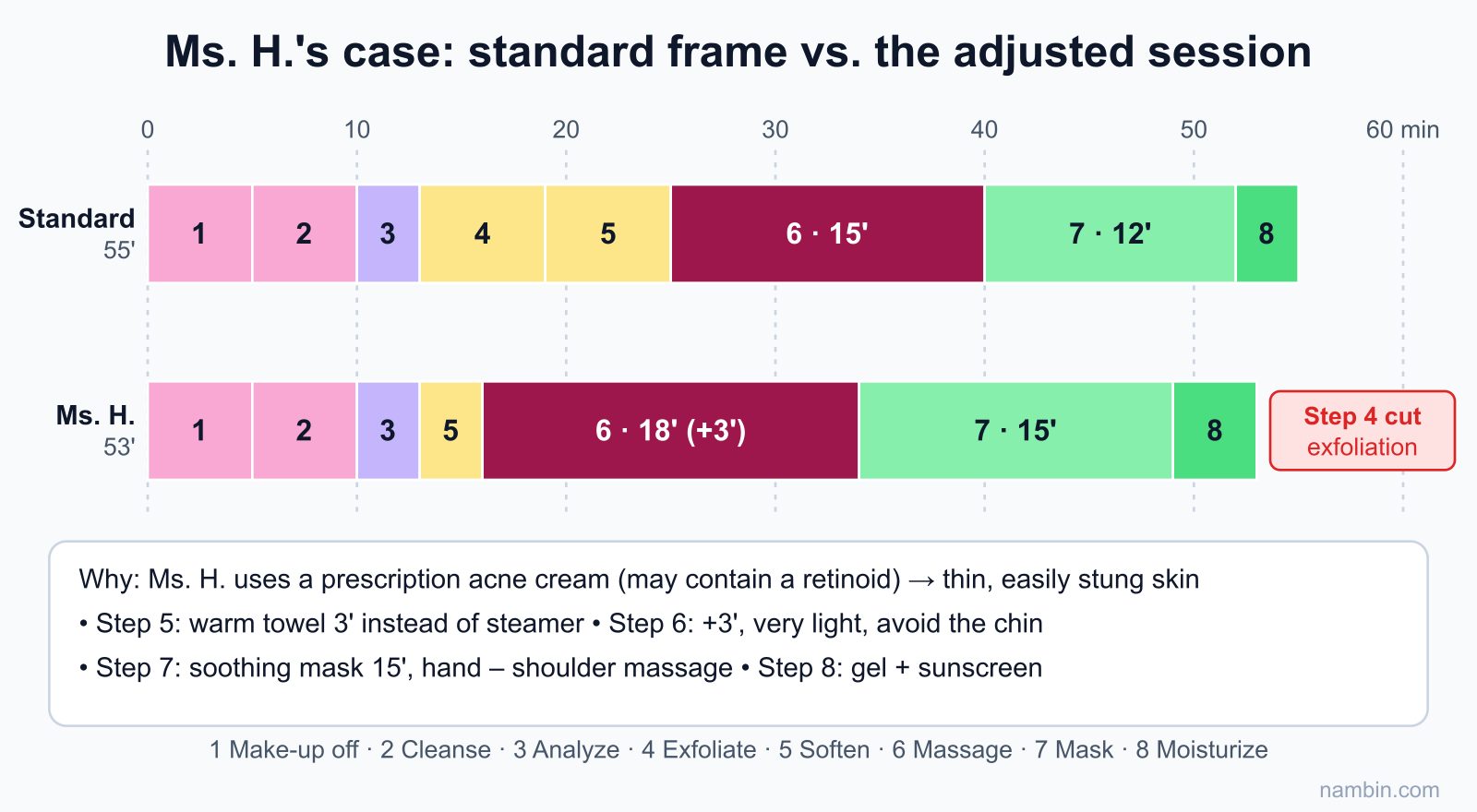
Ms. H., 32, an office worker, comes to the spa for the first time and wants to "deep-clean my skin, it gets oily a lot". On the form she writes that she has been applying a prescription acne cream for two months, she is not pregnant and has no known allergies.
Analysis before you start
A prescription acne cream may contain a retinoid or an active ingredient that thins the stratum corneum. You ask for the name of the cream; she does not remember. The safe decision: skip exfoliation, replace steam with a short warm towel, no extractions, and focus on gentle cleansing, a soothing mask and gel hydration. You explain to her: "The cream you are using may make your skin thinner, so today I won't exfoliate to avoid stinging; I'll focus on cleansing and hydrating. Is that all right with you?" She agrees, and you record the adjustment on the card.
How the session went
| Step | Time | Adjustment for Ms. H. |
|---|---|---|
| Make-up removal | 5 minutes | Mild micellar water; light make-up, so two passes |
| Cleansing | 5 minutes | Light gel cleanser, thorough on the T-zone |
| Skin analysis | 3 minutes | Oily T-zone, cheeks slightly dry and flaky, 2 inflamed spots on the chin — noted "avoid" |
| Exfoliation | 0 minutes | Skipped because of the acne cream |
| Softening | 3 minutes | Warm towel instead of the steamer |
| Facial massage | 18 minutes | Extended by 3 minutes to make up for the skipped step, very light pressure, avoiding the chin |
| Mask | 15 minutes | Soothing mask over the whole face; hand and shoulder massage while waiting |
| Moisturizer, sunscreen | 4 minutes | Alcohol-free toner, gel moisturizer, sunscreen because she goes to work in the afternoon |
Finishing and filling in the card
The treatment time is 53 minutes; with preparation and raising the bed it is still about 60 minutes, as announced. Ms. H.'s skin is clean, not red, and her cheeks are softer. The card reads: "Oily-leaning combination skin, dehydrated cheeks. Using prescription acne cream — no exfoliation, no steam. Inflamed spots on chin: avoid, suggest she checks with her treating doctor. Reaction: no irritation. Next visit in 3 weeks, ask again for the cream's name." A session with "fewer steps" still gives full value while staying safe.
What not to do in a basic treatment
- Do not squeeze inflamed spots or cysts — there is a risk of infection and scarring. Advise the customer to see a dermatologist.
- Do not use products or devices beyond what you are trained for and what the spa allows.
- Do not promise "no more acne" or "whiter skin" after one session.
- Do not share cotton, brushes or towels between two customers; never put fingers or a used brush back into a product jar.
When to advise the customer to see a doctor
A spa therapist cares for healthy skin and does not treat skin diseases. Advise the customer to see a dermatologist when you notice: many painful inflamed spots or cysts; red, flaky patches that last a long time; a mole that changes shape or color; skin that reacts strongly to many products in a row; damaged skin after using unregulated products at home. Say it gently without alarming them: "I think a dermatologist should look at this area first; I only take care of the healthy skin."
Common mistakes and how to avoid them
The customer's skin is red and stinging after the session
Sign: red, hot skin that stings when moisturizer goes on. Cause: exfoliating too long or too hard, steaming too close, or a customer using a retinoid who was not asked carefully. Fix: stop all active products, apply a cool towel, use a soothing product, note it on the card and tell the manager; next time, ask carefully about medication and reduce exfoliation time.
The customer breaks out a few days later
Sign: the customer comes back reporting small spots. Cause: the massage cream or moisturizer was too heavy for oily skin, or the massage cream was not fully removed before the mask. Fix: use a lighter massage product for oily skin, wipe thoroughly with a warm towel after massage, and record the products used so you can compare.
Running late, the customer has to wait
Sign: a 60-minute session stretches to 75 minutes. Cause: products not set out in advance, massage too long. Fix: set out products before the appointment, keep a clock in view, and divide the time as in the worked example table.
Product gets into the eyes
Sign: the customer squeezes their eyes shut, tears running. Cause: applying too close to the eyelid, a towel that is too wet. Fix: rinse the eye with plenty of clean water, do not rub; if pain or blurred vision continues, tell the manager and advise the customer to see an eye doctor.
Aftercare advice for the customer
- Avoid heavy make-up and strong sun for the rest of the day.
- Use sunscreen and drink enough water.
- Contact the spa if redness or itching lasts.
- Suggest a suitable return interval (usually every 2–4 weeks), without pushing extra products.
- If you exfoliated, advise the customer to pause exfoliating products at home for 2–3 days so the skin can recover.
Frequently asked questions
Does oily skin need moisturizer?
Yes. Oily skin can still be dehydrated. Choose a light gel moisturizer and apply just enough. Skipping moisturizer leaves the skin tight and uncomfortable, and many customers find it gets even oilier.
Should extractions be part of a basic facial?
The basic treatment in this lesson does not include extractions. Extractions require separate training, sterile tools and the spa's own rules. Inflamed spots and cysts are never squeezed at a spa under any circumstances — advise the customer to see a doctor.
What if there is no steamer?
Use a warm towel 2–3 times, 1–2 minutes each time. The softening effect is enough for a basic treatment and safer for sensitive skin.
How often should the customer come back?
Usually every 2–4 weeks is reasonable for healthy skin. Sensitive skin, or skin under prescription treatment, needs longer intervals and should follow the doctor's advice. Never suggest weekly sessions just to sell a package.
Practice exercises
- Practice all 8 steps on a family member, timing each step.
- Prepare a sample customer card: health information, skin type, products used, reaction, next appointment.
- Analyze the skin of 3 different people, recording skin type and condition in the order forehead → T-zone → cheeks → chin → neck; ask your trainer to check your notes.
- Rewrite the worked example for a 50-year-old customer with dry skin who takes no medication: which steps you keep, which you adjust, and the time for each step.
Self-assessment criteria
- Total time is no more than 5 minutes off the 60 minutes you announced.
- You asked about current medication, allergies and recent procedures before starting.
- You did not take your hands off the customer for long, and did not have to get up to fetch things halfway through.
- The customer rates your pressure on the face as "comfortable", and the skin is not red or stinging after the session.
- The card records skin type, skin condition, products, reaction and a recommendation for next time.
You will notice that most of the safety decisions in this lesson — skipping exfoliation, replacing steam with a warm towel, avoiding inflamed spots — begin with a question asked before you touch the skin. That is why, once you are confident with body massage and basic facials, the next step in the roadmap is Customer consultation and the health information form: how to ask so the customer tells you about all current medication and recent procedures, and how to decide whether to proceed as normal, adjust or postpone.