It is Saturday afternoon. A male client who has just had lunch and two cans of beer drops by the spa wanting to "sweat it out and sober up". At the same moment, a female client steps out of the steam room, pale-faced, steadying herself against the wall. If you were on duty in the heat area, how would you handle these two situations?
In a heat room the client sits alone in a hot, enclosed space, and every person tolerates heat differently. The therapist is responsible for preparing the room, screening the client, monitoring them and stopping the session at the right time.
By the end of this lesson, you will be able to: tell the difference between a dry sauna and a wet steam room; check the room; screen clients and recognise contraindications; monitor and cool clients down; spot the signs that mean you must stop, give first aid and know when to call 115 (Vietnam's emergency number); and clean the rooms and towels.
How a dry sauna differs from a steam room
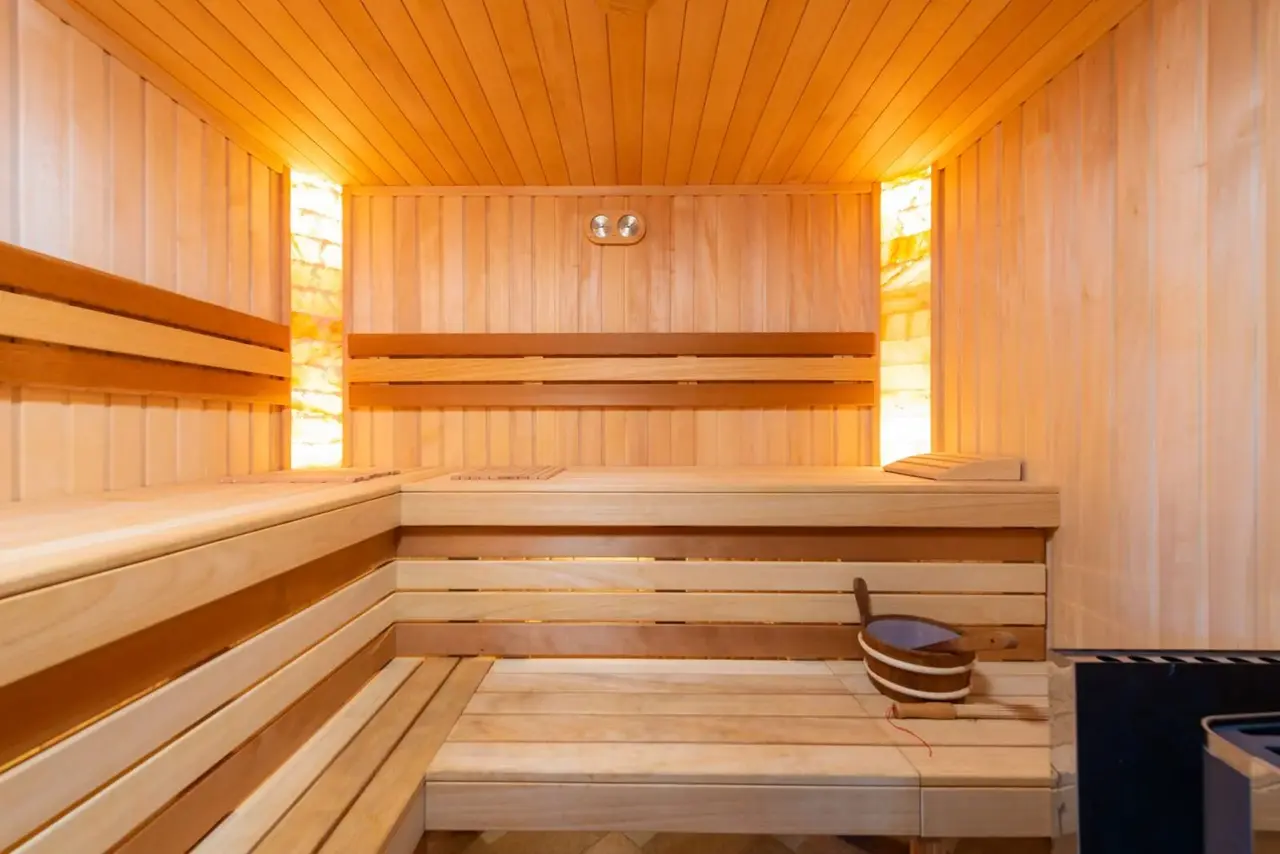
A dry sauna is a wood-lined room with a heater that warms a basket of stones. The air is very hot but dry. In a traditional sauna a little water may be ladled onto the stones to create a short burst of hot steam, but only when the spa allows it and only with the proper ladle. Because sweat evaporates quickly, clients can tolerate a higher air temperature than in a wet room.
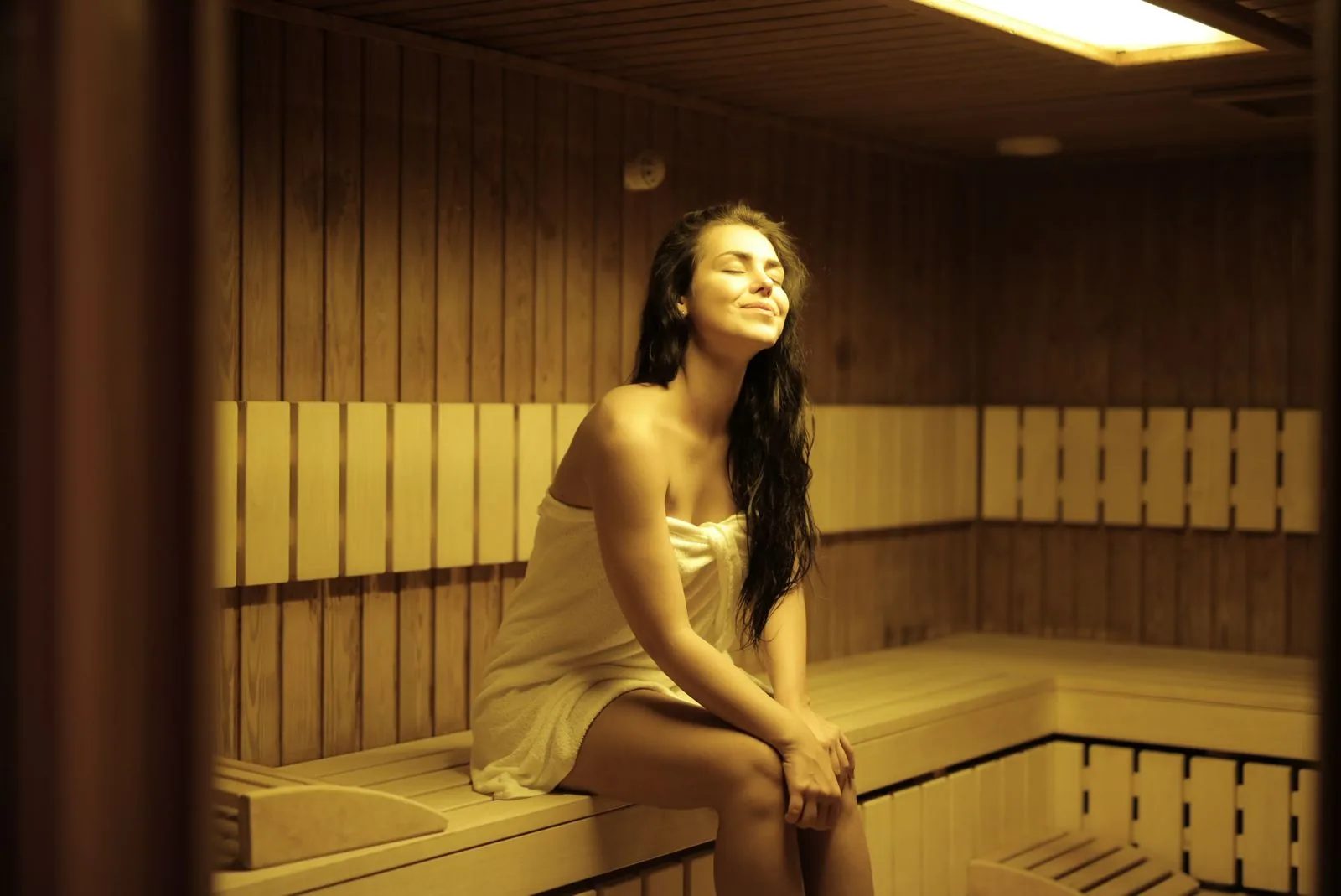
Figure 1. A female client wrapped in a bath towel relaxes on a wooden bench in a dry sauna. Clients should sit on their own towel, wear no jewellery and always stay within the therapist's view through the glass door. (Photo: Andrea Piacquadio, Pexels)
A steam room is lined with tiles or stone, and a steam generator pumps water vapour in through a nozzle. The temperature is lower than in a sauna but the humidity is very high and the room is foggy. Sweat hardly evaporates at all, so clients feel hot and "stuffy" quickly even though the thermometer reads lower. Steam at the nozzle can be extremely hot: clients must not sit right next to it or put their hand where the steam comes out.
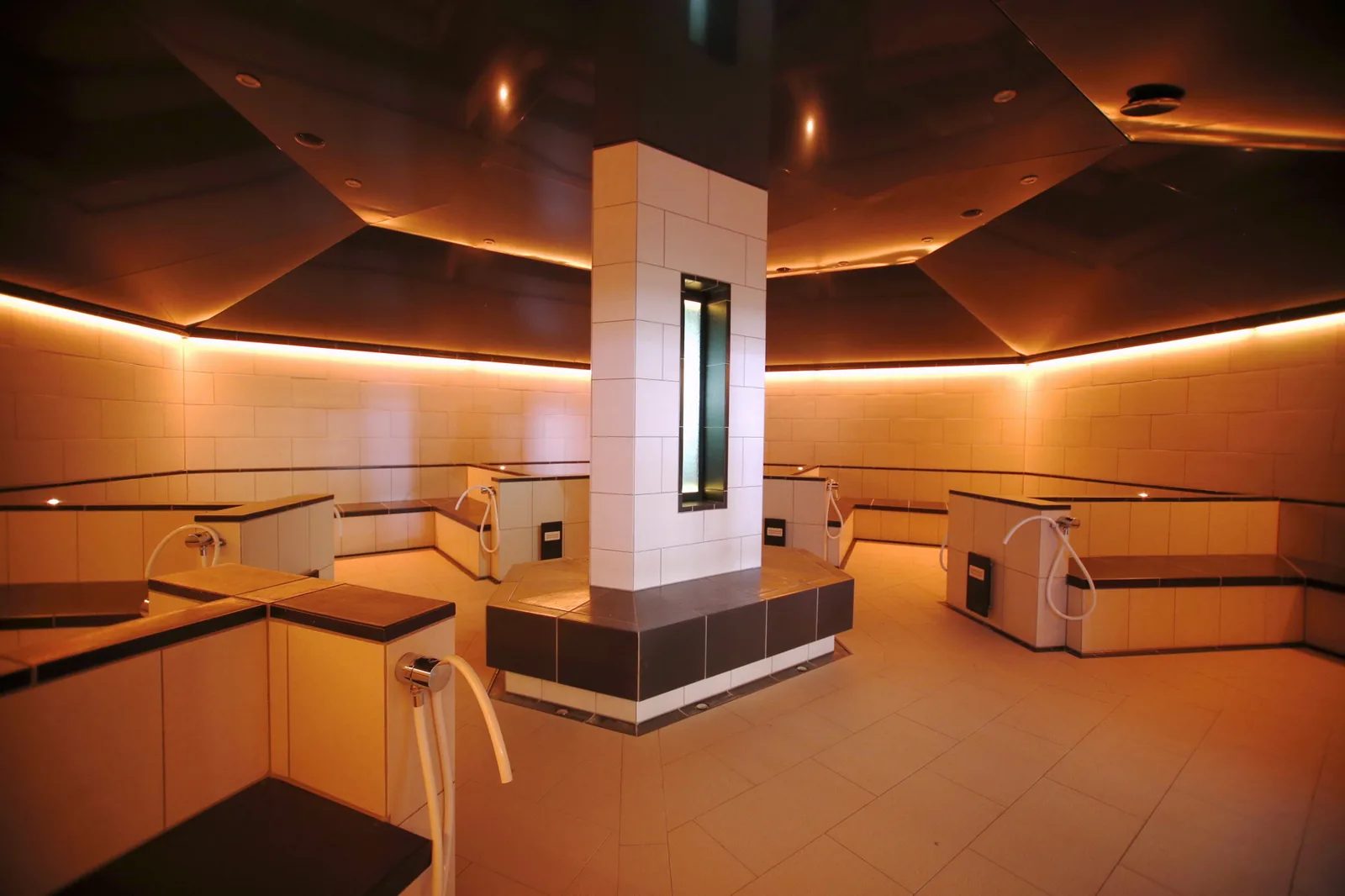
Figure 2. A tiled steam room with a tiled bench and a hand-held shower next to the seat for rinsing the bench and the body. Surfaces are always wet and therefore slippery: remind clients to walk slowly, and check the floor and the drain before every shift. (Photo: Obermain Therme, Wikimedia Commons, CC BY-SA 4.0)
The most important thing they have in common: both make the body lose water through sweat, make the heart beat faster and can easily cause dizziness when the client stands up. Every safety step below revolves around these three facts.
Reference table: temperature, humidity and time
The table only helps you picture the differences. It is not a standard: the actual figures follow the equipment manufacturer's instructions and your spa's rules. Where the spa's rules differ from the table, follow the spa.
Item | Dry sauna | Steam room |
|---|---|---|
Typical air temperature | About 70–90°C (for reference; follow the manufacturer's instructions and spa rules) | About 40–50°C (for reference; follow the manufacturer's instructions and spa rules) |
Humidity | Low; rises briefly when water is poured on the stones | Very high, the room is foggy |
Typical length of one session | About 8–15 minutes; shorter for first-timers (for reference; follow spa rules) | About 10–15 minutes; shorter for first-timers (for reference; follow spa rules) |
Additional risks to watch | Burns from touching the heater, stones or metal parts; overheating | Steam burns at the nozzle; slipping; a stuffy feeling, difficulty breathing |
Three principles:
The time is a maximum, not a target. If the client feels unwell, they come out immediately, even if they have only been in for two minutes.
First-timers start short and sit on the lower bench (closer to the floor, cooler).
Never raise the temperature on your own beyond the level the spa allows, even if the client asks for "hotter".
Checking the heat room before inviting the client in
Don't just look at the control panel; go into the room and check it in person.
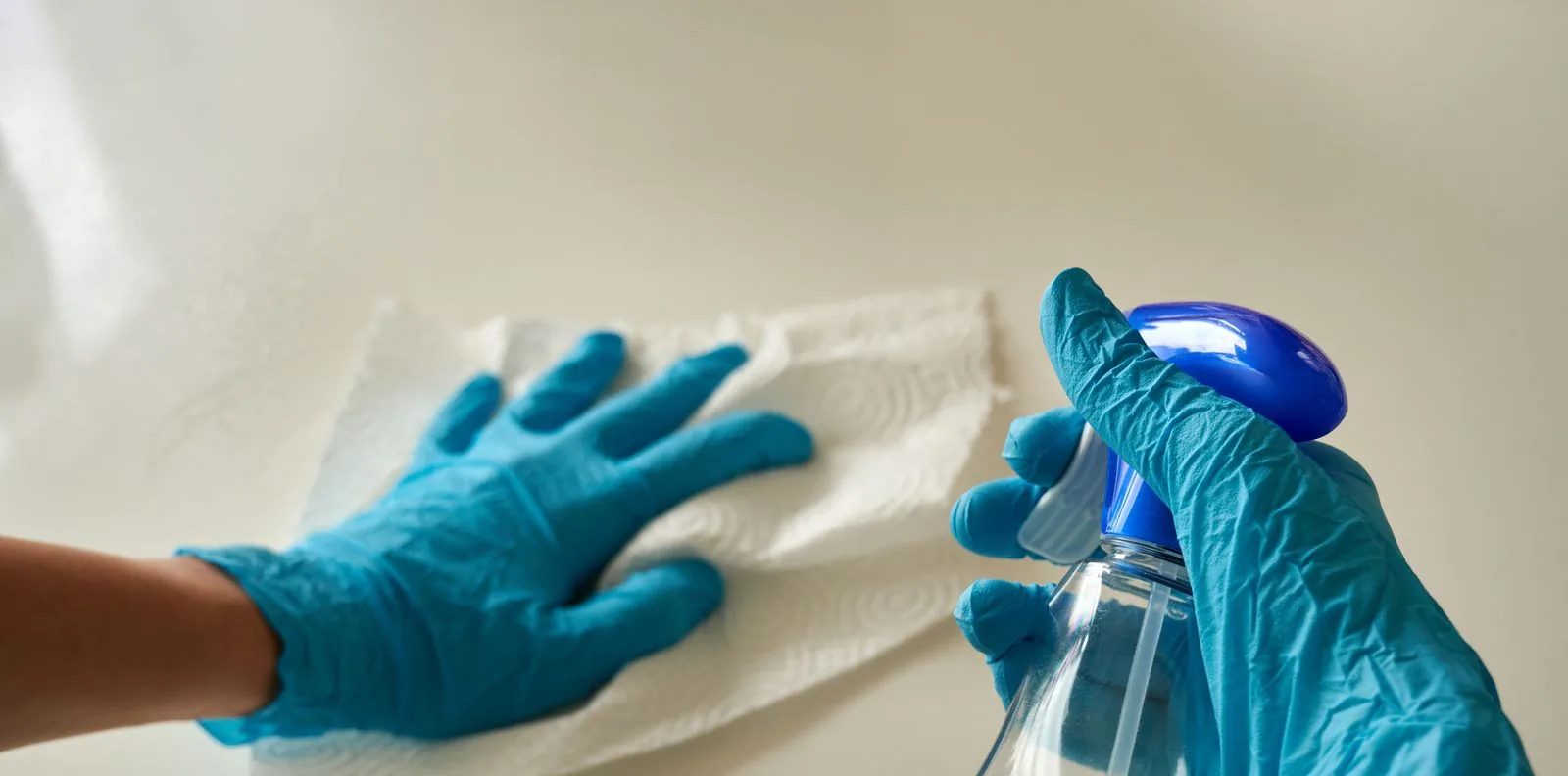
Figure 3. Two gloved hands: one wipes a surface with a paper towel, the other holds a spray bottle of cleaning solution. Benches, door handles and surfaces clients touch are cleaned before the shift with the chemical the spa specifies for each material. (Photo: Anton Uniqueton, Pexels)
For the dry sauna
The thermometer (and hygrometer, if fitted) works, and the reading is within the spa's set range.
The guard around the heater is secure; a client cannot accidentally touch the heater.
Nothing is on or next to the heater: no towels, robes, bottles. A towel hung over the heater is a fire hazard.
Stones are stacked correctly and not crumbling; ladle and bucket are clean; never add essential oil to the stones unless the manufacturer and the spa allow it.
Wooden benches have no cracks, splinters or protruding screws (metal heats up very quickly).
For the steam room
The steam generator runs smoothly with no strange noises; the nozzle has a guard or is located away from the seating.
Floor and benches are not slimy or slippery; there is an anti-slip mat at the entrance; the drain is clear.
No mould on the grout or in the ceiling corners; if there is, report it to the manager.
For both rooms
The door opens outwards easily and has no latch or lock on the outside; you can see clearly inside through the glass.
Lights are on, the emergency call button (if fitted) works when tested, the extractor fan runs.
Next to the room there is a shower, drinking water, a cool resting area, clean towels, a wall clock, a first-aid kit, the shift manager's number and the 115 number.
If you find a fault you cannot fix (loose heater guard, broken thermometer, sticking door, slippery floor), do not let clients in: put up an "out of service" sign and tell the manager.
Preparing the client before the session
Re-check health information
The client fills in or updates the health information form as for any service (how to go through the form is covered in the "Client consultation & health information form" step). Before inviting them into the room, ask a few short questions again:
"Are you feeling tired, feverish or dizzy today? Have you had any alcohol in the last few hours? Do you have any heart or blood pressure problems, or are you pregnant?"
The therapist does not diagnose and does not give treatment advice. Your job is to recognise cases that need caution, bring in the manager to review together, and suggest the client checks with their doctor.
Instructions to give the client
Drink a moderate amount of water before going in.
No alcohol or stimulants before or during the session.
Do not use the heat room right after a big meal, nor when very hungry.
Remove jewellery, watches, metal-framed glasses and metal hair clips: metal heats up quickly and can cause burns.
Do not bring a phone in: it can overheat or be damaged by steam, and a distracted client can easily stay in too long.
Take a quick shower and dry off; tie long hair up; in the sauna, sit on your own towel.
The mandatory sentence: "If you feel dizzy, nauseous, your heart races or you feel unwell in any way, come out straight away, don't wait for the time to run out, and call me."
Contraindications: when to refer to a doctor, refuse or postpone
This table is not a complete medical list; the spa's rules and the client's doctor have the final say.
Client's condition | How to handle it |
|---|---|
Pregnant or possibly pregnant | Do not accept for the heat room without a doctor's opinion and the manager's approval under spa rules; suggest another service |
Heart disease, previous heart attack or stroke, pacemaker | Ask them to consult a doctor first; bring in the manager, don't decide alone |
Uncontrolled high or low blood pressure, often dizzy on standing | Suggest consulting a doctor; if dizzy right now, postpone |
Fever, cold or flu, infection, diarrhoea, vomiting | Postpone until fully recovered |
Has drunk alcohol or used stimulants | Politely refuse and rebook for another day |
Has just eaten a large meal, just done a hard workout, is exhausted | Postpone; invite them to rest and drink water |
Sunburn, open wounds, burns, inflamed skin condition | Postpone until the skin has healed; skin conditions should be checked with a doctor |
Recent laser, peel, wax or other intensive skin treatment | Postpone for the period specified by the doctor, the product manufacturer or the spa |
Diabetes, asthma, respiratory disease, epilepsy, kidney disease | Suggest consulting a doctor; people with asthma may feel worse in the steam room |
Taking medication that affects blood pressure, heart rate or sweating, or that causes drowsiness | Suggest asking a doctor or pharmacist |
Elderly people, children, people afraid of enclosed spaces | Follow spa rules; if accepted, shorten the time and monitor more closely |
Short, non-judgemental refusal phrases:
"For your safety, since you've had some beer today the spa can't offer you the heat room. Let me book you in for another day, or today you could try a foot soak or relax in the lounge area."
"With the blood pressure condition you just mentioned, I'd suggest you check with your doctor first. Once your doctor says it's fine, come back and I'll look after you."
Never say "a little bit of heat won't hurt", "sweat it out and the fever will go" or "use the sauna to sober up". That advice is wrong and dangerous.
Guiding the client through a heat session
Step 1. Confirm the client and the service
Check the client's name, package and type of room; ask the screening questions again.
Step 2. Brief the client before they go in
Hand over a towel, robe and slippers; point out the shower, drinking water, resting area, emergency call button and how to open the door.
Example: "For your first round, please stay in for about 10 minutes at most and sit on the lower bench to get used to it. If you feel unwell, come out straight away or press this button and I'll come in immediately."
Step 3. Take the client in and record the time
Remind the client to step slowly. In the sauna, remind them to spread their towel to sit on and not to touch the heater guard or the stones; in the steam room, show them a seat away from the nozzle. Record the time in on the form or on the board by the door.
Step 4. Monitor and bring the client out on time
Monitor as described in "Supervising clients in the heat room" below. When time is up, knock and invite the client out, even if they want to stay longer. Remind them to stand up slowly: sit upright for a moment before standing, holding on if needed.
Step 5. Cool down and rest before the next round
The client showers, rests and drinks water. Only start another round (if the package allows) when their breathing is normal and they feel well.
Step 6. Finish and record
Ask the client how they feel; record the time out and anything unusual.
Supervising clients in the heat room
A rule with no exceptions: whenever a client is in the heat room, someone is on duty and watching. If you have to leave the heat area, hand over to a colleague and tell them clearly which client went in and at what time.
Look through the glass door regularly at the interval the spa sets, usually every few minutes. Watch first-timers, older clients and clients with something flagged on their health form more closely.
Observe: is the client slumping their head, lying motionless, clutching their chest or holding their head?
Check in briefly if the client has been sitting a long time: open the door slightly, "Are you feeling OK?". If they answer slowly, sound confused or don't answer, go in immediately.
Never let a client fall asleep in the room.
Record the time in and time out for every client so no one is forgotten, especially when it's busy.
Signs you must stop, and first aid
Signs the client must come out immediately
Dizziness, light-headedness, blurred vision; nausea, vomiting.
An abnormally fast or pounding heartbeat; difficulty breathing, rapid breathing, a suffocating feeling.
Severe headache, exhaustion, cramps.
Pale skin with cold sweat, or red, hot, dry skin.
Drowsiness, confused speech, slow responses.
The client says "I don't feel right", even without a clear reason.
What to do immediately
Take the client to a cool, airy place, supporting them rather than letting them walk alone; call a colleague for help.
Let the client lie down or sit reclined. If the client is dizzy but conscious and not injured from a fall: lay them on their back with their legs slightly raised.
Loosen the towel or robe; place towels soaked in cool water on the forehead, neck and arms; turn on a gentle fan.
Give small sips of cool water only when the client is fully alert and not nauseous.
Never leave the client alone, and don't let them get up and walk around, shower or leave before they have fully recovered.
Inform the shift manager and record the time, the signs and what you did.
Do not pour ice water over a dizzy client or put them in a cold plunge pool; do not give alcohol or coffee to "bring them round".
When to call 115 for an ambulance
Call 115 immediately (or ask someone else to call while you stay with the client) when:
The client faints, does not respond when spoken to, or has a seizure.
There is chest pain or tightness, or pain spreading to the shoulder, arm or jaw.
Severe difficulty breathing, wheezing, blue lips.
Drowsiness or confused speech, especially with hot, red, dry skin.
Repeated vomiting, or no improvement after a period of rest and cooling.
Large burns or big blisters from touching the heater or the steam jet; the client has fallen and hit their head.
When you call, give the spa's address clearly and say whether the client is conscious and breathing. If the client is unconscious and not breathing normally, follow the dispatcher's instructions; trained staff should perform cardiopulmonary resuscitation (CPR) and use an automated external defibrillator (AED) if the spa has one. If in doubt, call: an unnecessary call is better than a late one.
Cooling down and resting after the session

Figure 4. A woman with a towel wrapped around her hair drinking a glass of water. After each heat session the client needs to rest in a cool, airy place and drink water to replace the fluid lost through sweat. (Photo: Maria Orlova, Pexels)
Many fainting episodes happen just as the client stands up or while they are showering.
Stand up slowly and hold on when stepping out.
Take a warm or cool shower to bring the body temperature down gradually. A cold plunge pool or strong cold shower (if available) should only be used according to spa rules; clients with heart or blood pressure problems should not use them without asking a doctor.
Sit or lie down to rest in an airy area, with a towel over them if they feel cold.
Drink filtered water or a light herbal tea; never serve alcohol in the heat area.
If a massage or facial follows, only move on once the client has rested and stopped sweating heavily.
Advise the client as they leave: drink more water, and if they still feel tired or dizzy, don't drive straight away.
Cleaning the heat rooms and towels
The rooms are hot, humid and shared, so they easily develop odours and mould. The exact cleaning schedule follows spa rules.
During the shift: after each client, replace the bench towel and pick up litter and hair. In the steam room, rinse the benches and floor with the hand-held shower and squeegee the water towards the drain. Check that no towel has been left near the heater.
End of day, dry sauna: switch off the heater according to the instructions and wait for the room to cool. Scrub the wooden benches with the product the spa specifies for sauna wood; do not use harsh or strong-smelling chemicals, because wood absorbs chemicals and gives off fumes when heated. Leave the door open so the room dries out.
End of day, steam room: switch off the steam generator and wait for it to cool. Scrub the floor, benches, walls and grout with the solution the spa specifies, at the correct concentration and contact time stated on the label; rinse thoroughly, clear the drain and leave the door open to dry.
Wipe door handles, glass and buttons; record the cleaning in the log along with anything unusual (mould marks, cracked wood, a noisy machine). Wear gloves and protective equipment as stated on the chemical label; never mix chemicals together.
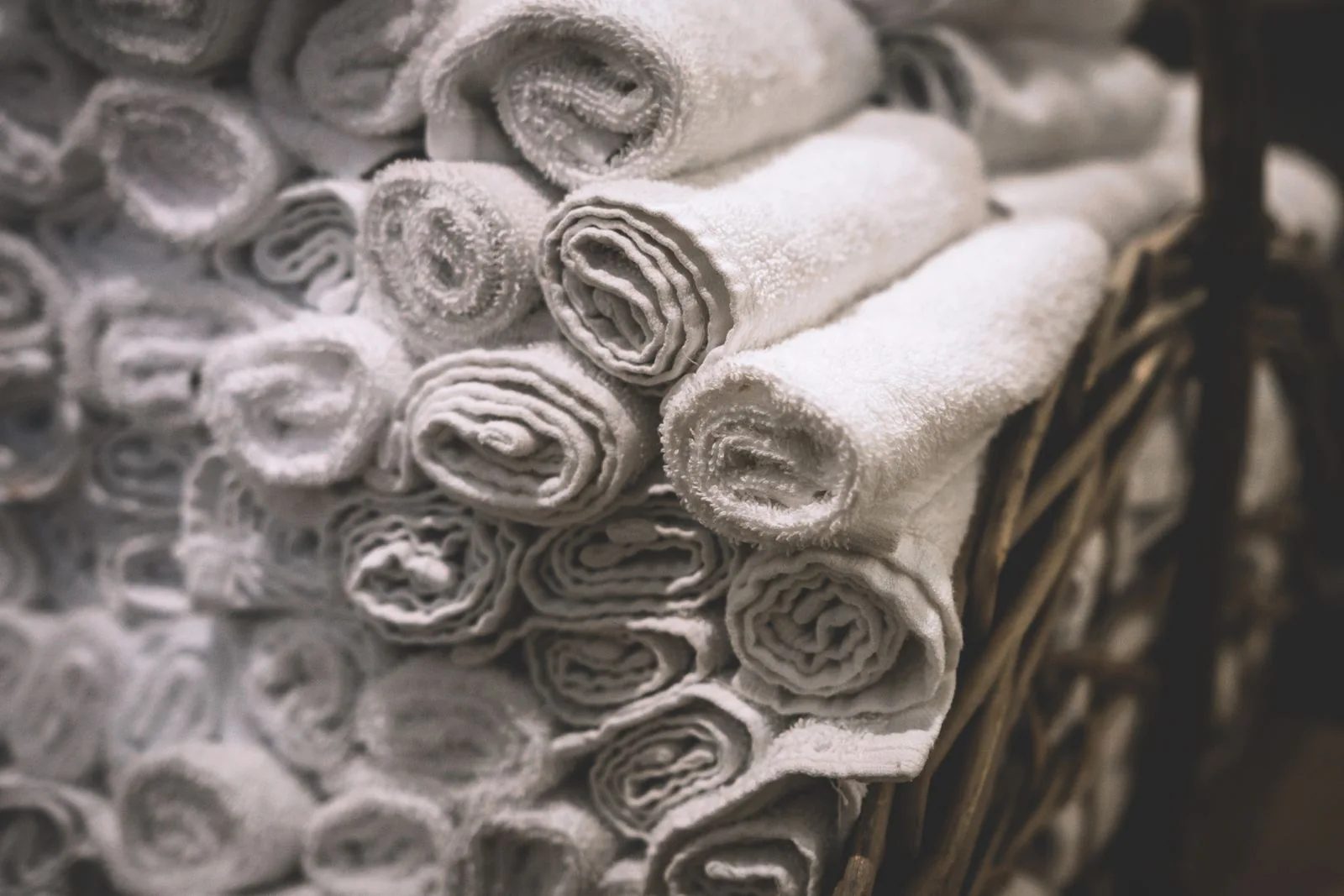
Figure 5. White cotton towels rolled up and ready in a basket. Each client uses their own towels; used towels go into a lidded laundry bin and never get mixed with clean ones. (Photo: Lum3n, Pexels)
Towels and robes:
Each client gets a clean set of towels and a robe; the sauna bench towel is used once for one client only.
Used towels go straight into a lidded bin; never "dry them out and reuse them".
Keep clean towels in a dry place, separate from dirty ones; wash and dry them according to the spa's procedure; discard towels that are stained, smell odd or are mouldy.
Heat area safety checklist
Before the shift:
Temperature within the spa's set range; thermometer working.
Heater guard secure; nothing on or next to the heater; steam nozzle guarded.
Door opens easily and has no outside lock; glass gives a clear view; lights, emergency call button and extractor fan working.
Floor not slippery, drain clear; benches not cracked, no protruding screws.
Drinking water, clean towels, resting area, first-aid kit, the 115 number and the shift manager's number available.
For each client:
Screened (tiredness, fever, alcohol, heart problems, blood pressure, pregnancy, recent skin treatments) and fully briefed.
Shown the emergency call button, how to open the door and the maximum time.
Time in recorded, monitored regularly, time out recorded.
End of day: switch equipment off according to instructions, clean once the rooms have cooled, fill in the log and report any faults.
Frequently asked questions
Which is better, a dry sauna or a steam room?
Neither is better for everyone. They are two different experiences; clients choose whichever feels more comfortable. Therapists should not promote healing effects for either.
What if a client wants to stay in longer than the set time?
Politely explain that the spa limits the time for safety reasons, invite the client out to rest and drink water, then go in for another round if the package allows. Do not give in and exceed the rules.
A client asks whether the sauna helps with weight loss or detox. What should I say?
Do not claim or promise anything. The weight lost right after a session is mainly water lost through sweat, and it comes back once the client drinks. Present the heat room as a relaxation service.
A client faints in the room while I'm on duty alone. What do I do first?
Open the door, shout for a colleague, move the client to a cool place if you can do it safely, check whether they are conscious and breathing, call 115 (or have someone call) and follow the dispatcher's instructions. Never leave the client alone.
Practical exercise
Work in groups of three: one person plays the client, one plays the therapist, and one observes and scores using the checklist.
Room check: walk around the heat room (or a mock-up room) and read out each item on the "Before the shift" checklist. The observer deliberately sets up one fault (a towel near the heater, a blocked door, standing water on the floor) for you to find.
Screening: the "client" plays, in turn, someone who has just drunk beer, a pregnant woman, someone with a slight fever, someone who had a skin peel yesterday, and a healthy first-timer. You decide whether to accept, postpone or suggest seeing a doctor, and deliver a polite refusal.
One-minute briefing: maximum time, where to sit, removing jewellery, no phones, the emergency call button, "if you feel unwell, come out immediately".
Emergency scenario: the "client" comes out saying they feel dizzy and nauseous; you carry out each first-aid step. The observer then adds a sign such as "chest tightness" or "no response when spoken to" so you call 115 and give the right information.
Cleaning: name two differences between cleaning the dry sauna and the steam room at the end of the day.
You pass when you: never let a client into a room that still has a fault; recognise all the cases that must be postponed or referred to a doctor without diagnosing; always record times and monitor regularly; and in an emergency, move the client to safety, never leave them alone and call 115 at the right moment.
This lesson belongs to the "Safety checks & service skills" step; you will use these skills again when practising the "Delivering a complete client treatment" step that includes a heat session.