“I asked you to go gently and you kept pressing hard. Now my whole back hurts. I'm not paying for this session.” When they hear this, some new therapists argue back, some panic and promise “I'll refund you”, and some stay silent and let the client leave angry. All three reactions make things worse.
Complaints are a normal part of any service job. What matters is receiving them calmly, recognising which ones involve the client's safety, and knowing when to stop, call a manager or get medical help.
By the end of this lesson, you will be able to: (1) quickly classify a complaint; (2) handle it with a 6-step procedure, apologising without admitting professional or medical fault; (3) use sample phrases for common situations; (4) write an objective incident record; (5) make a follow-up call and prevent repeat complaints.
The therapist's role when a client complains
You are usually the first person to hear a complaint. Your job is to receive it, keep the client safe, record the facts correctly and pass it to the right person. You do not judge who is right or wrong.
Things that are within your scope:
Stop or adjust the service immediately: lighten the pressure, adjust the room temperature, add another towel.
Listen, apologise for the client's experience, and ask questions to clarify.
Give first aid within the scope the spa has trained you for; report to the manager and keep a record.
Things that are not within your scope (unless the spa has clearly authorised you):
Promising refunds, discounts, free sessions or package changes.
Stating the cause of a skin reaction with certainty (“it's because your skin is weak”, “this product is faulty”) or saying “it's nothing”.
Applying medicines or creams that are not on the spa's first-aid list; replying to the client's online reviews.
Classify first: a safety issue or an experience issue
First, ask yourself: does this complaint involve the client's body?
Safety group: the client reports pain, stinging, heat, itching, redness, a rash, swelling, dizziness, nausea or difficulty breathing, or you notice something unusual about their skin. This group is the top priority: stop the service, take care of the client, report to the manager; money matters come later.
Experience group: running late, a cold or noisy room, pressure that is not to the client's liking but does not cause pain, a service that does not match the booked package, staff attitude, prices, room hygiene. This group needs listening, fixing on the spot whatever can be fixed, and passing anything beyond your authority to the manager.
“You're pressing too hard” is an experience issue if the client feels comfortable once you lighten the pressure. But if the client still feels sharp pain after you have stopped, or calls back to report bruising or swelling, treat it as a safety issue. When in doubt, put it in the safety group.
The 6-step complaint procedure
Step 1. Stop and make sure the client is safe
If the client complains in the middle of a session, stop your hands first and then speak; cover the client with a towel for privacy. If it is a safety issue, follow the safety section below. If the client is upset at the reception desk, invite them to a private seat, pour them a glass of water, and avoid having the conversation in front of other clients.
Step 2. Listen fully, without interrupting

Figure 1. A therapist in a white coat holds a glass tool while the client sitting opposite points at it and asks a question. When a client has a question or complaint, let them finish speaking, look at them and nod, and do not rush to explain. (Photo: RDNE Stock project, Pexels)
Look at the client, nod, and respond briefly: “Yes”, “I understand”. Do not cut in with “but…” or “you didn't tell me beforehand”. Note the main points: what is bothering them, since when, in which area, and what the client wants.
Step 3. Apologise for the experience, not for the cause
You apologise because the client felt uncomfortable; you do not conclude what caused it before it is clear.
Do say: “I'm very sorry you felt pain during today's session.” / “I'm sorry you had to wait so long.”
Avoid saying: “You're having an allergic reaction”, “This product is faulty”, “You've probably been burned”. These are conclusions you have no basis to make.
Do not blame the client: “It's because your skin is sensitive.”
Step 4. Repeat back and ask for more detail
Summarise to be sure: “Let me repeat this so I record it correctly: when I was working on your calves, you felt the pressure was too strong and it still feels sore now, is that right?” Then ask: “How are you feeling now?”, “How would you like the spa to help you?”
Step 5. Act within your scope, pass anything beyond it to the manager
Fix what you can fix right away. Anything involving money, package changes, compensation and every safety-group incident must be reported to the manager or shift leader. Tell the client clearly who will handle it and when.
Example: “I'll ask the shift manager to come and talk with you directly. Could you wait a few minutes for me?”
Step 6. Record and follow up
Fill in the spa's incident record form as soon as the client has been looked after; do not leave it until the end of the day. The manager decides who will make the follow-up call and when.
Client reports pain, stinging, redness or dizziness: handling it safely
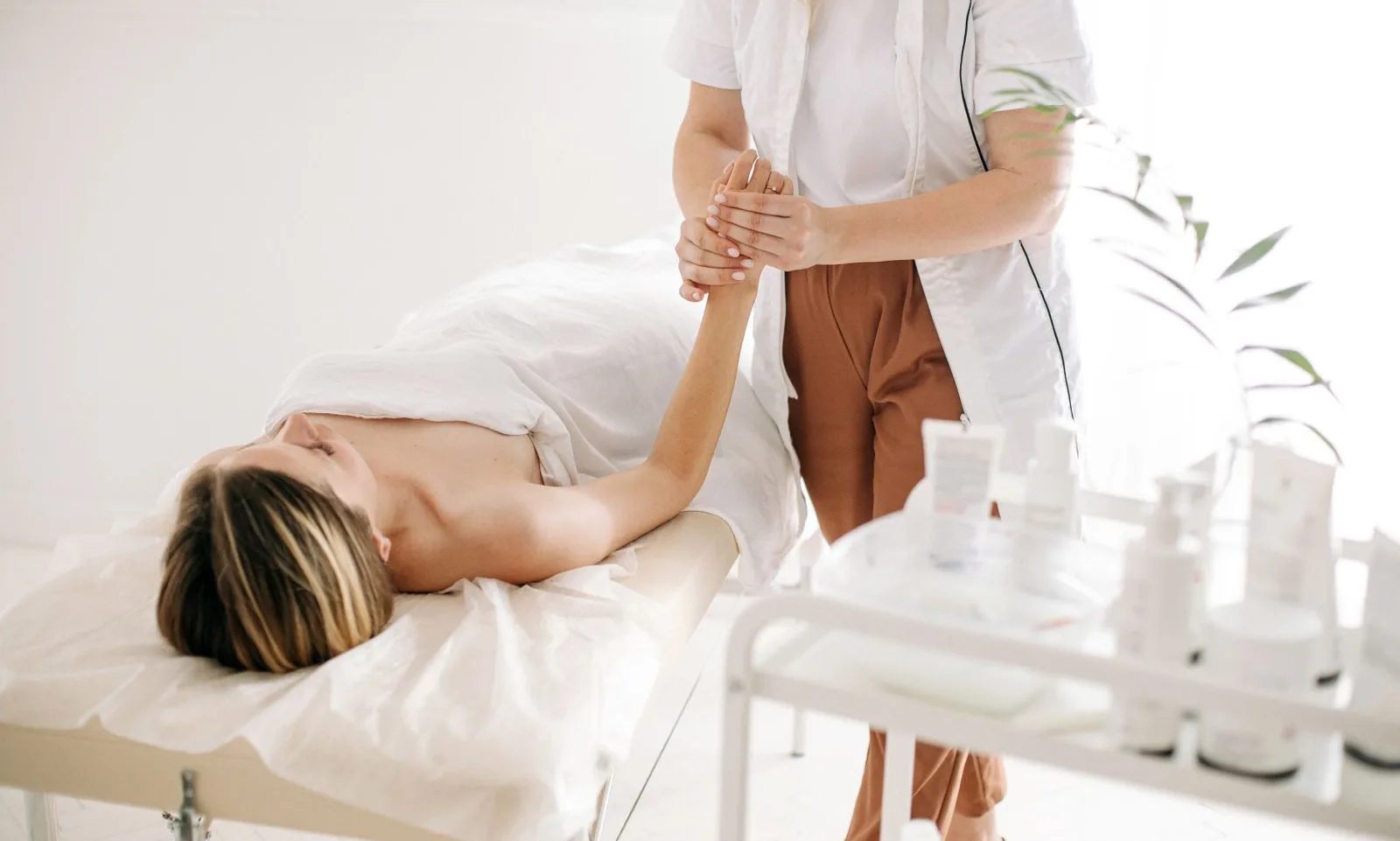
Figure 2. A therapist stands beside the bed, holding the hand of a client lying face up under a white towel. When a client reports discomfort mid-session, stop the movement, keep the client lying still and covered, and ask how they feel before doing anything else. (Photo: Ivan S, Pexels)
The order is always: stop – observe – give initial first aid according to the spa's procedure – report to the manager – call for medical help if needed.
What to do immediately
Stop the service. Do not continue on that area, and do not “just finish it off”.
Remove the suspected cause. If a product is on the skin (oil, mask, exfoliant…), wipe or rinse it off gently with clean water as the spa instructs. If heat is suspected (hot stones, hot towels, wax, a machine), remove the hot item at once.
Cool the skin if a minor heat burn is suspected. Following standard first-aid guidance, cool the area with clean, cool water (not iced water, and do not apply ice directly). Do not apply toothpaste, grease, oil or anything that is not on the spa's first-aid list. Do not pop any blisters.
Let the client rest. A dizzy client should lie down or sit reclined, not stand up suddenly, and not walk alone.
Report to the manager immediately, even if the client says “I'm fine, I can go home”.
Do not use diagnostic language. Instead of saying “you have an allergy”, describe what you see: “I can see this area of skin is redder than at the start.”
Signs that require calling emergency number 115
Call the 115 emergency service in Vietnam (or follow the spa's emergency procedure) and report to the manager immediately if the client shows any of these signs:
Difficulty breathing, wheezing, chest tightness; swelling of the lips, tongue, eyelids or face; a rash spreading quickly over the body.
Faintness, drowsiness or confusion, fainting, pale cold clammy skin.
A large burned area, large blisters, skin that is white or dark in colour, or a burn on the face.
Severe pain that keeps increasing even after the service has stopped.
While waiting, stay with the client, do not give them any medicine yourself, and note the time the symptoms started. In milder cases, still advise the client to see a doctor if symptoms persist, get worse, or the client is worried.
Reference table: complaint type, first response, who handles it, what to record
Complaint type | Therapist's first response | Who handles it next | What to record |
|---|---|---|---|
Pain, stinging, redness or rash during or after the service | Stop immediately, remove the product/hot item, give initial first aid according to procedure | Manager immediately; call 115 if there are serious signs | Time, skin area, product/equipment, symptoms, actions taken, who was informed |
Dizziness, nausea, feeling unwell overall | Stop, have the client lie down or sit reclined, do not let them stand up suddenly | Manager immediately; call 115 if breathing difficulty or fainting | Time, symptoms, the client's position at the time, service being performed |
Pressure too strong or too light | Stop, apologise, ask what pressure they want, adjust | Therapist; report to the manager if the client is still in pain | Area being worked, the client's words, what was adjusted |
Running late, long wait | Apologise, state clearly how much longer the wait is, do not blame colleagues | Reception/manager decides whether to make up the time | Appointment time, actual start time, reason, what the client chose |
Room too cold, hot, noisy or smelly | Apologise, fix what can be fixed at once, add a towel | Therapist; report to the manager if a room change is needed | The problem, what was done, whether it recurs |
Service does not match the booked package | Apologise, reconfirm the package the client booked, do not argue | Reception/manager checks the booking slip | Package the client mentions, package on the slip, steps performed |
Asks for a refund or discount | Acknowledge, make no promises, invite the manager | Manager, according to spa policy | The client's request and the reason they give |
Staff attitude | Listen, apologise, do not argue | Manager | The client's words as close to verbatim as possible, time, people involved |
Client threatens to post, or has posted, a bad review | Do not argue, do not reply online yourself | Manager/person in charge of the spa's pages | What the client said, where it was posted (if known) |
This table is a reference framework; each spa has its own rules on compensation, emergencies and record forms.
Sample phrases for common situations
These phrases are for reference; say them in a natural voice and always back them up with real action.
Client says the pressure is too strong
“I'm sorry, I'll lighten the pressure right away. Could you rate it for me on a scale of 0 to 10 — roughly what level would you like?”
Avoid: “Strong is what feels good”, “It hurts because your muscles are tight”.
If the client is still in pain after you lighten the pressure: skip that area and report to the manager.
Client reports pain or redness after the service
“Thank you for telling me straight away. May I take a look at that area of skin? I'll ask the shift manager to come in as well to help you.”
If the client calls after getting home: “I'm very sorry to hear that. Is that area swollen or blistered now, and are you having any difficulty breathing? If it gets worse, you should see a doctor right away. I'll let the manager know so she can call you back.”
Avoid: “It's nothing, it'll be gone tomorrow”, “Try putting this cream on”.
Running late, client has to wait
“I'm sorry you've had to wait. The room will be ready in about 10 minutes. Would you like to wait a little longer, or shall I ask reception to book you another time?”
Give a real number. If the service has to be shortened, say so in advance and let the manager decide how to make up for it; do not rush through the treatment on your own to catch up.
Room too cold, hot or noisy
“I'm sorry, I'll turn the air conditioning up and put another towel over you right away. Do you feel warmer now?”
“I'm sorry about the noise, let me check whether there is a quieter room.”
Service does not match the booked package
“I'm sorry, let me check the booking slip right away. Which package did you book, so I can compare?”
If it really was a mistake: “You're right, I did the wrong step, I apologise. I'll tell the manager so she can talk with you about how we can help.”
Do not add extra steps outside the package to “make up for it” without the manager's approval.
Client asks for a refund
“I understand you're not happy with today's session. Whether a refund or other support is possible is decided by the manager according to the spa's policy, so I'll ask her to talk with you directly right now.”
Avoid: “I'll refund you”, “The spa never gives refunds”. Neither is something you have the authority to say.
Client threatens to post, or has posted, a bad review
“I'm very sorry the session didn't meet your expectations. Could you tell me what upset you most, so I can note it down and report it to the manager to deal with?”
Do not beg the client to remove the post, do not offer gifts in exchange for removing the review, and do not argue.
Incident records: what to write and how

Figure 3. A person sits on a chair with a clipboard on their lap, writing on a form. Fill in the incident record right after the client has been looked after, while the details are still fresh. (Photo: Alex Green, Pexels)
An incident record helps the spa support the client in the right way, learn from what happened, and shows that you followed the correct procedure.
Sections to include
Date and time of the incident; client name or code, room, service being performed; therapist in charge.
Who was informed and at what time.
Description of the incident: what the client said (close to verbatim, in quotation marks) and what you saw.
Products and equipment in use (batch number if the spa requires it).
Actions taken and their times: stopping the service, first aid, calling the manager, calling 115…
The client's condition when leaving; whether the client saw a doctor (if they told you).
What the client wants, how the manager plans to handle it, who will make the follow-up call and when.
Recording principles
Record facts, not guesses. Write “skin on the top of the foot is red, client says it stings”, not “client is allergic to the product”.
Do not alter or erase anything already written. If you make a mistake, strike it through with a single line and rewrite it, with your signature or initials as the spa requires.
Photos of the skin area may only be taken with the client's consent and according to spa rules; never with your personal phone.
Confidentiality: incident records and health forms are the client's private information.
Example of a short record
14:20 – Room 3 – 60-minute body massage – Therapist: Lan. At about minute 25, while working on the left calf, the client said: “You're pressing too hard, it hurts.” The therapist stopped immediately, apologised, lightened the pressure and skipped the left calf. At the end of the session, the client said “the calf still feels sore”; no swelling or bruising was seen when the client left. 15:25 reported to Ms Ha (shift manager). Ms Ha spoke with the client and arranged a follow-up call for the next day.
Follow-up calls after an incident
The manager decides who calls and when. If you are asked to call, reread the incident record first. Suggested steps:
Greet the client, give your name and the spa's name, and ask whether it is a convenient time to talk.
Ask how they are: “Yesterday you mentioned your calf was sore after the massage. How are you feeling today?”
Listen. If the symptoms have worsened, advise the client to see a doctor and report to the manager immediately.
Thank the client for the feedback and briefly mention what the spa has changed.
Record the outcome of the call: time of the call, what the client said, next steps.
Do not use the call to sell a new package.
When a client posts a bad review online

Figure 4. A woman in a white sweater sits on a sofa, focused on typing on her phone. Clients may write a review right after a session; therapists do not reply online themselves but report it to the spa's person in charge. (Photo: Mikhail Nilov, Pexels)
A bad review that mentions your name can easily hurt. Here is what to do:
Report it to the manager or the person in charge of the spa's pages.
Do not reply, and do not message the client privately to argue.
Do not post the client's information online to “clear your name”.
When asked, describe exactly what is in the record, without adding or leaving anything out.
Preventing complaints in advance
Many complaints can be avoided with small actions:
Confirm the package before starting: “Today you've booked the 60-minute body massage, is that right?”
Check the pressure at several points during the session, especially when moving to a new area.
Check the room beforehand: temperature, towels, music, smells, cleanliness.
Test the temperature of stones, hot towels and wax according to each service's procedure before placing them on the client's skin.
Read the health form carefully before every session.
Learn from incidents: focus on fixing the procedure, not on naming and shaming anyone.
Safety checklist
When a client reports pain, stinging, itching or dizziness, I stop the service before saying anything.
I know where the first-aid kit is, the spa's first-aid procedure, the 115 emergency number and who to report to on my shift.
I do not apply medicines outside the first-aid list, do not pop blisters, and do not put ice directly on the skin.
I do not let a dizzy client stand up suddenly or leave alone.
I do not diagnose, do not say “it's nothing”, and do not promise refunds.
I report every safety-group incident to the manager, even if the client says they are fine.
I fill in the incident record during my shift, recording facts, with times.
I keep the client's information and images confidential.
Frequently asked questions
Does apologising to the client mean admitting fault?
Not necessarily. You apologise for the unpleasant experience (“I'm sorry you felt pain”) without concluding the cause. The cause and responsibility are reviewed by the manager; health matters need a doctor's opinion.
The client complains, but I believe I followed the procedure correctly. Should I explain?
Yes, but only after you have heard them out and apologised for the experience. Keep the explanation short, do not argue about who is right, and record everything in full so the manager can review it.
What should I do if a client shouts at or insults me?
Stay calm, speak slowly and quietly, and do not answer back. If the client keeps insulting or threatening you, say “Let me ask the shift manager to help you,” then politely leave the room and go to where your colleagues are. Report to the manager and record what happened.
Practice exercises
Practise in groups of three: client, therapist and observer.
Quick classification: the instructor reads out 10 complaints (“the room is too cold”, “this spot stings a bit”, “I feel a little dizzy”…). You answer quickly: which group, and what is the first thing to do.
6-step role-play: pressure too strong, running late, wrong package, refund request; the observer checks that all 6 steps were followed.
Safety scenario: the “client” says their back is burning after hot stones. You simulate: stop, remove the stones, observe, give first aid according to procedure, report to the manager. Then the sign “difficulty breathing” is added so you must decide to call 115.
Write a record: after each role, write an incident record within 5 minutes. Swap with a classmate, who underlines anything that is a guess.
Follow-up call: practise a call using the 5 suggested steps.
Self-assessment criteria — you pass when:
In every safety-group situation, you stop the service first and report to the manager.
You say nothing that diagnoses, blames the client or promises a refund.
Your incident record includes times, actions taken and who was informed, with no guesswork.
This lesson belongs to the “Safety checks & service skills” step; you will use it in every session when practising the “Serving a client through a full treatment course” step.