After the first six steps of the roadmap, you need to answer one question: am I safe enough to take real clients? In a spa, a technical mistake leaves a client unhappy; a safety mistake can injure them. That is why this assessment, modelled on the checks many spas run before letting a new therapist work a shift, scores safety first and skill second. By the end of this lesson, you will be able to:
- Work through a set of 20 theory questions, check your answers and understand why each option is right or wrong.
- Rehearse the 45-minute practical exam with a model client, following the brief, the time limits and the 100-point rubric.
- Handle three common situations: an allergic reaction, a dizzy client and a complaint.
- Recognise the mistakes that cost points and the automatic-fail mistakes, so you do not fail over things that "seem minor".
- Know exactly when to simply monitor, when to advise the client to see a doctor and when to call 115 (the emergency ambulance number in Vietnam).
Structure of the assessment and pass conditions
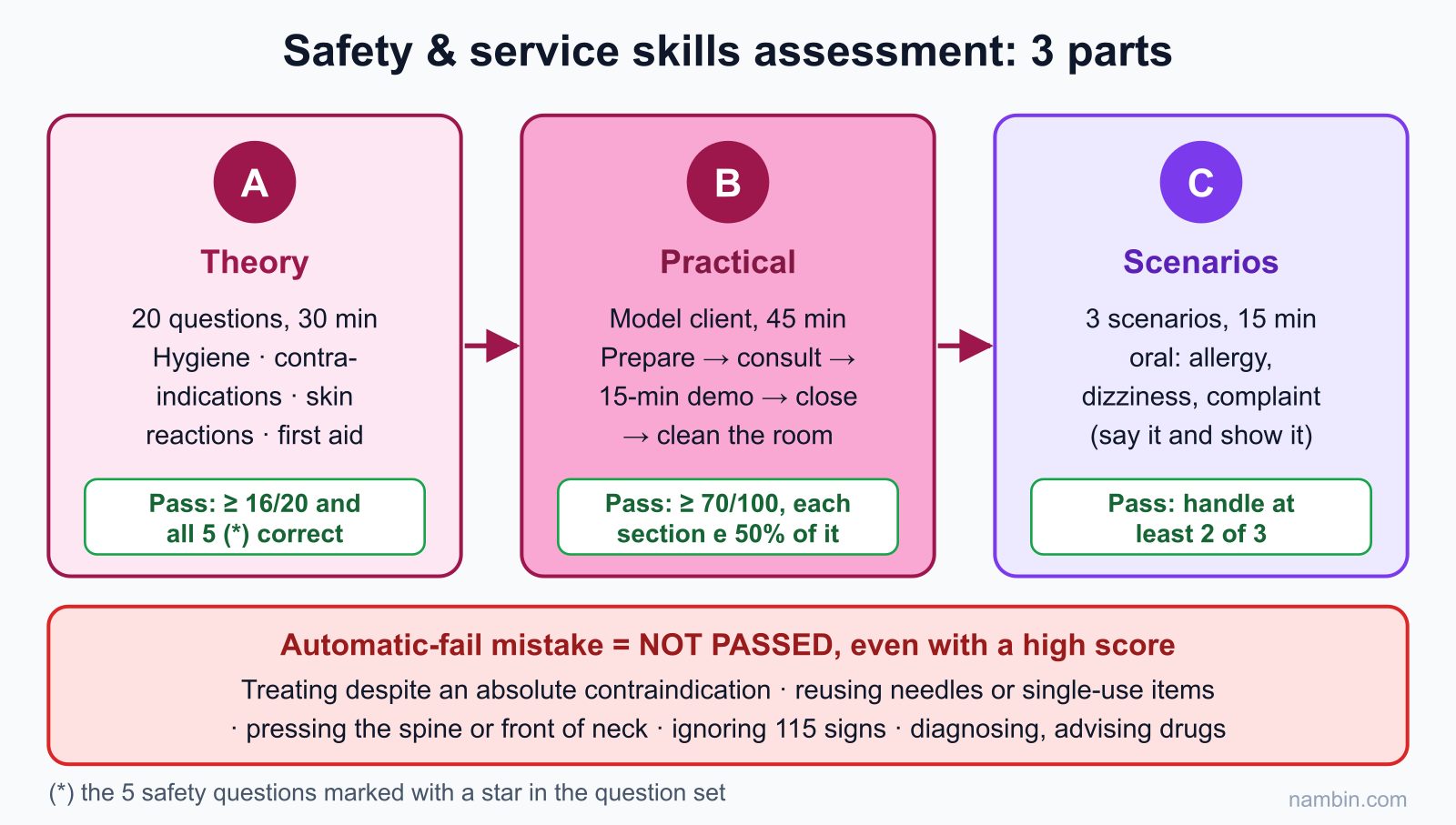
The assessment has three parts, completed in one session and marked by an instructor. You can practise at home with a classmate playing the client.
| Part | Format | Time | Pass condition |
|---|---|---|---|
| A. Theory | 20 multiple-choice questions | 30 minutes | At least 16/20 correct, including all 5 questions marked (*) |
| B. Practical | Serving a model client | 45 minutes | At least 70/100 points, and no section below 50% of its own points |
| C. Scenarios | Oral answers and demonstration | 15 minutes | Handle at least 2 of the 3 scenarios correctly |
You must pass all three parts. Each spa may set different score thresholds, but the principle that "safety is a mandatory condition" is the same everywhere.
Part A: 20 self-check questions with answers
Answer all 20 questions first and write your answers on paper; only then read the explanations. Questions marked (*) are safety questions that you must get right.
Group 1: Hygiene and disinfection
Question 1. The correct order for processing reusable metal tools (tweezers, comedone extractors): A) Soak in disinfectant, then wash; B) Wash clean, dry, then disinfect or sterilise; C) Wiping with alcohol is enough.
Answer B. Sebum, blood and fluids stop the chemical from reaching the tool surface, so cleaning must come first. Tools that touch blood or broken skin need sterilising according to the spa's rules.
Question 2 (*). After use, a single-use extraction lancet or razor blade should be: A) Recapped and thrown in the bin; B) Dropped straight into a sharps container, without recapping; C) Washed and reused for the same client.
Answer B. Recapping a needle is the action that causes the most needle-stick injuries. Single-use items are never reused.
Question 3. When mixing a surface disinfectant, the most important point is: A) Make it stronger to be sure; B) Use the correct ratio, respect the contact time on the label and write the mixing date; C) Mix once and use it all week.
Answer B. A stronger mix does not clean better; it harms skin and damages surfaces. A chemical only kills germs if the surface stays wet for the full contact time.
Question 4. Clean a treatment room in this order: A) Dirty to clean; B) Clean to dirty, top to bottom; C) Any order.
Answer B. This avoids dragging germs from dirty areas to clean ones, and dust falls onto the parts you have not cleaned yet.
Question 5. Washing hands with soap means: A) Rinsing for 5 seconds; B) Scrubbing palms, backs of hands, between fingers, backs of fingers, thumbs and fingertips for at least 20 seconds; C) No need to wash if you wear gloves.
Answer B. Gloves do not replace hand washing: wash before putting them on and after taking them off.
Group 2: Contraindications and screening
Question 6 (*). A client has a fever of 38.5 °C and wants a massage to "sweat it out": A) Use a light touch; B) Decline politely and rebook for when they are well; C) Offer the steam room instead.
Answer B. Fever is a contraindication (a reason not to treat) for massage and steam: the client dehydrates easily, feels worse and may infect others.
Question 7 (*). One calf is swollen, warm and more painful than the other: A) Massage firmly to improve circulation; B) Do not massage the leg; advise the client to see a doctor soon; C) Apply a hot compress, then work.
Answer B. It could be a deep vein thrombosis (a blood clot in a deep vein); massage could make the clot move. You do not diagnose; you stop and refer.
Question 8. A pregnant client wants a body massage: A) Treat her like any other client; B) Only if the spa offers a pregnancy service and you are trained in it; no lying face down, avoid the abdomen; C) Refuse in every case.
Answer B. Pregnancy massage is a separate service. If the spa has no procedure for it, tell the manager and offer another suitable service.
Question 9. An area with an open wound, a pustular spot or a mole that has recently changed colour: A) Avoid that area completely; B) Apply plenty of oil; C) Massage gently.
Answer A. This is a local contraindication: treat the other areas, avoid that one and note it on the client card. A mole that changes colour or bleeds should be checked by a dermatologist.
Question 10. A client has just drunk a lot of alcohol: A) Treat as normal; B) No heat treatments, steam or deep massage; tell the manager and rebook; C) Steam to "sober up".
Answer B. Alcohol dilates blood vessels, so blood pressure can drop and the client may faint, especially with heat.
Group 3: Skin reactions
Question 11. Using a new product on a client for the first time: A) Apply it straight to the whole face; B) Ask about allergies and do a patch test on a small area (behind the ear, inner forearm) as the product instructions say; C) Expensive products do not need testing.
Answer B. For strong active ingredients, many brands require a test 24–48 hours in advance; follow the label and the spa's rules.
Question 12 (*). During a face mask, the client says it burns and the skin turns red. The first thing to do: A) Wait until the time is up so it works fully; B) Stop, remove the product and rinse gently with clean cool water; C) Apply a moisturiser to soothe it.
Answer B. Every minute the product stays on adds irritation. After rinsing, only apply a cool compress; put nothing else on the skin.
Question 13. Which sign means you must call 115? A) Mild redness where the mask was; B) Swollen lips or eyelids, difficulty breathing, hives spreading over the body; C) Slight itching that passes.
Answer B. These are signs of anaphylaxis (a severe allergic reaction), which can become life-threatening within minutes.
Question 14. After a skin reaction, what goes on the client card? A) Nothing, to avoid trouble; B) Product name, batch number, skin area, time, signs and what you did; C) Just "had an allergy".
Answer B. Full notes stop the product being used again, help the doctor if the client seeks care and protect you.
Question 15. A client using a retinoid cream, or who had a chemical peel last week, wants an exfoliation: A) Exfoliate firmly for an even tone; B) No exfoliation and no strong actives; only gentle cleansing, and tell the manager; C) Steam for longer.
Answer B. The skin is thin and sensitive; further exfoliation can easily cause stinging, peeling and damage.
Group 4: Basic first aid
Question 16 (*). A client sits up and feels dizzy, pale and sweaty but is still conscious: A) Help them outside for fresh air; B) Lay them down, raise the legs, loosen towels and stay with them; C) Give them coffee.
Answer B. This is usually a drop in blood pressure on changing position. Standing or walking makes a fall very likely; lying with raised legs helps blood return to the brain.
Question 17. A minor burn from a hot towel or hot stone: A) Apply toothpaste; B) Run clean cool water over it for about 20 minutes and do not pop any blisters; C) Put ice directly on it.
Answer B. Running cool water reduces heat and pain; direct ice causes further damage.
Question 18. Product splashes into the client's eye: A) Let them rub it; B) Rinse with plenty of gently running clean water for at least 15 minutes; if pain, redness or blurred vision remain, see a doctor; C) Use any eye drops.
Answer B. Bring the product packaging to the clinic so the doctor knows the ingredients.
Question 19. A client gets a nosebleed during a facial steam: A) Tilt the head back; B) Sit up, lean slightly forward and pinch the soft part of the nose firmly for 10–15 minutes; C) Push cotton deep into the nose.
Answer B. Tilting the head back sends blood down the throat and causes nausea.
Question 20 (*). A client faints, does not respond when called and is not breathing or is breathing abnormally: A) Wait a few minutes; B) Call 115 immediately, shout for help and do chest compressions as the dispatcher instructs; C) Give them water.
Answer B. Every minute of delay lowers the chance of survival, and an unconscious person given water may choke. Take a hands-on first aid and CPR (cardiopulmonary resuscitation) course.
Self-scoring: 18–20 correct means you are solid; 16–17 means re-read the groups you missed; below 16, or any (*) question wrong, means not yet passed: go back to the matching lesson in the roadmap.
Part B: The practical exam with a model client
The brief
Model client: female, 35, office worker, with a stiff neck and shoulders from sitting at a computer. Her health form says: combination skin, once had itching from an essential oil, currently taking blood pressure medication. She has booked a "back and shoulder relaxation" service. The examiner may have the model client add one detail during the session (for example "I had a vaccination in my left shoulder yesterday") to see whether you ask follow-up questions and adjust.
Task: prepare the room, welcome and consult the client, demonstrate 15 minutes of technique on the back and shoulders (or a facial cleanse if the examiner says so), close the session, fill in the client card and clean the room. Total time: 45 minutes.
What the examiner expects you to spot in this brief: ask which essential oil caused the itching so you can avoid it, and choose an unscented carrier oil; because she takes blood pressure medication, take care when she sits up and avoid strong heat; avoid direct pressure on the area that was just vaccinated.
Time for each part
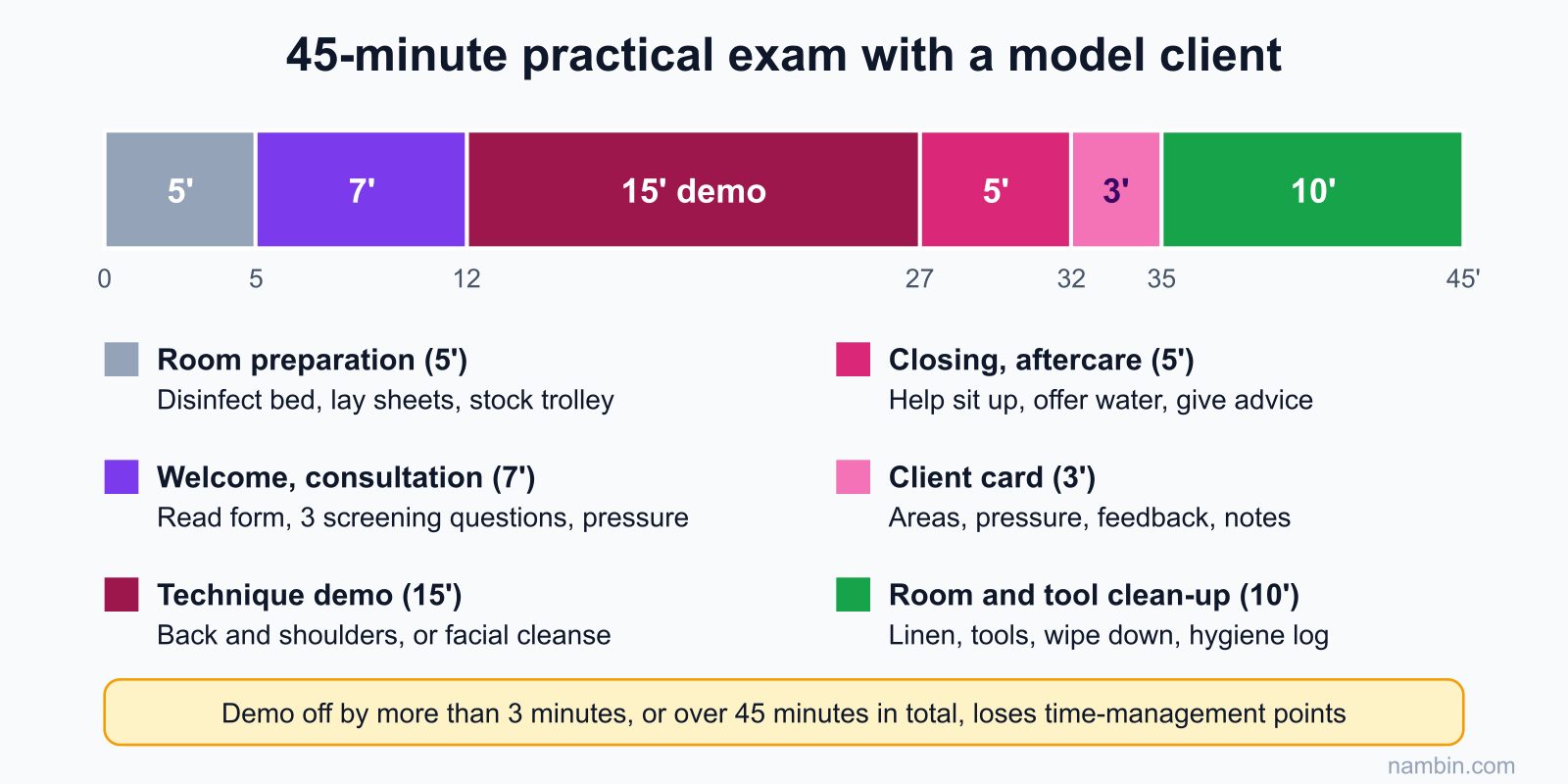
The examiner times each part; you may use a wall clock or a silent timer. Do not try to "give the client extra" when time is up: on a real shift, running over makes the next client wait.
The 100-point rubric
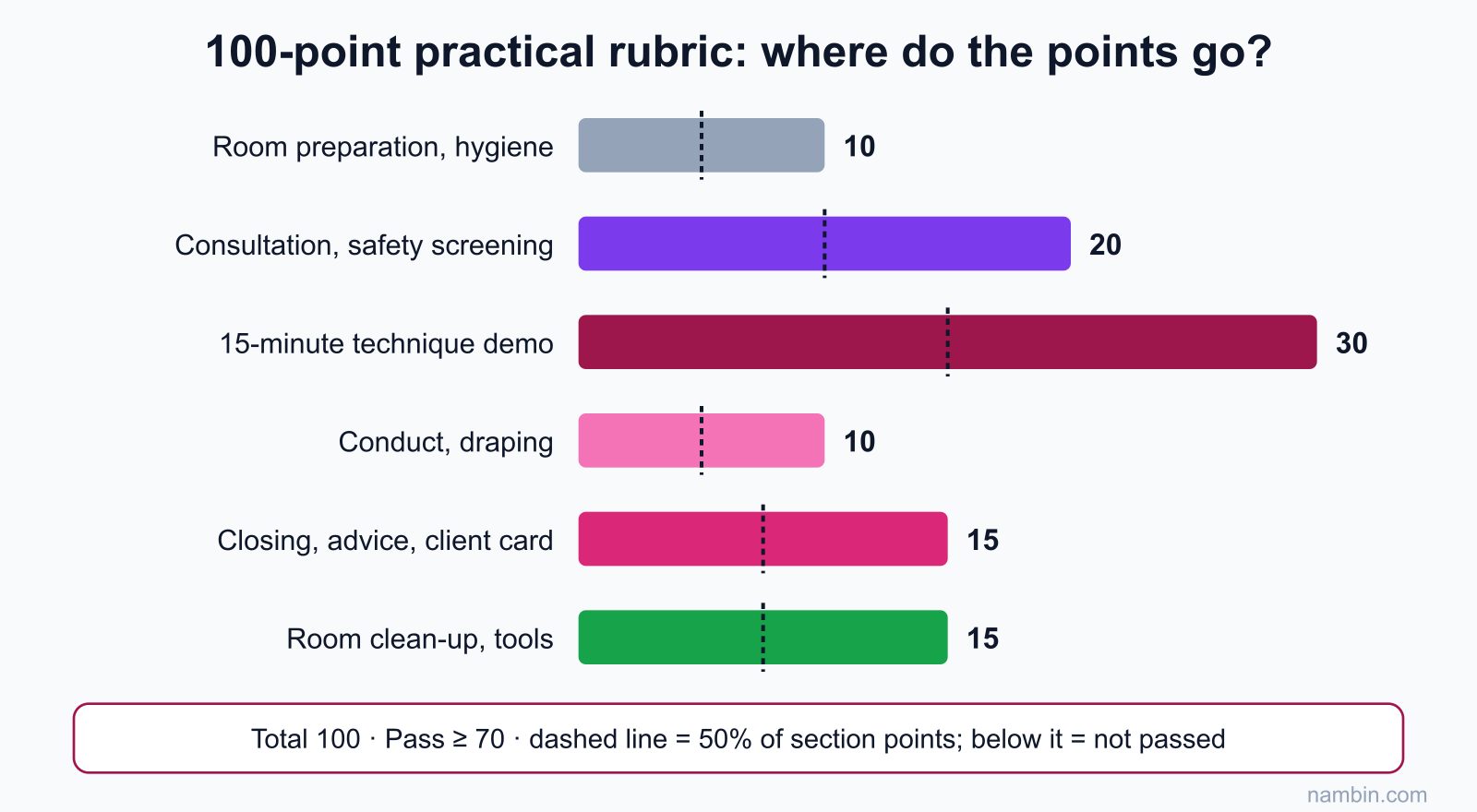
| Section | Points | What the examiner looks at |
|---|---|---|
| Room preparation, hygiene | 10 | Hand washing, bed wiped with disinfectant, clean sheets and towels, fully stocked trolley, suitable room temperature |
| Consultation, safety screening | 20 | Reads the form, re-checks allergies, current medication and painful areas; asks preferred pressure; picks up the new detail and adjusts |
| 15-minute technique demo | 30 | Posture, even pressure, continuous rhythm, no sudden loss of contact, correct stroke direction, avoids the spine and no-go areas, checks pressure |
| Conduct, draping | 10 | Uniform, short nails, no hand jewellery, untreated areas fully covered with towels, polite speech, respect for privacy |
| Closing, aftercare advice, client card | 15 | Helps the client sit up slowly, offers water, advises drinking water and reporting anything unusual; card records areas, pressure, feedback, notes |
| Room clean-up, tool processing | 15 | Linen into the dirty bag, tools through the clean–disinfect procedure, wiping from clean to dirty, hygiene log filled in |
| Total | 100 | Pass from 70 points with no section below 50% |
Example: a student with beautiful technique scores 28/30, but forgets to ask about medication and ignores the vaccination detail, so the consultation gets only 8/20. The total may still be above 70, but the consultation section is below 50%, so the result is not passed: nobody passes on hand skill alone while skipping safety.
Part C: Three scenarios to handle
The examiner reads a scenario; you say each step you would take and demonstrate the actions (supporting the client, positioning them, making the call). You do not need to memorise wording, but the order of priorities must be right.
Scenario 1: An allergic reaction during a face mask
Five minutes into the mask, the client says it feels hot and burning, and both cheeks turn red. Follow Figure 4: stop, remove the product and rinse with cool water; immediately check for severe signs; if there are none, apply a cool compress, monitor for 15–30 minutes, then decide whether to note it on the card or advise a doctor's visit. If the client carries an adrenaline (epinephrine) auto-injector prescribed by a doctor, help them use it themselves, following the instructions on the pen, while waiting for the ambulance.
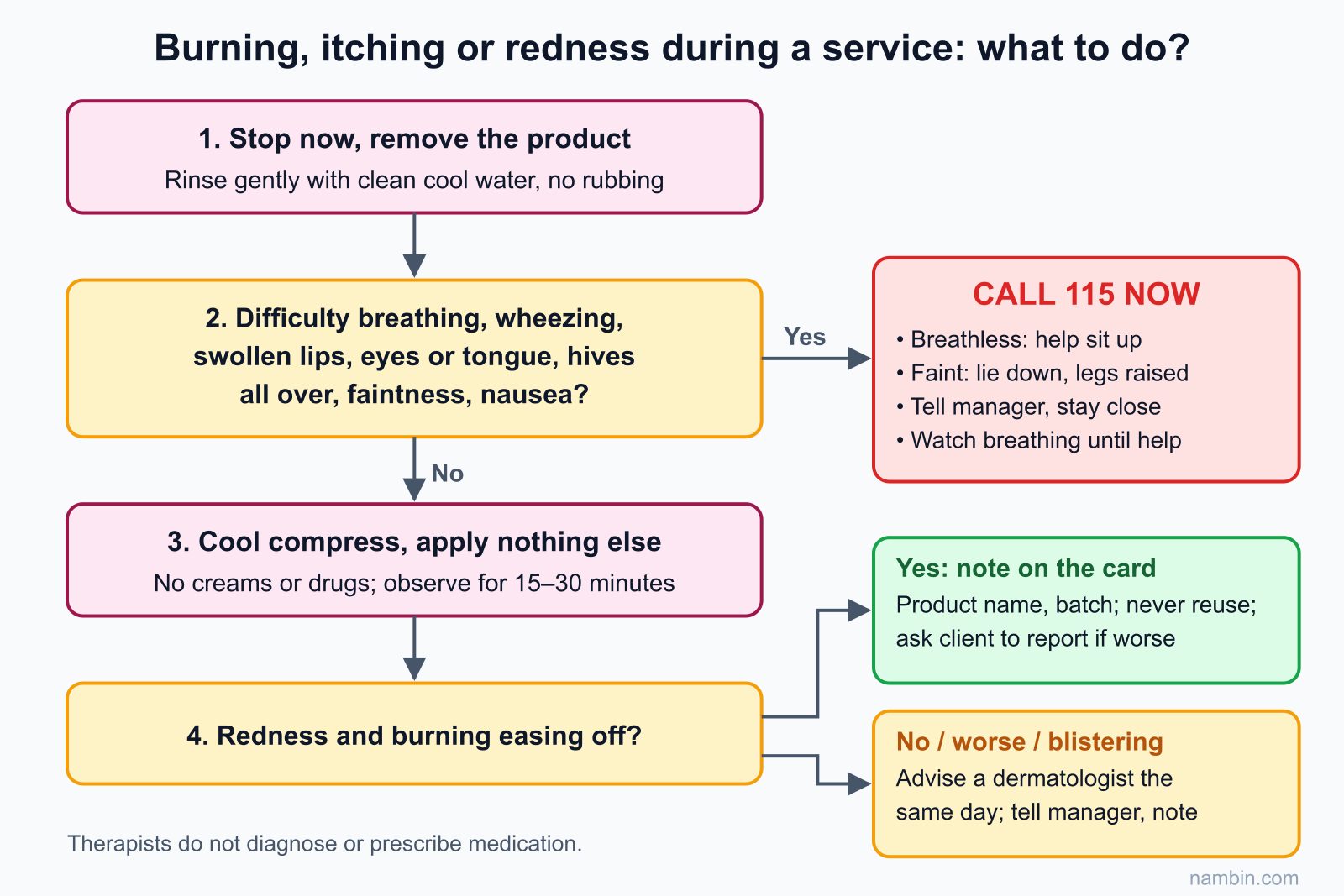
Common mistakes in answers: applying a "soothing" cream to irritated skin, giving the client your own allergy tablets, or saying "it's fine" and carrying on. All three lose heavy points; giving medication to a client is an automatic fail.
Scenario 2: A client feels dizzy when sitting up
A female client on blood pressure medication has just finished a 60-minute massage. When she sits up she says "I feel really dizzy", looks pale and is sweating.
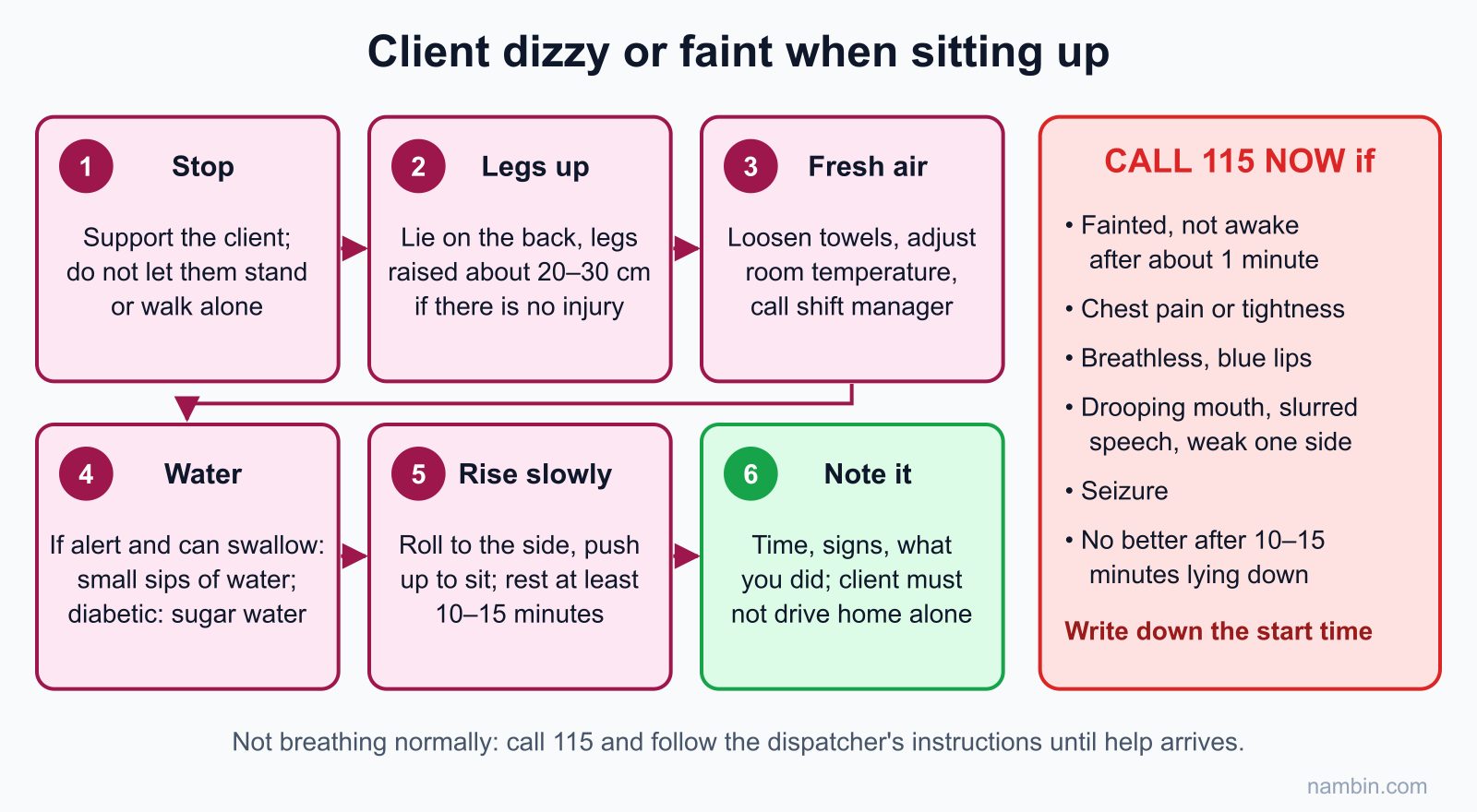
What the examiner wants to hear: do not let the client stand or walk alone; lay her down with legs raised; only give a drink once she is alert and can swallow (sugary water for a diabetic client or one who has not eaten for a long time); let her sit long enough before standing; note it on the card and advise a light meal before the next session. Prevention beats treatment: with clients on blood pressure medication, older clients or anyone just out of the steam room, always help them sit up slowly and sit on the edge of the bed for a while before standing.
Scenario 3: A client complaint
At the till, the client says: "That massage hurt, and you left me lying there cold the whole time." A high-scoring response:
- Listen fully, without interrupting or explaining straight away.
- Apologise for the experience: "I'm sorry today's session left you feeling sore and cold."
- Ask specifics: which area hurt, and does it still hurt now? If there is a lot of pain, bruising or swelling, use the three referral levels described later.
- Inform the shift manager so they can make amends under spa policy; do not promise a free session or a discount yourself.
- Note it on the card: lighter pressure next time, an extra towel, adjust the room temperature; thank the client for the feedback.
Points are lost for blaming the client, arguing, or walking away in silence. The technical lesson: check pressure in the first minute of each area, and watch for the client tensing up, holding their breath or hunching their shoulders.
Point-deduction mistakes and automatic-fail mistakes
| Mistake | Penalty |
|---|---|
| Forgetting to wash hands before touching the client or after removing gloves | Minus 3–5 points |
| Leaving untreated body areas exposed, not draped | Minus 3–5 points |
| Breaking contact suddenly, pressure going from strong to light | Minus 2–4 points |
| Never checking pressure during the demo | Minus 3 points |
| Demo off by more than 3 minutes, or going over the 45-minute total | Minus 3–5 points |
| Client card incomplete or vague | Minus 2–5 points |
| Cleaning the room in the wrong order, mixing dirty and clean items | Minus 3–5 points |
| Treating a client with an absolute contraindication (fever, suspected blood clot, infected area) | Automatic fail |
| Reusing needles, blades or single-use items | Automatic fail |
| Pressing hard directly on the spine, the front of the neck or the back of the knee | Automatic fail |
| Ignoring signs that require calling 115, or letting a faint client walk alone | Automatic fail |
| Diagnosing illness, prescribing or handing medication to a client | Automatic fail |
Under stress, candidates most often make two mistakes: ignoring new information from the client and letting a dizzy client stand up alone. Train them into reflexes: new information = stop and ask again; dizzy client = lie down.
When should you refer a client to a doctor?
A spa therapist cares for healthy people and does not treat illness. When something unusual happens, your job is to stop the service, give first aid at the right level, refer to the right place and write it down. Use the three levels below to decide quickly.
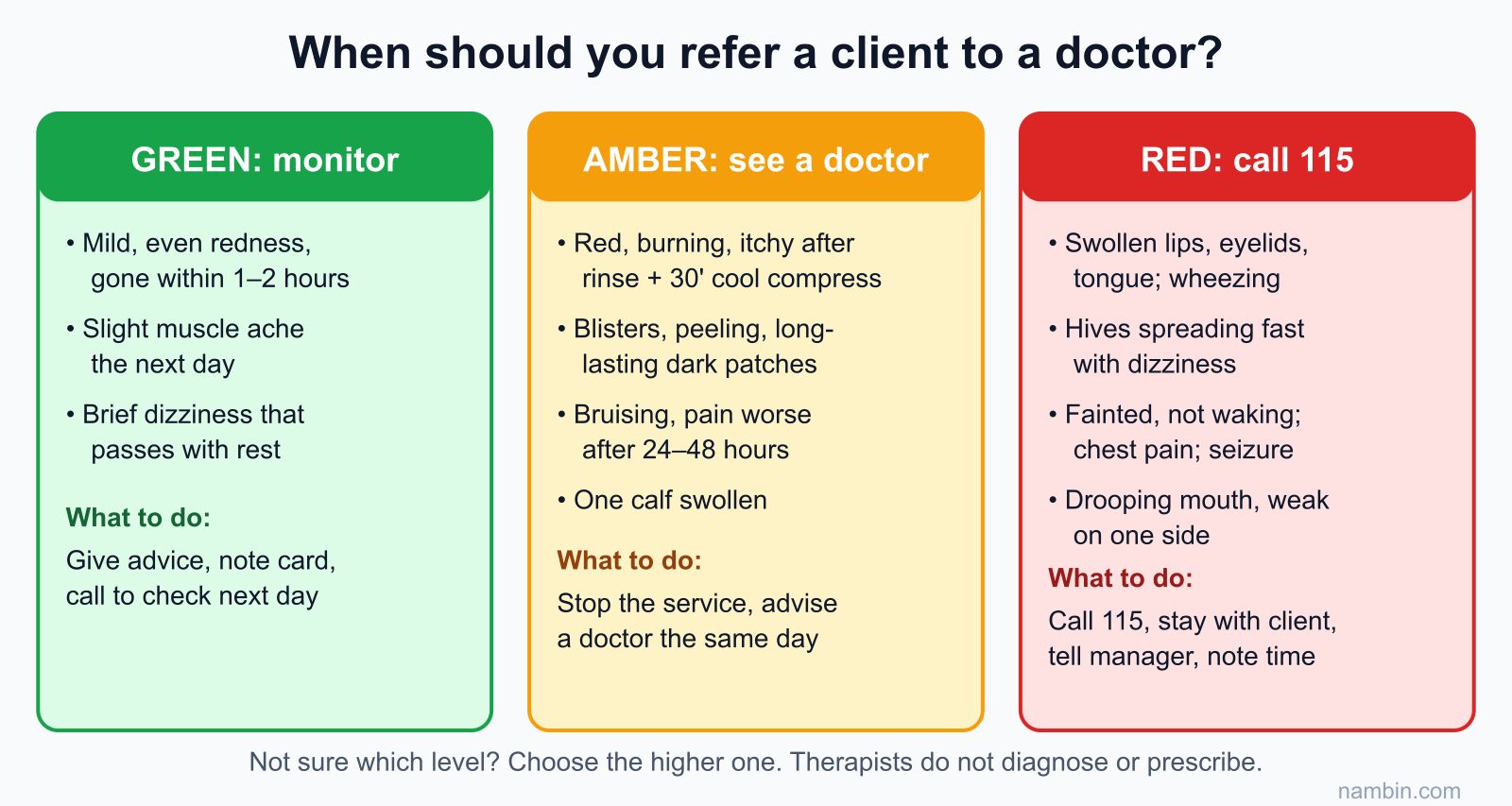
Safety warning: you are not a doctor. Never diagnose, never give or recommend medication and never let a client who has fainted or felt faint drive home alone. When in doubt, treat the situation as the next level up and call for help early.
Besides the signs in the figure, the amber level also includes: a blistering burn larger than the palm, or on the face or a joint; an eye that is still painful, red or blurry after rinsing; and a nosebleed that has not stopped after about 20 minutes. When you advise a client to see a doctor, explain why, suggest where to go (a dermatologist for skin reactions, the nearest clinic or hospital for other signs), hand over details of the product used, tell the manager and call the client afterwards to check on them.
Frequently asked questions
If I fail the practical, do I have to start the course again?
Usually not. You practise the sections where you scored low and retake the practical after one or two weeks. For an automatic-fail mistake, the instructor may ask you to redo the related lesson (for example, the disinfection lesson) before the retake.
If the model client is a classmate I know, do I still need the full procedure?
Yes. Treat them like a real client: greet, consult, drape and protect their privacy. The examiner also scores how you communicate.
Can I take clients without a first aid certificate?
That depends on each spa's rules, but you should take a hands-on first aid and CPR course run by a medical facility or a reputable organisation. Reading a lesson cannot replace practising on a training manikin.
What if I am so nervous that my hands shake during the exam?
Arrive early, take a few deep breaths before placing your hands on the client and start with broad, light gliding strokes; your pressure and rhythm will settle after a few passes. The examiner assesses the whole session, not the first few seconds.
Checklist before the assessment day
- Redo the 20 questions in Part A and get at least 18 right, including all 5 (*) questions.
- Time the full 45-minute practical at least three times with someone playing the client, asking them to add a surprise detail each time.
- Talk through the three scenarios out loud (allergy, dizziness, complaint) in the correct order of priorities.
- Know the green, amber and red levels and the 115 number by heart.
- Nails cut short and unpolished; no rings, watch or bracelets; hair tied back; clean uniform.
- Prepare a blank health form and a session record card.
- Sleep well and eat lightly before the exam so your hands and head are steady.
Self-assessment criteria after each practice run: the person playing the client scores you 70 points or more on the rubric above; you make no automatic-fail mistakes; no part runs more than 3 minutes off; and your card is complete enough for another therapist to read it and continue with the client next time.
Passing this assessment means you have a strong enough safety foundation to serve real clients under supervision. The final step of the roadmap is Professional certificates & spa career development: the certificates spas usually ask for, how to build a skills portfolio and the path to senior therapist, shift leader and manager.