Once you have learned the techniques, many people face the same questions: do I need a certificate, where should I study, and where do I go after a few years on the job? Quite a few spend money on "crash courses" that promise to teach everything, then end up drawn into services outside their professional scope. Others become very good with their hands but stay in the same place for five years because nobody knows how good they are. This is the final step of the roadmap: it helps you see the long road of the profession clearly.
By the end of this lesson, you will be able to: tell apart the different kinds of spa certificates and training certificates and choose a course that is worth the money; define clearly what a spa therapist may do and must refuse; picture the five career levels and the conditions for moving up each one; estimate reference income; build a skills portfolio; and draw up your own 12-month learning plan.
Spa certificates and vocational training in Vietnam: what kinds exist
When you look for work, you will hear many names: elementary-level vocational certificate, certificate of course completion, international certificate, "spa diploma". They differ in who issues them, how long the training lasts and how much they are worth. Understanding the difference before you pay tuition helps you avoid studying the same thing twice or studying the wrong thing.
Vocational certificates issued by vocational training institutions
This is the most common type, and the one that well-run spas and beauty salons usually ask for. The course is run by a licensed vocational education institution and typically lasts about 3–6 months at the elementary ("so cap") level, with a curriculum, theory hours, practical hours and a final exam. Content usually covers basic skin anatomy, hygiene and sterile technique, body massage, facial care, client consultation and professional ethics. Its greatest value is that it proves you were trained properly — something a spa owner needs when hiring and when the authorities inspect staff records.
In-house training and product-based training certificates
Many spas train new staff themselves according to their own procedures, or send them on courses run by cosmetics brands or equipment suppliers. At the end you receive a certificate of completion. This kind of training is very useful for following the procedures of the place you work and for using one specific product line correctly, but it does not replace a vocational certificate: it shows that you know how to use product A, not that you have mastered the foundations of the trade. Keep all of these certificates in your portfolio and note the number of training hours.
International certificates
Some foreign organisations offer certificate programmes in beauty therapy and massage. They are usually taught in English, cost a lot and have their own exams — worth considering if you are aiming for resorts, hotels or working abroad. Beginners should first get a domestic certificate and some real work experience.
Check the course before you pay
- Training licence: ask to see the licence for vocational education activities, or ask the local labour authority.
- Share of practice: most of the time should be supervised hands-on practice.
- Final exam: there should be a theory exam and a practical exam, not "pay in full and get the paper".
- Right scope: a course that promises to teach injections, cosmetic tattooing or deep microneedling "in one week" to people with no medical background is a warning sign.
- Support after the course: internships at partner spas and job referrals.
| Type | Typical duration | Reference cost, 2026 | Used for |
|---|---|---|---|
| Elementary-level vocational certificate | 3–6 months | about 8–25 million VND | Job applications, proof of proper training |
| Spa in-house training | 2–8 weeks | usually free or deducted gradually from wages | Following the procedures of your workplace |
| Product or equipment course | 1–5 days | about 1–5 million VND, or paid by the spa | Using one product line or machine correctly |
| International certificate | several months, with its own exam | tens of millions of VND or more | Resorts, international clients, working abroad |
The costs in the table are only reference ranges for 2026 and vary a lot by region (1 million VND is roughly 40 US dollars). Choose the course with the most supervised practical hours you can afford.
Scope of practice: what you may do and what you must refuse
A spa vocational certificate allows you to work with healthy skin and healthy bodies for relaxation, cleansing and care. It does not allow you to treat disease or intervene beneath the surface of the skin. This boundary protects the client and protects you: when something goes wrong with a procedure outside your scope, the person who performed it may face legal liability, not just lose their job.
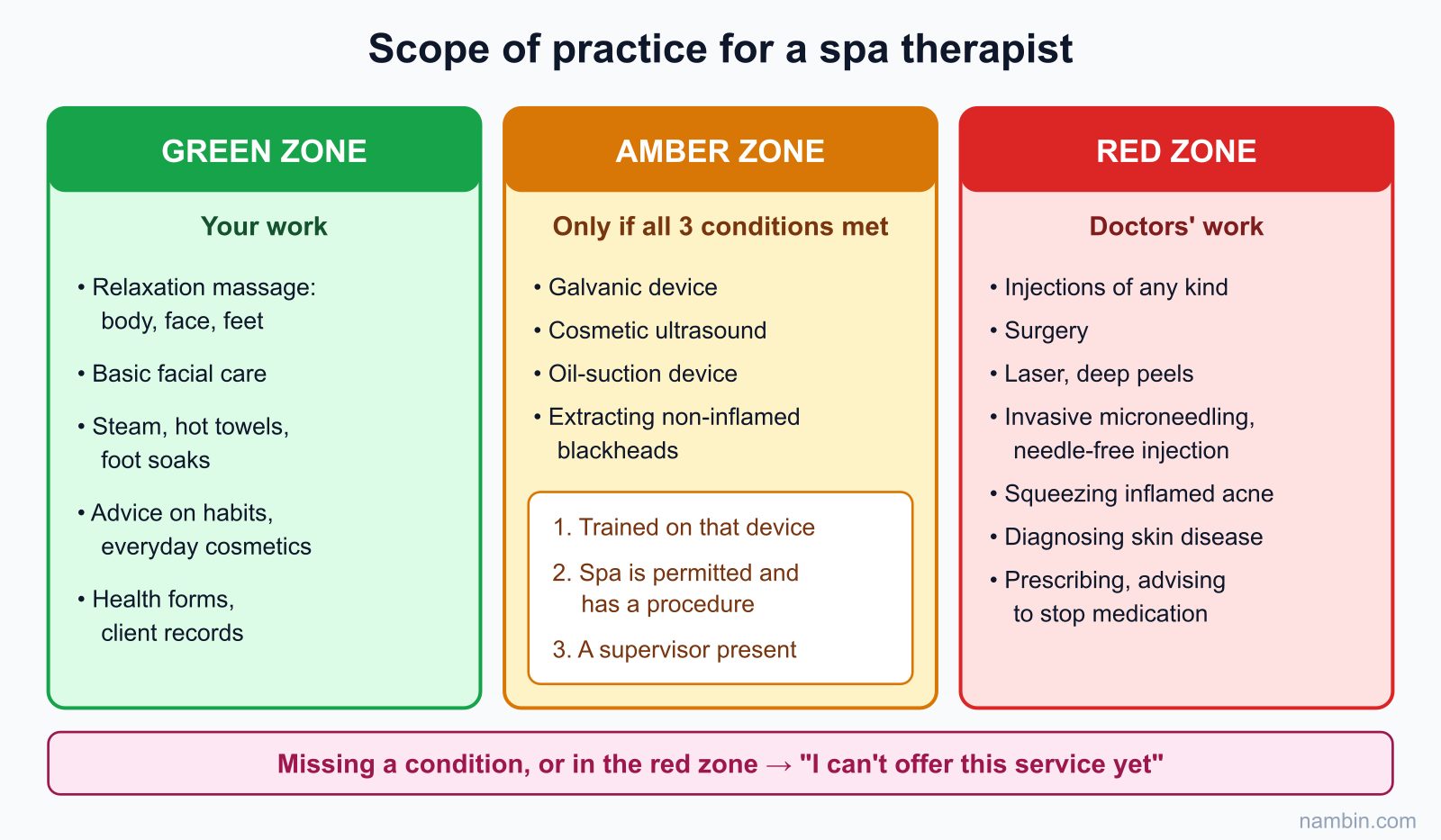
Green zone: the spa therapist's work
Relaxation massage for the body, face and feet; basic facial care (cleansing, surface exfoliation, masks, moisturising); steam, hot towels, foot soaks; home-care advice at the level of habits and ordinary cosmetic products; filling in health forms and client records. This is what you learned in the earlier steps of the roadmap.
Amber zone: only with specific training and spa permission
Some non-invasive devices and techniques, such as galvanic (iontophoresis) machines, cosmetic ultrasound devices, oil-suction devices and extraction of non-inflamed blackheads. They fall within your scope only when all three conditions are met: you have been trained on that specific device, the spa has a procedure and is permitted to offer the service, and there is a supervisor in charge. If any one condition is missing, the answer is "I can't offer this service yet".
Red zone: the work of doctors and medical facilities
Injections of any kind (fillers, drugs, "meso" with needles), surgery, laser and deep peels, invasive microneedling or needle-free injection, squeezing inflamed or cystic acne, diagnosing skin disease, prescribing drugs or advising someone to stop taking medication. Many of these procedures may only be performed at a licensed medical examination and treatment facility by a person holding a medical practising certificate. No spa course turns you into someone allowed to do them.
Warning: if a spa asks you to perform a red-zone service, or an amber-zone service you have not been trained for, refuse and report it to your manager in writing or by a message that is kept on record. When a client has complications after an invasive procedure done elsewhere — hot swelling, increasing pain, skin discolouration, fever — do not try to treat it yourself; advise the client to go to a medical facility immediately. Good hand skills are not worth trading for a client's health and your own career.
Five career levels in the spa industry
The most common path goes through five levels. The timings below are typical for someone who works steadily; moving faster or slower is perfectly normal, as long as you know where you are and what you need to take the next step.
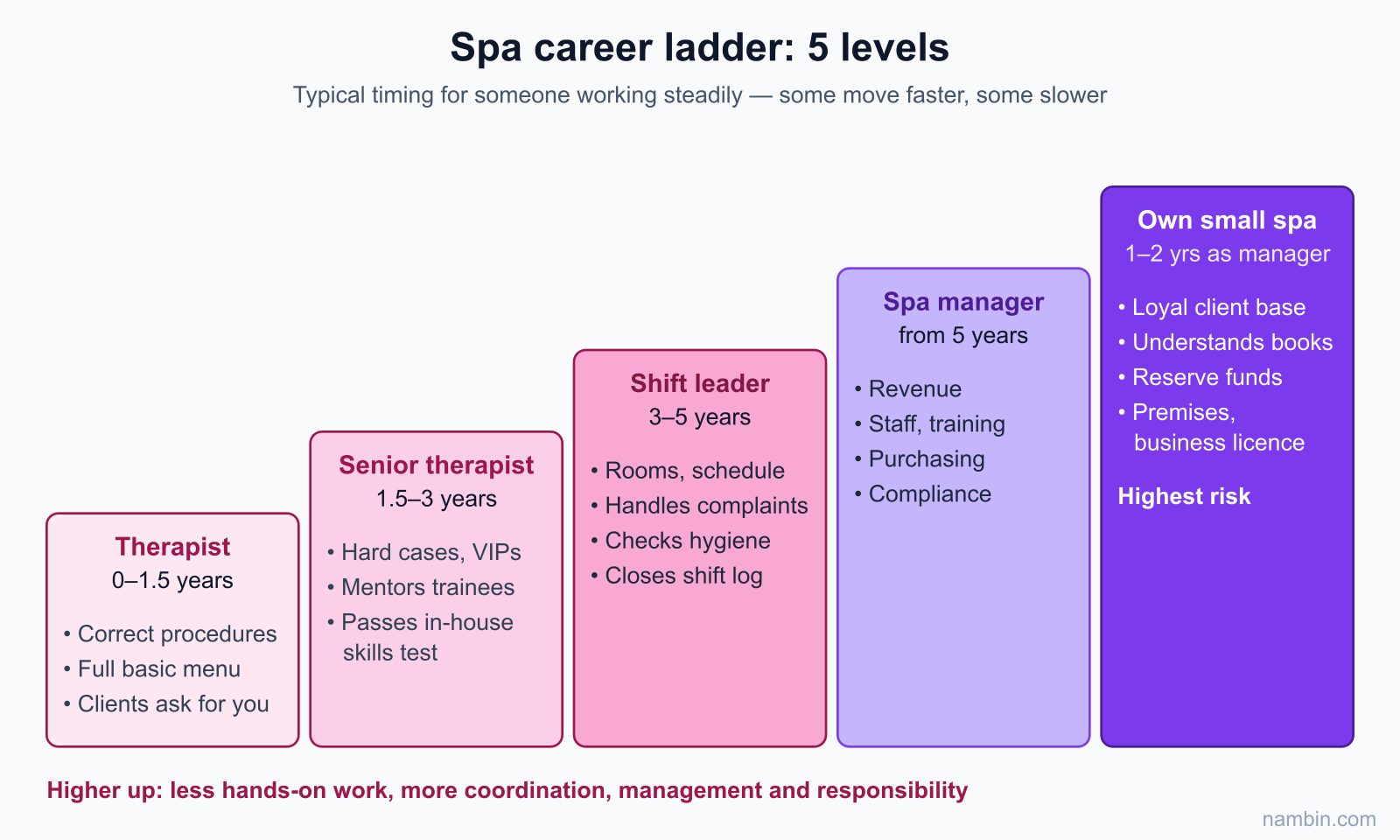
Therapist (0–1.5 years)
You start as a supervised trainee, then take clients on your own for basic services. The measures at this level: following hygiene procedures, being on time, having no safety incidents, and clients rating your pressure and attitude well. To move up, you need to be fluent in the spa's entire basic menu and have a number of returning clients who ask for you by name.
Senior therapist (1.5–3 years)
You take the difficult cases: sensitive clients, clients with many health notes, VIP clients; and you are asked to mentor new trainees. Spas usually decide on promotion to senior therapist based on years of service, client return rate, in-house skills test results and having no procedure violations. This is a good time to add one or two amber-zone skills if the spa needs them and offers proper training.
Shift leader (3–5 years)
The work gradually shifts from "hands-on" to "coordination": assigning rooms and therapists to the schedule, handling late arrivals and complaints, checking room hygiene, closing the shift log. You still see clients, but fewer. The decisive skill at this level is staying calm when many tasks pile up at once and being able to talk to clients, colleagues and the owner alike.
Spa manager and running a small spa (from 5 years)
A manager is responsible for revenue, staff, training, purchasing, client care and regulatory compliance for the whole facility. Some people go on to open a small spa or a home treatment room — the highest potential income but also the highest risk: you carry the rent, equipment and business licence, and some months you lose money. Work as a manager or shift leader for a year or two, understand the books and build a base of regular clients before opening your own.
Reference income in 2026
Spa income usually consists of base pay + commission per session ("tour", one treatment served) + commission on products and packages sold + tips. Because the variable part is large, two people with the same job title can earn quite different amounts depending on client numbers, region and type of facility. The table below gives reference ranges for total monthly income in large cities in 2026; in the provinces it is usually lower, and at resorts and upscale hotels it can be higher thanks to service charges and tips.
| Level | Reference total income (million VND/month, 2026) | Main variable part |
|---|---|---|
| Trainee | 4–7 | Allowance, few session commissions |
| Therapist | 7–12 | Session commission, tips |
| Senior therapist | 10–18 | Difficult sessions, requested by name, mentoring allowance |
| Shift leader | 12–20 | Responsibility allowance, shift sales bonus |
| Spa manager | 15–30 | Facility revenue bonus |
| Small spa owner | highly variable, some months at a loss | Profit after rent, staff and stock costs |
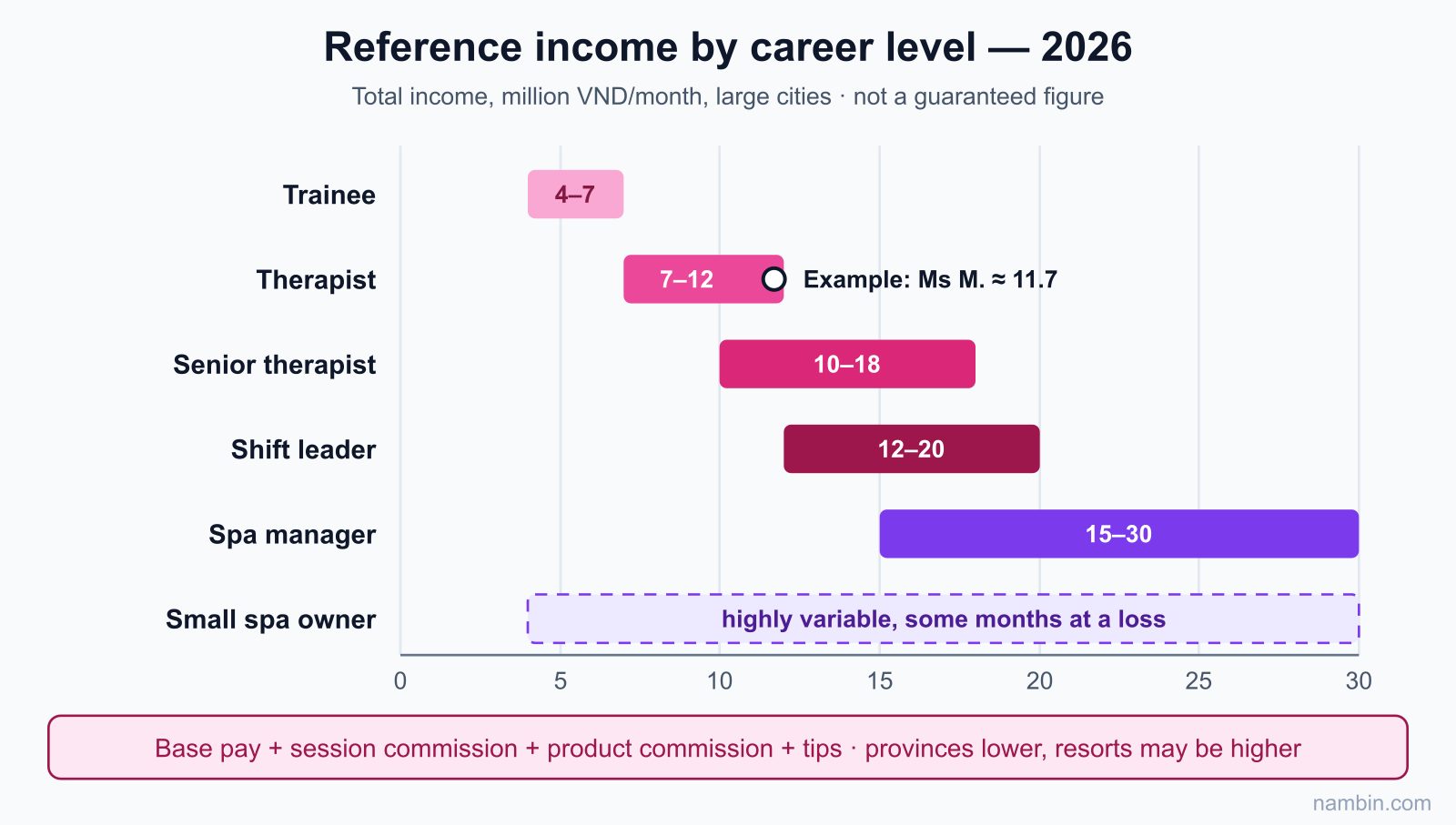
Worked example: one month's income for a therapist
Ms M. is a second-year therapist at a spa in a central district. The policy where she works (an illustrative example): base pay of 5 million VND, a commission of 40 thousand VND for each 60-minute session, 60 thousand for a 90-minute session, and 5% of product sales.
- She works 26 days, averaging four 60-minute sessions and one 90-minute session a day: 104 sessions of 60 minutes and 26 sessions of 90 minutes.
- Session commission: 104 × 40 thousand = 4.16 million; 26 × 60 thousand = 1.56 million; total 5.72 million.
- Products: clients buy 8 million VND worth after advice matched to their real needs; 5% = 0.4 million.
- Tips average about 0.6 million.
- Total: 5 + 5.72 + 0.4 + 0.6 ≈ 11.7 million VND, within the reference range for the therapist level.
The lesson from this calculation: most of the difference comes from the number of sessions, meaning clients who come back and ask for you by name — not from pushy selling. When comparing employers, ask about the commission per session and the average number of sessions current staff do, not just the base pay.
Build a skills portfolio: let others see that you are good
A certificate shows that you have studied. A skills portfolio shows what you can actually do and how consistently you do it — more convincing than any self-introduction when you apply for a job or ask for a promotion.
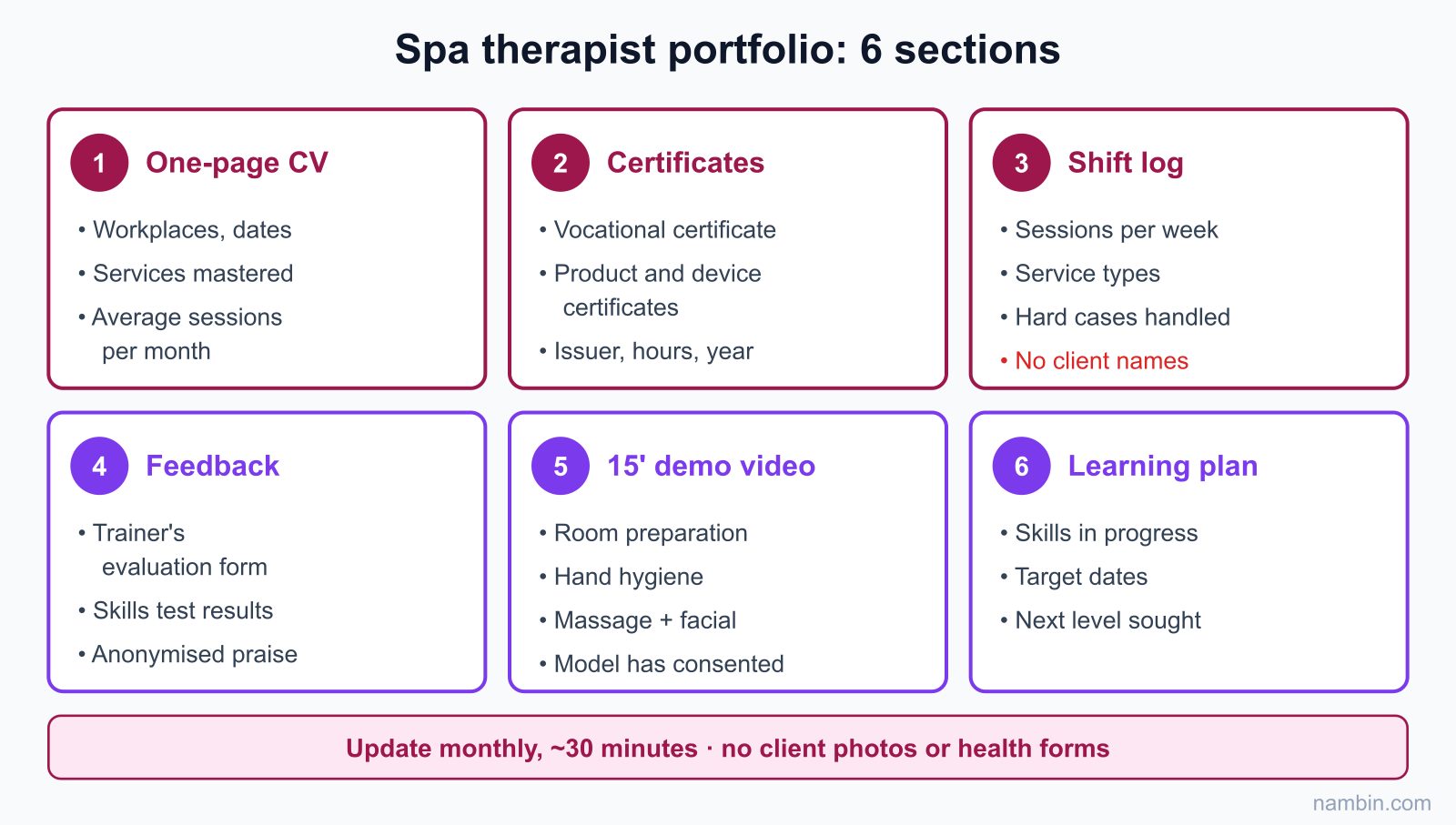
What the portfolio contains
- One-page CV: workplaces, dates, services you are fluent in, average number of sessions per month.
- Copies of certificates: note the issuer, training hours and year of completion.
- Shift log: each week record the number of sessions, service types and difficult cases handled (do not record client names or health information).
- Feedback: your trainer's evaluation forms, in-house skills test results, anonymised praise from clients.
- 15-minute demo video: filmed on a model who is a classmate or relative and has given consent, showing room preparation, hand hygiene, a massage segment and a facial care segment.
- Learning plan: the skills you are learning and your expected target dates.
Privacy rules and job interviews
Do not photograph or film real clients without clear consent; do not post "before and after" photos promising to cure acne or melasma; do not put clients' health forms in your personal portfolio. At interviews, most spas ask for a 15–30 minute trial: the recruiter watches your conduct — washing hands, draping towels, asking about pressure, checking the health form, finishing on time — more than beautiful movements. Prepare an answer to "If a client asks for a service outside your scope, what do you do?".
Soft skills decide how fast you advance
At the therapist level, hand skills decide most things. From senior therapist upwards, the people chosen are usually those who communicate well, are trustworthy and work well in a team, not just those with the nicest technique.
- Communication and client retention: remember regular clients' names and their preferred pressure and scents; explain briefly before each step; know when to stay quiet if the client wants to rest. Each month, count how many clients asked for you by name.
- Discipline and reliability: be on time, keep hygiene standards even when nobody is checking, report incidents honestly, including your own mistakes. Spa owners give shifts and trainees to people they trust.
- Mentoring newcomers: demonstrate slowly, explain the reasons, let the trainee try and then correct one point at a time, never scold them in front of clients — this is the natural "exam" for promotion to senior therapist.
- Looking after your health: use your body weight instead of finger strength, adjust the bed height, stretch between sessions; if pain persists or your hands go numb, see a doctor early.
A 12-month learning plan
The plan below is for someone who has just completed this roadmap and is starting work. Each quarter has a measurable goal; at the end of the quarter, review it with your mentor, then adjust the next quarter.
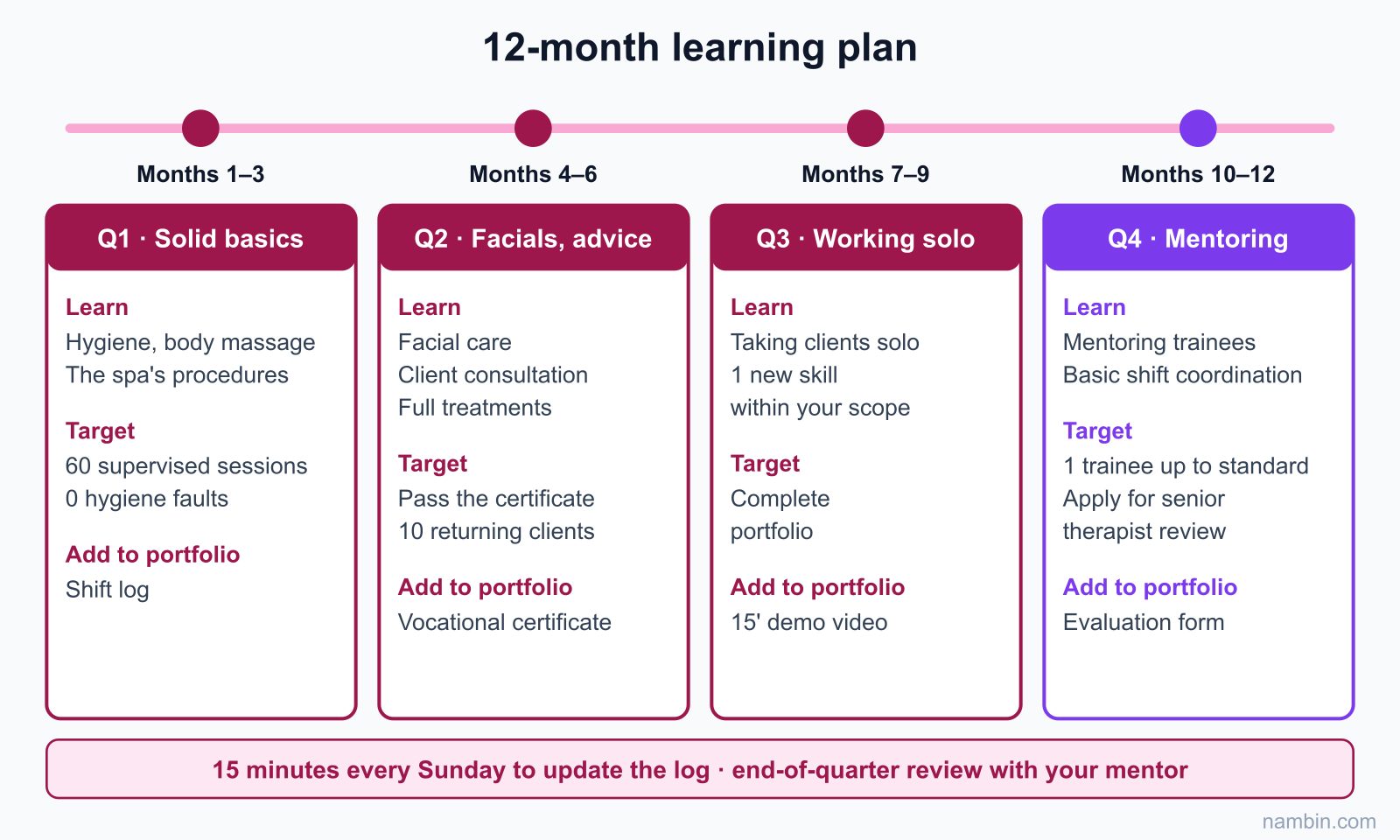
| Period | What to learn | Measurable goal |
|---|---|---|
| Months 1–3 | Hygiene, body massage, the spa's procedures | 60 supervised sessions with no hygiene faults; start your shift log |
| Months 4–6 | Facial care, consultation, delivering full treatment courses | Pass the vocational certificate (if you do not have one yet); 10 returning clients |
| Months 7–9 | Taking clients independently; one new skill within your scope | 15-minute demo video; complete skills portfolio |
| Months 10–12 | Mentoring trainees, basic shift coordination | Mentor one newcomer to standard; request a review for promotion to senior therapist |
How to use the plan
Every Sunday, spend 15 minutes updating your log and marking your progress. If you miss a quarter's goal — for example, the spa is quiet so you do not get enough sessions — write down the reason, move the goal back, and use the free time to revise theory on skin and contraindications instead of abandoning the whole plan.
Case study: Lan, 22, from trainee to senior therapist
Lan worked as a restaurant helper for two years, then switched to the spa trade, studied the basic roadmap and applied to train at a spa with 8 treatment rooms.
The first year
For the first three months, Lan did body massage under supervision and wrote up her log every evening. In the fifth month, she took an elementary vocational certificate course in the evenings at a licensed institution. In the eighth month, a client asked her to "do microneedling to whiten faster"; Lan refused, explained that it is a procedure requiring a doctor, and reported it to her manager. By the end of the year, she had her certificate, a log of about 900 sessions, 25 regular clients who asked for her by name, and a 15-minute demo video.
The second year
Lan mentored two trainees and took a galvanic device course arranged by the spa, working under supervision before working on her own. In month 20, based on her portfolio, client return rate and skills test, Lan was promoted to senior therapist; her income rose from about 9 to about 13 million VND a month (reference, 2026). She did not move faster than others because of an expensive course, but because she kept regular records, stayed within her professional scope and had concrete evidence when she asked for a review.
Frequently asked questions
Can I work in a spa without a certificate?
Many places still take trainees and train them in-house. But well-run spas usually prefer people with a vocational certificate, and without one it is harder to move up or move to a better workplace. Aim to get your certificate within your first year of work.
When should I learn amber-zone skills?
Once you are solid in the green zone, usually after 12–18 months, and when the spa has a real need, offers proper training and has a supervisor. Learning devices while your knowledge of skin is still weak easily leads to misuse.
Can my income exceed the reference range?
Yes, at busy spas, resorts, or when you have many regular clients. It can also be lower at quiet places. The ranges in this lesson are only for comparison and goal setting, not guaranteed figures.
What should I prepare before opening a small spa?
Experience as a shift leader or spa manager, a base of regular clients, an understanding of income and expense records, reserve funds for the first few months, and careful research at the local authorities into business registration procedures, premises requirements and the scope of services permitted. Ask people who have opened a spa and professional officials rather than relying only on what you read online.
Checklist and end-of-roadmap exercises
- List the certificates you hold, with the issuer, hours and year; mark what is still missing.
- Write three polite refusals for when a client or supervisor asks for a red-zone service.
- Identify which level you are at and write two concrete conditions for reaching the next one.
- Calculate your monthly income (or that of the place you plan to apply to) using the method from Ms M.'s example.
- Build a first version of your portfolio: one-page CV, copies of certificates, a log of the last 4 weeks.
- Fill in your own 12-month plan with a measurable goal for each quarter.
Self-assessment criteria
- You can tell a vocational certificate apart from a product-based training certificate.
- You can correctly name at least 5 red-zone procedures and know who to refer the client to.
- Your 12-month plan has concrete numbers (sessions, returning clients, exam dates), not just "learn more".
- Your portfolio contains no personal information or photos of clients who have not given consent.
This is the final step of the Spa Therapist roadmap, but it is not the end. Return to the lesson on safety testing and service skills every six months to check yourself, and revise consultation and contraindications before each promotion review — with solid foundations, every step is steady.