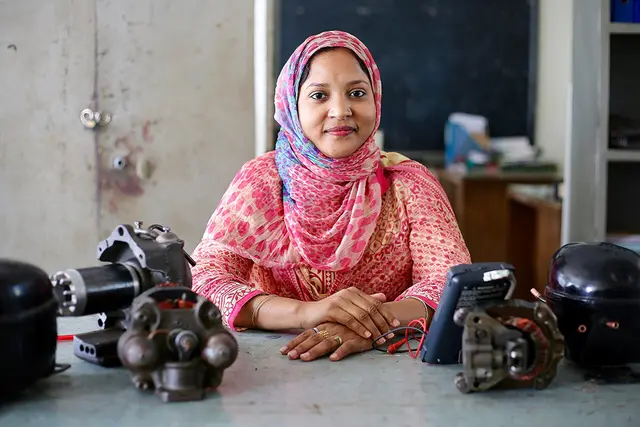
Learning residential electrical work in Vietnam takes about 3–6 months to start earning as an electrician's helper, about 1.5–3 years to become a journeyman electrician who can wire a whole house independently, and usually 3–5 years or more to become a master electrician who takes on three-phase power, pumps and rooftop solar. Your own timeline depends on how you learn (a training centre, apprenticing with an electrician, or online self-study), how many hours of supervised practice you get each week, and how much real work you do. This lesson compares each way of learning, gives 2026 reference costs, and helps you build your own plan.
By the end of this lesson, you will be able to:
- Answer "how long does it take to learn electrical work" in terms of three milestones — helper, journeyman, master — with typical months and years.
- Compare 3 common ways of learning (vocational school or centre, apprenticing with an electrician, online self-study plus practice) by time, 2026 reference cost and the paperwork you receive.
- List the 4 groups of foundation knowledge and the minimum hours (165–240 hours) needed before you can work as a helper.
- Put together a minimum tool kit costing about 1.8–4.5 million VND and know which items you do not need yet.
- Work out a 12-month learning plan covering costs, income and promotion milestones.
Want to start properly today? NAMBIN's Residential Electrician Level 1 – Helper course teaches exactly the foundations a journeyman checks before taking on a trainee: electrical safety (the test requires 100% to pass), tools and meters, cables, wire colours and joints, and wiring lighting circuits and earthed sockets. Study online at your own pace, then take the skills into hands-on practice.
Quick answer: how long does it take to learn electrical work?
"Finishing" electrician training is not a single date but three milestones in a row. Thinking in milestones keeps you from being fooled by "qualified in 1 month" courses, and also from losing heart because you think you must study for three years before earning anything.
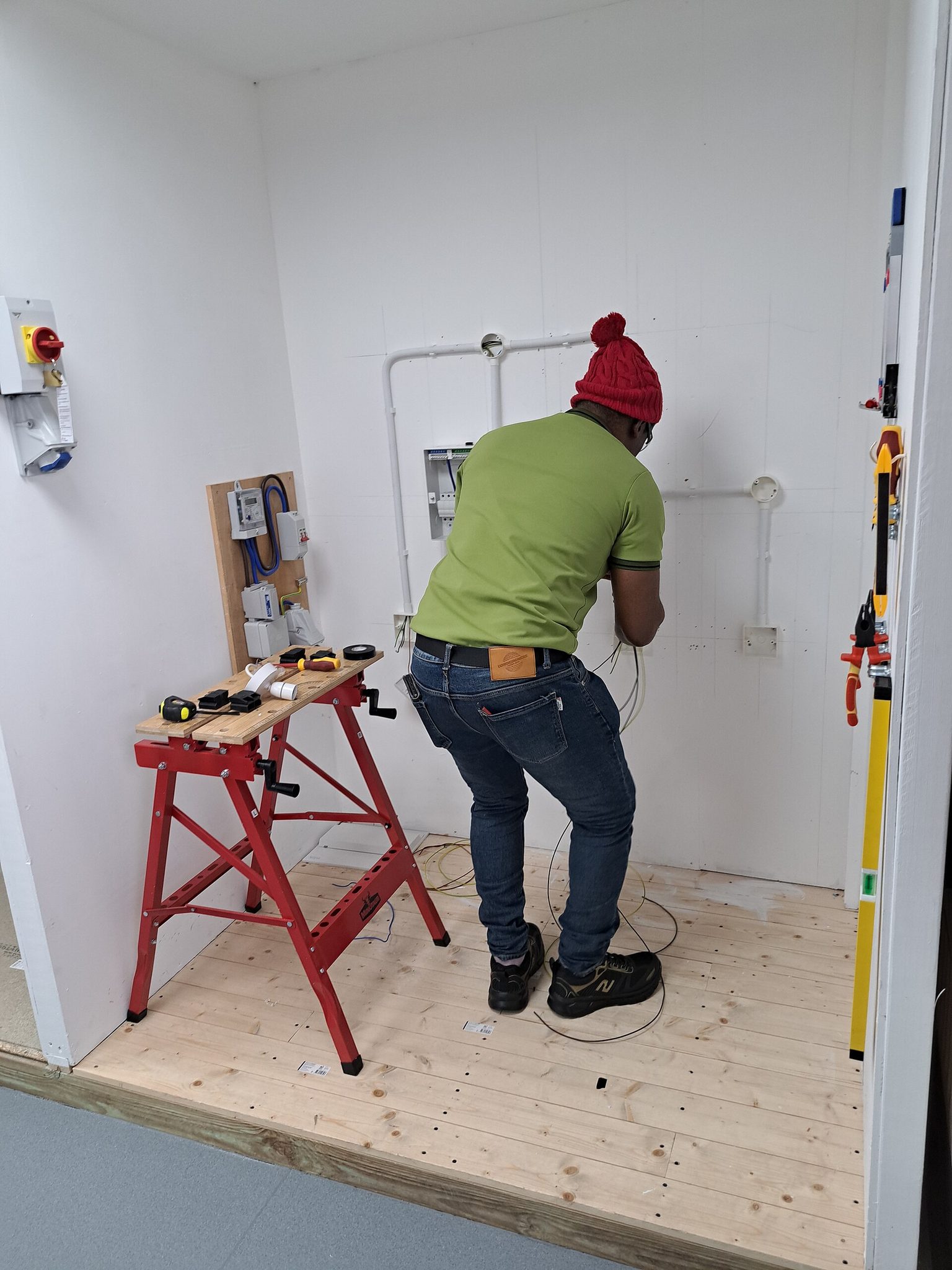
Photo: Charanjitmannu / Wikimedia Commons, CC BY-SA 4.0
Milestone 1: paid helper — about 3–6 months
This is when you have a firm grasp of electrical safety, can use tools and meters, join wires to standard, and can wire lighting circuits and earthed sockets on your own under a journeyman's inspection. The foundation knowledge takes about 165–240 hours of study and hands-on practice (see the table in a later section). Studying evenings and weekends at about 15 hours a week takes 11–16 weeks, or 3–4 months; add a few weeks of helping on site to get used to real jobs and you start earning a helper's day rate.
Milestone 2: journeyman — usually after 1.5–3 years
A journeyman reads drawings, calculates loads, selects cables and circuit breakers, installs distribution boards, finds faults and signs off on inspection and handover. The theory for this level can be learned in a few months, but the title of journeyman comes from the number of real jobs completed. People who work steadily, 22–24 days a month, usually reach this milestone faster than those who only work weekends.
Milestone 3: master electrician and running your own jobs — usually from year 3–5
A master electrician takes on work few others can do: three-phase power, motors and pumps, heavy loads such as induction hobs or EV chargers, lightning protection and rooftop solar. Running your own jobs also requires quoting, managing workers and handling warranties. Income rises clearly with each milestone; the lesson on residential electrician pay by level (in Vietnamese) has detailed day rates and reference incomes.
Where to learn: comparing 3 common paths
In Vietnam there are three main routes: a vocational school or training centre, apprenticing with an electrician, and online self-study combined with practice. Choose by answering three questions: how much money do you have, how soon do you need an income, and do you need a vocational certificate straight away?
| Path | Time until you can work as a helper | 2026 reference cost | Paperwork received | Best for |
|---|---|---|---|---|
| Vocational school or centre (elementary level) | 3–6 months | 4–12 million VND; some groups receive support | Elementary vocational certificate | People who need paperwork and like classes with fixed hours |
| Intermediate or college diploma in electrical work | 1–3 years (full programme) | Per academic year, depends on the school | Intermediate or college diploma | Young people who want formal training and may work for companies or factories |
| Apprenticing with an electrician | 6–12 months | Free; usually paid 150,000–300,000 VND per day | Usually none | People who need income immediately and find a careful journeyman |
| Online self-study + practice | 3–4 months for the foundations, then helping on site | 0–3 million VND (course + practice materials), tools extra | Course completion certificate (depends on provider) | Shift workers, people far from a centre, self-motivated learners |
These figures are 2026 reference ranges (1 million VND is roughly 40 US dollars); costs are usually higher in big cities than in the provinces, and this is not the price list of any specific institution. An approach that works for many people is to combine them: learn the foundations systematically, work as a helper to build real skills, then sit the certificate exam once you are working.
Vocational schools and training centres
An elementary-level residential electrical course usually lasts 3–6 months, with a syllabus, a practice workshop and a final exam leading to an elementary vocational certificate. The advantage is having someone correct your hands directly, as in Figure 2, and paperwork to apply to companies. The disadvantages: fixed class hours, and the number of practice hours on training boards varies a lot between institutions. Some groups, such as people receiving unemployment insurance or rural workers, may get tuition support under policies that change from time to time — ask your local employment service centre.
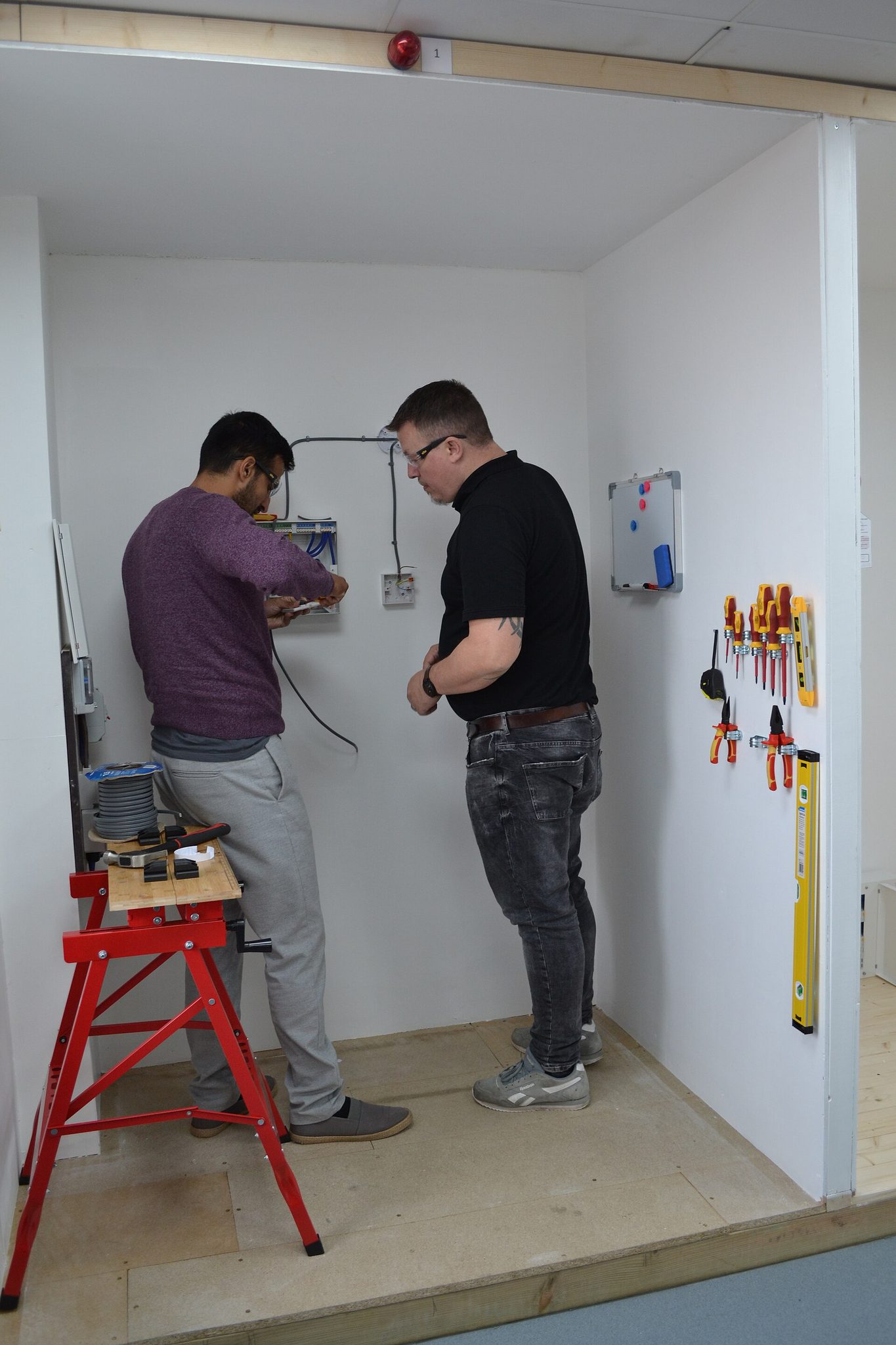
Photo: Charanjitmannu / Wikimedia Commons, CC BY-SA 4.0
Apprenticing with an electrician
You work as a helper for a journeyman; in the first month you mostly chase walls and pull cables, then you are gradually allowed to make connections. You earn money immediately and learn on real jobs. The risk is picking up your mentor's bad habits: not isolating the power, "borrowing" a neutral from another circuit, leaving out the earth — so you still need to study safety and principles on the side.
Online electrical courses combined with practice
Theory (safety, Ohm's law, cables, circuit diagrams) can be learned online at your own pace; hand skills are trained on a practice board at home and while helping on site. Learning only online is not enough: screw torque, stripping technique and running conduit need someone to watch and correct you.
What you need to learn and how many hours it takes
Whichever path you choose, you must cover 4 groups of foundation knowledge before anyone trusts you with work; the most common gap is safety. The table below gives the minimum reference hours to reach the helper milestone.
| Knowledge group | What you learn | Minimum hours |
|---|---|---|
| Electrical safety | Electric shock and the human body; isolate, lock off, tag, test again; first aid | 15–20 hours |
| Tools and measurement | Insulated tools, protective equipment, multimeter, clamp meter, voltage tester | 20–30 hours |
| Electrical fundamentals | Current, voltage and power; cables; wire colours; joining wires and crimping lugs | 30–40 hours |
| Basic installation | Running conduit, junction boxes, lighting and switch circuits, earthed sockets, checks before energising | 100–150 hours |
| Total | 165–240 hours |
At 15 hours a week (3 evenings × 2 hours + 9 hours on Sunday), 165–240 hours takes 11–16 weeks. Full-time study at a centre, 40 hours a week, takes about 4–6 weeks. Any course promising you will be "qualified" after 20–30 hours is cutting most of this workload, usually the supervised, graded installation practice.
Safety: learned first, tested most strictly
You must understand why current through the body is dangerous, the 30 mA threshold of a residual current device (RCD), and know by heart the procedure of isolating, locking off, tagging and testing again before touching any wire. Read the lesson on 5 safety rules before touching any electrical wire carefully before you pick up a screwdriver.
Fundamentals: know why, not just how
Ohm's law and power calculations let you estimate current and understand why a loose joint can melt even though the breaker never trips. Telling live, neutral and earth apart by colour is the first lesson on site — see the lesson on live, neutral and earth wire colours under TCVN (Vietnam's national standards), and remember that older houses are often wired with the wrong colours, so you must always measure.
Installation: the part that takes the most hours
Your hands need hundreds of repetitions to become consistent: stripping wire to the right length, tightening screws firmly enough, running conduit perfectly vertical or horizontal, switching the live conductor. A wooden practice board with a few boxes, some conduit, switches, sockets, lamp holders and a circuit breaker is enough to practise at home.
NAMBIN's 4-level path: time per level
NAMBIN's 4-level Residential Electrician path divides the trade into four courses, each with its own test, matching the three milestones described at the start. The time to study each course is measured in weeks, but the time to "reach the level" on real jobs is measured in months and years — the table shows both.
| Level | Course study (10 lessons, 4 modules) | Reaching the level on the job | What you can do |
|---|---|---|---|
| Level 1 – Helper | about 3–4 months including hands-on practice | 3–6 months | Safety, testing, wiring lighting circuits and earthed sockets |
| Level 2 – Journeyman | about 2–3 months | 1.5–3 years | Reading drawings, load calculation, distribution boards, fault finding, handover inspection |
| Level 3 – Master electrician | about 2–3 months | 3–5 years | Three-phase power, pumps, heavy loads, lightning protection, solar, smart homes |
| Level 4 – Master contractor | about 2–3 months | usually from year 5 | Design, cost estimating, managing a crew, maintenance, running an electrical services business |
Level 1 – Helper
The Level 1 – Helper course has 4 modules: electrical safety (the test requires 100% to pass), tools and measurement, electrical fundamentals, and wiring lighting circuits and sockets. This corresponds to the 165–240 foundation hours in the table above. Once you finish, you are ready to work as a helper and to be trusted with connections that a journeyman checks.
Level 2 – Journeyman
The Level 2 – Journeyman course teaches reading drawings, calculating loads, sizing cables for current and voltage drop, selecting MCBs and RCDs, earthing, installing an apartment distribution board, diagnosing faults and writing handover inspection reports. Testing and inspection, as in Figure 3, is the skill that separates a journeyman from a helper. Take this course after about 6–12 months of helping, so you have real examples to compare against.
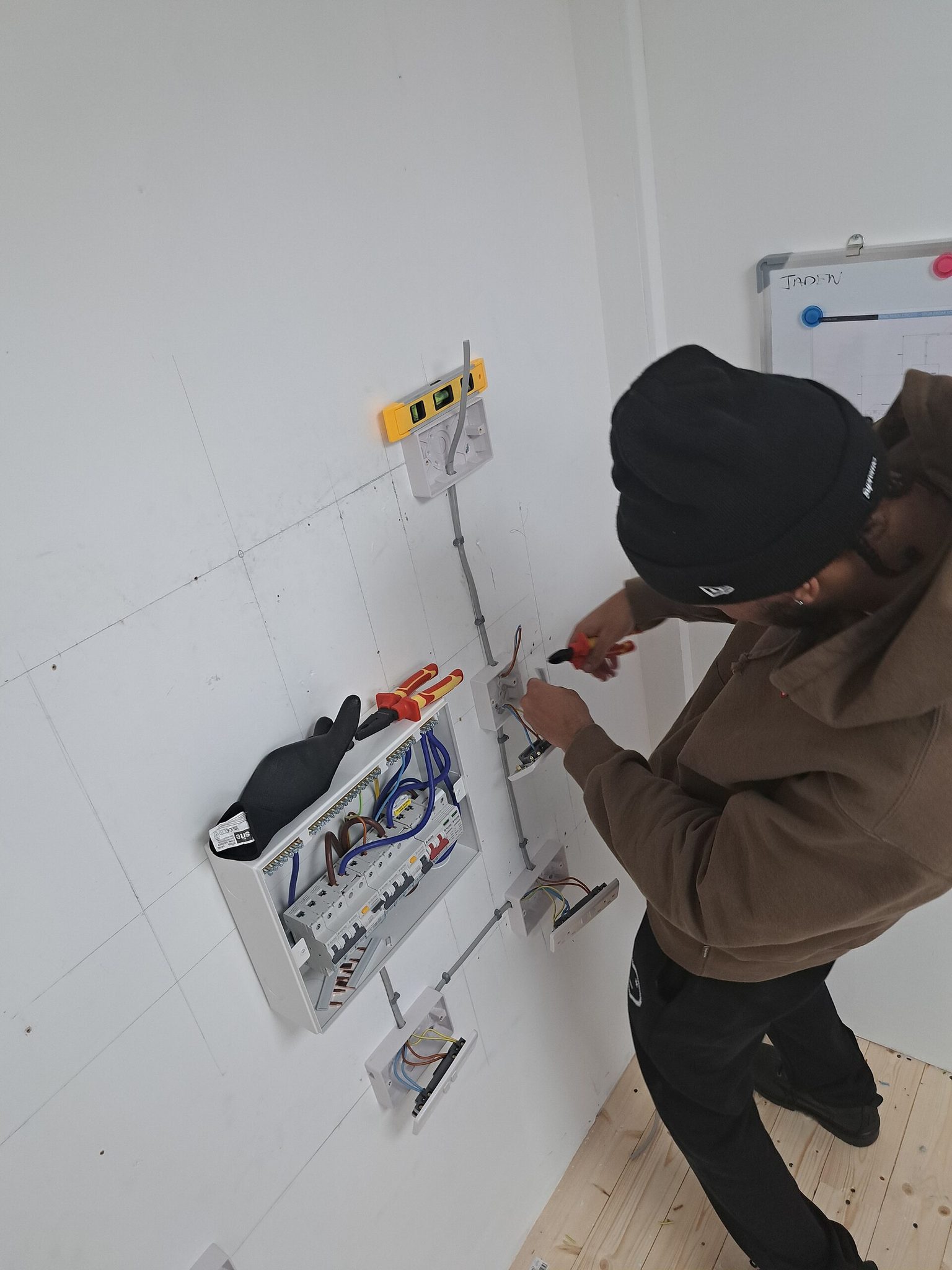
Photo: Charanjitmannu / Wikimedia Commons, CC BY-SA 4.0
Level 3 – Master electrician and Level 4 – Master contractor
The Level 3 – Master electrician course covers difficult, higher-paid work; the Level 4 – Master course is for people who want to run their own jobs and manage a crew (see the table above for content). Both levels require years of real work; do not jump ahead before you are solid at Level 2 — studying solar after only a few months, when you still cannot explain why an RCD trips, is learning in the wrong order.
The minimum tool kit for a beginner
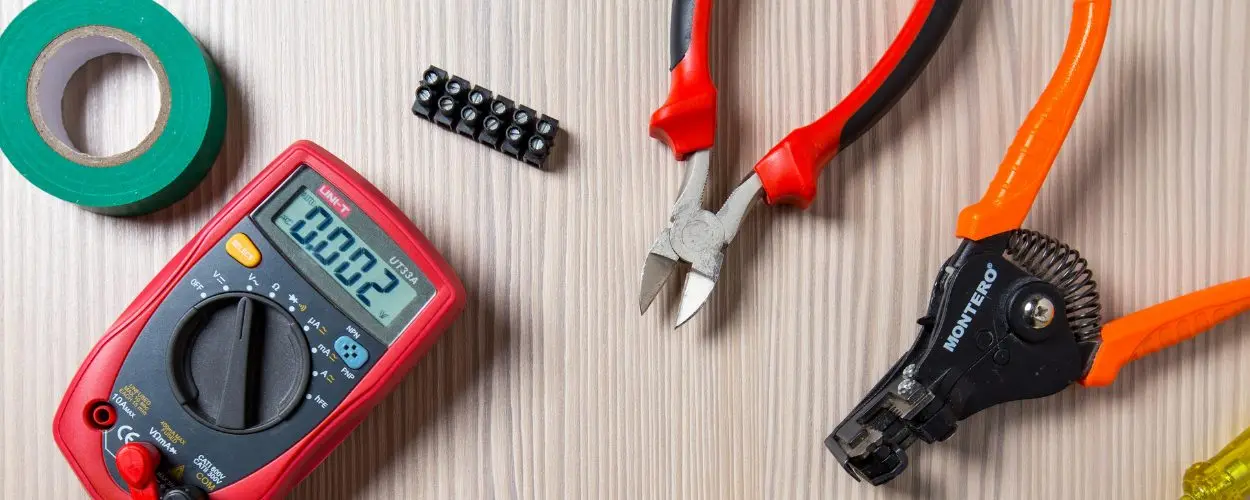
Beginners often buy too much, or buy cheap tools that are not insulated. The kit below is enough to study Level 1, practise on a board at home and work as a helper for the first few months. Figure 4 shows a similar basic tool set.
Photo: Pazanyon12 / Wikimedia Commons, CC BY 4.0
| Item | What to look for | Reference price (VND) |
|---|---|---|
| Insulated flat and Phillips screwdriver set | Double-triangle 1000V symbol (IEC 60900) | 250,000–600,000 |
| Combination pliers, side cutters, wire strippers | Insulated handles, strips 1–6 mm² | 300,000–700,000 |
| Voltage tester pen (contact + non-contact) | For quick checks, does not replace a meter | 100,000–300,000 |
| Multimeter | Measures AC voltage up to 600V, rated CAT III 600V or higher | 400,000–1,200,000 |
| Crimping tool for lugs | Ratchet type, sized for the lugs you use most | 200,000–500,000 |
| Tape measure, marker, tape, wire connectors | Good-quality insulating tape | 100,000–200,000 |
| Protective gear: gloves, glasses, shoes | Insulating-sole shoes, dust glasses for chasing walls | 300,000–700,000 |
| Tool bag or box | With compartments, wearable on a ladder | 150,000–300,000 |
| Total | 250 + 300 + 100 + 400 + 200 + 100 + 300 + 150 thousand (lowest) | 1,800,000–4,500,000 |
What to buy first, what to buy later
Buy screwdrivers, pliers and a multimeter first — the three things you use every day and that determine your safety. The multimeter is the one item not to buy at the cheapest price: without a proper CAT rating and with poor test leads, it can cause a short circuit when you measure inside a board. How to read and use a meter correctly is covered in the lesson on using a multimeter as an electrician.
Not needed yet
A concrete drill, a wall chaser, a clamp meter, an insulation resistance tester and an insulated ladder are journeyman's tools; while you are a helper you share them with your mentor.
Safety warning: never teach yourself by "trying things out" on the live wiring in your home, and never work on anything live even if it is "just changing a socket". A practice board must be supplied through a 30 mA RCD, and only energised after someone who knows the trade has checked it. Beginners must never touch anything before the electricity meter, the utility company's lines or a building's main distribution board — that is the responsibility of the power company and appropriately certified electricians.
Worked example: Nam, 22, and his 12-month learning plan
Nam works day shifts as a factory worker in an industrial park, has 8 million VND in savings, and is free three evenings a week and on Sundays — about 15 hours a week. He wants to switch to electrical work without losing income for too long. All figures below are an illustrative example using 2026 references and vary by region.
Months 1–3: learning the foundations while still working
- Study Level 1 theory online in the evenings and practise on the board on Sundays: 13 weeks × 15 hours = 195 hours, within the 165–240 hour range above.
- Costs: an online foundation course (assumed) 1.5 million; minimum tool kit 2.5 million; practice board materials (wood, conduit, boxes, cable, switches, sockets, breaker) 1.0 million.
- Total: 1.5 + 2.5 + 1.0 = 5.0 million VND, taken from savings; 8 − 5 = 3 million left.
Months 4–12: working as a helper and getting certified
- Leave the factory job and work as a helper for a journeyman: 300,000 VND × 24 days = 7.2 million a month; minus 0.6 million for fuel and phone, 6.6 million a month remains.
- 9 months × 6.6 million = 59.4 million VND net income; 9 × 24 = 216 real working days.
- Months 7–9: an evening elementary vocational class at a licensed centre, assumed tuition 6 million, followed by the exam for the elementary certificate.
- Months 10–12: start studying Level 2 (reading drawings, load calculation) in the evenings, comparing it with the jobs he is working on.
Results after 12 months
Total spent on training: 5.0 + 6.0 = 11 million VND. Net income from 9 months as a helper: 59.4 million, so after training costs he has 59.4 − 11 = 48.4 million (about 1,900 US dollars, not counting his factory wages for the first 3 months). By the end of the year Nam has an elementary certificate, 216 real working days and is studying Level 2 — right on track to become a journeyman somewhere between months 18 and 36. The trade-off to accept: in the first months as a helper, income may be lower than factory wages; in return, the income ceiling for electricians is much higher once you move up.
Common mistakes when learning electrical work
Choosing the shortest, cheapest course
Sign: a 1–2 week course promising "qualified, start work immediately". Cause: comparing by days and price instead of practice hours. Fix: ask exactly how many hours of supervised, graded hands-on practice there are; under about 165 hours for the foundations is not enough.
Working as a helper without learning the principles
Sign: you can do familiar tasks but are stuck when an unusual fault appears, or you copy your mentor's bad habits. Cause: learning only by watching. Fix: spend 3–5 hours a week on theory following the path, and note down questions from the job to look up later.
Studying only online, with no hands-on practice
Sign: you know the diagrams by heart but nick strands when stripping wire, leave screws loose and run crooked conduit. Cause: no practice board and nobody to correct you. Fix: build a practice board at home, film your work and send it to an experienced electrician for feedback, and start helping on site as early as possible.
Frequently asked questions
How long until I can work as an electrician?
About 3–6 months to work as a paid helper, if you complete 165–240 foundation hours and practise regularly. Becoming a journeyman usually takes 1.5–3 years of real work; a master electrician usually from year 3–5 onwards.
Where should I learn residential electrical work?
Three main options: a vocational school or centre (elementary certificate, 3–6 months), apprenticing with an electrician (paid from day one, usually no paperwork), and online self-study combined with practice (flexible and cheap). Many people combine them: learn the foundations online or at a centre, work as a helper to build skill, then sit the certificate exam once they are working.
Can I really learn electrical work from an online course?
Yes, for theory and safety: Ohm's law, cables, circuit diagrams, the isolation procedure. Hand skills must be practised on a board and on site with someone correcting you. A good online course has tests, practical exercises and clear pass criteria.
Is electrical work hard to learn?
Not for someone patient and careful; you only need basic multiplication and division. The hard part is daily safety discipline and the hours of hands-on practice. People aged 30–40 can still learn it, as long as they are fit enough to climb ladders, chase walls and work in the heat.
Do I need a certificate to work as an electrician?
Usually not to work as a helper for a journeyman. Companies and contractors often ask for a vocational certificate and an electrical safety training certificate; for the exact rules, ask your local labour authority.
Exercise: build your own electrician learning plan
- Write down how much money you can put into training and how many months you can live on a low income.
- Write down your free hours per week, then divide 165 and 240 by that number to get the weeks needed for the foundations.
- Choose 1–2 paths from the comparison table and calculate total costs and income over 12 months, as in Nam's example.
- List your tool kit using the table, write down the prices you found and add up the total.
- Set milestones: which month you finish Level 1, start helping, sit the certificate exam and begin Level 2.
Self-assessment criteria
- Pass: the plan has a total cost in numbers that add up; at least 165 foundation hours; a helper milestone within the first 6 months. Not yet: it only says "take a crash course, then get a job", with no hours.
- Pass: the tool list includes 1000V insulated screwdrivers and a CAT III multimeter, with a total within 1.8–4.5 million VND. Not yet: no multimeter, or non-insulated tools.
- Pass: you can name at least 3 things a beginner must never do (work live, touch anything before the meter, energise a practice board before anyone has checked it). Not yet: the plan has no safety section.
This lesson belongs to the Electrical safety and basic tools step of the path. The next step is Multimeters and voltage testers — the first tool you must master before working as a helper.
Ready to start your first milestone? Enrol in the Residential Electrician Level 1 – Helper course to cover all 4 foundation modules, including the safety test, then explore the full 4-level Residential Electrician path to see where you will go next.