It is a hot evening in a rented room. The only wall socket is behind the bed, so everything runs from a cheap power strip on the floor: a phone charger, a fan, the TV, a router and, tonight, a borrowed electric kettle. A minute after the kettle switches on, someone notices that the strip's plug is warm and the plastic around one socket smells faintly sharp. Nothing trips. The kettle boils, the smell fades, and the same thing happens the next night, and the night after that.
Extension cords and power strips are among the most useful things in a home, and among the most misused. They are made for convenience and light, temporary loads, yet they are often asked to do the job of a proper socket circuit: running kettles, irons and heaters, chained together, coiled up, hidden under rugs or left out in the rain.
This guide explains how to choose a safe extension, read its ratings, add up your appliance load with worked examples, use it without overheating, recognise when it should be retired, and know when a new fixed socket is the better answer.
Scope of this guide. Written for homeowners, tenants and trainee residential electricians on 230 V / 50 Hz single-phase supplies as used in homes in Vietnam. All appliance wattages, cable sizes and current figures here are for reference only: always read the marking on your own extension, plug and appliance nameplate and follow the manufacturer's instructions. Choosing and using plug-in extensions is safe for anyone. Opening a power strip, repairing a cord, adding a socket or working on house wiring is a job for a competent electrician after the circuit has been isolated and proved dead. If you see smoke, flames or sparking, switch off at the main switch if it is safe to do so, get everyone out and call the fire service on 114.
Why extensions overheat
Current flowing through any conductor produces some heat. A wall socket circuit is designed so that this heat stays small: the cable in the wall is sized for the breaker that protects it, and the socket grips the plug pins firmly. A plug-in extension adds weak points to that path:
Thinner flexible cable. Many cords use a smaller cable than the wall wiring. Overload it and it warms along its whole length.
More contact points. The plug, the joints inside the strip and every socket are places where metal touches metal. A loose, worn or dirty contact heats up at that one spot.
Protection not matched to the cord. The breaker in your board protects the wall wiring, not a thin cord plugged into it. It can allow more current than a light-duty cord can carry for long, so it may never trip while the cord slowly cooks.
Trapped heat. Cable coiled on a reel, bundled, under a rug or behind furniture cannot shed heat.
Heat feeds on itself: a warm contact oxidises, its resistance rises and it gets hotter still, which is why an extension that "has always been fine" can fail after months of mild overloading.
Step 1: Know the main types
Extension reel (cable drum): a long cable wound on a drum with sockets on the hub, for garden tools, workshops and temporary lighting. The wound cable traps heat, so many reels show a lower power rating for wound cable than for fully unwound cable.
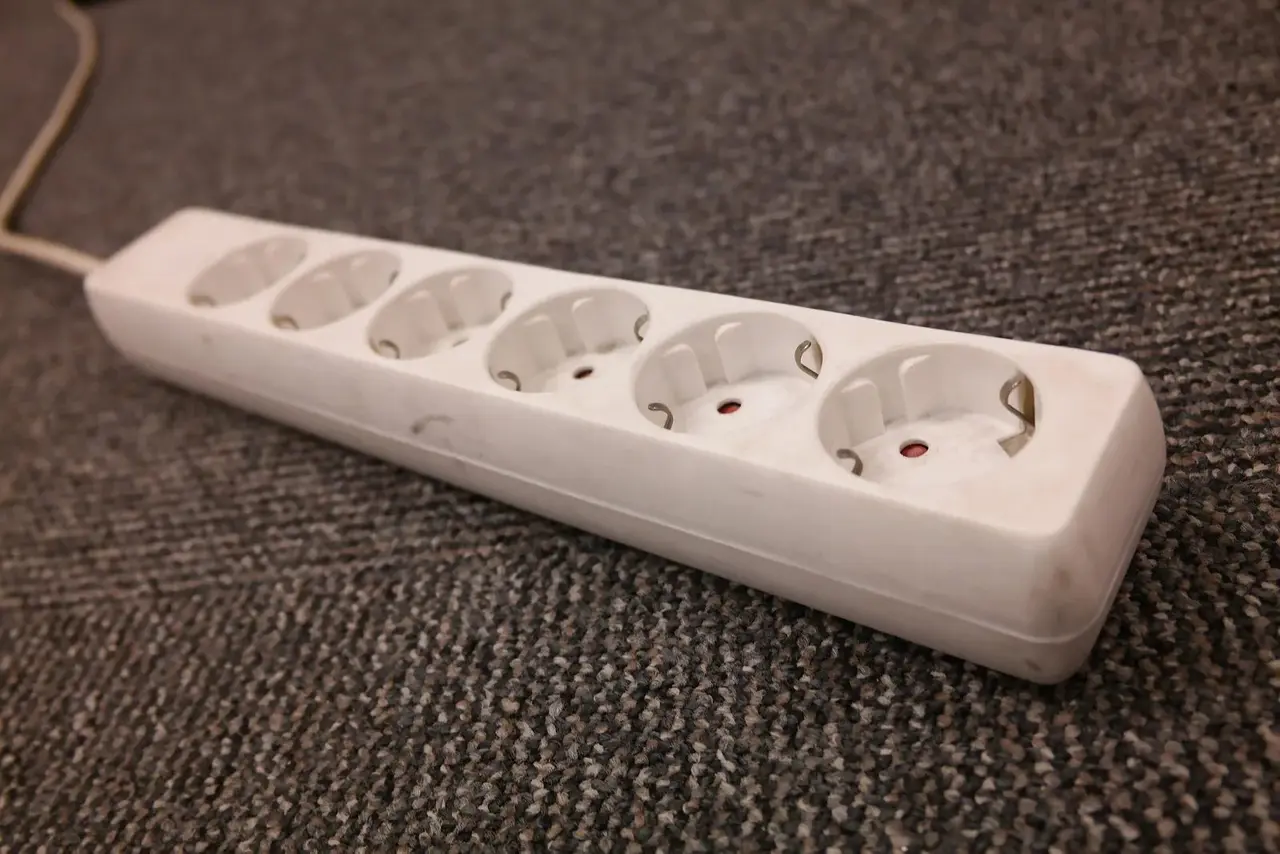
Power strip (multi-socket extension): a row of sockets on a short cord, for groups of small devices on desks, behind TVs and beside beds.
Surge-protected strip: a power strip with components that absorb short voltage spikes, usually with an indicator light. It does not protect against overload, low voltage or a direct lightning strike, its protection can wear out over time, and it does not replace surge protection in the distribution board.
Outdoor (IP-rated) extension: marked with an IP code. The first digit is protection against solids and dust, the second against water. For reference, IP44, often seen on outdoor extension sockets, means protection against splashing water, not immersion, and often only with the lids closed. Indoor strips have no water protection at all.
Step 2: Read the ratings
Turn the strip or reel over and find the marking: a current in amperes (A), a voltage and often a maximum power in watts (W).
Converting amps to watts
For heating loads such as kettles and irons, power is roughly watts ≈ volts × amps:
10 A at 230 V ≈ 10 × 230 = 2,300 W
16 A at 230 V ≈ 16 × 230 = 3,680 W
Some products print a wattage calculated at 250 V (10 A × 250 V = 2,500 W), because 250 V is a common voltage rating for sockets. For a real load in a Vietnamese home, use 230 V or the lower of the two figures. Motors and electronic appliances can draw a little more current than watts divided by volts, so leave headroom.
The weakest part sets the limit
The safe load is set by the weakest of the plug, the cable, the strip and the wall socket. A strip with 16 A sockets on a thin cord or a 10 A plug is a 10 A strip at best.
Reference table: cable size
Flexible cords are usually marked on the sheath with the number of cores and the cross-section of each, for example "2 × 1.0 mm²" or "3 × 1.5 mm²". A larger cross-section heats less for the same current.
Cross-section printed on cable | Pairing commonly seen in shops (for reference) | Example uses |
|---|---|---|
0.75 mm² | Light-duty cords, usually below 10 A | Chargers, lamps, small fans, TV |
1.0 mm² | Often with 10 A plugs and strips | Desk and TV use; one medium appliance |
1.5 mm² | Often with 16 A plugs and strips | Heavier temporary use such as a power tool |
Not marked, very thin | Unknown | Light loads only, or do not use |
The manufacturer's marking is what counts, and long cables or cables in hot places can carry less.
Earthed or unearthed?
An earthed strip has an earth pin or earth clips and a third core in the cable; an unearthed strip has two-pin sockets and two cores.
Metal-bodied appliances with an earthed plug, such as many irons, kettles, microwaves, washing machines and refrigerators, rely on earth to make a fault safe. An unearthed strip silently removes that protection.
An earthed strip only helps if the wall socket is earthed. Many older Vietnamese homes have two-pin sockets with no earth. Ask an electrician to test them; see our guide on earthing a house.
Never break off an earth pin or use an adapter that leaves it unconnected.
Switch, fuse and overload protection
Switch: handy for turning devices off at night, but it may break only one conductor. Unplug the strip from the wall before inspecting or cleaning it.
Overload protection: a fuse or a small thermal breaker with a reset button. If it trips, the load is too high: unplug something before resetting. Never hold a reset button in or tape it down.
Child-resistant shutters: covers inside the socket holes that open only for a proper plug.
Solid build: a firm plug, cable clamped where it enters the plug and the strip, sockets that grip pins firmly and a clear rating. Avoid very light, unmarked strips with thin cable.
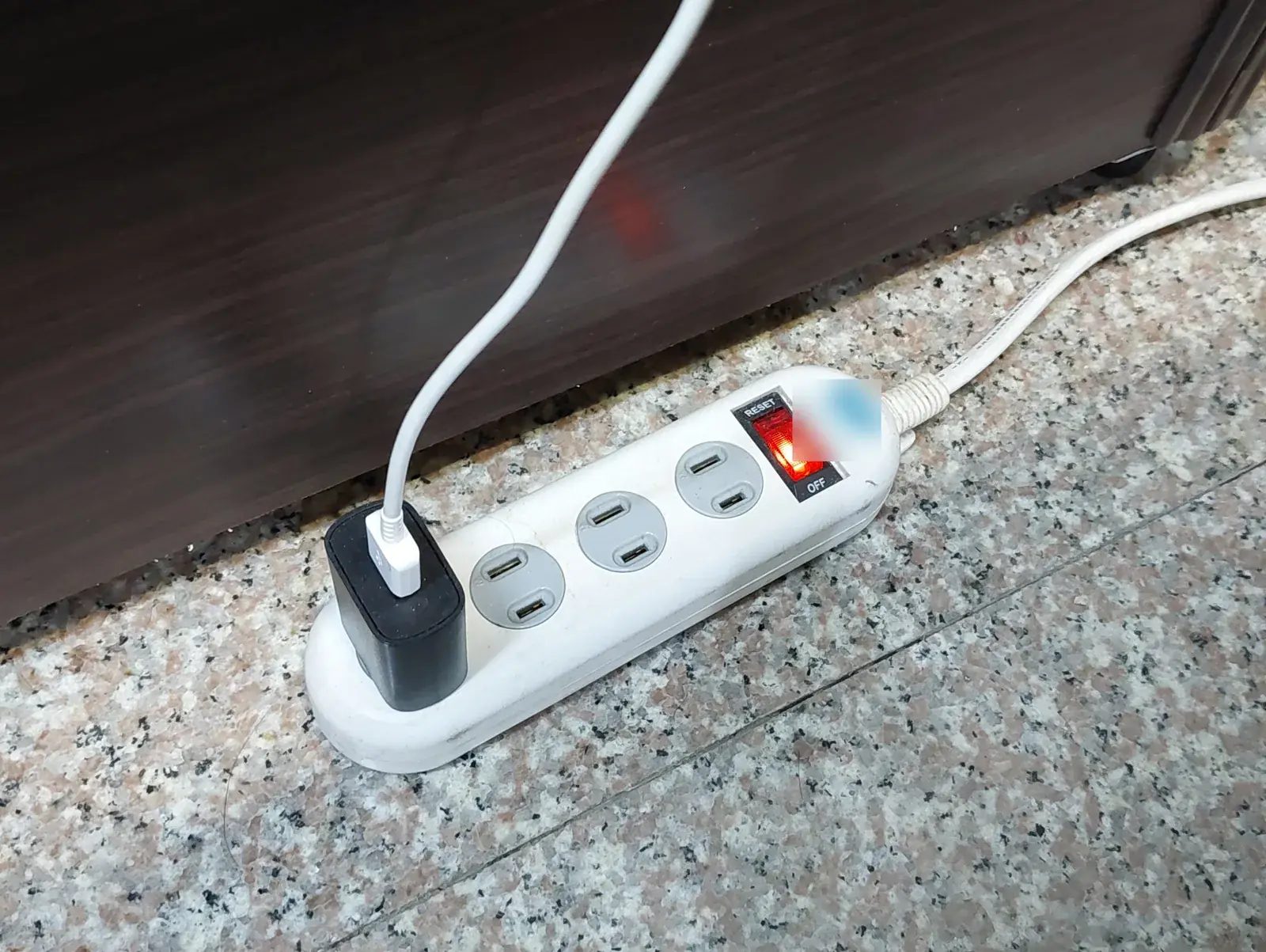
Figure 1. A white three-socket power strip on a speckled stone floor beside a cabinet, with a black USB charger plugged into the first socket and a red illuminated rocker switch marked RESET and OFF at one end. On strips like this the switch usually doubles as an overload breaker: if it trips, remove some of the load before resetting it. (Photo: S101006, Wikimedia Commons, CC BY-SA 4.0)
Step 3: Add up the load
Every appliance has a nameplate showing its power in watts (sometimes a range) or its current in amps. Add up everything that could run at the same time on one strip and compare the total with the strip's rating and the wall socket's rating.
Reference table: typical appliance power
Appliance | Typical power (for reference; check the nameplate) | On a power strip? |
|---|---|---|
Phone charger | About 5–30 W | Yes |
Laptop charger | About 45–100 W | Yes |
Wi-Fi router, LED lamp | About 5–20 W | Yes |
Television | About 50–200 W | Yes |
Stand fan | About 40–70 W | Yes |
Rice cooker | About 500–1,000 W | Better on its own in a wall socket |
Hair dryer, steam iron | About 1,000–2,400 W | Wall socket |
Electric kettle | About 1,500–2,200 W | Wall socket |
Fan heater, oil heater | About 1,000–2,000 W or more | Wall socket |
Air conditioner, induction cooker, water heater | High; normally a dedicated circuit | Never on an extension |
Worked example 1: the bedside strip
A strip marked 10 A, so about 2,300 W. Plugged in: phone charger 20 W, laptop 65 W, TV 120 W, router 10 W, fan 50 W. Total = 20 + 65 + 120 + 10 + 50 = 265 W, far below 2,300 W. This is exactly what power strips are for.
Worked example 2: adding the kettle and the iron
Now a 2,000 W kettle and a 1,200 W iron are added. Total = 265 + 2,000 + 1,200 = 3,465 W, about 1.5 times the rating. The plug, cord and wall socket are all pushed hard, and if the strip has no overload protection, nothing may trip. The kettle alone is close to the 2,300 W limit, and heating appliances draw full power for minutes at a time. They belong in a wall socket, one at a time.
Worked example 3: the heater that runs all night
A 16 A strip (about 3,680 W) feeds a 2,000 W fan heater behind a sofa, with the cord under a rug. On paper it is within the rating, but the load runs for hours and the heat at the plug and in the covered cable cannot escape. Plug the heater directly into a wall socket in the open.
As a common rule of thumb, for reference, keep long-running loads well below a strip's maximum, roughly 80% of it or less, and keep heating appliances off strips altogether.
Step 4: Send high-load appliances to a wall socket
A simple rule: anything that heats, cools or has a large motor goes straight into a wall socket, one appliance per socket. That includes kettles, irons, hair dryers, rice cookers, microwaves, space heaters, washing machines and refrigerators. Air conditioners, induction cookers and electric water heaters normally need their own dedicated circuit. E-bike and electric scooter chargers run for hours, often overnight; see our guide on installing a safe charging socket for electric scooters.
A power strip cannot make a weak or loose wall socket safe. If the wall socket or its plug gets hot, see our guide on hot wall sockets and plugs.
Step 5: Use extensions correctly
Do not daisy-chain
Plugging one strip or extension into another adds contact points and thin cable but no capacity: everything still flows through the first plug and the wall socket, and overloading becomes easy. Use one extension of the right length and rating plugged directly into the wall. Needing more sockets than one strip provides is a sign you need more fixed sockets.
Fully unwind cable reels
Current in a tightly wound cable heats each turn and the turns around it, and the heat cannot escape. Under a heavy load the inner turns can get hot enough to soften the insulation. Unwind the whole cable for anything more than a small load, even if you need only a few metres, and follow the reel's label: the lower "wound" rating applies whenever cable is left on the drum.
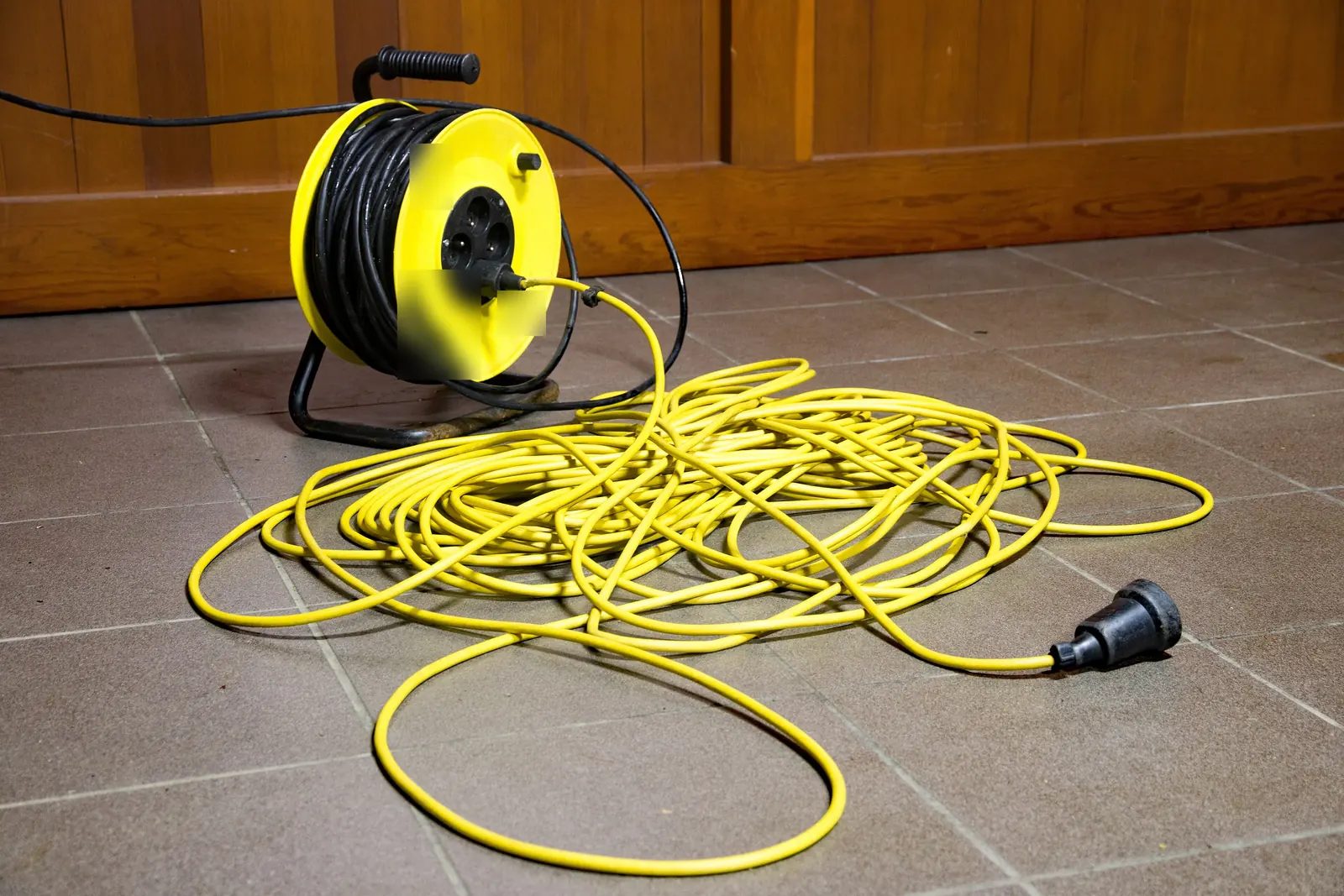
Figure 2. A yellow cable reel on a metal stand on a tiled floor, with its long yellow cable unwound and laid loosely across the floor, ending in a black rubber socket. Unwinding the whole cable lets heat escape along its length; in use it should also be laid out so that no one trips over it. (Photo: Sally V, Wikimedia Commons, CC BY-SA 4.0)
Keep cables out from under rugs, doors and furniture
Rugs and mats trap heat and hide damage while people walk on the cable.
Doors and windows pinch and cut cables every time they close.
Furniture crushes cables, and furniture pushed against a plug bends it and loosens the contacts.
Nails, staples and tight ties damage the insulation; extension cords are not meant to be fixed to walls.
Other good habits
Keep strips in the open, not buried under papers, clothes or bedding.
Pull plugs out by the plug body, never by the cable.
Do not let heavy chargers or adapters hang from a strip or wall socket.
Keep strips away from sinks, plant pots and mopping water, and unplug those you do not need overnight.
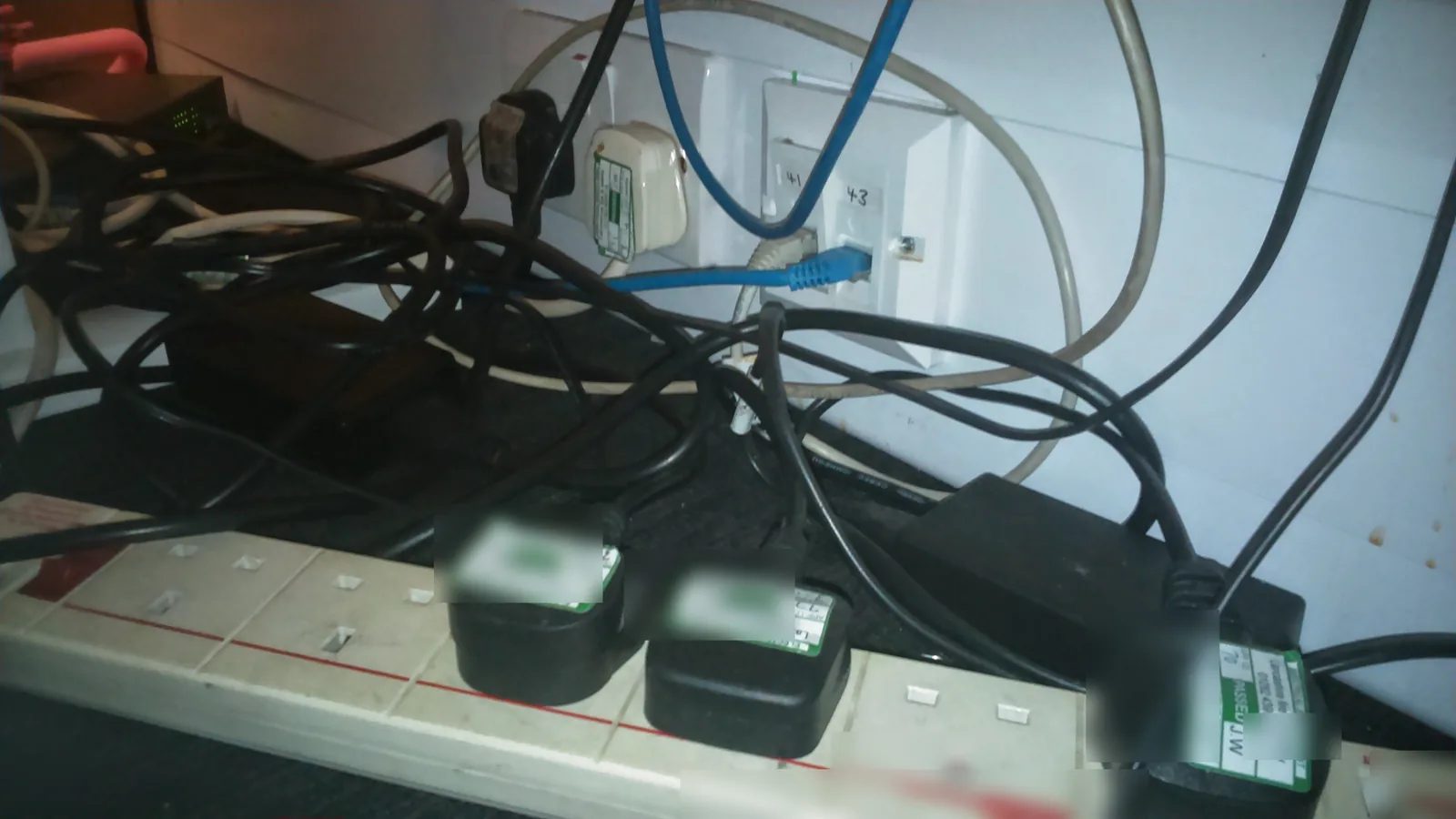
Figure 3. Bad example: a crowded power strip on the floor under a desk, with several heavy black plugs and power adapters in it and a tangle of power and network cables piled over the strip and in front of the wall socket and network points behind. Clutter like this traps heat, hides damaged cables and makes it hard to see what is plugged in. (Photo: 247homerescue, Wikimedia Commons, CC0; labels and markings blurred)
Step 6: Outdoors, wet areas and RCD protection
Outdoors, use only extensions marked for outdoor use with a suitable IP rating, and keep socket lids closed.
Keep connections off the ground, out of puddles and out of the rain; bring indoor strips back inside.
Plug outdoor equipment into a circuit protected by an RCD (or an RCBO, which combines breaker and RCD). For protecting people, a high-sensitivity device, commonly 30 mA, is the type normally used. An electrician can confirm whether your circuits have one. Press its test button as the manufacturer recommends.
Never use an extension in a bathroom or near a bathtub, shower or pool.
Check the cable before every outdoor job for cuts, crushing and sun damage.
Step 7: Keep children safe
Choose strips with child-resistant shutters and place them out of reach without crushing the cable.
Never leave a live extension with an empty socket end lying on the floor.
Replace any cord chewed by a child or pet immediately.
Step 8: Travel adapters and mixed plug types in Vietnam
Vietnamese homes have a mix of plug types. Many older sockets and cheap strips accept both flat two-pin and round two-pin plugs in the same opening; you will also see plugs with earth pins or earth clips, and "universal" sockets designed for several plug shapes. This causes a few risks:
Loose contact: a socket that accepts many shapes may not grip any of them firmly. A wobbly plug heats up under load; use another socket and keep high-power appliances off it.
Lost earth: an adapter that turns an earthed plug into a two-pin plug disconnects the earth. Acceptable for a phone charger, not for a metal-bodied appliance.
Stacked adapters: a chain of weak contacts and a heavy lever on the socket. Avoid them.
No voltage conversion: a plug adapter only changes shape. Check that the appliance label says 230 V or a range such as 100–240 V; a device made only for about 110–120 V can be damaged on 230 V.
Low ratings: travel adapters are often rated lower than a wall socket; use them for chargers and small devices.
Step 9: Recognise warning signs
Stop using an extension and unplug it from the wall, if it is safe to touch, when you notice:
A plug, socket or section of cable that feels warm or hot in normal use (a charger body being slightly warm can be normal; a hot plug pin or socket face is not)
Discolouration: brown or black marks around socket holes or on pins, or bubbled, deformed plastic
Buzzing, crackling or hissing
Loose sockets, or a plug that falls out under its own weight
A burning, hot-plastic or fishy smell (our guide on electrical burning smells explains how to trace the source)
Flickering, or an appliance that stops when you move the cord
An overload button or fuse that trips repeatedly
Cracked casing, exposed inner cores, a cable pulled out of its clamp, or tape repairs
If there is smoke, flame or sparking, do not touch it: switch off at the main switch if safe, get everyone out and call 114. Never throw water on anything that may be live.
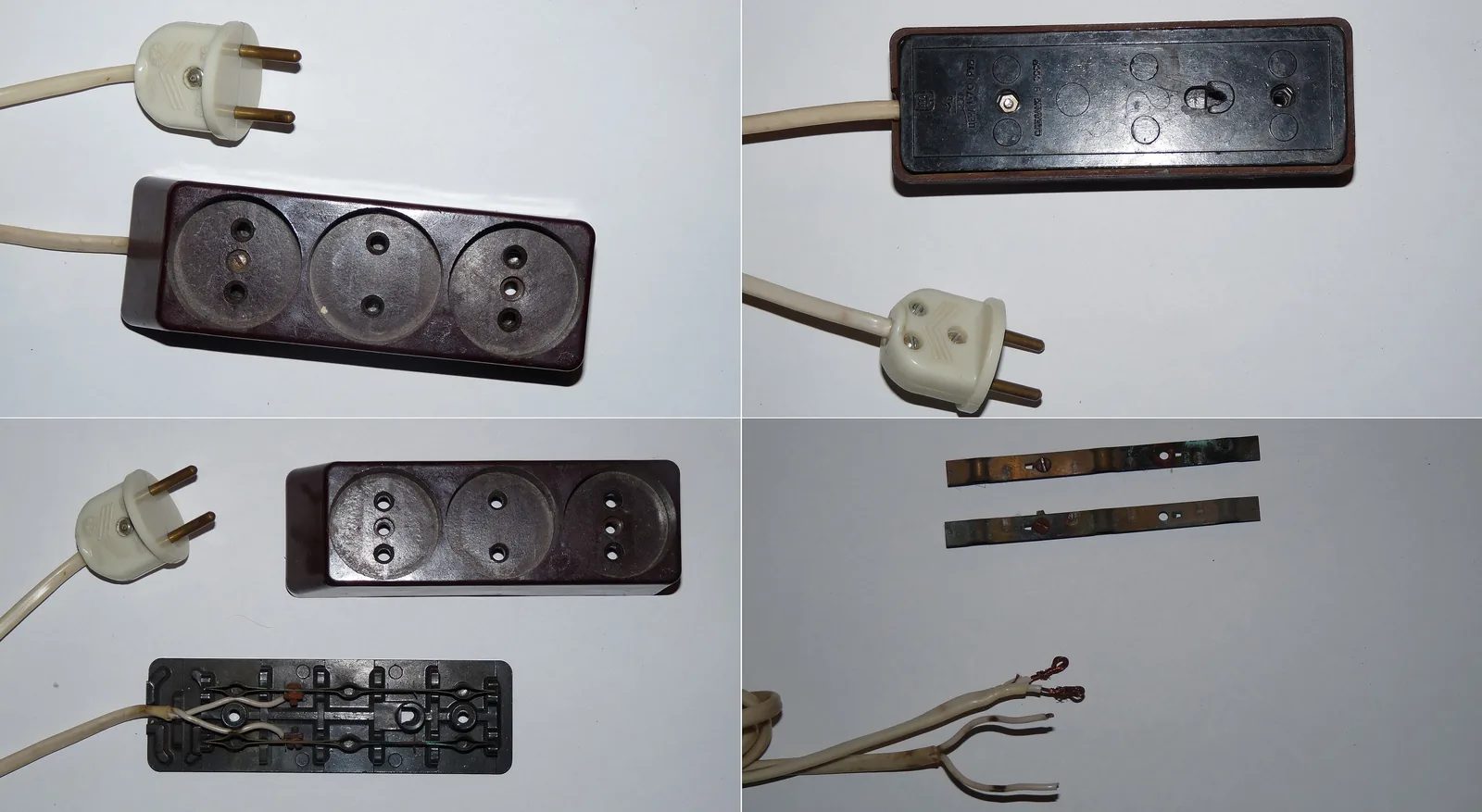
Figure 4. Four views of an old brown three-socket extension with a two-pin plug and no earth: the front, the back, the opened base, and the metal contact strips and cable ends taken out of it. The contact strips are darkened and stained green, and the cable ends are discoloured; according to the photographer, it had been loaded well beyond its rating. Damage like this hides inside the case, so do not wait for it to show on the outside. (Photo: Dmitry G, Wikimedia Commons, CC BY-SA 3.0)
Step 10: Inspect and retire extensions
Every few months, and before heavy or outdoor use, unplug the extension and check:
Marking: still legible and suitable for how you use it.
Plug: pins straight and not discoloured, body not cracked, cable firmly clamped.
Cable: run it through your hands end to end, feeling for cuts, flattened sections, kinks and tape.
Sockets: no discolouration or cracks; plugs grip firmly.
Switch and indicator: the switch works cleanly; on a surge strip, the indicator shows protection is active as the instructions describe.
In use: after half an hour on its usual load, the plug and strip should be no more than barely warm.
Replace, do not repair, a strip that shows any warning sign, has been crushed, wet or badly dropped, has loose sockets, a surge indicator showing protection has ended, or no legible rating. Cut the cable before throwing it away so no one reuses it. Most household strips are not designed to be opened; an electrician may rewire a good heavy-duty extension, but cheap strips are simply replaced.
Step 11: When a fixed socket is the better answer
An extension is a temporary solution. Talk to an electrician about adding or moving a socket if the same extension never moves, you need more than one strip in a room, a cable crosses a doorway or runs under a rug permanently, a high-power appliance has no wall socket nearby, or you regularly charge an e-bike or run equipment outdoors. A new socket must come from a circuit with spare capacity, with the right cable, breaker and, where needed, RCD protection; our guide on adding a new socket outlet to an existing circuit explains how an electrician plans it.
Example: the rented room, fixed properly
An electrician checking the room from the start of this article found a light, unmarked two-pin strip with very thin cable carrying the kettle, fan, TV, router and charger; brown discolouration around the socket the kettle used; a warm plug after one boil; and a loose wall socket behind the bed.
The fix: the strip was cut up and thrown away. The electrician isolated the circuit, proved it dead and replaced the loose wall socket. A new marked 10 A strip with overload protection now feeds only the small devices (about 265 W) and sits in the open. Because the tenant needed power at the table every day, the landlord had a fixed socket added there, and the kettle now plugs directly into it.
Safety checklist
Rating (A, V, W) clearly marked on the strip or reel
Total load added up from nameplates and well below the lowest rating of plug, cable, strip and wall socket
Kettles, irons, heaters, hair dryers, microwaves and washing machines plugged directly into wall sockets
Air conditioners, induction cookers and water heaters on their own circuits
No daisy-chaining and no stacked adapters
Cable reels fully unwound for anything more than a small load
No cables under rugs, through doors or crushed by furniture
Metal-bodied appliances on earthed strips in earthed wall sockets
Outdoor equipment on outdoor-rated extensions, kept dry, on an RCD-protected circuit
Child-resistant shutters and strips out of reach where there are young children
Any warm, discoloured, buzzing, loose or smelly strip retired
Permanent extension use replaced by a fixed socket installed by an electrician
Frequently Asked Questions
How many watts can I plug into a power strip?
Multiply the strip's amp rating by 230 V: about 2,300 W for 10 A and about 3,680 W for 16 A. If the strip prints a lower wattage, use that. The real limit is the weakest part, including the wall socket, and long-running loads should stay well below the maximum.
Is it safe to plug a kettle or iron into a power strip?
It is not recommended. Either one alone can use most of a 10 A strip's capacity at full power for minutes at a time. Plug them directly into a wall socket, one high-power appliance per socket.
Can I plug one power strip into another?
No. Daisy-chaining adds contacts and cable without adding capacity and makes overloading easy. Use one suitable extension in the wall socket and add fixed sockets if you need more.
Why does my extension reel get hot?
Usually because the cable is still wound on the drum and the heat cannot escape. Unwind it fully and check the reel's wound and unwound ratings. If it still gets hot when fully unwound, it is overloaded or faulty.
Does a surge protector stop a power strip from overloading?
No. Surge protection deals with short voltage spikes; overload protection is a separate fuse or resettable breaker. Some strips have both, so read the marking and instructions.
Practice Exercises
Label reading: Find three extensions or power strips. Record each one's current rating, voltage, wattage, cable marking and whether it is earthed, work out the approximate maximum watts at 230 V and note which part sets the limit.
Load calculation: List every appliance on one power strip with its nameplate wattage, add them up, compare with the rating and decide which appliances should move to a wall socket.
Hazard walk: In a home or workplace, find any daisy-chained strips, stacked adapters, cables under rugs or wound reels in use, and write a one-line fix for each.
Explain it to a customer: In under one minute, explain why a 2,000 W heater should not run all night on a power strip behind the sofa even though the strip is rated 16 A.