You walk into a room and notice it: a sharp smell of hot plastic, something "fishy", or a faint smell of burning that comes and goes. Nothing has tripped, the lights are on, and you cannot see smoke. Is it the wiring, a socket, an appliance, or just someone cooking next door? A burning smell is one of the few early warnings an electrical fault gives before it becomes a fire, so it deserves a calm, methodical search rather than a shrug.
This guide explains how residential electricians track down an electrical burning smell: deciding in the first minute whether it is an emergency, ruling out non-electrical causes, a search order by room and item, useful tools, and proper repairs.
Scope and safety. Written for trainee and working residential electricians, and for homeowners who want to understand the process, on 230 V / 50 Hz single-phase supplies as used in most homes in Vietnam. Homeowners can safely do the non-invasive checks in this guide: smelling, looking, unplugging appliances, switching breakers and pointing an infrared thermometer at closed covers. Removing socket or switch plates, opening light fittings, appliances or the distribution board, and any repair to wiring must be done by a competent, licensed electrician after isolating the circuit and proving it dead with a suitable tester. If there is smoke, flame, sparking or a cover that is too hot to touch, treat it as an emergency (see Step 1) and call the fire service on 114.
Why a burning smell matters
Most electrical burning smells come from heat in the wrong place. A conductor carrying current through a good, tight connection stays only slightly warm. When a connection is loose or corroded, its resistance rises and it turns part of the electrical energy into heat at one small spot. Plastic around that spot softens, discolours and gives off fumes, which is what you smell. The heat also makes the connection worse over time, so the problem tends to grow.
Two points are worth explaining to every customer:
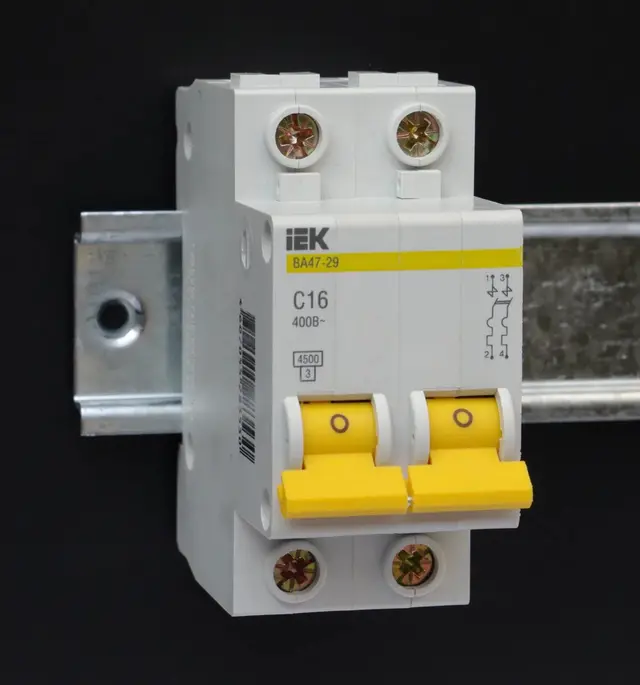
A circuit breaker does not detect this kind of fault. An MCB trips on overload and short circuit; an RCD trips on current leaking to earth. A loose terminal that is overheating may be carrying perfectly normal current, so neither device sees anything wrong. The smell may be the only warning.
The smell often disappears before you find it. Many faults only heat up under load: when the air conditioner runs, the water heater is on or the rice cooker is boiling. That is why the time and circumstances of the smell are as useful as its location.
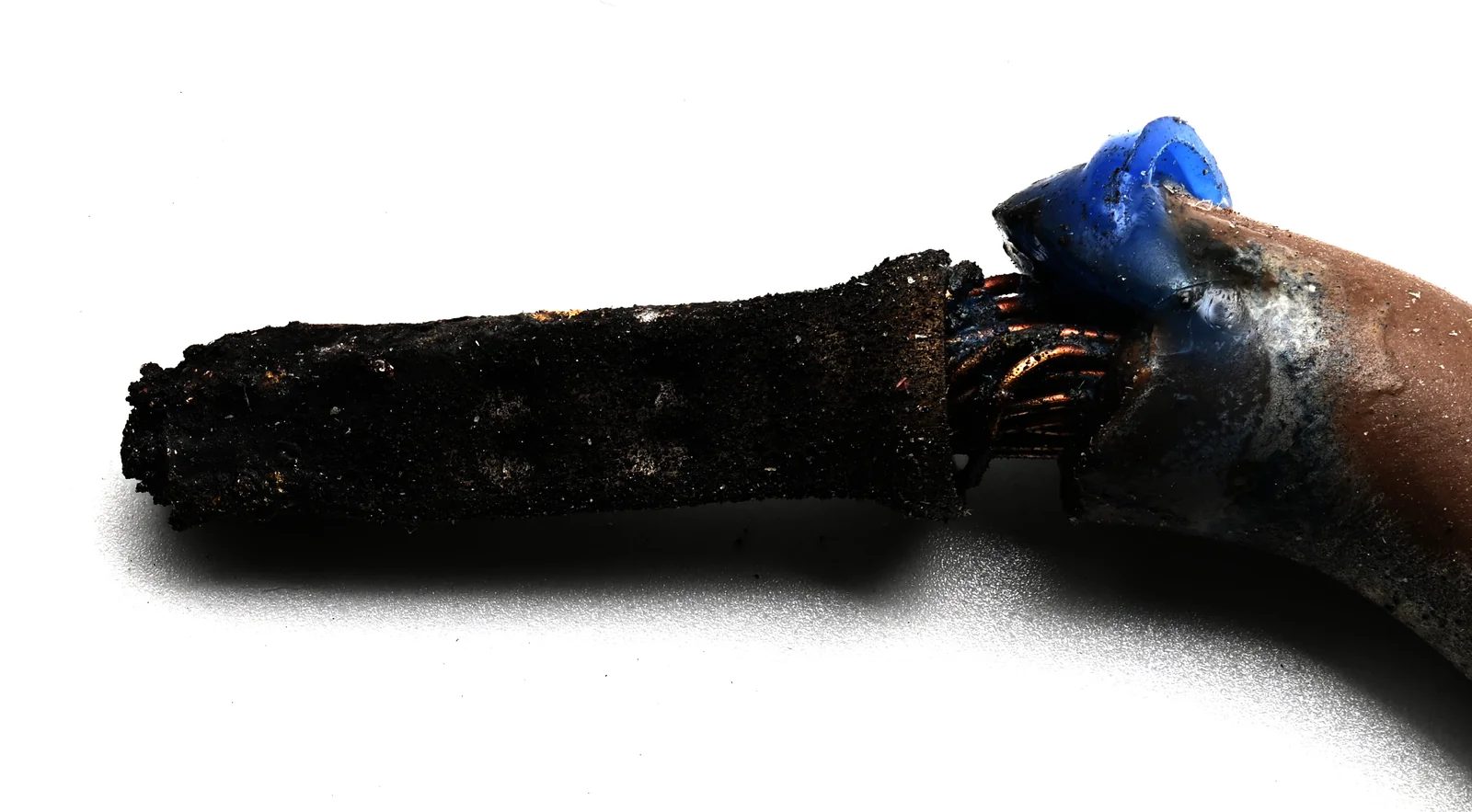
Figure 1. A stranded conductor removed from a screw terminal after it overheated: the crimped ferrule on the end is charred black, its blue plastic collar has partly melted, and the brown insulation behind it is discoloured by heat. A loose or poor connection can do this without tripping the breaker. (Photo: Phiarc, Wikimedia Commons, CC BY-SA 4.0)
Step 1: Decide in the first minute whether it is an emergency
Treat it as an emergency if you see or hear any of these
smoke or haze coming from a socket, switch, light fitting, appliance or the distribution board;
flames, glowing, sparks or repeated crackling or popping;
a socket, plug, switch plate or board cover that is too hot to keep your hand near;
a strong, rising smell together with lights dimming or flickering;
melted or bubbling plastic.
What to do
If it is safe to reach, switch off the main switch at the distribution board or the breaker beside the meter. Do not reach into smoke or past flames to do it, and do not touch a board that is smoking or visibly burning.
Get everyone out and close the door of the room behind you if you can.
Call the fire service on 114. Call 115 if anyone is injured.
Never use water on anything that may still be live. Only fight a very small fire if you have been trained, have a clear escape route and have an extinguisher rated for electrical equipment, such as CO2 or a suitable dry powder type; read the label.
Do not switch the power back on until a licensed electrician has found and repaired the cause.
If none of these signs is present, you have time for a systematic search. If you have any doubt, switch off and call an electrician; an hour without power costs much less than a fire.
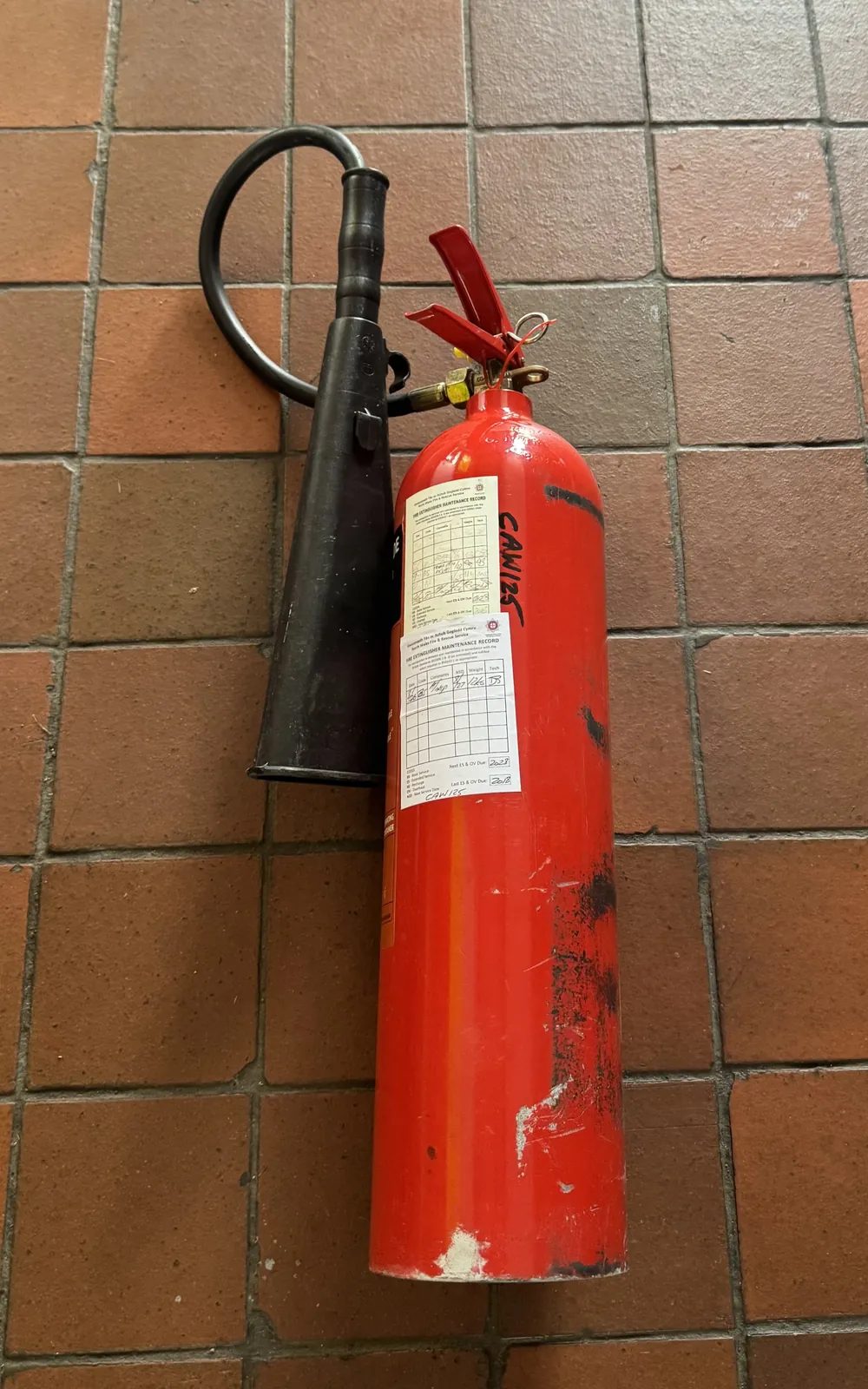
Figure 2. A red CO2 fire extinguisher with a black discharge horn and a maintenance tag, standing on a tiled floor. CO2 and suitable dry powder extinguishers can be used on electrical equipment; water cannot. Check your own extinguisher's label; leaving and calling 114 always comes first. (Photo: Eunosfire986, Wikimedia Commons, CC0)
Step 2: Rule out non-electrical causes
Many "electrical" smells are not electrical at all. Ask a few quick questions:
Is someone cooking, grilling or frying, in your home or next door? In tube houses and apartments, cooking smells travel through stairwells, shafts and gaps between buildings.
Is anyone burning rubbish, leaves, incense or mosquito coils nearby? These are common causes of a smoky smell in the evening.
Is it a heater, iron, hair dryer or air conditioner being used for the first time in weeks? Dust burning off a heating element can smell briefly; it should fade within minutes. If it continues, stop using the appliance.
Is it a new appliance? A light "new plastic" smell for the first few uses can be normal; stop if it is strong or gets worse.
If none of these explains it, continue.
Step 3: Narrow it down by place and time
Walk through the house, including the stairwell, closed rooms and the meter area, and find where the smell is strongest. Then ask the occupants:
When did it start? Today, or on and off for weeks?
What was running? Air conditioner, water heater, cooktop, washing machine, pump, iron, charger?
What time of day? In the evening, when many appliances run at once, a weak connection carries more current and heats up more.
What has changed? A new appliance or power strip, recent electrical work, a flood or roof leak, signs of rats in the ceiling.
Any other symptoms? Flickering lights, a loose socket, a warm plug, buzzing, breaker trips.
A smell that only appears when the air conditioner runs already points to the AC's socket, plug, isolator, cable or the AC itself.
Step 4: Check the most likely places, in order
Work from the most common sources to the least common. Keep any suspected appliance running only as long as needed to confirm, and switch it off as soon as you find heat or smell.
4.1 Plugs, adaptors, power strips and chargers
In homes, this is where electricians most often find the problem. Look for:
a plug of a high-power appliance (kettle, iron, rice cooker, heater) that is hot rather than slightly warm, has brown or black marks on the pins, or a deformed body;
multi-plug adaptors and power strips plugged into each other, or feeding several heating appliances at once;
plug-in chargers and adaptors with a strong smell of hot electronics;
a plug that wobbles or falls out of the socket: the socket contacts have lost their grip, and loose contacts heat up.
Unplug a suspect item and look at both the pins and the socket face. Discoloured pins usually mean the socket is damaged too; replacing only the plug will not fix it.
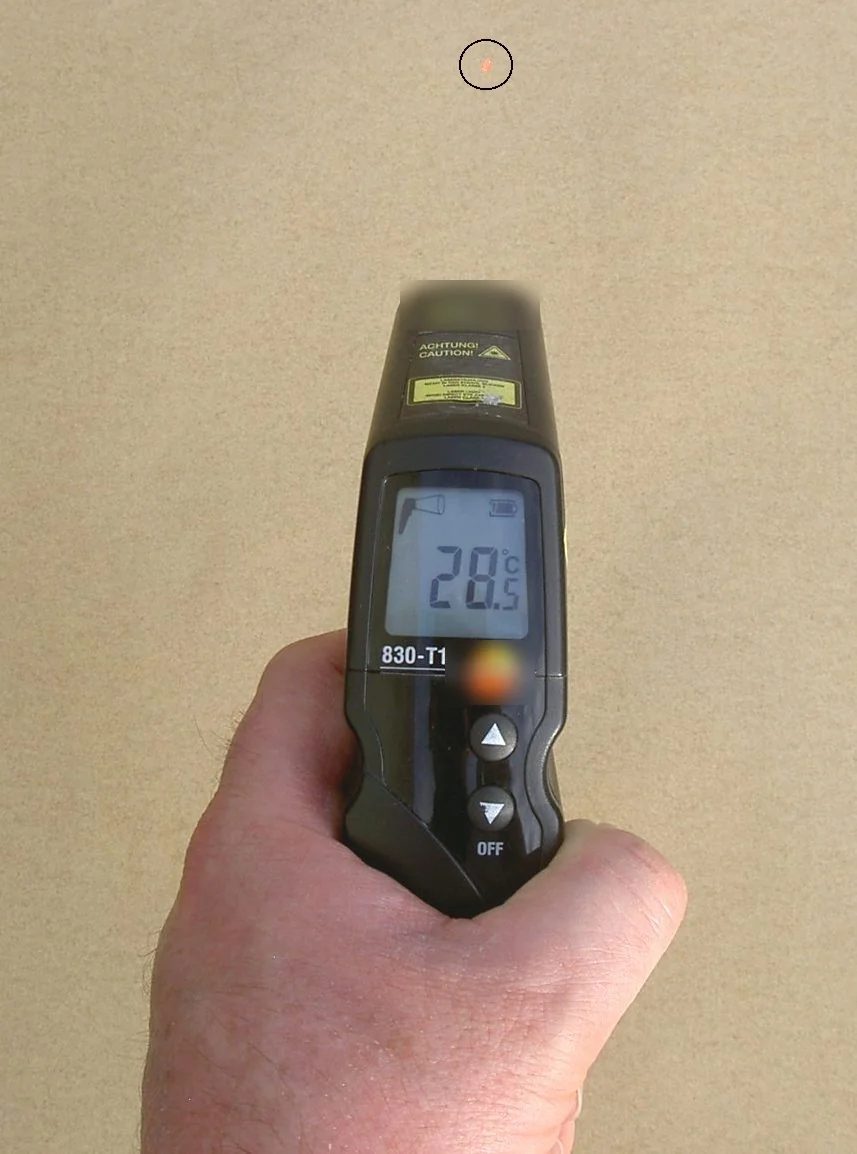
Figure 3. A multi-outlet adapter plugged into a wall socket, with several plugs and charging cables plugged into it, lit by low sunlight through a window blind. Fine for chargers, but feeding heating appliances through adaptors, or plugging adaptors into each other, often overheats contacts. A product label has been blurred. (Photo: Steve A Johnson, Pexels)
4.2 Socket outlets and switches
Without removing any cover, check each faceplate near the smell for brown or black marks around the holes, a plate noticeably warmer than identical ones elsewhere (use the back of your fingers on the plastic), crackling or buzzing, or a switch that feels loose or soft. Any of these signs means the accessory should not be used until it has been checked. The repair is covered in our guides on hot sockets and plugs and on faulty light switches.
4.3 Light fittings, LED drivers and old fluorescent fittings
LED drivers and panels in hot ceilings under metal roofs, ageing magnetic ballasts in old fluorescent fittings, scorched lamp holders and downlights buried under insulation or debris can all give off a "hot electronics" or burnt-plastic smell. Switch the lights in the area off and on one group at a time and notice whether the smell changes, and look for discoloured diffusers or ceiling around a fitting. Opening a fitting is a job for an electrician after the lighting circuit has been isolated and proved dead.
4.4 Fans, pumps and other motors
A fan that hums, runs slowly or gets hot (failing capacitor, worn bearings, damaged winding), an overheating wall speed regulator, an extractor or kitchen hood motor, a pump that runs dry or struggles to start, or an air conditioner that smells when it starts can all be the source. A sharp, hot "varnish" smell from a motor usually means its windings are overheating. Switch it off at the switch, isolator or breaker and keep it off until it has been checked.
4.5 Fixed appliances on their own circuits
Water heaters, cooktops, ovens and air conditioners draw large currents for long periods, so the connections feeding them are under the most stress. Without opening anything, check the isolator or RCBO, the plug or flex outlet behind the appliance, and the appliance casing. If the smell appears only when one of them is on, switch it off at its isolator or breaker and call an electrician, who will check the terminations and whether the cable and breaker suit the load.
4.6 The distribution board and the meter area
A smell near the board, especially in the evening, can mean an overheating breaker or a loose terminal. From the outside only, smell close to the cover, look for discoloured plastic or soot, listen for buzzing, and compare temperatures with an infrared thermometer (Step 5). Do not open the board yourself. If one breaker clearly smells or is hotter than the rest, switch it off if that is safe and call an electrician. If the problem is at the meter or the incoming cable before your main switch, that belongs to the power company: contact EVN and do not touch it.
4.7 Hidden wiring in walls and ceilings
If the smell is strongest near a wall or ceiling and you cannot link it to any accessory, fitting or appliance, suspect a junction box, a buried joint or a cable damaged by rats, nails or water. Switch off the breaker for the area if you know it, do not keep using the circuit "to see if it happens again", and call an electrician.
Step 5: Use tools to confirm the source
Infrared (non-contact) thermometer
An infrared thermometer measures surface temperature from a distance. Point it at closed faceplates, plug bodies, power strips, the board cover in front of each breaker and the casings of appliances, and compare similar items under similar load. Never aim the laser at anyone's eyes. A socket face clearly warmer than its neighbours, or one breaker clearly warmer than the identical breakers beside it, is a lead worth following.
Keep its limits in mind: it measures only the surface (the real hot spot may be behind the plate), shiny metal gives misleading readings, the measured spot grows with distance, and a normal reading means little if the circuit is lightly loaded at the time. Electricians generally compare like with like rather than relying on fixed "safe" temperatures; treat any figures you see as for reference only and follow manufacturers' information.
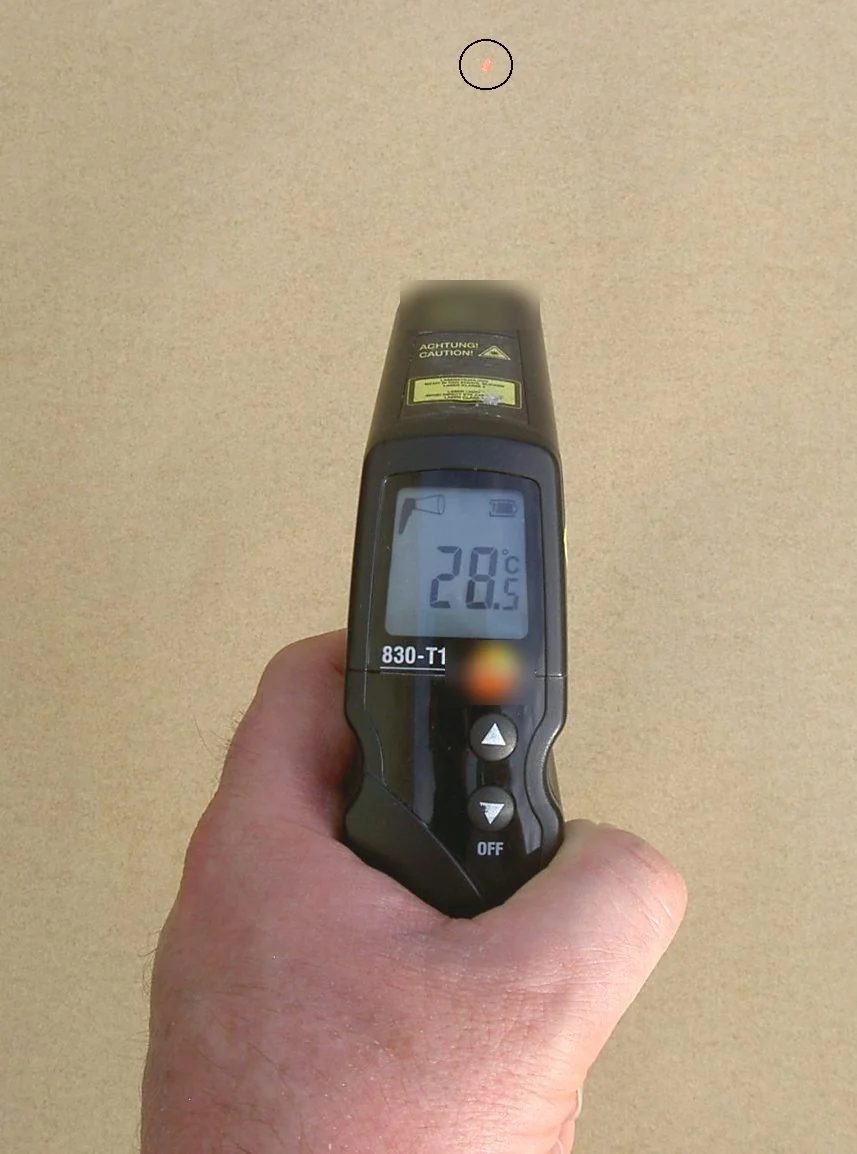
Figure 4. A hand-held infrared thermometer aimed at a wall, its display reading 28.5 °C; the small red laser dot marking the centre of the measured area is visible at the top of the photo. It lets you compare closed socket plates, plugs and breakers without touching them. Brand marks blurred. (Photo: Cjp24, Wikimedia Commons, CC BY-SA 3.0)
Clamp meter
Used by a qualified person, a clamp meter shows how much current a circuit or appliance draws. If a circuit that smells carries more than its cable and breaker are meant for, the cause may be overload rather than one bad connection. Clamp one conductor only and stay within the meter's ratings. For hidden wiring, an electrician may also use a thermal camera under load or, with the circuit isolated, an insulation resistance test.
Reference table: what the signs may mean
What you notice | Likely sources | What to do |
|---|---|---|
"Fishy" or hot-plastic smell near a socket, plug or switch | Overheating plastic around a loose or damaged contact | Unplug, stop using the socket, look for discolouration; electrician to replace accessory and check cable |
Smell only when a heater, AC, water heater or cooktop runs | Plug, socket, isolator, cable connection or the appliance itself | Switch off at isolator/breaker; electrician checks connections, cable and breaker sizing |
Strong "hot electronics" smell, sometimes with a click or pop | Failed charger, adaptor, LED driver or appliance power supply | Unplug or switch off; replace the device; do not reuse it |
Hot "varnish" smell from a fan, pump or motor | Overheating winding, failing capacitor or seized bearings | Switch off; motor checked or replaced |
Smell near the board, worse in the evening | Loose terminal on a breaker or main switch, overheating breaker | Do not open the board; switch off the affected breaker if safe; electrician |
Smell near a wall or ceiling with no visible source | Junction box, buried joint, rat-damaged cable | Switch off the circuit if known; electrician to investigate and test |
Brief dusty burning smell when an appliance is first used after a long time | Dust on heating element | Usually harmless if it fades quickly; stop if it continues |
Smell with smoke, sparks, flames or crackling | Active fault or fire | Main switch off if safe, get out, call 114 |
Step 6: Fix the cause properly
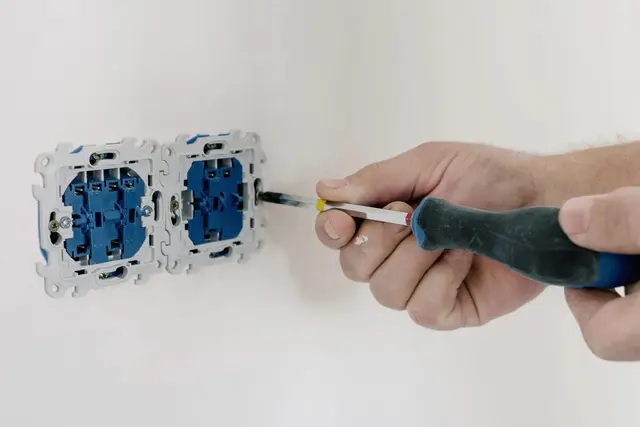
The repair must remove the cause, not just the smell. Before any work, the electrician isolates the circuit, locks or tags the breaker, proves the tester on a known live source, tests at the point of work, and proves the tester again.
Replace, do not clean. An overheated socket, switch, plug, lamp holder or terminal block has contacts that no longer grip properly; scraping off black marks will not restore them.
Check the cable behind the damage. Heat travels along the conductor. If the insulation is hard, brittle or discoloured, cut back to sound cable, or add a proper accessible joint or replace the section if length is short.
Make good connections. Use terminals rated for the conductor, insert the full stripped length with no stray strands, and tighten to the manufacturer's torque where stated. Twisted, taped joints buried in walls are a frequent hidden cause.
Remove the conditions. Move heating appliances off power strips, provide dedicated circuits for air conditioners, water heaters and cooktops where they share a socket circuit, replace poor-quality strips and chargers, ventilate hot light fittings, and deal with rats before re-running cables.
Test before handing back. Run the circuit under normal load for a while and recheck the repaired point and its neighbours; test any RCD with its test button.
Practical examples
Example 1: Fishy smell in a bedroom at night
A family notices a fishy smell in a bedroom most nights, worse after the air conditioner has run for an hour. The AC has a plug and is fed through a two-way adaptor that also powers a phone charger. The AC plug is very warm and the adaptor's plastic around one pin is brown.
Cause: the adaptor contacts, and possibly the socket behind, have overheated under the AC's continuous load.
Fix: stop using the adaptor and socket. After isolating and proving dead, the electrician finds the socket contacts discoloured and the insulation browned at the terminal, replaces the socket, cuts the cable back to sound copper, and recommends a dedicated AC circuit with its own breaker.
Example 2: Smell near the board at dinner time
In a three-storey house, the owner smells something near the board most evenings. Through the closed cover, one breaker reads clearly warmer than the identical breakers beside it while the cooktop is on.
Cause: a loose terminal on the cooktop breaker, or a failing breaker.
Fix: the electrician isolates the board, finds the conductor discoloured at the terminal, cuts back, re-terminates and replaces the breaker. See our guide on hot or buzzing circuit breakers for the detailed checks.
Working with the customer
Ask before you search. The occupants' answers about when and where they notice the smell often save more time than any tool.
Explain calmly that breakers do not detect overheating connections, so the smell is a warning worth taking seriously.
Show what you found, for example a photo of a burnt terminal or an infrared reading, so they understand why parts must be replaced.
Leave written advice: no heating appliances on power strips, which breaker to switch off if the smell returns, call 114 if there is smoke.
Be honest if you cannot find it on the day; say what to keep switched off and arrange a follow-up while the suspect load is running.
Safety checklist
Checked first for smoke, flames, sparking, crackling and very hot covers
Emergency plan clear: main switch off if safe, everyone out, call 114 (115 for injuries); no water on anything live
Ruled out cooking, outside burning and first-use dust smells
Recorded when the smell occurs and what was running
Checked plugs, adaptors, power strips and chargers first
Only closed covers touched or measured; no covers removed while live
Suspect appliance or circuit switched off and kept off until checked
Board opened only by a qualified electrician; meter and incoming supply left to EVN
Before repair: isolated, locked/tagged, tester proved, dead tested at the point of work, tester re-proved
Overheated parts replaced, cable cut back to sound insulation, circuit rechecked under load, RCD tested
Frequently Asked Questions
Is a burning smell from an outlet an emergency?
If there is smoke, sparking, crackling, melted plastic or the plate is too hot to touch, yes: switch off at the main switch if it is safe, leave and call 114. If there are no such signs, unplug everything from that socket, stop using it and have an electrician check it as soon as possible. Do not keep using it to see whether the smell returns.
Why does an electrical fault smell like fish?
Some plastics and resins used in electrical accessories give off a smell many people describe as fishy when they overheat. If a room smells fishy with no food nearby, check sockets, plugs and switches first.
Why didn't the breaker trip?
A breaker trips on overload or short circuit, and an RCD on current leaking to earth. A loose or corroded connection can overheat while carrying normal current, so neither device sees a fault. Some countries use arc fault detection devices (AFDDs) that can detect certain arcing faults, but they are not a substitute for good connections and regular checks.
The smell came and went and I can't find anything. What now?
Note when it happens and what was running, and check again under the same conditions. If it returns and you still cannot find the source, switch off the suspect circuits and call an electrician, who can check connections under load, measure currents and, if needed, test hidden wiring.
Is it safe to leave the power on overnight while I wait for the electrician?
If you have found the source, unplug it or switch off its breaker and leave the rest of the house on. If you have not found it and the smell persists, switch off the circuits in that area, or the main switch, until it has been checked. A working smoke alarm adds protection.
Practice Exercises
Emergency decision. List the signs that turn a burning smell into an emergency, and write the actions you would take, in order.
Interview. Write six questions you would ask an occupant who reports a burning smell, and explain what each answer could tell you.
Search order. For a two-bedroom apartment with an air conditioner in each bedroom, a water heater and an induction cooktop, write your search order for a smell reported "in the evening, near the kitchen".
Infrared survey. Using an infrared thermometer, measure and record the faceplate temperatures of five sockets in your training room or home: first with no load, then with a kettle or heater running on one of them. Explain what you would conclude, and the limits of the measurement.
Repair plan. A socket behind a refrigerator has a browned faceplate and the cable insulation at the terminal is hard and discoloured. Write the steps for a safe repair, from isolation to final checks.