How many kilometres between motorbike oil changes? For bikes ridden in Vietnamese city traffic, the practical interval is about 1,500–2,000 km for ordinary manual-gear bikes and scooters, or every 2–3 months if the bike is ridden little — whichever comes first. On a scooter, the final-drive (gear) oil is changed about once every three engine-oil changes. This lesson explains where those intervals come from, how to read the owner's service book, and how to build a km-based maintenance schedule that a mechanic can pin up at the reception desk straight away.
By the end of this lesson, you will be able to:
- Answer a customer's "how many km between oil changes?" for manual-gear bikes, scooters and manual-clutch sport bikes, with reasons based on riding conditions.
- Choose the right oil by API grade, JASO MA/MB and the viscosity in the service book, and fill the correct quantity.
- Change engine oil and scooter gear oil in 8 steps, tighten the drain bolt to the correct torque and recheck the oil level.
- Draw up a 12-month km-based maintenance schedule for a specific bike, working out the number of changes and the total cost.
Thinking of becoming a motorbike mechanic? Routine servicing is the first job you are given as an apprentice at a workshop or dealer. See the 8-step motorbike mechanic roadmap — from workshop safety, servicing, brakes and tyres and the electrical system to electronic fuel injection and opening your own shop.
Quick answer: how many km between motorbike oil changes?
There is no single number that is right for every bike. The interval depends on three things: what the manufacturer recommends in the service book, the conditions the bike is ridden in, and the type of oil. A good mechanic doesn't recite a number by heart but asks the customer two questions: "How many kilometres do you ride a day, and on what roads?" and "At what km was the last change?"
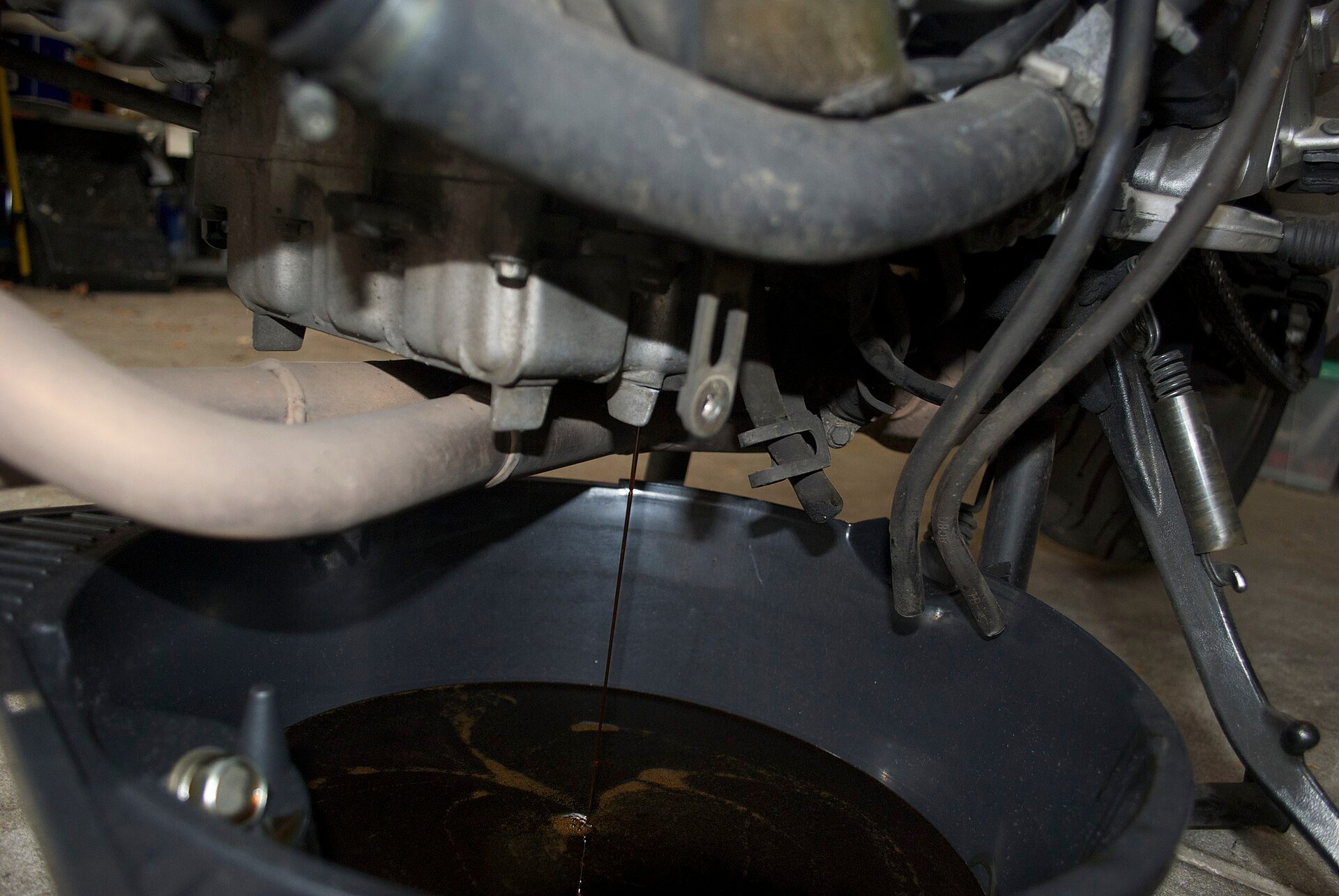
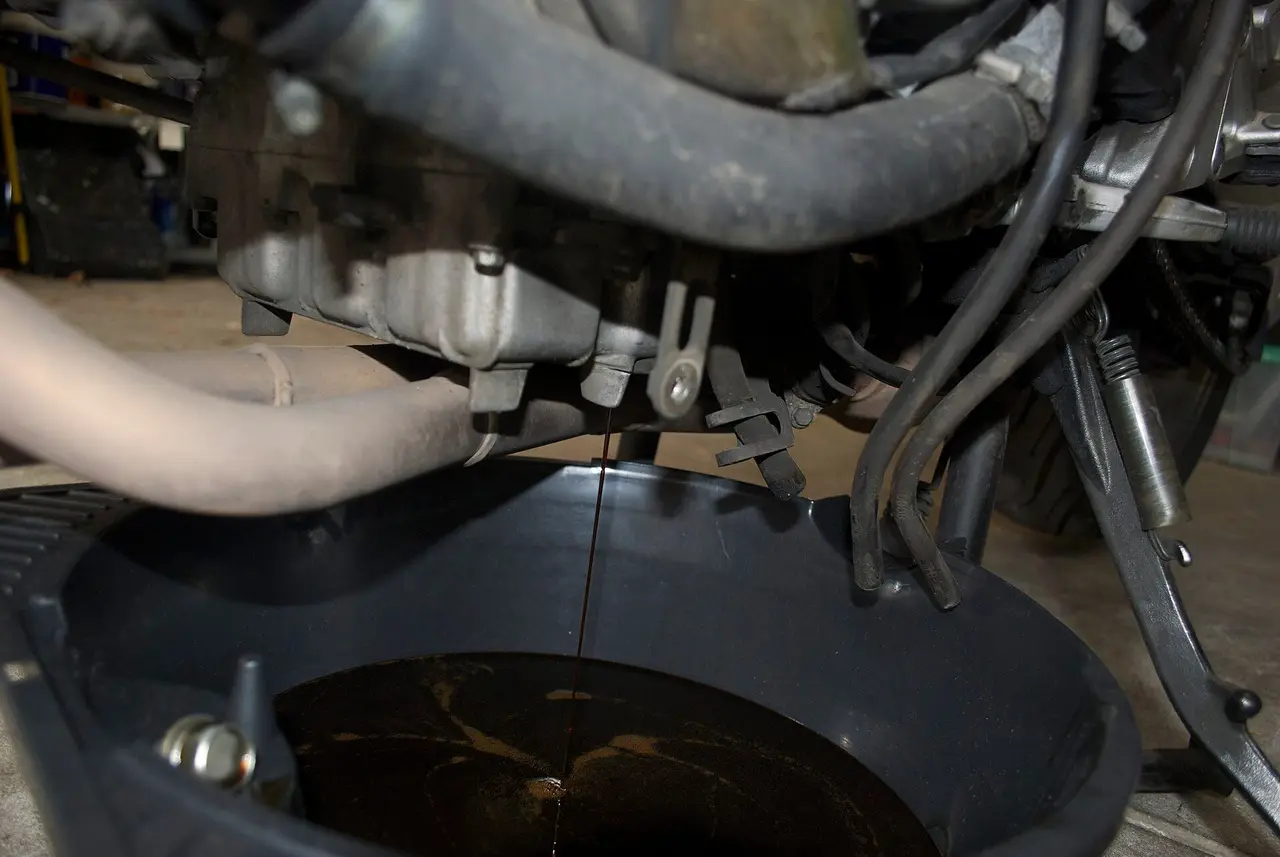
Photo: Andrew Napier / Wikimedia Commons, CC BY 2.0
The service-book interval and the real-world interval in Vietnam
Many manufacturers' service books put the first change at around 1,000 km (the running-in period for a new bike), with longer intervals afterwards — some say up to 3,000–4,000 km under "normal operating conditions". But riding in heavy city traffic in Hanoi or Ho Chi Minh City is a severe condition: constant stop-and-go, the engine hot for long periods, sun at 35–38 °C and lots of dust. That is why most mechanics and dealers advise customers to change earlier, around 1,500–2,000 km. Always start from the interval in the book for that exact model year, then shorten it if the bike is worked hard.
The time interval: bikes that are ridden little still need changes
Oil oxidises and absorbs moisture over time, even when the bike is standing still. A bike that only goes to the market, covering 200–300 km a month, reaches 1,500 km only after half a year, but the oil is already old. An easy rule to remember: km or months, whichever comes first — usually 1,500–2,000 km or 2–3 months, and at most about 6 months for a bike that is hardly used.
Summary table of reference oil-change intervals
| Bike type | Example models | Engine oil quantity at change | Engine oil interval (city riding) | Gear oil |
|---|---|---|---|---|
| Manual-gear (underbone) 100–125 cc | Wave, Sirius, Future | about 0.8–1.0 litre | 1,500–2,000 km or 2–3 months | None separate (shares engine oil) |
| Scooter 110–125 cc | Vision, Lead, Air Blade, Janus | about 0.7–0.9 litre | 1,500–2,000 km or 2–3 months | about 0.1–0.12 litre, every 3 engine-oil changes |
| Manual-clutch 150–155 cc | Exciter, Winner | about 1.0–1.2 litres (depending on filter change) | 1,500–2,000 km; sooner if ridden at high speed | Shares engine oil; change the oil filter every 2 oil changes |
The quantities in the table are reference ranges; the exact figure is printed in the owner's manual or on the filler cap or engine casing of each model. Overfilling and underfilling are both harmful, so always check with the dipstick after filling.
Why does motorbike oil break down so fast?
Engine oil does four jobs: it lubricates, cools, seals and carries away dirt. Each of these wears the oil out — understanding this helps you explain to customers why they need to change it early.
Heat and friction shear the oil
Air-cooled motorbike engines run hot, and the piston and rings rub thousands of times a minute. The oil molecules are gradually "sheared", the oil thins and the oil film gets thinner. When the film is no longer thick enough, metal touches metal: the engine gets noisy, heats up quickly and uses more fuel.
Manual-gear and manual-clutch bikes: the oil also has to look after the gearbox and clutch
On a manual-gear bike such as the Wave (see Figure 2), one single batch of oil lubricates the engine, lubricates the gearbox and bathes the wet clutch (the friction plates that engage and disengage the drive). The gearbox gears grind the oil very hard, so oil in a manual-gear bike breaks down faster than in a scooter of the same capacity. Symptoms customers often describe: stiff gear changes, a "clunk" when shifting, and the clutch slipping on hills.
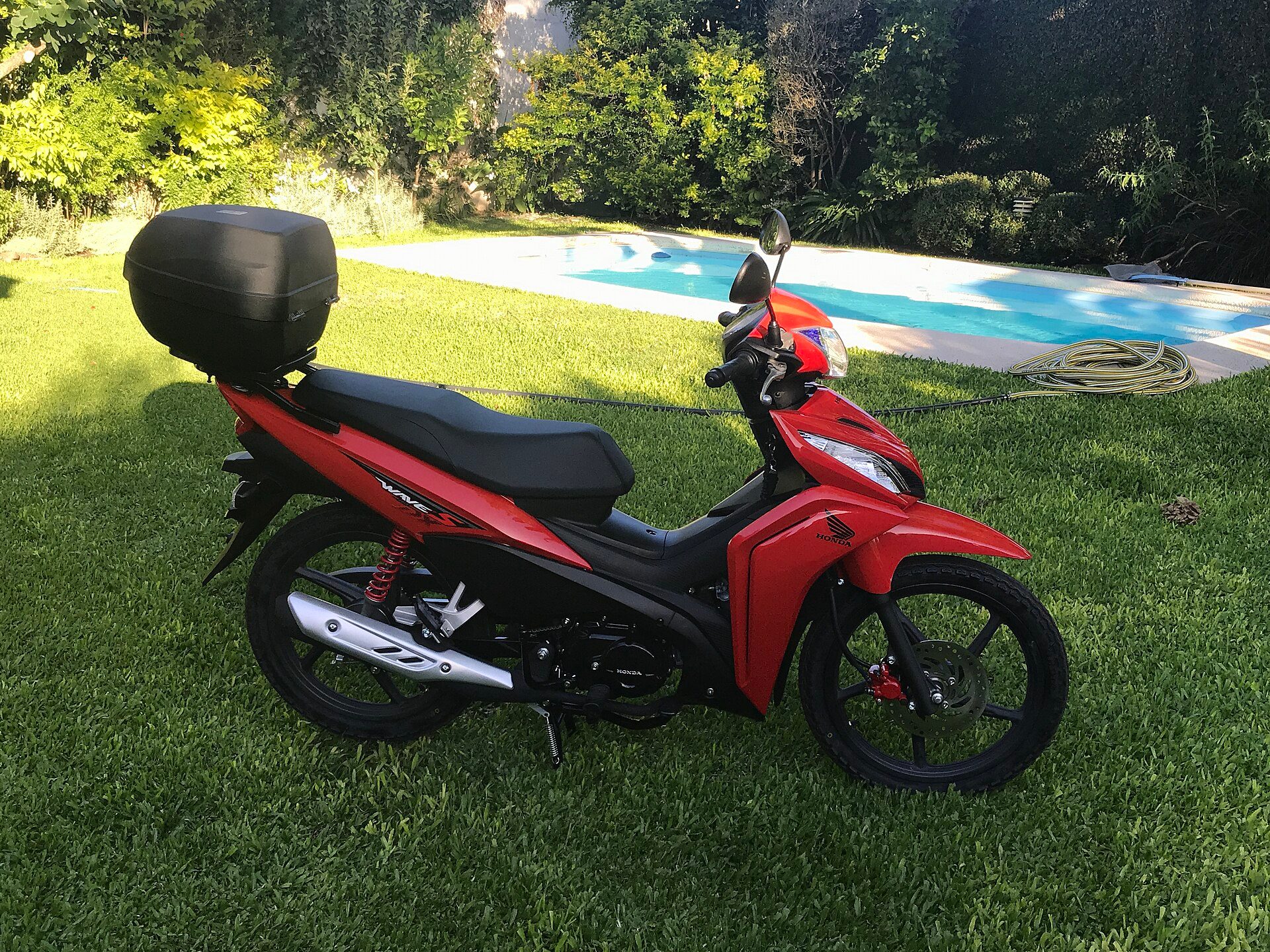
Photo: Zaldi.txiki.75 / Wikimedia Commons, CC BY-SA 4.0
Scooters: engine oil and gear oil are separate
Scooters such as the Vision (see Figure 3) drive through a belt and a dry centrifugal clutch, so the engine oil doesn't have to bathe a clutch. At the back there is a small reduction gearbox in the rear wheel hub, which uses its own oil called gear oil (often called "final-drive oil" by mechanics), only about 100–120 ml. It is a small amount but is often forgotten: some bikes run 20,000–30,000 km without a single change, the gears wear and they whine when cruising at steady throttle.
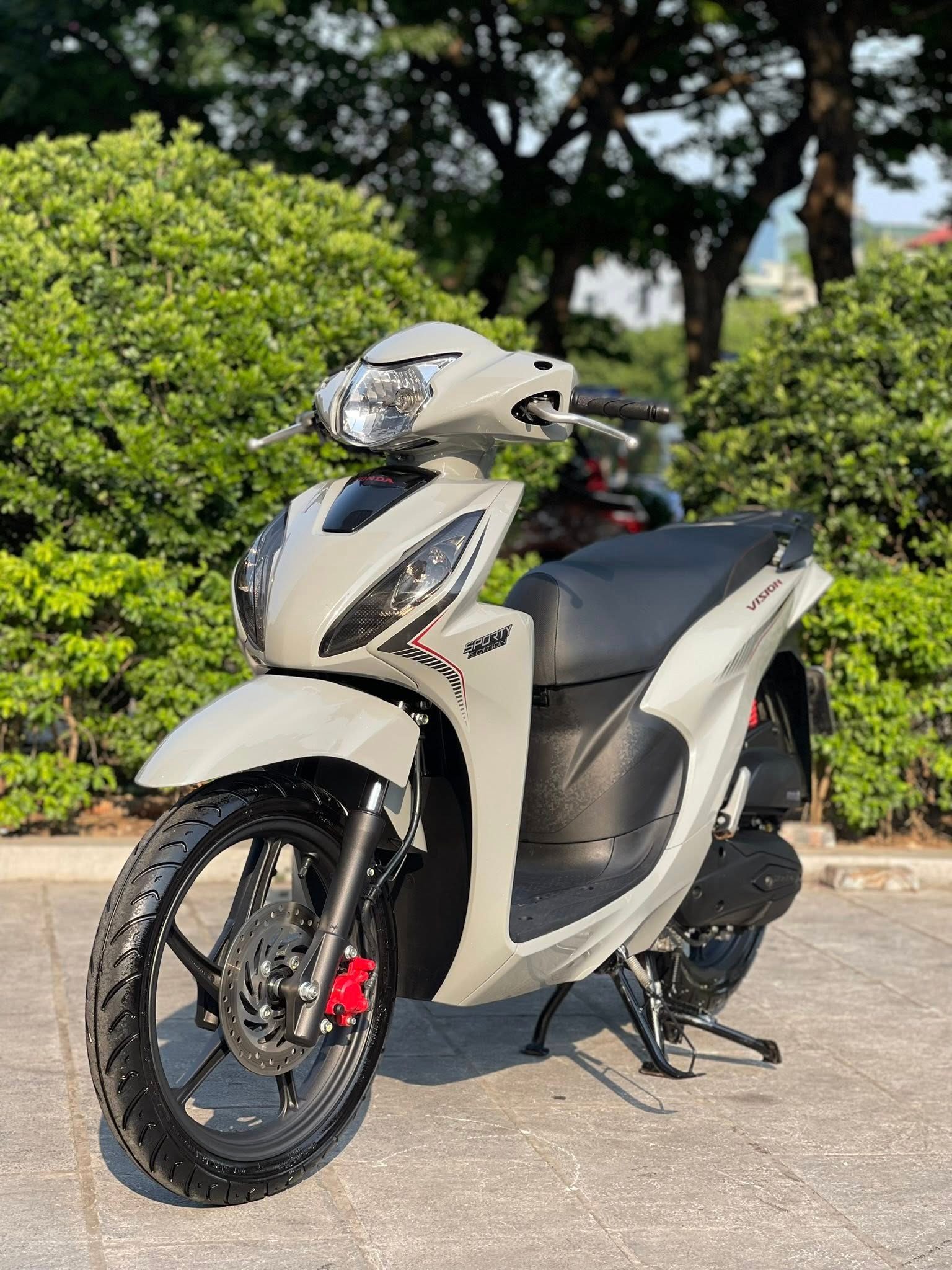
Photo: Blemo25 / Wikimedia Commons, CC BY-SA 4.0
Dust, fuel and water vapour getting into the oil
A little unburnt fuel vapour and water vapour always gets past the piston rings into the crankcase (the bottom of the engine that holds the oil). On short trips, the engine never gets fully hot, the water doesn't all evaporate and the oil emulsifies, leaving a milky white film under the filler cap. This is why a bike that does "3 km to the market each day" needs its oil changed by the month, not only by km.
Choosing the right oil: reading API, JASO and viscosity
Changing at the right interval with the wrong oil still harms the engine. There are three pieces of information on the oil bottle that you must be able to read before pouring it into a customer's bike.
Viscosity: what do 10W-30 and 10W-40 mean?
The number before the W (winter) tells you how well the oil flows when the engine is cold; the number after it tells you how thick it is when the engine is hot. Vietnam's climate has no harsh winter, so the number to watch is the second one: 30 or 40 is common for motorbikes. Follow the owner's manual: many newer scooters recommend 10W-30, and many manual-gear and manual-clutch bikes use 10W-40. Oil that is too thick doesn't make the engine "stronger"; it makes starting harder and uses more fuel.
API quality grade and the JASO standard
API (the American Petroleum Institute standard) gives the quality grade, for example SL, SN, SP — the later the letter, the newer the grade. JASO (the Japanese standard for motorcycles) matters more to a mechanic:
- JASO MA/MA2: for bikes with a wet clutch — manual-gear and manual-clutch bikes. The oil has no strong friction modifiers, so the clutch does not slip.
- JASO MB: for scooters (dry clutch, outside the oil). It contains friction modifiers, so the engine runs smoother and uses slightly less fuel.
A common workshop mistake: putting scooter oil (MB) into a manual-gear bike. A few hundred km later, the customer comes back complaining that the clutch slips — the engine revs but the bike doesn't go. MA oil in a scooter does no damage, it just isn't optimal.
Mineral, semi-synthetic or fully synthetic?
Synthetic oil copes better with heat and holds its viscosity longer, but costs more. For an everyday bike ridden in town, a mineral or semi-synthetic oil of the right standard, changed on time, is enough; using synthetic oil is not a reason to stretch beyond the interval in the book.
How to change engine oil and scooter gear oil
An oil change is the first job an apprentice is given, and also the job most likely to cause serious damage if done carelessly: forgetting to tighten the drain bolt, underfilling, or stripping the thread in the engine casing. Follow the 8 steps below exactly.
Tools and supplies to prepare
- A drain pan (see Figure 1), funnel, clean rags and a lidded container for used oil.
- A socket or spanner of the right size for the drain bolt (usually 12, 14 or 17 mm depending on the bike) and a torque wrench.
- Engine oil of the right type and quantity; for scooters, gear oil as well plus a small pump or a bottle with a nozzle.
- A new drain-bolt washer — an aluminium or copper washer that has been crushed for a long time no longer seals.
- Oil-resistant gloves and safety glasses.
8 steps to change oil correctly
- Warm the engine for 2–3 minutes, then switch off. Warm oil drains completely and carries the sludge with it; don't let the engine get too hot, or you risk burns.
- Put the bike on its centre stand on level ground, upright so that the oil drains fully and the level reads accurately.
- Remove the filler cap (dipstick) first to let air in so that the oil drains faster.
- Remove the drain bolt, catch the oil in the pan and wait 5–10 minutes until it is only dripping. Look at the oil: are there shiny metal particles, is it milky white? Note it on the job card.
- Wipe the drain bolt clean and fit a new washer. On bikes with a strainer screen or an oil filter (see Figure 4), clean the screen or change the filter at its interval.
- Tighten the drain bolt with a torque wrench to the value in the service manual for that exact model (for many small bikes it is around 20–30 N·m). Overtightening is the main cause of stripped threads in aluminium engine cases.
- Pour in the new oil to the correct quantity, run the engine for 1–2 minutes, switch off, wait 1–2 minutes and check with the dipstick: the level should be between the upper and lower marks. On many bikes the dipstick is read resting on the mouth of the hole, not screwed in — check the owner's manual for that bike.
- Check for leaks around the drain bolt, write the km on the job card and stick a reminder label on the bike: "next change at ... km".
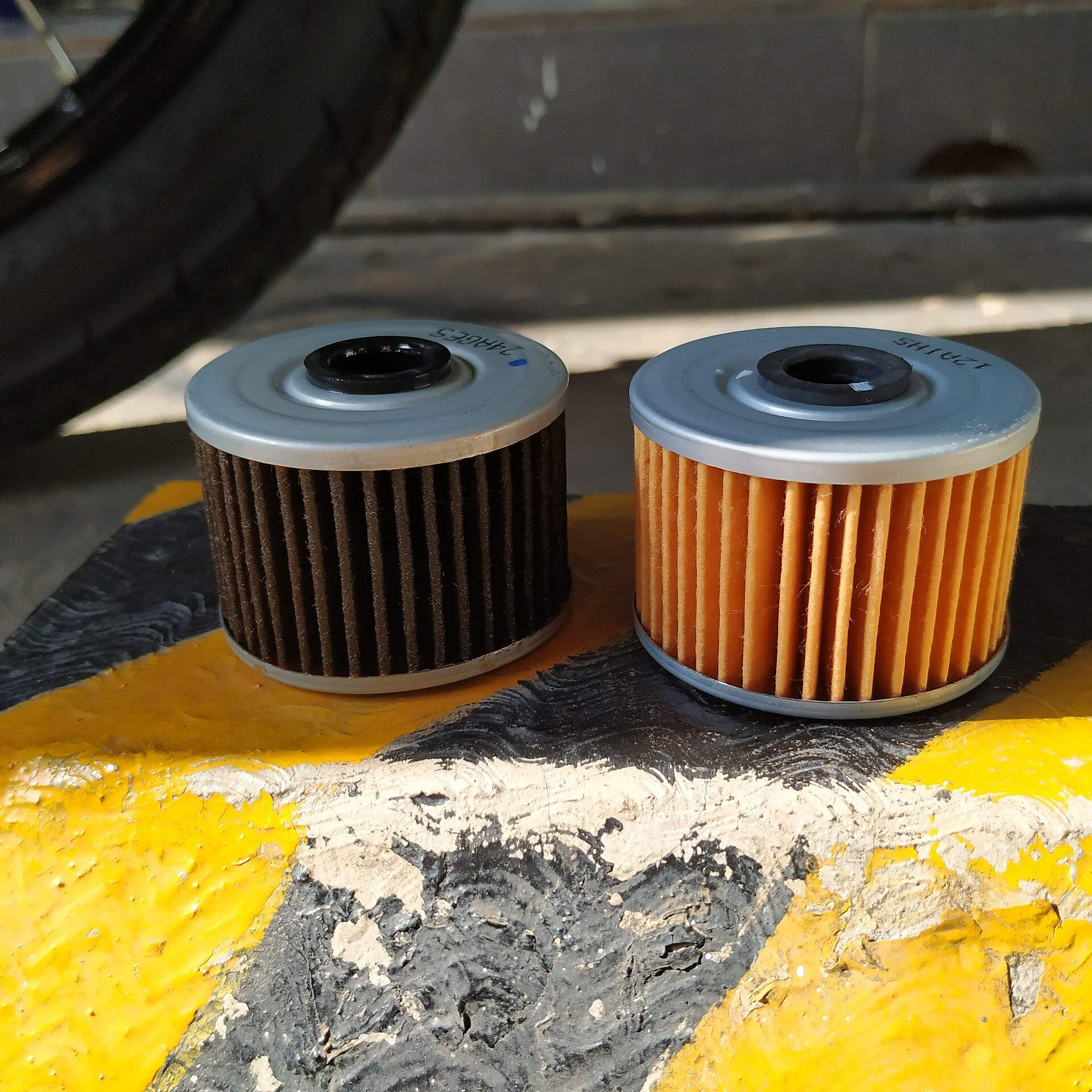
Photo: Ilhamajipratomo / Wikimedia Commons, CC BY-SA 4.0
Changing scooter gear oil
The gear-oil filler bolt and drain bolt are on the rear-wheel assembly, on the left side of the bike. Remove the filler bolt first, then the drain bolt and let it drain completely, fit a new washer, tighten the drain bolt, then pump in the correct amount of gear oil according to the book (usually about 100–120 ml) and tighten the filler bolt. Don't use engine oil instead of gear oil when the book specifies a separate type; dedicated gear oil handles the pressure between gear teeth better.
Safety warning: after riding, the oil and exhaust can be above 80–100 °C and will burn on contact — wear gloves and stand clear of the oil stream when removing the bolt. No smoking and no naked flames near the oil-change area or the fuel tank. Used oil is hazardous waste: put it in a lidded container and hand it to a licensed collector; never pour it down a drain or onto the ground. Wash your hands with soap after the job; prolonged skin contact with used oil causes irritation.
Routine maintenance schedule by km for manual-gear bikes and scooters
The oil change is only one line in the maintenance schedule. When a customer brings a bike in for an oil change, a good mechanic looks at the odometer and reminds them of any other items that are due. The table below is a reference schedule for everyday bikes ridden in town; the exact intervals always follow the service book for each model.
| Item | Manual-gear (Wave, Sirius, Future) | Scooter (Vision, Lead, Air Blade) | Notes |
|---|---|---|---|
| Engine oil | 1,500–2,000 km or 2–3 months | 1,500–2,000 km or 2–3 months | First change on a new bike: about 1,000 km |
| Gear oil | — | Every 3 engine-oil changes (about 5,000–6,000 km) | Check for leaks at the rear-wheel assembly |
| Oil strainer / filter | Clean the strainer at oil changes as per the book | Clean the strainer as per the book | Manual-clutch: change the paper filter every 2 oil changes |
| Air filter | Clean every 4,000 km, replace at about 12,000–16,000 km | Replace at about 12,000–16,000 km; sooner on dusty roads | Do not blow oil-impregnated paper filters with compressed air to "clean" them |
| Spark plug | Check every 4,000 km, replace at about 8,000–12,000 km | Check every 4,000 km, replace at about 8,000–12,000 km | Iridium plugs have longer intervals, per the book |
| Chain and sprockets | Adjust and lubricate every 500–1,000 km | — | Slack is usually about 2–3 cm, per the book |
| Drive belt, variator rollers | — | Check every 8,000–12,000 km, replace when worn (usually 20,000–25,000 km) | Wear faster with heavy loads and hilly roads |
| Brake fluid, brake pads | Check at every service | Check at every service; change brake fluid about every 2 years | Details in the Brakes, tyres and chain step |
| Injector, throttle body | Clean when running roughly, about 10,000–15,000 km | Clean when running roughly, about 10,000–15,000 km | Fuel-injected bikes only |
How to read the table when a customer comes in
Subtract the km at the last service of each item from the current km. For example, a Lead at 12,300 km whose last air-filter change was at 0 km (never changed): it is past the 12,000 km interval, so tell the customer it needs replacing. Record every job on the shop's job card or logbook; when the customer returns, just look up the number plate to see which items are due.
When to shorten the intervals
- Ride-hailing or delivery riders: 100–200 km a day, engine hot all the time.
- Regularly carrying a passenger or heavy loads, or riding mountain passes.
- Dusty roads and building sites; bikes that have been through flooded streets.
- Older bikes whose engines "burn oil" (lose oil between changes): check the dipstick every week.
Worked example: a 12-month schedule for a delivery Vision
Tam is a delivery rider in Ho Chi Minh City on a 2021 Vision with 18,000 km on the clock. He rides about 60 km a day, 25 days a month. He asks: "How many oil changes do I need a year, and how much will it cost?" (all prices are 2026 reference figures in VND, Vietnamese dong, and vary by area; 100,000 VND is roughly 4 US dollars).
Step 1: work out the km per month and per year
- Km per month: 60 km × 25 days = 1,500 km.
- Km per year: 1,500 × 12 = 18,000 km; by the end of the year the bike will be at about 36,000 km.
- Delivery riding is a severe condition, so choose an engine-oil interval of 1,500 km — exactly once a month.
Step 2: count the changes for each item
- Engine oil: 18,000 ÷ 1,500 = 12 changes.
- Gear oil: every 3 engine-oil changes → 12 ÷ 3 = 4 changes.
- Air filter: interval about 12,000 km; the old job cards show it has never been changed even though the bike is at 18,000 km → replace it in the first month, and the next one falls at about 30,000 km (month 8) → 2 changes.
- Spark plug: interval about 10,000 km → replace in the first month and around month 7 → 2 changes.
- Drive belt: check at every gear-oil change; assume one replacement during the year when it reaches about 25,000 km.
Step 3: work out the cost
| Item | Times | Reference unit price (incl. labour) | Amount |
|---|---|---|---|
| Engine oil 0.8 litre, semi-synthetic | 12 | 150,000 VND | 1,800,000 VND |
| Gear oil | 4 | 60,000 VND | 240,000 VND |
| Air filter | 2 | 150,000 VND | 300,000 VND |
| Spark plug | 2 | 100,000 VND | 200,000 VND |
| Drive belt | 1 | 400,000 VND | 400,000 VND |
| Total | 2,940,000 VND |
Check the addition: 1,800,000 + 240,000 + 300,000 + 200,000 + 400,000 = 2,940,000 VND (about 115 US dollars), or an average of 245,000 VND a month. A concrete figure like this is far more convincing to a customer than "you should change your oil regularly".
Common oil-change mistakes and how to avoid them
Putting the wrong oil in a manual-gear bike
Sign: after the oil change, the manual-gear bike's clutch slips — it revs but doesn't pull, especially uphill. Cause: JASO MB (scooter) oil poured into a bike with a wet clutch. Fix: drain it and refill with JASO MA/MA2 oil of the right viscosity; if the clutch still slips after a few dozen km, inspect the clutch plates.
Overtightening the drain bolt and stripping the thread
Sign: the drain bolt keeps turning without tightening, and oil seeps around it. Cause: tightening by feel with a long bar instead of a torque wrench; reusing the old washer and cranking it down to seal. Fix: always fit a new washer and tighten to the specified torque. If the thread is already damaged, tell the customer and have the thread repaired — don't try to get by with PTFE tape or sealant.
Overfilling or underfilling
Sign: too little oil and the engine runs hot and ticks; too much and it may smoke, the oil foams and oil seals get pushed out and leak. Cause: pouring "the whole 1-litre bottle" into every bike, or reading the dipstick with the bike leaning. Fix: fill to the quantity in the book and recheck with the bike upright on its centre stand.
Forgetting scooter gear oil
Sign: a whine from the rear wheel that rises with speed. Cause: both customer and mechanic only remember the engine oil. Fix: record the gear-oil interval on the job card, and remind the customer at every third engine-oil change.
Frequently asked questions
When should a new bike have its first oil change?
Usually at about 1,000 km or at the running-in interval in the service book. The first oil carries a lot of metal particles produced as new parts bed in, so don't stretch it.
How often should I change the oil on a bike I rarely ride?
By time: about every 2–3 months, and at most about 6 months even if the km haven't been reached. Oil still oxidises and absorbs moisture while the bike stands still.
How much does a motorbike oil change cost?
2026 reference: for everyday manual-gear bikes and scooters about 100,000–180,000 VND with mineral or semi-synthetic oil, 180,000–350,000 VND with synthetic oil; gear oil about 40,000–80,000 VND; prices depend on the oil brand and the area.
Do I need to change the oil filter at every oil change?
Everyday manual-gear bikes and scooters usually have only a strainer screen, cleaned as per the book. Manual-clutch bikes have a paper oil filter, commonly changed every 2 oil changes, or at every change if ridden hard.
Practical exercise and self-assessment
- Choose 2 bikes at home or at the workshop (1 manual-gear, 1 scooter) and look up in the owner's manual: oil type, viscosity, JASO grade, quantity and drain-bolt torque.
- Under the supervision of a senior mechanic, change the engine oil on both bikes using the 8 steps; on the scooter, change the gear oil as well.
- Fill in the job card: current km, condition of the old oil, km for the next change, and items coming due according to the maintenance table.
- Draw up a 12-month schedule for an imaginary customer (choose the km per day yourself) and work out the total cost as in Tam's example.
Self-assessment criteria
- Pass: JASO MA chosen for the manual-gear bike, MB or as per the book for the scooter; oil level between the two marks; drain bolt with a new washer, tightened with a torque wrench; no leaks after 5 minutes of running.
- Pass: the 12-month schedule has numbers of changes that match the divisions, and a total that matches the addition.
- Not yet: filling "the whole bottle", tightening the drain bolt by feel, pouring used oil down the drain, or not writing the next-change km for the customer.
Once you are confident with routine servicing, move on to the next step of the roadmap: Brakes, tyres, chain and sprockets, and suspension — the group of jobs most directly tied to the customer's safety. In parallel, the lesson motorbike won't start on the electric starter: checking the battery, relay and starter motor helps you deal with the most common fault in the electrical-system step. See the 8-step motorbike mechanic roadmap to know where you are and what to learn next.