A drain snake (also called a plumbing auger or drain cable) is one of the first tools an apprentice plumber buys, and one of the most misused. Used well, it clears a hair clog from a shower or basin in minutes without chemicals or breaking tiles. Used badly, it kinks, scratches a toilet bowl, cracks a plastic trap or gets jammed deep in a pipe.
This guide explains which drain snake to use for which job, how to feed and crank the cable correctly, how to clear or pull out a blockage, and when to stop and call for a machine or camera inspection. It focuses on the tool and the technique. For fixture-specific step-by-step guides, see our articles on unblocking a toilet, clearing a kitchen sink blocked by grease, fixing a blocked floor drain, and finding why drains gurgle.
Scope of this guide. It is written for trainee plumbers and for homeowners in Vietnamese homes, where drain pipes are usually uPVC and most bathrooms have a floor drain. Powered machines are covered as an overview only: they can cause serious hand and arm injuries and need hands-on training on that machine.
What a drain snake does (and what it cannot do)
A drain snake is a flexible steel cable, usually a tightly wound spring, with a working tip. You push it into the pipe and rotate it; rotation helps it round bends and makes the tip bore into, break up or hook the blockage.
It works best on soft, local blockages: hair and soap in a shower or basin waste, a wad of paper in a toilet trap, sludge just past a floor drain. It does not remove grease coating the whole inside of a kitchen pipe, cannot fix a sagging or broken pipe, and a small hand snake cannot cut roots in a main sewer line.
Types of drain snake
Small hand cable and drum auger (basins, showers, small drains)
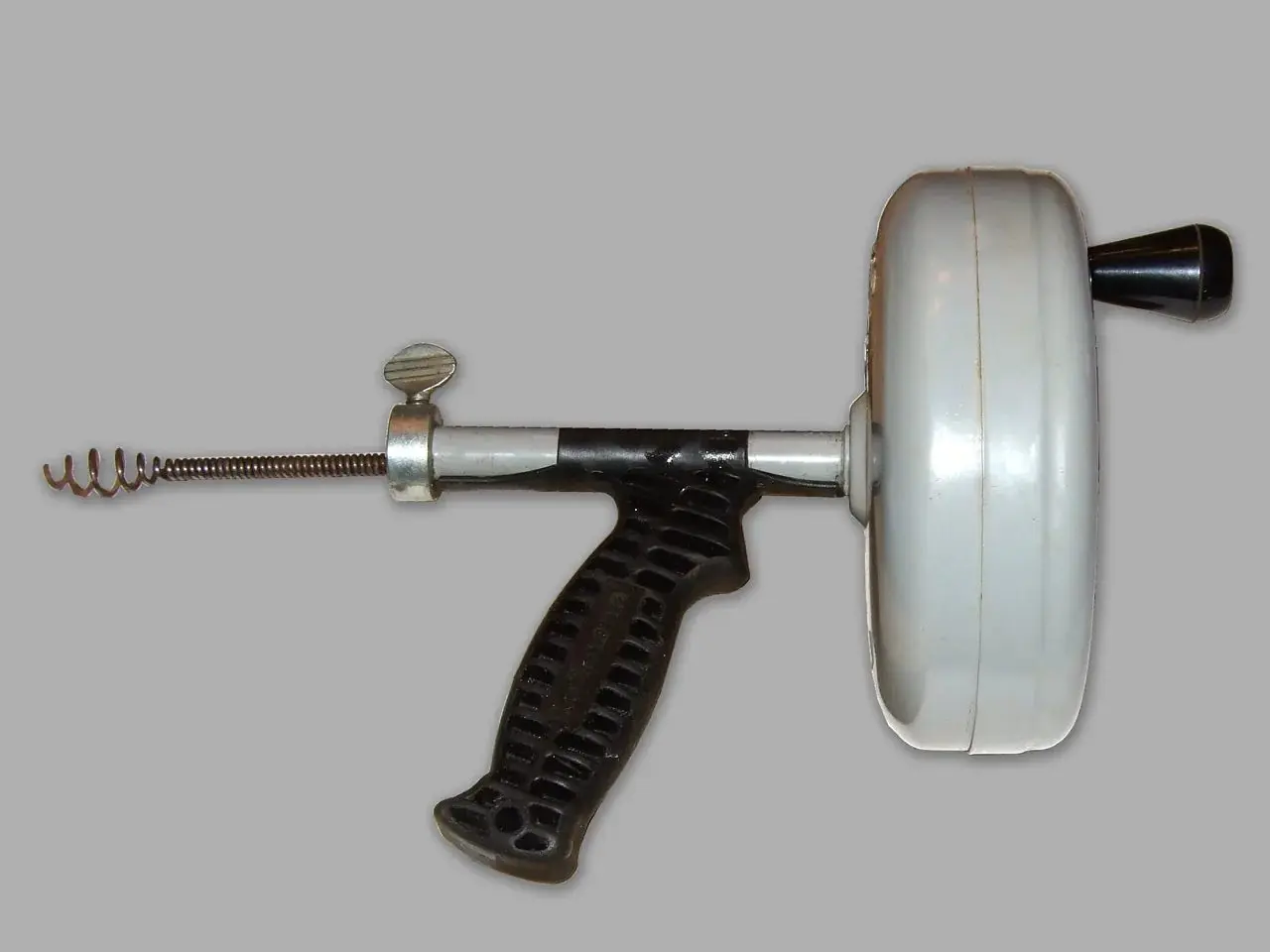
The simplest version is a bare spring cable with a crank handle that slides along it. The more convenient version keeps the cable coiled inside a drum, with a handle and a lock (a thumbscrew or chuck) that grips the cable so that turning the drum turns the cable.
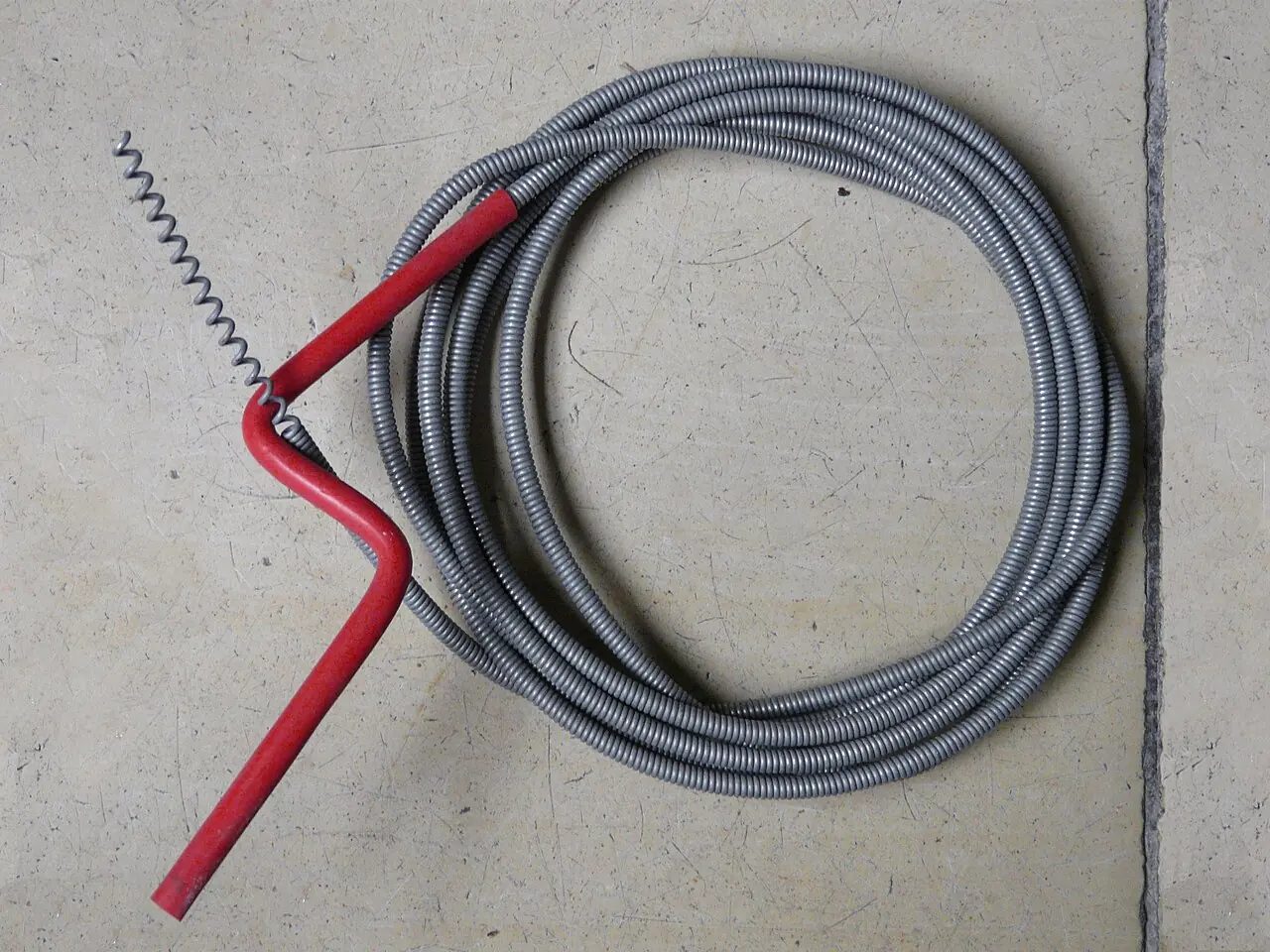
Figure 1. A simple hand drain cable: a long coiled steel spring cable with a small coiled-spring tip and a red cranked handle that slides along the cable and clamps onto it. (Photo: Frank C. Müller, Wikimedia Commons, CC BY-SA 2.5)
Toilet auger (closet auger)
A toilet auger has a short, stiffer cable inside a rigid tube with a crank handle at the top. The bottom of the tube is bent and covered with a rubber or plastic sleeve that protects the porcelain. It is made to pass through the toilet's built-in trap. Do not push a bare drum auger or a sharp cable into a toilet bowl: the steel cable can leave grey or black scratches on the glaze that are hard to remove, and it is more likely to coil up inside the trap.
Flat tape
A flat steel ribbon with a spring or pointed tip, pushed by hand. It pushes well along fairly straight runs but does not rotate well and struggles with several bends.
Powered drum machines and sectional machines (overview only)
For longer runs and larger pipes, plumbers use powered machines. A drum machine keeps a long cable in a rotating drum. A sectional machine joins short cable sections together and drives them with a motor. Many have a foot switch so both hands stay on the cable.
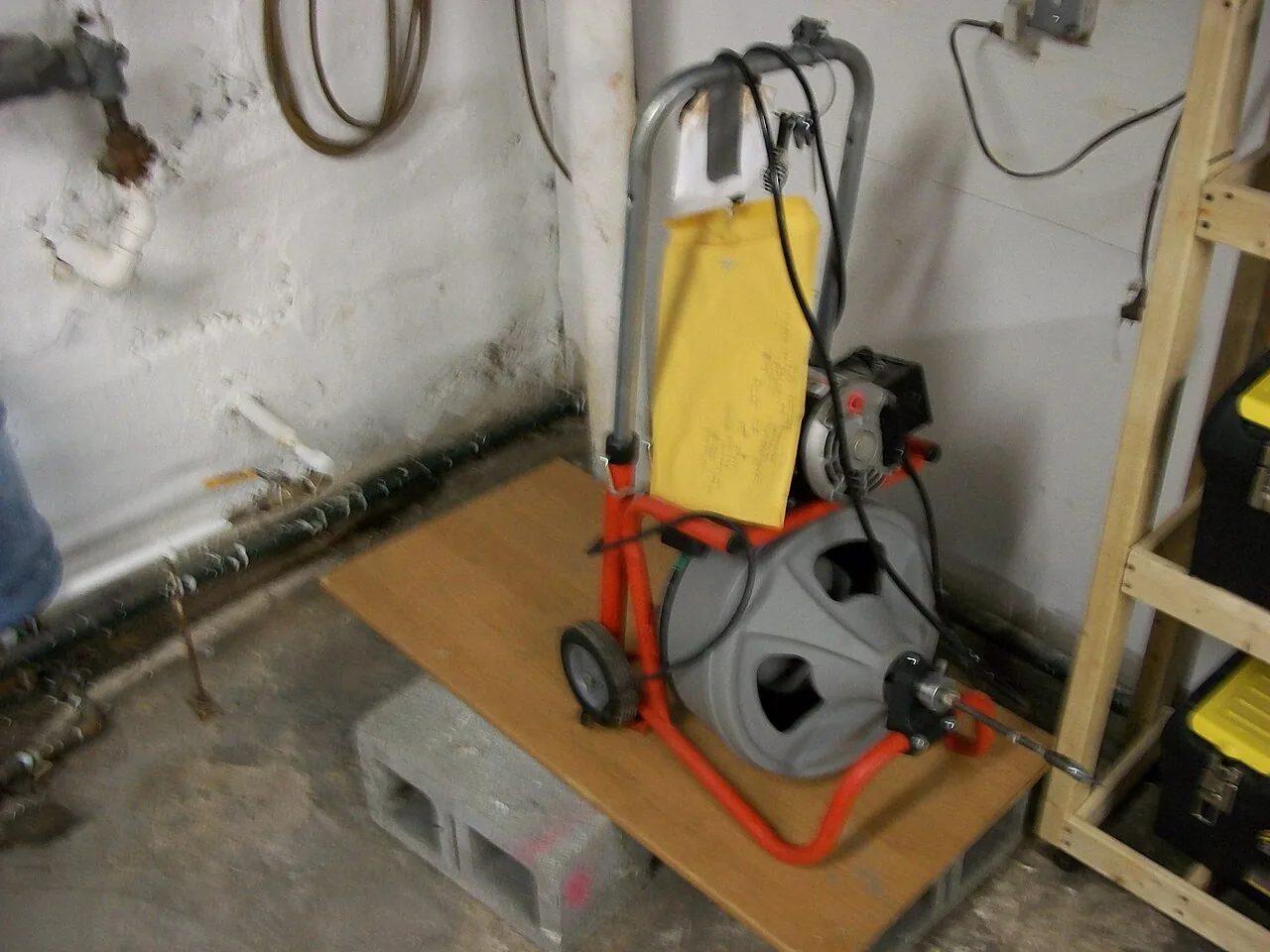
Figure 2. A powered drum drain-cleaning machine on a wheeled red frame in a basement, the cable leaving the front of the grey drum. (Photo: Tomwsulcer, Wikimedia Commons, Public domain)
These machines store a lot of energy in the twisting cable. If the tip catches while the motor keeps running, the cable can loop, whip and wrap around a hand or arm. Training, the maker's gloves, no loose clothing, the correct cable and an RCD-protected socket are the minimum.
Choosing the right cable for the pipe
The rule is simple: a cable thin enough to pass the bends, but strong enough not to kink in that pipe. A thin cable in a large pipe tends to coil up on itself; a thick cable cannot get through a small trap. The table below is a starting point only. All sizes and lengths are for reference; always follow the tool maker's recommended pipe range.
Job | Typical pipe (Vietnam, for reference) | Suitable tool | Cable diameter / length (for reference) | Notes |
|---|---|---|---|---|
Basin, bidet, small shower waste | uPVC Ø34–42 mm | Hand cable or small drum auger | About 6–8 mm; 3–8 m | Best to remove the trap and go into the wall pipe |
Shower or bathroom floor drain | uPVC Ø42–90 mm | Drum auger with medium cable | About 8–10 mm; 5–10 m | Remove the grate and anti-odour insert first |
Toilet trap | Built-in trap of the toilet | Toilet (closet) auger with sleeve | Short cable, about 1–2 m | Only clears the trap and the first part of the outlet |
Branch line under the floor, kitchen line | uPVC Ø60–90 mm | Larger drum auger or powered drum machine | About 10–16 mm; 10–20 m | Work from a cleanout where possible |
Main stack or line to the septic tank / sewer | uPVC Ø90–114 mm or more | Powered drum or sectional machine (trained operator) | Larger cable as specified by the maker | Consider CCTV inspection if it keeps blocking |
Before you start, estimate where the blockage probably is: just below the fixture (only one fixture is slow) or further along (several fixtures are affected).
Finding the right access point
Basins: remove the trap rather than forcing through it
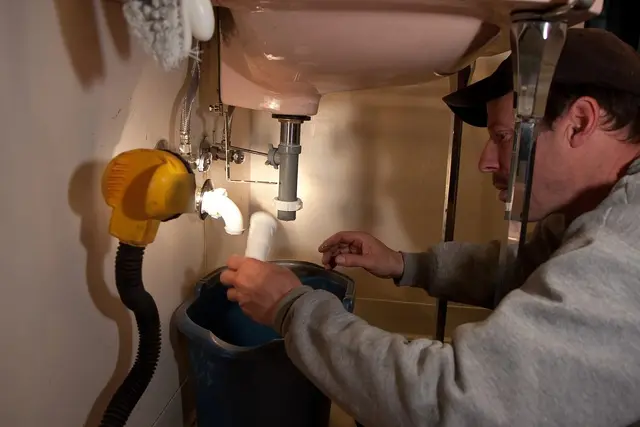
The trap under a basin has tight bends, and a pop-up waste often blocks the plughole. Pushing a cable down the plughole often scratches the waste or packs the clog into the trap. A better method:
Put a bucket and an old towel under the trap.
Unscrew the trap nuts by hand (or gently with grips over a cloth) and remove the trap. Clean it; often the blockage is right there.
If the pipe in the wall is still blocked, feed the cable directly into the wall outlet.
Refit the trap with its washers seated correctly and hand-tight plus a little more for plastic nuts. Do not over-tighten plastic threads.
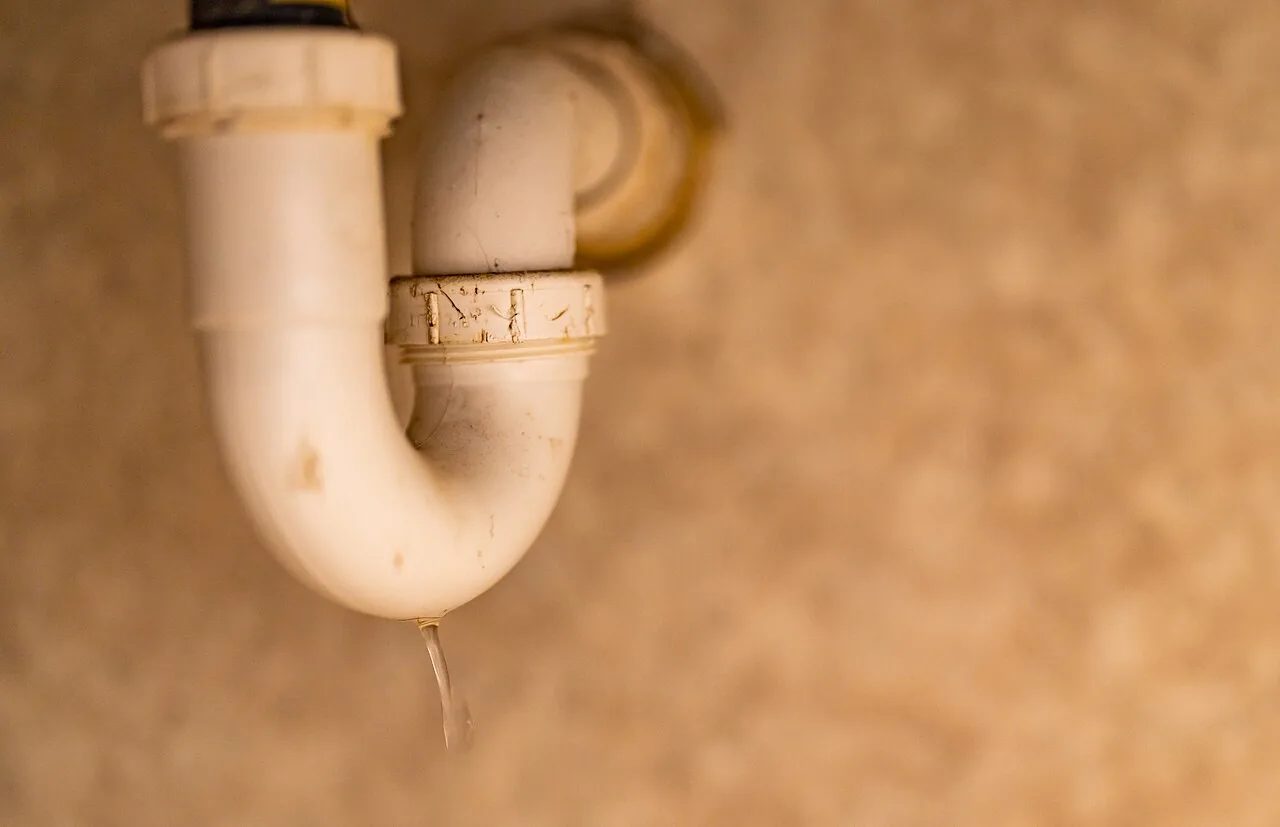
Figure 3. A white PVC P-trap under a basin, with slip nuts at the joints and a drop of water falling from the bottom of the bend. After you remove and refit a trap, run water and check every joint for drips like this one. (Photo: Tony Webster, Wikimedia Commons, CC BY 2.0)
Floor drains: remove the grate and the anti-odour insert
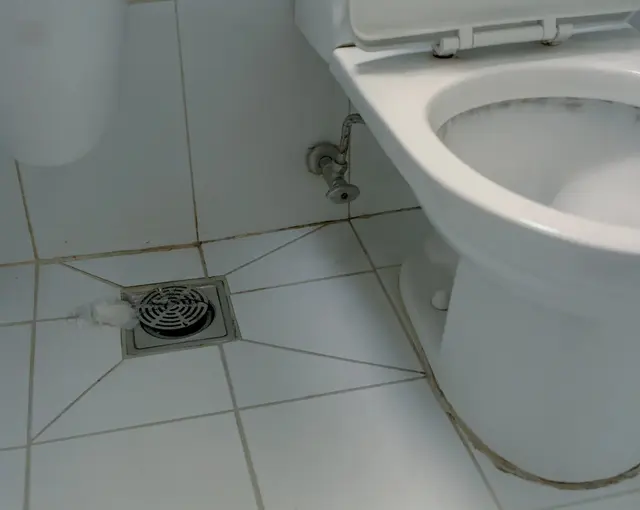
Most Vietnamese bathrooms have a square floor drain with a grate and, underneath, an anti-odour insert (a cup, bell or flap that holds water or closes to block smells). The cable cannot pass this insert. Lift the grate, pull out the insert, clean it, and then feed the cable into the pipe below.
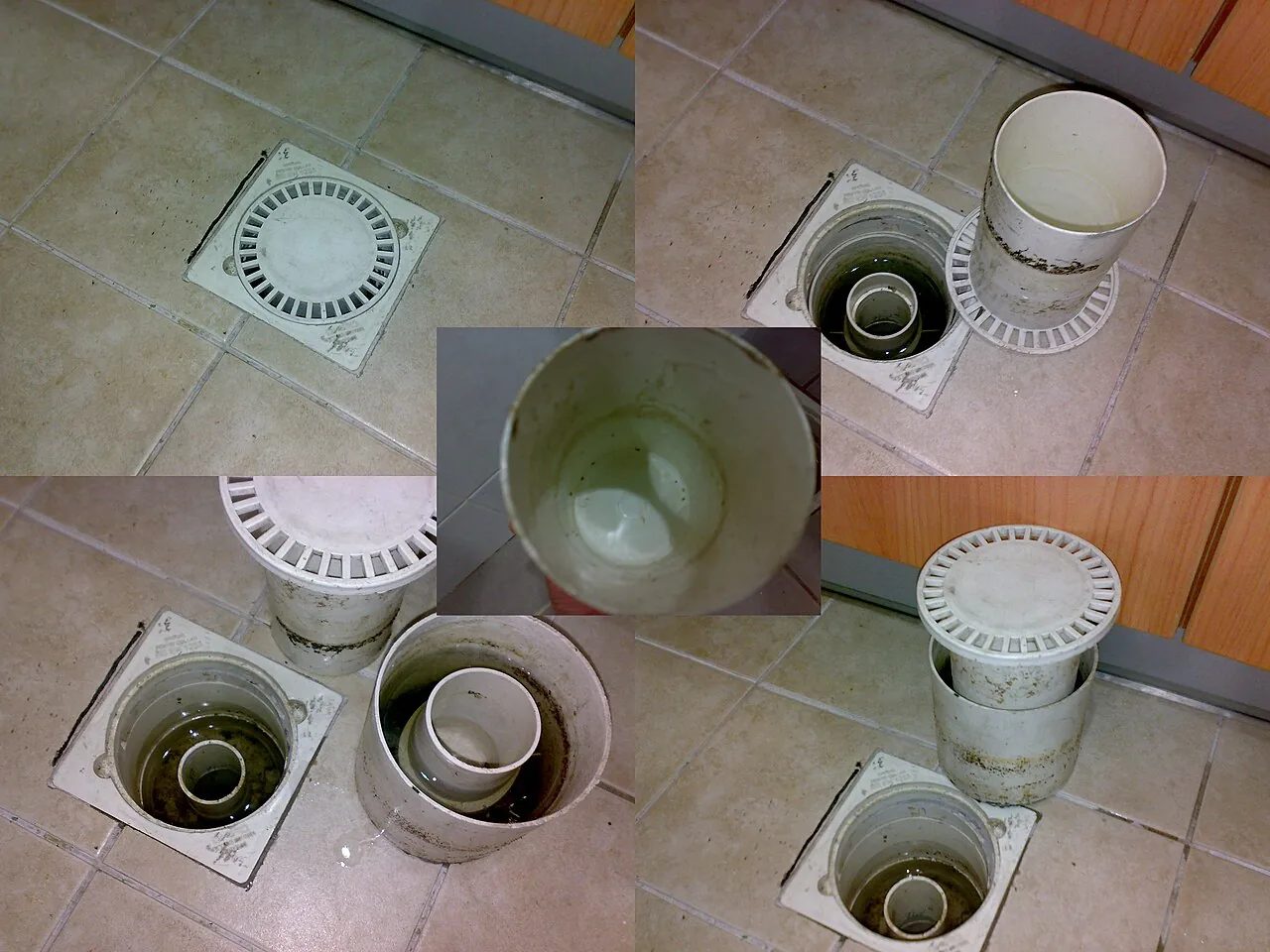
Figure 4. Photos of a square tiled floor drain with the grate in place, then with the grate and its tall cylindrical trap insert lifted out, showing the water-filled drain body and inner pipe. (Photo: KLLvr283, Wikimedia Commons, CC BY-SA 3.0)
Put the insert back afterwards, or smells and insects will come up through the drain.
Cleanouts and other openings
If the building has a cleanout (an access fitting with a screw cap) on the line, use it: it gives a straighter path and keeps the dirty work away from the fixture. Open a cleanout cap slowly with a bucket ready, because a blocked line can be full of standing water behind it. Avoid feeding cable through a basin overflow hole; the path is tight and easily damaged.
How to feed and crank a drum auger: step by step
Step 1: Prepare the work area
Protect the floor with a plastic sheet or cardboard and old towels. Have a bucket, rags and a bin bag ready.
Wear waterproof gloves and eye protection; drain water carries bacteria and a cable flicks it as it comes out.
Ask whether anyone has used a chemical drain cleaner. If yes, see the warning below before doing anything.
Bail out standing water first.
Step 2: Set the cable length
Pull about 15–30 cm of cable out of the drum (for reference) and lock it with the thumbscrew or chuck. Keep the drum close to the drain opening. A long loose section between the drum and the drain is the main reason cables twist, loop and kink.
Step 3: Push and rotate in the forward direction
Push the tip into the drain and turn the drum in the forward (cutting) direction, normally clockwise as seen from the handle side; follow the direction marked by the maker. Turn steadily while pushing gently. When the locked section has gone in, unlock, pull out another short length near the opening, lock again and repeat.
Do not keep turning if the cable is not moving forward. Cranking while the tip is held builds twist in the cable until it jumps into a loop and bends permanently (a kink). A kinked cable must be repaired or replaced.
Step 4: Learn to feel the difference between a bend and a blockage
A bend or fitting: the cable stops, but when you keep rotating and push gently, it suddenly slips past. In a trap or a 90° bend you may need to pull back slightly and try again while turning.
A soft blockage (hair, soap, paper): the cable goes into something that feels spongy, the turning gets heavier, and the cable may "grab" and pull itself in.
A hard obstruction: the cable stops dead every time at the same place and will not rotate past it. This can be a solid object, a collapsed pipe, a heavy deposit or roots. Do not force it.
Note the cable length where it stops; that distance helps if the job later needs a machine or camera.
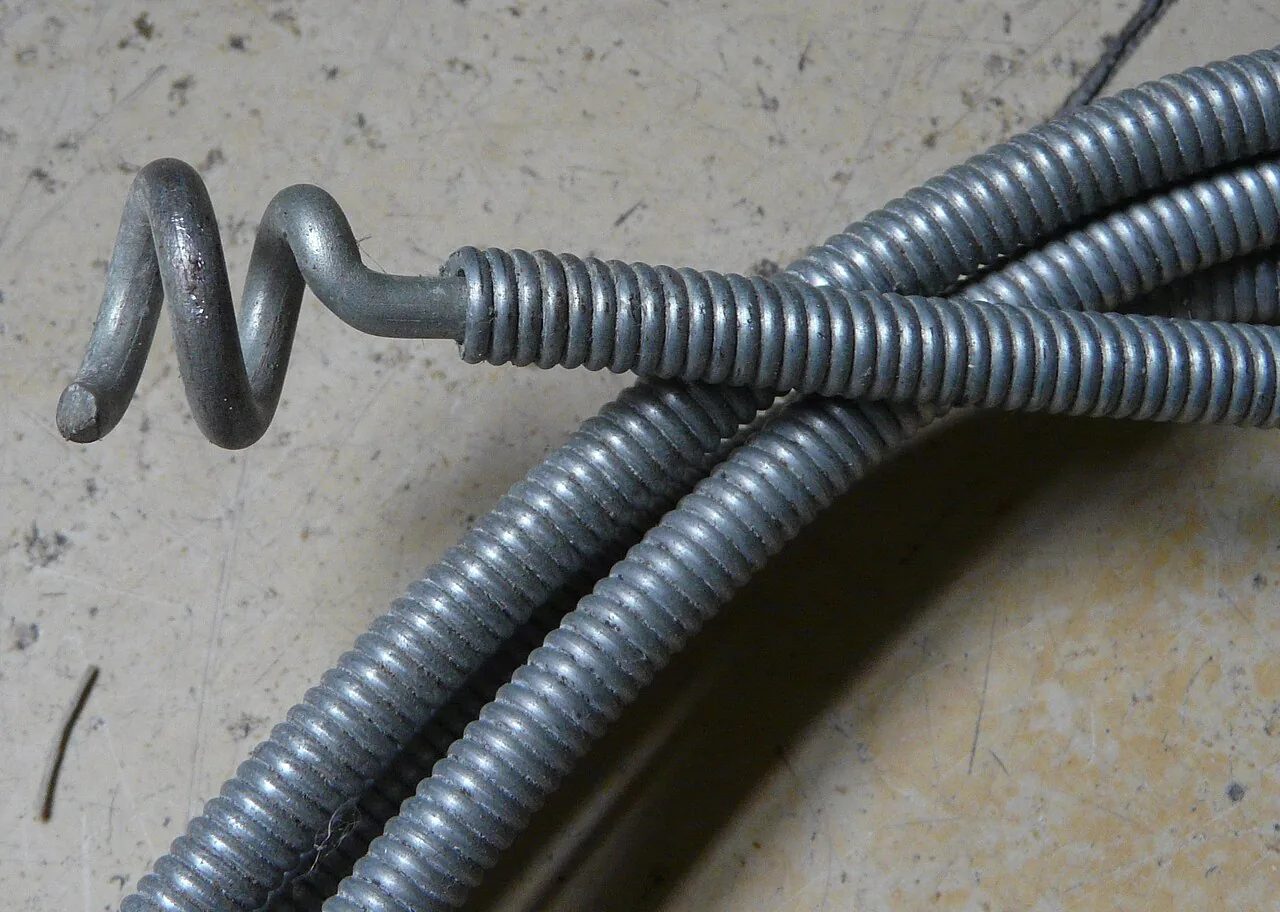
Figure 5. Close-up of the end of a spring drain cable: a solid corkscrew-shaped tip fixed into the tightly wound steel spring. This kind of tip bores into a soft blockage and hooks hair and fibres so they can be pulled out. (Photo: Frank C. Müller, Wikimedia Commons, CC BY-SA 4.0)
Breaking through or pulling out the blockage
Decide which approach you want:
Hook and retrieve is best for hair, soap scum and fibres in basins, showers and floor drains. Push the tip into the clog, turn several times so the hair wraps around the tip, then pull the cable back slowly, still turning gently forward. Wipe the clog into the bin bag and repeat until the tip comes back clean.
Break through is for soft material that can safely continue downstream, such as soft paper in a toilet trap. Bore through, work the tip back and forth a few times, then let water carry the loose material away.
Pulling hair out is usually better than pushing it deeper, where it re-forms out of reach.
Feed the cable back into the drum slowly, wiping it with a rag in your gloved hand. Do this only with a hand-turned auger; never hold a rag around a motor-driven cable.
Using a toilet auger without damaging the bowl
Pull the crank handle up so the cable is drawn into the tube, with only the tip showing at the sleeve.
Place the sleeved end into the bottom of the bowl, pointing into the trap opening, with the sleeve resting on the porcelain.
Turn the crank forward while pushing the handle down, so the cable feeds into the trap.
When the handle reaches the tube, work it gently back and forth while turning to break up or catch the blockage.
Withdraw the cable by pulling the handle up slowly while turning in the forward direction. Keep the sleeve against the bowl until the cable is fully back in the tube.
Test with a normal flush, ready to close the toilet's angle valve if the water rises.
If a toilet is blocked by a hard object (a toy, a bottle cap), the auger may push it into a position where it is stuck even harder. If you know an object went in, removing the toilet is often better; our guide to unblocking a toilet covers this.
Never snake a drain right after chemical drain cleaner
Many chemical drain cleaners are strongly alkaline or acidic. If the drain is still blocked, the chemical is sitting in the standing water. A spinning cable, a plunger, or opening a trap will splash that water onto your hands, face and eyes and the customer's floor.
Always ask the customer first, and read the product label if the container is available.
Do not use a snake or plunger, and do not open the trap, until the chemical has been safely dealt with as the product label directs. If you cannot be sure, leave the job for a professional with suitable protective equipment.
Never add a different chemical on top of another one: some mixtures react violently or release toxic gas.
Testing and flushing after clearing
Refit any trap or anti-odour insert you removed.
Run a good amount of water through the fixture. For basins and showers, hot tap water helps move soap residue. Do not pour boiling water into uPVC drains or toilet bowls: very hot water can soften or distort plastic pipes and joints, and sudden heat can crack porcelain.
Watch the drain empty. It should run freely without gurgling or backing up. Then check every joint you opened for drips with dry tissue.
If a basin and floor drain share a branch, run both and check water does not rise in one while the other drains.
Cleaning, drying and storing the cable
Most spring cables are carbon steel and rust quickly in Vietnam's humid climate:
After a dirty job, pull the cable out and rinse it (outdoors or in a utility sink, never the customer's kitchen sink), then wash with soapy water or a mild disinfectant.
Dry it completely: wipe it and let it air dry, uncoiled if possible, before winding it back.
Wipe a thin film of light machine oil along the cable to prevent rust, or use the product the maker recommends.
Check for kinks, broken coils and rust; store dry, away from food and drinking-water fittings.
Common mistakes
Too much loose cable outside the drain: it loops and kinks. Feed in short sections.
Cranking while the tip is stuck: builds up twist and breaks or kinks the cable.
Turning backwards to free the cable: on many spring cables this can unwind the spring or loosen the tip. Follow the maker's instructions.
Forcing through a basin trap: scratches the waste and cracks plastic. Remove the trap instead.
Bare cable in a toilet bowl: scratches the glaze. Use a toilet auger with a sleeve.
Wrong cable size: thin cable coiling in a big pipe, or thick cable stuck in a small trap.
No gloves, glasses or floor protection, or a wet floor left for someone to slip on.
Forgetting the anti-odour insert, or putting the cable away wet.
When to stop and call for a machine, camera or professional
Stop and recommend a bigger solution when:
The same drain blocks again within days or weeks after clearing. Something is catching the waste: a sag, a broken joint, heavy deposits, or a wrongly sloped pipe. A camera (CCTV drain inspection) shows the cause.
Several fixtures are blocked or slow at the same time, or water comes up in the floor drain when the toilet is flushed. The blockage is probably in the main line or stack, beyond the reach of a small hand auger. See also our article on gurgling drains.
The cable brings back roots, soil, sand or pieces of pipe. These suggest roots or a broken pipe; the pipe needs inspection and repair, not just cleaning.
The cable stops hard at the same point every time, or gets stuck and will not come back easily. Do not pull hard or keep cranking; you may break the cable inside the pipe.
There is sewage overflowing, or a smell of sewer gas inside the house.
Working with the customer
Explain what you will do and that some dirty water may come out; protect the floor and cabinet, and clean up afterwards.
Show the customer what you pulled out (hair, wet wipes, food scraps).
Give practical advice: a hair catcher on the shower drain, not flushing wet wipes, scraping grease into the bin rather than the sink (see our article on kitchen sink grease blockages).
If you found signs of a bigger problem, say so honestly and recommend an inspection, rather than promising that it will not block again.
Safety checklist
Waterproof gloves and eye protection on; long hair tied back, no loose sleeves.
Asked about chemical drain cleaners; none present, or the job has been left to a professional.
Floor protected; bucket, rags and bin bag ready; standing water bailed out.
Correct tool and cable size for the pipe; toilet auger with sleeve for toilets.
Cable fed in short sections; drum kept close to the drain; no cranking while the tip is held.
Powered machines used only by trained people, with the maker's gloves, foot switch and an RCD-protected socket.
Traps and anti-odour inserts refitted; joints checked for leaks.
Tested with hot (not boiling) water or a normal flush.
Cable cleaned, disinfected, dried and oiled; hands washed afterwards.
Frequently Asked Questions
Which drain snake should a beginner buy first?
A small drum auger with a thin cable for basins, showers and floor drains, plus a toilet auger with a protective sleeve. These two cover most household jobs. Powered machines come later, with training.
Can I use a drill to turn my drum auger?
Only if the auger is made for a drill, and only at low speed as the maker recommends. A drill makes over-twisting and kinking much easier.
Why does my cable keep coming back with nothing on it?
The tip may be passing beside the blockage (a thin cable in a large pipe), or it is not a soft clog. Try a larger cable, another tip or access point, then consider a camera inspection.
Can a drain snake damage pipes?
Used correctly, a hand snake rarely damages sound uPVC pipe. Damage comes from forcing it, oversized cutting heads, or powered machines on old or broken pipes. Plastic traps and chrome wastes scratch and crack easily.
Practice Exercises
Choose the tool. For each job, choose the tool and cable size: (a) a slow bathroom basin, (b) a shower floor drain full of hair, (c) a toilet that fills up after flushing, (d) a floor drain, a toilet and a basin all slow on the ground floor. (Answer: (a) remove the trap, then a thin hand cable; (b) remove the grate and insert, then a drum auger to hook the hair; (c) toilet auger with sleeve; (d) likely a main-line blockage: stop and recommend a machine or professional.)
Feel the pipe. On a practice rig of uPVC pipe with two bends and a hair plug, feed a drum auger through and note how a bend feels compared with the clog.
Trap removal. Remove, clean and refit a basin bottle trap or P-trap, then leak-test it with running water and dry tissue.
Customer talk. In three sentences, explain to a customer why their floor drain blocks often and what they can do to prevent it.
A drain snake rewards patience more than strength. Choose the right cable, enter at the right point, feed it in short sections, feel what the tip tells you, and stop when the signs point to a bigger problem.