The water is perfect for ten seconds, then it turns icy. You nudge the handle towards hot, and a moment later it is scalding. Someone flushes the toilet and you jump out of the stream. A shower that keeps switching between hot and cold is one of the most common bathroom complaints, and the cause is not always the mixer. The swing can come from the way the house is plumbed, from a pump, from the water heater, or from a small part inside the valve that is partly blocked or worn.
This guide shows how to find the cause step by step instead of replacing parts at random. The key questions: does the temperature change suddenly or slowly, hotter or colder, and when something else in the house is used?
Scope and safety. Written for trainee and working residential plumbers, and for homeowners who want to understand the process, in typical Vietnamese homes: a rooftop tank feeding by gravity, sometimes a booster pump, and hot water from a storage heater (bình nóng lạnh), an instant electric heater or a solar tube heater, on a 230 V / 50 Hz supply. Homeowners can safely do the observation and comparison tests. Opening an electric water heater, working on its wiring or changing its thermostat is a job for a competent electrician or the manufacturer's service technician. Always switch the heater off at its own breaker before removing any cover. Numbers marked for reference are typical examples, not rules or limits from a standard.
Why a shower changes temperature
A shower mixes two streams, hot and cold. A simple manual mixer passes any change in either stream straight to you. The causes fall into four groups: pressure changes (other taps, toilets, pumps, unequal supplies), hot-water temperature changes (the heater running out or cutting in and out), restrictions (blocked screens, sticking non-return valves, scaled cartridges, half-closed valves) and crossflow between the hot and cold pipes.
Step 1: Get a precise description
Before opening anything, ask the customer (or note for yourself):
Hotter, colder, or both in turn?
Sudden or gradual? A swing within a second or two usually means a pressure change or a heater switching. A slow fade over several minutes usually means the hot water is running out.
Is there a rhythm? A regular cycle often matches a pump starting and stopping.
What else is running? A toilet flush, another tap, the washing machine.
Since when? After a new pump, heater or mixer, or after the supply was shut off (which can bring debris into the pipes)?
Which showers, and which heater? One bathroom or all; storage, instant, solar, or solar with electric backup.
Step 2: Rule out safety problems first
Stop diagnosing and deal with the danger if you find any of these:
Water is much hotter than usual or steams: a stuck thermostat can overheat the water. Switch the heater off at its breaker and call a technician.
A tingle from the water, mixer, heater or a metal rail: switch the heater off at its breaker and have an electrician check the earthing and the residual current device (RCD, often called an ELCB or anti-shock breaker in Vietnam).
The heater's RCD or breaker trips repeatedly, or there is a burning smell or water near its wiring.
Step 3: Test whether other taps change the temperature
This is the quickest and most useful test. Run the shower at a comfortable temperature and keep a hand (or a thermometer) in the stream. Ask a helper to do these one at a time, with a pause between each: flush a toilet; fully open a cold tap elsewhere; fully open a hot tap elsewhere; start the washing machine filling.
Shower gets hotter when cold is used elsewhere: the shared cold supply cannot keep up, so the mix swings to hot. This is the dangerous direction because it can scald.
Shower gets colder when hot is used elsewhere: the shared hot supply cannot keep up.
No change: look at the mixer and the heater instead.
A small, brief change is common and not usually a fault. A change big enough to make someone jump is worth fixing, and with children or elderly people it is a safety issue.
Step 4: Find out where hot and cold come from
Many fluctuation problems come from hot and cold being supplied at different pressures. Trace both pipes back to their source. Common Vietnamese layouts include:
Both from the rooftop tank by gravity. Cold goes straight to the bathroom; hot goes through the storage heater first. Pressures are similar, but low on the top floor.
One side pumped, the other by gravity. A booster pump was added to fix a weak shower, but only on one pipe. The pumped side is now much stronger, the mixer is hard to set, and the balance changes every time the pump starts or stops.
Cold from the street main, hot from the rooftop tank: mains pressure varies through the day.
Solar heater on the roof feeding hot by gravity while cold comes from a pump or the main, so hot is weak on upper floors.
To compare the sides, time how long it takes to fill a bucket to a mark with hot only, then with cold only. If one side takes roughly twice as long as the other (for reference), the supply is clearly unbalanced.
The usual cure is to feed hot and cold from the same source at the same pressure, for example by placing the pump so it feeds both the heater inlet and the cold pipe. Before doing this, check in the manuals that the heater, its safety valve and the mixer are rated for the new pressure, and fit a pressure-reducing valve if needed. See our guides to weak shower flow and pressure-reducing valves.
Step 5: Look at the mixer type
Manual mixers
Two-handle mixers and most single-lever mixers in Vietnamese homes are manual: they set a fixed opening for hot and cold and do not correct for changes in either supply.
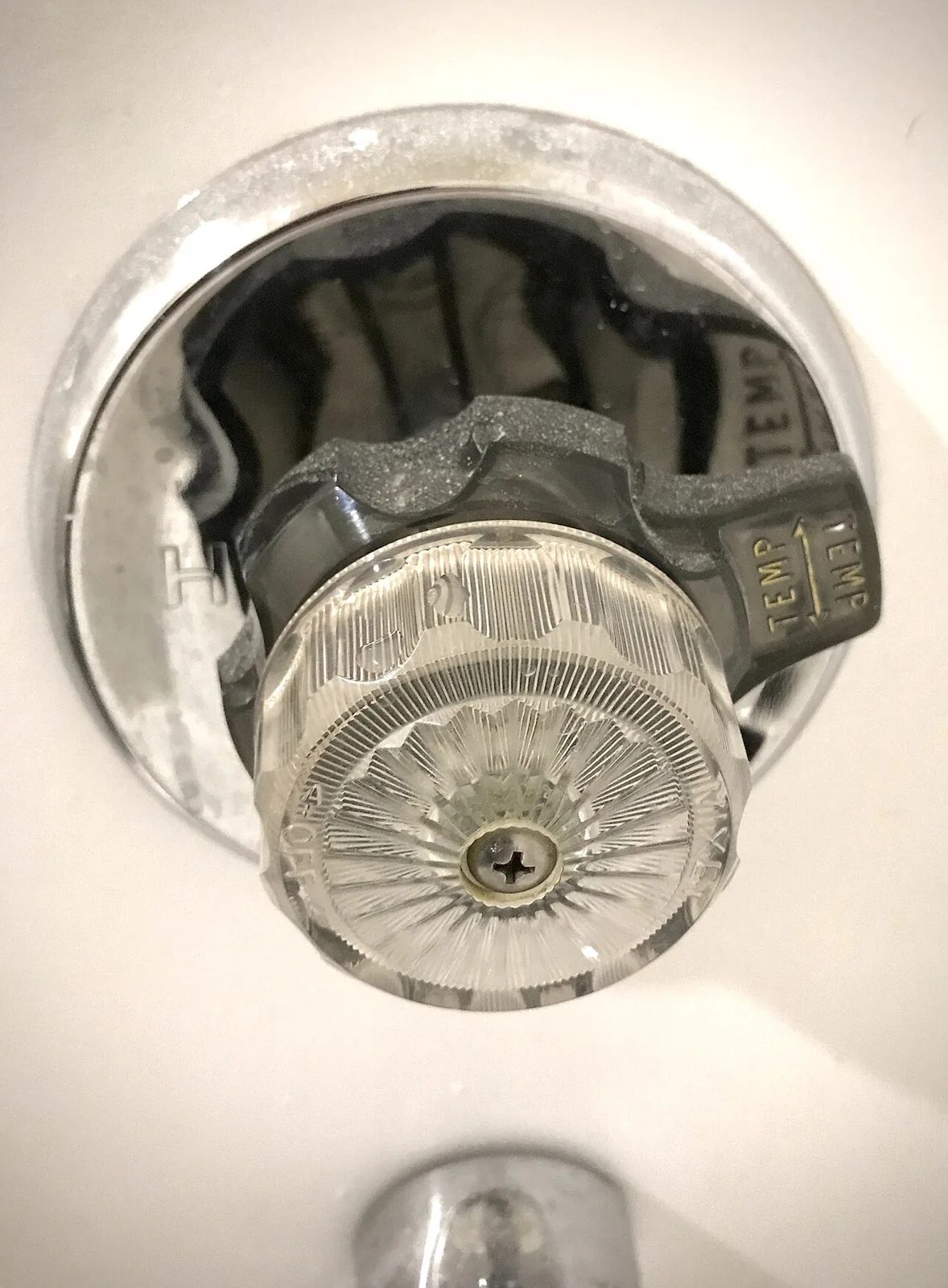
Figure 1. A single-handle shower valve set into the wall above a bathtub, with a clear plastic knob over a dark lever marked "TEMP" with an arrow. One handle sets the mix of hot and cold. Whether a valve like this corrects for pressure changes depends on the cartridge inside, which cannot be judged from the outside; check the model's documentation. (Photo: Steven Pavlov, Wikimedia Commons, CC BY-SA 4.0)
Pressure-balancing valves
A pressure-balancing valve has a spool or diaphragm that reacts to the pressures of both supplies. If cold pressure drops, it throttles the hot side to keep the ratio similar. It reduces sudden swings from pressure changes, but it does not correct a change in hot-water temperature, and the flow drops while it compensates.
Thermostatic mixers
A thermostatic mixer has a temperature-sensitive element (often a wax capsule) that moves a shuttle to hold the outlet near the temperature set on the dial. It handles both pressure and temperature changes within its limits, but:
It needs a minimum supply pressure; gravity pressure on the top floor may be too low. Check the manufacturer's data.
It works best when hot and cold pressures are reasonably balanced.
Most have filter screens and non-return valves in the inlets that can block.
It cannot make hot water the heater does not supply. Many models reduce or stop the flow if the cold supply fails, as a safety feature.
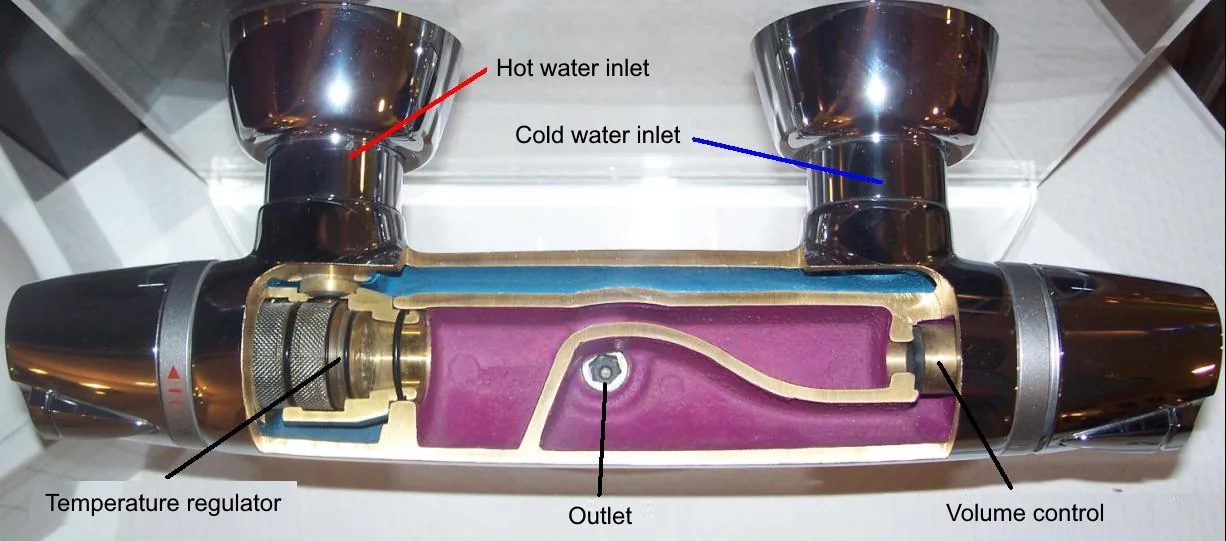
Figure 2. A cutaway thermostatic bar mixer with English labels: hot and cold water inlets at the top, the temperature regulator on the left, the volume control on the right and the outlet in the middle of the body. The regulator holds the temperature-sensitive element that adjusts the hot and cold openings as conditions change. (Image: CschirpCschirp, Wikimedia Commons, CC BY-SA 3.0)
A thermostatic mixer is the most effective single upgrade for a shower that swings, especially for children or elderly users, but it does not cure a heater that runs out.
Step 6: Check filters, non-return valves and the cartridge
Suspect a restriction if the problem started after supply works or crept in over months. First shut off both supplies, switch the water heater off at its breaker, and open the shower to release pressure.
Stop valves: make sure every valve on the hot and cold lines, including the one at the heater outlet, is fully open. A half-closed valve on one side looks exactly like a mixer fault.
Inlet filters and non-return valves: many mixers, and some eccentric S-unions, have a mesh screen or a non-return valve in each inlet. Remove the mixer body from the unions (towel and container ready), rinse the screens and replace any non-return valve that sticks. Do not leave them out: they protect the mixer and help prevent crossflow.
Cartridge: scale or grit on the ceramic discs of a single-lever mixer makes the lever jumpy, so a tiny movement gives a large temperature change. Remove it as the maker describes, clear any debris, and replace it if scaled or damaged. A thermostatic element can be cleaned or replaced according to the manual; recalibrate the dial afterwards.
Shower head: a heavily scaled head reduces flow, which matters most with instant heaters (Step 7).
A mixer that drips when closed is a separate problem, covered in our leaking shower mixer guide.
Step 7: Check the water heater
Run the shower on hot only for several minutes and watch the temperature (carefully: it can be very hot). If hot alone swings or fades, the heater or hot supply is the problem, not the mixer.
Storage heater (bình nóng lạnh)
Fine at first, then slowly colder: the tank has run out. This is normal when the tank is small for the household. Options: a lower-flow shower head, a higher thermostat setting (within the maker's range, with a thermostatic mixer against scalding), or a larger heater.
Runs out much sooner than it used to: possible failed element, heavy scale or a faulty thermostat. A technician should check it.
Hot water stops completely: the overheat cut-out may have tripped. Resetting it repeatedly without finding the cause is not safe.
Breaker or RCD trips: stop using the heater and call an electrician; an element may be leaking current to earth.
A storage heater's thermostat switching on and off does not normally cause sudden swings, because the tank holds a large volume of water. Sudden swings with a storage heater point back to pressure (Steps 3 and 4) or the mixer (Steps 5 and 6).
Instant electric heater
An instant heater heats water only while it flows. It switches on when it senses enough flow or pressure, and most have an overheat cut-out. Typical problems:
Bursts of cold: the flow falls below what the heater needs to stay on, so it switches off and on. Causes include low supply pressure, a blocked inlet filter, a scaled head, or turning the flow down too far.
Too hot, then cold: the flow is too low for the power setting, the water overheats and the cut-out switches off until it cools.
Cold mixed in after the heater: some models are meant to be controlled only by their own dial and flow; mixing cold downstream can drop their flow below the minimum. Follow the heater's manual.
Weaker in the evening: low supply voltage at peak times reduces output (an electrical issue).
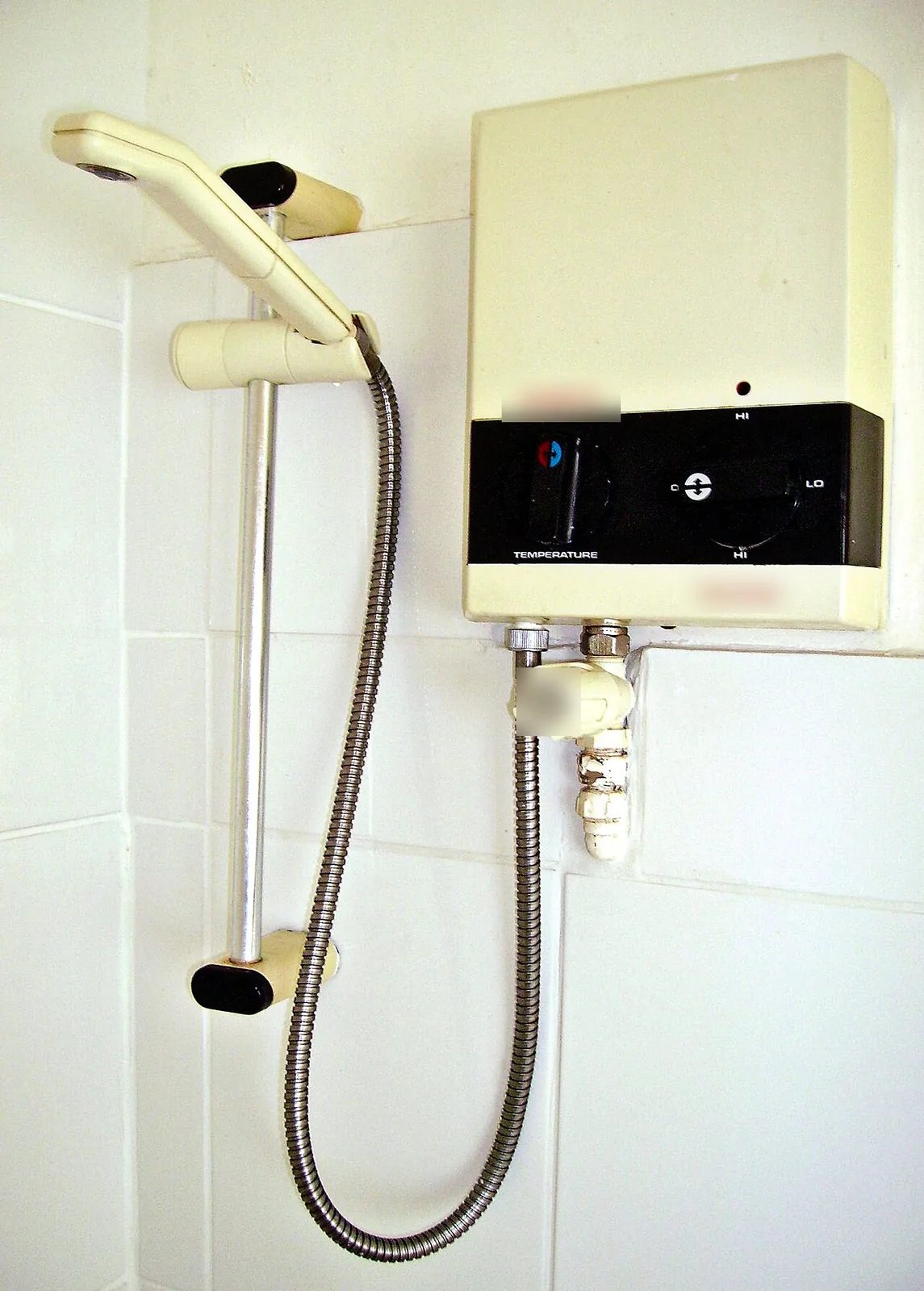
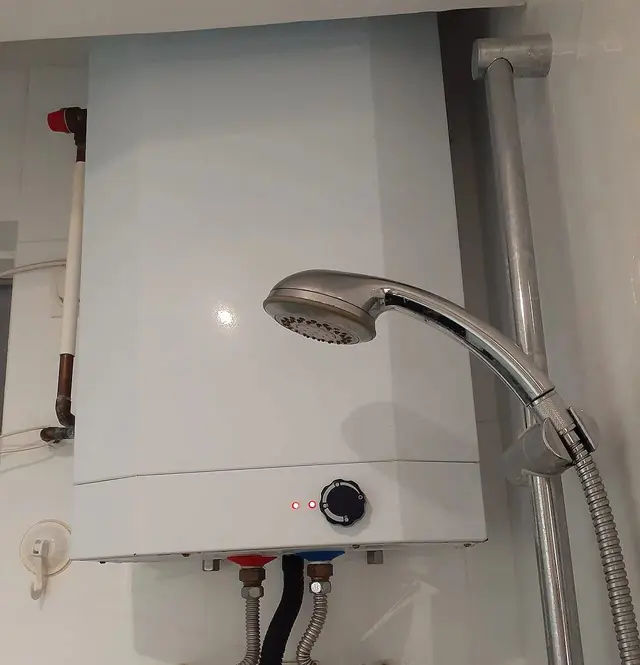
Figure 3. A wall-mounted instant electric shower heater on a tiled wall, with a temperature knob and a second selector marked LO and HI, a metal hose up to a hand shower on a slide rail, and the inlet pipe and valve underneath. Units like this switch on only when enough water flows; low flow can make them cut out and deliver bursts of cold water. Brand names have been blurred. (Photo: Immanuel Giel, Wikimedia Commons, public domain)
An instant heater needs its own correctly sized circuit, an earth connection and RCD protection, as its installation instructions state. Never open its cover with the power on; anything inside the casing is for a qualified technician.
Solar water heater
Very hot on sunny afternoons, lukewarm on cloudy days or early mornings: normal behaviour, so yesterday's mixer setting is wrong today. A thermostatic mixer at the shower or a thermostatic mixing valve at the solar outlet solves most of this.
Big swings from small changes: with very hot stored water the shower uses only a little hot, so a slight pressure change gives a large temperature change.
Weak hot flow upstairs: the tank sits only a little above the top-floor shower, so pumped cold overpowers it (Step 4).
Spluttering: often air in the hot line; see our guide to air in water pipes.
Electric backup element: treat it with the same electrical precautions as a storage heater.
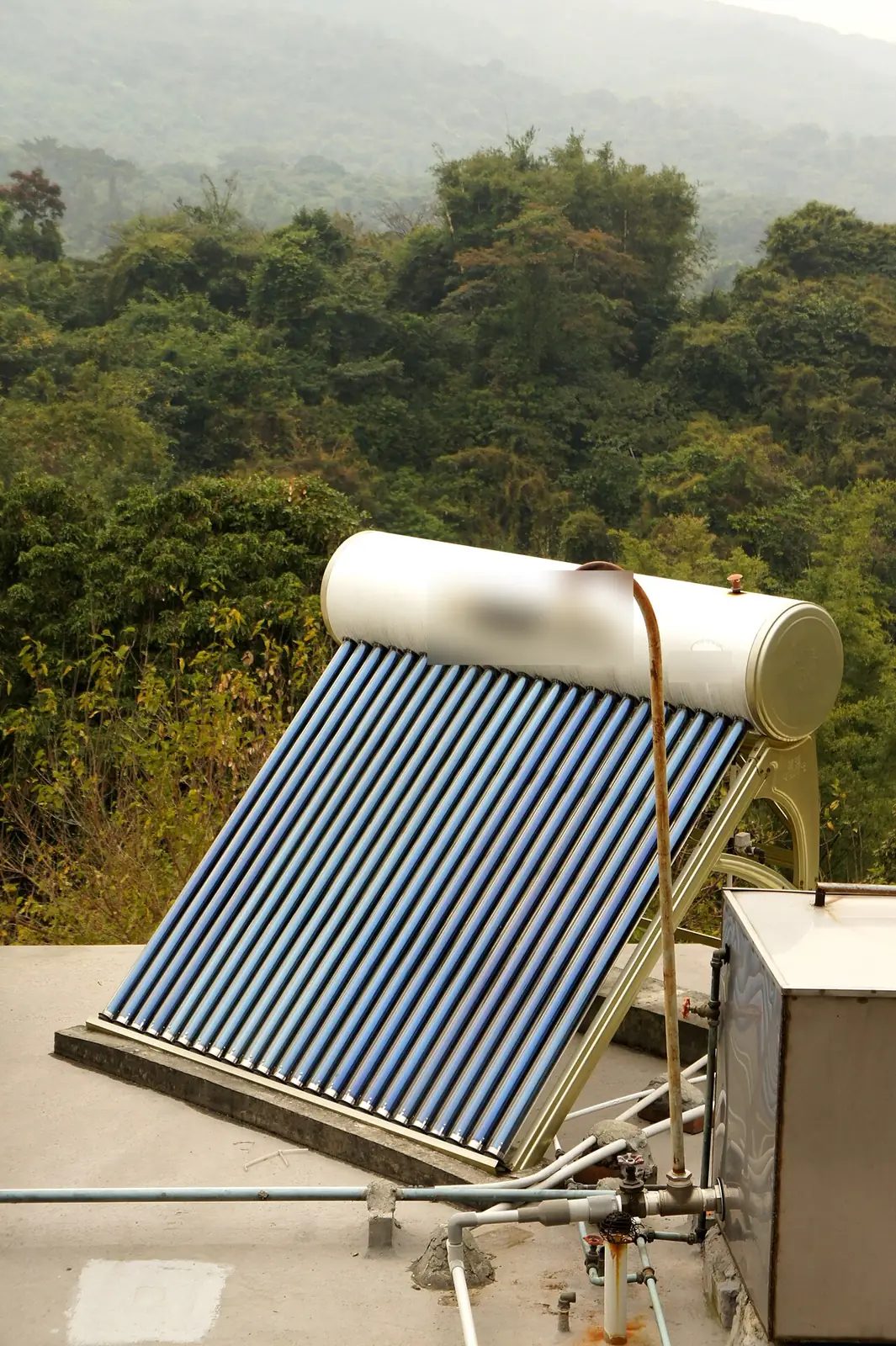
Figure 4. A solar water heater with a row of glass vacuum tubes under a horizontal storage tank on a flat roof, with pipework and a metal box beside it. Water from a heater like this can be very hot after a sunny day and much cooler after cloudy weather, which is why a fixed mixer setting does not stay right. The maker's label has been blurred. (Photo: Mk2010, Wikimedia Commons, CC BY-SA 3.0)
Step 8: Check for crossflow between hot and cold
Crossflow happens when the higher-pressure side pushes into the lower-pressure side through a faulty mixer elsewhere, such as a single-lever mixer with a worn cartridge or a thermostatic mixer with a failed non-return valve. Signs: hot taps never get fully hot, warm water comes from cold taps, or the shower changes when another mixer is used.
A simple test with a storage heater: switch the heater off at its breaker, close the cold inlet valve to the heater, then open a hot tap. After a little water drains, the flow should almost stop. If it keeps running steadily, cold water is entering the hot pipes somewhere. Isolate the mixers one at a time until the flow stops. Afterwards, reopen all valves and make sure the heater is full, with air bled from a hot tap, before switching it back on.
Step 9: Check the pump
If the temperature changes in a regular rhythm, watch the booster pump during a shower. If the swings match the pump starting and stopping, it is cycling. Common reasons are a pressure tank that has lost its air charge, a pressure switch with a narrow on/off difference, a leaking non-return valve, or a leak in the pipework. Fixing the cycling (see our booster pump guide) often fixes the shower.
Symptom reference table
What the customer notices | Most likely causes | First check | Typical fix |
|---|---|---|---|
Suddenly hotter when a toilet is flushed or a cold tap opened | Shared cold supply cannot keep up; small pipes; low tank height | Other-taps test (Step 3) | Improve and balance supplies; pressure-balancing or thermostatic mixer |
Suddenly colder when hot is used elsewhere | Shared hot supply cannot keep up; restricted heater outlet | Other-taps test; heater outlet valve fully open | Open up the hot supply; thermostatic mixer |
Hot and cold in a regular rhythm | Booster pump cycling on one side | Watch the pump during a shower | Fix cycling; pump feeds both sides |
Tiny handle movement gives a big change | Unbalanced pressures; very hot (solar) water; scaled cartridge | Bucket comparison; hot-water temperature | Balance supplies; thermostatic mixer; clean or replace cartridge |
Fine at first, slowly colder | Storage tank running out; failed element; scale | Hot-only test | Less hot-water use, larger tank, technician check |
Bursts of cold with an instant heater | Flow too low for heater to stay on; blocked filter or head | Clean head and inlet filter; check flow | Better supply pressure; use as the manual says |
Very hot some days, lukewarm others | Solar output varies with the weather | Note weather and time of day | Thermostatic mixing valve; backup heating |
Warm water from cold taps; hot taps never fully hot | Crossflow through a faulty mixer or valve | Heater inlet closed, hot tap open (Step 8) | Replace the faulty cartridge or non-return valve |
Water suddenly very hot; tingle from metalwork; heater breaker trips | Thermostat or electrical fault | Switch the heater off at its breaker | Electrician or service technician immediately |
Practical examples
Example 1: The top-floor shower and the new pump
In a four-storey tube house, a booster pump had been added to the cold pipe of the top-floor bathroom. The shower became strong but jumped between hot and cold. Hot still came by gravity through the storage heater from the rooftop tank, while cold came from the pump, so every pump cycle changed the balance. After confirming the heater's rated pressure covered the pump's maximum, the plumber re-piped so the pump fed both the heater inlet and the cold line. The temperature became steady.
Example 2: Cold halfway through
A family of four said the shower "goes cold halfway through". The hot-only test showed a slow fade after a few minutes and other taps made no difference. The small storage heater, chosen when two people lived there, was simply running out. The plumber fitted a lower-flow shower head and quoted for a larger heater; no mixer parts were needed.
Example 3: Cold bursts with an instant heater
In a rented room, an instant heater kept giving bursts of cold. Its inlet filter (described in the manual) was partly blocked after supply works and the head was scaled. With the heater off at its breaker, both were cleaned, and the flow then kept the heater on.
Tell customers honestly: rebalancing fixes the cause, a thermostatic mixer protects against the effect, and a bigger heater only solves running out.
Safety checklist
Switch the water heater off at its own breaker before removing covers, opening hot-water joints or draining it.
Shut off both supplies and release pressure before taking a mixer apart.
Take care with hot-only tests; use a thermometer or test the stream cautiously.
Check that every electric heater is earthed and RCD-protected; press the RCD test button as its instructions describe and confirm it trips.
Never bypass or repeatedly reset an overheat cut-out without finding the cause.
Do not permanently remove filter screens or non-return valves to "improve flow".
Before changing pump positions or pressures, check the heater's and mixer's rated pressures; fit a pressure-reducing valve if needed.
After any work on a storage heater, refill it fully and bleed air from a hot tap before switching it on; heating an empty tank can destroy the element.
Recommend a thermostatic mixer where children, elderly or disabled people shower.
Frequently Asked Questions
Why does my shower get hot when someone flushes the toilet?
The cistern refills from the cold pipe. If that pipe also feeds your shower and cannot keep up, the shower briefly loses cold water and the mix becomes hotter. Better and balanced supplies, or a pressure-balancing or thermostatic mixer, reduce this.
Will a thermostatic mixer fix every temperature problem?
No. It handles pressure swings and moderate hot-water temperature changes within its limits, but it cannot create hot water when the heater runs out, and it may not work well below its minimum pressure or with badly unbalanced supplies.
What temperature should my storage heater be set to?
Follow the manufacturer's instructions. A comfortable shower is usually around 38–40 °C (for reference), but heaters store water hotter than that so it lasts longer when mixed. A higher setting gives more usable hot water but raises the scald risk, which is why a thermostatic mixer is recommended with high settings.
Can I use an instant heater with a normal shower mixer?
It depends on the model. Some instant heaters are designed to be the only temperature control; mixing cold after them can reduce flow below their minimum and cause cut-outs. Check the heater's manual or ask the supplier.
Practice Exercises
Fault interview. Write eight questions for a customer who says "my shower keeps going hot and cold", grouped under pattern, timing, other appliances and heater type.
Supply mapping. In a training house or your own home, sketch where the hot and cold supplies to one shower come from (tank, pump, main, heater, valves) and mark which side is pumped and which is by gravity.
Bucket comparison. Time how long it takes to fill the same container with hot only and with cold only at one mixer, and decide whether the supplies look balanced.
Sorting cases. Name the likely cause and first check for: (a) shower gets colder every minute or so in a regular rhythm; (b) shower fades slowly to cold after six minutes; (c) cold bursts from an instant heater after the supply was shut off for works; (d) warm water from the kitchen cold tap.
Customer explanation. In three or four sentences, explain why a thermostatic mixer helps when a toilet flush makes the shower hot, and what it cannot fix.