Classic vegetable cuts are the named, fixed-size cuts that every Western kitchen shares: brunoise is a dice of about 3 mm, macedoine a dice of about 5 mm, julienne a 3 × 3 mm strip 5–6 cm long, chiffonade finely shredded leaves, plus batonnet, paysanne and mirepoix. To cut like that, a commis has to hold the knife with a pinch grip and keep it sharp by honing and sharpening, and only then move on to filleting fish and breaking down chicken. This lesson includes a worked mise en place example for an evening service, with usable yield and portion cost figures that add up.
By the end of this lesson, you will be able to:
- Hold a chef's knife with a pinch grip, keep a "claw" guiding hand and cut with steady push and rocking motions.
- Tell honing from sharpening, hone at the right angle before every shift and check the edge yourself.
- Cut seven classic cuts to size: brunoise, macedoine, julienne, batonnet, paysanne, chiffonade and mirepoix.
- Fillet a side of salmon into 160 g portions, remove the pin bones, and break a chicken down into 8 pieces.
- Work out usable yield and portion cost, and spot how uneven cuts lead to uneven cooking.
Learning Western cooking properly? Knife skills are step 2 of the roadmap, right after food safety and kitchen organization, and before stocks, the five mother sauces and heat techniques. See the 8-step Western cuisine cook roadmap to learn in the right order.
Why does a Western kitchen insist on cuts accurate to the millimetre?
In a Western kitchen, a cut is not just for looks. The size of each piece decides cooking time, tenderness and how the dish sits on the plate.
Even cuts cook evenly
Heat travels from the outside in. In the same pan, a 3 mm carrot dice turns tender in a few minutes while a 6 mm dice is still raw in the middle. If a tray of brunoise mixes big and small pieces, cooking for the small ones leaves the big ones hard, and cooking for the big ones turns the small ones mushy and scorched at the edges.
Cut names are a shared language
A recipe card says "onion brunoise" or "carrot julienne", not "chopped small". When the head chef calls for "500 g of macedoine", the whole kitchen understands the same size, and the dish comes out the same from shift to shift.
Speed comes after accuracy
The right order is: correct size first, consistency second, speed last. Cutting fast with poor technique only means more cut fingers.
Choosing and holding a Western chef's knife
A commis does not need an expensive knife set. The minimum is one chef's knife, one paring knife and one boning knife, plus a honing steel. Knives must be sharp, with handles that do not slip and that feel balanced in your hand.
A commis's minimum knife kit
- Chef's knife: blade about 20–25 cm, with a gently curved belly for rocking. It does 80% of the work: onions, carrots, herbs, boneless meat.
- Paring knife: blade about 8–10 cm, for peeling, coring tomatoes and trimming vegetables held in the hand.
- Boning knife: narrow blade about 13–15 cm, for breaking down chicken and cutting meat close to the bone.
- Fillet knife: thin, flexible blade for fish. A small kitchen can share the boning knife if it is thin enough.
The pinch grip
Pinch the blade just in front of the handle between your thumb and the side of your index finger, and wrap the other three fingers around the handle. This grip keeps the blade vertical and stops it wobbling sideways, so slices come out flat and even. Beginners often rest the index finger on the spine; that tires the hand quickly and lets the blade tilt in hard vegetables.
The claw hand and the two main cutting motions
The hand holding the food curls its fingertips under, and the knuckles touch the side of the blade as a guide; for 3 mm slices you move the hand back 3 mm per stroke. The basic grip is covered in the knife skills lesson of the Vietnamese cuisine roadmap; in a Western kitchen you add two motions:
- Push cut: tip on the board, push the blade forward and down. Used for carrots, potatoes and other hard vegetables.
- Rock chop: the tip barely leaves the board while the heel rises and falls in rhythm. Used for herbs, roughly cut onion and garlic.
The board must not move: put a damp cloth or a non-slip mat under it, and use the right board colour for the food, as covered in the lesson on the one-way kitchen and food safety.
Honing and sharpening are two different jobs
A dull knife is more dangerous than a sharp one: it slides off a tomato skin, you press harder, and the blade slips towards your hand. A dull knife also crushes vegetables: onions weep and basil turns black.
Honing before every shift
Honing means drawing the blade along a honing steel to straighten an edge that has rolled over in use; it removes almost no metal. A safe method for beginners (Figure 1):
- Stand the steel upright with its tip resting on a cloth on the bench, holding the handle firmly behind the guard.
- Place the heel of the knife at the top of the steel and tilt the blade to the knife's edge angle, usually around 15–20° per side depending on the knife.
- Draw the knife down and towards you so the whole edge, heel to tip, passes over the steel. Light pressure, no banging.
- Alternate sides, 5–6 strokes each. Wipe the blade clean before cutting food.
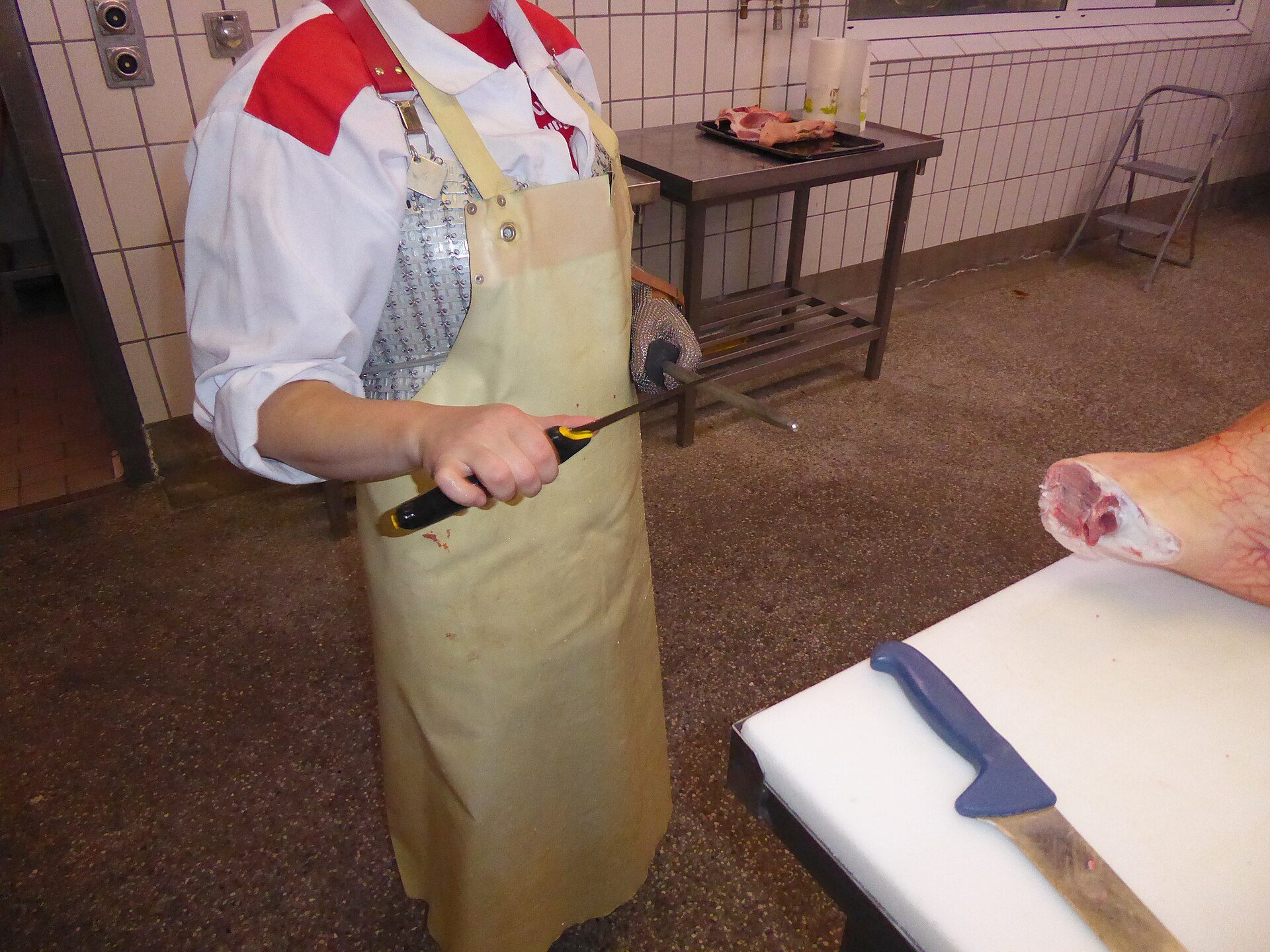
Photo: Fridolin freudenfett / Wikimedia Commons, CC BY 3.0 de
Sharpening on a stone when honing no longer works
If the knife still slides on a tomato skin after honing, the edge is worn and needs sharpening. Sharpening removes a layer of metal to form a new edge: a coarser stone (around #1000) to rebuild the edge, a finer stone (around #3000–6000) to refine it. Using a two-sided whetstone is explained step by step in the kitchen knife skills lesson of the Vietnamese cuisine roadmap; the principle is the same. Japanese-style knives are usually sharpened at a smaller angle than German-style ones, so read your knife maker's advice.
Two quick sharpness checks
- Tomato: rest the edge on the skin and draw lightly without pressing. A sharp knife bites in at once; a dull one slides.
- Onion: after cutting brunoise, a dry board means a sharp knife; a wet board and crushed onion mean a dull one.
Classic Western vegetable cuts and their sizes
The table shows common reference sizes from Western culinary training. Each school or kitchen may differ by about 1 mm; at work, the size on the head chef's recipe card is the final standard.
| Cut | Shape | Reference size | Used for |
|---|---|---|---|
| Brunoise | Very fine dice | 3 × 3 × 3 mm (fine brunoise about 1.5 mm) | Garnish for clear soups, sauces, salsas, stuffings |
| Macedoine | Small dice | About 5 × 5 × 5 mm | Mixed vegetable salads, soups, garnish |
| Julienne | Thin strip | 3 × 3 mm, 5–6 cm long | Salads, garnish, quick stir-fried vegetables |
| Batonnet | Square stick | 6 × 6 mm, 5–6 cm long | Boiled side vegetables, fries, the starting point for dice |
| Paysanne | Thin flat piece | 1–1.5 cm sides, about 3 mm thick | Rustic vegetable soups, sauteed vegetables |
| Chiffonade | Shredded leaves | Ribbons about 1–2 mm wide | Basil, lettuce, spinach for finishing dishes |
| Mirepoix | Rough chunks | 1–2.5 cm depending on cooking time | Stocks, sauces, braises |
Step 0: square off the vegetable
Even strips and dice start from a rectangular block. Cut the carrot into 5–6 cm lengths, then trim off the four curved sides to make a rectangle. Do not throw the curved trim away: put it in a labelled container for stock mirepoix or blended soup.
Julienne and batonnet: from slices to strips
- Cut the squared block into slices exactly 3 mm thick (for julienne) or 6 mm thick (for batonnet).
- Stack 3–4 slices with the edges lined up.
- Cut down through the stack into strips as thick as the slices. A correct strip is square in cross-section, not flat.
Brunoise and macedoine: from strips to dice
Brunoise is cut from julienne: gather a bundle of 3 mm strips and cut across them every 3 mm to get 3 mm cubes (Figure 2). Macedoine is made the same way from 5 mm slices and strips. For onions, the quick method is to halve the onion lengthwise, keep the root on, make parallel lengthwise cuts and a few horizontal cuts, then slice down; the root holds the layers together.
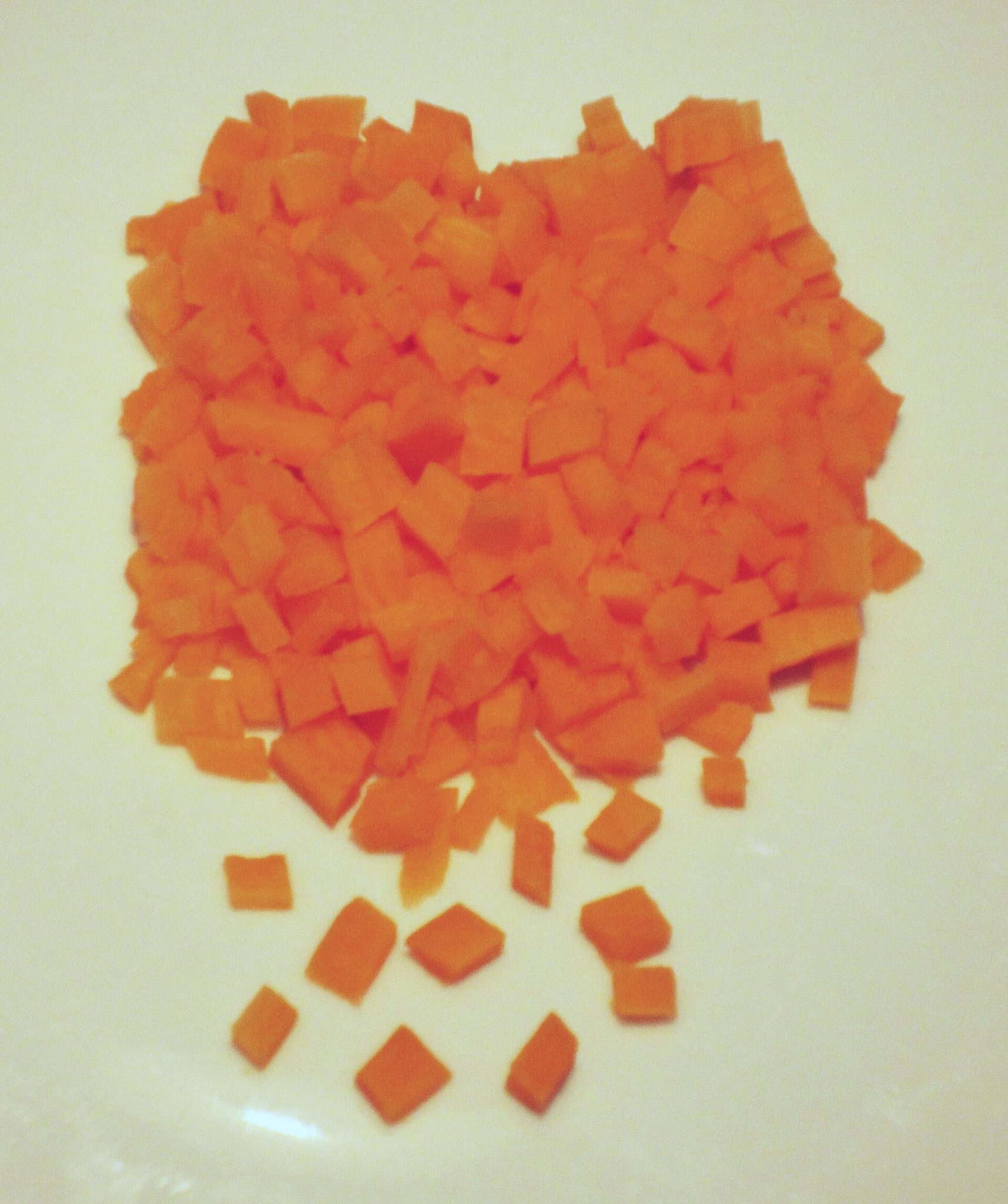
Photo: Martin.Tontsch / Wikimedia Commons, CC0
Chiffonade, paysanne and mirepoix
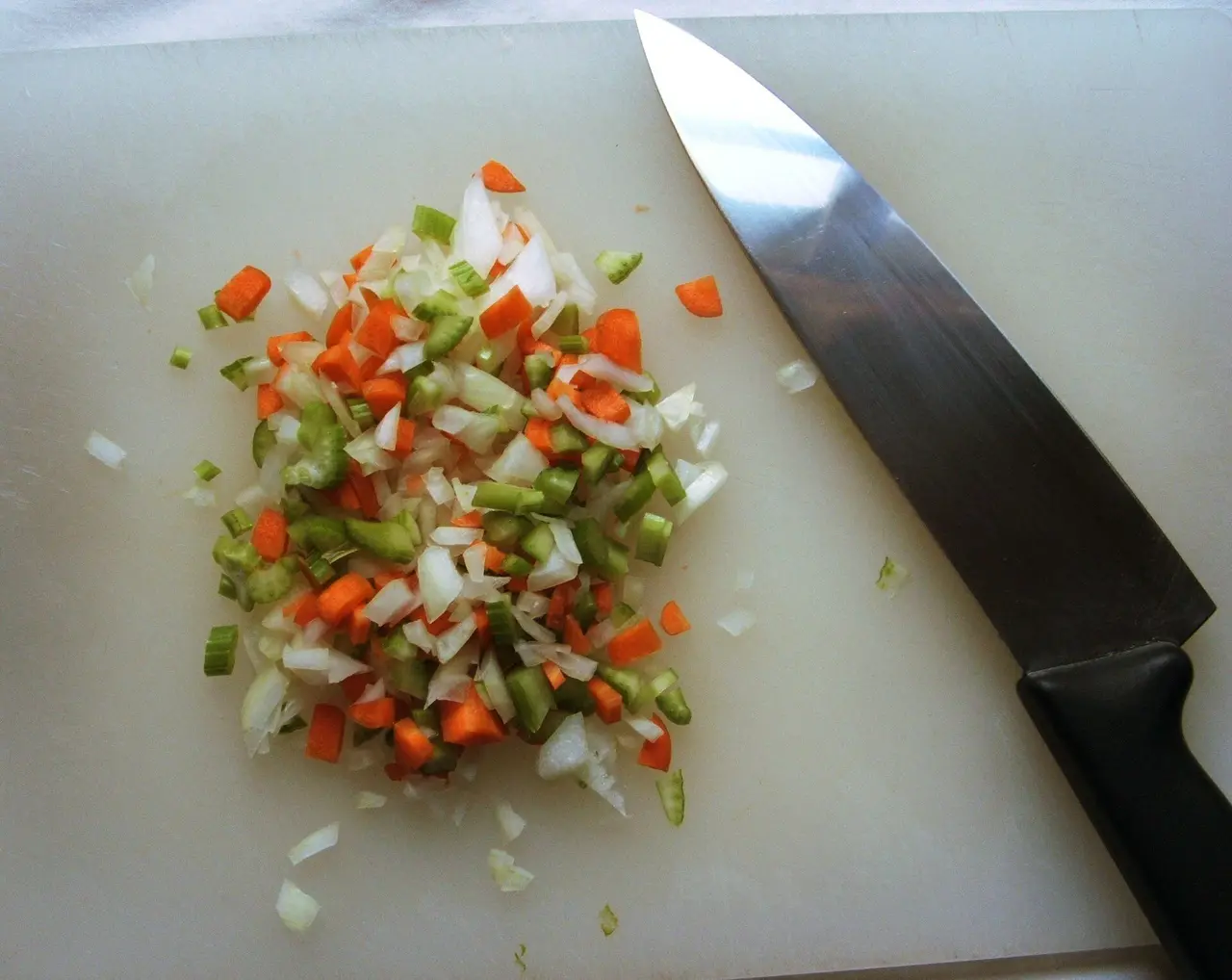
Chiffonade is for leaves: stack 5–6 basil leaves, roll them tightly lengthwise like a cigar, then slice across very thinly with a sharp knife in a single drawing stroke, without chopping (Figure 3). A dull knife or repeated chopping blackens the leaves. Paysanne is a thin flat piece, usually cut from a batonnet sliced 3 mm thick. Mirepoix is a mix of onion, carrot and celery in rough chunks; the size depends on cooking time, and the longer it cooks the larger you cut it (Figure 4).
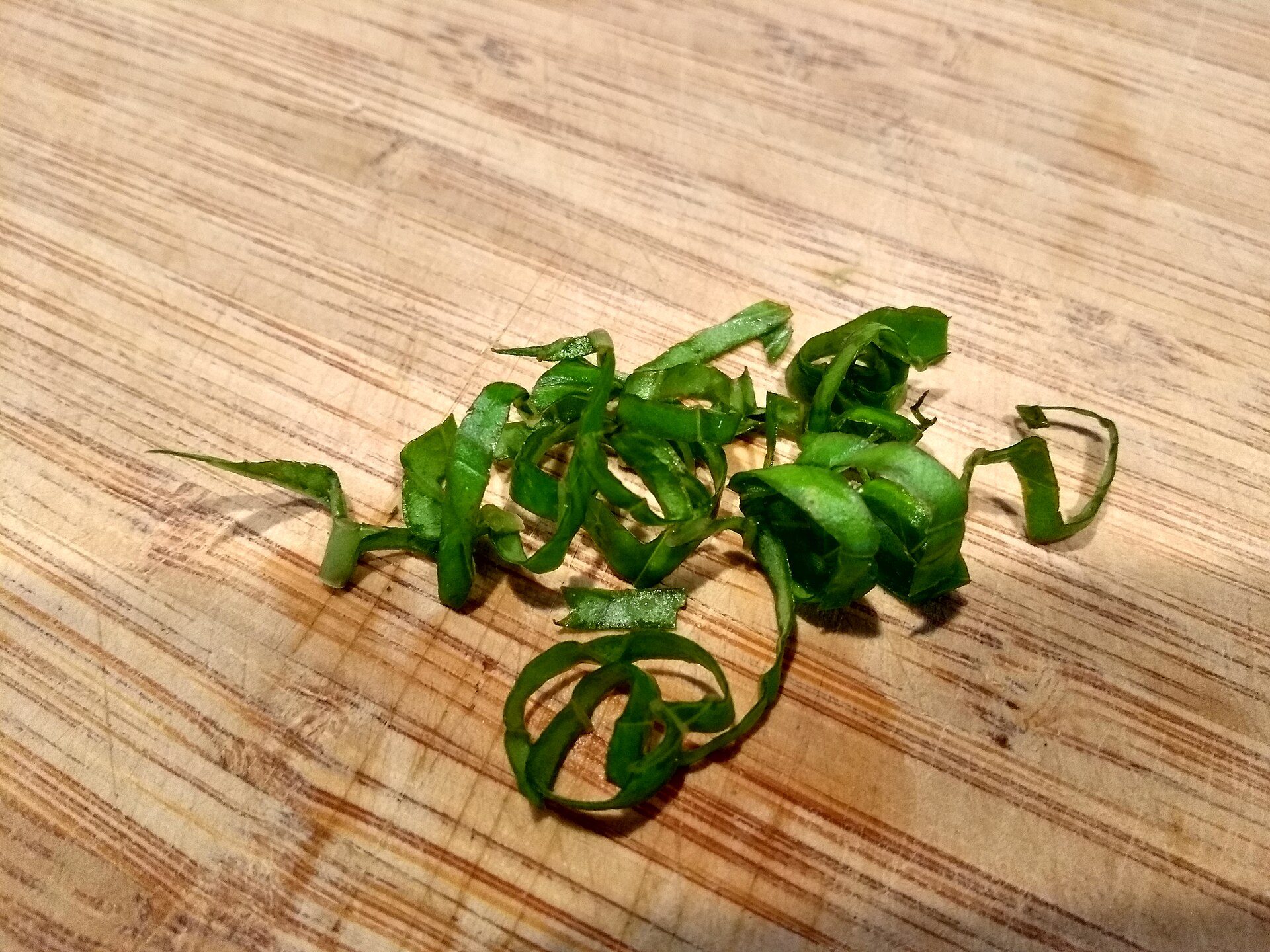
Photo: Cesdeva / Wikimedia Commons, CC BY-SA 4.0
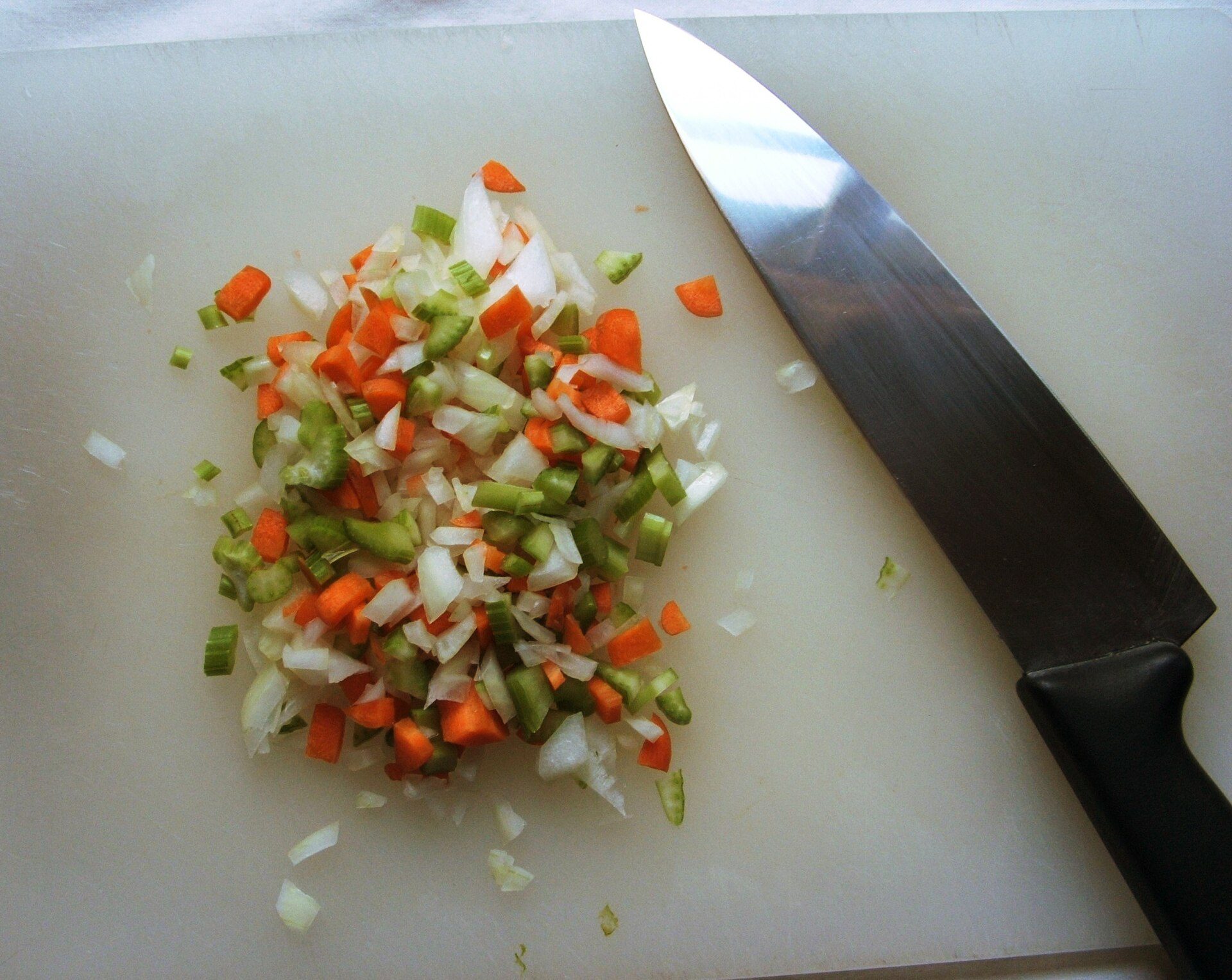
Photo: Mirepoix(cuisine).JPG : Glane23 derivative work: Jerpeck ( talk ) / Wikimedia Commons, CC BY-SA 3.0
Filleting fish the Western way
Fish usually arrives in a Western kitchen whole (sea bass, snapper) or as a whole side of salmon. The commis cuts out clean, boneless flesh of even thickness on the blue board, keeping the fish cold throughout.
Round fish: two fillets
- Start with a scaled, gutted fish, patted dry. Lay it on its side with the back facing you.
- Make a diagonal cut behind the gills, down to the backbone without cutting through it.
- Cut along the back from head to tail, keeping the blade flat against the backbone in long strokes rather than sawing.
- Lift the flesh and glide the blade over the rib bones to free the fillet. Turn the fish over and repeat.
- Trim off the thin belly bones and neaten the edges.
Removing pin bones and skin
Salmon and sea bass have a row of pin bones running down the middle of the fillet. Run a finger against the grain to find them, and pull them out with fish tweezers at an angle towards the head so the flesh does not tear (Figure 5). To skin a fillet, lay it skin side down, hold the tail end firmly, set the knife almost flat between skin and flesh, and work the skin back and forth while the knife stays still.
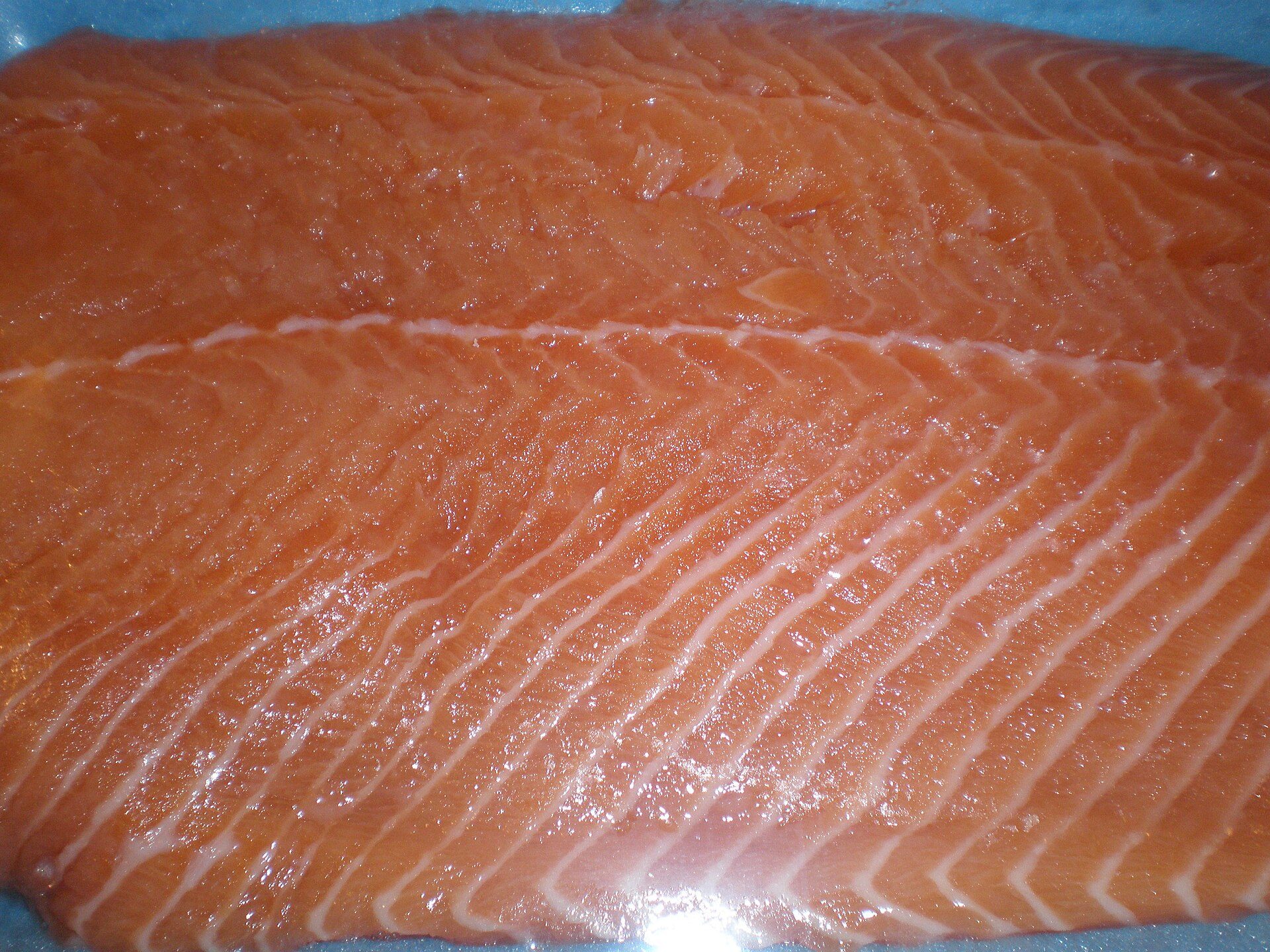
Photo: BrokenSphere / Wikimedia Commons, CC BY-SA 3.0
Portioning to an even weight
A main-course fish portion is usually about 150–180 g depending on the menu. Cut narrower pieces from the thick head end and wider ones from the thin tail end so every portion weighs the same. Weigh each portion and record the count in the log.
Breaking down a chicken into 8 pieces
Breaking down a chicken means separating it at the joints rather than chopping through bone. Done well, the pieces are neat with no bone splinters, and the carcass goes into stock in the next step. Use the raw poultry board and a boning knife.
The 8-piece method
- Lay the chicken on its back. Cut the skin between leg and body, bend the leg back until the hip joint pops, then cut through the joint. You now have a leg quarter, drumstick plus thigh (Figure 6). Repeat on the other side.
- Find the knee joint with your finger (a thin line of white fat) and cut through it to separate drumstick and thigh: 4 pieces.
- Pull out each wing and cut through the shoulder joint: 2 wings.
- Cut along both sides of the breastbone, keeping the blade against the carcass, and lift off 2 breasts. In total, 2 thighs + 2 drumsticks + 2 wings + 2 breasts = 8 pieces.
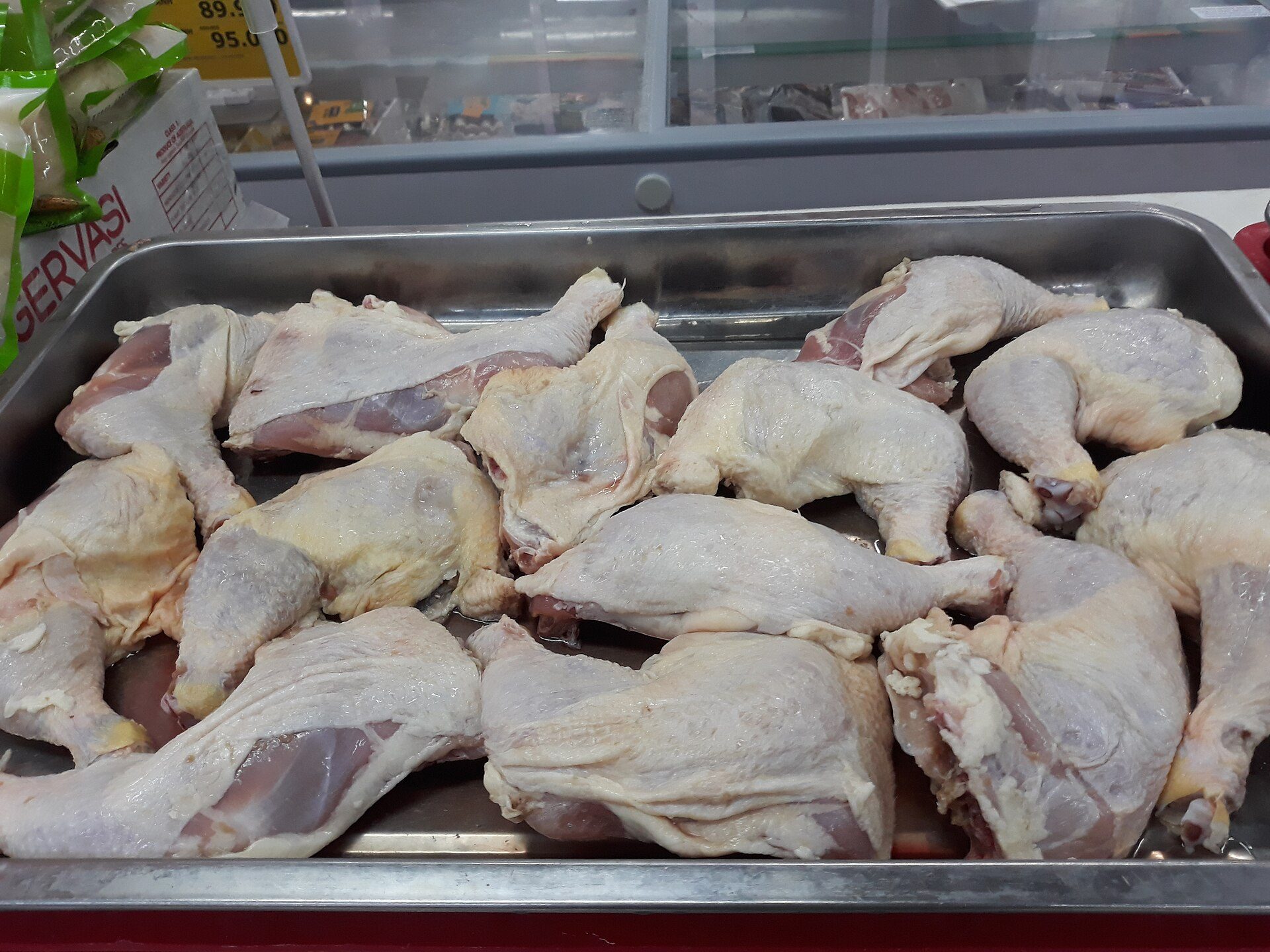
Photo: Baoothersks / Wikimedia Commons, CC BY-SA 4.0
Chicken supreme
A chicken supreme is a skin-on breast that keeps the first wing bone, scraped clean of meat. When lifting the breast, leave the wing attached, cut off the two outer wing sections, then scrape the remaining bone with the back of the knife.
Hygiene after breaking down chicken
Do not rinse raw chicken under the tap, because splashing water spreads bacteria around. When you finish, put the bones in a labelled container in the chiller, wash the knife and board, sanitize the bench and wash your hands before cutting vegetables.
Knife safety in a Western kitchen
Safety warning: Chef's knives, boning knives and mandolines are the most common cause of injury for a commis. Always cut on a board that cannot slip, and give round vegetables a flat side to rest on before cutting. Never try to catch a falling knife; step back and let it drop. Never leave a knife hidden in a sink of soapy water, where someone may reach in and get cut. Carry a knife point down, close to your thigh, and pass it to someone by laying it on the bench. Use the food guard or a cut-resistant glove with a mandoline.
Small habits that prevent cuts
- Keep your eyes on the blade while cutting; if you want to talk, put the knife down.
- Scrape food across the board with the spine, not the edge (safer and keeps the edge sharp).
- When finished, put the knife back in its rack, never under a pile of vegetables.
First aid for a cut and when to see a doctor
Stop cutting and move any food that may have blood on it out of the area. Rinse the wound under clean running water, press firmly with clean gauze or a clean cloth for about 10 minutes and raise the hand above the heart. Cover it with a brightly coloured plaster (many kitchens use blue), put a glove over it, and only then go back to work. This guidance does not replace a doctor.
Go to a clinic straight away or call 115 (the emergency number in Vietnam) if: the bleeding has not stopped after about 10–15 minutes of firm pressure; the cut is deep or gaping and may need stitches; the finger is numb or hard to move; or the wound came from a knife covered in raw meat or dirt, or later becomes swollen, red, hot or full of pus. Ask the doctor about a tetanus shot.
Worked example: mise en place for a 40-cover evening service
Scenario: a 40-seat Western restaurant in Da Nang. The chef de partie asks the commis to prepare before service: carrot brunoise for soup garnish, onion brunoise for a sauce, celery julienne for a salad, basil chiffonade, one side of salmon cut into 160 g portions, and 2 chickens broken down. The figures are an example for learning how to calculate.
Time for each task
| Task | Quantity | New commis (minutes) | Target after 1–2 months (minutes) |
|---|---|---|---|
| Carrot brunoise | 1 kg raw | 40 | 20 |
| Onion brunoise | 1 kg | 25 | 12 |
| Celery julienne | 500 g | 20 | 10 |
| Basil chiffonade | 100 g leaves | 10 | 5 |
| Fillet and portion salmon side | 1.6 kg | 30 | 15 |
| Break down 2 chickens into 16 pieces | 2 birds | 20 | 10 |
| Total | 145 | 72 |
Check: 40 + 25 + 20 + 10 + 30 + 20 = 145 minutes and 20 + 12 + 10 + 5 + 15 + 10 = 72 minutes. A new commis needs almost 2 hours 30 minutes, so must start the shift early. Order of work: vegetables first, then fish, chicken last.
Usable yield of carrots
From 1 kg of carrots: peeling removes about 100 g, squaring off produces about 250 g of trim, leaving about 650 g of brunoise. Check: 650 + 250 + 100 = 1,000 g. The usable yield for brunoise is 650 ÷ 1,000 = 65%. The 250 g of trim is not thrown away: it goes into a container labelled "Mirepoix – carrot" with date, time and name, and is used for that day's stock.
Salmon portion cost (2026 reference, varies by supplier and region)
Assume a skin-on salmon side costs 500,000 VND/kg (about 19 USD); actual prices may range from about 400,000 to 700,000 VND/kg depending on origin and season. A 1.6 kg side costs 1.6 × 500,000 = 800,000 VND. Careful filleting (removing skin, pin bones, thin belly and tail) leaves 1.28 kg of good flesh, an 80% yield, which gives 1,280 ÷ 160 = 8 portions. Cost per portion = 800,000 ÷ 8 = 100,000 VND; check: 8 × 100,000 = 800,000 VND.
If a dull knife leaves flesh on the bones and you get only 1.12 kg, you can cut 1,120 ÷ 160 = 7 portions, and the cost rises to 800,000 ÷ 7 ≈ 114,300 VND per portion, purely because of knife technique. The belly and trim go into cooked dishes or staff meals, following kitchen rules.
Common cutting and filleting mistakes, and how to fix them
Uneven cuts that cook unevenly
Sign: a brunoise tray with big and small pieces; after sauteing, half is mushy and half still hard. Cause: the vegetable was not squared off, slices went from thick to thin, the guiding hand moved back unevenly. Fix: always start from a rectangular block, cut slices first and measure a few with a ruler, use your knuckles as a guide and move back the same distance each stroke.
Crushed, wet vegetables and blackened leaves
Sign: a wet board after cutting onions, basil turning black at the edges. Cause: a dull knife or repeated chopping. Fix: hone at the start of the shift, cut with one decisive drawing stroke, and cut herbs close to service time.
Julienne strips stuck together
Sign: you lift a whole bundle of strips still joined at the bottom. Cause: the blade did not reach the board along its whole length, often from rocking only the tip without a full push. Fix: finish every stroke with the edge touching the board along the full length of the cut.
Torn fillets with bones left in; chicken with bone splinters
Sign: fillets with jagged saw marks, guests finding pin bones, chicken pieces with sharp bone fragments. Cause: sawing back and forth, chopping through bone instead of finding the joint. Fix: use long strokes close to the bone, check for pin bones by touch before portioning, and find each joint with your fingers before cutting.
Frequently asked questions
What is brunoise, and how does it differ from macedoine?
Brunoise is a very fine dice of about 3 mm, cut from julienne strips. Macedoine is a larger dice of about 5 mm. Brunoise is for garnishes and sauces that need small pieces that cook fast; macedoine is for mixed vegetable salads and soups.
What is a julienne cut, and what size is it?
A strip with a square cross-section of about 3 × 3 mm and 5–6 cm long. A 6 × 6 mm strip is called a batonnet.
What is chiffonade?
Chiffonade is a technique for cutting leaves into fine ribbons: stack the leaves, roll them tightly and slice across. It is used for basil, lettuce and spinach; the knife must be sharp so the leaves do not blacken.
How often should I hone and sharpen my knife?
Hone at the start of every shift and whenever the knife begins to slide. Sharpen on a stone when honing no longer lets it cut a tomato skin; in a busy kitchen that is usually every few weeks, depending on the steel and the workload.
Which knife should a beginner in Western cooking buy first?
One chef's knife with a blade of about 20 cm that suits your hand, one paring knife and a honing steel. One decent knife kept sharp beats an expensive set left dull.
Practice exercises and self-assessment
- Cut 500 g of carrots into julienne and then brunoise; measure 10 random cubes with a ruler, note the time and weigh the trim.
- Cut one onion into brunoise keeping the root on; check whether the board is wet.
- Chiffonade 20 basil leaves, wait 15 minutes, then check the colour of the edges.
- Break down one chicken into 8 pieces; if possible, fillet one sea bass into 2 fillets and remove the pin bones.
- Calculate usable yield and portion cost as in the worked example, using the prices you actually pay.
Self-assessment criteria
- Pass: at least 8 of 10 brunoise cubes measure 2.5–3.5 mm; julienne strips are square in cross-section and separate.
- Pass: the board stays dry after cutting onion; the basil chiffonade has not blackened after 15 minutes.
- Pass: all 8 chicken pieces were cut through joints with no splinters; no pin bones can be felt in the fish fillet.
- Not yet: cutting on a sliding board, using an unhoned knife, or throwing away trim instead of labelling it for stock.
Once your cuts are even, move on to the next step of the roadmap: Stocks & the five mother sauces, where the chicken bones, fish frames and mirepoix you have just prepared become the base of every Western sauce. When you reach heat techniques, slicing meat against the grain in the lesson on pan-searing a beef steak relies on the same sharp knife you learned to keep here.
Keep learning Western cooking: after knife skills come stocks and the five mother sauces, heat techniques, pasta and risotto, plating, and a 3-course set menu for 20 guests. See the 8-step Western cuisine cook roadmap.