Food hygiene in a professional kitchen comes down to one sentence: keep raw and cooked food apart, keep food out of the 5–60°C range for as short a time as possible, keep hands and tools clean, and keep yourself safe around flames, hot oil and gas. New staff in a restaurant or rice shop are usually given washing, picking and prep jobs first, so these habits have to be in place from day one, even before knife skills. This lesson is step 1 of the Vietnamese cuisine cook roadmap, written the way a head chef briefs a new kitchen helper: every rule comes with the reason, the method and a way to check yourself.
By the end of this lesson, you will be able to:
- Organise a fridge and freezer in the right raw-to-cooked order, read a fridge thermometer and keep a temperature log every shift.
- Apply 10 rules for personal hygiene, tools and the prep area during a real kitchen shift.
- Take and store food samples correctly when the kitchen cooks pre-portioned meals or caters events.
- Know which food safety papers and health checks kitchen staff in Vietnam usually need, and where to ask.
- Respond correctly to a burn, a pan of oil on fire and the smell of gas.
Learning to cook Vietnamese food properly? Food safety and kitchen safety are the first of 8 steps on the roadmap, before knife skills, broths and braises or stir-fries. See the Vietnamese cuisine cook roadmap to learn in the right order.
Why is food safety the first lesson of cooking as a trade?
A delicious dish that makes guests ill costs a restaurant its customers and its reputation, and can lead to fines. Food poisoning rarely comes from one big mistake. It comes from many small ones adding up: the board used for raw meat goes straight on to raw herbs, a pot of soup cools on the stove all afternoon, hands go unwashed after taking out the rubbish.
Three groups of kitchen hazards
- Biological: bacteria, viruses and parasites in raw meat, fish, eggs, vegetables, dirty water and on workers' hands.
- Chemical: dish soap and bleach stored near food, frying oil reused again and again, additives of unknown origin.
- Physical: bone fragments, broken glass, staples, hair and metal pieces from damaged tools.
The 5–60°C danger zone
Disease-causing bacteria multiply fastest between about 5 and 60°C, which is exactly room temperature in Vietnam. A common food safety rule is that cooked food should not sit at room temperature for more than 2 hours; if it is not being eaten, hold it hot above 60°C or chill it below 5°C. Every rule below about fridges, hot holding and cooling revolves around these numbers.
Small kitchens must do it right too
A 40 m² rice shop and a 200-seat restaurant kitchen follow the same principles. Only the scale differs: in a small shop one person covers several jobs, so fixed habits matter even more than memory when it gets busy.
10 food hygiene rules for the kitchen
This is the minimum set of rules any head chef checks in a new kitchen helper. Print it and stick it next to the hand-wash sink so the whole team sees it.
The 10 rules and how to check yourself
| # | Rule | How | Self-check |
|---|---|---|---|
| 1 | Wash hands at the right moments | Soap and clean water for at least 20 seconds, dry with paper towels | After touching raw food, rubbish, a phone, money or using the toilet |
| 2 | Clean kitchen clothing | Chef jacket, apron, cap or hairnet, short nails | No rings or bracelets during prep |
| 3 | Separate raw and cooked | Separate boards, knives and trays for raw and cooked food | Boards are coloured or marked, never mixed |
| 4 | Stack the fridge by shelf | Cooked and ready-to-eat food on top; raw meat and fish at the bottom | No meat juice dripping onto cooked food |
| 5 | Keep fridge temperatures | Chiller 0–5°C, freezer −18°C or colder | Log temperatures at the start and end of each shift |
| 6 | Thaw safely | Thaw in the chiller or under cold running water, never on the floor | Never refreeze thawed food |
| 7 | Cook thoroughly, reheat to boiling | Cook poultry and minced meat right through; reheated dishes must boil or be hot throughout | Probe the centre with a thermometer when in doubt |
| 8 | No cooked food at room temperature for over 2 hours | Hold hot above 60°C or cool quickly | Write the cooking time on the tray |
| 9 | First in, first out | Every box labelled with name, prep date and time | No unlabelled boxes in the fridge |
| 10 | Clean and sanitise after the shift | Wash, rinse, sanitise and air-dry boards, knives and counters | Chemicals stored separately and labelled |
Hand washing: the small job that matters most
A cook's hands are the fastest route for contamination from raw to cooked food. Wash palms, backs of hands, between the fingers, fingertips and wrists, then dry with single-use paper towels (Figure 1). Gloves do not replace hand washing: a dirty glove that touches raw meat and then raw herbs is more dangerous than a bare hand, because the wearer believes they are clean.
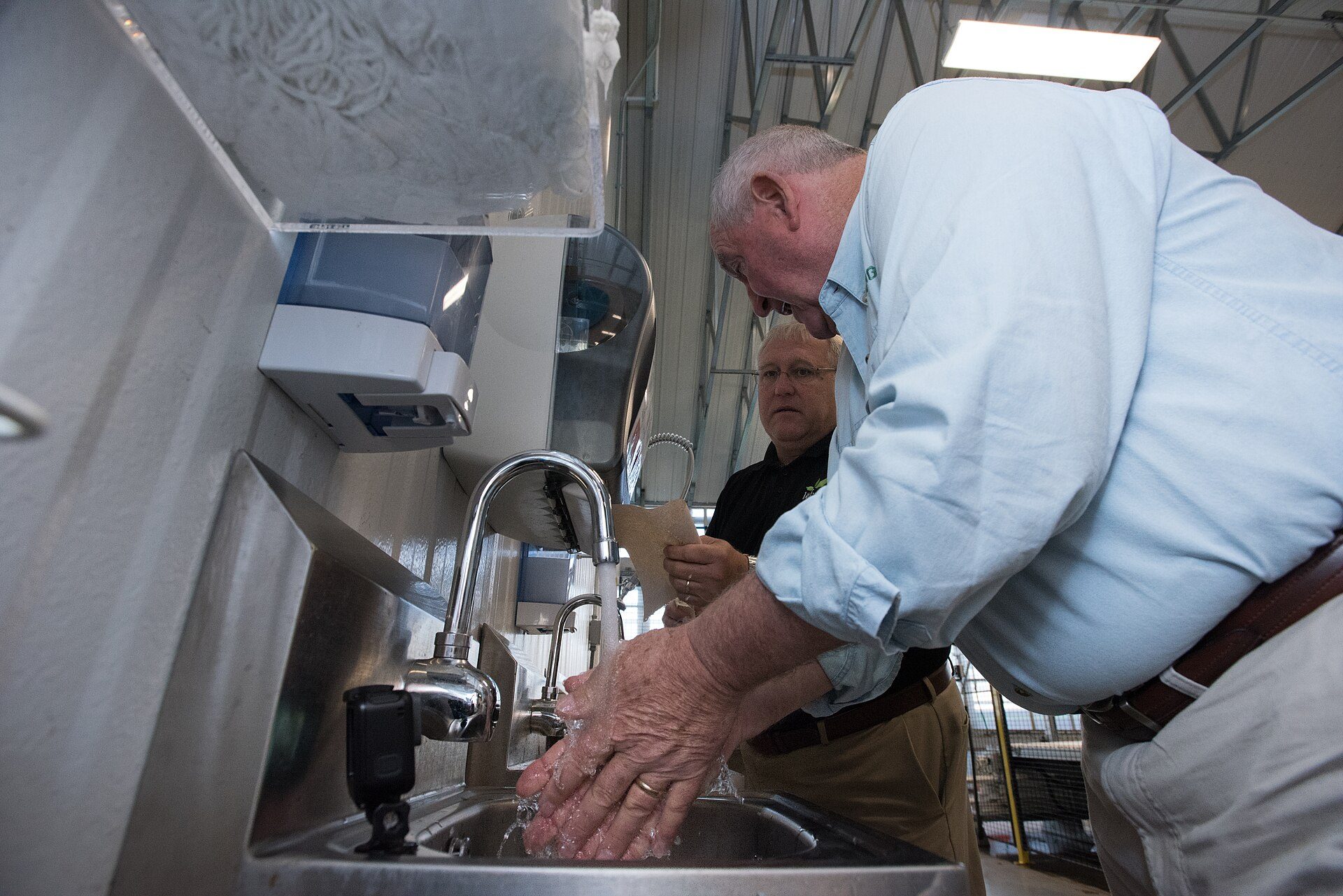
Photo: U.S. Department of Agriculture / Wikimedia Commons, Public domain
When to wear gloves
Wear gloves when you touch ready-to-eat food that will not be cooked again: portioning rice, arranging raw herbs, rolling fresh spring rolls, packing dishes into boxes (Figure 2). Change gloves when you switch tasks, when they tear, and after touching money, a phone or a dirty surface. An open cut on the hand must be covered with a waterproof dressing before putting a glove on.
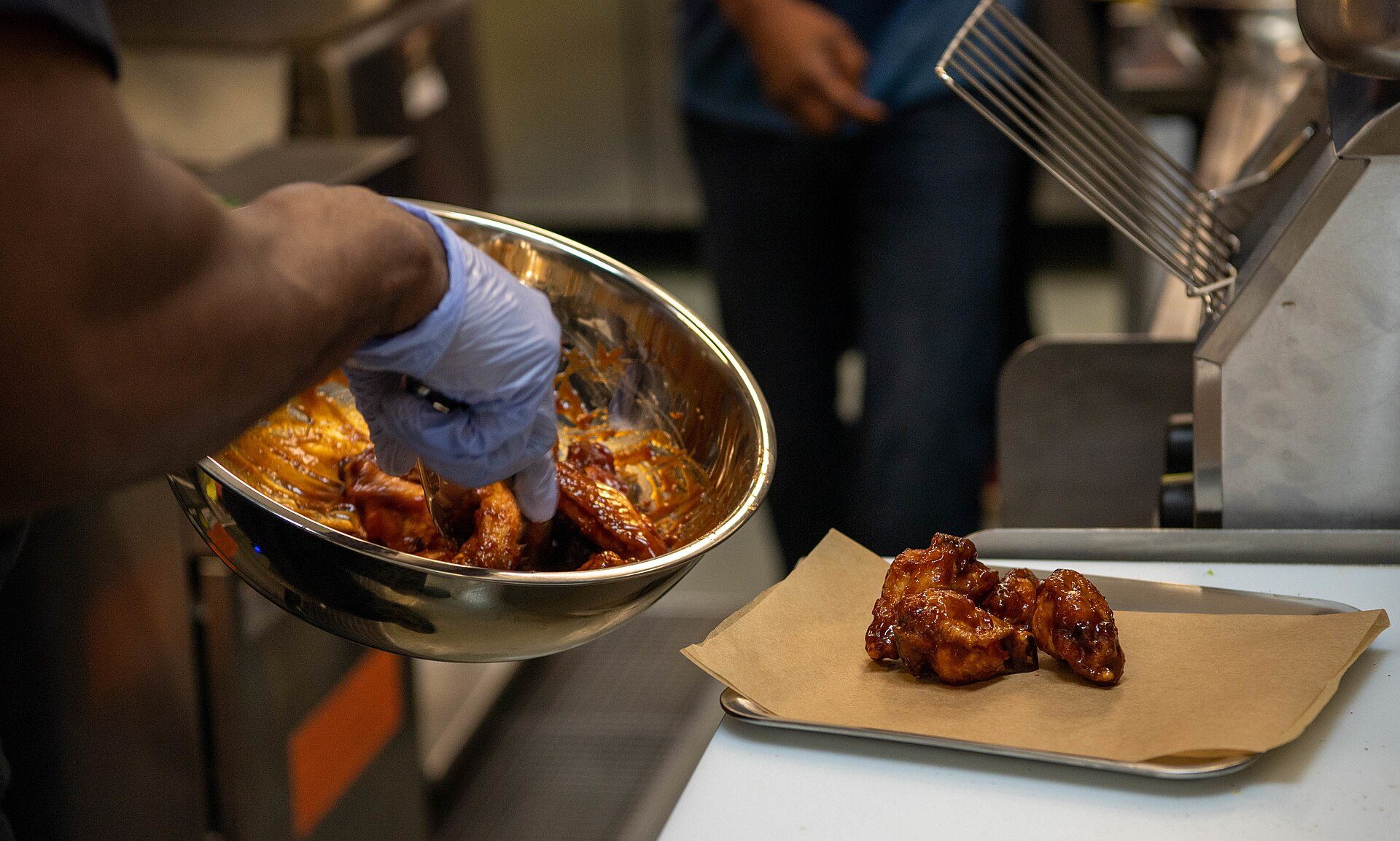
Photo: U.S. Air Force photo by Airman 1st Class Jordan Lazaro / Wikimedia Commons, Public domain
Keeping raw and cooked apart, and fridge and freezer temperatures
Most food poisoning cases in eateries start with cross-contamination: bacteria from raw meat, fish or eggs reach cooked food or raw salad via knives, boards, hands or juices dripping inside the fridge.
Separate boards, knives and trays
Vietnamese cooking uses a lot of raw food: fresh herbs, bean sprouts, cucumber and fresh rolls. So you need at least three sets of boards and knives: one for raw meat and fish, one for cooked food (boiled meat, pork roll), and one for fruit and vegetables eaten raw. Many kitchens use coloured plastic boards to avoid mix-ups, for example red for raw meat, blue for seafood, green for vegetables and white or yellow for cooked food. There is no single compulsory colour code; what matters is that the whole kitchen knows it and follows it.
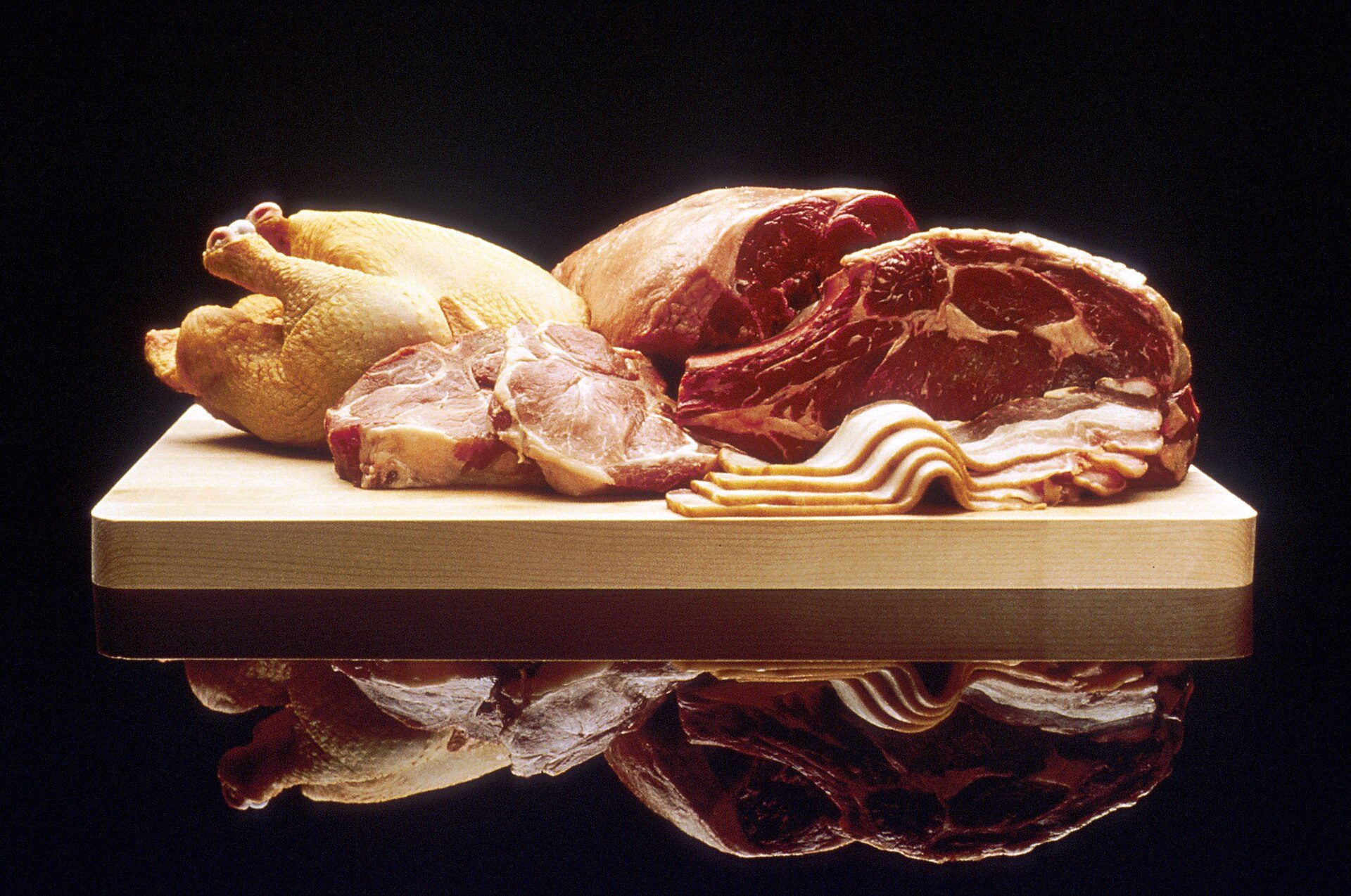
Photo: Unknown photographer / Wikimedia Commons, Public domain
Look at Figure 3: after cutting raw meat, a board like this carries meat juice and bacteria. If you then slice boiled pork on the same board, the cooked food is contaminated again even though it was cooked thoroughly.
Stacking the chiller by shelf
- Top shelf: cooked dishes, chilled broth, dipping sauces, washed vegetables to be eaten raw.
- Middle shelf: milk, eggs, unprepared vegetables, items prepped for cooking that day.
- Bottom shelf: raw meat, fish and seafood, in trays with sides and covered with a lid or cling film.
The reason is simple: juices from raw food run down, never up. Do not overfill the fridge, because cold air needs to circulate; in a crammed fridge the back is cold and the front is warm.
Fridge temperatures and the log
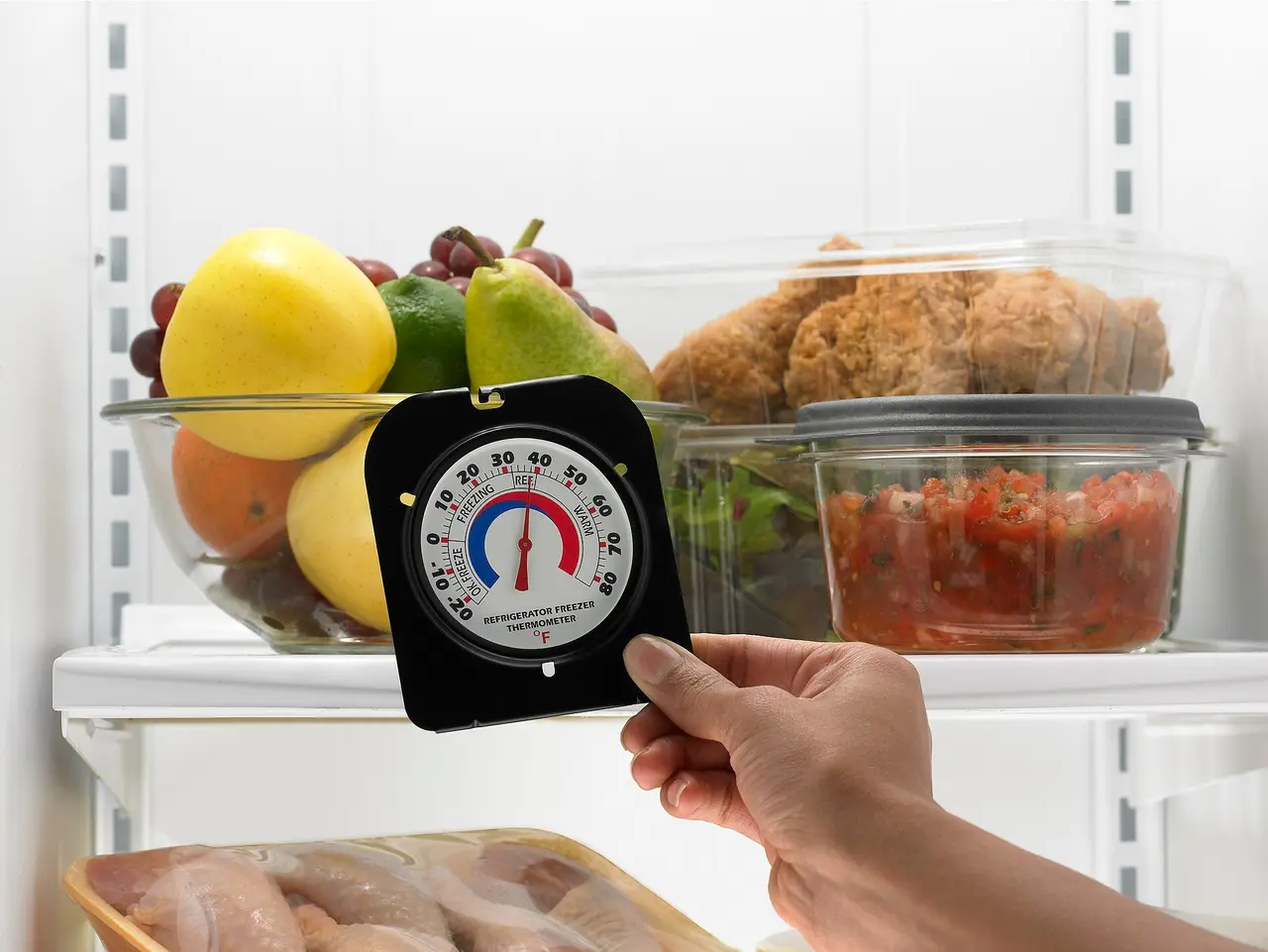
Put an independent thermometer in each fridge (Figure 4), and do not rely only on the display, because the fridge's own sensor may sit in the coldest spot. A common standard is a chiller at about 0–5°C and a freezer at −18°C or colder. Record the temperature twice per shift: when you open and when you close. If the chiller stays above 5°C for more than a few hours, tell the head chef so the contents can be checked.
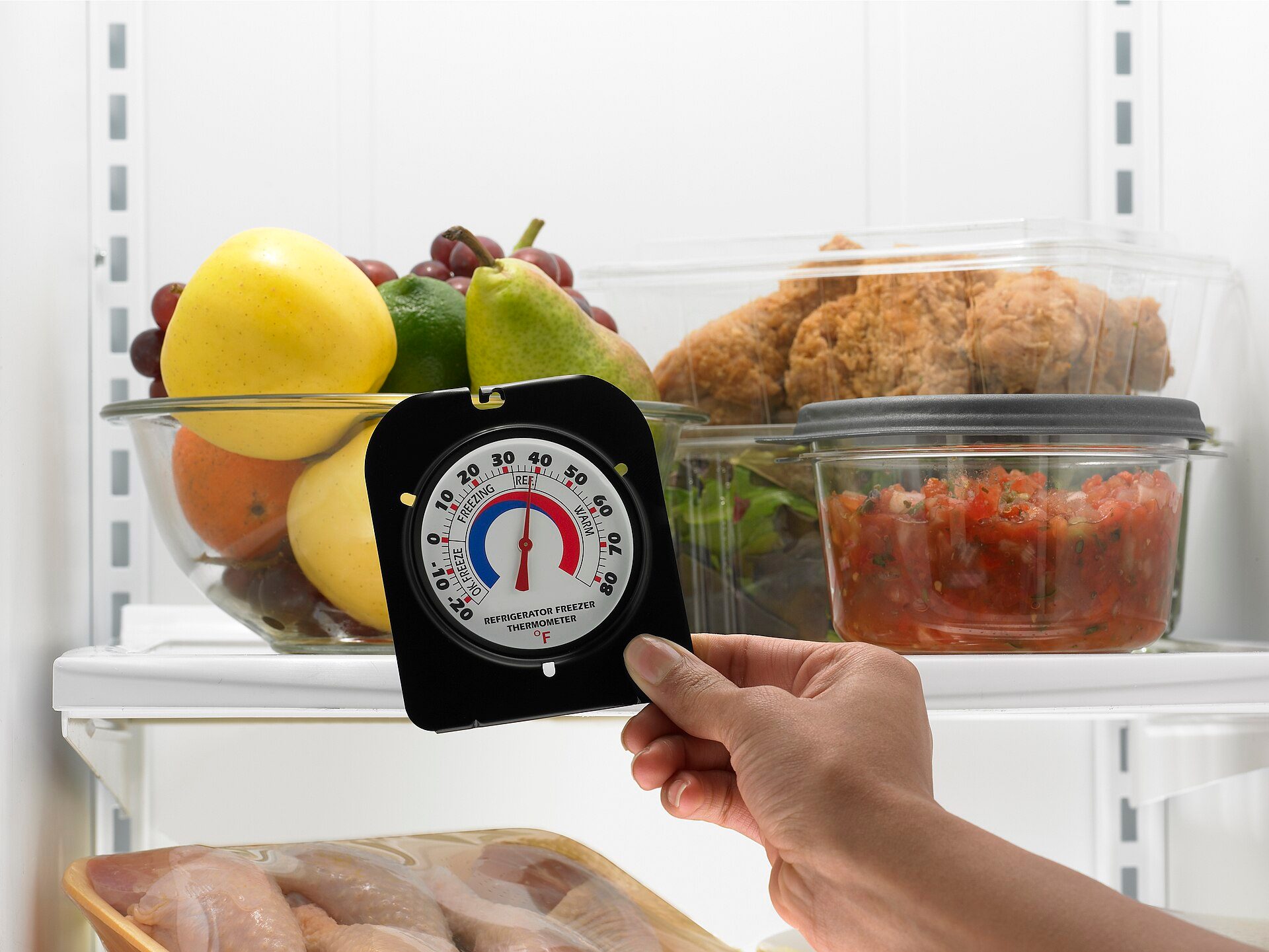
Photo: USDAgov / Wikimedia Commons, Public domain
Labelling and first in, first out
Every box in the fridge needs a label: dish or ingredient name, prep or cooking date and time, and who made it. New stock goes to the back, older stock comes forward to be used first. A box with no label and no date gets thrown away; losing one box is better than losing the restaurant.
Food samples, food safety papers and health checks
The owner usually handles the paperwork, but kitchen staff need to understand it to avoid mistakes and to know what to prepare when applying for jobs.
What is a food sample?
Keeping a food sample means setting aside a portion of every cooked dish in a clean lidded container, labelling it and keeping it chilled for a set period, so that if someone gets food poisoning, health authorities have a sample to test. Under the current guidance of Vietnam's Ministry of Health, common practice is about 100 g per solid dish and about 150 ml per liquid dish, kept at about 2–8°C for at least 24 hours. This is usually compulsory for canteens, pre-portioned meal kitchens and catered events; a made-to-order restaurant should check the specific requirements with the local authority.
How to take a sample properly
- Use a separate container for each dish, washed and scalded with boiling water or sterilised, with a tight lid.
- Take the sample as soon as the dish is cooked, using a clean ladle or tongs; never from food left by guests.
- Label it: dish name, time taken, who took it, and which meal or event.
- Store it in a separate chiller or a separate area of the fridge, away from cooking stock.
- Only discard the sample once the holding period has passed with no incident, and record it in the log.
Common papers for an eatery
- For the business: depending on type and size, a certificate that the premises meet food safety conditions, or a signed food safety commitment.
- For kitchen staff: confirmed food safety knowledge (through training and a test), and a health certificate when required.
The rules on these papers in Vietnam have changed several times and can vary between localities. This lesson is not a legal text: ask the owner, the district health office or the local food safety authority, and read the current regulations before opening an eatery.
When you must stay out of the kitchen
Anyone with diarrhoea, vomiting, fever, jaundice, a sore throat with fever, or an infected wound on the hands must not handle food directly. Tell the head chef so you can be moved to another task or take time off. Hiding an illness to keep working is the fastest way to make the whole kitchen and its guests sick.
Kitchen safety: burns, oil fires and gas leaks
Vietnamese kitchens do a lot of deep-frying and high-heat stir-frying, keep broth pots boiling all day and run on industrial gas burners. The three most common accidents for new staff are burns from boiling water or oil, a pan of oil catching fire, and gas leaks.
Safety warning: If a pan of oil catches fire, never pour water on it: water flashes into steam in hot oil and throws burning oil into a huge column of flame (see Figure 5). Turn off the heat, cover the pan tightly with a metal lid or fire blanket, and leave it until fully cool; never carry a burning pan away. If you smell gas: do not switch any electrical switch on or off, do not light anything, do not use a phone in the kitchen; close the cylinder valve, open doors for ventilation, leave the area, then call a qualified person to check. If the fire spreads or someone is badly hurt, call 114 (fire) and 115 (ambulance) in Vietnam.
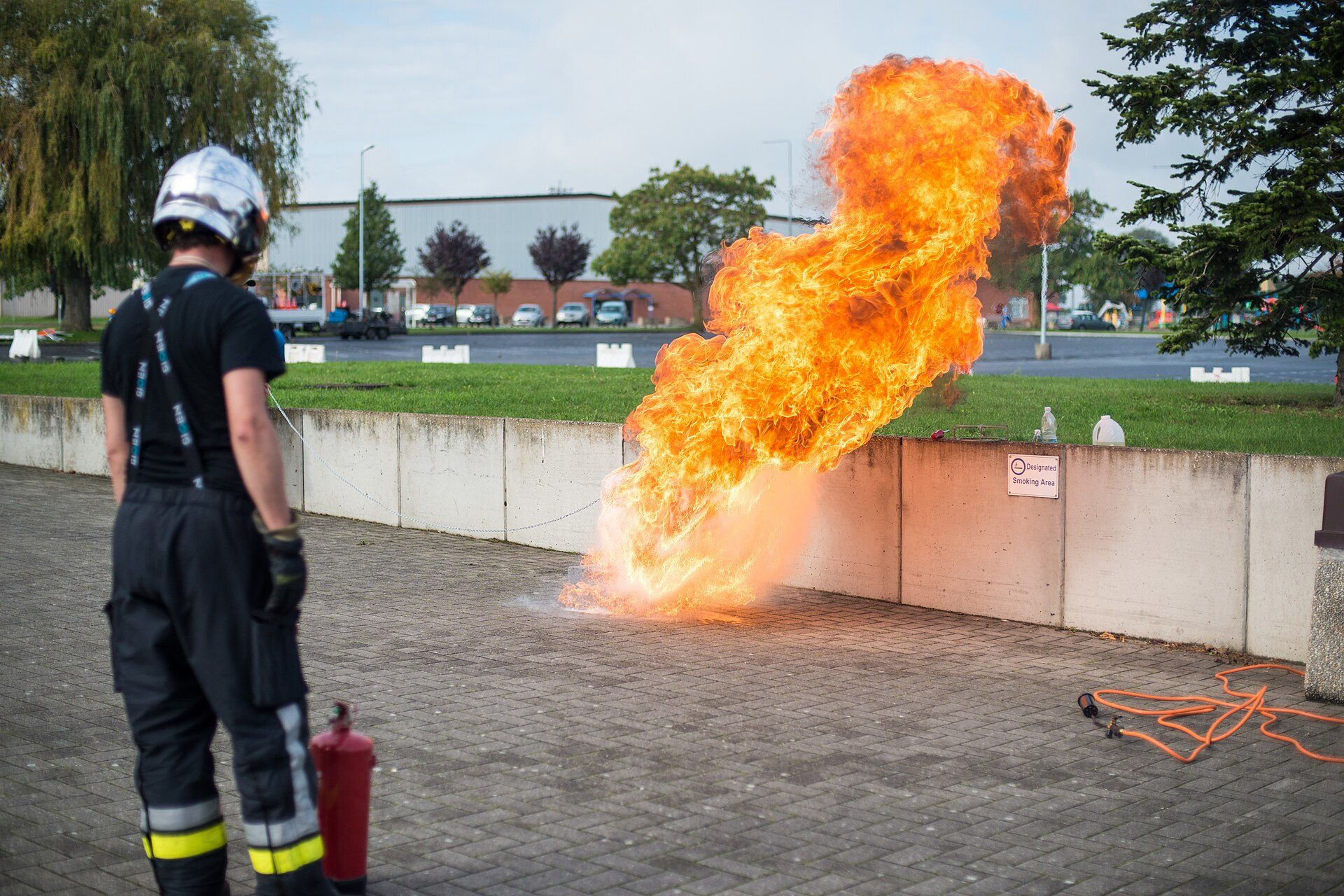
Photo: U.S. Army photo by Pierre Courtejoie / Wikimedia Commons, Public domain
Preventing burns around big pots and hot oil
- Turn pan and pot handles inward, never sticking out into a walkway.
- Food going into hot oil must be drained of water; slide it in from the edge of the pan, away from you.
- Never carry a full broth pot alone; ladle it out with a long-handled ladle or use a pot with a tap. Cooling large broth pots is covered in the lesson how to make pho beef broth in a 50-litre pot.
- Wear closed, non-slip shoes; mop up wet floors immediately.
- Call out "hot" or "behind" when carrying hot food past others.
First aid for burns
Cool the burn under clean, cool running water (not ice water) for about 20 minutes, and remove rings and watches before swelling starts. Do not apply toothpaste, fish sauce or folk remedies, and do not pop blisters. Cover with clean gauze. For large or deep burns, burns to the face, hands or genitals, or widespread burns from hot oil, go to a medical facility at once or call 115. This lesson does not replace a doctor's advice.
Gas burners and fire extinguishers
Check gas hoses and valves every morning with soapy water (bubbles mean a leak). Gas hoses must not run over hot spots or be kinked. Cylinders stand upright in a ventilated place. The kitchen must have an extinguisher and a fire blanket near the exit, and everyone must know where they are and how to use them. On your first day, ask the head chef: where is the main breaker, where is the main gas valve, where is the exit?
Worked example: one day of food safety in an 80-meal rice shop
An office rice shop sells 80 lunch portions with a kitchen team of three: the head cook, a new kitchen helper and a dishwasher. The head cook puts the new helper in charge of "food safety for the shift". This is how the helper works from morning to afternoon.
Hour-by-hour schedule
| Time | Task | Pass check |
|---|---|---|
| 6:30 | Log chiller and freezer temperatures; test the gas valve with soapy water | Chiller 3°C, freezer −19°C, no bubbles at the valve |
| 6:45 | Receive meat, fish and vegetables; check colour, smell and temperature; put raw items straight onto the bottom shelf | Meat cold to the touch, not slimy, no off smell |
| 7:00–9:30 | Prep: meat and fish on the red and blue boards; vegetables on the green board; wash hands at each change of task | No board mix-ups |
| 9:30–10:45 | The head cook makes 6 dishes; the helper samples each one as soon as it is done | 6 labelled sample boxes in the fridge before 11:00 |
| 11:00–13:00 | Service; main dishes kept in a bain-marie, soup kept on a low flame | Hot food above 60°C |
| 13:15 | Leftovers: cool quickly or discard according to shop policy | No cooked food out for more than 2 hours |
| 14:00 | Wash and sanitise boards, knives and counters; second fridge log | Chemicals stored separately, chiller below 5°C |
Working out the samples to keep
The lunch menu has 4 main dishes, 1 stir-fry and 1 soup. Solid dishes: 4 mains + 1 stir-fry = 5 dishes × 100 g = 500 g. Liquid dishes: 1 soup × 150 ml = 150 ml. That is 6 sample boxes a day. Samples are held for 24 hours, so the fridge always holds today's and yesterday's samples: 6 + 6 = 12 boxes, and you need about 15 boxes to rotate while some are being washed.
Starter safety equipment cost (2026 reference, varies by region)
| Item | Quantity × unit price | Total |
|---|---|---|
| Fridge thermometers (chiller + freezer) | 2 × 60,000 VND | 120,000 VND |
| Probe thermometer for food cores | 1 × 150,000 VND | 150,000 VND |
| Coloured plastic boards | 4 × 120,000 VND | 480,000 VND |
| Lidded stainless sample boxes | 15 × 30,000 VND | 450,000 VND |
| Portable fire extinguishers | 2 × 350,000 VND | 700,000 VND |
| Fire blanket | 1 × 250,000 VND | 250,000 VND |
| First aid kit (gauze, waterproof dressings) | 1 × 300,000 VND | 300,000 VND |
| Gloves and hairnets for 1 month | 1 × 400,000 VND | 400,000 VND |
| Total | 2,850,000 VND | |
Check: 120,000 + 150,000 + 480,000 + 450,000 + 700,000 + 250,000 + 300,000 + 400,000 = 2,850,000 VND (about 110 USD). Spread over 80 portions × 26 trading days = 2,080 portions in the first month, each portion carries about 1,370 VND; from the second month on, only gloves and hairnets remain. Real prices vary by brand and supplier.
Common beginner mistakes and how to fix them
One board for everything
Sign: a board with streaks of meat blood, and a moment later cucumber being sliced on it. Cause: rushing, too few boards, no agreed system. Fix: enough boards by colour, a colour chart on the wall, and boards washed straight after use rather than stacked.
Leaving soup or braise pots to cool on the stove until the afternoon
Sign: after service the pot sits on a switched-off burner with the lid on. Cause: thinking "let it cool before it goes in the fridge". Fix: split into shallow trays, set them in an ice bath, and refrigerate once the temperature has dropped; or discard leftovers according to shop policy.
Thawing meat on the floor or in a basin of water overnight
Sign: a bag of frozen meat in a corner of the kitchen since last night. Cause: forgetting to move it to the chiller early. Fix: plan thawing in the chiller from the day before; if in a hurry, thaw in its sealed bag under cold running water and cook it right away.
Storing chemicals next to seasonings
Sign: a bottle of bleach on the shelf next to the fish sauce and the oil. Cause: convenience. Fix: a separate chemical shelf, lower than any food, bottles kept in their original labelled containers; never decant chemicals into old water or fish sauce bottles.
Frequently asked questions
How is food hygiene in a restaurant kitchen different from a home kitchen?
The principles are the same, but a restaurant cooks more, holds food longer and serves many people, so one small mistake can affect dozens of guests. That is why restaurant kitchens need temperature logs, box labels, food samples when required, and papers for the premises and staff.
What temperature should a chiller be?
The common standard is about 0–5°C, with the freezer at −18°C or colder. Check with an independent thermometer and log it every shift. Opening the door constantly at peak times raises the temperature, so take items out in batches and close the door quickly.
How long are food samples kept, and how much?
Common practice under current Ministry of Health guidance in Vietnam is at least 24 hours, about 100 g of each solid dish and 150 ml of each liquid dish, kept at 2–8°C. Ask the local authority, because requirements can differ by kitchen type and may be updated.
What food safety papers does a new kitchen helper need to apply for a job?
Many employers ask for a health certificate and confirmed food safety knowledge; some send new staff to training after hiring. Ask the employer directly and keep copies of the papers you already have in your application file.
Can food left out overnight be reheated and used?
It should not be. Boiling kills many bacteria but does not destroy the toxins some bacteria produce while food sits in the 5–60°C range. Cooked food left out for more than 2 hours should be thrown away.
Practice tasks and self-assessment
- Sketch the chiller at your workplace or at home, re-stack it in the correct raw-to-cooked order, and take before and after photos.
- Log chiller and freezer temperatures twice a day for 7 days.
- Practise taking samples for a 4-dish meal: boxes, labels, sample size, time taken and time discarded.
- Explain out loud to your mentor what to do when oil catches fire, when you smell gas and when someone is scalded.
Self-assessment criteria
- Pass: the fridge is stacked by shelf, every box is labelled, the log has all 14 entries, and the chiller was never above 5°C without it being reported.
- Pass: 4 sample boxes with dish name, time, sampler and the right amount of 100 g or 150 ml.
- Pass: you state the correct order for an oil fire (heat off, cover tightly, no water) and a gas leak (close the valve, no switches, ventilate).
- Not yet: still sharing raw and cooked boards, unlabelled boxes in the fridge, or not knowing where the extinguisher is.
Once these safety habits are second nature, move on to the next roadmap step: Knife skills, meat, fish & herb prep, where you learn knife grip, slicing, julienne and dicing, cleaning fish, butchering meat and keeping herbs fresh, still with separate raw and cooked boards.
Keep learning Vietnamese cooking: after kitchen safety come knife skills, pho and noodle broths, regional dipping sauces, braising, stir-frying and steaming, rush-hour service and dish costing. See the 8-step Vietnamese cuisine cook roadmap.