Kitchen knife skills come down to three things you must master before you run a station: hold the knife firmly and keep your guide hand in a "claw" so you can slice, julienne and dice evenly; keep the knife sharp with a whetstone and a honing rod; and prep meat, fish, offal and herbs in the right order on the right board. A head cook can tell whether a newcomer has real skills just by looking at how even the cuts are, how much meat and fish ends up in the bin, and how the prep bench looks. This is step 2 of the Vietnamese cuisine cook roadmap, with a worked example of prep for a 60-portion rice shop lunch in which the times and costs add up.
By the end of this lesson, you will be able to:
- Choose three core knives, hold the knife and secure the board, and slice, julienne and dice to the sizes in the table.
- Sharpen a knife on a two-sided whetstone at a steady angle and check sharpness before every shift.
- Trim meat, cut beef across the grain, clean and deodorise pork offal, and clean and fillet fish without bursting the gall bladder.
- Pick, wash and store fresh herbs for 2–5 days, and order your prep so raw and cooked foods never cross-contaminate.
- Work out the usable yield of meat and fish and the food cost after prep for one lunch service.
Learning to cook Vietnamese food properly? Knife skills and prep are step 2 of the 8-step roadmap, after food safety and before pho, bun bo and hu tieu broths. See the Vietnamese cuisine cook roadmap to learn in the right order.
Choosing knives and boards, and holding the knife safely
A Vietnamese kitchen does not need an expensive knife set, just three sharp knives with solid handles. Beginners cut themselves because of blunt knives, slipping boards and a badly placed guide hand, not because a knife is too sharp.
Three knives for a Vietnamese kitchen
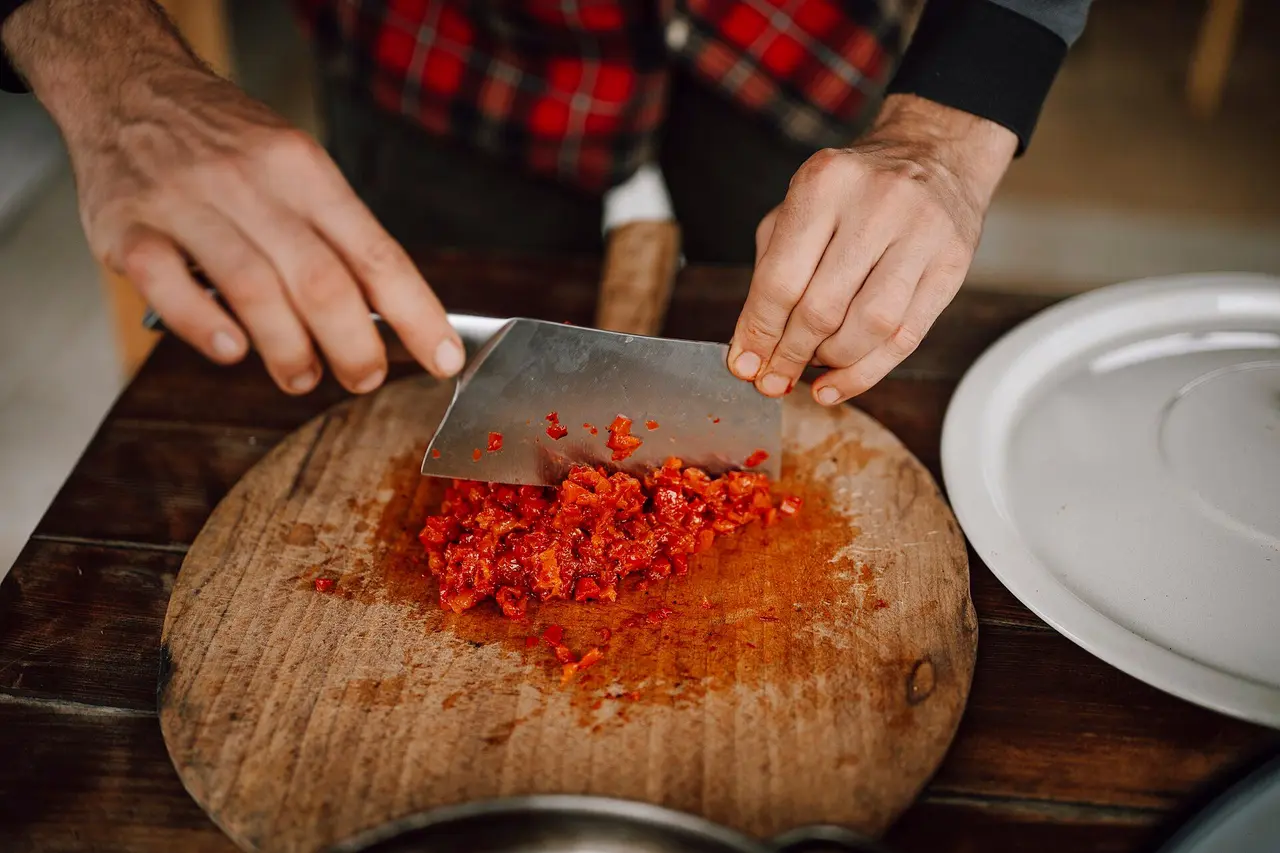
- Cleaver ("dao phay"): thick, heavy blade for chopping chicken and rib bones, crushing lemongrass, ginger and garlic, and mincing meat (Figure 1).
- Cook's knife with an 18–22 cm blade: the daily workhorse for slicing meat and vegetables, julienne and dice.
- Small knife with an 8–12 cm blade: peeling, carving chillies, scoring fish, trimming sinew and membrane.
Never chop bones with a thin slicing knife: the edge chips, and from then on it tears meat instead of cutting it.
How to hold the knife: pinch grip and claw grip
Pinch the blade just in front of the handle between your thumb and the second joint of your index finger, and wrap the other three fingers around the handle; the knife tracks straighter than with a full-fist grip. Curl the fingertips of your guide hand under like a claw, and rest the middle knuckle against the flat of the blade as a guide. The edge never rises above that knuckle, so your fingertips are never in the knife's path.
Securing the board and your stance
Put a damp cloth or a non-slip mat under the board, work at hip-height, and stand a fist's width from the bench. Round vegetables (carrot, daikon, onion) must have one flat side cut first and then sit flat side down; a vegetable rolling under the knife is the number one cause of cuts among beginners. The colour-coded board system (red for raw meat, blue for seafood, green for vegetables, white for cooked food) is covered in the lesson food hygiene in the kitchen.
Basic cuts: slices, julienne, dice and mince
Pieces of mixed sizes cook unevenly: small ones turn to mush while large ones stay raw. Only even cuts let you portion accurately and keep a dish the same every day.
Slicing
Push the knife forward on a diagonal and draw it back, letting the edge do the work instead of pressing straight down. Rare beef for pho and stir-fried beef are sliced 1–2 mm thick across the grain; boiled pork 2–3 mm. Meat firmed in the freezer for 20–30 minutes is far easier to slice thin.
Julienne
Cut the vegetable into slices as thick as the strips you want, stack 3–4 slices and cut lengthwise. Carrot and chayote are julienned for stir-fries; green papaya and green mango for salads; spring onion is split into fine strips and curled in iced water. Figure 2 shows vegetables cut into strips and slices, laid out in trays ready for service.
Dice and mince
Dice is julienne cut crosswise into cubes. Shallot, garlic, lemongrass, ginger and chilli are minced (Figure 3): slice thin, cut into strips, then mince with your guide hand on the spine and your knife hand rocking the handle up and down. Mince chilli last so the heat does not transfer to everything else.
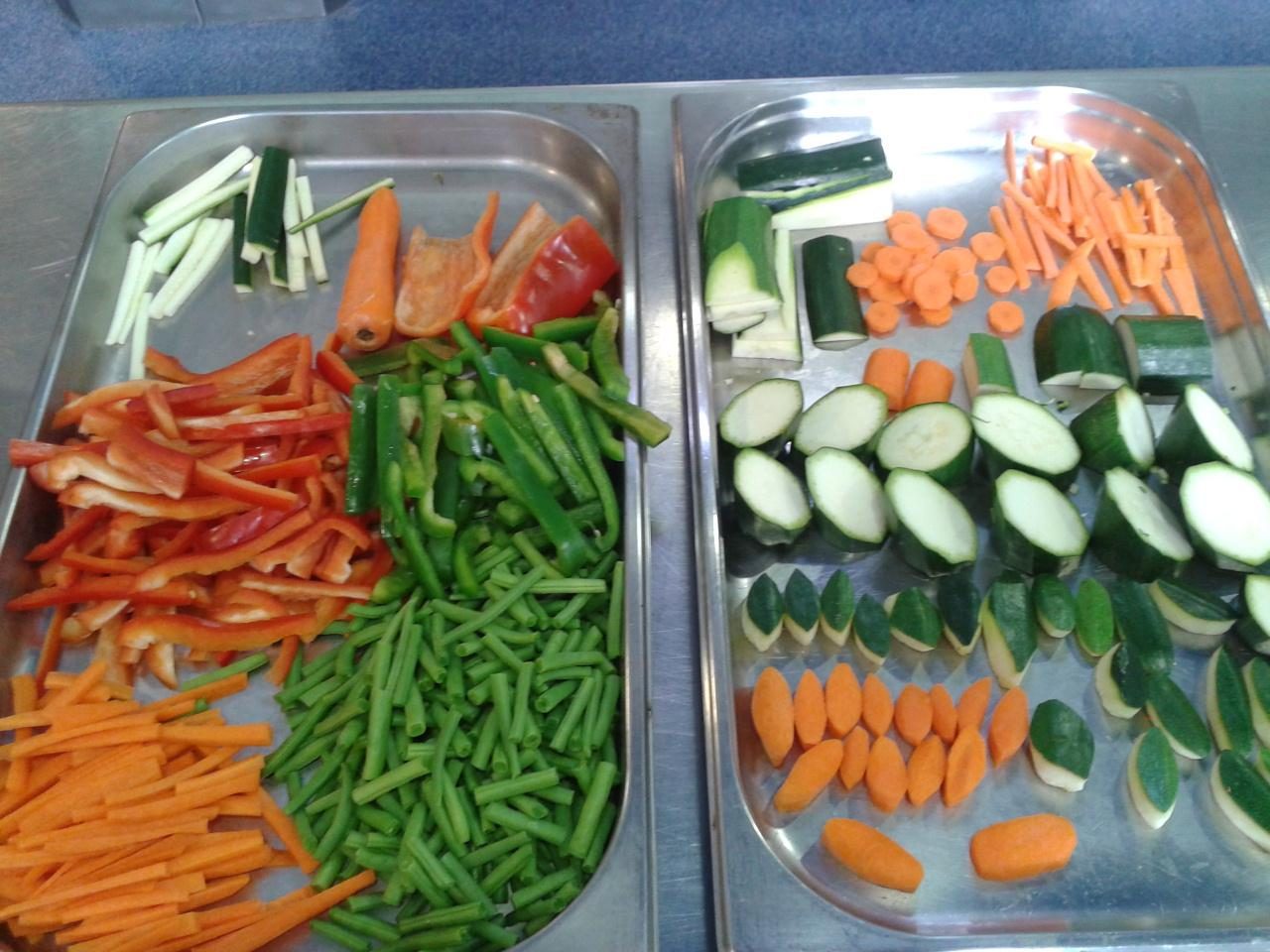
Photo: Paputx / Wikimedia Commons, CC BY-SA 4.0
| Cut | Reference size | Vietnamese example | Pass check |
|---|---|---|---|
| Thin slice | 1–2 mm | Rare beef for pho, stir-fried beef | Slightly translucent against light, not torn |
| Thick slice | 3–5 mm | Boiled pork, braised daikon | Stacked slices are the same height |
| Julienne | 2–3 mm × 5–6 cm | Papaya salad, stir-fried carrot | Strips separate, not joined at the base |
| Dice | 0.5–1 cm per side | Fried rice, spring roll filling | Sides differ by less than 2 mm |
| Mince | Under 2 mm | Fried shallot and garlic, lemongrass chilli | No large pieces, not mashed to liquid |
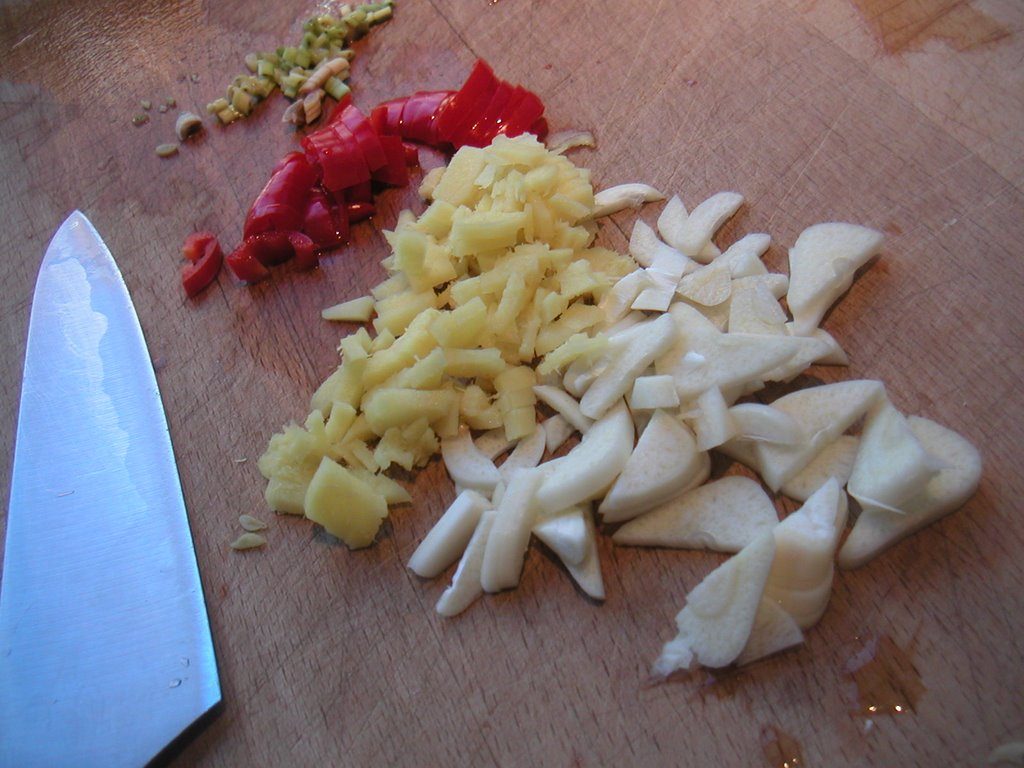
Photo: cyclonebill / Wikimedia Commons, CC BY-SA 2.0
Sharpening and keeping your knife sharp
A blunt knife needs force, and force makes the blade skid off tomato skin or fish skin and into your hand. A sharp knife cuts with light pressure and goes where you guide it. Sharpening is a safety task, not just a way to get neater cuts.
Sharpening on a two-sided whetstone
- Soak a water stone until it stops bubbling (usually 10–15 minutes; splash-and-go stones follow their own instructions).
- Set the stone on a damp cloth, coarse side up first (often around 800–1000 grit).
- Hold the blade at about 15–20 degrees to the stone; when learning, slide two coins under the spine to feel the angle.
- Push the blade diagonally across the stone from heel to tip, with the fingers of your other hand pressing lightly on the flat (Figure 4). Work one side until you feel a slight burr along the opposite edge, then switch sides.
- Turn to the fine side (around 3000–6000) and give both sides light strokes to remove the burr, then wash and dry the knife and stone.
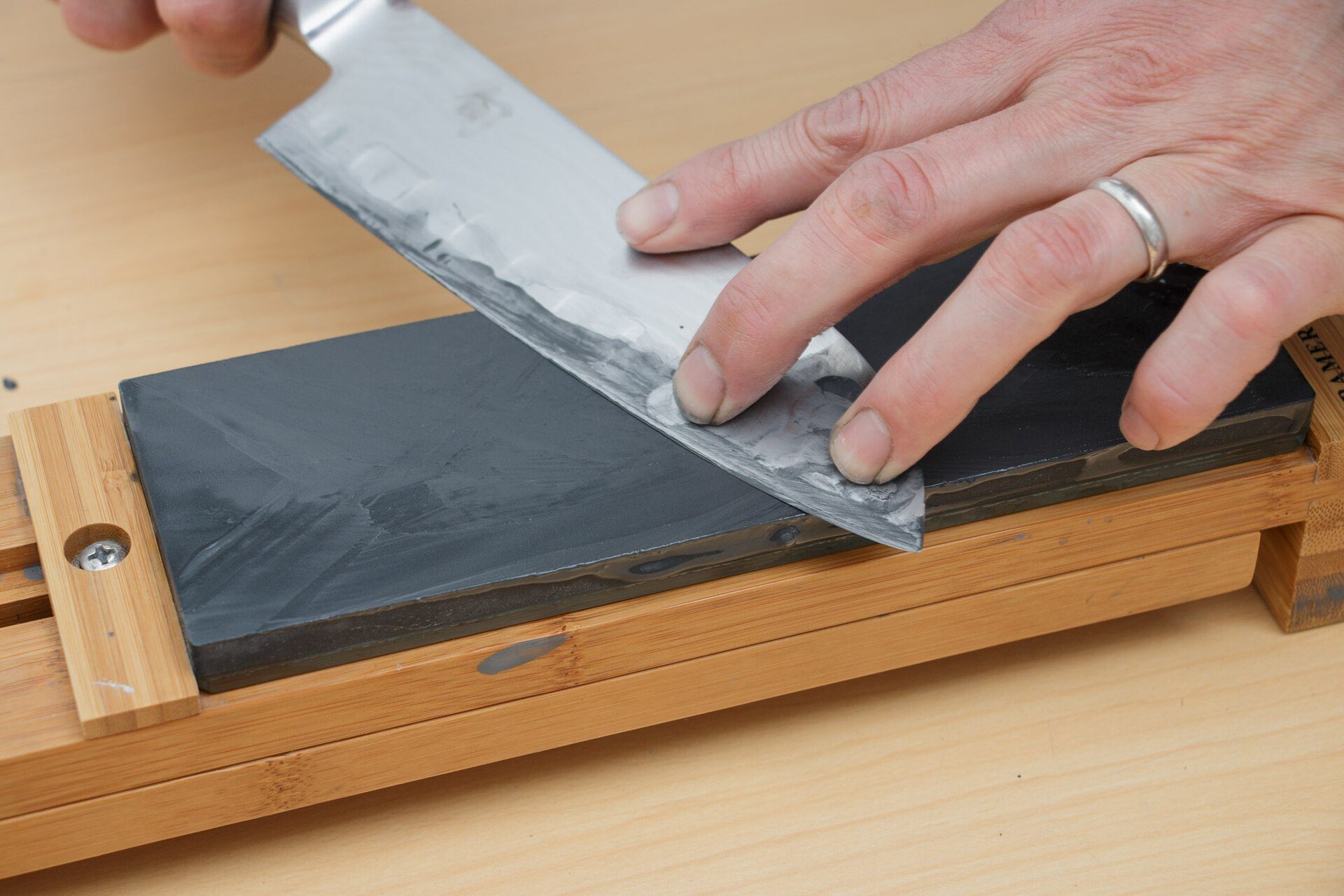
Photo: Didriks / Wikimedia Commons, CC BY 2.0
Honing rod and sharpness test
A honing rod does not remove steel; it straightens an edge that has rolled over. Four to six strokes per side before a shift is enough; only go back to the stone when honing no longer helps. Test on a ripe tomato: a sharp knife bites the skin on the first draw, a blunt one dents the skin before it breaks.
Sharpening schedule for a restaurant
In a kitchen using knives all day, hone every shift and use the stone about every 1–2 weeks depending on the steel and workload. Pull-through sharpeners are quick but remove a lot of steel. Grind a bone cleaver at a wider angle than a slicing knife so the edge does not chip.
Meat prep: trimming, cutting across the grain and cleaning offal
Meat is the most expensive ingredient. A skilled trimmer removes exactly the sinew, membrane and damaged parts; a clumsy one can waste twice as much and still leave the dish tough. The worked example below turns that difference into money.
Trimming pork and beef and cutting across the grain
- Beef: trim off silverskin and large sinew with the small knife, angling the edge toward the membrane so you do not shave away meat.
- Pork belly: scrape off hairs, scrape the skin, and cut to suit the dish (3–4 cm cubes for braising, whole slabs for boiling).
- The grain is the bundles of muscle fibre running in parallel. Cut at right angles to the grain to keep the fibres short and tender; cut along the grain and beef stays chewy even when cooked correctly.
- Portion straight after trimming: weigh in grams, put in lidded trays, label with the date and store on the bottom shelf of the fridge.
Washing or blanching meat
Several food safety agencies abroad, such as the UK Food Standards Agency (FSA), advise against washing raw chicken under the tap, because splashes spread bacteria around the sink and bench. If your kitchen still rinses or blanches meat as is customary in Vietnamese cooking, do it in the sink reserved for raw food with a gentle flow, then wash and sanitise the sink straight away. Blanching only removes scum; it does not cook the meat.
Cleaning and deodorising pork offal
- Choose fresh offal with a natural pink colour, no off smell and a clear source.
- Turn the intestines inside out, cut away excess fat and scrape off the slime with the back of the knife. Rub the stomach with salt on both sides and scrape off the white membrane.
- Knead with coarse salt and vinegar or lime, rinse, and repeat 2–3 times until no slime remains.
- Blanch for 2–3 minutes in boiling water with crushed ginger and a splash of rice spirit, plunge into cold water, then cook through fully for the dish.
- Do offal last in the shift, then wash and sanitise the sink, board and knife.
Streptococcus suis, a bacterium carried by pigs, can infect people who eat undercooked pork, offal or blood, or who handle raw pork with an open wound on the hand. Do not use pork from sick pigs or pigs that died of unknown causes; cover any scratch on your hand and wear gloves; always cook offal thoroughly.
Cleaning fish and filleting without fishy smells or a burst gall bladder
Fish spoils and taints fastest. Work quickly, keep the fish cold, and use a dedicated seafood board and sink, and the flesh stays firm with little fishy smell.
Scaling, removing gills and gutting
- Hold the tail with a dry cloth and scale from tail to head inside a basin of water so scales do not fly.
- Cut out the gills and stiff fins; the dorsal spines of climbing perch and red tilapia are very sharp, so cut them off with scissors first.
- Slit the belly shallowly from vent to gills with the knife tip pointing up so you do not pierce the gut or gall bladder; lift the guts out in one piece.
- Scrape away the black lining of the belly and the blood along the backbone, the main source of fishy smell.
Never eat or drink fish bile, including grass carp bile that folk tradition calls a tonic: there have been many cases of poisoning and kidney failure needing emergency care. If burst bile touches the flesh, cut that part away, because washing will not remove the bitterness.
Removing slime and fishy smell
Rub smooth-skinned fish (snakehead, catfish, basa) with coarse salt and lime or vinegar, scrape off the slime with the back of the knife and rinse. Marinate with ginger, shallot, rice spirit or tamarind according to the dish. Always cook freshwater fish thoroughly, because raw or rare freshwater fish dishes are a route for small liver flukes.
Filleting
Cut behind the gills down to the backbone, turn the knife almost parallel to the bone and run the blade along it from head to tail, pressing lightly against the bone so no flesh is left behind (Figure 5). Turn the fish over and repeat. To skin, lay the fillet skin side down, hold the tail and slide the angled knife between skin and flesh.
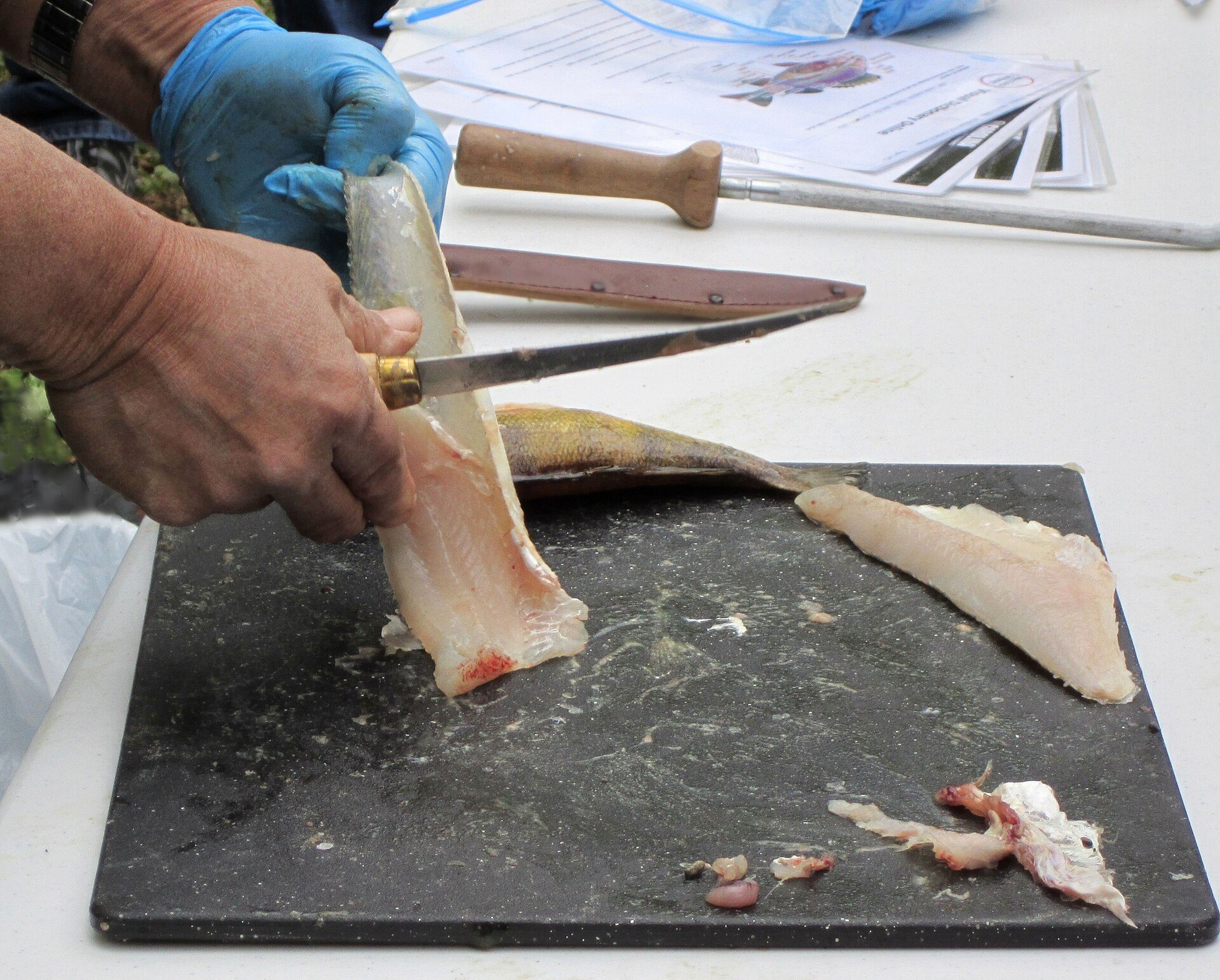
Photo: USFWSmidwest / Wikimedia Commons, Public domain
Picking, washing and storing fresh herbs
The herb plate served with pho, bun and banh xeo is eaten raw: it never meets heat, so any dirt on the leaves, the hands or the board goes straight to the customer. Wilted or blackened herbs are also the first thing customers notice.
Picking and washing herbs eaten raw
- Remove wilted and insect-damaged leaves, roots and old stems; for Thai basil, perilla and Vietnamese balm, keep the tips and mature leaves (see Figure 6).
- Wash your hands and use a separate basin, colander and board for raw vegetables, never the basin just used for meat or fish.
- Soak to loosen soil, then rinse under clean running water several times; soaking in salt water does not replace thorough rinsing. If you use a produce wash, use a food-grade product at the dose on the label and rinse again with clean water.
- Spin or shake the herbs completely dry before storing: wet leaves turn slimy fast.
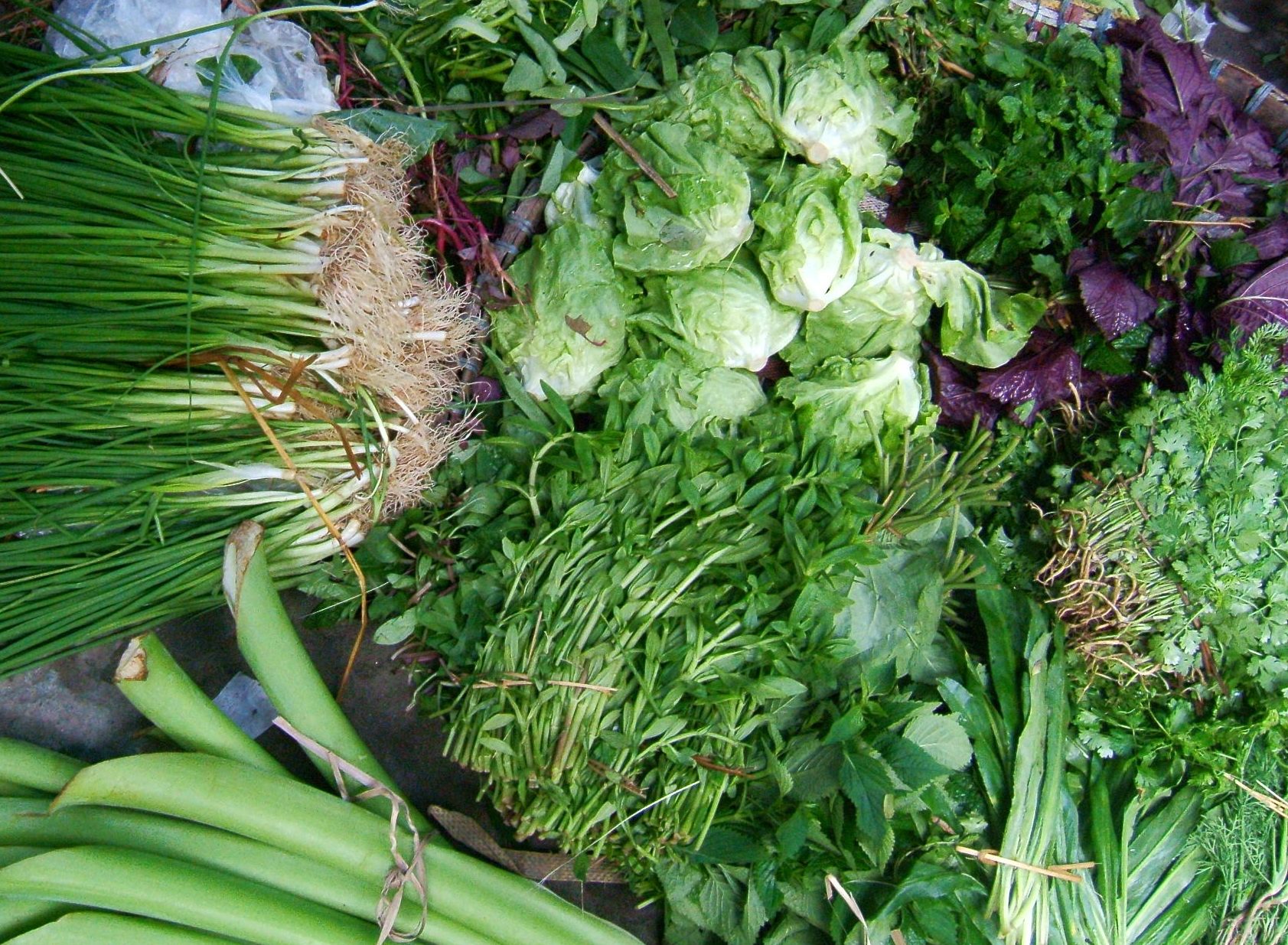
Photo: Viethavvh at Vietnamese Wikipedia / Wikimedia Commons, CC BY-SA 3.0
Storing herbs so they stay fresh
Pack loosely in a lidded box lined and topped with paper towel and keep on the top shelf of the fridge. Thai basil does not like cold and blackens next to the cooling plate. Spring onion and sawtooth coriander can stand with their roots in a glass of water. The times below are a guide for herbs that were fresh when bought.
| Herb | How to keep | Stays fresh for about | Throw out when |
|---|---|---|---|
| Thai basil, Vietnamese coriander | Box with paper towel, least cold spot | 1–2 days | Leaves black and limp |
| Perilla, Vietnamese balm, mint | Box with paper towel, top shelf | 2–3 days | Leaves yellow, slimy stems |
| Sawtooth coriander, spring onion | Roots in water or wrapped in paper towel | 3–5 days | Wilted leaves, rotting roots |
Prep order within a shift
Clean jobs first, dirty jobs last: raw herbs and salad, then cooked foods that need slicing, vegetables for cooking, meat, fish, and finally offal and whole poultry. Wash the knife and change boards when you change groups. Take out of the fridge only what you can prep in 20–30 minutes, and put prepped food straight back rather than stacking it on the bench.
Knife safety and what to do if you cut yourself
Safety warning: If a knife falls, step back and let it drop; never try to catch it. Carry a knife close to your body, point down, and call out "knife, behind" as you pass people. Never drop a knife into a basin of soapy water, and never leave one sticking out over the edge of the bench. Wear a cut-resistant glove when filleting fish or using a mandoline. Do not cut while looking away to chat or while rushing. Any open wound on your hand must be covered with a waterproof dressing and a glove before you touch raw pork or fish.
First aid for a cut
- Stop work and rinse the wound under clean running water.
- Press firmly with gauze or a clean cloth for about 10 minutes without letting go, with the hand raised above the heart.
- Once bleeding stops, disinfect, apply a waterproof dressing and a glove before going back to work; discard any food with blood on it.
When to see a doctor
Go to a clinic or hospital straight away if the cut is deep or gaping, still bleeds after 10 minutes of pressure, the finger is numb or hard to move, the wound is dirty or caused by a rusty blade, or a few days later it is red, swollen or has pus; ask the doctor about a tetanus shot. If you develop fever, chills or headache after handling raw pork with a wound on your hand, see a doctor and tell them you handled raw pork.
Worked example: prep for a 60-portion rice shop lunch
An office rice shop sells 60 lunches, each with braised pork belly, sour snakehead fish soup and stir-fried vegetables. The kitchen helper does all the prep from 6:30 to 9:30, 180 minutes, so the head cook can start cooking at 9:30.
Prep schedule from clean to dirty
| Task | Quantity | Time | Board |
|---|---|---|---|
| Pick and wash herbs and sour soup vegetables | 3 kg | 30 min | Green |
| Julienne carrot and chayote | 4 kg | 30 min | Green |
| Mince shallot, garlic, lemongrass, chilli | 1.5 kg | 25 min | Green |
| Trim and cube pork belly | 8 kg | 35 min | Red |
| Clean and cut snakehead into steaks | 6 kg | 35 min | Blue |
| Wash and sanitise knives, boards, bench, sink | – | 25 min | Whole area |
| Total | 180 min | ||
Check: 30 + 30 + 25 + 35 + 35 + 25 = 180 minutes, exactly 6:30 to 9:30.
Usable yield and food cost (2026 reference, varies by region)
8 kg of pork belly loses about 10% to thick skin, cartilage and excess fat: 7.2 kg remains, or 120 g per portion over 60 portions. 6 kg of whole snakehead, after removing scales, gills and guts and keeping heads and tails for stock, yields about 60% usable steaks (depending on fish size): 3.6 kg, or 60 g per portion. Reference wholesale prices in Vietnam: pork belly 120,000–160,000 VND/kg, snakehead 70,000–100,000 VND/kg; the example uses 135,000 and 80,000 VND/kg.
| Ingredient | Bought | Cost | Usable | Price per usable kg | Cost per portion |
|---|---|---|---|---|---|
| Pork belly | 8 kg × 135,000 VND | 1,080,000 VND | 7.2 kg | 150,000 VND | 18,000 VND |
| Snakehead fish | 6 kg × 80,000 VND | 480,000 VND | 3.6 kg | 133,333 VND | 8,000 VND |
| Total | 1,560,000 VND | 26,000 VND | |||
Check: 1,080,000 + 480,000 = 1,560,000 VND (about US$60); 1,560,000 ÷ 60 = 26,000 VND, which equals 18,000 + 8,000. If an unskilled hand cleans the fish badly and the yield drops to 55%, 6 kg gives only 3.3 kg, enough for 55 portions, 5 short. Making up the gap means buying about 0.55 kg more fish, roughly 44,000 VND a day, or over 1.1 million VND across 26 trading days. That is the price of knife skills.
Common prep mistakes and how to fix them
Uneven cuts
Sign: stir-fried vegetables partly mushy, partly raw. Cause: blunt knife, no flat side cut, cutting faster than your hands allow. Fix: hone the knife, cut a flat side, practise slowly for evenness before building speed.
Tough stir-fried beef
Sign: slices that will not chew through. Cause: cut along the grain, too thick, membrane left on. Fix: find the grain before cutting, slice across it at 1–2 mm, trim off all silverskin.
Bitter or fishy fish
Sign: fish soup tastes bitter or strongly fishy. Cause: burst gall bladder, black lining and blood left along the bone, fish left out too long. Fix: slit the belly shallowly, scrape off lining and blood, keep fish cold, cut away any flesh touched by bile.
Herbs blackened overnight
Sign: Thai basil black and perilla slimy by morning. Cause: stored wet, packed tight, next to the cooling plate. Fix: spin dry, pack loosely with paper towel, and pick only what you will use in 1–2 days.
Frequently asked questions
What is the correct way to hold a knife for a beginner cook?
Pinch the blade between your thumb and the second joint of your index finger with three fingers around the handle; curl the other hand into a claw with the knuckle against the flat of the blade. Practise slowly on cucumber or carrot with a flat side cut first.
How often should I sharpen a knife on a whetstone?
In a restaurant, hone every shift and use the stone about every 1–2 weeks. When the knife still slides on tomato skin after honing, it is time to sharpen.
How do you get rid of the smell of pork offal?
Turn the intestines inside out and scrape off the slime, knead with coarse salt and vinegar or lime 2–3 times, blanch in boiling water with ginger and rice spirit, plunge into cold water, then cook thoroughly. Offal that already smells off when you buy it cannot be rescued and must be thrown away.
How do I keep fresh herbs longer?
Wash, spin completely dry, pack loosely in a box lined with paper towel and keep on the top shelf of the fridge; keep Thai basil in the least cold spot. Most herbs last 2–5 days, Thai basil and Vietnamese coriander only 1–2.
Practice tasks and self-assessment
- Cut 1 kg of carrots: 300 g of 3 mm slices, 300 g of 2–3 mm julienne and 300 g of 1 cm dice; time each part.
- Sharpen a cook's knife on a two-sided stone and test it on a tomato before and after.
- Clean and fillet 2 fish, weighing before and after to calculate the usable yield.
Self-assessment criteria
- Pass: pieces of the same cut differ by less than 2 mm; 300 g of carrot julienne done in about 10 minutes.
- Pass: after sharpening, the knife cuts tomato skin on the first draw with no burr left.
- Pass: fillets with no burst gall bladder and a clean backbone; no boards mixed up during the session.
- Not yet: a cut from a rolling vegetable, beef cut along the grain, or herbs stored wet.
With a sharp knife and even hands, you are ready for the next step of the roadmap: Broths for pho, bun bo and hu tieu, where you will use your bone chopping, cross-grain beef slicing and charring of onion and ginger right away. Read ahead in the lesson how to make pho beef broth in a 50-litre pot.
Keep learning Vietnamese cooking: after knife skills come pho, bun bo and hu tieu broths, regional dipping sauces, braising, stir-frying and steaming, and running the kitchen at rush hour. See the Vietnamese cuisine cook roadmap.