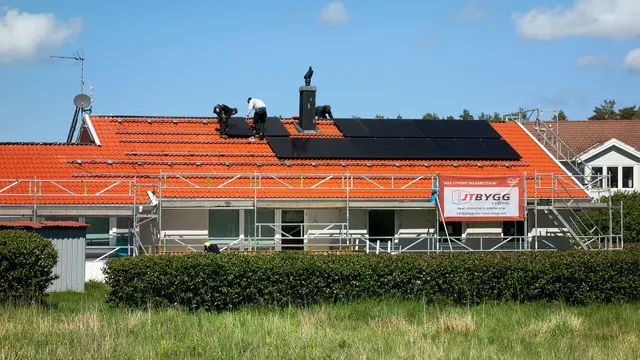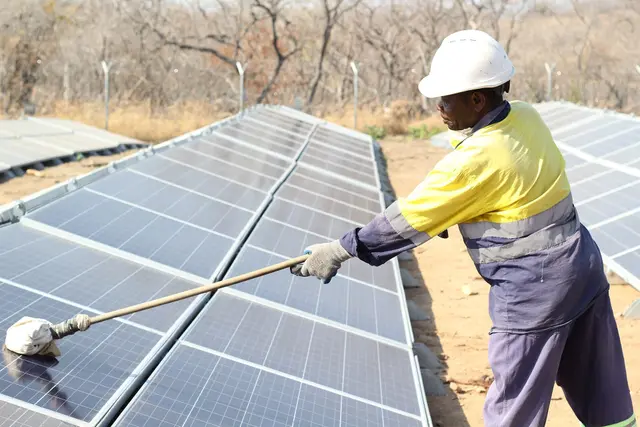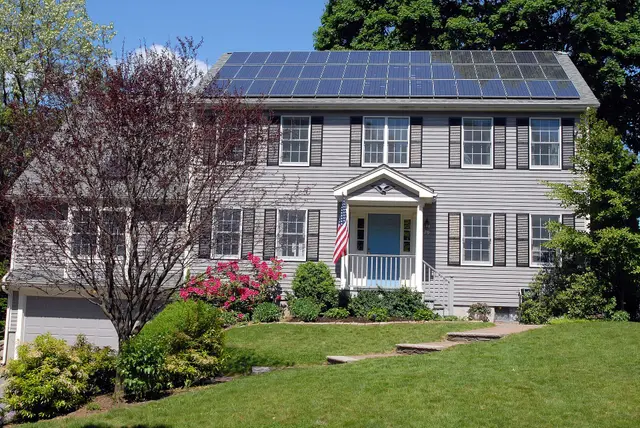
Grid-tied, hybrid and off-grid solar systems differ in two ways: whether the system is connected to the power grid, and whether it has battery storage. A grid-tied system runs in parallel with the grid, has no battery and shuts down when the grid fails; an off-grid system has no grid connection and lives on its battery; a hybrid system is connected to the grid but adds a battery for evening use and to keep priority loads running during power cuts. This lesson explains how each block works, how to read a panel label correctly, and why you must ask the local power company before connecting anything to the grid in Vietnam.
By the end of this lesson, you will be able to:
- Draw the power flow in grid-tied, off-grid and hybrid systems and say which ones still have power when the grid goes down.
- Tell mono PERC and TOPCon panels apart by efficiency, temperature coefficient and degradation on the datasheet.
- Read a panel label, explain Pmax, Vmp, Imp, Voc and Isc, and check that Pmax ≈ Vmp × Imp.
- Work out the usable capacity of a 51.2 V LFP battery and how many hours it can run priority loads.
- Prepare a list of questions for the power company before installing a grid-connected system.
Learning to install solar? Grid-tied, off-grid and hybrid principles are step 2 of the 8-step roadmap, after DC safety and before the roof survey. See the solar PV installer roadmap.
How do the three types of solar system differ?
Panels produce direct current (DC), while homes and the grid in Vietnam use 220 V, 50 Hz alternating current (AC), so every system needs an inverter. How the inverter works with the grid and with the battery decides which type of system it is.
Grid-tied (on-grid) systems
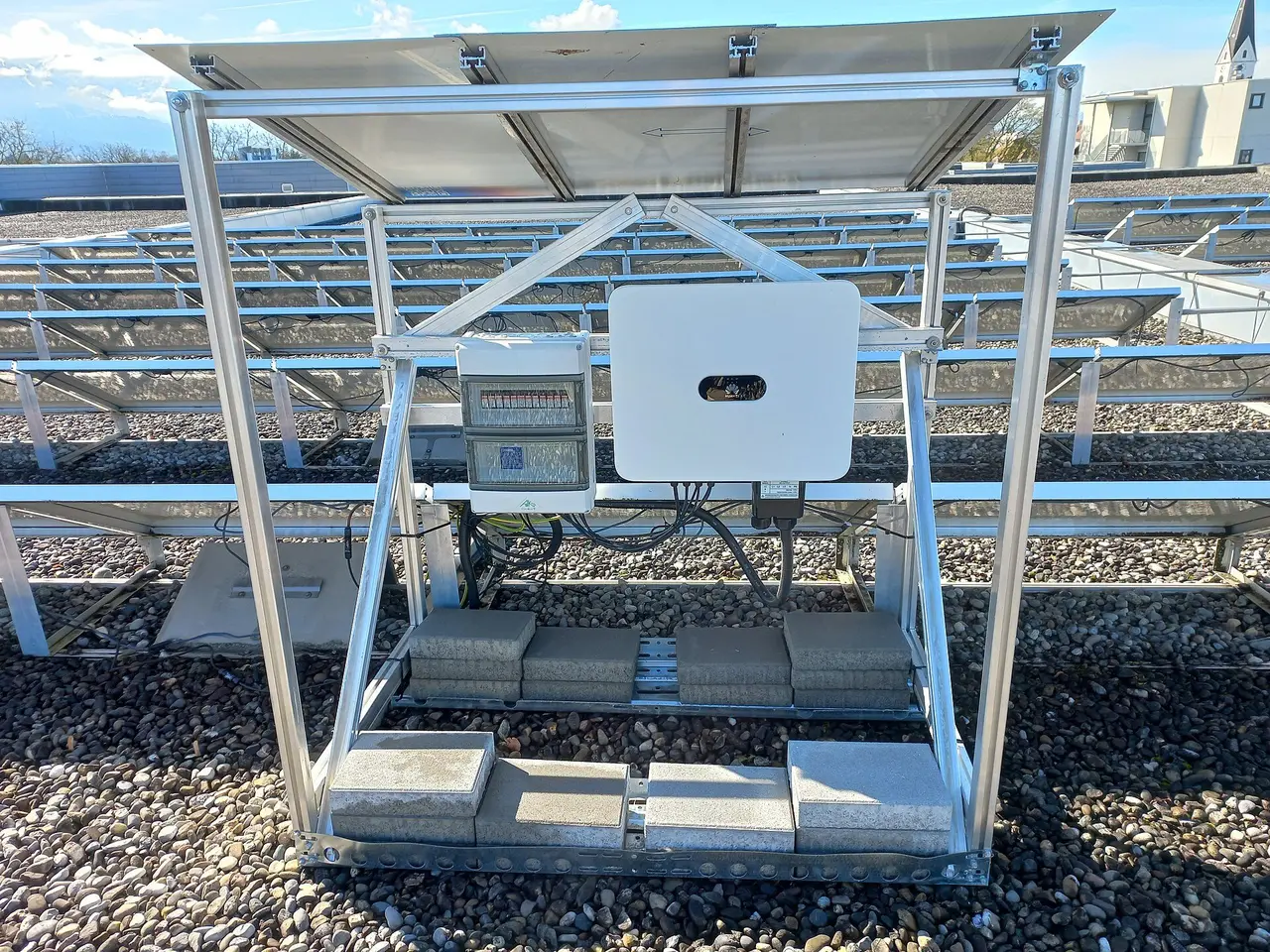
Array → grid-tied inverter → home distribution board, where solar power meets grid power. The inverter measures grid voltage and frequency and injects AC current in phase with it. During the day loads use solar first, the grid makes up any shortfall, and any surplus flows out to the grid (if allowed) or is curtailed by an export limiter. Figure 1 shows a grid-tied inverter mounted right under the array on a flat roof.
What customers often misunderstand: when the grid fails, a grid-tied inverter stops producing even in full sun. This is anti-islanding protection, which keeps power from homes from feeding back into lines that utility crews are repairing.
Off-grid systems
Array → charge controller → battery → off-grid inverter → loads, with no connection to the grid at all. During the day the panels run the loads and charge the battery; at night and on rainy days only the battery is left. These systems are used where there is no grid or bringing the grid in costs too much: orchard huts, farms, small islands, remote pumping stations.
Hybrid systems (grid-tied with storage)
The array and the battery both connect to a hybrid inverter, which is connected to the grid and has an extra backup output for priority loads. At midday surplus power charges the battery, in the evening the battery supplies the house, and during a power cut the inverter disconnects from the grid and supplies only the priority branch.
| Criterion | Grid-tied | Off-grid | Hybrid |
|---|---|---|---|
| Grid connection | Yes | No | Yes |
| Battery storage | No | Required | Yes (can be added later) |
| When the grid fails | Shuts down completely | Not affected | Supplies the priority branch |
| Investment (relative) | Lowest | High, depends on battery size | Medium to high |
| Suits | Homes using power by day, few outages | Places with no grid | Homes using power in the evening, frequent outages |
| Dealing with the power company | Ask first | Usually not, if truly separate from the grid | Ask first |
The cost of each option for a townhouse is broken down in 5 kW solar system cost in Vietnam; this lesson focuses on how the systems work.
What is the difference between mono PERC and TOPCon panels?
Almost all panels sold for homes today are monocrystalline silicon (mono). The differences lie in the cell structure, which decides efficiency, how much power is lost when hot, and how the panel ages.
Monocrystalline and polycrystalline
Polycrystalline (poly) cells have a shattered-ice pattern and lower efficiency, and are hardly used in new projects. Monocrystalline cells have an even colour and higher efficiency. In Figure 2, the two cells on the left are poly and the two on the right are mono; you will still meet poly panels when servicing older systems.
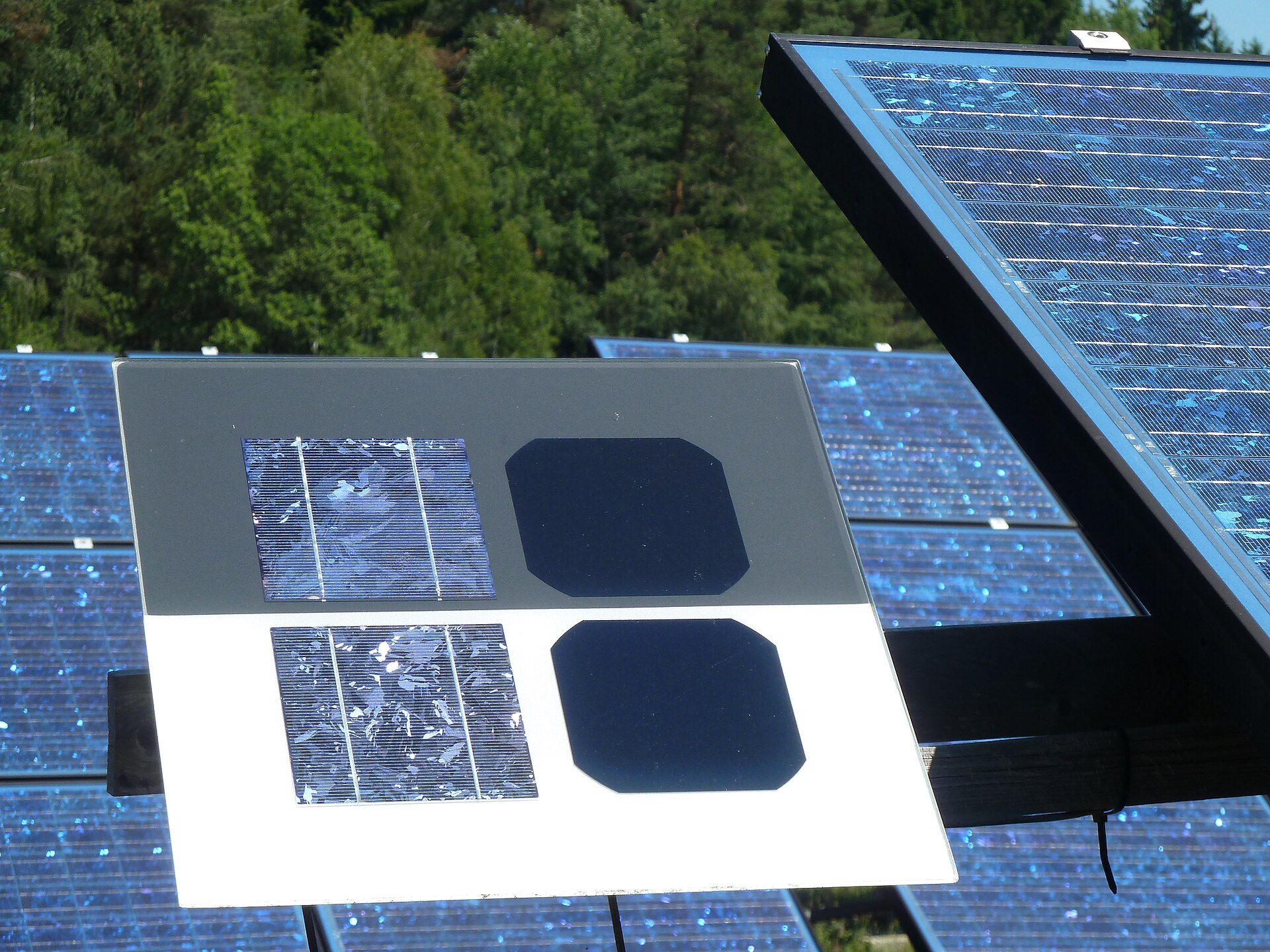
Photo: Klaus Mueller / Wikimedia Commons, CC BY 3.0
Mono PERC
PERC (Passivated Emitter and Rear Cell) adds a passivation layer on the back of the cell, which reduces charge losses and reflects unabsorbed light back into the cell. PERC uses p-type silicon wafers; it was the most common type a few years ago and is still plentiful in distributors' stock.
TOPCon
TOPCon (Tunnel Oxide Passivated Contact) uses n-type wafers with an ultra-thin oxide layer and a doped polysilicon layer on the back. On datasheets, TOPCon usually shows higher efficiency, less power loss when hot and slower degradation than PERC, so it is steadily replacing PERC on the market. HJT and back-contact (BC) cells sit in a higher price segment; you read their labels the same way.
| Datasheet figure | Mono PERC (typical) | TOPCon (typical) |
|---|---|---|
| Module efficiency | About 20-21.5% | About 21.5-23% |
| Pmax temperature coefficient | About −0.34 to −0.35%/°C | About −0.29 to −0.30%/°C |
| First-year degradation | About 2% | About 1% |
| Degradation in later years | About 0.55%/year | About 0.4%/year |
These are reference ranges; when advising a customer, always read the datasheet of the exact model being quoted.
Half-cut cells and bypass diodes
Common panels use half-cut cells to reduce heat losses. The junction box on the back usually holds 3 bypass diodes that let current flow around a shaded section, so shade on one corner can cost a third of the panel's output.
Reading panel ratings: Voc, Isc, Vmp, Imp, Pmax
The label on the back of a panel (Figure 3) is the document you will read most in this trade. Every later calculation of strings, inverters and fuses starts from these numbers.
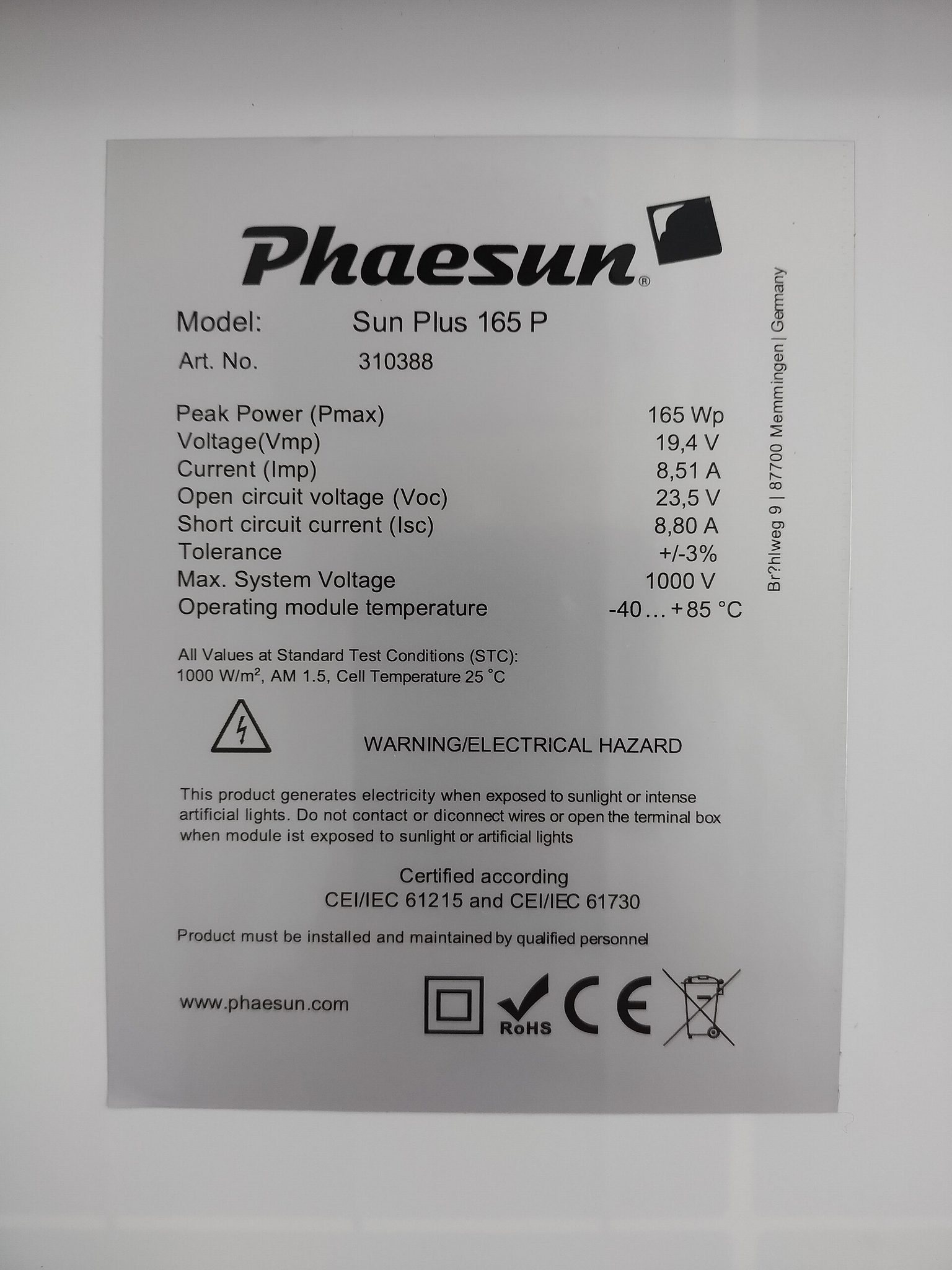
Photo: Veikk0.ma / Wikimedia Commons, CC BY 4.0
The five key numbers
| Symbol | Name | Meaning | Used to |
|---|---|---|---|
| Pmax (Wp) | Maximum power | Power at standard conditions | Work out array size (kWp) |
| Vmp | Voltage at maximum power | Voltage when the panel delivers most power | Check the inverter's MPPT range |
| Imp | Current at maximum power | Current when the panel delivers most power | Estimate string operating current |
| Voc | Open-circuit voltage | Highest voltage, with no load | Stay below the inverter and DC device voltage limits |
| Isc | Short-circuit current | Highest current, terminals shorted | Size fuses, cables and inverter input current |
Two relationships help you catch misreadings: Pmax ≈ Vmp × Imp, and Voc is always higher than Vmp while Isc is slightly higher than Imp. For the label in Figure 3: 19.4 V × 8.51 A = 165.09 W, matching 165 Wp. You calculated string Voc in solar installation safety; here you see where those numbers come from.
Maximum power point and MPPT
A panel has no fixed voltage. With a light load the voltage is close to Voc but the current is small; with a heavy load the current approaches Isc but the voltage collapses. In between there is one point where V × I is greatest, the point (Vmp, Imp). The MPPT circuit in the inverter keeps searching for this point as sunlight and temperature change; if string voltage falls outside the MPPT range, the inverter produces poorly or not at all.
STC, NOCT and temperature coefficients
Label values are measured at STC: irradiance of 1000 W/m² and a cell temperature of 25°C. On a metal roof at noon in a Vietnamese summer, cells often reach 55-70°C, so real output is lower than the label. NOCT or NMOT figures (800 W/m², 20°C ambient) on the datasheet are closer to reality. Temperature coefficients tell you how many percent Pmax and Voc drop for each degree above 25°C; in cold weather Voc rises. The label also shows the maximum system voltage (1000 V or 1500 V) and certifications such as IEC 61215 and IEC 61730.
How do grid-tied, off-grid and hybrid inverters work?
Grid-tied inverters: follow the grid and switch off
A grid-tied inverter has an MPPT stage, an inverter stage that produces AC, and grid measurement and protection circuits. It does not create its own grid; it always follows the grid's voltage and frequency and disconnects if the grid drifts outside its set limits or fails. Units fitted behind each panel are called microinverters; the usual choice for townhouses is a string inverter.
Off-grid: charge controller and grid-forming inverter
A classic off-grid system has a charge controller (cheap PWM or more efficient MPPT), a battery bank and an inverter that creates its own 220 V, 50 Hz supply. Figure 4 shows a small system like this. Many makers now combine all three in one unit. An off-grid inverter is the only source, so loads with high starting current such as pumps or air-conditioner compressors can easily overload it.
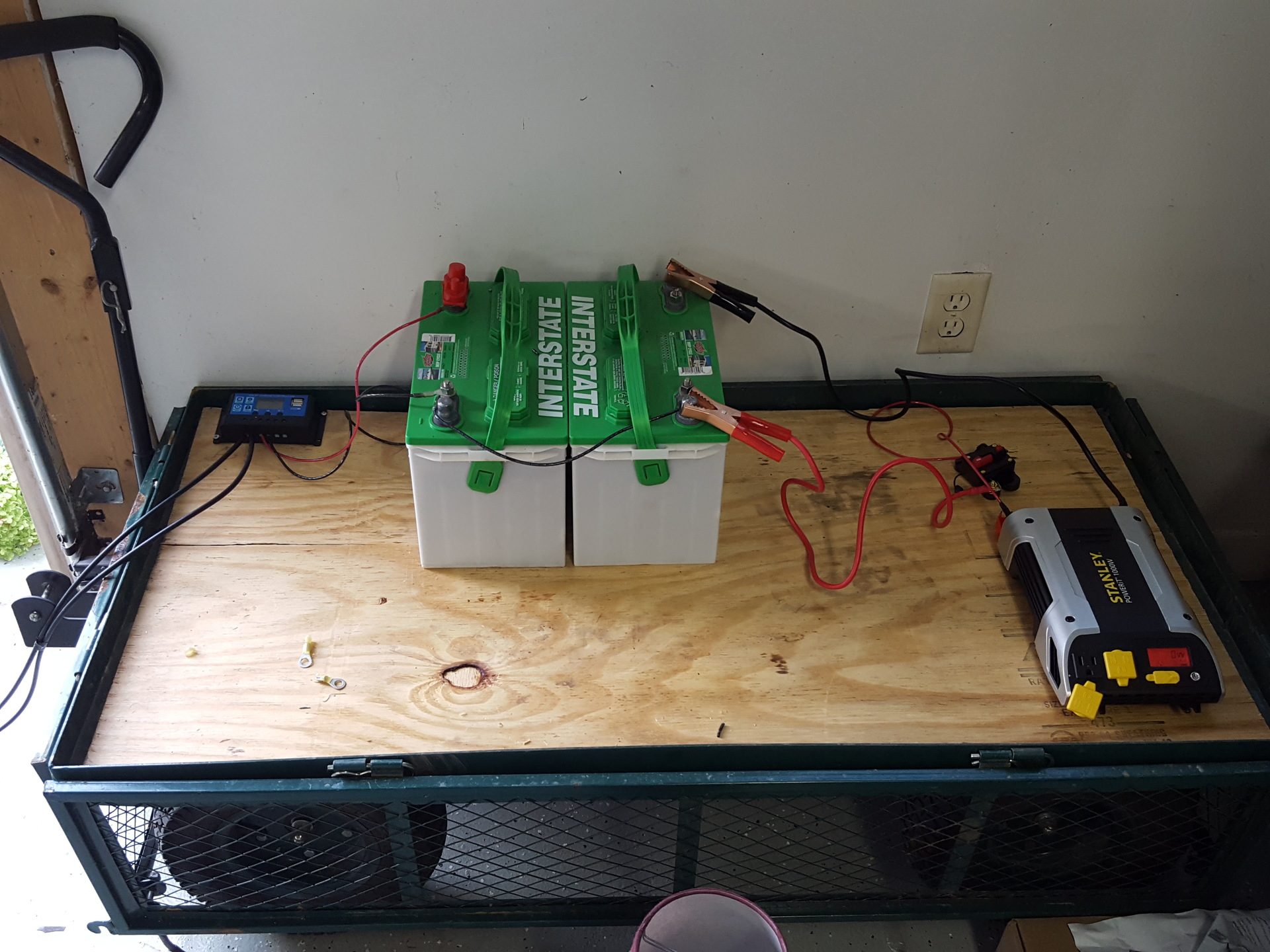
Photo: Photo by Cody Kabus. – U.S. Department of Energy from United States / Wikimedia Commons, Public domain
Hybrid inverters: three sources and a backup output
A hybrid inverter manages the array, the battery and the grid at the same time. It has a grid port feeding the main board and a backup output (called backup, EPS or load depending on the brand) feeding a priority-load board (Figure 5). When the grid fails, it disconnects and supplies only the backup output; the switchover time is on the datasheet, and while some models are almost seamless, others take long enough for a desktop computer to restart.
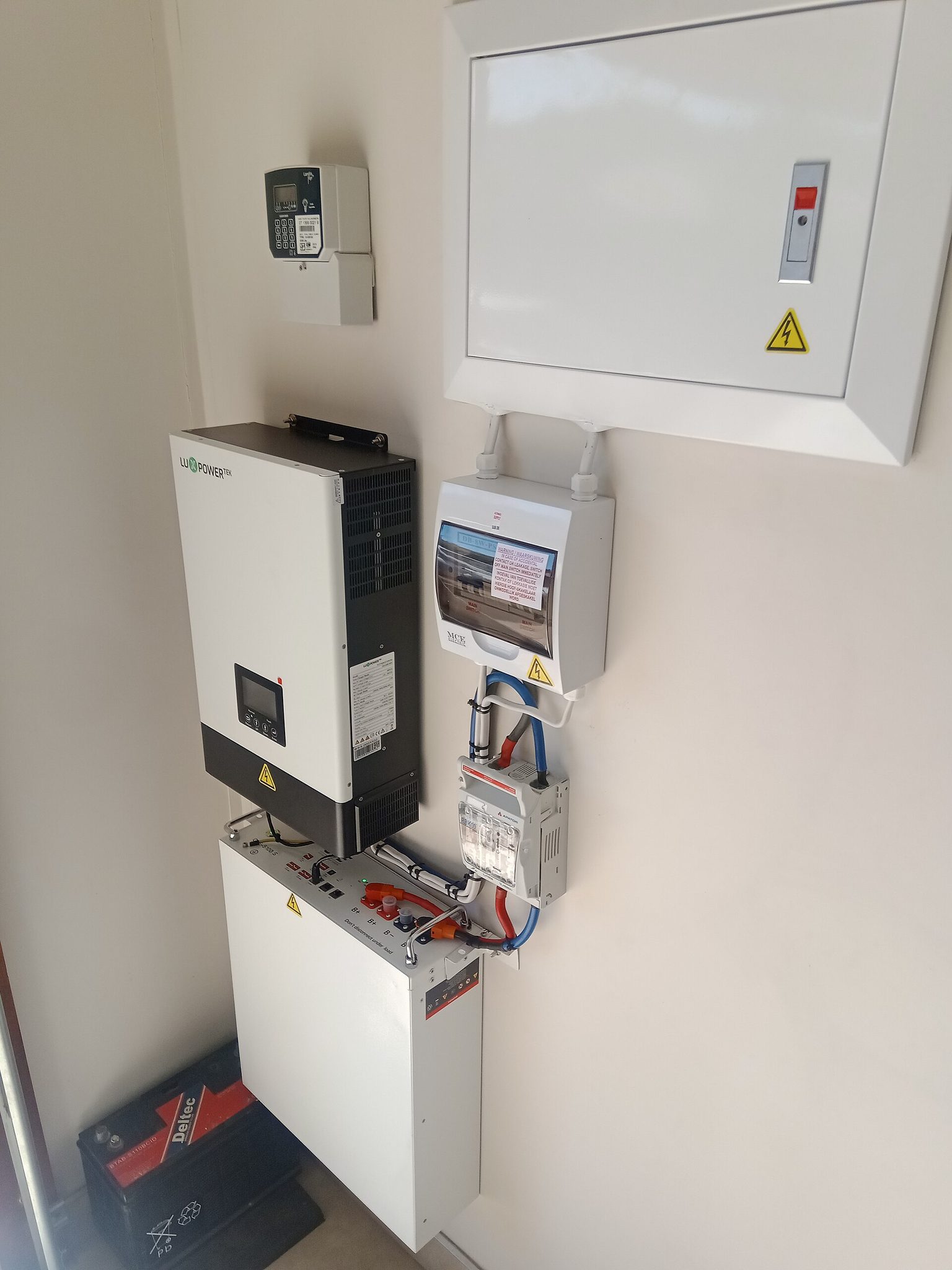
Photo: WisePsyco / Wikimedia Commons, CC BY-SA 4.0
The most common mode is self-consumption priority: sun supplies the loads first and the surplus charges the battery; at night the battery discharges first and the grid is used only when it is empty. There are also backup-priority modes (keep the battery full for outages) and time-of-use charging and discharging.
The battery must be on the inverter maker's compatibility list, because the two exchange data through the battery management system (BMS) communication port. Hybrid inverters come in low-voltage versions (48 V nominal batteries) and high-voltage versions (batteries of several hundred volts), which are not interchangeable.
LFP battery storage: voltage, capacity, lifespan
Home storage today is mostly lithium iron phosphate (LiFePO4, or LFP). LFP is more thermally stable than the lithium chemistries in phones, less prone to thermal runaway and has a long cycle life, at the cost of being heavier for the same capacity.
From a 3.2 V cell to a 51.2 V battery
Each LFP cell has a nominal voltage of 3.2 V. Sixteen cells in series give 16 × 3.2 = 51.2 V, the battery usually sold as a "48 V battery"; to increase capacity you add cells or batteries in parallel. Figure 6 shows large LFP cells joined by busbars, with boards on top that monitor each cell's voltage.
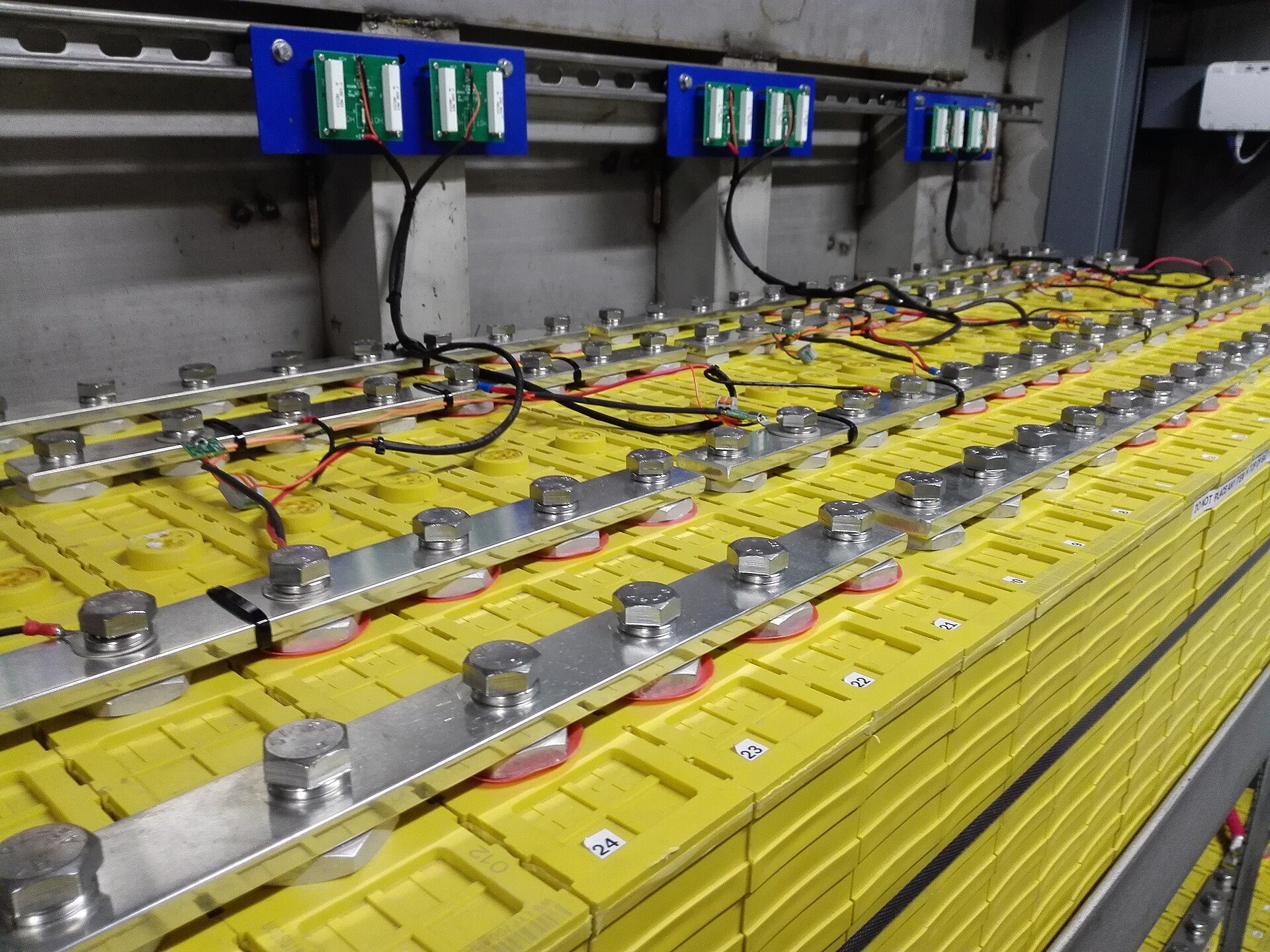
Photo: Yo-Co-Man / Wikimedia Commons, CC BY-SA 4.0
kWh, DoD, cycles and the BMS
Energy capacity in kWh = nominal voltage × Ah ÷ 1000. A 51.2 V, 100 Ah battery holds 51.2 × 100 = 5,120 Wh = 5.12 kWh. The allowed depth of discharge (DoD) is usually 80-90%, so the usable energy is less than the nominal figure. Many makers quote several thousand cycles (often 3,000-6,000) under the conditions stated; read the warranty carefully, as some count years and others total energy discharged. The BMS protects against overcharge, deep discharge, overcurrent and overheating and balances the cells; place the battery somewhere dry, ventilated and out of the sun, never in a bedroom or an escape route.
| Criterion | Deep-cycle lead-acid | LFP |
|---|---|---|
| Recommended depth of discharge | About 50% | About 80-90% |
| Cycle life | A few hundred to just over a thousand | Several thousand (per datasheet) |
| Upfront price per kWh | Lower | Higher, but cheaper per cycle |
Safety warning: Even at 51.2 V, a storage battery can deliver a short-circuit current of thousands of amps: a spanner dropped across the terminals can glow red, arc and cause serious burns. Use insulated tools, remove metal jewellery, keep terminal covers on until you connect, and always fit a correctly rated DC fuse or breaker between the battery and the inverter. With a hybrid system, opening the grid breaker does NOT de-energise the priority branch: before working on house circuits, shut down the inverter following the maker's procedure, open the battery breaker and verify with a meter. Never use an unbranded grid-tied inverter plugged straight into a socket. Isolate any battery that swells or gets unusually hot; if there is smoke or fire, evacuate and call 114, the fire service number in Vietnam. Beginners should connect batteries and inverters only under direct supervision.
Grid connection rules: ask the local power company first
Grid-tied and hybrid systems connect to the national grid and so fall under the power sector's rules. Policy for rooftop solar in Vietnam has changed several times, and the exact process can vary over time and between local power companies, so never answer customers from memory or rumour.
Questions to ask the power company
- Does a grid-connected system for this home need to be registered or notified, what documents are needed and where are they submitted?
- Can surplus power be exported to the grid, will it be paid for, or is an export limiter required?
- Are there requirements for the meter, inverter certification or inverter settings?
- Is there a limit on installed capacity compared with the household's contracted capacity?
What the technician should do
Write the power company's answers into the survey record, with the date and the name of the person who answered, and also check current regulations on official government websites. If export must be blocked, choose an inverter with export limiting and fit the sensor at the connection point; for the wiring, see grid-tied solar wiring diagram. An off-grid system in a house that also has grid power needs an interlocked changeover switch so the two sources can never be connected together.
Worked example: choosing a system for a townhouse with frequent outages
A family of four in a suburban area work all day and run air conditioning in the evening; their street has power cuts several times a month. They want the fridge, fans, lights, Wi-Fi and camera never to go off. The roof has room for 10 TOPCon 580 Wp panels whose datasheet reads: Pmax 580 W, Vmp 42.6 V, Imp 13.62 A, Voc 51.5 V, Isc 14.20 A, Pmax temperature coefficient −0.29%/°C.
Step 1: choose the system type
A grid-tied system shuts down during outages, so it does not meet the need; an off-grid system wastes the existing grid and needs a very large battery for rainy days. Conclusion: a hybrid system with a priority-load board.
Step 2: check the panel datasheet
- 42.6 × 13.62 = 580.2 W, matching Pmax 580 W; Voc > Vmp and Isc > Imp. The datasheet is consistent.
- Array size: 10 × 580 = 5,800 Wp = 5.8 kWp.
- Summer noon, cells at 65°C, 40°C above standard: loss of 40 × 0.29% = 11.6%, leaving 580 × 0.884 = 512.7 W per panel at standard irradiance.
- A 580 W PERC panel with −0.35%/°C: loss of 40 × 0.35% = 14%, leaving 580 × 0.86 = 498.8 W. About 14 W less per panel, 140 W for the whole array.
Step 3: size the battery for priority loads
| Priority load | Quantity × power | Power (W) |
|---|---|---|
| Fridge (average as the compressor cycles) | 1 × 100 W | 100 |
| Standing fans | 2 × 50 W | 100 |
| LED lights | 6 × 10 W | 60 |
| Wi-Fi and camera | 1 × 40 W | 40 |
| Total | 300 | |
Check: 100 + 100 + 60 + 40 = 300 W. One 51.2 V, 100 Ah LFP battery holds 5,120 Wh; at 90% DoD that is 5,120 × 0.9 = 4,608 Wh; through an inverter at 94% efficiency, 4,608 × 0.94 ≈ 4,332 Wh on the AC side. Run time for the priority loads during a night-time outage: 4,332 ÷ 300 ≈ 14.4 hours.
Step 4: test a larger load and conclude
If a 1 HP air conditioner (about 900 W while running) is added to the priority branch, the load becomes 300 + 900 = 1,200 W and the battery lasts only 4,332 ÷ 1,200 ≈ 3.6 hours; the owner chooses either to keep the air conditioner off the priority branch or to add another battery. For charging: on a sunny day the array yields about 3-4.5 kWh per kWp (reference figure, varies by region and season); at 3.5 that is 5.8 × 3.5 = 20.3 kWh, and filling the 4.608 kWh battery takes only about 23% of it. Proposal: a 5.8 kWp hybrid system, a 5-6 kW hybrid inverter, one 5.12 kWh LFP battery, a separate priority-load board, and a check with the power company before signing.
Common mistakes when advising and choosing a system
Promising "with solar you won't fear power cuts"
Sign: a customer with a grid-tied system complains that the house goes dark in an outage on a sunny day. Cause: anti-islanding was never explained. Fix: say from the start which systems keep power when the grid fails; if the customer needs backup, recommend hybrid, or a hybrid-ready inverter so a battery can be added later.
Mistaking Vmp for Voc
Sign: string voltage is calculated with Vmp, and on a cold morning the inverter reports overvoltage. Cause: not distinguishing operating voltage from open-circuit voltage. Fix: always calculate maximum voltage from Voc corrected for low temperature; use Vmp only to check the MPPT range.
Pairing a battery that is not on the compatibility list
Sign: the inverter shows a BMS communication error, the battery never fully charges or cuts out suddenly. Cause: a cheap battery the inverter maker does not support. Fix: check the maker's compatible battery list before quoting. Likewise, do not put the pump, water heater or induction hob on the backup output, or the inverter will overload as soon as the grid fails.
Frequently asked questions
What is a hybrid inverter?
An inverter that is grid-tied and also manages a battery: it takes power from the panels, charges and discharges the battery, runs in parallel with the grid and has a backup output for priority loads during outages.
Does a grid-tied solar system work during a power cut?
No. A grid-tied inverter switches off when the grid fails to protect line workers. To have power during outages you need a hybrid system with a battery or an off-grid system.
Which is better, TOPCon or PERC panels?
On typical datasheets, TOPCon has higher efficiency, loses less power when hot and degrades more slowly, which helps in hot climates. Price, warranty and the distributor's reputation also matter; compare the datasheets of the two specific models.
Do I need to tell the power company about a hybrid system?
A hybrid system is connected to the grid, so ask the local power company in advance about procedures, exporting surplus power and equipment requirements. Rules can change over time and differ between areas.
Practice and self-assessment
- Find datasheets for two panels of the same power, one PERC and one TOPCon; note the five key ratings and the Pmax temperature coefficient, check Pmax ≈ Vmp × Imp, and work out the output with cells at 65°C.
- Classify three customers: a coffee shop open by day with few outages; a townhouse whose owners work all day, with frequent outages; a shrimp-pond guard hut with no grid. Write which system each should use and why.
- Add up the priority loads in your own home and work out how long a 51.2 V, 100 Ah battery can run them (90% DoD, 94% efficiency).
Self-assessment criteria
- Pass: Vmp × Imp matches Pmax within about 1%, and the temperature loss uses the right coefficient.
- Pass: you classify all three customers correctly and say which systems keep power when the grid fails.
- Pass: you calculate battery kWh as V × Ah, subtract DoD and efficiency, and the load total adds up.
- Not yet: you still believe a grid-tied system has power during outages, or you use Vmp to calculate maximum string voltage.
Once you understand the system principles, move on to the next roadmap step: Roof survey & system sizing, where you measure orientation, tilt and shading, read power bills to size kWp, and design strings without exceeding the inverter's input voltage.
Keep learning solar installation: after system principles come the roof survey, mounting rails and panels, string wiring and inverters, battery storage, monitoring and maintenance. See the solar PV installer roadmap.