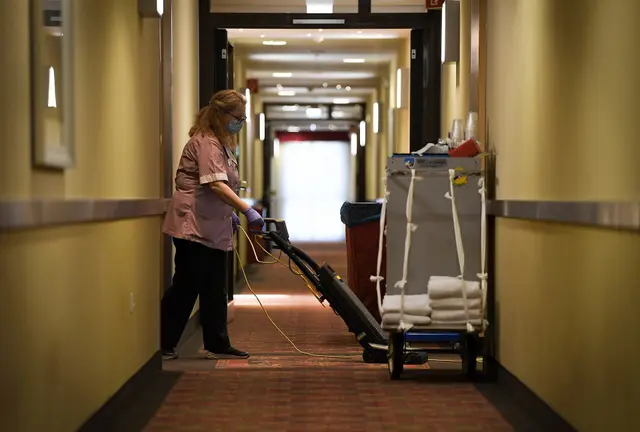
A well-stocked housekeeping trolley has heavy items on the bottom shelf, light items on top, clean items kept well away from dirty ones, enough amenities and linen for the whole shift, chemicals in their own labelled caddy, and cleaning cloths split by colour: one colour only for toilets, one for basins and bathtubs, one for mirrors and glass, one for wooden furniture and bedroom surfaces. Get this right and you will not have to run back to the store mid-shift, and you will not carry germs from the toilet to the TV remote. This lesson includes a sample colour chart, an 8-step trolley setup routine, vacuum cleaner care and a worked example of counting supplies for a 14-room shift.
By the end of this lesson, you will be able to:
- Stock a housekeeping trolley shelf by shelf, keeping clean and dirty apart, with enough for the whole shift and without piling it too high.
- Count the amenities, toilet rolls, drinking water and cloths you need from your list of departure and stay-over rooms.
- Use 4 cloth colours correctly for toilets, basins, glass and wood, and know when a cloth must go into the laundry bag.
- Park the trolley correctly while cleaning so it never blocks an exit and guests or children cannot reach the chemicals.
- Check, empty, clean the filter of and coil the cable of a vacuum cleaner so it keeps its suction and stays electrically safe.
Learning housekeeping? The trolley, tools and colour-coded cloths are step 2 of the roadmap, after chemical safety and posture, and before bed making, bathroom cleaning and room procedures. See the 8-step housekeeping attendant roadmap to learn in the right order.
What goes on a housekeeping trolley?
The trolley (or cart) is your mobile store room for the whole shift. Every time you leave a room half done to fetch another toilet roll from the store, you lose 5–10 minutes.
The main parts of the trolley
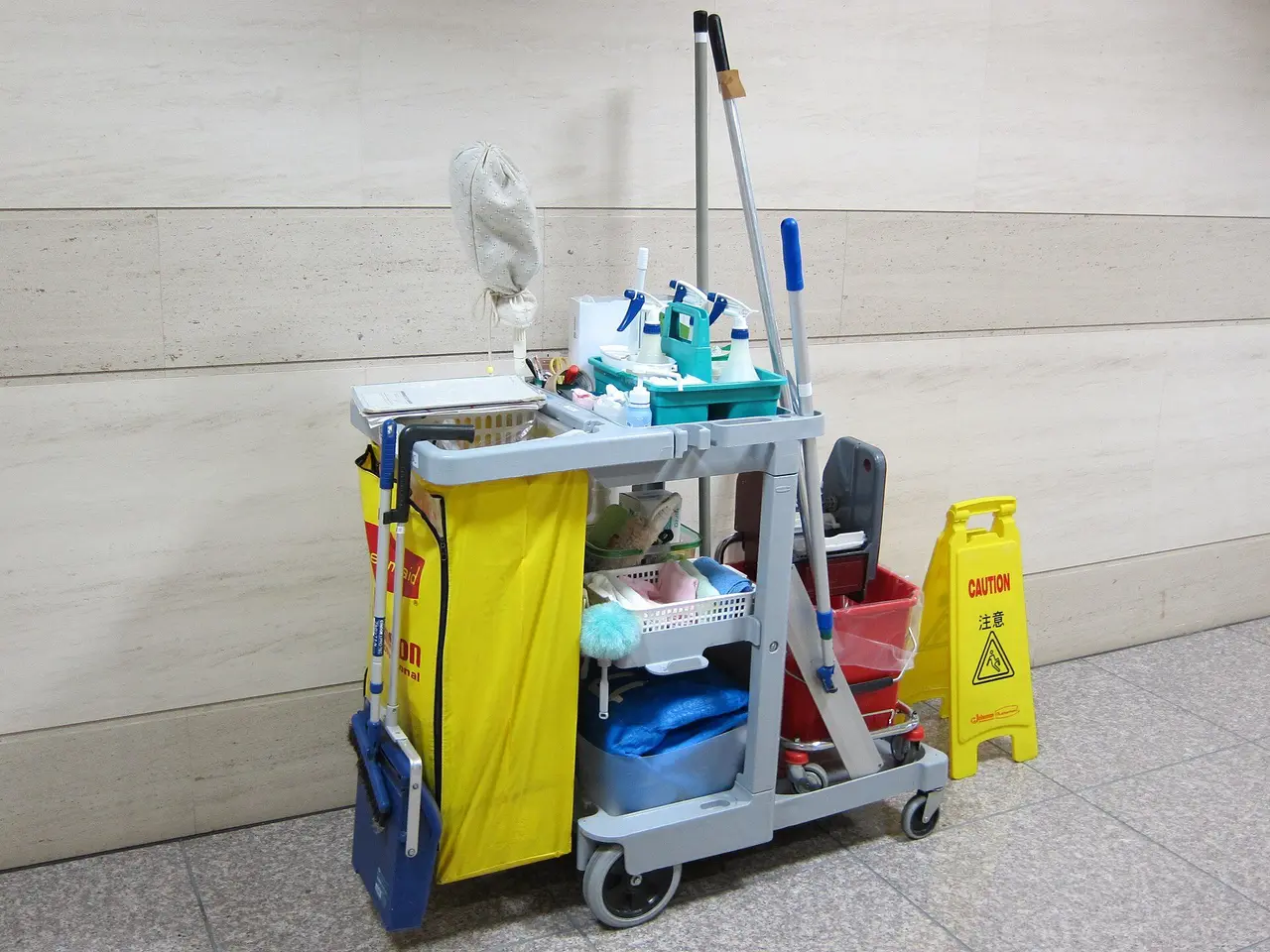
Trolleys come in different sizes, but most have the same parts as the one in Figure 1:
- Top surface and top tray: small amenities (shampoo, shower gel, soap, toothbrush kits), notepads, pens, room report slips.
- Middle shelves: clean linen such as sheets, duvet covers, pillowcases, bath towels, face towels and bath mats.
- Bottom shelf: heavy items such as bottled water, toilet rolls, tissue boxes and spare bin liners.
- Bags at each end: one for dirty linen, one for rubbish. The two bags always hang at opposite ends.
- Tool caddy: chemical spray bottles, brushes, scourers, gloves and colour-coded cloths. You carry this caddy into the bathroom.
Why clean and dirty must stay apart
Clean linen that touches the dirty linen bag counts as dirty. That is why the dirty bag hangs at the end furthest from the clean linen, and why you never put linen you have just stripped onto the top of the trolley.
How to set up your trolley before the shift
Stocking the trolley is the first job of the shift, done in the floor pantry after you receive your room list. An experienced attendant takes 10–15 minutes; a beginner may need 20–25 minutes.
The rule: heavy below, light above, clear line of sight
Heavy items low down keep the trolley stable as it rolls over the lift gap. Never stack anything above eye level, because you need to see guests, children and the corner of the corridor ahead. Always push the trolley in front of you; never pull it backwards.
An 8-step setup routine
- Get your room list: how many departures, stay-overs, VIP rooms and rooms with special requests (extra bed, extra pillows).
- Check the trolley: wheels turn freely with no hair or thread caught; the surface is clean and dry; the bags are not torn.
- Fit a new rubbish bag and a new dirty linen bag at the two ends.
- Load heavy items onto the bottom shelf: drinking water, toilet rolls, tissue boxes.
- Stack clean linen on the middle shelves, folded edges facing out, one pile per item so you can grab it quickly.
- Lay out amenities on the top tray in a fixed order, one compartment per item.
- Prepare the tool caddy: diluted, labelled spray bottles (see the lesson on housekeeping chemical safety for dilution), brushes, scourers, gloves and cloths in all 4 colours.
- Check the vacuum cleaner and walk once around the trolley: nothing sticking out, nothing stacked too high.
Parking the trolley while you clean
Many hotels want the trolley parked against the wall next to the room you are cleaning, with the supplies facing the wall so passing guests cannot help themselves; some ask you to park across the doorway to keep strangers out. Follow your hotel's rule, but never block a fire exit, staircase or fire extinguisher.
Amenities and linen: counting enough for the shift
Amenities are the free items provided for guests: shampoo, shower gel, soap, toothbrush and toothpaste, shower caps, combs, drinking water, tea and coffee. Guests see them the moment they step into the bathroom (Figure 2).
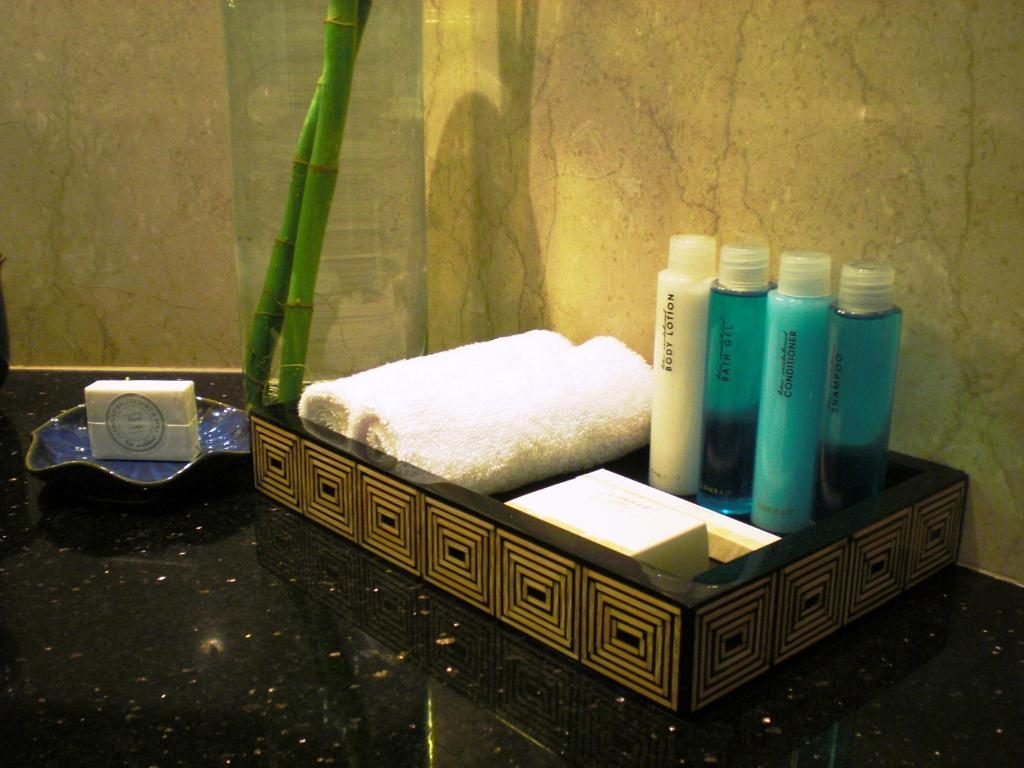
Photo: Matt @ PEK from Taipei, Taiwan / Wikimedia Commons, CC BY-SA 2.0
The amenity list for each room type
Hotels usually have an amenity list for each room type, giving the items and quantities per guest. Higher room categories add conditioner, lotion, a shaving kit and slippers. On your first day, ask your supervisor for this list and copy it into your notebook.
Departure rooms versus stay-over rooms
A departure room (the guest has checked out) gets a complete new set of amenities for the next guest, even if the old bottles are nearly full. A stay-over room (the guest is still staying) usually only gets items that are used up or nearly used up, according to hotel rules. So when you count supplies, keep these two types of room separate.
Linen to carry
Linen is counted by the number of beds and guests, plus a few spares for stained or torn items; the detailed count is in the lesson on how to make a hotel bed, which is the next step. For now just remember: clean linen never touches the floor, is never tucked under your arm, and a guest's bath towel is never used to wipe anything.
Colour-coded cloths: stopping cross-contamination
Cross-contamination is when germs from the dirtiest spot (the toilet) are carried by a cloth, glove or brush to a clean spot (the basin, the phone, a door handle). You cannot see it, so the most reliable defence is a strict rule: one cloth colour per area.
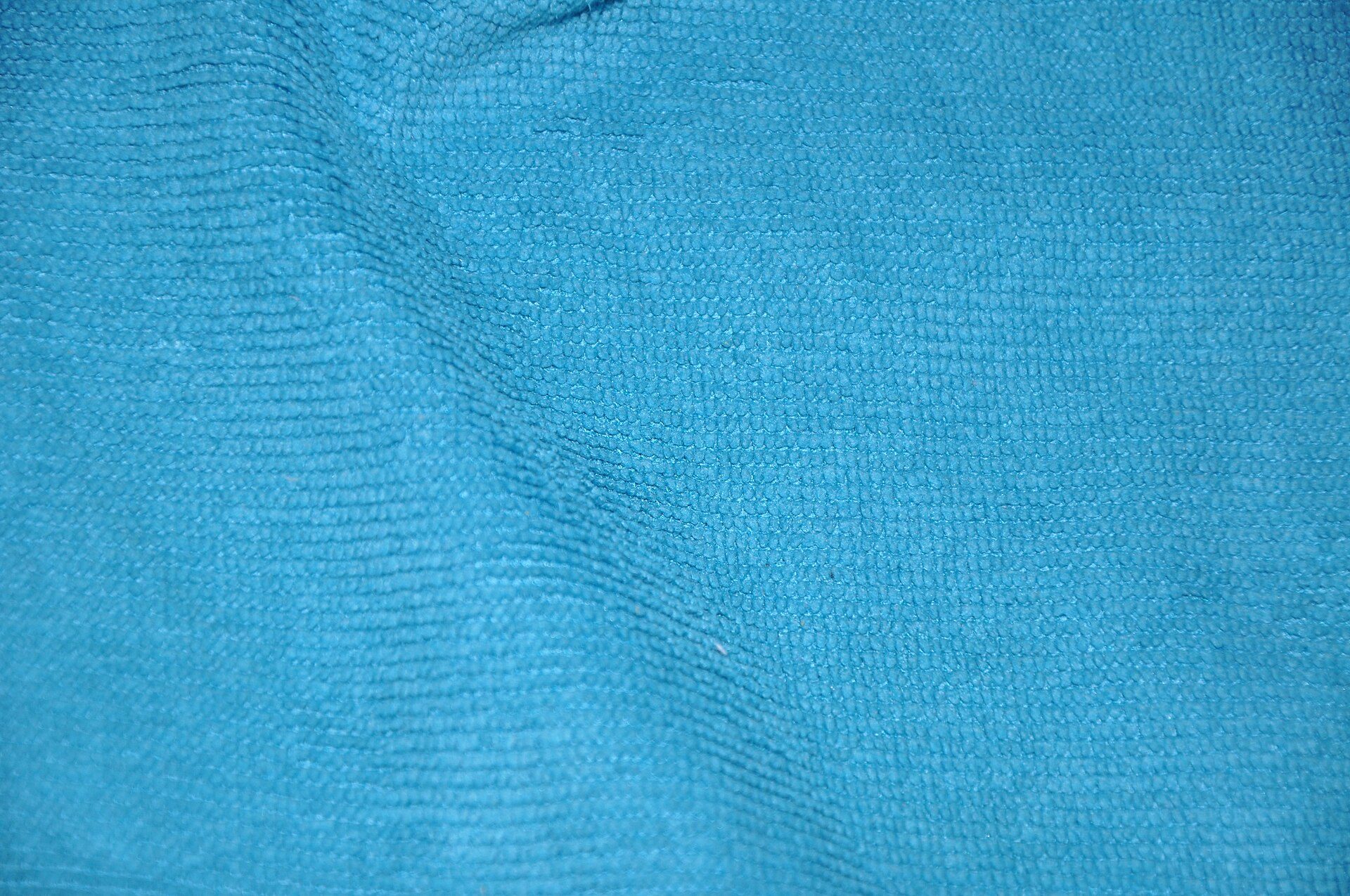
Photo: Philippe Alès / Wikimedia Commons, CC BY-SA 3.0
A sample colour chart
There is no single colour chart for every hotel. Red for toilets is a convention you will find in very many places; the other colours vary. The table below is an example for learning; at work you memorise your own hotel's chart, which is usually posted in the floor pantry.
| Cloth colour (example) | Only for | Never for | Risk level |
|---|---|---|---|
| Red | Toilets, urinals, the floor around the toilet, the toilet brush | Anything else | Highest |
| Yellow | Basins, taps, bathtubs, shower screens, bathroom tiles | Toilets, bedroom items, cups and glasses | Medium |
| Green | Mirrors, glass surfaces, glass doors, TV screens (dry cloth) | Toilets, basins | Low |
| Blue | Wooden furniture, desks, wardrobes, headboards, door handles, phones, remotes | Anywhere in the bathroom | Low |
Guests' cups and glasses: many hotels do not allow washing them in the guest bathroom and replace them with a clean set from the store or kitchen instead. Check the rule; never wipe glasses with a cloth of any of the colours above.
Cloth rules that make the colour code work
A microfibre cloth (Figure 3) only holds dirt well if you use it correctly. For glass, spray onto the cloth or close to the glass and wipe in one direction, as in Figure 4 (a green cloth, the colour for glass in the sample chart).
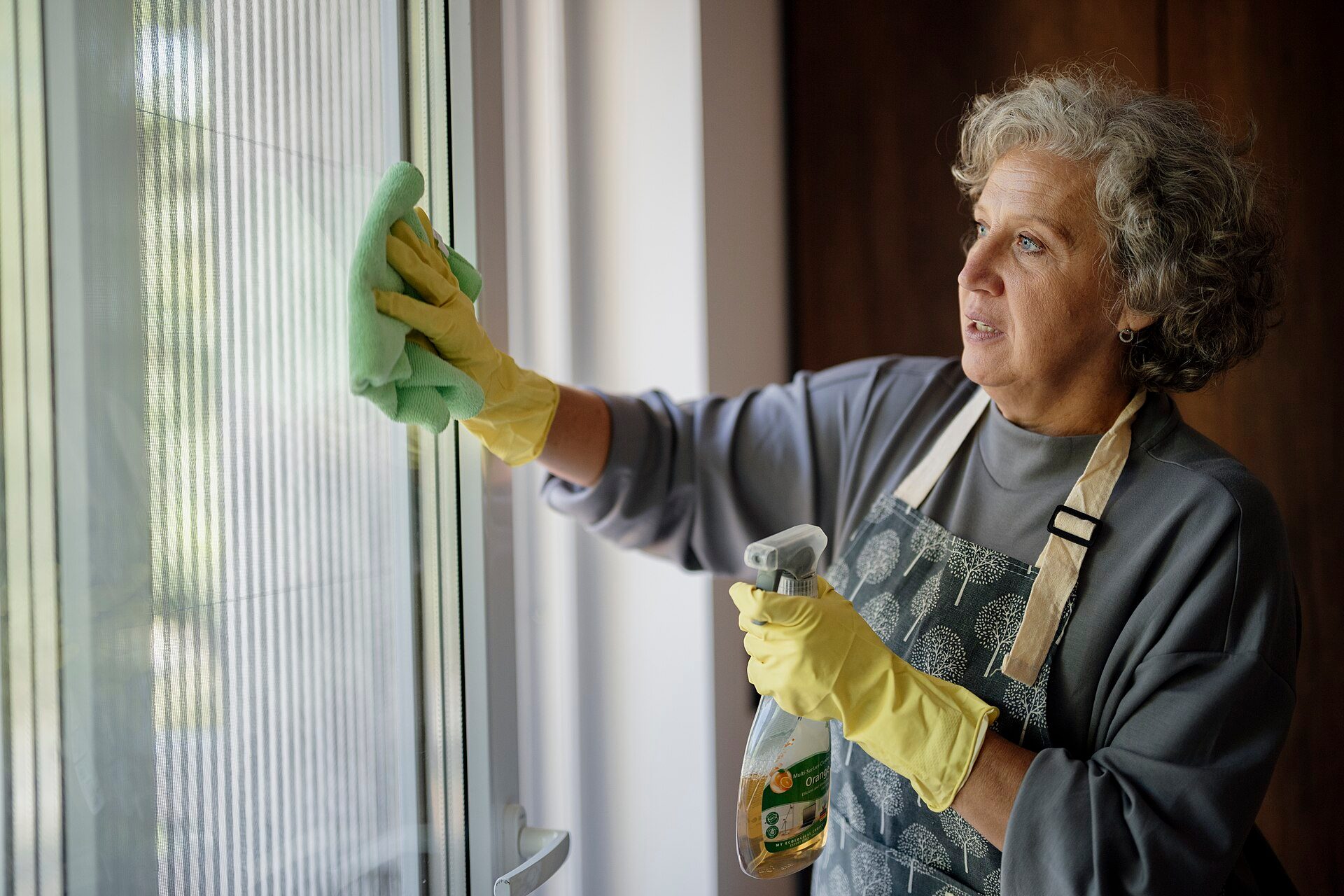
Photo: Shixart1985 / Wikimedia Commons, CC BY 2.0
- One set of cloths per room. When you finish a room, its cloths go into the dirty cloth bag; the next room gets fresh cloths.
- Fold the cloth into 8 faces. Fold in half, then in half again into 4 layers, each with 2 usable faces. When one face is dirty, turn to the next clean face.
- Clean to dirty, top to bottom. The basin first, the toilet last; on the toilet, the lid and outside first, the inside and base last.
- A cloth that falls on the floor is dirty. Bag it and take another.
- Red cloths never leave the bathroom and are never kept in the same compartment as other cloths on the trolley.
Gloves and brushes follow the zones too
The right cloth colour is useless if you are still wearing the gloves you just used on the toilet: change gloves when you move from the bathroom to the bedroom. The toilet brush and toilet scourer are also kept for the toilet only.
Washing and drying cloths
Dirty cloths go into their own bag, never mixed with guest linen, and are sent for washing following the laundry department's procedure. Throw away cloths that are worn, faded or still smell after washing, because faded cloths are easily used in the wrong zone.
Hand tools and chemicals on the trolley
The tool caddy goes in and out of bathrooms dozens of times a shift. When it is tidy and everything has its own place, your hand always knows where each bottle is.
What is in the tool caddy
- All-purpose spray, toilet cleaner, glass cleaner and disinfectant: every bottle labelled with its name and the date it was mixed.
- A soft scourer for basins and baths, a separate scourer for the toilet, and a small brush for tap joints and corners.
- A glass squeegee, pre-folded cloths in 4 colours and spare gloves.
- Damage report slips and a pen.
Storing chemicals so nothing is mixed up or spilt
Each bottle has a fixed slot in the caddy. Keep the toilet cleaner and the chlorine disinfectant apart, never standing side by side. Bottles always stand upright, with the spray nozzle locked while moving. Concentrate cans never travel on the trolley; carry only diluted solutions.
Safety warning: The chemicals on a trolley are the easiest thing in the hotel for children and curious guests to reach. Never leave the chemical caddy on top of the trolley in the corridor while you are inside a room; put it in a closed compartment or take it into the room with you. Never pour chemicals into drinking water bottles or hotel glasses. If you see a child holding a chemical bottle: take it back gently, ask whether they drank it or sprayed it in their eyes, and tell your supervisor at once; if you suspect swallowing or eye contact, call 115 (the emergency medical number in Vietnam) and bring the bottle.
Securing the trolley when you leave it
When you go to fetch supplies, lock the trolley if it has a lock; if not, push it into the floor pantry. A master key card is never left on the trolley.
The vacuum cleaner: using it and keeping it working
The vacuum cleaner is the most expensive piece of equipment you use every day, and it often breaks because it is used wrongly. A weak vacuum means going over the carpet again and again, which is slow and tiring. Figure 5 shows a canister vacuum with a flexible hose and a metal wand, the type often found in hotels.
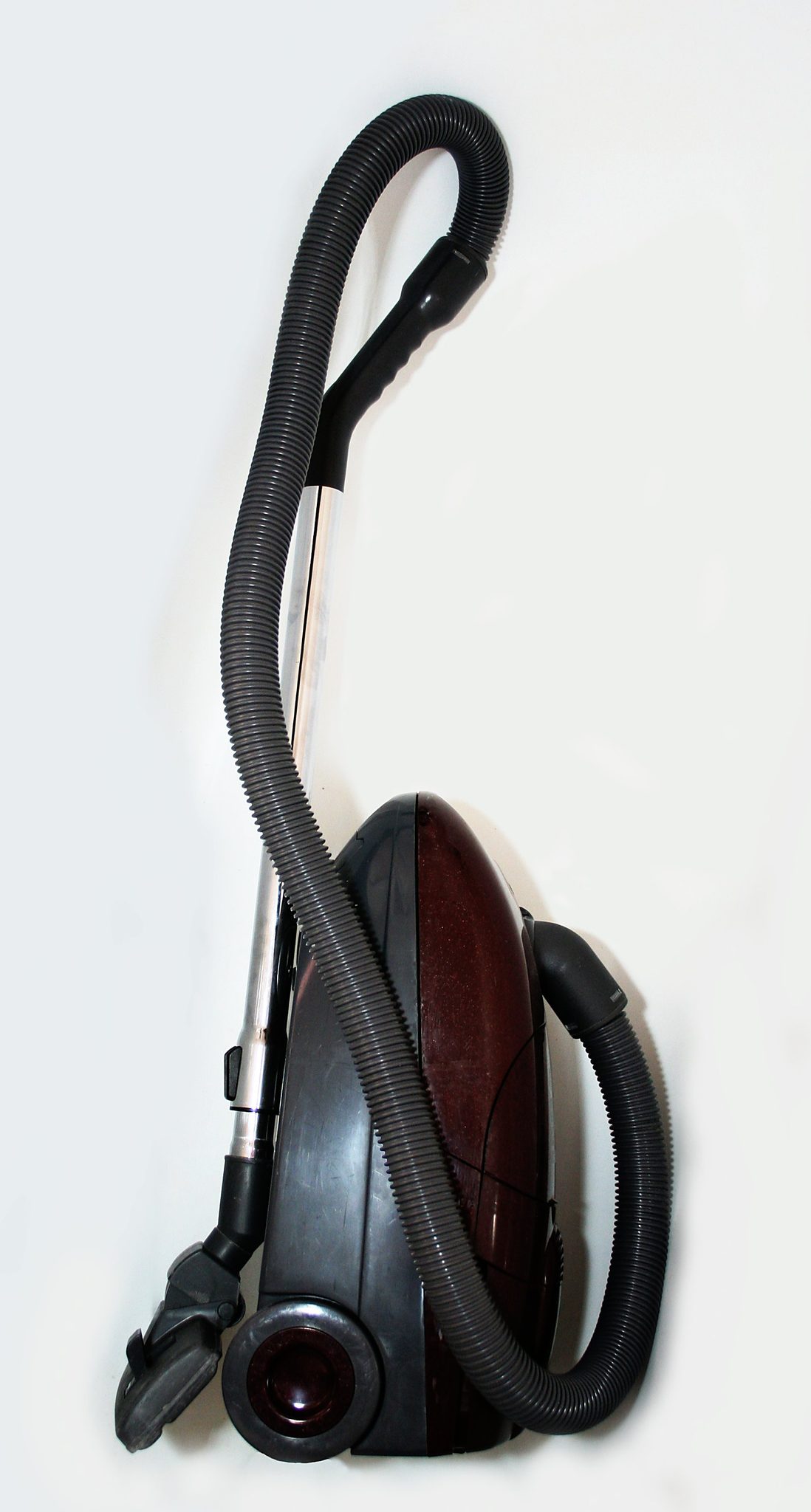
Photo: Che / Wikimedia Commons, CC BY-SA 2.5
Checks before the shift
- Cable and plug: no cracked insulation, no bare copper showing, no temporary tape repairs. If it is damaged, report it and do not use it.
- Dust bag or bin: has it been emptied, is it more than about 2/3 full?
- Filter: not clogged with dust, not torn.
- Hose and nozzle: no holes, no hair, thread or paper stuck inside. No hair wrapped round the brush roll.
- Test run: an even motor sound and no burning smell.
Using it correctly in the room
Plug in at the socket nearest the door and run the cable along the wall so nobody trips. Vacuum from the far corner back towards the door. First pick up by hand hairpins, coins, broken glass and anything that might belong to the guest, such as earrings or memory cards. Never use a dry vacuum on water, liquids or still-warm cigarette ash.
Care at the end of the shift
- Empty the bin or change the bag when it is nearly full; a full vacuum loses suction and overheats.
- Cut hair off the brush roll with small scissors instead of pulling hard and breaking the bristles.
- Tap out or wash the filter following the manufacturer's instructions; a washable filter must be completely dry before you refit it.
- Coil the cable in large loops, never wound tightly round the body or kinked.
- Store the vacuum in the floor pantry, somewhere dry, never in the corridor.
Electrical safety with the vacuum: Never plug in or unplug with wet hands or while standing on a wet bathroom floor. Unplug by holding the plug, never by yanking the cable. Switch off and unplug before removing the nozzle, clearing hair or emptying dust. A cracked cable, loose plug, burning smell or a motor that cuts in and out: stop using it, tag it as faulty and tell your supervisor or the engineering team. Never open the machine to repair it yourself.
Worked example: preparing the trolley for a 14-room shift
Lan is a new room attendant at a 3-star hotel in Da Nang. On the morning shift she is given 14 rooms on the 6th floor: 9 departures and 5 stay-overs, each with 2 guests. Suppose the hotel's amenity list gives each guest 1 bottle of shampoo, 1 bottle of shower gel and 1 toothbrush kit, and each room 2 bottles of drinking water per day and 1 spare toilet roll. Stay-over rooms only get items that are used up; Lan estimates each stay-over room has used 1 shampoo and 1 shower gel, while guests keep their toothbrushes.
Counting amenities and consumables
| Item | 9 departures | 5 stay-overs | Spare | Total to carry |
|---|---|---|---|---|
| Shampoo | 9 × 2 = 18 | 5 × 1 = 5 | 2 | 25 |
| Shower gel | 9 × 2 = 18 | 5 × 1 = 5 | 2 | 25 |
| Toothbrush kit | 9 × 2 = 18 | 0 | 2 | 20 |
| Drinking water (bottles) | 9 × 2 = 18 | 5 × 2 = 10 | 2 | 30 |
| Toilet rolls | 9 × 1 = 9 | 5 × 1 = 5 | 2 | 16 |
Check: shampoo 18 + 5 + 2 = 25; water 18 + 10 + 2 = 30; toilet rolls 9 + 5 + 2 = 16. The small spare stops her running back to the store for a dented bottle or a guest asking for more.
Counting cloths by colour
Each room gets a set of 4 colours, so each colour needs 14 cloths plus 2 spares: 14 + 2 = 16 cloths. Total: 16 red + 16 yellow + 16 green + 16 blue = 64 cloths (16 × 4 = 64). Lan pre-folds the cloths into 8 faces, one compartment per colour, with the red cloths in their own lidded compartment.
Loading and a final check
Lan puts 30 bottles of water and 16 toilet rolls on the bottom shelf, linen on the middle shelves, and 25 + 25 + 20 = 70 small amenities on the top tray. She pushes the trolley through the lift door as a test: a clear view ahead and no wobble. At the end of the shift she notes what is left over so she can estimate more closely the next day.
Common mistakes with trolleys and cloths
Stacking the trolley too high
Sign: you have to lean to see where you are going, and things fall off at the lift gap. Cause: wanting to carry as much as possible to avoid trips to the store. Fix: count from your room list as in the example, carry what you need plus a small spare, not extra "just in case".
One cloth for the whole bathroom
Sign: the cloth used on the toilet goes on to wipe the basin tap. Cause: rushing, or not bringing all the colours. Fix: prepare all 4 colours for every room at the start of the shift; if you run out, fetch more from the store, never "make do".
Dirty bag touching clean linen
Sign: clean bath towels smell or have hair on them. Cause: an overfull dirty bag spilling onto the clean shelf. Fix: change the bag at about 2/3 full and hang the two bags at opposite ends.
The vacuum gets weaker and weaker
Sign: going over the carpet many times and dust still left, the motor running hot. Cause: full bin, clogged filter, hair round the brush roll. Fix: do the end-of-shift care above; if it is still weak, report it to engineering.
Frequently asked questions
What goes on a housekeeping trolley?
Amenities on the top tray, clean linen in the middle, water and toilet rolls at the bottom, a dirty linen bag and a rubbish bag at the two ends, and a tool caddy with chemicals and colour-coded cloths.
What is cloth colour coding in hotels?
It is a rule that each area has its own cloth colour, so germs are not carried from the toilet to other places. Red for toilets is very common; the other colours depend on the hotel, so learn the chart where you work.
Why not use one cloth for several rooms?
A cloth used in one room carries that room's germs into the next. A fresh set of cloths for each room is the simplest and most reliable approach.
What is the fastest way to set up a housekeeping trolley?
Follow a fixed order every day: get the room list, count supplies, load heavy items low and light items high, prepare the caddy last. After 1–2 weeks you will be done in about 10–15 minutes.
How often should a hotel vacuum filter be cleaned?
Check it every shift, empty the dust when nearly full and clean the filter following the manufacturer's instructions and hotel rules. A torn filter or a burning smell means reporting it to engineering, not repairing it yourself.
Practice exercises and self-assessment
- Get the amenity list and cloth colour chart from your hotel (or use the sample chart in this lesson) and copy them into your notebook.
- For a list of 12 rooms (7 departures, 5 stay-overs, 2 guests each), build your own amenity and cloth count table like Lan's.
- Stock a real trolley, or simulate one with cardboard boxes, using the 8-step routine and timing yourself.
- Check a vacuum cleaner with the 5 pre-shift checks, empty it and coil the cable correctly.
Self-assessment criteria
- Pass: every line of your count table adds up, each item has a small spare, and you carry no more than a few extra items.
- Pass: trolley stocked in under 20 minutes, a clear view when pushing, dirty bag and clean items at opposite ends.
- Pass: all 4 cloth colours and their zones named correctly, and the red cloth never used outside the toilet.
- Not yet: leaving the chemical caddy open in the corridor, using one cloth for the whole bathroom, or using a vacuum with a damaged cable.
Once your trolley is tidy and your cloths are the right colours, move on to the next step of the roadmap: Hotel-standard bed making, where you use the clean linen on your trolley to make mitred corners, put on duvet covers, arrange pillows and practise making a double bed in under 4 minutes.
Keep learning housekeeping: after the trolley and colour-coded cloths come standard bed making, bathroom cleaning, occupied and departure room procedures, public areas and laundry, then cleaning 10 rooms against the clock. See the 8-step housekeeping attendant roadmap.