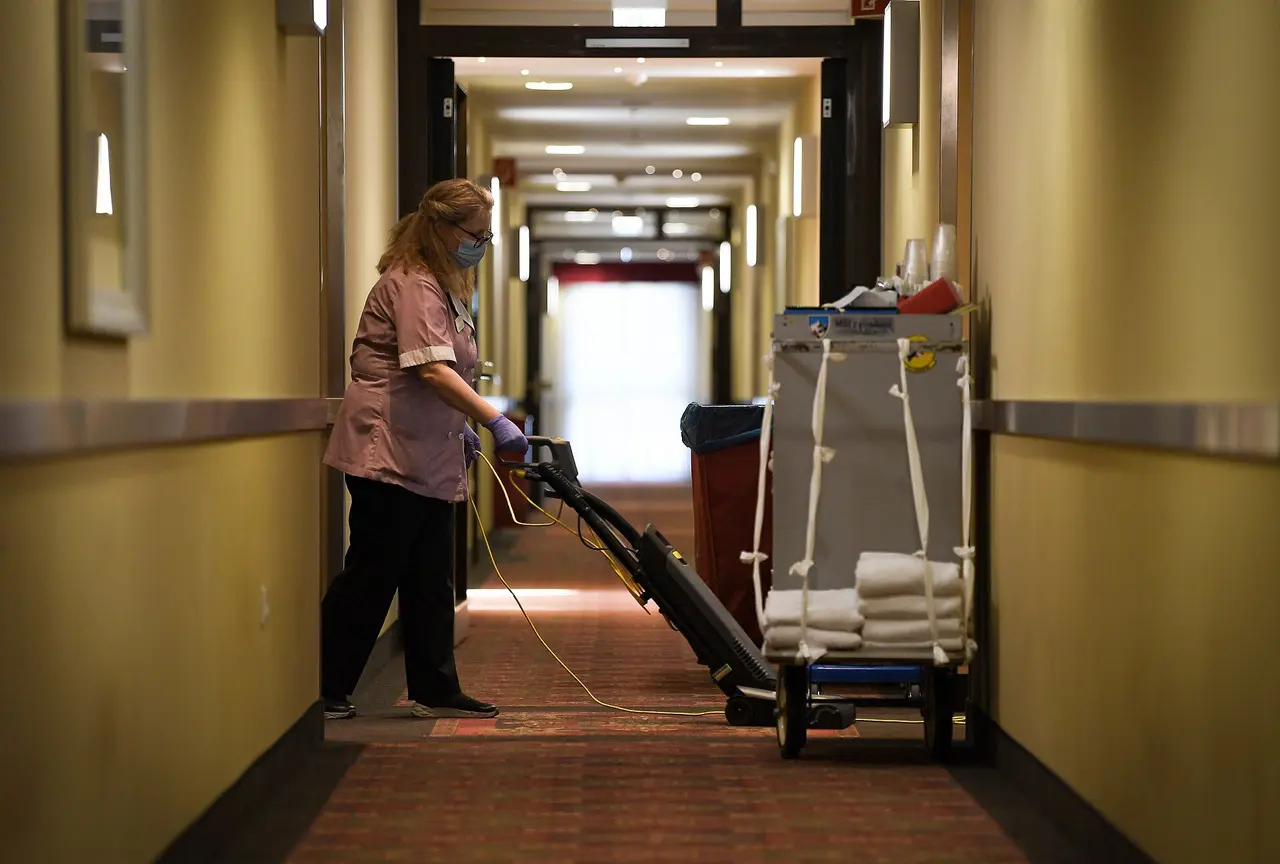
Using housekeeping chemicals safely comes down to 4 things: read the label before use, dilute to the stated ratio with a measuring cup rather than by eye, never mix two cleaning products (above all chlorine bleach with acidic toilet cleaner), and always wear gloves, adding a mask and goggles when diluting or spraying hard. Alongside that, a new room attendant must protect their back when lifting mattresses and bending to clean, and must handle needles, blood and vomit in guest rooms correctly: no bare hands, never pick up a needle yourself, report it to your supervisor at once. This is the first lesson of the roadmap, written the way a floor supervisor coaches a new starter, with a table of chemical groups, how to work out dilution amounts, and a worked example of preparing chemicals for a 12-room shift.
By the end of this lesson, you will be able to:
- Recognise the 5 common groups of housekeeping chemicals and know which must never be used together.
- Read the hazard pictograms on a label and work out how much concentrate to put in a spray bottle or bucket from the label ratio.
- Choose and wear the right gloves, mask and goggles for each task, and change gloves at the right moments.
- Bend from the knees, lift mattresses and push the trolley so your back does not ache after a shift.
- Follow the correct procedure for needles, blood and vomit, and know what to do after a needlestick injury.
New to housekeeping? Chemical safety, posture and hygiene are step 1 of the roadmap, before the trolley and tools, bed making, bathroom cleaning and room procedures. See the 8-step housekeeping attendant roadmap to learn in the right order.
What chemicals do room attendants use?
A housekeeping trolley usually carries 4–6 chemicals, each for a particular job. Understanding how they differ is the first step to never using the wrong one or mixing them by mistake. Brand names vary from hotel to hotel; look at the purpose and ingredients on the label.
The 5 common groups
| Group | Used for | Main hazard | Note |
|---|---|---|---|
| All-purpose cleaner (usually neutral) | Desks, wardrobes, floors, general surfaces | Skin irritation when used strong | Dilute as the label says |
| Toilet and limescale cleaner (often acidic) | Toilets, taps, glass screens with scale | Corrosive to skin and eyes; toxic gas if it meets chlorine | Never use with bleach |
| Chlorine bleach and disinfectant | Disinfecting toilets, bathroom floors, blood spills | Corrosive, pungent; toxic gas if it meets acid or ammonia | Never mix with anything else |
| Glass and mirror cleaner (alcohol, may contain ammonia) | Mirrors, glass, stainless steel | Flammable, irritates eyes | Do not spray near flames |
| Polish, deodoriser, air freshener | Wooden furniture, room air | Breathing irritation if overused | Spray sparingly, ventilate |
Concentrate and ready-to-use solutions
Hotels usually buy chemicals as concentrate (5-litre or 20-litre cans) and dilute them into spray bottles and buckets. Some use wall-mounted dosing units that dispense the right ratio at the press of a button. Concentrate is far more dangerous than diluted solution, so new staff are usually only given ready-diluted products until they have been trained to dilute.
Read the chemical label before use
The label is the shortest and most important instruction sheet. Before using a chemical for the first time, read 4 things: name and purpose, hazard pictograms, dilution ratio, and first-aid instructions (Figure 1).
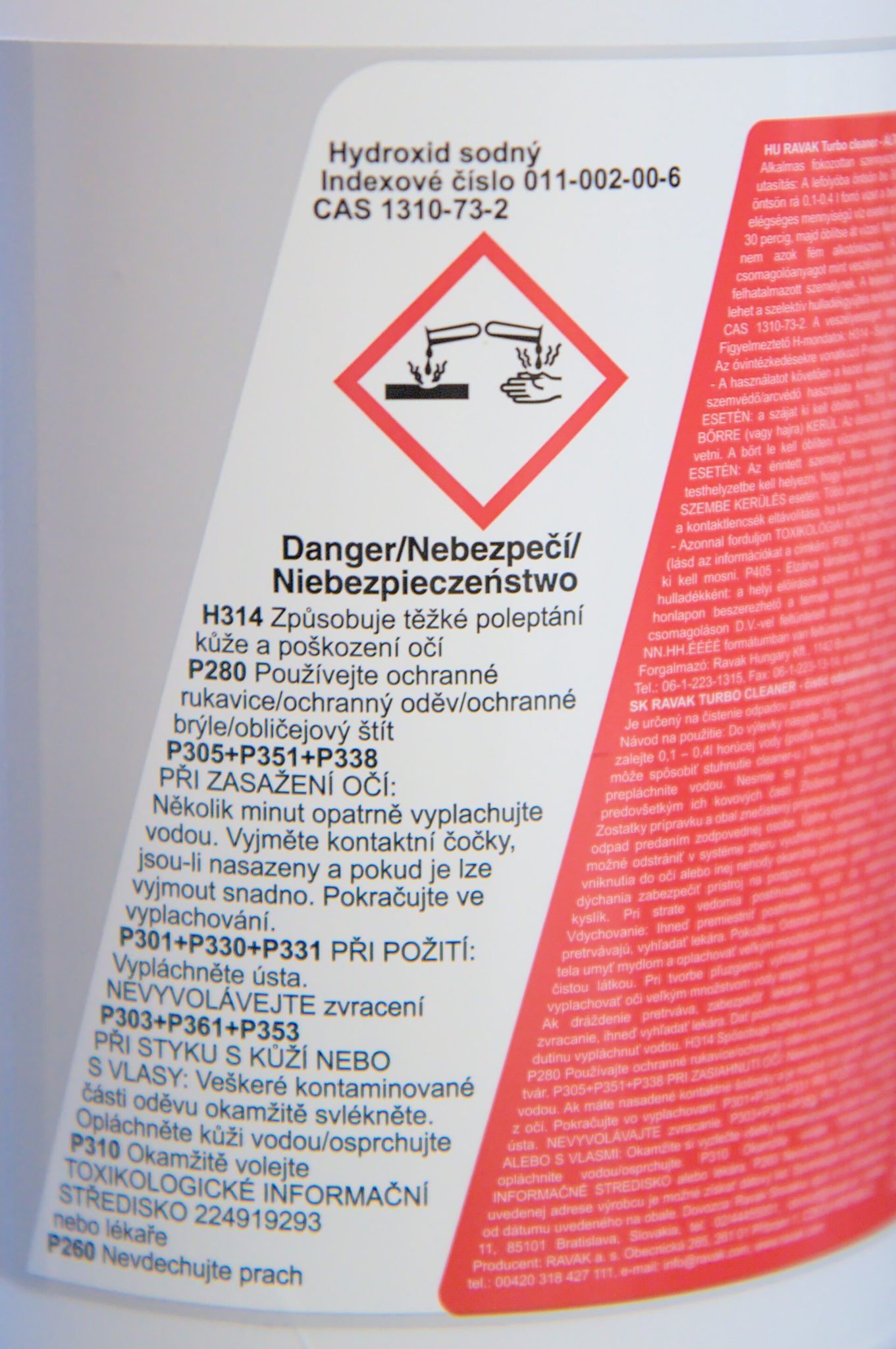
Photo: Petr Kadlec / Wikimedia Commons, CC BY-SA 4.0
Red-bordered diamond pictograms
- Corrosive (liquid eating into a hand and a metal surface): burns skin, damages eyes. Always wear gloves and goggles.
- Exclamation mark: irritates skin, eyes and airways.
- Flame: flammable; keep away from heat, never spray near candles or lighters.
- Skull and crossbones: acutely toxic; new staff do not use it alone.
The safety data sheet (SDS)
Every chemical has a safety data sheet (SDS, sometimes MSDS) listing ingredients, hazards, first aid and spill handling. On your first day, ask your supervisor where these sheets are kept (usually in the chemical store or housekeeping office). After an incident, take the bottle or sheet with you to the doctor so they know what you were exposed to.
Every diluted bottle needs a label
Every spray bottle you fill must be labelled with the solution name and date. Never pour chemicals into drinking water bottles, cups or hotel glasses; many accidental poisonings start with an unlabelled bottle.
Diluting chemicals to the right ratio
Stronger does not clean better: surfaces end up streaky and sticky and wear out sooner, your hands dry and crack, and chemical costs go up. Too weak, and the surface is neither clean nor disinfected. The right ratio gets all three right: clean, safe and economical.
Reading the ratio on the label
Labels usually say either "add 25 ml per 1 litre of water" or "ratio 1:40". The first is easiest: multiply the millilitres by the litres of water. For a ratio, ask your supervisor how the hotel converts it, then write down the millilitres for each bottle and bucket you use and post it in the store.
The 5-step dilution procedure
- Put on gloves and goggles (when handling concentrate).
- Put the water in the bottle or bucket first, close to the amount needed.
- Measure the concentrate with a measuring cup or dosing pump and pour it slowly into the water. Never pour water onto concentrate.
- Close the lid and shake or stir gently; do not shake hard enough to foam over.
- Label with the solution name and date; wipe up any drips.
Quick conversion table (example label: 25 ml per litre)
| Container | Water | Concentrate |
|---|---|---|
| Small spray bottle | 0.5 litre | 25 × 0.5 = 12.5 ml |
| Large spray bottle | 1 litre | 25 ml |
| Floor mop bucket | 8 litres | 25 × 8 = 200 ml |
The 25 ml per litre figure is only an example for practice; the real chemicals at your hotel have their own ratio on the label.
Never mix two cleaning products
This is the number one rule of the trade. When a bathroom is very dirty, new staff are tempted to "add some bleach to the toilet cleaner to make it stronger". The result can be a cloud of toxic gas in a small, enclosed space.
Safety warning: Never mix chlorine bleach with acidic cleaners (many toilet and limescale cleaners), as this releases toxic chlorine gas; never mix bleach with ammonia-based products (some glass cleaners), as this releases toxic gases that damage the lungs. Do not mix any two chemicals, even different brands for the same job. After using one product, rinse with clean water before using another on the same surface. Always run the extractor fan and open the door when cleaning bathrooms. If you notice a sharp smell, stinging eyes, coughing or difficulty breathing: leave the room at once, close that room's door and tell your supervisor; for breathing difficulty or chest tightness call an ambulance (115 in Vietnam). If a chemical splashes into your eyes, rinse under clean running water for at least 15 minutes, then see a doctor.
Why hotel bathrooms are prone to incidents
Bathrooms are small, often windowless, warm after a guest's shower, and have many surfaces needing different chemicals. Pouring two products into the same toilet a few minutes apart is as dangerous as mixing them in a bucket.
If you mix them by mistake
Do not lean in to sniff and do not try to flush it away. Leave the bathroom, close the door, open the bedroom window if there is one, and tell your supervisor. Only go back once the area has been ventilated and your supervisor says it is safe.
Protective equipment: gloves, masks, goggles
Personal protective equipment (PPE) is the last barrier between chemicals, germs and your body. The hotel is responsible for providing it; you are responsible for wearing it correctly (Figure 2).
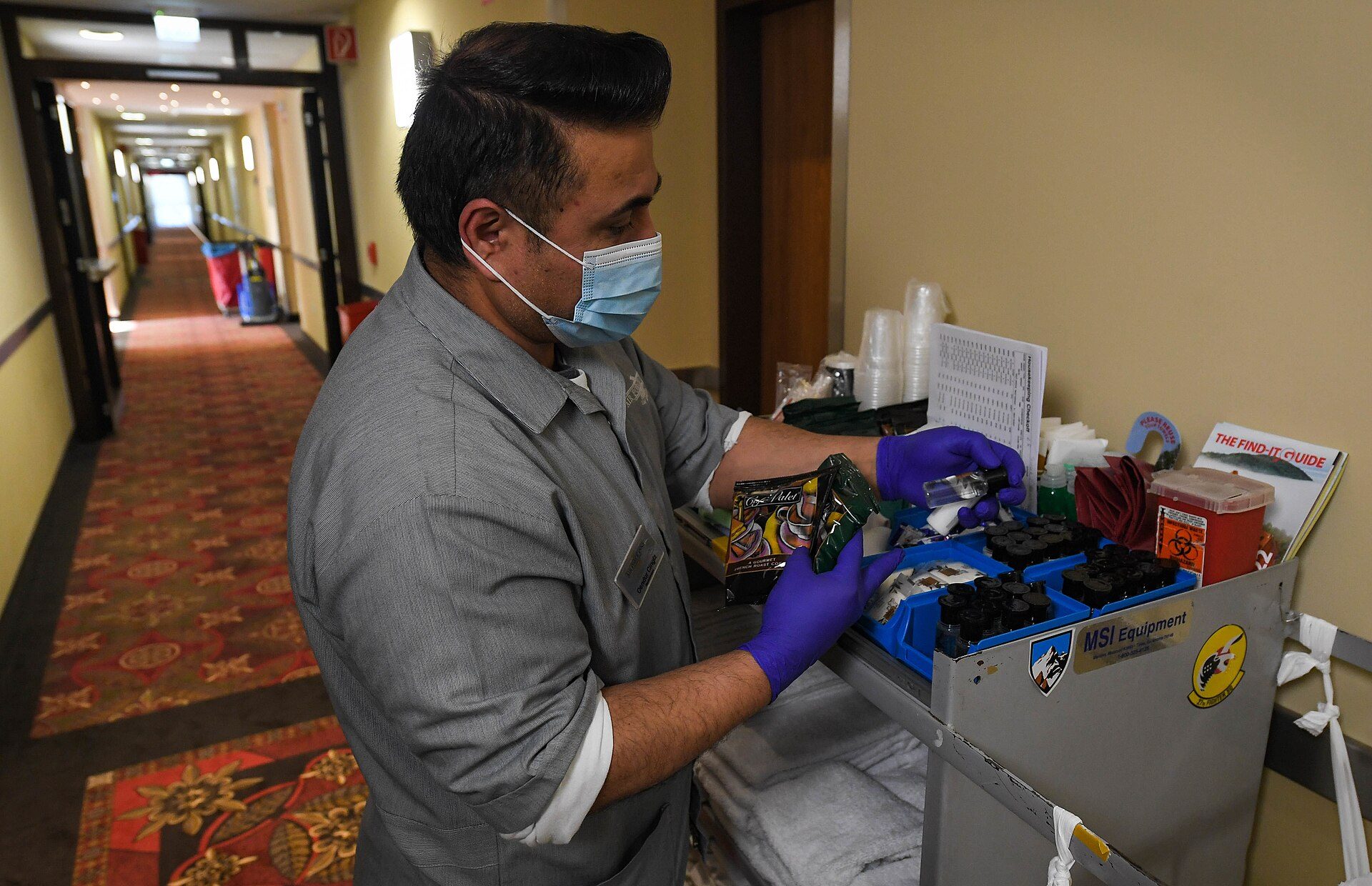
Photo: U.S. Air Force photo by Airman Jared Lovett / Wikimedia Commons, Public domain
Choosing gloves
- Thick, long-cuff rubber gloves: for bathrooms, toilets and handling concentrate.
- Disposable nitrile gloves: for light tasks, rubbish and soiled linen; discard after use.
- Many hotels use different glove colours for bathrooms and bedrooms so they never get mixed up; change gloves when moving from the bathroom to wiping items in the bedroom.
- Replace torn or punctured gloves at once. Remove gloves by turning them inside out without touching the outside, then wash your hands.
Masks and goggles
Wear a mask when spraying chemicals in enclosed spaces, sweeping dust or shaking out linen. Wear goggles when diluting concentrate and when scrubbing at face height or overhead (shower screens, ceilings), since chemicals easily splash back. When wiping desks and shelves, wear gloves and spray onto the cloth first (Figure 3) to reduce the fumes rising to your face.
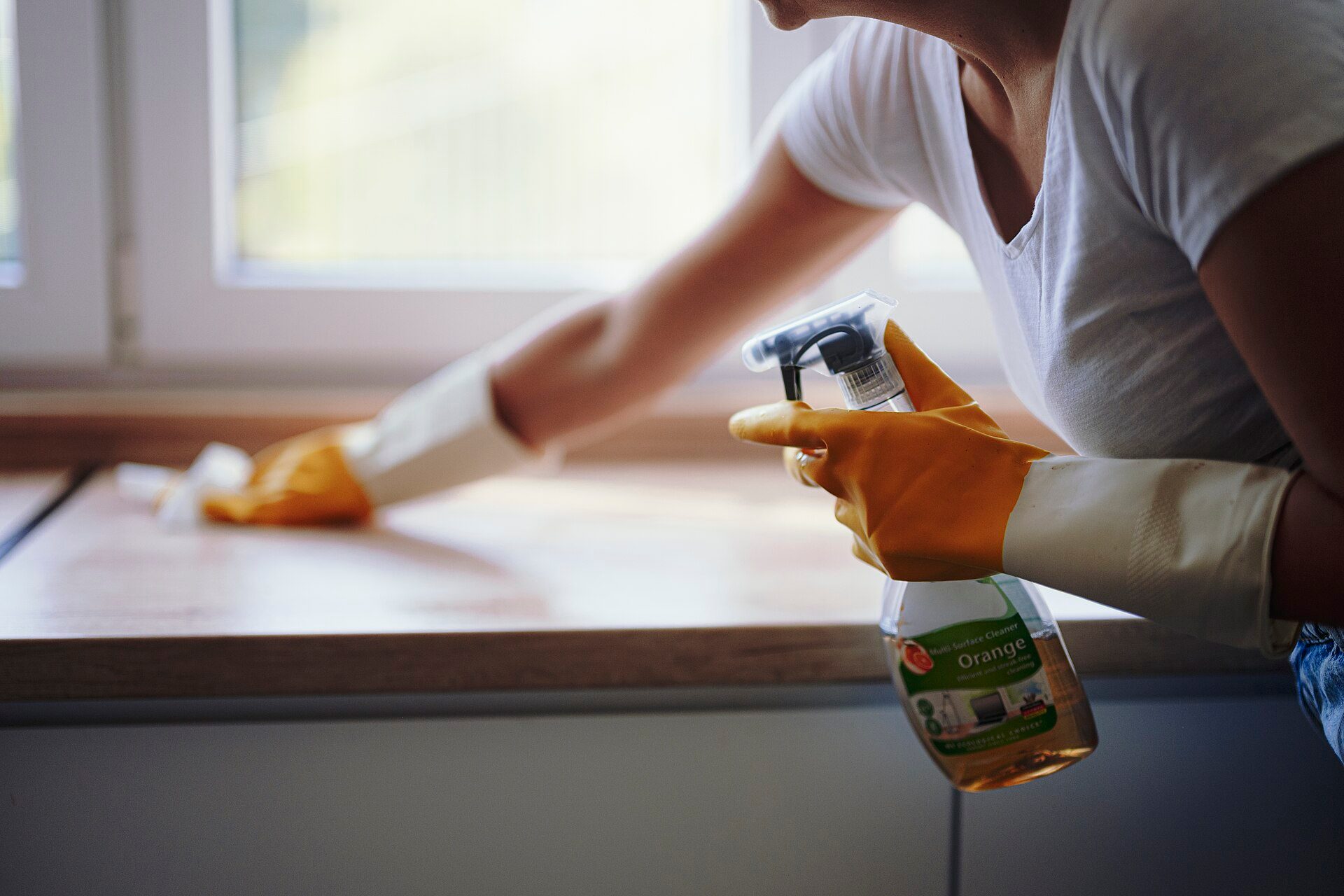
Photo: Shixart1985 / Wikimedia Commons, CC BY 2.0
Shoes and clothing
Closed, non-slip shoes; a wet, soapy bathroom floor is the commonest place for falls in this job. Keep sleeves neat so they do not brush against toilets or chemicals.
Working posture that protects your back
A shift of 10–14 rooms means hundreds of bends, lifts, reaches and pushes. Back pain is a major reason people leave the job early, and it usually comes from repeated poor posture rather than one heavy lift.
Bend your knees, not your back
When picking things up from the floor, cleaning around the toilet base or under the bed, lower yourself by bending your knees or kneeling on one knee (on a kneeling pad if available), keeping your back straight. For bathtubs and large floors, use a long-handled mop instead of bending and reaching.
Lifting mattress edges and heavy items
Stand close to the mattress, feet shoulder-width apart, bend your knees and use your legs to lift the edge just enough to tuck the sheet; never twist while lifting. Bed-making and corner-folding technique is covered in the lesson on how to make a hotel bed. Turning or flipping mattresses and moving heavy items such as suitcases or minibars is a two-person job.
Push the trolley, don't pull it
Push the trolley in front of you with your hands at waist height; do not pull it backwards and do not stack items so high they block your view. Fill soiled-linen bags only about two-thirds so they are easy to lift.
Handling needles, blood and biological waste
Most rooms are unremarkable, but in this job you will come across bloodstained towels, vomit, needles (from diabetic guests or others) and razor blades. The general rule: treat all blood and body fluids as potentially infectious and never touch them with bare hands.
Finding a needle or sharp object
- Do not pick it up by hand, do not recap it, do not bend it, do not push it into a rubbish bag.
- Mark the spot and report it to the floor supervisor or security according to hotel procedure.
- The person assigned uses tongs to place it in a dedicated rigid sharps container with a lid (Figure 4).
- Check the surrounding area, mattress gaps and bins carefully before continuing to clean.
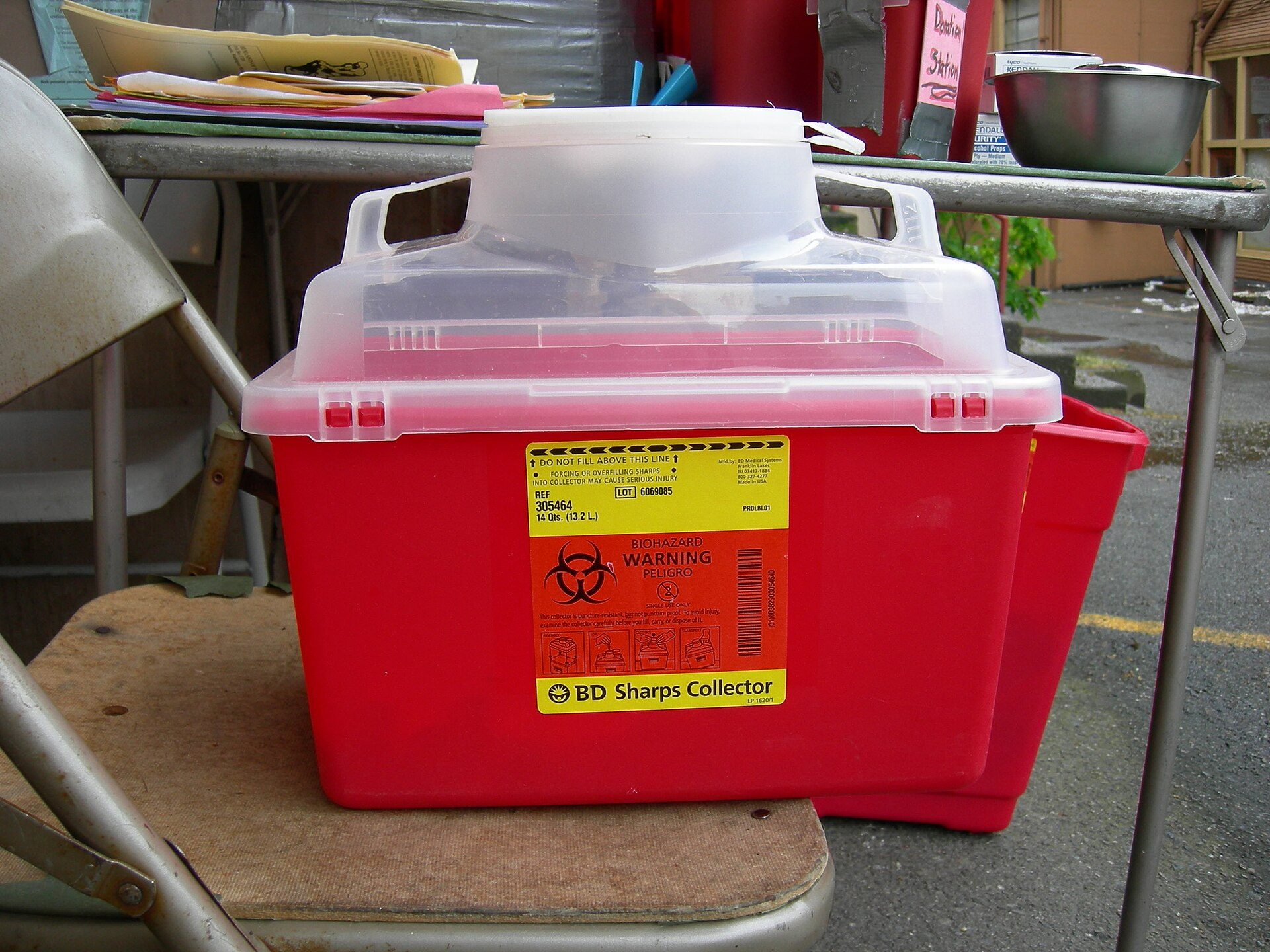
Photo: Joe Mabel / Wikimedia Commons, CC BY-SA 3.0
Blood, vomit and body fluids
Use the hotel's spill kit (usually gloves, mask, absorbent powder or pads, a separate bag and disinfectant). Absorb and collect the material from the outside inwards, bag it separately, then disinfect the surface according to the label. Bloodstained linen goes into a separate labelled bag for the laundry to process apart; do not shake it out or hold it against your body.
After a needlestick or blood in the eyes or a wound
Wash the area at once with soap under running water, let it bleed freely, do not squeeze hard and do not suck the wound; for blood in the eyes, rinse repeatedly with clean water. Tell your supervisor immediately and see a doctor as soon as possible (ideally within the first few hours) so they can assess the exposure risk and decide whether preventive treatment is needed. Note the time, the room and the type of sharp.
Worked example: preparing chemicals for a 12-room shift
Mai is a new room attendant at a 4-star hotel in Nha Trang, assigned 12 departure rooms on the morning shift. Suppose the hotel's labels say: all-purpose cleaner 25 ml per litre, chlorine disinfectant 20 ml per litre, toilet cleaner used neat at about 15 ml per toilet.
Working out the concentrate needed
| Container | Calculation | Concentrate |
|---|---|---|
| All-purpose spray bottle 0.5 litre, filled twice in the shift | 2 × (25 × 0.5) | 25 ml |
| Disinfectant spray bottle 0.5 litre, filled once | 20 × 0.5 | 10 ml |
| All-purpose floor bucket 8 litres | 25 × 8 | 200 ml |
| Toilet cleaner used neat, 12 toilets | 12 × 15 | 180 ml |
| Total concentrate | 415 ml | |
Check: 25 + 10 + 200 + 180 = 415 ml. Mai records 415 ml in the floor's chemical issue log.
Arranging the trolley
Mai places the acidic toilet cleaner and the chlorine disinfectant in different compartments, each bottle labelled; long-cuff rubber gloves for bathrooms, nitrile gloves for linen and rubbish; the sharps container on the top shelf as hotel policy requires.
An incident during the shift
Room 7 has a used needle on the bedside table. Mai does not touch it and calls the floor supervisor on the radio; the supervisor uses tongs to put it in the sharps container. Mai changes gloves and carries on cleaning, checking the mattress gaps and bin carefully.
Common mistakes new attendants make
Diluting by eye
Sign: sticky floors, streaky mirrors, dry cracked hands. Cause: pouring "a bit extra to be sure". Fix: always use a measuring cup or dosing pump and post the conversion table in the store.
Two products in the same toilet
Sign: an unusual sharp smell, stinging eyes. Cause: trying to shift a stain faster. Fix: one product at a time, rinse thoroughly before using another.
One pair of gloves for the whole room
Sign: cleaning the toilet, then wiping glasses and the TV remote with the same gloves. Cause: saving time. Fix: change or swap gloves when moving between areas.
Pressing rubbish down by hand
Sign: pushing a hand into the bin bag to compact it. Cause: a habit from home. Fix: hold the top of the bag and tie it; never push your hand into rubbish, which may hide razors, needles or broken glass.
Frequently asked questions
What chemicals are used in hotel housekeeping?
Typically an all-purpose cleaner, a toilet and limescale cleaner, a chlorine disinfectant, glass cleaner, furniture polish and air freshener. Brand names differ but the purposes are similar; read the label to know the group.
Is it dangerous to mix toilet cleaner with bleach?
Yes, very. Many toilet cleaners are acidic and release toxic chlorine gas when they meet chlorine bleach. Never use them together, not even a few minutes apart in the same toilet.
What dilution of bleach should I use for bathrooms?
It depends on the strength of the product, so follow only the instructions on the bottle and the hotel's procedure. Never make it stronger than instructed.
What should I do after a needlestick injury while cleaning?
Wash at once with soap under running water, let it bleed freely, do not squeeze hard, tell your supervisor and see a doctor as soon as possible for a risk assessment and advice on preventive treatment.
Is housekeeping work harmful to health in the long run?
Wearing PPE, diluting correctly and using good posture greatly reduce the risks. If you develop skin allergies on your hands, a lasting cough or back pain for several weeks, see a doctor and tell your manager so gloves, chemicals or duties can be adjusted.
Practice exercises and self-assessment
- Read the labels of 4 chemicals on the trolley and write down the name, group, pictograms and dilution ratio in your notebook.
- Dilute one 0.5-litre spray bottle and one 8-litre bucket to the label ratio, checked by your supervisor.
- Practise picking things up by bending your knees 10 times and lifting a mattress edge 5 times, with someone watching your back.
- Role-play finding a needle in a room and state the 4 handling steps correctly.
Self-assessment criteria
- Pass: all 4 chemicals grouped correctly, and you can say which pair must never be used together.
- Pass: diluted amounts within a few millilitres of the calculation, bottles labelled and dated.
- Pass: back kept straight and no twisting in all 15 bends and lifts.
- Not yet: mixing two cleaners, touching a needle by hand, or cleaning a bathroom without gloves.
Once safety is a habit, move on to the next step of the roadmap: Trolley, tools & colour-coded cloths, where you learn to stock the trolley for a whole shift and use cloths by colour so dirt never travels from the toilet to the glasses.
Keep learning housekeeping: after safety come the trolley and colour-coded cloths, standard bed making, bathroom cleaning, occupied and departure room procedures, then cleaning 10 rooms against the clock. See the 8-step housekeeping attendant roadmap.