Spraying crops with a drone safely rests on three layers that must all be in place before the propellers turn: the drone and the flight are legal under current rules (registered equipment, permission to fly, no restricted zones), the field has been surveyed for people, power lines, houses and fish ponds, and the pesticide is mixed exactly to the label while you wear full protective gear. Beginners tend to worry only about flying well, but most accidents and legal trouble in this trade come from skipping one of those three layers. This is the first lesson of the roadmap, written the way a spray crew leader briefs a new member, with a checklist you can use at the edge of the field.
By the end of this lesson, you will be able to:
- State the legal principles for flying spray drones in Vietnam and know where to ask for current information instead of trusting rumours.
- Survey a field in about 15 minutes and mark power lines, people, houses, fish ponds and buffer zones.
- Read a pesticide label for active ingredient, dose, pre-harvest interval and toxicity class, then work out the chemical per tank with figures that add up.
- Wear full protective gear while mixing, set up a safe mixing station and handle rinse water and empty containers properly.
- Recognise signs of pesticide poisoning and know when to stop work and take someone to a medical facility.
Training as an agricultural drone pilot? This is step 1 of the roadmap: flight rules, flight safety and pesticides, before drone anatomy and manual flying. See the 8-step agricultural drone pilot roadmap to learn in the right order.
Why safety is the first lesson for a spray drone pilot
A spray drone is an aircraft weighing several tens of kilograms with a full tank, with propellers spinning very fast, carrying toxic chemicals and flying low over people's heads. One small mistake can wreck a machine worth hundreds of millions of dong, kill the fish in the next pond, scorch a neighbour's rice or injure someone. That is why serious training courses teach rules and safety first and flying second.
The three layers of safety
- Legal layer: the drone, the pilot and the flight are legitimate; no flying into prohibited or restricted areas.
- Flight layer: the field has been surveyed, nobody is inside the work area, power lines, tall trees and houses are avoided, and the weather allows it.
- Chemical layer: the right approved product, the dose on the label, protective gear, and no contamination of water sources.
Agricultural drone flight rules: the principles you can rely on
Vietnam's rules on unmanned aircraft can change over time, so this lesson only sets out general principles. Document numbers, application forms, fees and processing times must be checked directly with the competent authority or in the current regulations.
Registering the drone and the pilot's papers
The principle: the drone must be registered with the competent authority, and the pilot must meet the required conditions (usually including a certificate of training on that type of drone). When you buy a drone, ask the dealer how much help they give with registration paperwork; many agricultural drone dealers have staff for this. Keep copies of the registration, flight permission and training certificate in a waterproof pouch and take them to every job.
Flight permission and its limits
The flight or the flying area must be licensed or approved under the rules. A permission is usually tied to a specific area, time and altitude; flying outside it counts as flying without permission. In practice, ask the local military authority or the commune government where the field is, the cooperative or the agricultural extension station about the procedure currently in force. The lesson Drone flight permits in Vietnam: rules, no-fly zones, safety checklist from the aerial filming career explains how to schedule the paperwork; the same principles apply to spray drones.
No-fly and restricted zones
Areas you must avoid or apply for separately include airports and approach paths, military areas and barracks, key government sites, border areas and places hosting major events. In the countryside, fields near a military airfield or radar station are a real situation. Do not rely only on the no-fly map in the manufacturer's app: it is for reference and does not replace a permission. A no-fly sign like the one in Figure 2 is the clearest signal, but many restricted areas have no sign at all.
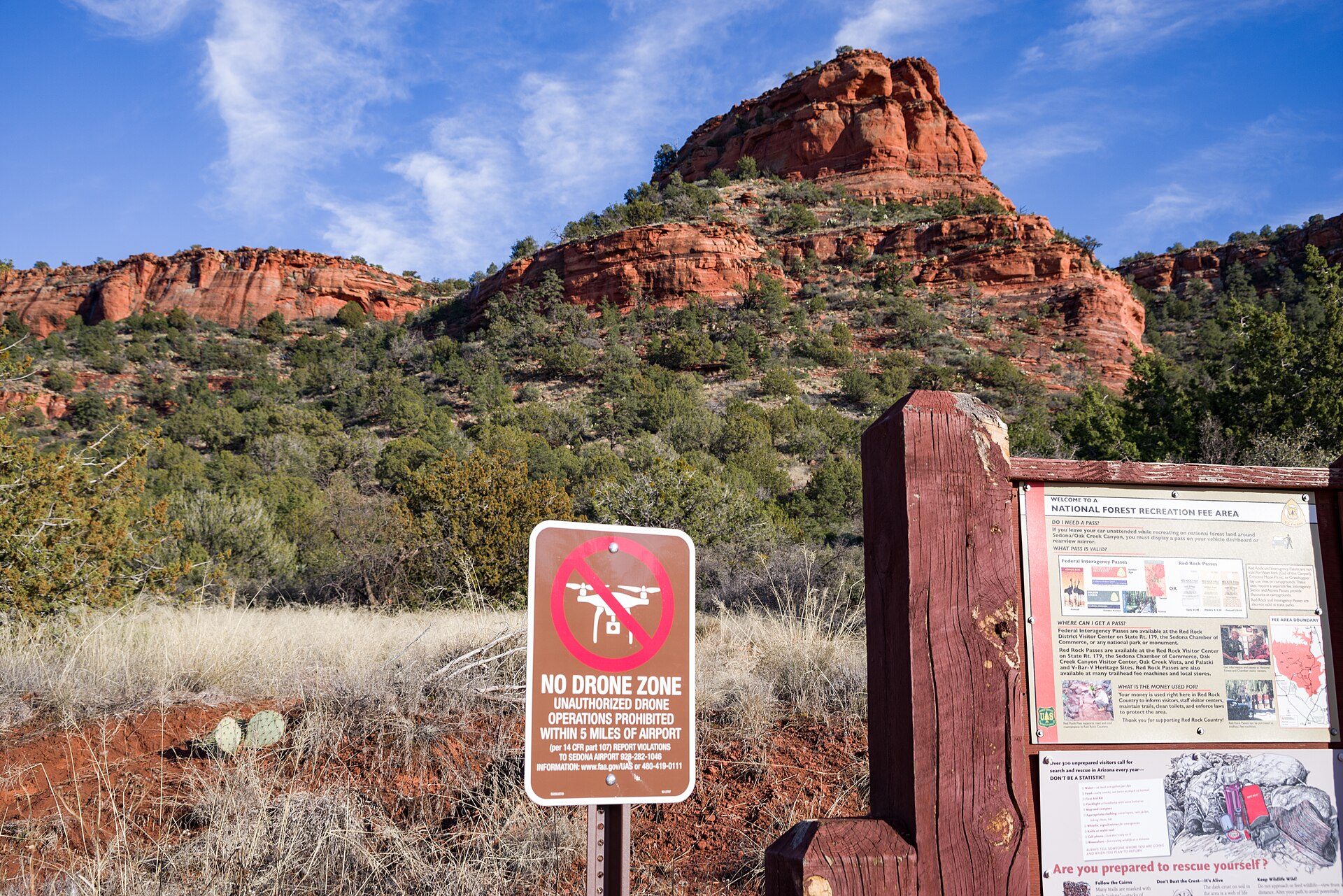
Photo: Coconino National Forest / Wikimedia Commons, Public domain
Checks before you accept a field
- Ask the farmer for the exact location (a map pin), area, crop and boundaries with other fields.
- Check the map for airports, military areas, radar stations or large residential areas nearby.
- Compare with the permission you hold: is this area within it?
- If unsure, ask the competent authority first; no answer means no flight.
Legal note: NAMBIN does not quote document numbers, fines or fees because the rules may have changed. Before taking paid spraying work, check with the current authorities on equipment registration, flight permission, pilot requirements and business registration. Flying without permission or into a prohibited zone can lead to fines and confiscation of the equipment.
Surveying the field before flying: people, power lines, houses, ponds
A survey means walking around the field and looking with your own eyes, not just at satellite images. Satellite images will not show a newly strung power line, a duck herder's hut or someone cutting grass on the bund.
Power lines and tall obstacles
Power lines are the most dangerous obstacle: thin, hard to see from a distance, and obstacle radar does not always detect them. Mark every pole, service drop into houses, fibre cable, tall tree, irrigation post and bamboo stake. When planning an automatic flight, set the boundary well away from lines and poles; if a line crosses the middle of a field, split it into two zones and spray the strip under the line by hand. Never fly underneath a power line.
People, animals and the take-off area
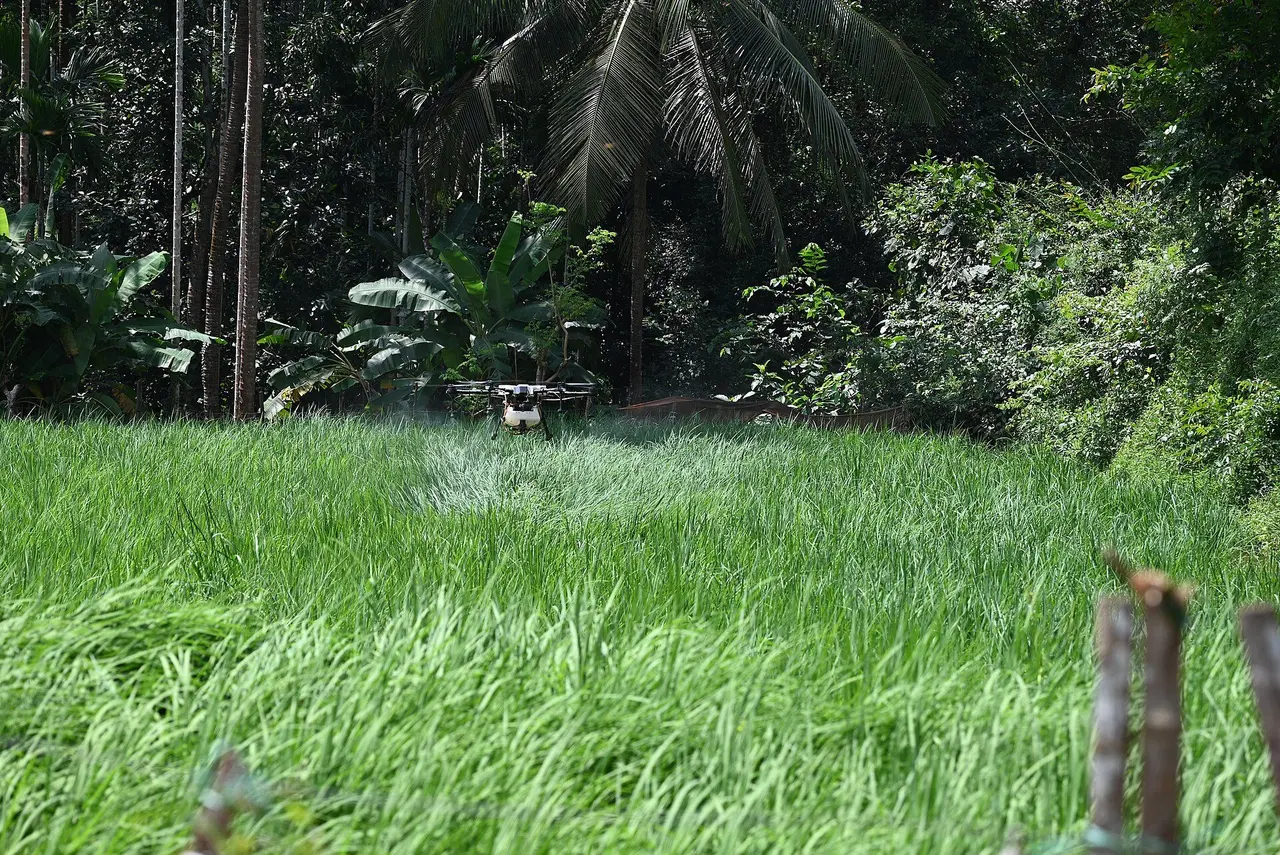
Ask the farmer and the neighbouring fields whether anyone is working there (Figure 3). Choose a flat, open take-off and landing spot away from paths, with someone holding a flag or a rope to warn passers-by. Children and curious onlookers tend to come close; keep them back and stop flying if anyone walks into the work area.
Buffer zones around ponds, houses, schools and vegetable plots
Spray mist drifts with the wind and can kill fish, shrimp and bees and damage a neighbour's leafy vegetables. Where a field borders a fish pond, an intake canal, houses, a school, livestock sheds or vegetable beds, leave a strip on that side that the drone does not spray; treat the edge with a hand sprayer aimed into the field, or skip it as agreed with the farmer.
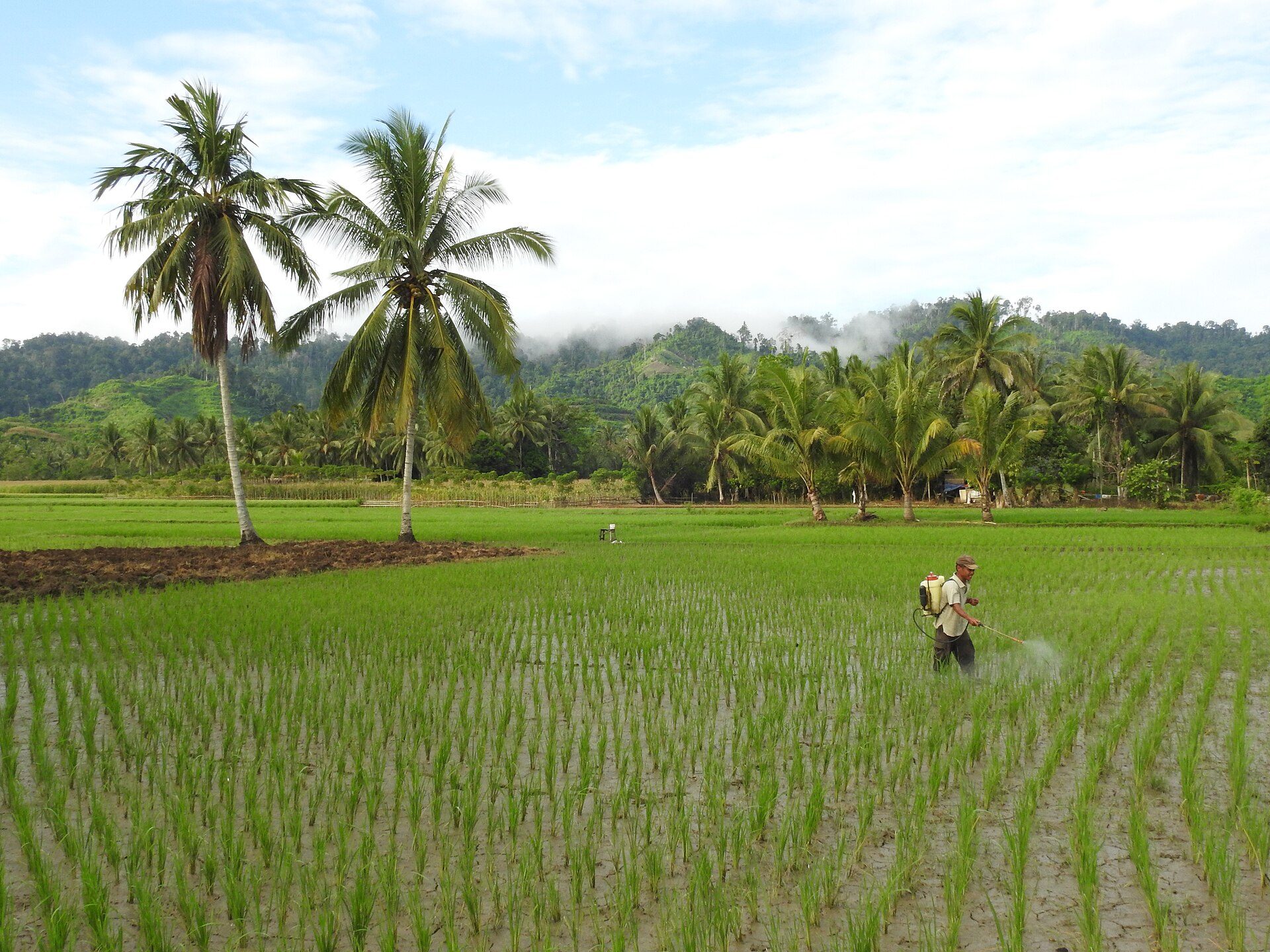
Photo: T. R. Shankar Raman / Wikimedia Commons, CC BY-SA 3.0
Survey hazard table
| Hazard | What to look for | How to handle it |
|---|---|---|
| Power lines, cables | Poles, service drops, lines strung across the field | Mark on the map, keep the flight boundary away from lines, spray the strip near lines by hand |
| People, animals | Farm workers, duck herders, children, buffalo and cattle | Warn in advance, post a lookout, stop flying if someone enters the work area |
| Ponds, canals, wells | Fish ponds, shrimp ponds, water intakes | Leave a buffer, do not spray when the wind blows toward the pond |
| Houses, schools, sheds | Houses on the bund, drying yards, chicken coops | Leave a buffer, spray when the wind blows away from houses |
| Tall trees, obstacles | Coconut palms, bamboo, irrigation posts, huts | Mark them, raise the safe turning height, avoid areas out of line of sight |
| Weather | Strong wind, storms, harsh midday sun | Spray early morning or late afternoon, stop when wind exceeds the maker's limit |
On distances, many spray crews set internal rules such as keeping people at least 15 m from the take-off area. That is a reference safety habit, not a legal figure; always read the manual of your drone and the current regulations.
Pesticides: read the label, mix the right dose, protect yourself
Pesticides are the most hazardous part of the job. A drone sprays far less water than a backpack sprayer, so the mixture in a drone tank is more concentrated, and while mixing you handle chemicals at high strength. This is when you are most likely to be exposed.
Read the label before mixing
- Active ingredient and concentration: know what you are using and avoid applying the same ingredient twice.
- Crop and target: use the product only on the crops and pests listed on the label.
- Dose: amount of product per hectare (or per sao, a local land unit) and water volume; for drones, ask the dealer or manufacturer how to convert for low water volumes.
- Pre-harvest interval: the number of days from the last spray until harvest is allowed; record it and tell the farmer.
- Toxicity warnings and first aid: read them in advance, not when something has already gone wrong.
Use only approved products from licensed sellers
Use only products on Vietnam's list of pesticides approved for use, bought from a licensed dealer, in intact packaging with a clear Vietnamese label. If a product has unknown origin, a label only in a foreign language, or is a ready-mixed liquid the farmer cannot identify, refuse to spray it. The list changes over time, so ask the local plant protection station or extension station when unsure.
Protective gear for mixing and loading
Put everything on before you open a bottle (Figure 4): long sleeves and trousers or a chemical-resistant suit, chemical-resistant gloves (nitrile rubber, never cloth), sealed safety goggles, a mask or respirator with filters suited to the product, and rubber boots with trouser legs worn outside the boots. Having a teammate check you, as in the photo, is a good habit.
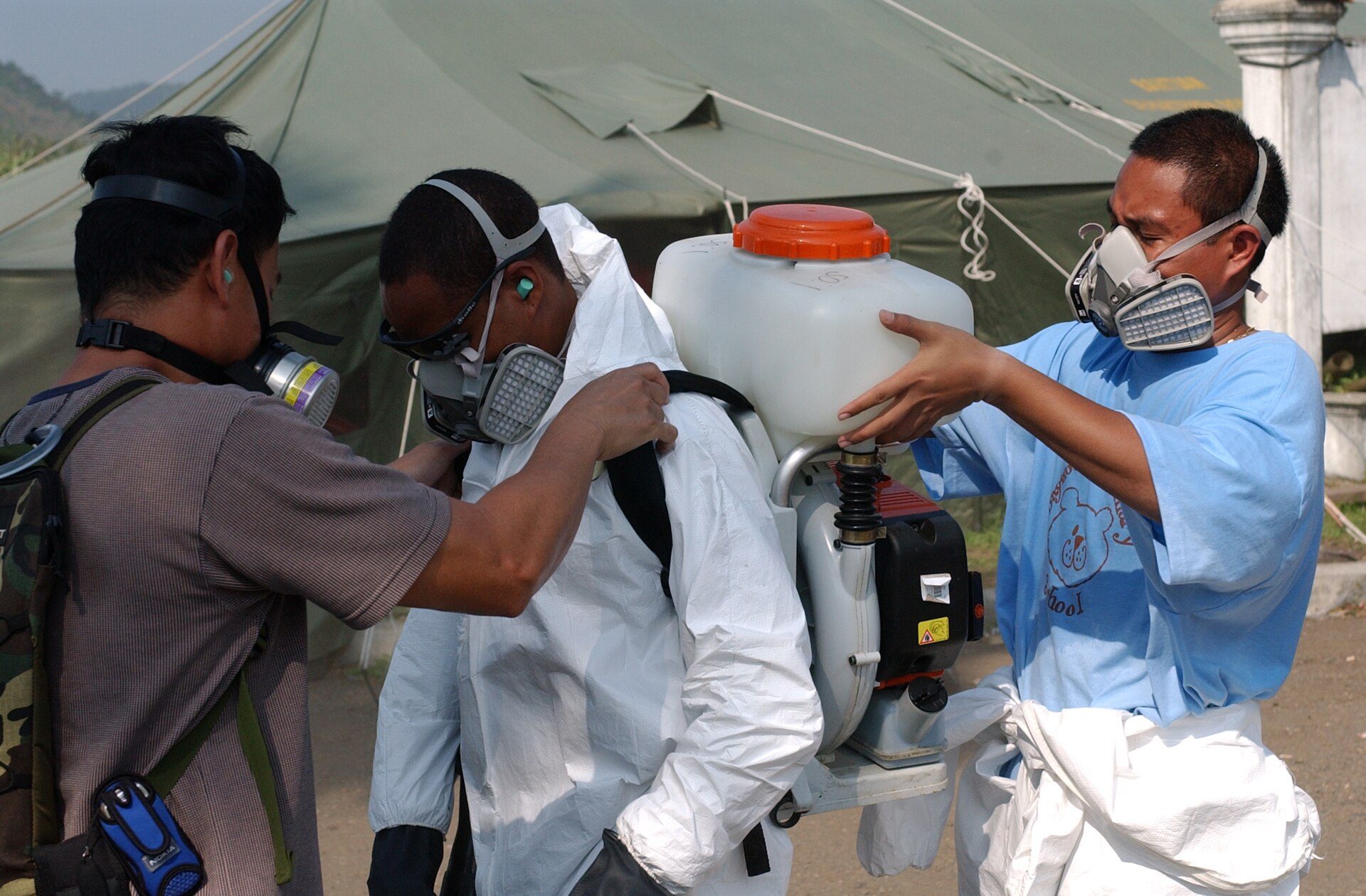
Photo: U.S. Navy photo by Photographer's Mate 2nd Class Timothy Smith / Wikimedia Commons, Public domain
Setting up a safe mixing station
- Pick a flat spot downwind of people and well away from ponds, canals and wells.
- Keep a separate can of clean water for washing hands and eyes, never shared with mixing water.
- Fill the mixing container about half with water first, add the measured product, stir, then top up with water.
- Use a dedicated graduated measuring cup for chemicals, never one used for food or drink.
- Rinse empty bottles three times and pour the rinse water into the mix; bag empty bottles and packaging and take them to the local collection point.
Safety warning: Pesticides are toxic if inhaled, absorbed through the skin, splashed in the eyes or swallowed. Do not eat, drink, smoke or take phone calls while mixing; remove your gloves and wash your hands with soap before eating or drinking. Spray drone propellers spin very fast: approach the drone only after the motors are locked, and never catch it by hand. Lithium batteries that are swollen, dropped, punctured or charged while hot can catch fire: stop using swollen packs, charge on a non-flammable surface and stay with them. Do not fly near power lines or over people. At any sign of poisoning, stop work at once, move the person away from the area, remove contaminated clothing, wash thoroughly and go to the nearest medical facility with the product label; in serious cases call 115, Vietnam's emergency number.
Safety routine for a spraying session: before, during and after
The routine below is a general framework; you will learn the detailed machine operations in later steps. From now on, practise following it in order.
Before flying
- Papers: drone registration, flight permission and training certificate on hand.
- Survey the field with the hazard table and agree the no-spray areas with the farmer.
- Check wind and sky: no flying with storms, rain on the way or wind above the maker's limit.
- Check the drone: propellers not cracked, arms locked, nozzles not leaking, batteries charged and not swollen.
- Mix to the correct dose in full protective gear.
During the flight
- Keep the drone in sight at all times, with a helper watching for people and obstacles.
- Stop spraying, hover or return home if someone enters the work area or the wind turns toward a pond or house.
- Never stand under the flight path; when the drone lands, stay back until the motors are locked.
After flying
- Rinse the tank and nozzles at the designated spot, never into a canal or ditch.
- Take off protective gear in order: wash the outer gloves first, then suit, goggles and mask, and gloves last; shower and change clothes.
- Keep a log: date and time, field, crop, product, dose, area, pre-harvest interval, weather and any incidents.
Worked example: spraying 6 ha of rice next to a fish pond
A farmer hires you to spray 6 ha of rice. The east side borders a fish pond and two houses, with a strip of about 0.4 ha next to the pond. A low-voltage power line runs along the north bund. The drone has a 20-litre tank. To practise the calculation, assume the label converted for drones gives 200 ml of product and 16 litres of spray liquid per hectare (these are assumed figures; in real work always use the exact numbers on the label and the manufacturer's instructions).
Step 1: area the drone will spray
- The 0.4 ha strip next to the pond: agreed with the farmer to be hand-sprayed, nozzle aimed into the field, when the wind is not blowing toward the pond.
- Drone spray area: 6.0 − 0.4 = 5.6 ha.
- The north bund has a power line: pull the automatic flight boundary inward; the edge under the line is part of the hand-sprayed work.
Step 2: chemical and number of flights
- Total product: 5.6 ha × 200 ml = 1,120 ml.
- Total spray liquid: 5.6 ha × 16 litres = 89.6 litres.
- One 20-litre tank covers 20 ÷ 16 = 1.25 ha and needs 1.25 × 200 = 250 ml of product per full tank.
- Flights: 89.6 ÷ 20 = 4.48, so 4 full tanks and a last tank of 9.6 litres (enough for 0.6 ha, needing 0.6 × 200 = 120 ml).
- Check: 4 × 250 + 120 = 1,120 ml; 4 × 1.25 + 0.6 = 5.6 ha. It matches.
Step 3: starting cost of protective gear
| Item | Quantity × unit price | Total |
|---|---|---|
| Chemical-resistant gloves | 2 pairs × 40,000 VND | 80,000 VND |
| Sealed safety goggles | 1 × 60,000 VND | 60,000 VND |
| Respirator with filters | 1 × 350,000 VND | 350,000 VND |
| Spare filters | 2 × 80,000 VND | 160,000 VND |
| Chemical-resistant suit | 1 × 250,000 VND | 250,000 VND |
| Rubber boots | 1 × 120,000 VND | 120,000 VND |
| Total | 1,020,000 VND | |
Check: 80,000 + 60,000 + 350,000 + 160,000 + 250,000 + 120,000 = 1,020,000 VND (about 40 USD; reference prices for Vietnam in 2026, varying by region and quality). That is small compared with a drone or a hospital visit for poisoning. At the end of the session the log shows: 5.6 ha by drone, 5 flights, 1,120 ml of product, 0.4 ha by hand, and the pre-harvest interval from the label to tell the farmer.
Common beginner mistakes and how to avoid them
Believing "farm drones do not need permission"
Sign: you hear that everyone in the village flies, so you skip the paperwork. Result: fines and a drone held in the middle of the season. Fix: ask the competent authority yourself, keep a record of what you were told, and accept work only when the papers are complete.
Skipping the survey because "I know this field"
Sign: you arrive and take off straight away. Result: hitting a newly strung power line or spraying someone cutting grass on the bund. Fix: walk the field and mark the map every session, even for fields you sprayed last season.
Mixing bare-handed with a cloth mask
Sign: it is hot, so you skip the protective gear. Result: chemicals soak through the skin and you breathe concentrated fumes, which harms your health over time. Fix: choose breathable gear, mix in the early morning, and treat full gear as a condition for being allowed to fly.
Raising the dose "just to be sure"
Sign: the farmer asks for extra chemical to make it stronger. Result: leaf burn, residues on the crop, wasted money and pest resistance. Fix: explain the label dose, write it in the log and refuse to mix above it.
When to stop work and see a doctor
This lesson does not replace a doctor. Signs of pesticide poisoning can appear immediately or after a few hours: headache, dizziness, nausea, vomiting, heavy drooling, sweating, blurred vision, muscle twitching and difficulty breathing.
First aid
- Move the person out of the spray area to fresh air, upwind.
- Remove contaminated clothing and wash the skin with plenty of clean water and soap.
- Chemical in the eyes: rinse with clean running water for at least 15 minutes.
- Do not induce vomiting unless the label says so.
When to call 115 or go to hospital immediately
Breathing difficulty, seizures, drowsiness or confusion, repeated vomiting, or any swallowed chemical: call 115 or go straight to the nearest medical facility, taking the label or bottle so the doctor knows the active ingredient. Even mild symptoms are worth a check-up; do not take home-remedy antidotes.
Frequently asked questions
Does a spray drone need flight permission?
As a general principle, the drone must be registered and the flight must be licensed or approved under current rules. For the exact procedure, ask the local military authority, the commune government or the dealer, and read the current regulations.
What is a safe distance between a drone and power lines?
This lesson does not give a single figure for every drone and every line. The principle is to keep the flight boundary well away from the line, never fly under it, hand-spray the strip near it, and follow the recommendations in your drone's manual.
Is drone spraying more toxic than backpack spraying?
The pilot stands far from the spray, so exposure during flight is lower, but mixing involves a more concentrated liquid. Protective gear for mixing and loading is still mandatory.
What is a pesticide pre-harvest interval?
It is the minimum number of days from the last spray until harvest, printed on the label. The pilot should record it and tell the farmer so the crop does not carry excessive residues.
Practice and self-assessment
- Pick a field near you, survey it and draw a sketch: power lines, houses, ponds, tall trees, the take-off spot and no-spray areas.
- Take a real pesticide label and copy out the active ingredient, crops, dose, pre-harvest interval and toxicity warnings.
- Redo the worked example for a 4.5 ha field with a 0.3 ha buffer, using the dose and water volume from the label you copied.
- Practise putting on and taking off protective gear in the right order, with someone watching and pointing out mistakes.
Self-assessment criteria
- Pass: the field sketch shows power lines, ponds, houses and buffers, and you can name the safe wind direction for spraying.
- Pass: the chemical and flight calculation adds up to the total area and total product.
- Pass: you can state four legal principles and where to ask about current procedures, without relying on rumours.
- Not yet: skipping the survey, mixing without protective gear, or not recording the pre-harvest interval.
To see how long training takes, which certificates you need and what the work pays, read Learning to fly agricultural drones: training time, papers, income. Once you are solid on safety, move on to the next step of the roadmap: Spray drone anatomy & equipment, where you look at the frame, propellers, motors, tank, nozzles, obstacle radar and remote controller.
Keep learning agricultural drone piloting: after safety come drone anatomy, manual flight, mapping automatic flights, mixing and running a spraying service. See the 8-step agricultural drone pilot roadmap.