When a motorbike will not start on the electric starter, the cause almost always sits in one of four groups: a weak battery, a broken starter control circuit (fuse, brake switch, starter relay), a failed starter motor, or an engine that cranks normally but is missing fuel or spark. The fastest way to know which group you are dealing with is to press the start button and listen: silence, a rapid "click-click-click", slow cranking, or strong cranking with no firing. This lesson walks you through each branch in the same order a working mechanic follows in a Vietnamese repair shop, measuring with a multimeter instead of guessing and swapping parts.
By the end of this lesson, you will be able to:
- Sort any "won't start" job into one of 4 branches within a minute, just from the sound the bike makes when you press the starter.
- Measure a 12V battery at rest, while cranking and with the engine running, and read the thresholds for a good battery, a weak battery and a faulty charging system.
- Check the fuse, brake switch, starter relay and starter motor in order from easiest to hardest.
- Handle the case where the engine cranks but will not fire: check fuel, the spark plug and the fuel-injection warning light.
- Give the customer a transparent repair quote once the measurements are done.
Learning motorbike repair properly? The electrical, charging and starting system is step 4 of the roadmap — after workshop safety, tools and routine maintenance. See the 8-step motorbike mechanic roadmap to learn in the right order.
How the motorbike starting circuit works
Before you repair anything, picture where the current goes when the rider presses the start button. The starting circuit has two branches: a low-current control branch and a high-current power branch. Most "won't start" faults come down to one of these two branches being broken or weak.
Control branch: ignition switch, fuse, brake switch, start button
When the ignition is switched on, current from the battery flows through a fuse to the coil of the starter relay. The circuit only closes when the safety conditions are met: on a scooter the rider must pull a brake lever (closing the brake-light switch); many manual bikes must be in neutral or have the clutch pulled; many bikes have a side-stand sensor that requires the stand to be up. When the button is pressed, a small current of a few hundred milliamps flows through the relay coil and pulls the contacts closed — that is the "click" you hear under the seat or behind a panel.
Power branch: starter relay, heavy cable, starter motor
The relay contacts connect the battery's positive terminal directly to the starter motor through a heavy cable. The starter draws a very large current — roughly 50–100 A for a split second depending on the bike — to spin the crankshaft through a gear set and a one-way starter clutch. Because the current is so high, a single loose terminal or a weak battery is enough to make the voltage collapse so the starter cannot turn the engine. Many newer Honda scooters use an integrated starter-generator (ACG) instead of a separate starter motor; the principles for diagnosing the battery and the control circuit stay the same.
Once the engine turns: fuel, spark and compression
The starter only turns the engine over. To actually run, the engine needs three things: the right air–fuel mixture, a spark at the plug at the right moment, and enough compression. That is why "cranks strongly but won't fire" is a separate branch, not a starting-system fault.
Listen to the starter: sort the fault in one minute
Experienced mechanics diagnose most jobs just by pressing the starter and listening. The table below shows how to branch; each branch has its own procedure in the sections that follow.
| What happens when you press start | Branch | Main suspects | Check first |
|---|---|---|---|
| Complete silence, dashboard lights still on | A – control circuit | Brake switch, side stand, fuse, start button, relay | Pull the brake and see if the brake light comes on |
| Silence, dashboard lights off or very dim | B – battery | Flat battery, main fuse blown, loose battery terminal | Measure battery voltage |
| Rapid "click-click-click", lights flicker | B – battery | Weak battery, corroded terminals | Measure voltage at rest and while cranking |
| One single "click", starter does not turn | C – starter, heavy cable | Worn brushes, burnt relay contacts, loose heavy cable | Measure voltage at the starter while pressing |
| Starter whirs but the engine does not turn | C – starter, starter clutch | Slipping one-way starter clutch, worn gears | Remove the cover and inspect the starter clutch |
| Engine cranks strongly and evenly but won't fire | D – fuel, spark | Out of fuel, fuel pump, spark plug, fuel-injection fault | Listen for the pump at key-on, check the warning light |
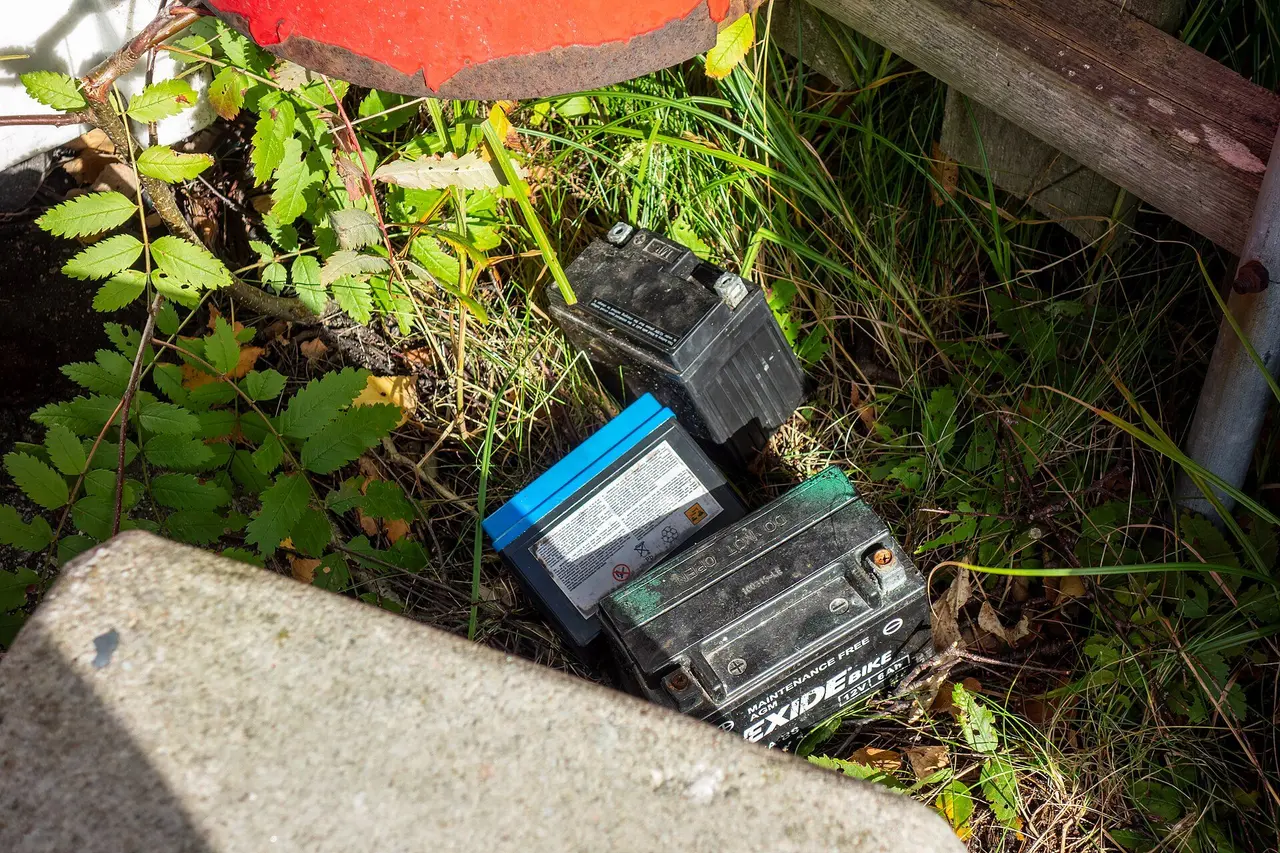
In shop experience, branch B (the battery) accounts for most jobs, especially after a long holiday or during the rainy season. But a battery should only be replaced after you have measured it — and a truly dead battery (Figure 1) must go to a collection point.
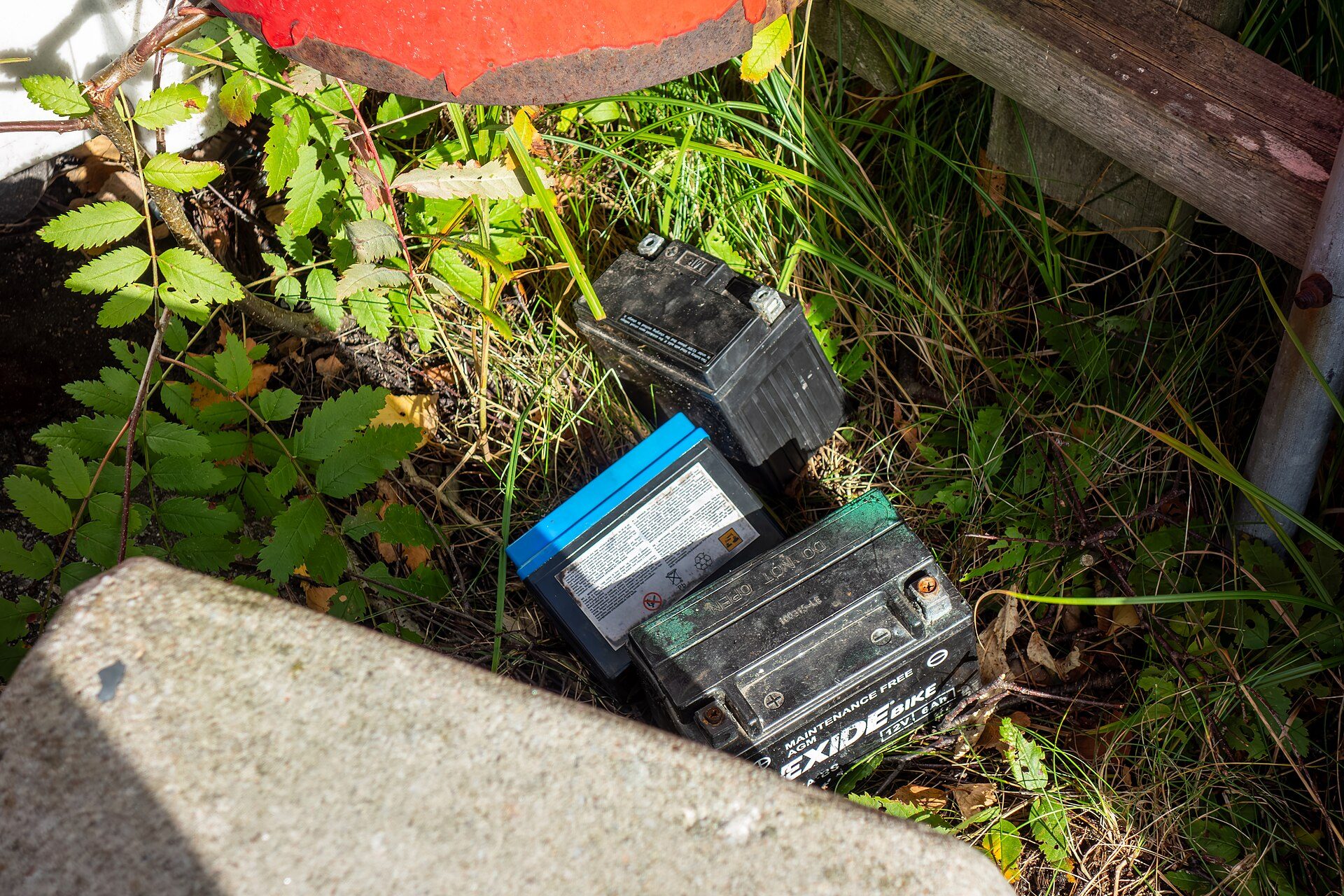
Photo: W.carter / Wikimedia Commons, CC BY 4.0
Ask the customer 3 questions before picking up a tool
- How long has the bike been parked? Two or three weeks is enough to drain a small motorbike battery, especially on bikes with a GPS tracker or alarm.
- Have you recently added extra lights, a horn or a phone charger? Add-on accessories often drain the battery and blow fuses.
- Did the problem appear suddenly or get gradually worse? A gradual decline usually points to the battery or starter brushes; a sudden failure usually points to a fuse, relay or connector.
Kick-start or try an external battery to narrow it down
If the bike still has a kick-starter and fires immediately when kicked, the engine, fuel and spark are fine — the fault lies in the starting system or the battery. On a scooter without a kick-starter, try a known-good external battery (a jump pack): if the bike cranks strongly on the external battery, the bike's own battery is almost certainly the culprit.
Branch B: test the battery the right way
A weak battery is the most common cause, but it is also where new mechanics most often replace a part that was not faulty: the battery is fine and the real problem is the charging system or a drain while the bike is off. A typical motorbike battery is 12V with a capacity of around 3–5 Ah, and most are sealed maintenance-free types (see Figure 2).
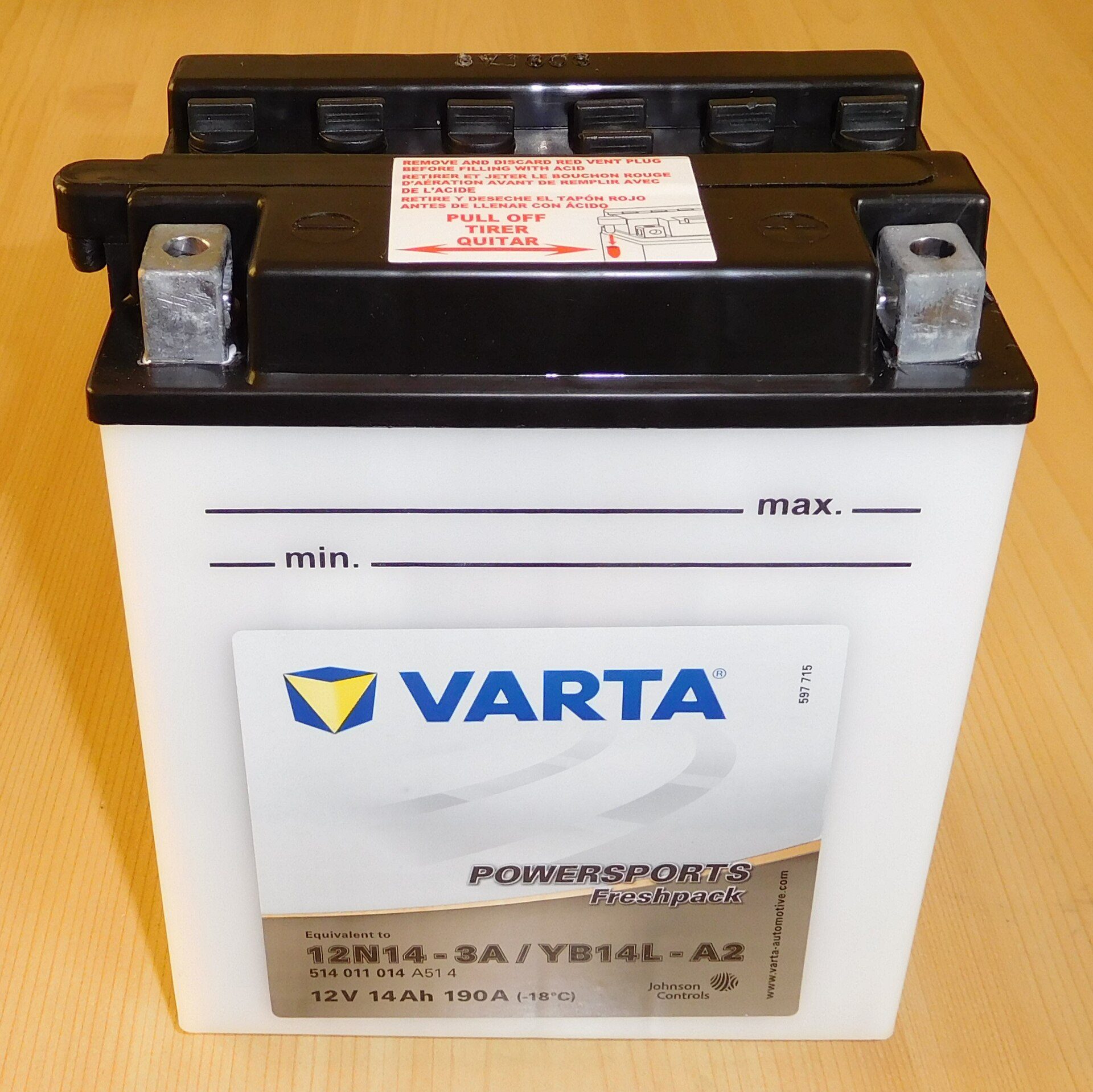
Photo: Cjp24 / Wikimedia Commons, CC BY-SA 4.0
Measure the resting voltage
Turn the ignition off and let the bike rest for at least 30 minutes if it has just been ridden. Set the multimeter to the 20V DC range, red probe on the positive terminal, black probe on the negative (Figure 3 shows the probe placement). Read the result against the table below.
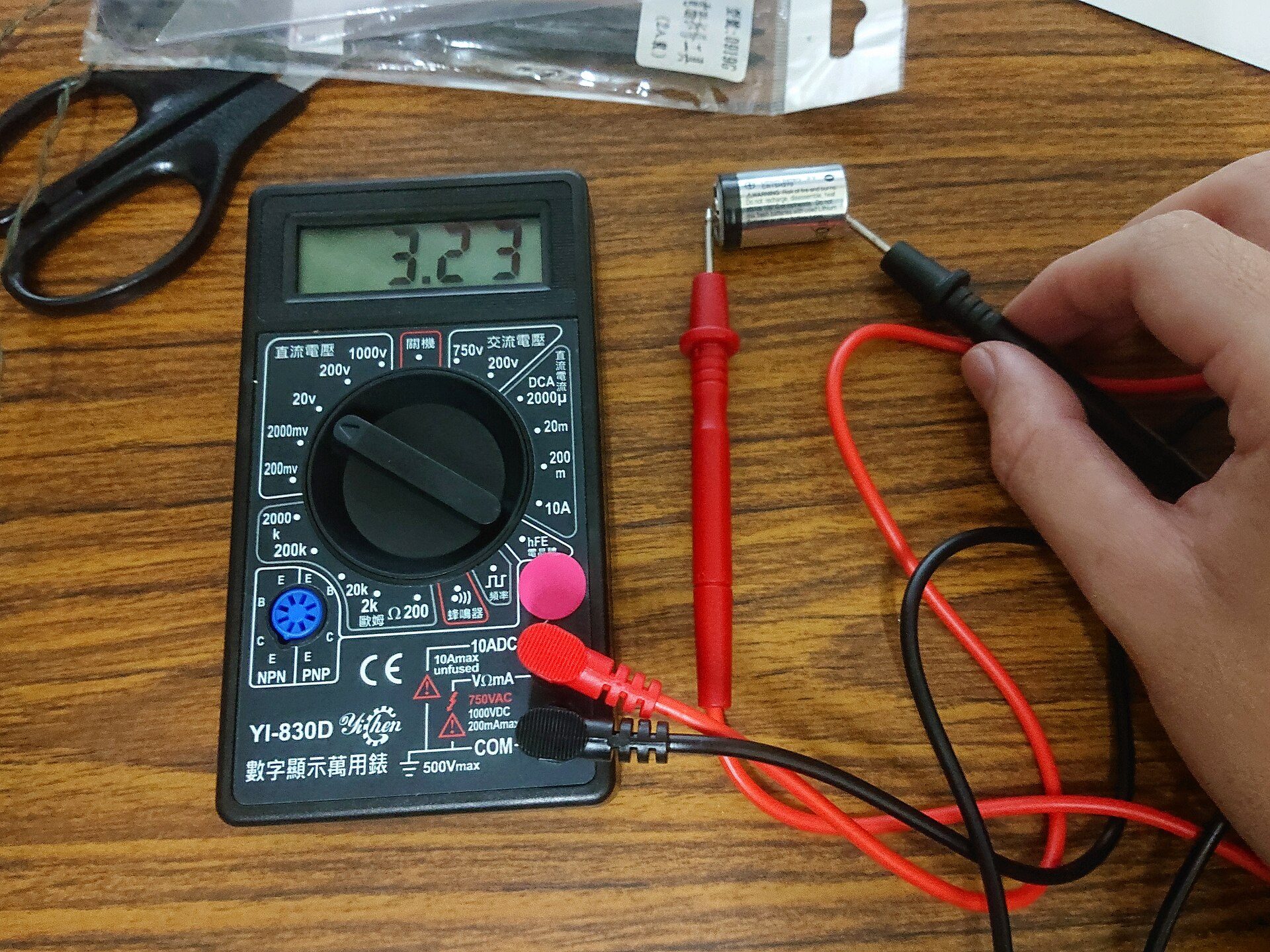
Photo: Jiazheng0609 / Wikimedia Commons, CC BY-SA 4.0
| When measured | Reading | Meaning |
|---|---|---|
| At rest (off for 30 min or more) | 12.6–12.8V | Fully charged |
| At rest | about 12.4V | About 3/4 charged, will still start |
| At rest | about 12.2V | About half charged, needs charging |
| At rest | below 12.0V | Weak or flat; charge it and measure again |
| While cranking | drops below about 9.6V | Battery cannot hold the load — usually needs replacing |
| Engine running at about 3,000–5,000 rpm | about 13.5–14.5V | Charging system normal |
| Engine running | below 13V or above 15V | Suspect weak charging or a failed regulator/rectifier |
These thresholds are the usual convention for 12V lead-acid batteries; for lithium batteries or bikes with their own service data, follow the manufacturer's documentation.
Measure while cranking: the most important test
A battery can read 12.4V at rest and still fail to start the bike, because its internal plates have sulphated and can no longer deliver a high current. Keep the probes on the terminals and ask someone to press the starter for 2–3 seconds: if the voltage drops below about 9.6V and the starter turns sluggishly, the battery is finished — charging it will only buy a few more days.
Good battery that keeps going flat: check charging and parasitic drain
If a new battery goes flat again after a few days, do not replace it a second time. Measure the voltage with the engine running to check charging (table above). Then measure the drain with the ignition off: disconnect the negative terminal and connect the meter, set to its current range, in series between the battery's negative post and the negative lead. A stock bike usually draws only a few mA; if you see several tens of mA, pull fuses or accessory connectors (GPS tracker, alarm, auxiliary lights) one at a time to find the culprit. Never press the starter while the meter is connected on the current range — the starter current will blow the meter's internal fuse.
Safety warning: lead-acid batteries contain sulphuric acid and give off flammable hydrogen gas while charging — charge in a ventilated area, no smoking, no sparks near the battery. When removing a battery: ignition off, disconnect the negative terminal first, then the positive; when refitting, connect positive first and negative last, so a spanner touching the frame cannot cause a short. Wear eye protection and gloves when handling a cracked or leaking battery. Never crank for more than 5 seconds at a time; rest 10–15 seconds between attempts so the starter and cables do not overheat. When checking the fuel branch, remember petrol ignites very easily: work in a ventilated area with a fire extinguisher nearby.
Branches A and C: fuse, starter relay and starter motor
When the battery has tested good and the bike still will not crank, the fault is in the control circuit or the power branch. Work from the easiest checks to the ones that need the most disassembly.
Step 1: brake switch, side stand, fuse
Switch on the ignition and pull the brake: the rear brake light must come on. If it does not, the brake switch or fuse is at fault — a very common problem on scooters, because without a brake signal the starting circuit never closes. Check the side stand is up (on bikes with a sensor). Next, open the fuse box: look at the wire inside each fuse, or test continuity across the two fuse legs using the resistance range. Replace a fuse only with the amp rating printed on the fuse box lid; if the new fuse blows straight away, there is a short circuit that must be found. Never fit a higher-rated fuse.
Step 2: the starter relay
A starter relay usually has 2 large posts (battery cable and starter cable) and a small connector (the control coil). Press the starter and listen for the "click": if there is no click, measure the voltage at the small connector while pressing — if about 12V is present but the relay stays silent, the coil has failed; if there is no voltage, the fault is upstream at the start button or brake switch. If you hear the click but the starter does not turn: measure the voltage at the relay's output post to the starter while pressing; below about 9V with a good battery means the relay contacts are burnt and pitted, and the relay must be replaced.
Step 3: starter motor and starter clutch
If full voltage reaches the starter and it does not turn, or turns weakly, remove it for inspection (see Figure 4). Common faults: brushes worn short, a dirty or burnt commutator, dry bushings. If the starter whirs but the engine does not move, the starter clutch — the one-way clutch linking the starter to the crankshaft — is slipping, or the intermediate gear is worn. Replacing brushes and cleaning the commutator is usually much cheaper than fitting a new starter motor.
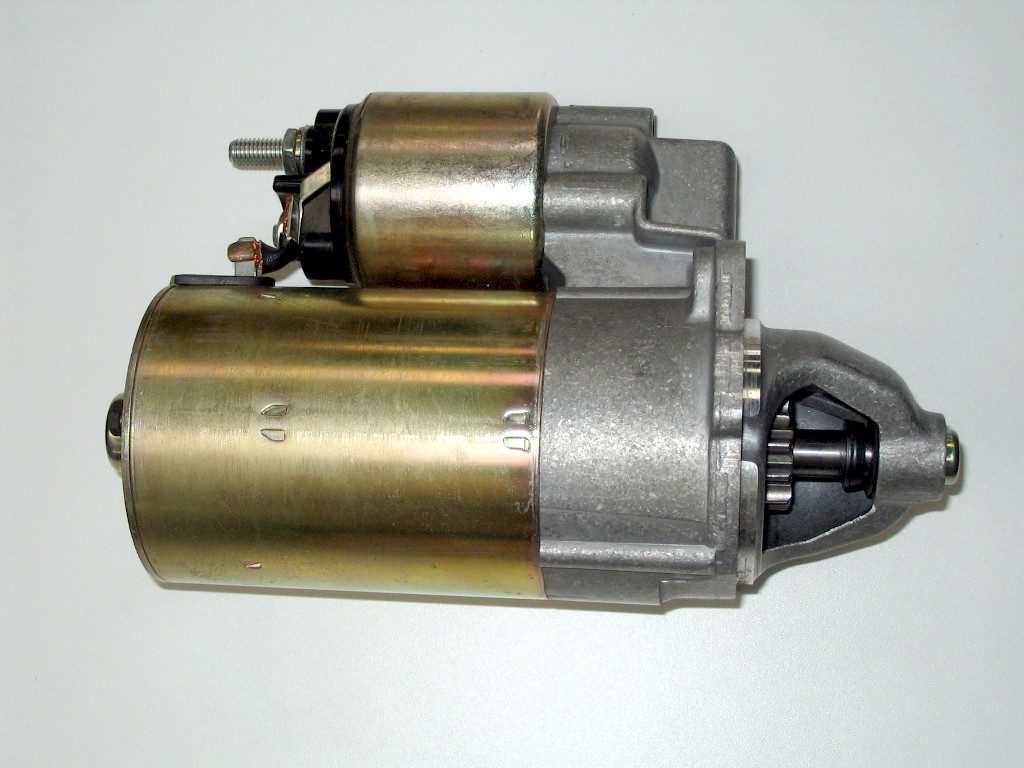
Photo: Willdre 00:20, 8 February 2007 (UTC) / Wikimedia Commons, CC BY-SA 3.0
Branch D: cranks strongly but won't fire
If the engine turns over evenly and as fast as usual, the starting system has done its job. Now check fuel, spark and compression in that order.
Fuel: listen for the pump, look in the tank, check the warning light
The fuel gauge can be wrong — open the filler cap and look. On a fuel-injected (FI) bike, switching on the ignition should make the fuel pump hum for about 1–2 seconds; if you hear nothing, suspect the pump, the pump relay or a fuse. An engine warning light flashing in a pattern means the ECU is reporting a fault code — for example from the tilt sensor after the bike has fallen over. Reading and clearing codes is the content of the next step of the roadmap.
Spark: remove and inspect the plug
Remove the spark plug (see Figure 5): a petrol-wet tip means fuel is arriving but spark is missing, or the engine has flooded from repeated cranking; a completely dry tip means no fuel. Heavy black soot, an electrode gap that is too wide, or cracked porcelain means the plug must be replaced with the correct part number. Test for spark with a proper spark tester that has an adjustable gap, rather than holding the plug against the engine by hand.
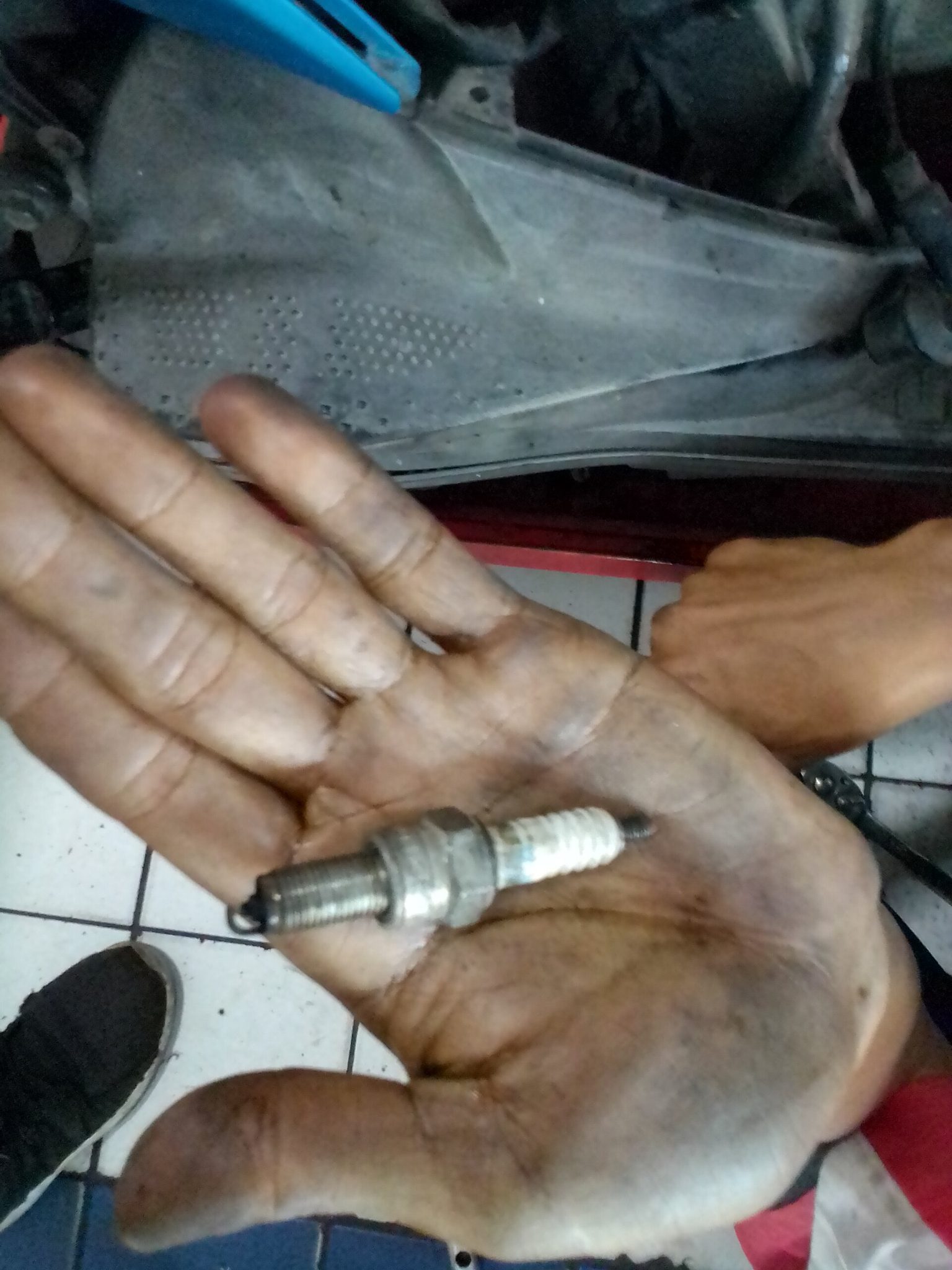
Photo: DARMAS SB 9 / Wikimedia Commons, CC BY-SA 4.0
Compression: rare, but do not skip it
An old bike with a worn engine or a valve held open will crank suspiciously "light", and the starter will sound unusually fast. Measure compression with a compression gauge; look up the standard figure in the service manual for that model. Low compression is a job for an engine overhaul, covered in a later step.
Worked example: a Honda Vision parked for 3 weeks won't start on Monday morning
Ms Lan wheels her 2019 Honda Vision scooter into the shop: it sat at home for 3 weeks while she was on a business trip, and this morning the starter only went "click-click-click" with the dashboard flickering. The bike has a GPS tracker fitted. The mechanic works as follows (reference prices for 2026, which vary by region; 1,000 VND is roughly 4 US cents, so 100,000 VND is about 4 USD).
Measure and narrow it down
- Sound: continuous "click-click-click" → branch B, battery.
- Resting voltage: 11.6V → flat battery. Terminals clean and tight.
- Charge the battery with a proper charger at a low current (about 0.5A for a 5Ah battery) for 6 hours; after resting 30 minutes it reads 12.7V.
- Voltage while cranking: drops to 10.4V, the starter turns strongly and the engine fires → the battery can still hold the load.
- Charging voltage with the engine at about 4,000 rpm: 14.2V → charging normal.
- Drain with the ignition off: 28 mA. Unplug the GPS tracker and the drain falls to 2 mA → the tracker is what emptied the battery.
Calculate how long the battery lasts, to explain it to the customer
A 5 Ah battery, assuming only about half its capacity can be used before it is too weak to start the bike: 5 × 0.5 = 2.5 Ah = 2,500 mAh. With a 28 mA drain: 2,500 ÷ 28 ≈ 89 hours, less than 4 days. After 3 weeks parked, a flat battery was inevitable. After the fix, with a 2 mA drain: 2,500 ÷ 2 = 1,250 hours, about 52 days.
Quote and repair
| Item | Reference cost |
|---|---|
| Charge the battery (still good, no replacement needed) | 30,000 VND |
| Rewire the GPS tracker through a switched supply or fit a cut-off switch | 50,000 VND |
| Total | 80,000 VND (about 3 USD) |
If the mechanic had heard the "click-click" and simply fitted a new battery (around 350,000–600,000 VND for a 5 Ah battery), the customer would have paid several times more, and three weeks later the new battery would have gone flat in exactly the same way. Note: some trackers need a permanent supply for anti-theft use — ask the customer before rewiring, or suggest disconnecting the negative terminal when the bike will be parked for a long time.
Common mistakes new mechanics make with no-start bikes
Replacing the battery before measuring
Symptom: a new battery is fitted and the customer is back a few days later. Cause: charging and parasitic drain were never measured. Fix: always take all three readings — at rest, cranking and running — and measure the drain if the battery keeps going flat.
Jump-starting from a running car
Symptom: a dead regulator, a damaged ECU or blown bulbs after the jump. Cause: a car alternator supplies a large current and its voltage can spike. Fix: use a motorbike jump pack or a booster with protection; if you must jump from a car, switch the car's engine off and connect with the correct polarity, positive first then negative.
Cranking over and over when the engine won't fire
Symptom: a hot starter, a burning smell from the starter cable, a completely drained battery. Cause: forcing the starter instead of checking branch D. Fix: crank for at most 5 seconds at a time; after 3 failed attempts, stop and check fuel and the spark plug.
Ignoring the brake switch on a scooter
Symptom: the starter has been removed and the relay replaced, but there is still silence. Cause: nobody checked the brake light first. Fix: pulling the brake and watching the brake light is step one, and it takes 5 seconds.
Frequently asked questions
The bike won't start on the button but starts with the kick-starter. What is wrong?
The engine, fuel and spark are all fine; the fault lies in a weak battery, the starter relay, the starter motor or the control circuit (switches, fuse). Test the battery first, then follow branches A and C above.
How long does a motorbike battery last?
Usually about 2–3 years on a bike that is ridden regularly; less if the bike is often parked for long periods, has many electrical accessories, or has a faulty charging system. A common sealed battery costs roughly 250,000–600,000 VND in 2026 (about 10–24 USD), depending on capacity and brand.
How much does a starter motor repair cost?
Reference for 2026: new brushes and a cleaned commutator about 80,000–200,000 VND; a new starter relay about 80,000–250,000 VND; a new starter motor about 400,000–1,200,000 VND, depending on the model and whether the part is genuine or aftermarket.
What does a "click-click-click" when pressing the starter mean?
Usually a weak battery or loose, corroded battery terminals: the relay closes, the voltage collapses, the relay opens, and the cycle repeats. Clean and tighten the terminals, then measure the voltage while cranking to confirm.
Newer Honda scooters have no separate starter motor. How do I check them?
Bikes with an integrated starter-generator (ACG) are checked in the usual way for the battery, fuses, brake switch and relay. The windings and sensors of the integrated unit need the service manual and are usually tested at a dealer or by a mechanic with a diagnostic tool.
Practice exercises and self-assessment
- On 3 different bikes (at least 1 scooter), measure and record the battery voltage at rest, while cranking and with the engine at about 4,000 rpm.
- On 1 bike, measure the drain with the ignition off and pull fuses one at a time to see how the current changes.
- Under a senior mechanic's supervision, remove an old starter motor, measure the brush length, clean the commutator and reassemble it.
- Write a diagnostic sheet for an imaginary job following Ms Lan's example: branch, measurements, cause and quote.
Self-assessment criteria
- Pass: you assign the right branch A/B/C/D from the starter sound; you read the voltage thresholds in the table correctly; you disconnect negative first and reconnect positive first.
- Pass: your diagnostic sheet includes all measurements, the battery-drain calculation matches the figures, and the quote totals correctly.
- Not yet: you replace the battery or starter without measuring, crank for more than 5 seconds at a time, or fit a fuse rated higher than the value on the fuse box.
Once you are confident with the electrical and starting system, you are ready for the next step of the roadmap: Electronic fuel injection (FI) and fault codes — reading blink codes and checking sensors and the fuel pump for the "cranks but won't fire" branch. If you are not yet sure of the service schedule, revisit the lesson on how many kilometres between oil changes in the roadmap. See the 8-step motorbike mechanic roadmap.