CNC machinist pay in Vietnam in 2026 is roughly 7–12 million VND a month for a new machine operator (including overtime), 12–20 million for a setter, and 15–25 million or more for a CNC/CAM programmer, depending on the region, the type of shop and how much overtime you work (2026 reference figures; about 1 USD ≈ 25,000 VND, so 10 million VND is roughly 400 USD). The biggest gap is not your diploma but what you can do at the machine: only load parts and press cycle start, or set up the workpiece and tools yourself, edit programs and hold the tolerance. This lesson breaks down every line of a payslip, compares industrial zones with city workshops, works through one month with overtime and night shifts, and shows how to pass the practical skills test at hiring.
By the end of this lesson, you will be able to:
- Tell apart the four levels of CNC work (apprentice, operator, setter, programmer) and the reference pay range for each.
- Read a payslip: separate base pay, allowances, overtime, night-shift premium and insurance deductions.
- Calculate weekday, rest-day and night-shift premiums from base pay to check your own payslip.
- Estimate how long it takes to move up each level and prepare the four parts of a typical hiring test.
- Compare a job offer in an industrial zone with one in a small city workshop by real take-home income.
Learning CNC? Job hunting and the skills test is step 8, the final step of the roadmap — after machine safety, drawings, measuring tools, cutting tools, machine setup, G-code and machining a part to tolerance. See the 8-step CNC machinist roadmap to find the parts you still need.
What does a CNC machinist do, and why does pay vary so much?
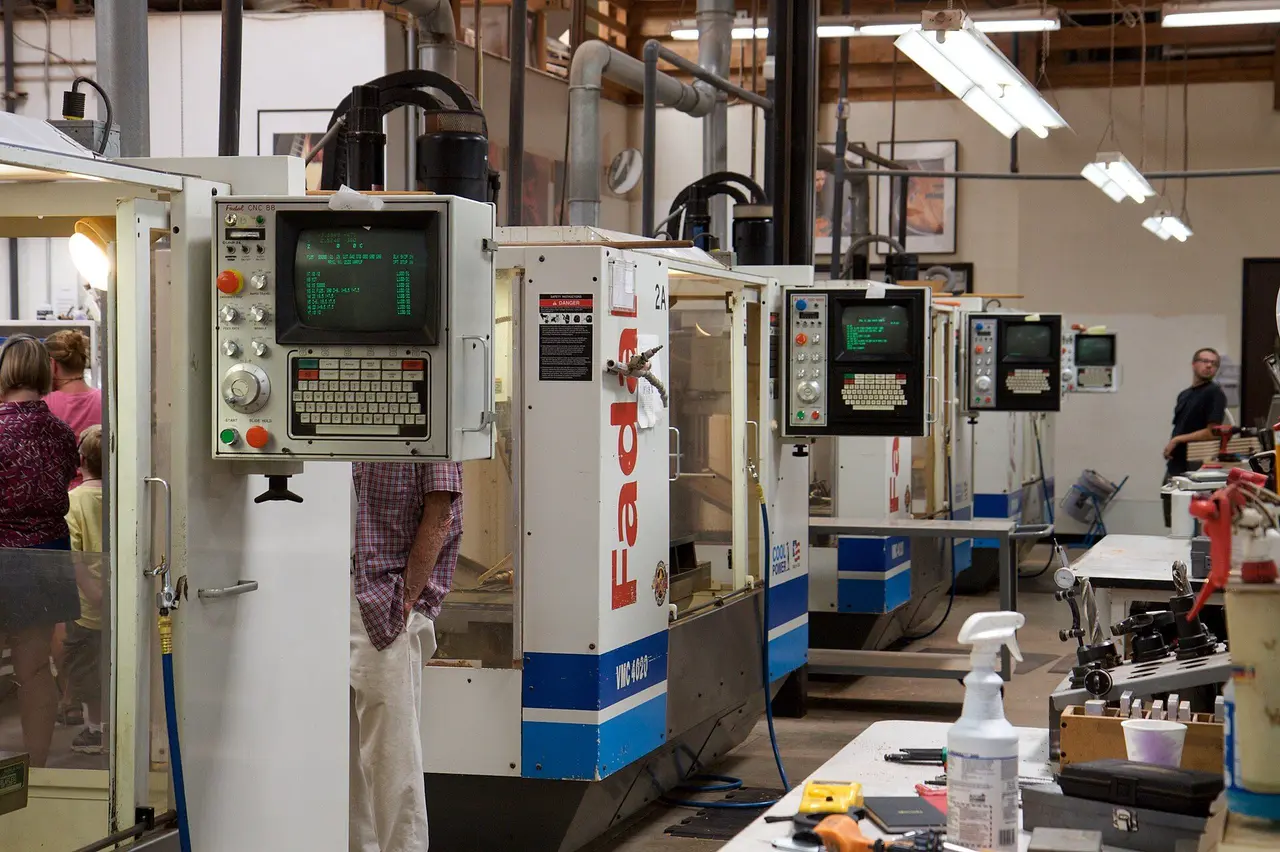
CNC (computer numerical control) machines are mills, lathes and machining centres that follow a numeric program. The machinist does not turn handwheels as on a manual machine; instead they prepare the stock, tools and program, then watch the machine cut to size. Figure 1 shows a row of CNC mills in a production shop.
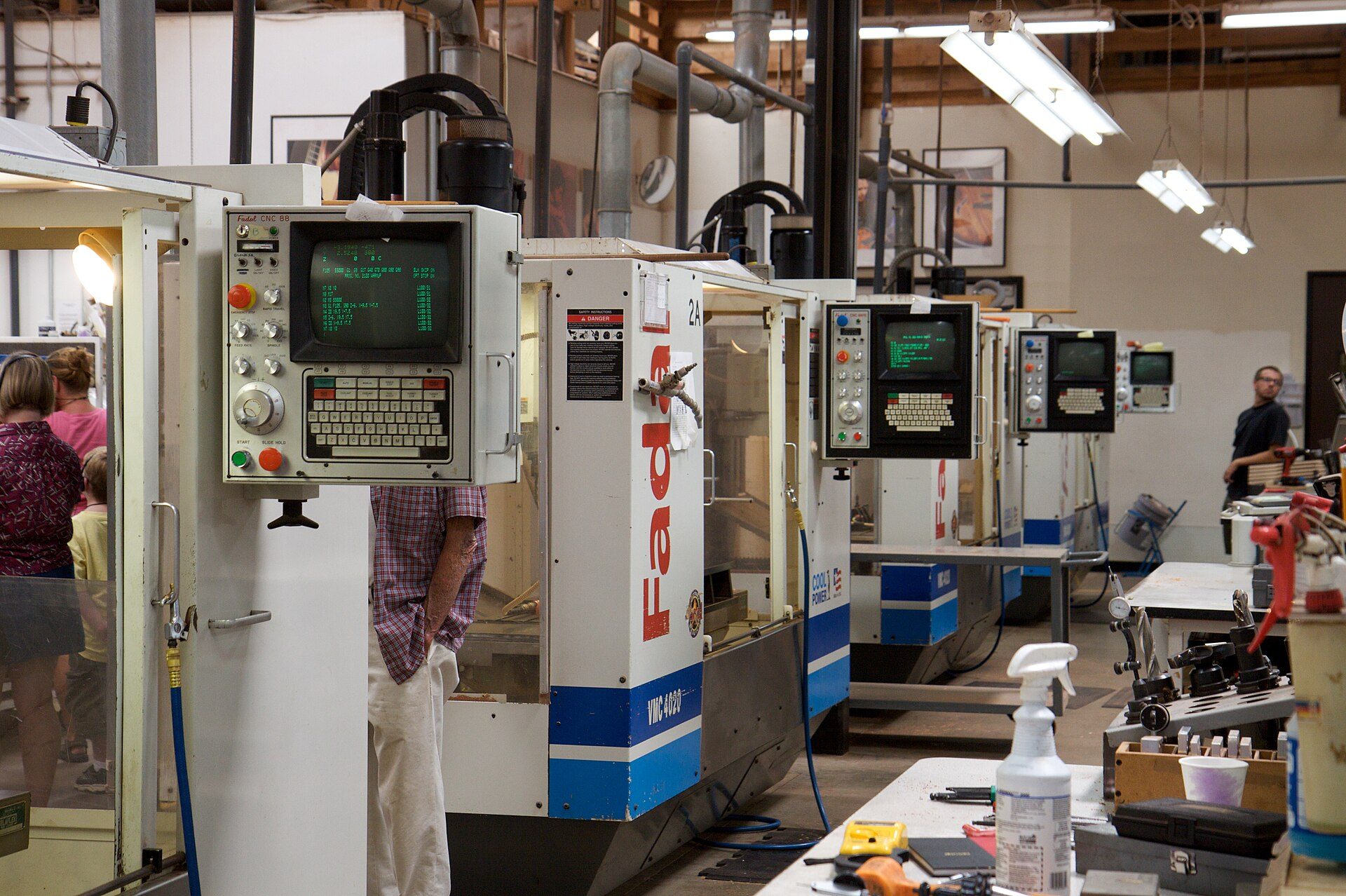
Photo: Marcin Wichary / Wikimedia Commons, CC BY 2.0
Four levels in a CNC shop
- Apprentice / machine helper: fetches stock, unloads parts, blows off chips, deburrs sharp edges and takes simple measurements as instructed.
- Operator: runs existing programs, changes worn tools, applies tool offsets when a size drifts, measures parts and fills in the inspection sheet.
- Setter: mounts vices, chucks and fixtures; sets the work zero and tool lengths; proves out new programs and deals with chatter and size errors.
- CNC/CAM programmer: reads drawings, plans the machining sequence, writes G-code or uses CAM software, chooses tools and cutting data, and shortens cycle time.
You are paid for responsibility, not years
One wrong work zero can scrap a whole batch, break tools or crash the spindle, costing tens of millions of VND. That is why shops pay more to the person trusted to run the first part of a batch. Some machinists stay operators for five years because they never learned setup; others set up both mills and lathes after two. Figure 2 shows a certified machinist coaching a colleague at the control — the fastest way to learn setup.
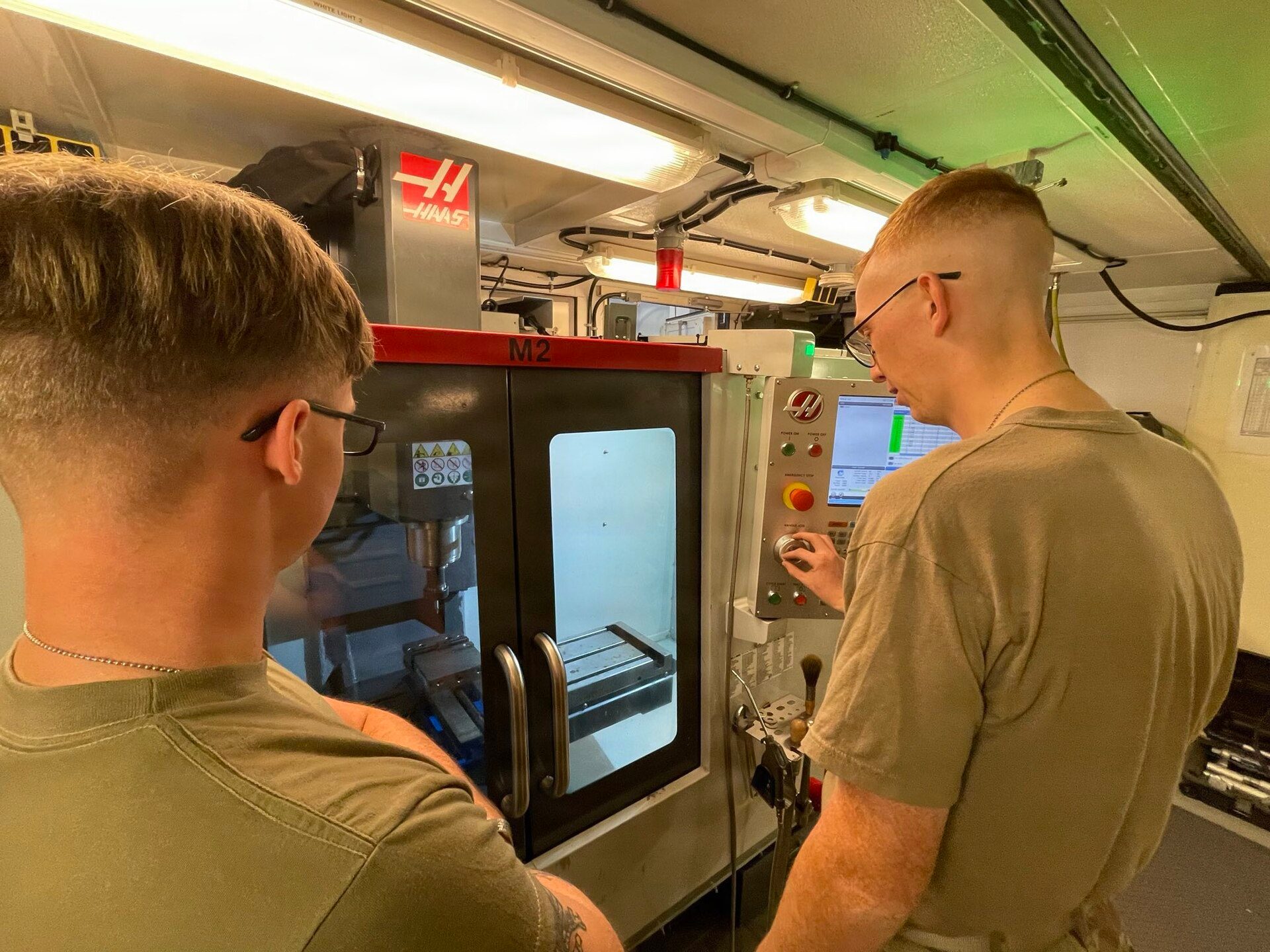
Photo: U.S. Army 310ESC by Capt. Robert Wooldridge / Wikimedia Commons, Public domain
The product also pushes pay up
Shops making simple high-volume parts pay less than mould shops and precision suppliers for electronics, cars and medical devices. Tolerances of ±0.01 mm and hard materials such as stainless steel, titanium or hardened steel need more skill, so they pay more.
CNC machinist pay by role (2026 reference)
The figures below are 2026 reference ranges based on typical hiring in Vietnam's main machining regions; real pay depends on the region, company size, product and negotiation. "Total income" includes allowances and normal overtime, before insurance deductions.
| Role | Typical experience | Base pay (million VND/month) | Total with overtime (million VND/month) |
|---|---|---|---|
| Apprentice, machine helper | 0–3 months | 5–7 | 6–9 |
| Operator | 3 months – 2 years | 6–9 | 8–13 |
| Mill or lathe setter | 1–4 years | 9–15 | 12–20 |
| CNC/CAM programmer | 2–5 years | 13–22 | 15–25 |
| Team leader, 5-axis or mould programmer | 5+ years | 18–30 | 20–35 |
Why beginners see ads promising "12 million"
Many job ads quote total income with heavy overtime and night shifts. The actual base pay may be only 6–7 million. Ask clearly: what is the base pay, what salary is insurance paid on, and how many overtime hours a month are normal.
Day rates in small workshops
Small city workshops often pay by the day: roughly 250,000–400,000 VND a day for an operator and 400,000–700,000 VND for someone who can set up and program. Over 26 days that matches the table above, but there are usually fewer allowances and you should ask carefully about social insurance.
Industrial zone or city workshop?
Demand for CNC machinists is concentrated in provinces with large industrial zones: Bac Ninh, Bac Giang, Hai Phong and Vinh Phuc in the north; Binh Duong, Dong Nai and Long An in the south. Hanoi and Ho Chi Minh City have many small job shops, mould makers and fabrication workshops.
| Factor | Industrial-zone company (often foreign-invested) | Small city workshop |
|---|---|---|
| Base pay | Stable, rises by grade each year | Negotiated, can be higher if you are good |
| Overtime, nights | Plenty, paid by law, rotating shifts | Depends on orders, busy then quiet |
| Allowances, benefits | Shift meals, shuttle bus, attendance, housing, 13th-month bonus | Fewer, up to the owner |
| Insurance | Paid in full under the contract | Ask clearly; some shops do not pay |
| Learning | Strict procedures, easy to stay on one machine for years | You do many jobs and reach setup and programming sooner |
Language allowances in Japanese and Korean firms
Japanese- and Korean-owned companies often pay an allowance for reading drawings and speaking basic Japanese or Korean, roughly 0.5–3 million VND a month depending on level. Being able to read English or Japanese drawing notes is an advantage at interview.
Living costs change the real number
Earning 11 million in a provincial industrial zone, renting a room for 1–1.5 million and eating free shift meals, can leave more savings than 14 million in Ho Chi Minh City with rent of 3–4 million. When comparing offers, subtract rent, food and travel first.
How overtime, night shifts and the payslip work
Overtime is a large part of a CNC machinist's income because machines run two or three shifts. Under Vietnam's current Labour Code, overtime is paid at least 150% of the hourly rate on normal days, 200% on weekly rest days and 300% on public holidays; night hours (10 pm to 6 am) earn at least an extra 30%. Check the current law and your company's rules, since employers may pay more than the minimum.
Finding the hourly rate from base pay
Many companies use: hourly rate = base pay ÷ standard working days (often 26) ÷ 8 hours. With base pay of 6,240,000 VND: 6,240,000 ÷ 26 ÷ 8 = 30,000 VND an hour. Whether the divisor is 26 or the actual days in the month is set in the pay policy; ask HR.
Deductions
Employees on a contract usually have about 10.5% of their insured salary deducted for social, health and unemployment insurance (under current rules, which can change). At a new operator's income, personal income tax is usually zero after family deductions; check the details on your payslip. Some companies also deduct union fees or late-arrival penalties under their internal rules.
Worked example: one month for an operator in Bac Ninh
Hung, 22, has run a CNC mill for six months at a parts company in an industrial zone. His base pay is 6,240,000 VND, plus allowances of 500,000 for attendance, 500,000 for housing and 300,000 for travel. This month he works 40 overtime hours on weekdays, 16 hours on Sundays (2 days × 8 hours) and 13 night shifts × 8 hours = 104 night hours.
| Item | Calculation | Amount (VND) |
|---|---|---|
| Base pay | Full 26 days | 6,240,000 |
| Allowances | 500,000 + 500,000 + 300,000 | 1,300,000 |
| Weekday overtime | 40 h × 30,000 × 150% | 1,800,000 |
| Sunday overtime | 16 h × 30,000 × 200% | 960,000 |
| Night premium | 104 h × 30,000 × 30% | 936,000 |
| Total income | 11,236,000 | |
| Insurance deduction | 6,240,000 × 10.5% | −655,200 |
| Take-home pay | 10,580,800 | |
Check: 6,240,000 + 1,300,000 + 1,800,000 + 960,000 + 936,000 = 11,236,000 VND; minus 655,200 leaves 10,580,800 VND (about 420 USD). If next month has no night shifts and only 20 weekday overtime hours, total income drops to 6,240,000 + 1,300,000 + 900,000 = 8,440,000 VND. So never treat your best month as your average.
How long does it take to move up each level?
These timelines are typical for someone keen to learn with a senior machinist coaching them; evening self-study makes it faster.
| Stage | Typical time | What you must be able to do |
|---|---|---|
| Apprentice → operator | 1–3 months | Machine safety, calipers and micrometers, running existing programs, spotting worn tools |
| Operator → setter | 6–18 months | Workholding, work zero, tool setting, offsets, reading toleranced drawings, safe prove-out |
| Setter → programmer | 1–3 years | G-code, drilling and tapping cycles, CAM (Fusion 360, Mastercam), cutting data |
School or on-the-job training
Elementary vocational courses in metal cutting or CNC operation usually take 3–6 months, with 2026 fees of roughly 5–15 million VND depending on the school. Intermediate and college programmes in metal cutting take 2–3 years and give a stronger grounding in drawings and materials. Many companies hire people without a certificate and train them in-house; you then learn the machine quickly but should study drawings and G-code on your own.
Why manual lathes are still worth learning
People who have run a manual lathe or mill (Figure 3) understand how a cut feels, the sound of chatter and what good or bad chips look like. When they move to CNC they choose cutting data and spot problems faster than someone who only presses buttons.

Photo: Myousry6666 / Wikimedia Commons, CC BY-SA 4.0
Do certificates raise pay?
An elementary certificate, an intermediate diploma or a national occupational skills certificate helps your application pass screening and may place you on a higher pay grade at large companies. But your final pay is still decided by the practical test and the probation period.
The practical skills test at hiring
Most CNC shops give a hands-on test of 30–90 minutes instead of just an interview. The content depends on the role, but it usually covers these four parts.
1. Reading a drawing
You get a part drawing and are asked which dimensions matter most, what the tolerances are (for example Ø20 h7, ±0.02), and what the surface roughness, parallelism and perpendicularity symbols mean. Foreign-invested shops may give drawings with English or Japanese notes.
2. Measuring
You measure a part with a caliper and a micrometer, read to 0.01 mm and write the results on an inspection sheet (Figure 4). The examiner watches whether you wipe the faces clean, check zero, use the micrometer ratchet for even pressure and measure at several points.

Photo: U.S. Navy photo by Photographer’s Mate Airman Andrew Wallace / Wikimedia Commons, Public domain
3. Setup and prove-out
For a setter role you may be asked to clamp a part in a vice, set the work zero with an edge finder or a tool, set tool lengths, then run the program in single-block mode with reduced rapid speed. Examiners score safe handling more than speed.
4. G-code and cutting data
Common questions: the difference between G00 and G01, G02/G03, what G54 is, M03/M05/M08. A spindle speed question: n = 1000 × Vc ÷ (π × D). For a 10 mm end mill in aluminium at Vc = 200 m/min: n = 1000 × 200 ÷ (3.14 × 10) ≈ 6,370 rpm; on the machine you would set about 6,300–6,400 rpm, within the machine's limit.
Safety during a skills test: do not wear cloth gloves, watches or rings near a rotating spindle; tie back long hair; wear safety glasses; close the machine doors before running. Always run the first pass in single block with reduced rapids and keep a hand near the emergency stop. If you are unsure about the work zero, stop and ask — examiners value a machinist who knows when to stop over one who is fast and crashes the tool.
Negotiating pay and avoiding traps
After the test, you are entitled to ask about every item before you sign.
Questions worth asking
- What are the base pay and the insured salary? What percentage is paid during probation?
- How many overtime hours a month on average, are there night shifts, and how often do shifts rotate?
- Which allowances (attendance, housing, travel, language, skill) apply, and what loses the attendance bonus?
- How often are grades reviewed, and is there a path to setup or programming?
Warning signs
- Being asked for a "job placement fee" or a deposit before starting.
- Promises of "15 million income" without the base pay written in the contract.
- Probation longer than the law allows, or no contract signed after probation.
The fastest way to earn more
Ask to learn setup as soon as you are a steady operator; keep a notebook of every size error and its fix; study CAM in the evenings. After one or two years you can compare the market and bring photos of parts you made and inspection sheets (with the company's permission) to interviews.
Common mistakes when judging pay and offers
| Mistake | Result | How to avoid it |
|---|---|---|
| Comparing peak-month totals | Disappointment when orders drop and overtime disappears | Ask for six-month average overtime and work from base pay |
| Forgetting rent and travel | Choosing higher pay but saving less | Make an income and cost table for each offer |
| Only operating, never learning setup | Pay stays flat for years | Aim to set up a machine within 12–18 months |
| Ignoring insurance | No health or unemployment cover when needed | Prefer employers who sign a contract and pay in full |
Frequently asked questions
How much does a newly trained CNC machinist earn?
As a 2026 reference, base pay of about 5–7 million VND and total income of 6–9 million with overtime, depending on region. After 3–6 months of steady operating, a raise is usually reviewed.
Can I get a CNC job without a certificate?
Yes, many shops take apprentices and train them. Still, an elementary certificate or vocational diploma helps you pass screening at large companies and can shorten probation.
Do CNC machinists have to work nights?
In industrial zones most machines run two or three shifts, so rotating shifts are common. Night work pays extra, but you need enough sleep to avoid accidents and mistakes.
How long does it take to learn CAM programming for work?
If you can already set up confidently, 2D and 2.5D milling CAM takes about 2–4 months of guided self-study. Five-axis or mould programming takes years.
Does working abroad as a CNC machinist pay more?
It can pay much more, but costs, conditions and risks vary by country and agency. Only go through licensed agencies and read the contract carefully.
Practice and self-assessment
- Take your latest payslip (or a made-up one) and split it into five items: base pay, allowances, overtime, night premium and deductions.
- Recalculate overtime from the hourly rate as in Hung's example and compare with the payslip.
- Measure five dimensions of a part with a caliper and a micrometer, record them, and measure again after 10 minutes.
- Hand-write a short G-code program for milling a straight slot using G00, G01, M03 and M08, and explain each line.
Self-assessment criteria
- Pass: your overtime calculation differs from the payslip by no more than 1%, and you can explain every deduction.
- Pass: two micrometer readings of the same dimension differ by no more than 0.01 mm; you read drawing tolerances correctly.
- Not yet: you cannot tell G00 from G01, or you prove out a new program without single block.
This is the last step of the roadmap. Before each test, revise Measuring tools & part inspection and Operating, part and tool setup on CNC mills & lathes; once you are hired, your next goals are CAM programming and machining parts to tighter tolerances.
Getting ready to apply for CNC jobs? Go back through every step from drawings and measuring to G-code in the 8-step CNC machinist roadmap and mark the parts you are still weak on.