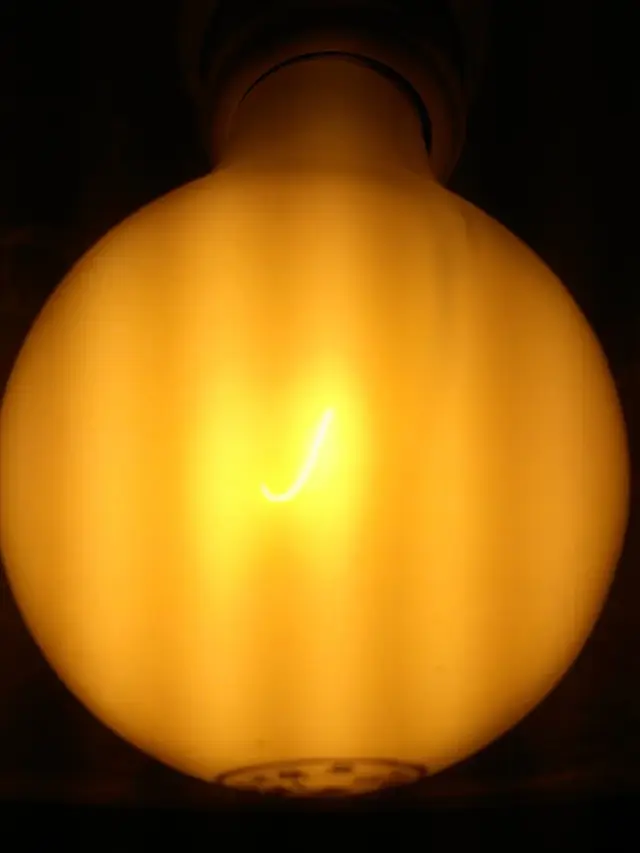
Every switch in the room is off, yet the new LED ceiling lamp still gives a faint glow, or it flashes every few seconds all night. Clients call it a "ghost light", and it has become a common complaint since homes in Vietnam moved from incandescent and fluorescent lamps to LEDs.
Sometimes the cause is harmless. Sometimes it warns that the switch is breaking the neutral instead of the line conductor, or that current is leaking through damaged insulation. Your job is to tell these apart with proper tests, fix the real cause and explain it to the client. This guide is for trainee electricians on single-phase supplies in Vietnam (nominally 220–230 V, 50 Hz).
Scope and safety. This article covers LED lamps that glow, flash or flicker while switched OFF on existing household lighting circuits. Flicker while the lamp is ON (incompatible dimmer, loose connection, supply fluctuations) is a different problem. Some of the tests below are made on live circuits. Mains voltage can kill: learners should only do this work under the supervision of a qualified electrician, using a voltage tester that has been proved on a known live source before and after use. Every figure in this article is for reference only; the manufacturer's instructions for the lamp, switch and test instrument, and local rules, always take priority.
Why LEDs glow when an old bulb would not
An incandescent filament needs a large current before it even turns red; a tiny stray current just warms it slightly and you see nothing.
An LED lamp contains an electronic driver that rectifies the mains and feeds the LED chips. LED chips give visible light from a very small current, and many drivers have an input capacitor that charges from any stray current. Two behaviours follow:
A steady faint glow: a small continuous stray current lights the LED chips dimly.
A periodic flash (every second or few seconds): the stray current charges the input capacitor until the driver can start; it fires briefly, empties the capacitor, the LED flashes, and the cycle repeats.
In most cases the LED is not faulty; it simply reveals a small current that was always there. The question is where that current comes from, and whether it means danger.
The five common causes
Cause 1: The switch is wired in the neutral
The switch must break the line (L) conductor. If it is wired in the neutral (N), the lamp goes out, but the lamp holder and driver stay connected to line voltage. This alone does not always cause a glow; it shows when there is some path from the lamp's "neutral side" to earth, such as moisture in a fitting, a damaged conductor touching metalwork, or the capacitance of the switched cable to earth. A small current then flows from line, through the driver, to earth, and the LED glows.
This is the cause that matters most for safety. Anyone changing a bulb or opening the fitting with the switch "off" can touch a live part. It is not rare in old houses or in rooms wired by unqualified people, so always check for it first.
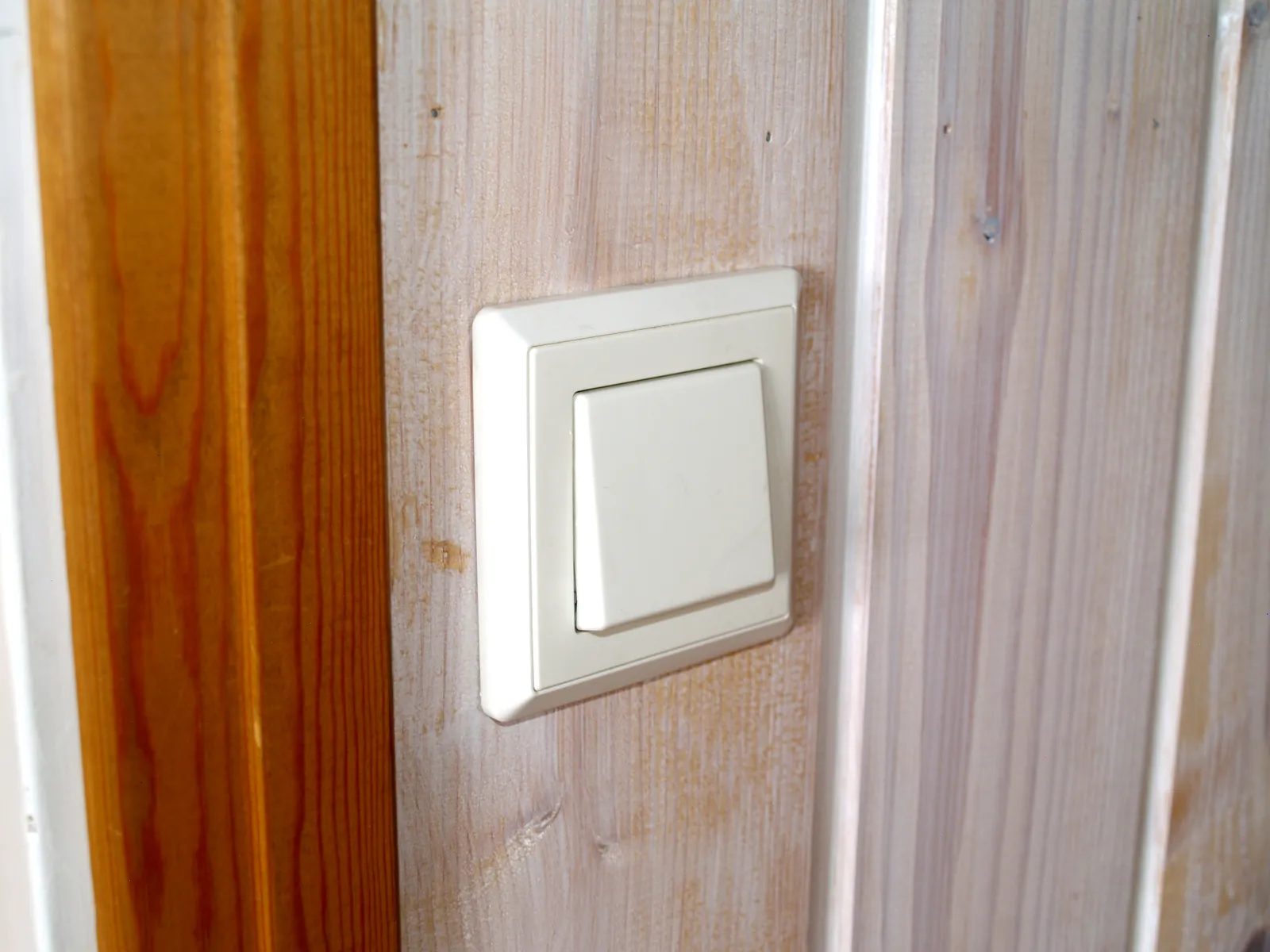
Figure 1. A plain single-gang light switch on a wooden wall. From the outside you cannot tell whether the switch breaks the line or the neutral conductor; only testing at the switch and at the lamp holder will tell you. (Photo: Santeri Viinamäki, Wikimedia Commons, CC BY-SA 4.0)
Cause 2: Induced voltage in long parallel cable runs
Two insulated conductors side by side in a cable or conduit behave like a small capacitor. If one is live and the other is the switched line to the lamp, the alternating voltage couples a small current into the switched conductor even with the switch open. This is capacitive coupling, and the voltage it creates on the "dead" conductor is called induced or ghost voltage.
The longer the conductors run together, the more current is coupled. Typical situations:
Two-way switching (a stair or corridor lamp controlled from two places). The two travellers run the whole distance between the switches; in the OFF position one is live and the other is connected to the lamp.
Long switch drops or shared conduits, where the switched line runs beside a permanent live conductor of the same or another circuit.
The coupled current is far too small to be a shock hazard in itself, but it is enough for a sensitive LED driver. The wiring can be completely correct and still produce this glow.
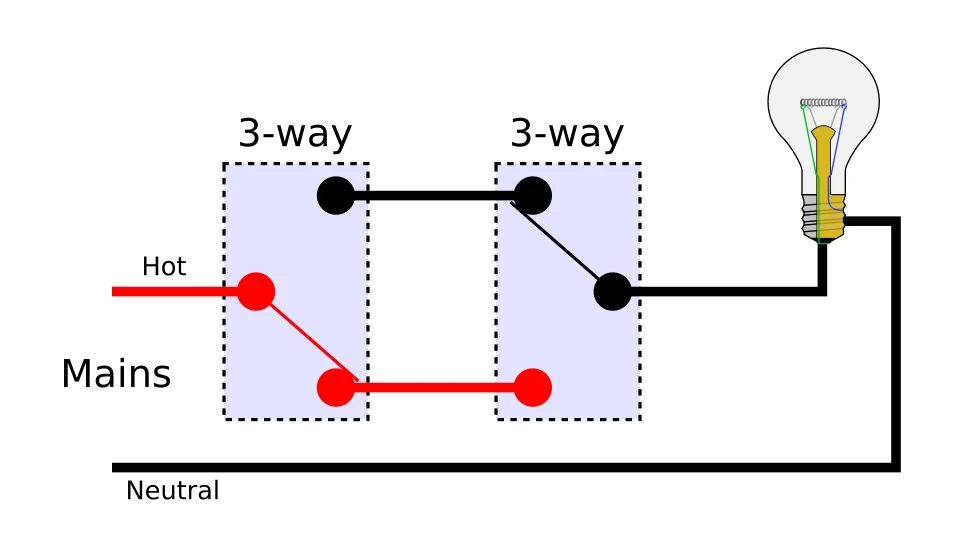
Figure 2. Two-way switching (labelled "3-way" in North American terms, where "hot" means line). In this position the first switch connects the line to the lower (red) traveller, while the second switch connects the lamp to the upper (black) traveller, so the lamp is off. The upper traveller is disconnected from the supply but runs alongside the live traveller for the whole distance between the switches, which is exactly where induced voltage can light an LED dimly. (Diagram: Cburnett; light bulb by Fastfission, Wikimedia Commons, CC BY-SA 3.0)
Cause 3: Illuminated (neon or LED indicator) switches
Many switches have a small locator light so you can find them in the dark. In a two-wire switch, the only way to power it when the switch is OFF is to connect a neon lamp or small LED (with a series resistor) across the switch contacts. A small current then flows from line, through the indicator, through the lamp, to neutral. An incandescent bulb hides it; an LED lamp often glows or flashes. Classic sign: the problem started the day LEDs were fitted, and the switch plate has a small glowing dot.
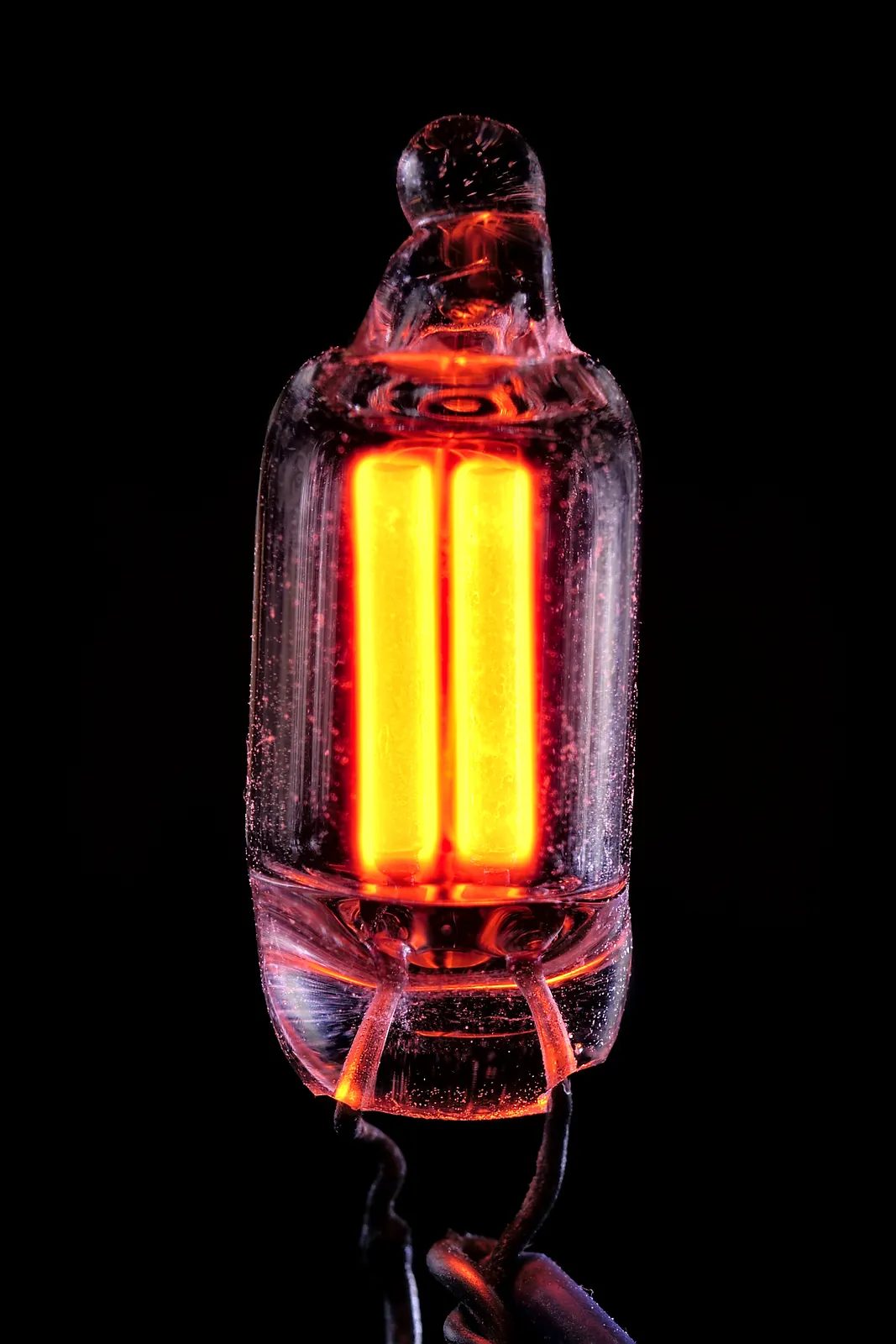
Figure 3. Close-up of a small NE-2 type neon lamp glowing on alternating current. Lamps of this kind, or small LEDs, are used as locator lights inside illuminated switches. When the switch is off, the indicator is connected across the open contacts, so its small operating current also passes through the light it controls. (Photo: Junkyardsparkle, Wikimedia Commons, CC0)
Cause 4: Smart and electronic switches without a neutral
Touch, Wi-Fi/Zigbee, timer and motion-sensor switches contain electronics that need power all the time. A model wired to the neutral powers itself from line and neutral. But many are designed for a two-wire switch box with no neutral, and keep themselves alive by passing a small current through the lamp while it is "off". The LED may glow, flash, or the switch may behave erratically. Many makers of no-neutral switches state a minimum lamp load and offer a bypass module to fit across the lamp terminals; follow their instructions rather than improvising.
Cause 5: Earth leakage and insulation faults
Damaged or damp insulation lets a small current flow from a live conductor into the switched conductor, or from line through the lamp to earth. Look at outdoor and bathroom fittings where water has got in, cables crushed under clips, badly taped joints in junction boxes, and old brittle cable. Warning signs: a glow that is worse after rain or in humid months, an RCD/RCBO that sometimes trips, corrosion or discoloration in the fitting, a burning smell. This is a genuine safety issue: the same leakage path can energise metalwork and lead to fire.
A contributing factor: the LED driver itself
Two lamps on the same circuit can behave differently. Very cheap drivers, such as simple capacitive dropper supplies, tend to be more sensitive to stray current than better designs. Changing to a better lamp is a valid fix only after you have ruled out a switch in the neutral and a leakage fault; never use a "less sensitive" lamp to hide a dangerous wiring problem.
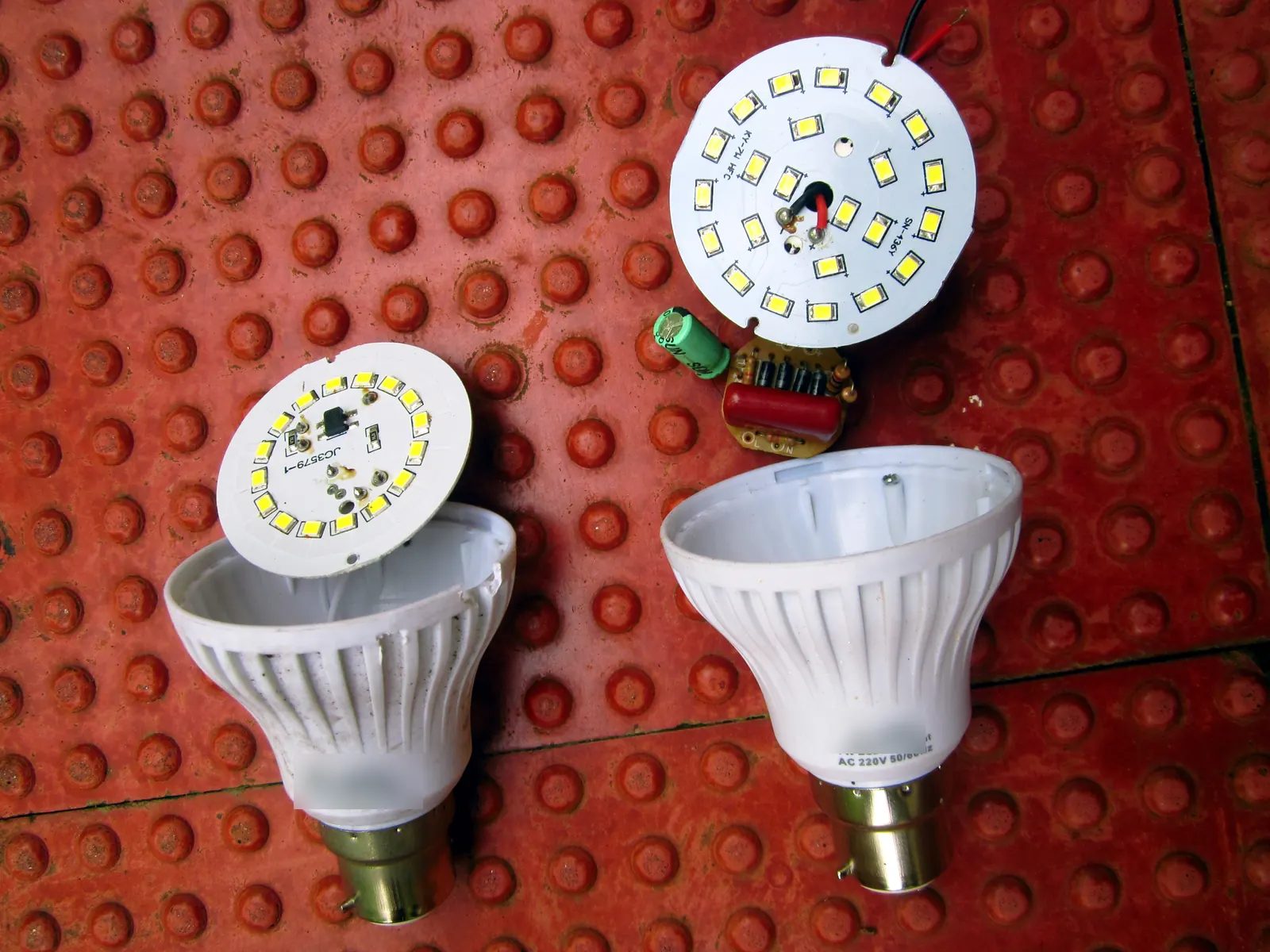
Figure 4. Two inexpensive B22 LED bulbs opened up. On the right, the small driver board next to the LED disc can be seen, with a red film capacitor and a green electrolytic capacitor; the file description identifies the circuit as a capacitive power supply. Simple drivers like this can react to a very small stray current when the switch is off. Brand marks on the housings have been blurred. Never open a lamp that is connected to the supply. (Photo: Kottakkalnet, Wikimedia Commons, CC BY-SA 4.0)
Tools and why the reading can lie
Tools you need
A two-pole voltage tester and a known live source or proving unit.
A digital multimeter, ideally with a low-impedance (LoZ) voltage mode.
A non-contact voltage tester, for screening only.
An insulation resistance tester if leakage is suspected (de-energised circuits only, trained users only).
Non-contact testers react to induced voltage
A non-contact tester senses the electric field around a conductor. It beeps on a conductor carrying only induced voltage, and can stay silent on a live conductor that is shielded or deep in a cable. Use it for screening, but it can never prove a conductor dead, and its beep alone does not prove a fault.
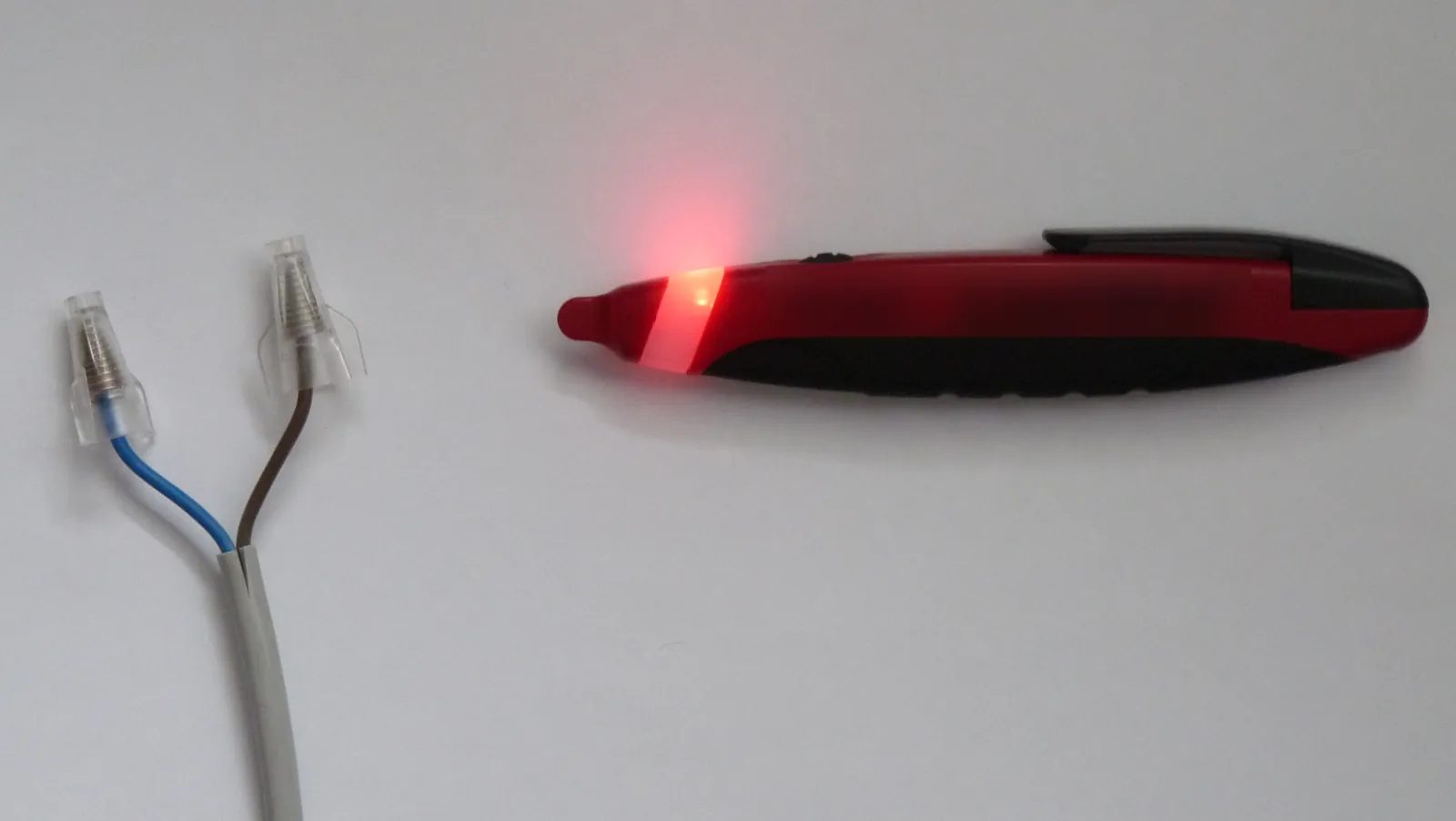
Figure 5. A non-contact voltage tester lit up beside the brown and blue cores of a cable, whose ends are covered by insulated twist-on connectors. A tester like this only senses an electric field: it will also light near a conductor that carries nothing more than induced voltage, and it cannot prove a circuit is dead. The brand name and model on the tester have been blurred. (Photo: Dmitry G, Wikimedia Commons, CC BY-SA 3.0)
High-impedance meters show ghost voltage
A normal digital multimeter has a very high input impedance on its voltage range (often in the order of 10 MΩ, for reference; check your meter's specification). Because it draws almost no current, it can show a high reading on a conductor that is only capacitively coupled to a live one, anywhere from a few volts to close to the supply voltage depending on the cable run. That can mislead you either way: into thinking a coupled wire is live, or into dismissing a real fault as "only induced".
A LoZ (low-impedance) mode, or a two-pole tester with a built-in load, loads the conductor so that a coupled voltage, which can only supply a tiny current, collapses towards zero, while a real connection to the supply stays at full voltage:
High on the normal range, near zero on LoZ: induced (ghost) voltage.
High on both: a real connection to the supply, through a wiring error, an indicator, a smart switch or a leakage path.
Check your meter's manual: not all meters have LoZ, LoZ is not meant for sensitive electronic circuits, and a LoZ measurement from line to earth can trip an RCD. Use the meter within its category rating.
Step-by-step diagnosis
Step 1. Ask questions and observe
Did the glow start when LEDs or a new switch were fitted, or after rain or building work? Steady glow or regular flash? One lamp or several? Is the switch illuminated, smart, or one of a two-way pair? Does the RCD ever trip? The answers often point straight to the cause.
Step 2. Swap the lamp as a quick check
With the circuit isolated if you must open a fitting, try a different good-quality LED lamp, or temporarily an incandescent lamp. If the glow disappears, the original lamp is sensitive to a small stray current, but you must still complete Step 3 before accepting "change the lamp" as the answer.
Step 3. Check that the switch breaks the line
This is a live test: do it under supervision, with the lamp switch OFF.
Prove your two-pole tester on a known live source.
At the lamp's terminal block (reached safely, without touching terminals), measure from each supply terminal to earth.
If either terminal shows close to full supply voltage to earth, the lamp is still connected to line, which usually means the switch is in the neutral.
Confirm at the switch: one terminal (the incoming feed) should be at full voltage to earth and the other near zero. If the incoming terminal reads zero and the lamp-side terminal shows voltage, the switch is in the neutral.
Prove your tester again on the known live source.
If the switch is in the neutral, correct it before anything else. Wire colours in older Vietnamese houses are not reliable; test, do not assume.
Step 4. Measure the voltage at the lamp, on both ranges
With the switch OFF, measure the lamp's switched-line terminal to neutral, on the normal AC range and then on LoZ. A reading that collapses on LoZ points to induced voltage (Cause 2); one that stays high points to a real current path (Causes 3–5, or a wiring error).
Step 5. Isolate the switch
Isolate the circuit and prove it dead, disconnect the switched line at the switch (insulate and secure the loose end), then restore the supply. If the glow stops, the current came through the switch: an indicator lamp, a switch fault, or a smart switch's standby current. If it continues, the current comes from the cable route: coupling from a parallel live conductor, a wrong connection in a junction box, or a leakage fault.
Step 6. Test for insulation faults if you suspect leakage
With moisture, corrosion, RCD trips, or a reading that stays high with no indicator or smart switch involved, isolate the circuit and carry out an insulation resistance test. Disconnect LED lamps, drivers, smart switches and other electronics first, as the test voltage can damage them. Compare results with the applicable standard or your supervisor's acceptance values; do not guess a pass mark.
Reference table: symptom, likely cause, test and fix
Symptom (switch OFF) | Likely cause | How to confirm | Typical fix |
|---|---|---|---|
Lamp glows; lamp holder still live to earth | Switch in the neutral (often with a small leakage path to earth) | Two-pole tester at lamp: L–E or N–E near full voltage with switch off | Move the switch to the line conductor; check the whole circuit for other reversals |
Faint glow, only on a long run or two-way switching | Capacitive coupling between parallel conductors | High reading on normal range, near zero on LoZ | Bypass/load module across the lamp per manufacturer; better-quality LED; double-pole switching; for very long runs, consider relay control |
Glow or flash started after fitting a switch with a locator light | Neon/LED indicator across the switch contacts | Glow stops when the switched line is disconnected; indicator visible | Replace with a plain switch, or one stated as suitable for LED loads (some need a neutral) |
Glow or flash with a touch, Wi-Fi, timer or sensor switch | No-neutral switch passing standby current through the lamp | Glow stops when the switch is disconnected; check the manual for a minimum load | Use the manufacturer's bypass module, a model that uses a neutral, or a lamp type the maker approves |
Glow worse after rain; RCD trips sometimes | Earth leakage / insulation fault, water in fitting | Insulation resistance test (circuit isolated, electronics disconnected); inspect fitting | Find and repair the damaged section; replace the fitting with one of a suitable IP rating |
Only one brand/model of lamp glows | Driver sensitive to small stray current | Other lamps on the same circuit are dark | After ruling out the causes above, change to a better-quality lamp |
Regular flash every few seconds | Driver capacitor charging from any of the stray currents above | Same tests as above to find the source | Remove the source; the flash is a symptom, not the cause |
Fixes in detail
Move the switch to the line conductor
Isolate, prove dead, and re-terminate at the switch, the lamp and any junction box so the switch breaks the line and the neutral goes straight to the lamp. Test again afterwards. If one switch was wired this way, check the others: the same person probably wired them all.
Load (bypass) capacitor or snubber
Where the stray current comes from coupling or a no-neutral smart switch, a load device across the lamp terminals gives that current an easier path than the driver, so the driver's voltage stays too low to light it. If you use one:
Use only a product designed and rated for connection across the mains (often based on an X2-class safety capacitor, sometimes with a resistor), never a general-purpose capacitor.
Fit it inside the fitting or a junction box, fully enclosed, terminated in proper connectors.
Follow the switch or module manufacturer's instructions on where and how to fit it.
Do not build your own resistor-capacitor network on site unless your supervisor has approved the design and the parts are correctly rated; a wrong value can overheat.
Replace the indicator switch
Replace it with a plain switch, or with an illuminated model its manufacturer states is suitable for LED lamps (some need a neutral at the switch). Tell the client why the locator light will be lost.
Double-pole switching
A double-pole switch opens both line and neutral, which greatly reduces, and usually removes, the path for stray current through the lamp. It is useful for outdoor fittings and shorter runs, and it does not excuse wrong polarity.
Better-quality LED lamps or drivers
When tests show only a small coupled current, a different lamp is often the simplest fix. Choose one from a reputable supplier, marked for the local supply; if it is claimed to suit electronic switches, check the manufacturer's information.
On very long multi-way runs, a larger redesign is to replace the travellers with push buttons controlling an impulse (latching) relay; agree this with the client and your supervisor first.
When the glow is a safety problem
Treat the glow as a safety issue, not just an annoyance, if:
The lamp holder is live with the switch off (switch in neutral).
The RCD trips, the fitting is damp or corroded, or there is a burning smell or discoloration.
A reading stays at full voltage on LoZ with no indicator or smart switch to explain it.
The circuit shares a neutral with another circuit, or a junction box has unexpected connections.
Isolate the circuit, tell the client it must not be used until fixed, and involve a qualified electrician.
Worked examples
Example 1: Staircase lamp with two-way switches
A townhouse stair lamp is controlled by two-way switches on two floors, with a long cable route between them. With the lamp off, it glows faintly. A two-pole tester with a built-in load shows both lamp terminals close to zero to earth, so the switch is in the line. The multimeter shows a high reading switched line–neutral on the normal range, near zero on LoZ: coupling between the travellers. Fix: a bypass module from a reputable maker, fitted across the lamp terminals inside the fitting as instructed. The glow stopped, and the client was told the wiring is correct and safe.
Example 2: Bedroom lamp that flashes every few seconds
A bedroom LED lamp "blinks like a warning light" at night, and the switch has a blue locator light. The switch is correctly in the line. With the switched line disconnected at the switch, the flashing stopped. Fix: a plain switch from the same range.
Example 3: Damp bathroom fitting
An LED mirror light in a bathroom glows after showers, and the RCD has tripped twice this month. With the switch off, the fitting's terminals were live to earth (switch in the neutral), and the fitting held water droplets and corrosion. Fix: switch rewired into the line, fitting replaced with one of a suitable IP rating, and an insulation resistance test passed against the applicable requirements. The glow was the visible sign of two real faults.
Safety checklist
Two-pole voltage tester proved on a known live source before and after use.
Non-contact tester used for screening only, never to prove a circuit dead.
Meter used within its category rating; LoZ used to separate ghost voltage from real voltage.
Switch confirmed to break the line conductor, at the switch and at the lamp.
Circuit isolated, locked or tagged, and proved dead before any terminal is touched or rewired.
Electronics disconnected before any insulation resistance test.
Bypass modules and capacitors used only as supplied and rated by a manufacturer, fully enclosed.
Damp, corroded or burnt fittings replaced, not just cleaned.
All covers refitted, terminals tight, no exposed conductors.
Client told what was found, what was done, and whether any risk remains.
Frequently Asked Questions
Is a faint LED glow with the switch off dangerous?
Not always. Coupling or a locator light produces only a tiny current. But the same symptom can come from a switch in the neutral or an insulation fault, both real hazards. Only testing tells you which.
Why does my LED flash every few seconds instead of glowing?
A small stray current slowly charges a capacitor inside the LED driver. When it reaches the driver's starting voltage, the driver fires briefly and the lamp flashes, then the cycle repeats. The flash is a symptom; find where the stray current comes from.
My non-contact tester beeps on the lamp wire with the switch off. Is it live?
Not necessarily. Non-contact testers react to induced voltage as well as real voltage. Use a two-pole tester, or a multimeter in LoZ mode, to tell the difference, and never rely on a non-contact tester to prove a conductor dead.
Can I fix it by just using a different LED bulb?
Sometimes, if testing shows the switch is in the line and there is no leakage fault. But never change the bulb without testing first: a "quieter" bulb could hide a switch in the neutral.
Practice Exercises
Exercise 1: Interpret the readings. On a two-way staircase circuit with both switches off, your multimeter reads a high voltage between the lamp's switched line and neutral on the normal AC range and almost zero on LoZ. The two-pole tester shows no voltage from either lamp terminal to earth. What is the most likely cause, is it a safety issue, and what fix would you propose?
Exercise 2: Find the reversal. With the switch OFF, you measure close to full supply voltage between one lamp terminal and earth. Describe, step by step, how you would confirm whether the switch is in the neutral, and how you would correct it safely.
Exercise 3: Smart switch choice. A client wants a Wi-Fi switch in a box with only two conductors (permanent line and switched line), controlling one small LED downlight. What would you check in the switch's instructions, and what options would you offer?
Exercise 4: Client explanation. In three or four plain sentences, explain to a client why their new LED lamp glows faintly when the old bulb never did, and why you must test the wiring before recommending a different lamp.