A good hair consultation follows a fixed order: ask what the client wants and what chemical services the hair has had, then check the hair with your own hands (coarse or fine, dense or sparse, porous or not, still elastic or not) and the scalp, and only then look at face shape and lifestyle to suggest one or two styles that will really work, writing everything on a client card. Most "it doesn't look like the photo" cuts and "my perm fried my hair" disasters are not caused by poor scissor skills but by skipping these 10–15 minutes of analysis. This lesson covers how to read hair, when to refuse a service, a face shape table, a consultation routine and a worked example.
By the end of this lesson, you will be able to:
- Assess a client's strand thickness, density, porosity, elasticity and chemical history with quick tests at the chair.
- Inspect the scalp, spot the signs that mean a chemical service must stop, and advise the client to see a dermatologist without diagnosing a disease yourself.
- Identify face shape, cowlicks, hairline and lifestyle so you choose a style that is easy to maintain.
- Run a 15-minute consultation in 5 steps, explain the risks clearly and agree a plan with the client.
- Fill in a client card well enough that you or another stylist can carry on next time.
Learning hairdressing properly? Hair diagnosis and style consultation are step 2 of the roadmap, right after salon hygiene and chemical safety. See the 8-step hairdresser roadmap to learn in the right order before you pick up scissors or mix colour.
Why analyse the hair before every service?
Every head of hair reacts differently to scissors, heat and chemicals. With the same perm formula, virgin hair takes a lovely curl while hair that has been straightened twice can break at the ends. With the same bob, coarse dense hair puffs out at the sides while fine sparse hair falls flat against the head. Analysis turns the client's inspiration photo into a plan that works on her own hair.
10–15 minutes that save a ruined service
A failed service costs more than its price: the salon has to treat the hair for free and you lose a regular client. When clients see a stylist ask carefully, touch the hair and explain the risks, they trust you more, even when you advise against the service they wanted today. In many salons the junior asks the questions and fills in the card, and the senior stylist confirms the plan.
The order: ask, look, touch, test
- Ask: what the client wants and what has been done to the hair in the last 1–2 years.
- Look: dry hair under good light: roots, mid-lengths, ends, parting, cowlicks, scalp.
- Touch: run your fingers along a strand, hold the ponytail, feel how smooth, rough and thick it is.
- Test: elasticity and how fast it absorbs water; for chemical services add the 48-hour allergy test and a strand test as in step 1.
Do this on dry hair, before shampooing. Wet hair looks darker and flatter, hiding split ends and colour bands.
Reading the strand: thickness, density, porosity, elasticity
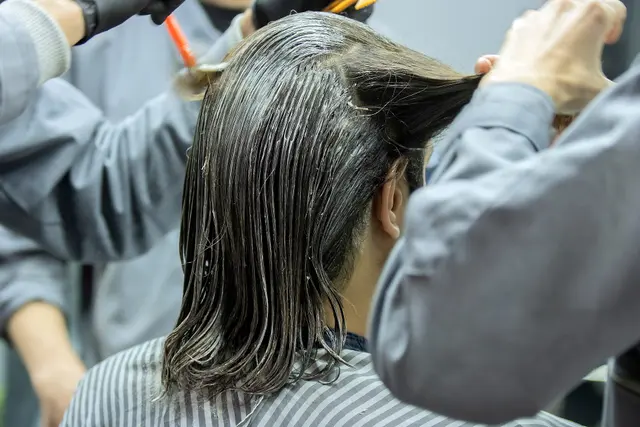
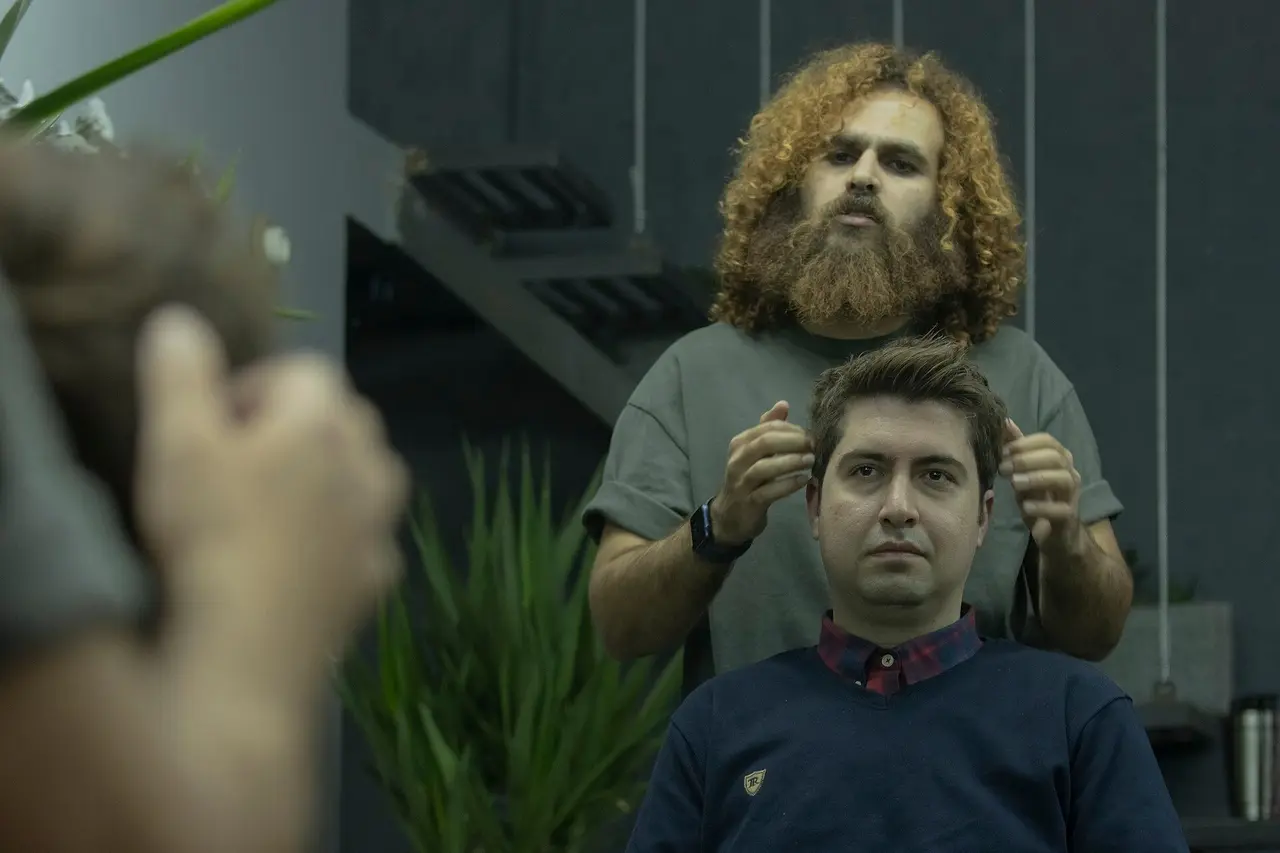
These four factors decide which styles will hold, how long blow-drying takes and how fast chemicals will process. Don't just say "you have thick hair": thick can mean coarse strands or lots of strands, and the advice is completely different. Look at Figure 1: the stylist holds a section on each side to compare both length and thickness.
Strand thickness (coarse, medium, fine)
Pick a loose hair from the client's shoulder or the comb and roll it between thumb and forefinger. A fine strand can barely be felt; a coarse strand rolls clearly like sewing thread. Coarse hair usually takes chemicals more slowly but holds a set longer; fine hair takes a set easily but is easily damaged by high heat.
Density (thick or thin)
Density is the number of hairs on an area of scalp. Make a centre parting at the crown and look at how much skin shows: very little skin means high density, a wide parting with clearly visible scalp means low density. With thin hair avoid heavy thinning; with dense hair plan to remove bulk from the lower sections.
Porosity
Porosity tells you whether the outermost layer of the strand (the cuticle, made of overlapping scales like roof tiles, see Figure 2) is tightly closed or has opened. The more open the cuticle, the faster the hair absorbs water, dries, takes chemicals and also fades. Tests at the chair:
- Spray water on a dry section: water that beads on the surface means low porosity; water that soaks in at once, darkening the hair, means high porosity.
- Hold a strand and slide your fingers from the end towards the root: smooth means a closed cuticle, rough means the cuticle has lifted.
- Compare roots and ends: ends are usually more porous because they have had more sun and heat.
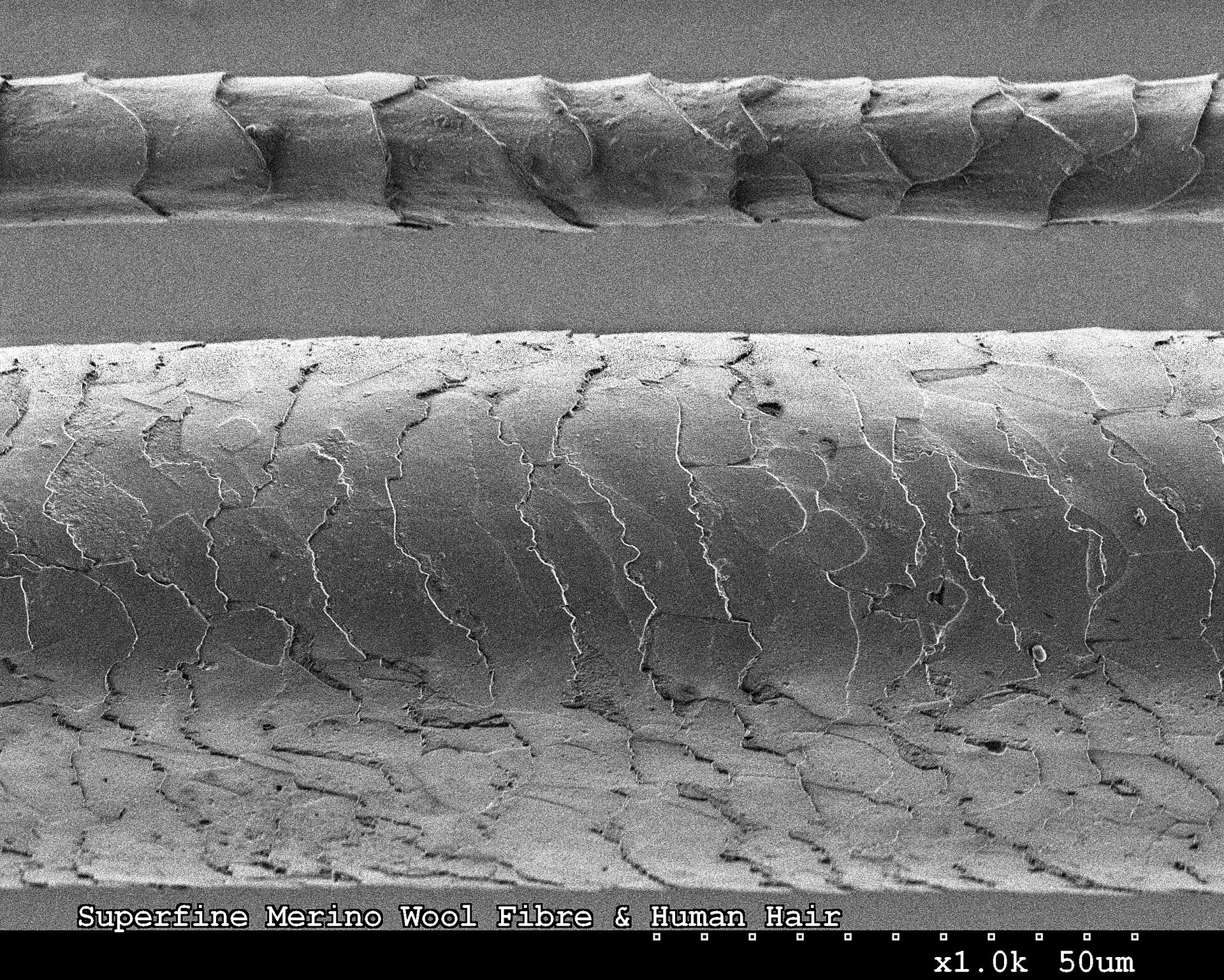
Photo: division, CSIRO / Wikimedia Commons, CC BY 3.0
Elasticity
Gently stretch a wet hair: healthy hair stretches a little and springs back. Hair that stretches like a slack rubber band and does not return, or snaps at once, is weak inside. How to read the result before strong chemical services is covered in how to bleach hair safely; at this step, just remember: poor elasticity means no perm and no bleach in that session.
Asking about and recognising chemically treated hair
Chemical history matters more than anything you can see. Hair that has been straightened, permed, bleached or coloured has a changed structure in the treated part, and that part does not heal by itself; it can only be cared for or cut off. Clients often forget about colouring at home, so ask specifically.
Questions you must ask
- In the last 1–2 years have you had a perm, chemical straightening, rebonding, colour, bleach or a keratin treatment? When was the last one?
- Do you colour your hair at home, and with what (regular dye, grey coverage dye, "herbal" dye, henna)?
- Have you ever had itching, burning or a rash after colouring?
- Do you use a hair dryer, flat iron or curling iron every day?
Home dyes, "herbal" products or grey coverage dyes with unknown ingredients can react with perm lotion or bleach, causing heat, odd colour changes or breakage. Don't guess: do a strand test on a small section at the back first.
Visible signs
- Colour bands: natural dark roots, mid-lengths and ends a different colour, with a clear line between.
- Straightening or perm line: the regrowth has its natural wave, the hair below is dead straight or still has an old curl.
- Split, frayed, faded ends: signs of heat and chemical damage (see Figure 3).
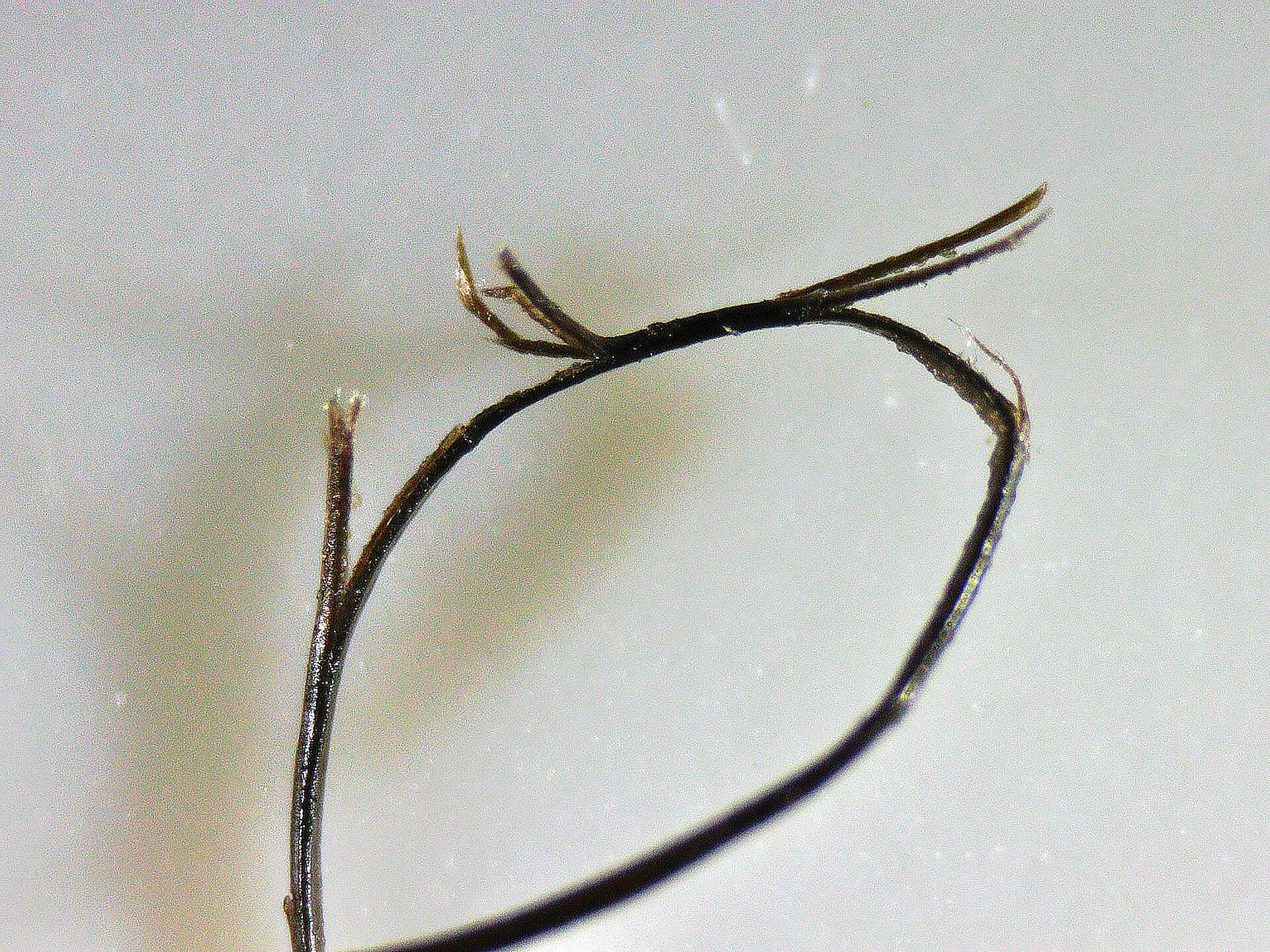
Photo: RealGatba / Wikimedia Commons, CC0
Estimating how much hair has been treated
Hair grows on average about 1 cm a month, varying from person to person. If a client was straightened 6 months ago, the natural regrowth is about 6 cm and everything below that is straightened hair. Measure with a tape and write it on the card: this number decides where you apply product, how much you cut off and where you pick up next time.
Checking the scalp and when to send the client to a doctor
The scalp is the foundation of every service. Part the hair in a few lines at the crown, both temples and the nape, and look under good light, without scratching or raking.
What to look for
- Oily, dry, flaky: roots greasy after a day or the skin flaking; few or many flakes, any redness underneath.
- Scratches, spots, wounds: if present, no chemicals on that area.
- Cowlicks and hairline: how many, where, and which way the hair grows at the front, temples and nape (see Figure 4).
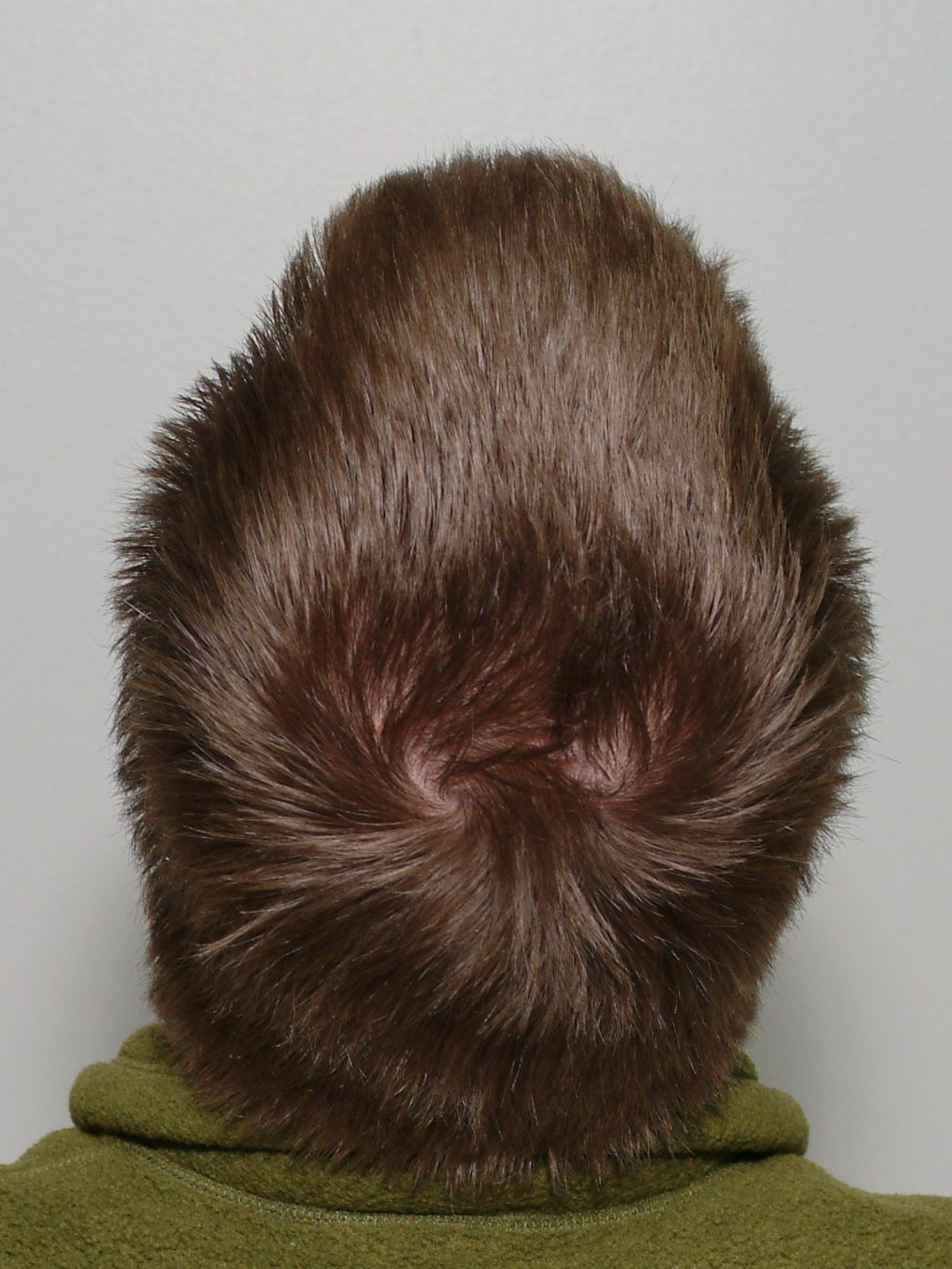
Photo: No machine-readable author provided. HorsePunchKid assumed (based on copyright claims). / Wikimedia Commons, CC BY-SA 3.0
Signs to stop and recommend a dermatologist
A hairdresser does not diagnose skin conditions and does not name a disease to the client. Your job is to notice what is unusual, stop chemical services and advise the client to see a dermatologist when you see:
- Round bald patches, unusually thin areas, or the client reports sudden heavy hair loss.
- Thick, red, peeling scales with clear edges, or scaling spreading to the forehead or behind the ears.
- Pustules, sores, weeping, crusts, or red, swollen, hot skin.
- Persistent intense itching, or a past reaction to hair dye (redness, burning, swelling, blistering).
Safety warning: Never apply perm lotion, straightener, colour or bleach to a scalp with scratches, inflamed spots, red scales or unusual hair loss: chemicals can burn and make the condition worse. Don't scratch or rake the client's scalp before a chemical service, and don't recommend medicated creams or shampoos yourself. A client who has reacted to hair dye before should not be coloured without a doctor's advice; every colour service still needs the 48-hour allergy test from step 1. If you suspect something that could spread through tools (scaling, pustules, fungus), keep the comb, towel and gown separate and disinfect them following the salon procedure.
How to tell the client tactfully
Speak privately and gently, describing what you see rather than naming a disease: "I can see this area is red with thick flakes, so I can't put product here. It would be best to have a dermatologist look at it first, and once the doctor says it's fine we'll do it." Note what you saw and the advice you gave on the client card.
Reading the face, features and lifestyle
Only once you know what the hair can take do you ask which style suits. Face shape is a guide, not a rule: a "textbook" style that the client has no time to maintain is still the wrong style.
Identifying face shape
Brush all the hair back and tie it. Look straight at the client's face in the mirror and compare three widths (forehead, cheekbones, jaw) and the length of the face against its width. Never say "your face is big" or "your face is wide"; talk about the goal: "this style will make your face look slimmer".
| Face shape | Features | Styles that usually suit | Think carefully about |
|---|---|---|---|
| Oval | Longer than wide, widest at the cheekbones, narrow chin | Most styles, from bobs to long layers | Very heavy fringes that hide the balanced features |
| Round | Length close to width, soft lines | Long layers past the chin, wispy side fringe, a little lift at the crown | Chin-length bobs, heavy blunt fringes, volume at the cheeks |
| Square | Forehead and jaw about equally wide, defined jaw angle | Loose waves, soft layers around the face, side parting | A straight cut line right at the jaw |
| Long | Clearly longer than wide | Straight or wispy fringe, volume at the sides, shoulder length | Long, flat, straight hair; height at the crown |
| Heart | Wide forehead, pointed chin | Wispy fringe to soften the forehead, volume at chin level | Lots of volume at the crown and temples |
Cowlicks, hairline, neck and build
Cowlicks decide where the hair naturally falls; cut too short and it stands up (Figure 4), and a cowlick at the front hairline makes a blunt fringe hard to control. A short neck suits styles that keep the nape clear; on a petite person very thick, long hair can look out of proportion.
Lifestyle: the style has to survive outside the salon
- Morning time: does the client have 5 minutes or 30 to do her hair? Can she use a dryer and round brush?
- Helmets: in Vietnam many clients ride a motorbike every day, and a helmet flattens a lifted fringe and curls at the crown; favour styles that look good when air-dried.
- Work: hair must be tied back, outdoor work in the sun, regular swimming.
- How often she visits: a style that needs trimming every 4–6 weeks does not suit a client who comes in every few months.
The 15-minute consultation at the chair
A new client needs about 15 minutes; a regular with a card on file needs about 5. Work in front of the mirror, standing behind the client so you both look at the same picture.
5 consultation steps
- Greet and ask what she wants (about 3 minutes): ask an open question such as "What would you like to change today?", look at her inspiration photos, ask what she likes and dislikes about her hair now.
- Ask about history (about 3 minutes): use the chemical history questions above, ask about allergies and hair care habits.
- Check hair and scalp (about 4 minutes): thickness, density, porosity, elasticity, regrowth, cowlicks, scalp.
- Propose 1–2 options (about 3 minutes): the style, how long it takes, how to keep it at home, the risks, and the next appointment if it needs several sessions.
- Confirm and record (about 2 minutes): repeat the plan in the client's own words, start only after she agrees, fill in the card.
Turn the client's words into numbers
"Just a little shorter" can mean 2 cm or 10 cm. Always point to a spot on her hair and ask "Up to here, is that OK?". The same goes for "thin it out", "a soft perm" or "ash brown": show a colour chart, photos of curls. Hair in inspiration photos may be extensions, heavily styled and colour-edited.
Saying "no" and keeping the client
When the hair cannot take the service she wants yet, give the reason and offer an alternative: "Your ends have been straightened twice, so a perm today could break them. Today let's cut off the split ends and treat the hair; in 4 weeks I'll do a strand test and if it's fine we'll perm." Clients agree more easily when they see you have a plan.
Client cards: what to record so you can carry on next time
The client card (paper or software) is the salon's memory: when a client comes back after 3 months, another stylist still knows what was done and which formula was used. Write it right after the consultation and add to it when the service is finished (see Figure 5).

Photo: Kristin Hardwick / Wikimedia Commons, CC0
Client card fields
| Section | What to record | Example |
|---|---|---|
| Client | Name, phone number (with consent), visit date | Ms Hanh, 34, first visit |
| Hair condition | Thickness, density, porosity, elasticity, length | Medium strands, medium density, highly porous ends, poor elasticity at the ends |
| Chemical history | Service, when, length of treated hair | Straightened 7 months ago; about 7 cm natural regrowth |
| Scalp, allergies | What you observed, allergy history, advice given | Slightly oily scalp, no damage; no previous allergy |
| Today's service | Style, products, ratios, timing, result | Long layers, 15 cm off the ends, volume blow-dry |
| Next visit plan | Planned service, date, conditions to meet | Strand test in 4 weeks; if it passes, loose wave perm on the regrowth |
Before and after photos and privacy
Before and after photos make it easy to compare colour and length precisely, but always ask before taking them and never post them online without the client's agreement. A card with a phone number and allergy history is personal information: store it carefully and don't share it in group chats. Salon owners who keep client data in software should check the current Vietnamese rules on personal data protection.
Worked example: Ms Hanh, 34, straightened hair, wants waves
Ms Hanh is an accountant who rides a motorbike 40 minutes a day and has about 10 minutes each morning for her hair. She brings a photo of loose waves and wants a perm today. Her hair is 55 cm long measured from the crown; it was straightened 7 months ago and she coloured it brown at home 3 months ago.
Analysis results
- Medium strands, medium density, strong roots, low porosity at the roots.
- Natural regrowth of about 7 cm (consistent with 7 months at about 1 cm a month).
- About 15 cm of ends split into several branches; sprayed water soaks in at once, and a wet strand stretches without springing back: poor elasticity.
- Slightly oily scalp, no scratches, no red scales, no previous reaction to hair dye.
- Slightly round face, one cowlick at the crown, off to the right.
The agreed plan
Cut off 15 cm of damaged ends: 55 − 15 = 40 cm, made up of 7 cm natural regrowth and 33 cm of straightened hair (7 + 33 = 40 cm). No perm today because the lengths are straightened and have recent home dye. Cut long layers past the chin to slim the face, part the hair following the right-hand cowlick, and blow-dry a little lift at the roots so it keeps its shape after wearing a helmet. Book a visit in 4 weeks: strand test on a section at the nape, a 48-hour allergy test if any dye will be used, and only discuss a perm if they pass.
Session timing
| Stage | Time (minutes) |
|---|---|
| Consultation: greeting and wishes 3 + history 3 + hair and scalp check 4 + options 3 + confirm and record 2 | 15 |
| Shampoo and conditioning | 15 |
| Cutting off the ends and layering | 45 |
| Volume blow-dry, styling, showing how to do it at home | 25 |
| Total | 100 |
3 + 3 + 4 + 3 + 2 = 15 minutes of consultation; 15 + 15 + 45 + 25 = 100 minutes, or 1 hour 40 minutes. Tell the client the total time up front so she can plan her day.
Common consultation and analysis mistakes
Copying the photo without reading the client's hair
Sign: after the cut the client says "it doesn't look like the photo". Cause: the hair in the photo was fine and styled, the client's hair is coarse and dense. Fix: say up front what can be matched and what cannot, and adapt the style to the hair type.
Not asking about chemical history
Sign: after a perm or bleach the hair breaks or turns an odd colour. Cause: the client had been straightened or coloured at home, and the stylist neither asked nor did a strand test. Fix: always ask the full set of questions, look for colour bands, write it on the card.
Frequently asked questions
What haircut suits fine, thin hair?
Fine or sparse hair usually suits short to shoulder-length styles with a full, blunt line at the ends and little thinning, perhaps with light layers around the face and a root-lift blow-dry. Thin hair grown very long tends to look sparse at the ends.
Which hairstyles suit a round face?
A round face usually suits long layers past the chin, a wispy side fringe, a side parting and a little lift at the crown to lengthen the face. Think carefully about chin-length bobs and heavy blunt fringes. Lifestyle and hair type still matter more than face shape.
Can straightened hair be permed?
Straightened lengths usually should not be permed straight away, because they have already had a strong chemical service and break easily. Usually only the regrowth is permed, or the damaged part is cut off and treated, followed by a strand test. Always follow the product maker's instructions.
Can hair be coloured if the scalp has a lot of dandruff?
With light flaking and no redness or scratches, colour is usually still possible after a 48-hour allergy test. With thick scales, redness, strong itching, pustules or patchy hair loss, don't colour; advise the client to see a dermatologist first.
Practice tasks and self-assessment
- Give a 5-step consultation to 5 family members or friends, time each one and fill in a full client card using the template above.
- For each person, do all 4 tests: rolling a strand, parting to judge density, spraying water for porosity, stretching a wet strand for elasticity.
- Identify each person's face shape, suggest 2 styles and explain out loud why they suit that hair type and lifestyle.
- Check the suggested practice hours for this step in how long it takes to learn hairdressing.
Self-assessment criteria
- Pass: each consultation finishes in about 15 minutes and the card has all 6 sections.
- Pass: your porosity and elasticity readings match the senior stylist's for at least 4 of the 5 people.
- Pass: you can list the scalp signs that stop a chemical service and advise a dermatologist visit without naming a disease.
- Not yet: forgetting to ask about chemical history, only asking "how do you want it cut?", not filling in a card, or deciding on a scalp disease yourself.
Once you can read hair and consult with confidence, move on to the next roadmap step: Shampoo, blow-dry & quick styling. What you wrote on the card (porosity, strand thickness, cowlicks, how much time the client has each morning) will decide the dryer temperature, the round brush size and which style the client can recreate at home.
Keep learning hairdressing: after diagnosis and consultation come shampooing, blow-drying and quick styling, then women's cuts and chemical services. See the 8-step hairdresser roadmap.