The common nail shapes in a salon are square, squoval, round, oval, almond, coffin (ballerina) and stiletto; the best shape is the one that suits the client's nail plate, fingers and job, not the one trending online. New technicians often file to match a photo the client shows them, and a week later the client is back with broken nails or nails that catch on the keyboard. This lesson helps you understand nail anatomy, recognise each shape and consult a client in about 10 minutes before you start work.
By the end of this lesson, you will be able to:
- Name the parts of the nail correctly and know which parts must not be touched.
- Recognise 7 common nail shapes and explain the pros and cons of each.
- Measure the nail bed and choose a length and shape that suit the client's hands and job.
- Ask about allergies and health with a fixed set of questions and keep a consultation card.
- Suggest polish colours based on skin undertone and the client's situation, with a simple reason.
Learning to be a nail technician? This is step 2 of the NAMBIN 8-step roadmap, right after tool hygiene and disinfection and before cuticle work and shaping. See the 8-step nail technician roadmap to learn in the right order.
Nail anatomy: the parts a nail technician must name correctly
A fingernail is a sheet of hard keratin that grows out from the root of the nail and sits on a layer of pink skin underneath. A technician must know where each part begins and ends, because each part has things you may do and things you must never do. Figure 1 labels the four parts that are easiest to see.
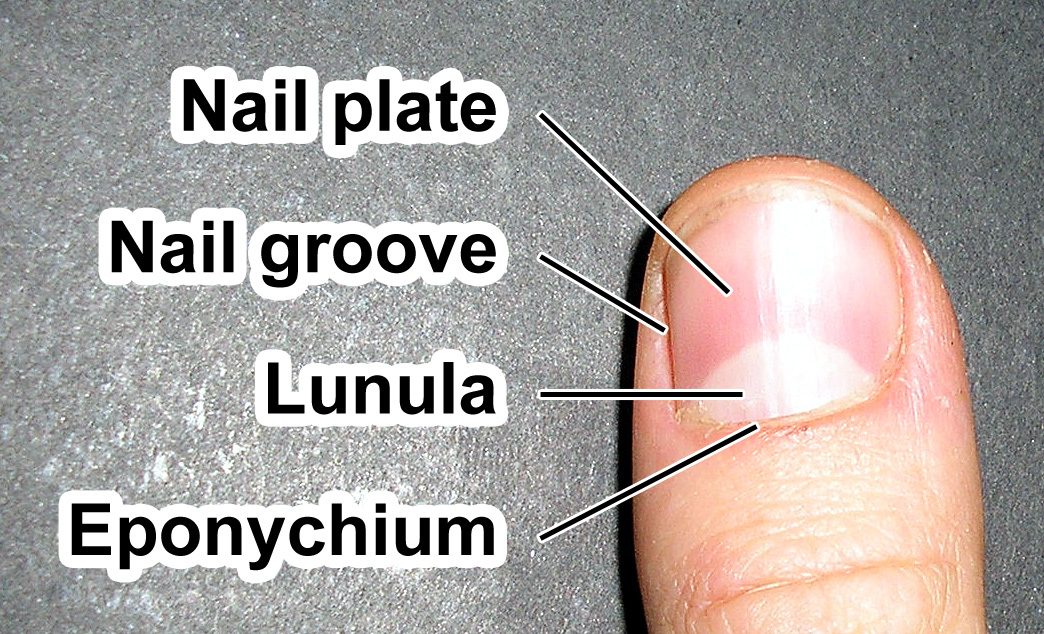
Photo: User:Kipton . / Wikimedia Commons, Public domain
The visible parts: nail plate, nail bed, free edge and smile line
- Nail plate: the hard nail you paint on. It is very thin; heavy filing on the surface weakens it straight away.
- Nail bed: the skin with blood vessels under the plate, which is why the nail looks pink.
- Smile line: the curved border between the pink part (nail still attached to the bed) and the white part (nail that has separated from the bed).
- Free edge: the white nail that extends past the fingertip, the part you cut and file to create a shape.
The surrounding skin: cuticle, eponychium, sidewalls
- Cuticle: a thin layer of dead skin stuck to the nail plate near the base; this is what you push back and clean off.
- Eponychium: the rim of living skin around the base of the nail, which acts like a seal that keeps germs out of the nail root.
- Sidewalls and nail grooves: the skin along each side and the groove the plate slides along as it grows; the corners are easily scratched when filing or cutting too deep.
- Hyponychium: the skin just under the free edge, another protective seal. Do not dig or scrape deep here.
The hidden parts: matrix and lunula
The matrix lies under the skin at the base of the nail and is where new nail plate is made. The lunula, the white half-moon at the base (see Figure 1), is the visible part of the matrix. If the matrix is injured by hard pressure, deep cutting or long-lasting inflammation, the nail may grow back ridged or misshapen for a long time, so always work gently around the base.
Adult fingernails usually grow about 3 to 3.5 mm a month, more slowly in older people; replacing a whole fingernail takes about 4 to 6 months. If a client wants 3 mm more length, that takes about a month, not a week.
The stress area
The stress area is where the free edge starts to separate from the bed, at the two ends of the smile line; when a nail hits something hard, it often breaks across here. The longer and more tapered the shape, the more load this area takes.
| Part | You may | You must not |
|---|---|---|
| Nail plate | Clean, lightly buff, paint | Thin it with heavy filing |
| Cuticle | Push back, remove dead skin | Scrape hard and scratch the plate |
| Eponychium | Push gently, moisturise | Cut deep, cause bleeding |
| Lunula, matrix | Observe | Press hard on the nail base |
| Hyponychium | Brush gently with a soft brush | Dig or scrape deep |
| Free edge | Cut and file to shape | Cut into the pink part |
Read the hands and nail plates before choosing a shape
Before thinking about shapes, look at the client's hands for about a minute under a bright lamp to answer three questions: what shape is the nail plate, are the nails strong or weak, and are the fingers long or short.
Nail plate shape
- Narrow, long plates: suit almost every shape, including almond and coffin.
- Wide, short plates: a square shape makes the hand look wider; oval or almond makes fingers look slimmer and longer.
- Fan-shaped nails (wider at the tip than the base): taper the sides slightly and avoid a straight square.
Strong or weak nails
Press the tip lightly: a strong nail is firm and springy, a weak nail is soft and bends easily. If the tip is peeling, cracked or chipped, choose a short round or squoval shape. Figure 2 shows short natural nails with only a thin rim of free edge; filing a long almond or coffin on nails like these is not realistic. Nails that have just had gel or extensions removed are thin on the surface, so do not file a tapered shape straight away either.
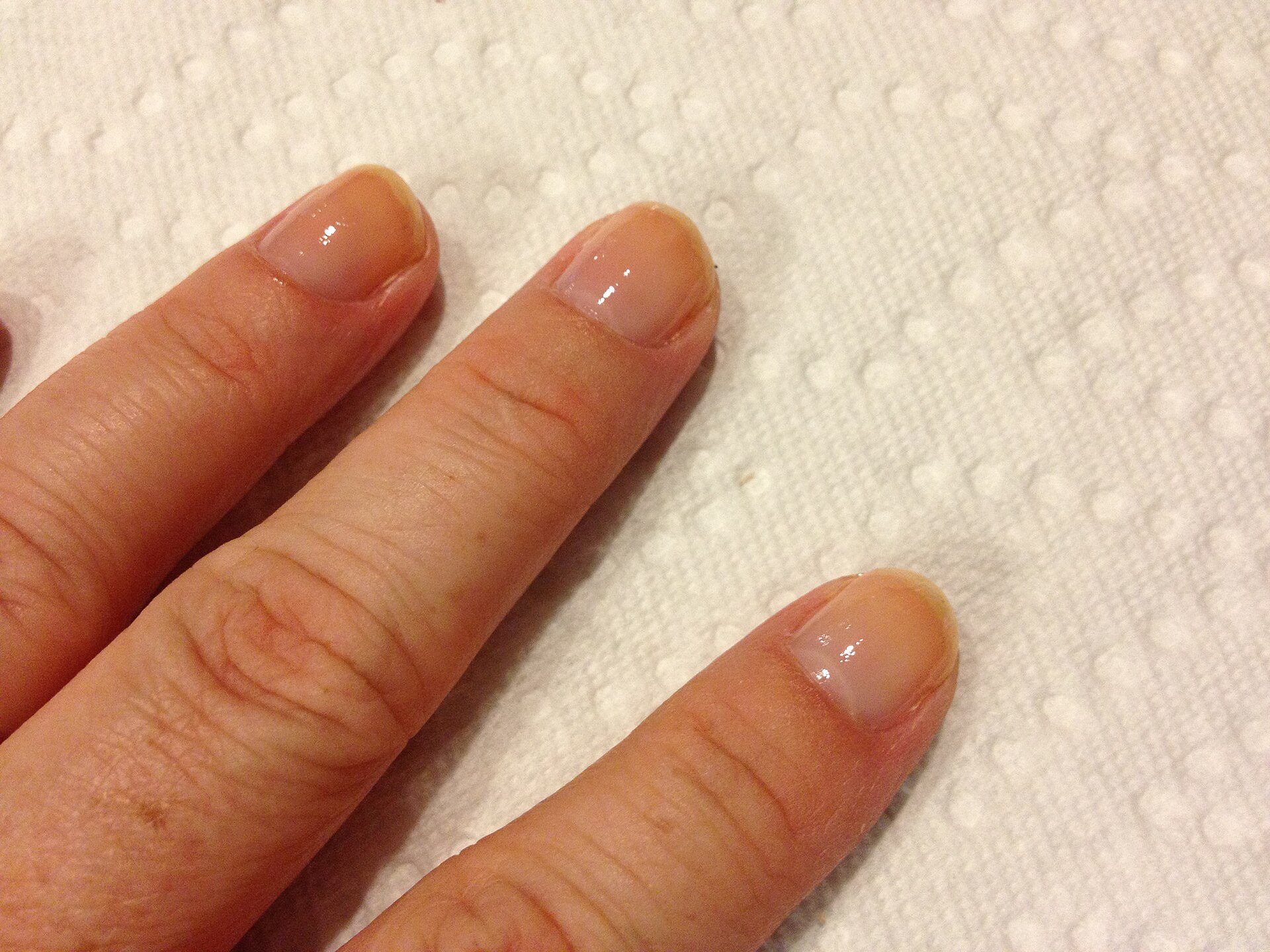
Photo: Espejop2319 / Wikimedia Commons, CC BY-SA 4.0
Measure the nail bed with a ruler
Use a small plastic ruler on the middle finger: from the eponychium to the smile line is the nail bed length, and from the smile line to the tip is the free edge. Write both numbers on the client card; next time you will know how much the nail has grown and which shapes are possible.
7 common nail shapes and how to recognise them
A nail shape is the outline of the nail seen from above. To identify it, look at two things: whether the sides are parallel or tapered, and whether the tip is flat, round or pointed.
Square and squoval
A square nail has parallel sides, a flat tip and sharp corners. Squoval keeps the parallel sides and flat tip but rounds off both corners, so it catches and chips less (see Figure 3); it is the safest shape for new clients and clients who work with their hands a lot.
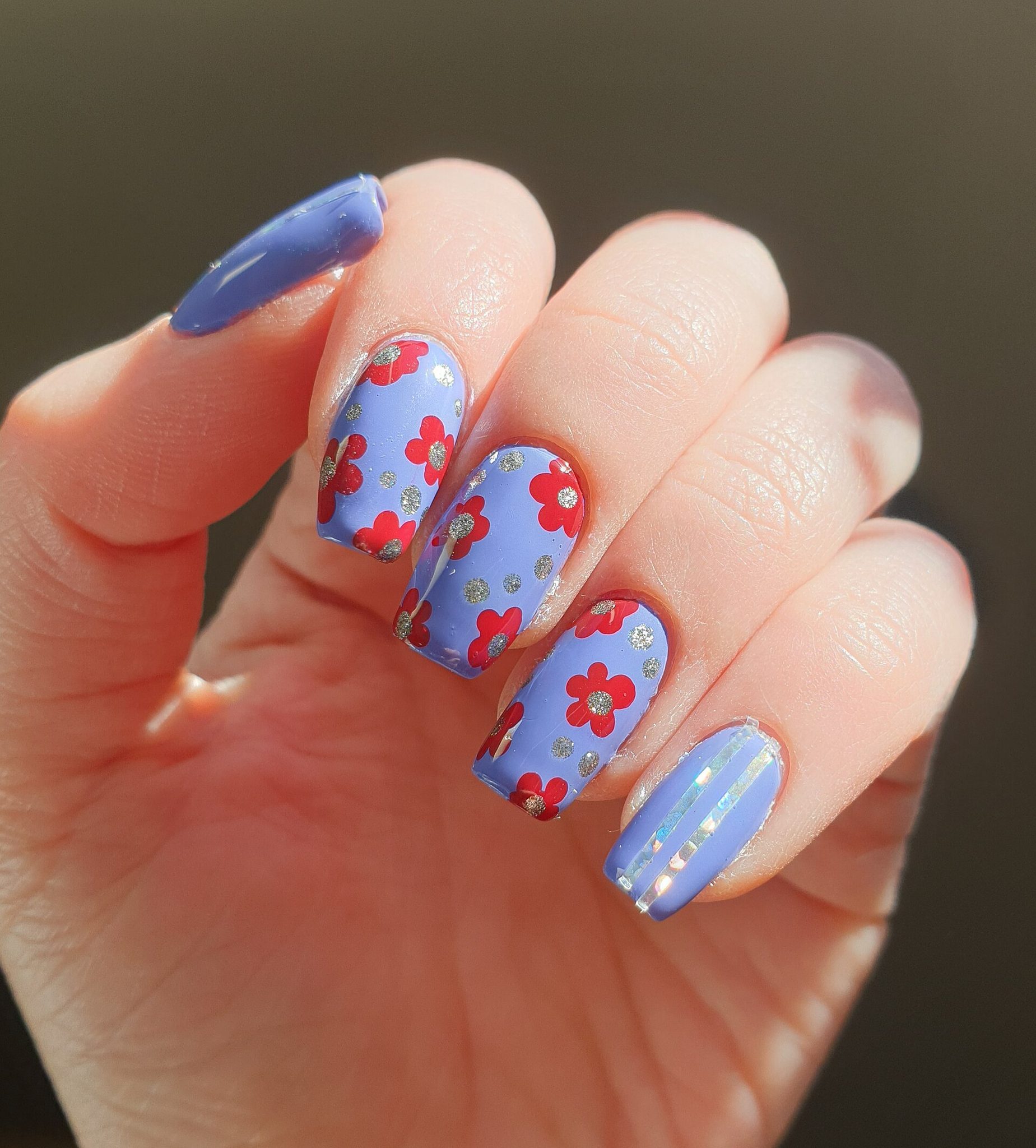
Photo: Köttbulleledaren / Wikimedia Commons, CC BY-SA 4.0
Round and oval
A round nail follows the curve of the fingertip, is usually kept short, is very durable and suits weak nails. An oval looks like an egg: the sides taper slightly and the tip is evenly rounded, a little longer than a round nail, and it makes short fingers look longer.
Almond
An almond nail tapers clearly on both sides to a narrow rounded tip, like an almond (Figure 4). Fingers look slimmer, but because more nail is filed away at the sides it is weaker than an oval on thin nails, and it needs enough free edge.
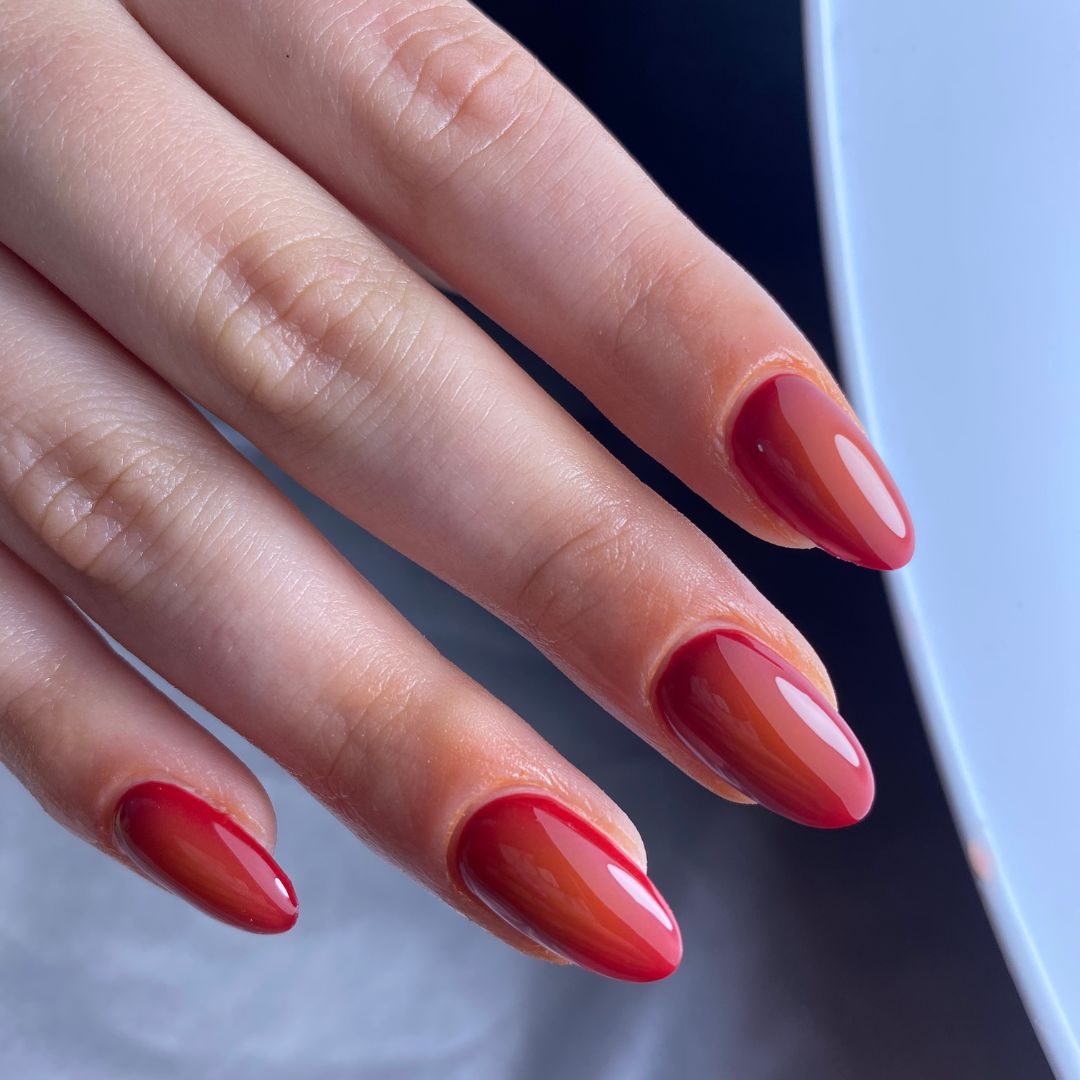
Photo: Jasminmaaroufi / Wikimedia Commons, CC BY-SA 4.0
Coffin (ballerina) and stiletto
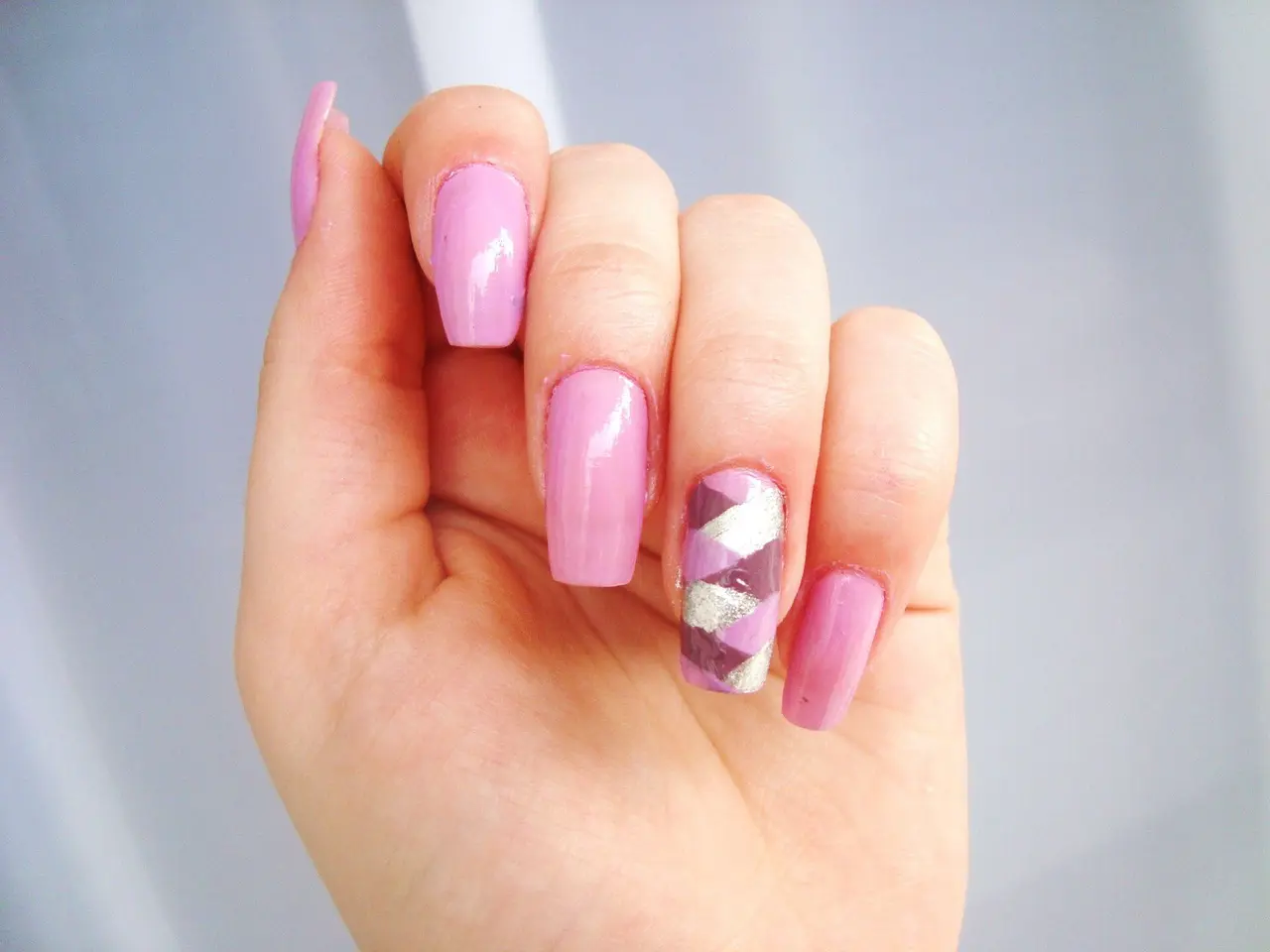
A coffin nail tapers like an almond but the tip is cut flat, like the toe of a ballet shoe; it is usually done on long tips or sculpted extensions. Figure 5 shows a long set with flat tips and slightly tapered sides, somewhere between a long square and a coffin; a true coffin tapers more. A stiletto tapers to a sharp point; it is eye-catching but breaks easily and can scratch skin, so keep it for sculpted extensions on clients already used to long nails.
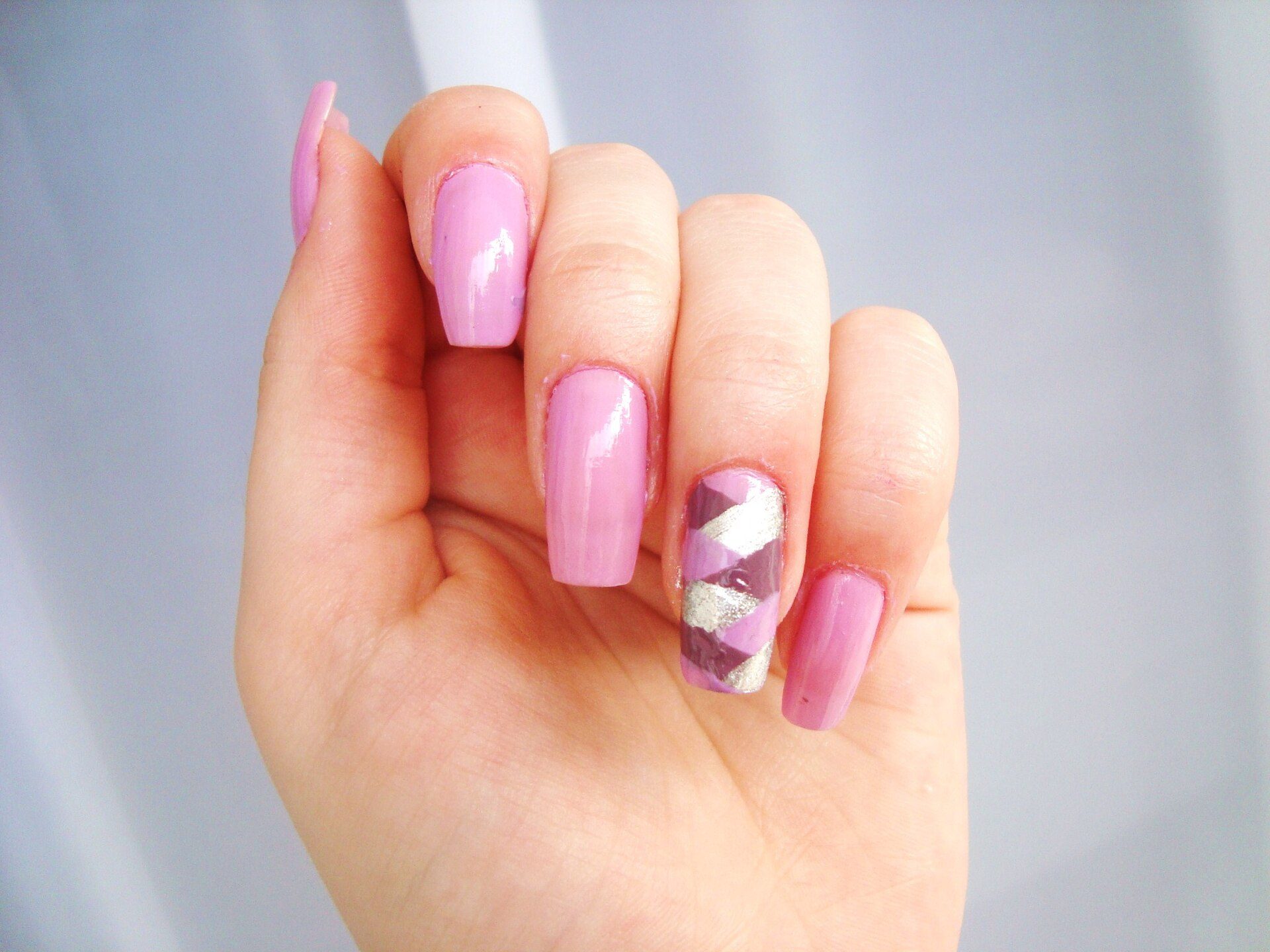
Photo: Geórgia Moro / Wikimedia Commons, CC BY 2.0
| Shape | How to spot it | Pros | Cons | Suits |
|---|---|---|---|---|
| Square | Parallel sides, sharp corners | Strong, good for French | Corners catch | Long fingers, narrow plates |
| Squoval | Square with rounded corners | Durable, rarely catches | Less striking | New clients, manual work |
| Round | Follows the fingertip | Most durable | Looks short | Weak nails, kitchen work |
| Oval | Slight taper, rounded tip | Fingers look longer | Needs medium length | Short fingers, wide plates |
| Almond | Clear taper, narrow round tip | Slim, elegant | Weak on thin nails | Strong nails, tips |
| Coffin | Tapered, flat tip | Lots of room for art | Needs length, corners chip | Tips, extensions |
| Stiletto | Pointed tip | Very striking | Breaks, scratches | Sculpted extensions |
Choose shape and length for the client's job
Once you have read the hands and nail plates, the deciding factors are the client's daily work and the length.
By job
Ask what the client does and what their hands do most of the day. Healthcare, kitchen and food-factory workers are often required to keep nails short, and some workplaces do not allow polish or artificial nails; the World Health Organization's hand hygiene guidance also advises healthcare workers not to wear artificial nails when caring directly for patients. Rules differ from place to place, so let the client confirm with their own workplace.
| Client's job | Suggested shape | Suggested free edge | Consultation note |
|---|---|---|---|
| Office, lots of typing | Squoval, oval, short almond | About 1/3 to 1/2 of the nail bed | Too long and they type with their nails, which break |
| Homemaker, carries small children | Round, squoval | Short, 1 to 3 mm | Avoid pointed shapes that scratch |
| Healthcare, kitchen, food | Round, squoval | Very short, per workplace rules | Ask whether polish or artificial nails are allowed |
| Events, weddings, photo shoots | Almond, coffin, long oval | As the client likes, ideally on tips | Explain wear time and removal first |
A rule of thumb for length
"Free edge about 1/3 to 1/2 of the nail bed" is a rule of thumb many technicians use for the natural nails of clients who work with their hands, not a standard. Tips and sculpted extensions have their own structure and can be longer. If the nails are weak, tell the client honestly that they need to grow out first; clients usually trust a technician who says "not yet" more than one who agrees to everything.
Choose polish colours that suit the client's hands
Guide the client so they do not pick a colour that makes their hands look dull.
Read the skin undertone: warm, cool or neutral
- Warm: skin leans yellow, wrist veins look slightly greenish, gold jewellery suits better than silver. Brick red, terracotta, beige nude and milky brown work well.
- Cool: skin leans pink, veins look blue or purple, silver suits better. Cool pink, wine red, purple and navy work well.
- Neutral: hard to tell, both gold and silver suit; many colours work.
This is a quick salon check, not a measurement; the surest test is still to hold a colour sample right next to the client's finger under white light.
Colour by shape and occasion
A nude close to the skin tone with an oval shape makes fingers look longer; dark colours such as wine red or black make nails look shorter. Clients in offices, banks or reception jobs often need understated colours: nude, pale pink, French. Also ask whether they have a special occasion in the next 2 to 3 weeks.
A 10-minute consultation before every manicure
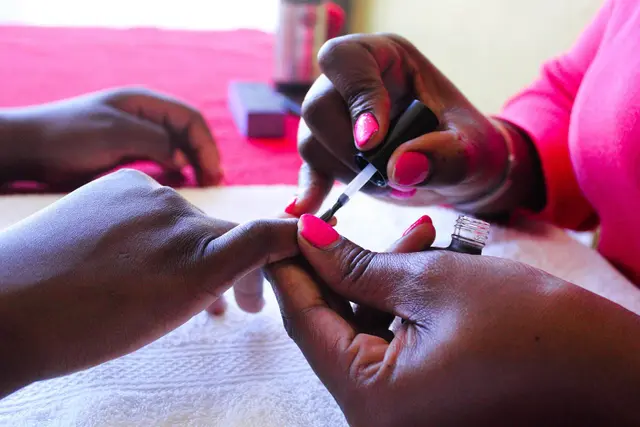
Ten minutes of consultation saves you many redos. Figure 6 shows a manicure at a small table with polish bottles laid out for the client to choose from.
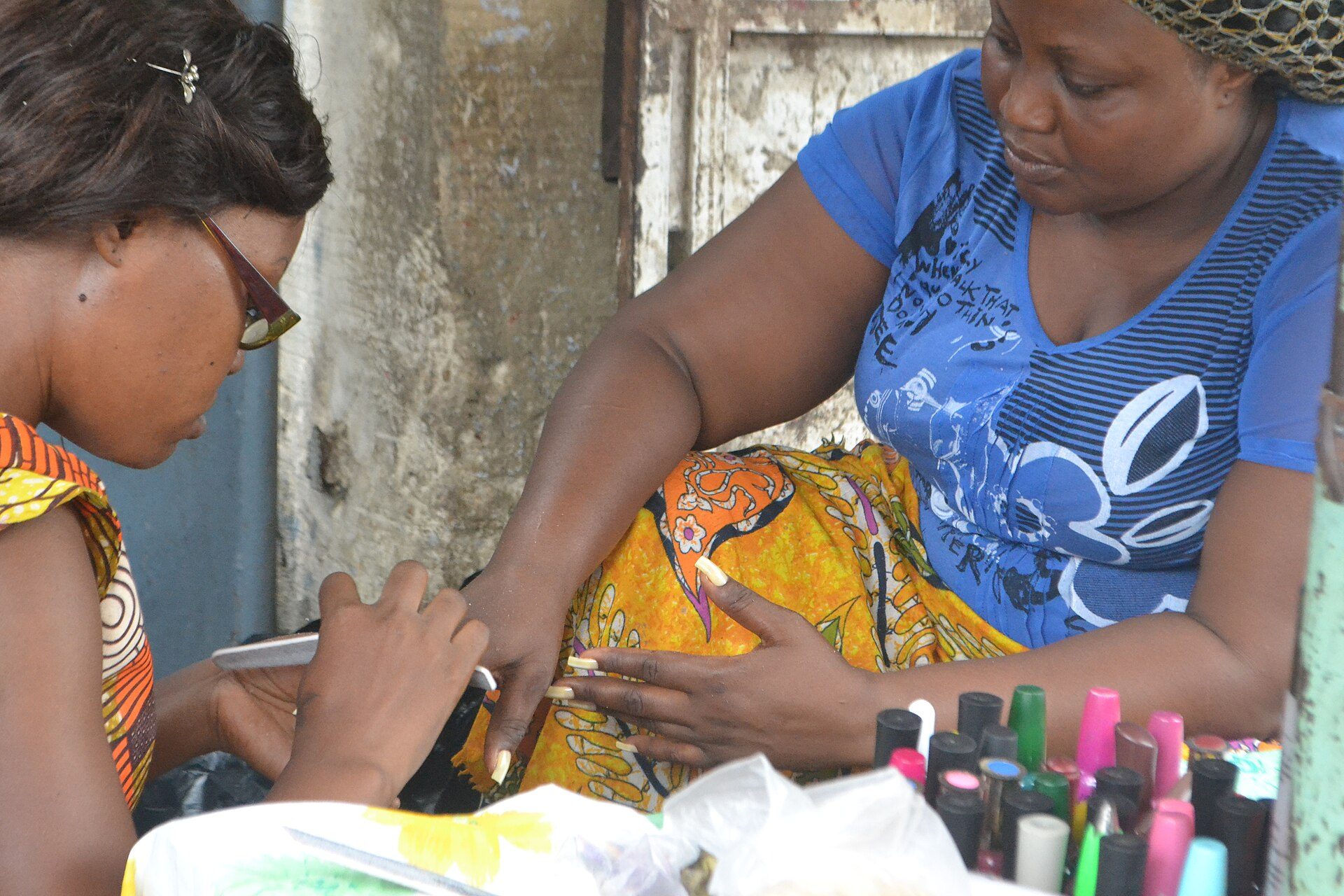
Photo: Minette Lontsie / Wikimedia Commons, CC BY-SA 4.0
The consultation steps
- Greet and look at the hands (1 minute): ask the client to wash their hands, look at both hands under the lamp, do not pick up tools yet.
- Ask about health and allergies (3 minutes): use the questions below and write the answers on the card straight away.
- Check nails and skin (2 minutes): look for the signs that mean you must refuse, as learned in step 1; measure the nail bed and free edge of the middle finger.
- Ask about work and wishes (2 minutes): job, upcoming occasions, shapes worn before, any breaking or lifting.
- Propose, agree and quote (2 minutes): offer 2 options for shape, length and colour with reasons; give the price, working time and expected wear; start only when the client agrees.
Allergy and health questions
- Have you ever had itching, redness, swelling or blisters around the nails, or on the eyelids or face, after gel or acrylic?
- Do you have any known allergies (nail glue, polish remover, cosmetics, rubber gloves)?
- Are you taking blood thinners, being treated for diabetes or a skin condition, or having chemotherapy?
- Are you pregnant, and do chemical smells bother you?
The answers help you decide whether to work more gently or to suggest the client asks a doctor first.
The consultation card
Take the basic client card from step 1 and add: nail bed and free edge measurements; the chosen shape, length and colour code; the service and price; notes after 2 to 3 weeks (wear, lifting, which nails broke).
Safety warning: if a client says they have had itching, swelling or weeping skin around the nails, or on the eyelids or face, after gel or acrylic, do not apply gel or acrylic that day and advise them to see a dermatologist. Once someone is allergic to acrylates (ingredients in gel and acrylic), the allergy usually lasts a long time and can flare up with each new exposure. Never "test on one nail" to see whether they react.
When the client wants a shape that does not suit them
Do not just say "no". Give the reason using the measurements and the client's job, then offer two safe options: one you can do today on the natural nails, and one that means growing the nails out or using tips (see the worked example below).
Worked example: consulting Hanh, 34, an accountant
Hanh is an accountant who types about 8 hours a day. She shows a photo of a long pink coffin set and wants the same. The figures are illustrative; prices are 2026 references and vary by region and salon.
Step 1: look, ask and measure
- Slightly short fingers, wide nail plates, warm skin undertone.
- No known allergies, no medication, no itching after her last gel manicure.
- No signs of fungus or infection; thin nails, two of them peeling at the tip.
- Middle finger: nail bed 11 mm, free edge 2 mm.
Step 2: work out a length that suits her job
Using the 1/3 to 1/2 rule of thumb for heavy typists: 11 mm × 1/3 ≈ 3.7 mm and 11 mm × 1/2 = 5.5 mm. You choose a free edge of about 4 mm. She has 2 mm now, so she needs 4 − 2 = 2 mm more. At about 3 mm of growth a month, 2 mm takes about 2/3 of a month, roughly 3 weeks. A long coffin on thin natural nails with only 2 mm of free edge cannot be done today.
Step 3: propose and agree
- Option A (Hanh's choice): today, file off the peeling layers, shape a short squoval and apply a warm pinkish-nude gel polish. Book her in 3 weeks later to change to a short almond of about 4 mm.
- Option B: coffin tips at a medium length if she needs long nails now; explain that typing will be harder and the tips must be removed properly.
Step 4: time and cost that add up
| Task | Time | Example price |
|---|---|---|
| Consultation (1 + 3 + 2 + 2 + 2 minutes) | 10 minutes | Free |
| Cuticle care and squoval shaping | 20 minutes | 50,000 VND |
| Plain gel polish (base, 2 colour coats, top) | 30 minutes | 150,000 VND |
| Total | 60 minutes | 200,000 VND |
Check: 10 + 20 + 30 = 60 minutes; 0 + 50,000 + 150,000 = 200,000 VND (about US$8). Record on the card: nail bed 11 mm, free edge 2 mm, squoval, colour code, date to change shape. Three weeks later, measure again; once the free edge reaches about 4 mm, do the almond as agreed.
Common mistakes when consulting and choosing shapes
Copying an online photo exactly
Sign: the client comes back with two or three broken nails. Cause: the sample photo shows long sculpted nails, while the client has thin natural nails. Fix: measure the nails, explain that the photo shows extensions and offer a suitable option.
Forgetting to ask about allergies
Sign: a few days later the client reports itching and redness around the nails. Cause: no allergy history was taken. Fix: ask the full set of questions for every new client.
Ten nails, ten shapes
Sign: uneven shapes, some nails longer than others. Cause: filing each nail without a common reference. Fix: agree the shape and length using measurements, and after filing compare both hands side by side.
When to advise the client to see a doctor
A nail technician does not diagnose or treat. If you see the signs below, stop, explain gently and advise the client to see a dermatologist; the conditions that mean refusing service are covered in the lesson disinfecting nail tools: a 4-step routine.
Signs in the nail
- Nails turning yellow, cloudy white or green, or a new dark streak running along the nail.
- Thickened, crumbly nails or nails lifting off the bed; swollen, red, painful skin around the nail, or pus.
Signs of allergy
- Itching, redness or blisters around the nails, or itchy swollen eyelids or face after the previous appointment.
- Numb or painful fingertips that last after a manicure.
Clients with existing conditions
For clients with diabetes, on blood thinners, having chemotherapy or with a skin condition on the hands: do only gentle work (filing, regular polish), do not cut cuticles, and suggest they ask their treating doctor before gel or extensions. Bleeding that is hard to stop, swelling and pain that keep getting worse, or a fever after a manicure need medical attention straight away.
Frequently asked questions
Which nail shape suits short fingers and wide nail plates?
A medium-length oval or almond with a nude close to the skin tone; avoid a square cut close to the fingertip.
What is the difference between almond and oval nails?
Both have a rounded tip. An oval tapers slightly with a wide rounded tip like an egg; an almond tapers clearly to a narrow rounded tip, looks slimmer, but is weaker on thin natural nails.
What is the smile line of a nail?
The smile line is the curved border between the pink part (nail attached to the bed) and the white free edge. Even smile lines across all fingers make a set look neat; when painting a French, the white tip usually follows this line, see the lesson on how to do a French manicure.
How long do nails need to grow before changing shape?
Changing to an oval is usually possible straight away if there is 2 to 3 mm of free edge. Almond or coffin on natural nails needs a few more millimetres, about 3 to 6 weeks; if it is urgent, use tips.
Practice and self-assessment
- Draw the nail anatomy from memory and label all 10 parts from this lesson.
- Do practice consultations with 3 friends using the 10-minute routine, with a card recording the nail bed and free edge of the middle finger and 2 options for shape, length and colour.
- File the 7 shapes on practice nails, line them up and name each one correctly.
Self-assessment criteria
- Pass: you name all 10 parts of the nail and say which ones must not be cut or pressed hard.
- Pass: you tell the 7 shapes apart without confusing almond with oval or coffin with square.
- Pass: the consultation takes no more than 12 minutes and the card records allergies, conditions, measurements, shape, colour and price.
- Not yet: you skip the allergy questions, or choose a shape only because it is trending without considering the client's job.
Once you can agree a shape and length with the client, move on to the next step of the roadmap: Cuticle work, shaping & manicure, where you learn to push and trim cuticles without bleeding, file symmetrical shapes and buff without thinning the nail plate.
Keep learning nails: after this step come cuticle work and shaping, gel polish, tips and extensions, and nail art. See the 8-step nail technician roadmap.