A safe straight razor shave for a client means: a new blade for every client, softening the beard with a warm towel and lather, stretching the skin with your free hand, holding the blade at about 30 degrees and shaving short strokes with the direction of hair growth; a second pass across the grain is only for clients with healthy skin who want a closer shave. Most nicks, redness and ingrown hairs after a shave come from a beard that was not soft enough, a dull blade, slack skin or shaving against the grain on the first pass. This lesson is written the way a senior barber coaches an apprentice, covering hygiene, hot towels, lather, holding the razor, the order of shaving zones, handling nicks, and a 20-minute shave service with materials costed out.
By the end of this lesson, you will be able to:
- Change a razor blade correctly, dispose of the old blade safely and disinfect the handle between clients.
- Check a client's skin before shaving and know when to refuse or suggest seeing a doctor.
- Apply a hot towel at the right temperature, build lather and soften the beard in about 5 minutes.
- Hold the razor, stretch the skin and shave each area of the face and neck in the right direction in 2 passes.
- Handle small nicks, care for the skin after shaving and work out the time and materials for one shave service.
Learning barbering properly? Shaving and beard trimming are step 6 of the roadmap, after tool hygiene, consultation, scissor over comb, fades and popular men's styles. See the 8-step barber roadmap to learn in the right order.
Razors in a barbershop: which kind, and why replaceable blades
The straight razor (a folding cut-throat razor) is the barber's traditional shaving tool. There are two types: the solid-blade razor that must be honed and stropped, and the replaceable-blade razor (shavette) that holds half of a disposable double-edge blade (Figure 1). In barbershops today, client shaves are done almost exclusively with replaceable blades.
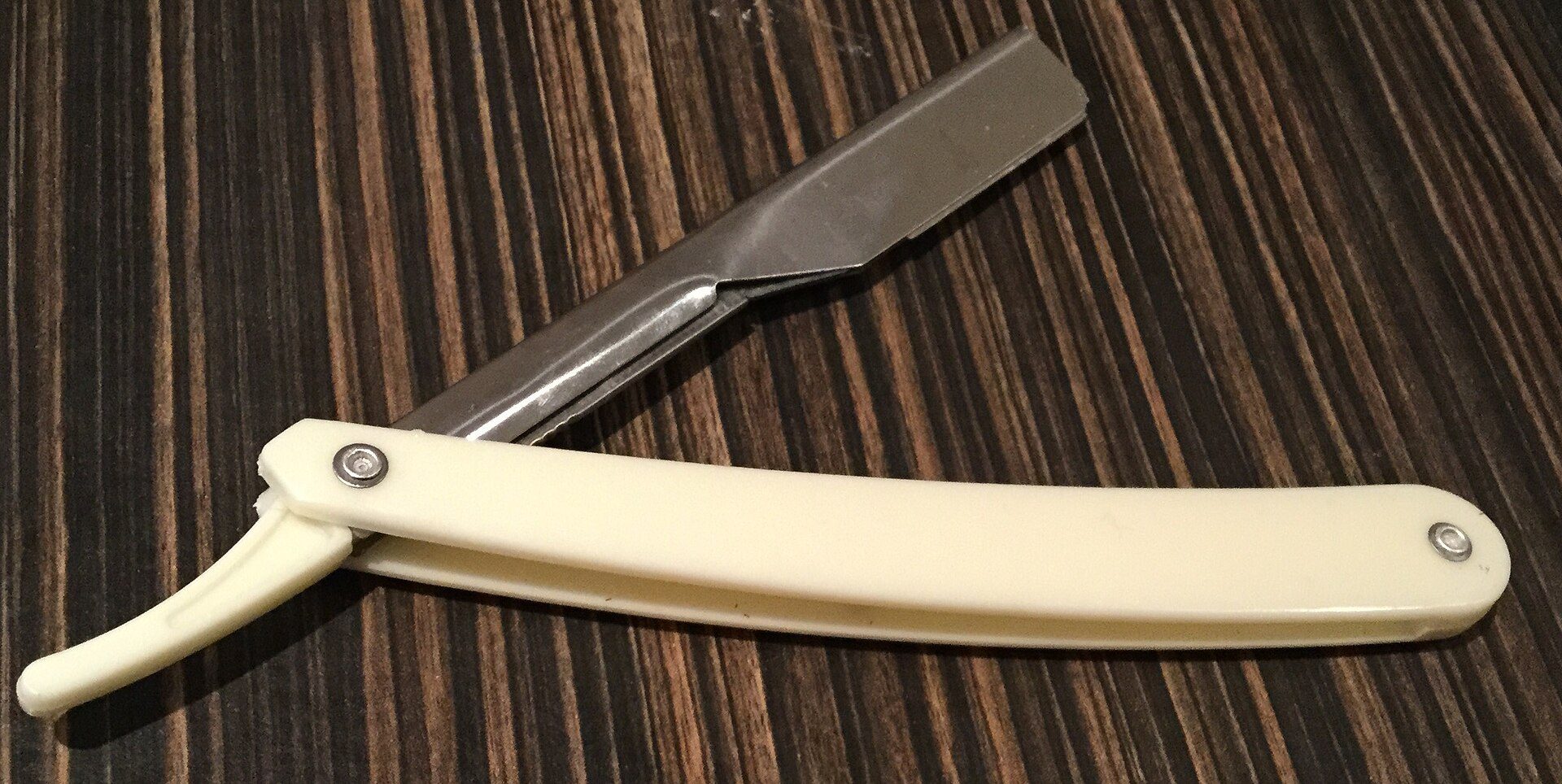
Photo: Kyral / Wikimedia Commons, CC BY-SA 4.0
Why blades must be single-use
A razor blade can cause tiny abrasions you cannot see and picks up blood and skin fluid. Sharing a blade between two clients risks spreading blood-borne infections such as hepatitis B, hepatitis C and HIV, as well as skin fungi and bacteria. A solid blade cannot be disinfected fast enough between clients during a rush, so a single-use blade is the most practical and safest option.
Parts to know
- Blade: usually half of a double-edge blade snapped in two, or a single blade made for shavettes.
- Blade holder: holds the blade and must be wiped and disinfected carefully because it touches lather, hair and blood.
- Folding handle and pivot: a loose pivot lets the blade wobble and cut; check it daily.
- Tang: where your finger rests to control the blade angle.
Hygiene before and between clients
Clients judge the whole shop by how you change a blade. Do it in the right order in front of the client; it is both safety and service.
Changing the blade and disinfecting
- Wash your hands with soap and put on disposable gloves.
- Wipe the razor body with a clean cloth, then spray or wipe it with a tool disinfectant and leave it for the contact time on the label.
- Open a new blade packet in front of the client and snap a double-edge blade in half inside its paper wrapper so you do not cut yourself.
- Fit the half blade into the holder and check that it sits straight, square and does not wobble.
- After the shave, remove the blade using its paper wrapper or tweezers and drop it straight into a lidded sharps container, never into a normal bin.
Towels, lather brush and cape
Each client gets a set of clean towels washed hot and fully dried; used towels go into a separate lidded basket. Rinse the lather brush, shake it out and let it dry in the air; for clients with acne or sensitive skin, lather with a gloved hand or a separate brush. A disposable neck strip goes between the cape and the client's neck. The principles for disinfecting tools are similar to those in the lesson on cleaning and disinfecting spa tools; cleaning clippers between clients is covered in the lesson on how to do a fade haircut.
Checking the skin and when not to shave
Before laying the towel, look and ask. One minute of checking prevents nicks, infections and complaints.
Ask the client
- Does your skin redden easily, and do you get ingrown hairs after shaving?
- Are you using strong acne creams, or blood thinners (cuts that take long to stop bleeding)?
- Have you had strong sun, or a facial procedure (peel, laser) recently?
- Do you want a close shave or just a tidy one, and are you keeping a moustache or beard line?
When not to shave an area
| Skin condition | What to do | Why |
|---|---|---|
| Red, swollen inflamed acne, pustules, boils | Avoid the area, trim only with a guarded clipper | The blade bursts spots and spreads infection |
| Cold sores on the lip, ulcers, impetigo, suspected fungus | Do not shave, suggest a dermatologist | Spreads to the barber, the tools and the next client |
| Open wounds, peeling sunburn | Postpone until healed | Stinging, bleeding, infection |
| Raised moles, skin tags | Shave around them with the skin stretched, never over them | Easy to cut, bleeds a lot |
| Client on blood thinners, very thin skin | One pass with the grain only, or offer a clipper trim | Even small nicks take long to stop |
| Client is drunk and cannot sit still | Refuse the razor shave, rebook | Sudden movement can cause a deep cut |
Barbers do not diagnose skin disease. If you see something unusual, say gently that a dermatologist should look at it first, and offer a safer service such as a clipper beard trim.
Softening the beard: hot towel and lather
Dry beard hair is as tough as copper wire; after a few minutes of absorbing warm water it softens noticeably, so the blade cuts cleanly with less pulling and irritation. This step is the difference between a barbershop shave and shaving at home.
Applying a hot towel at the right temperature
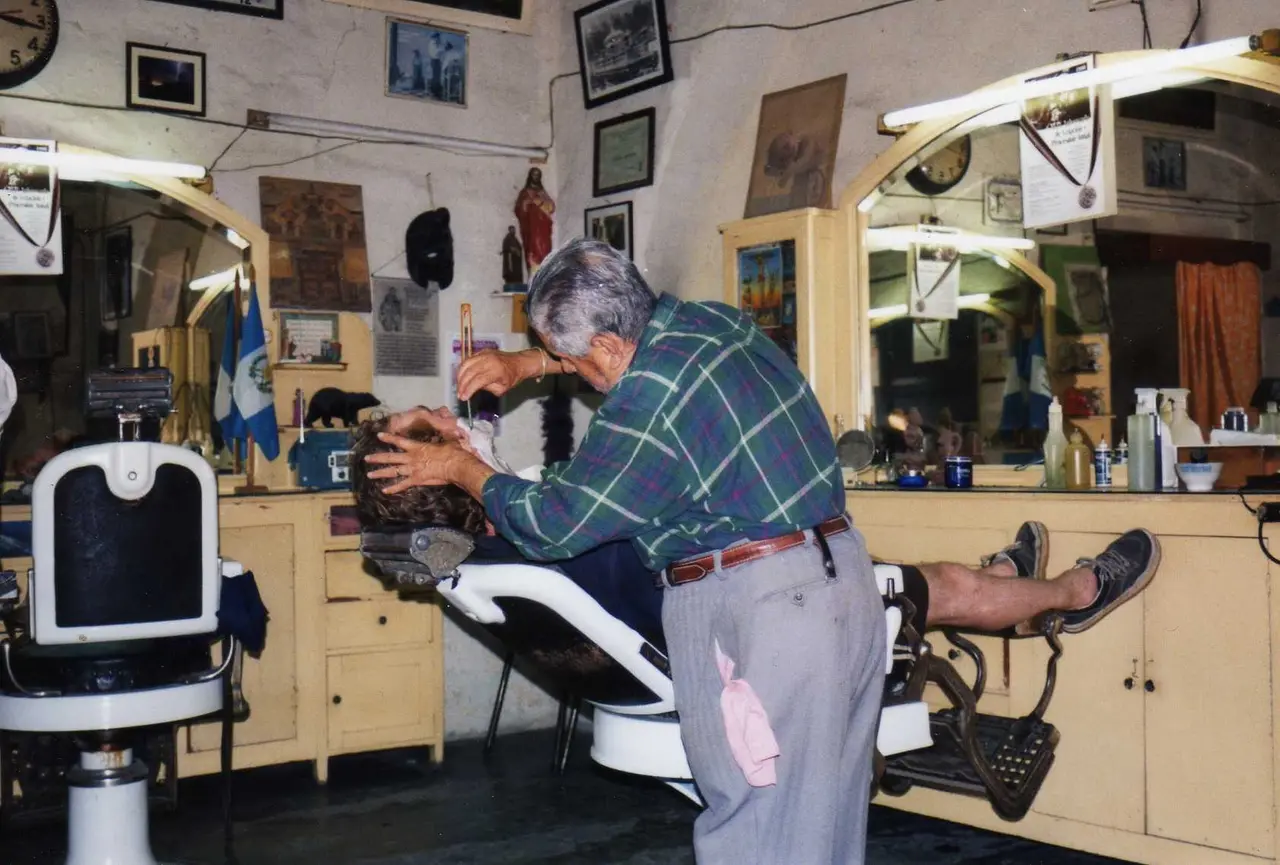
- Recline the chair so the client's head rests firmly and the neck is straight (the position in Figure 4), then fit the neck strip and a chest towel.
- Take a towel from the towel warmer, or dip it in hot water and wring it out thoroughly.
- Test the towel on the inside of your wrist for a few seconds: it should feel pleasantly hot, not burning. Open and shake it to release steam if it is too hot.
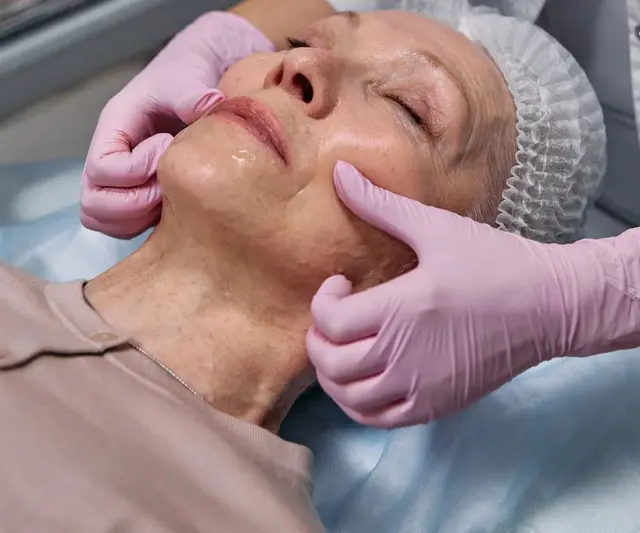
- Lay the towel from the chin up, leaving the nose free so the client can breathe (Figure 2), press gently around the beard area and hold for about 2–3 minutes.
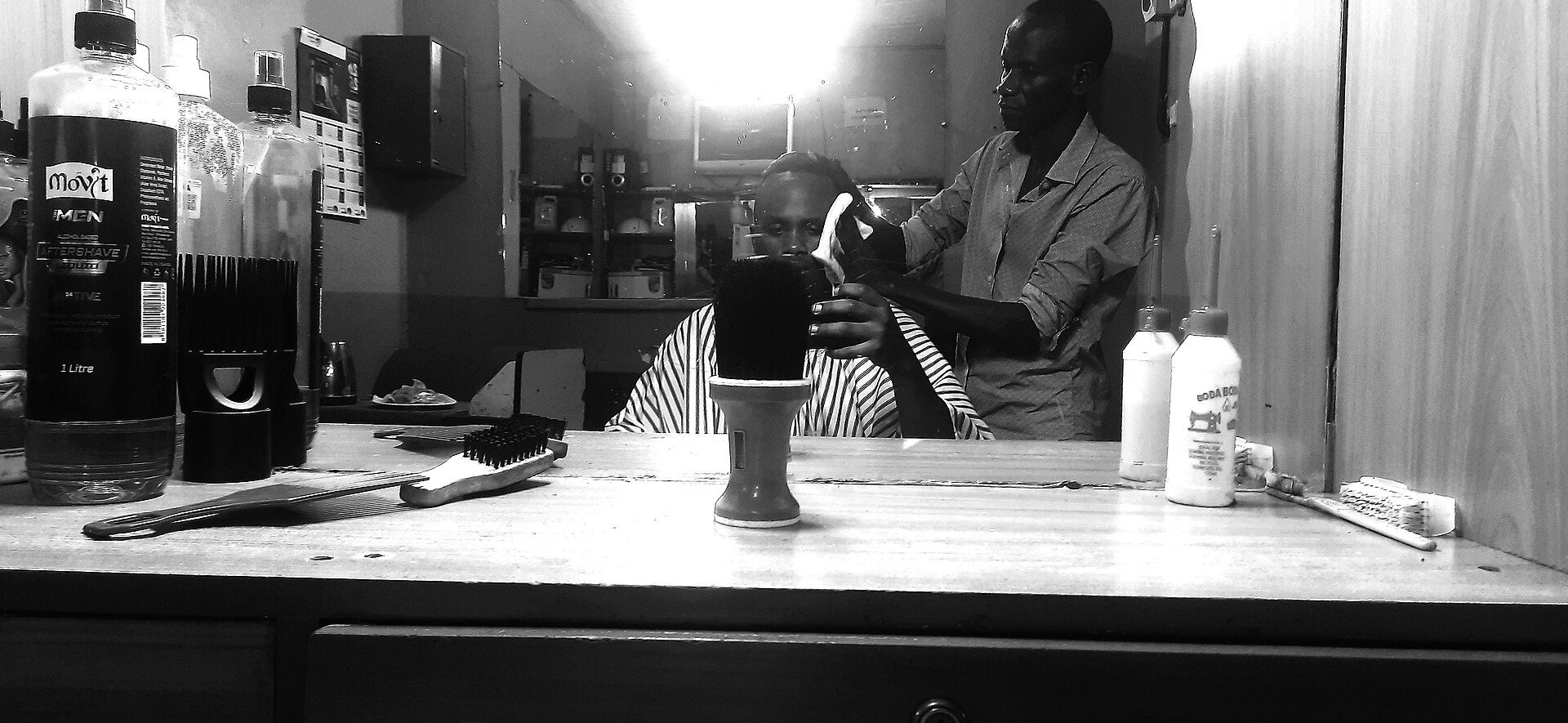
Photo: Alvinategyeka / Wikimedia Commons, CC0
Building and applying lather
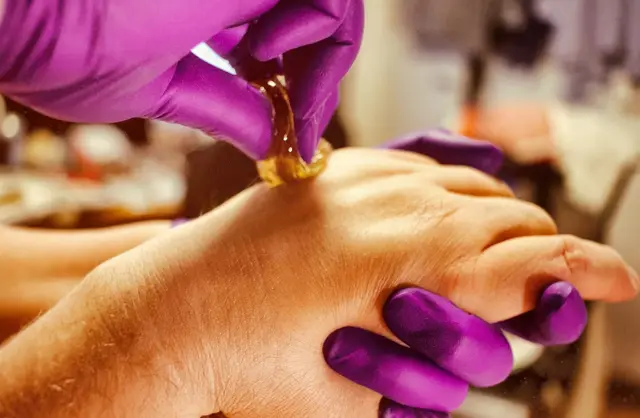
Whip shaving cream or soap with a little warm water in a bowl with a brush (Figure 3) until the lather is thick, fine and glossy like whipped cream, with no large bubbles. Apply it with the brush in small circles against the grain to lift the hairs, then smooth it with the grain. The layer should be about 2–3 mm thick, enough to cover the beard while still showing the beard line so you can shave precisely.
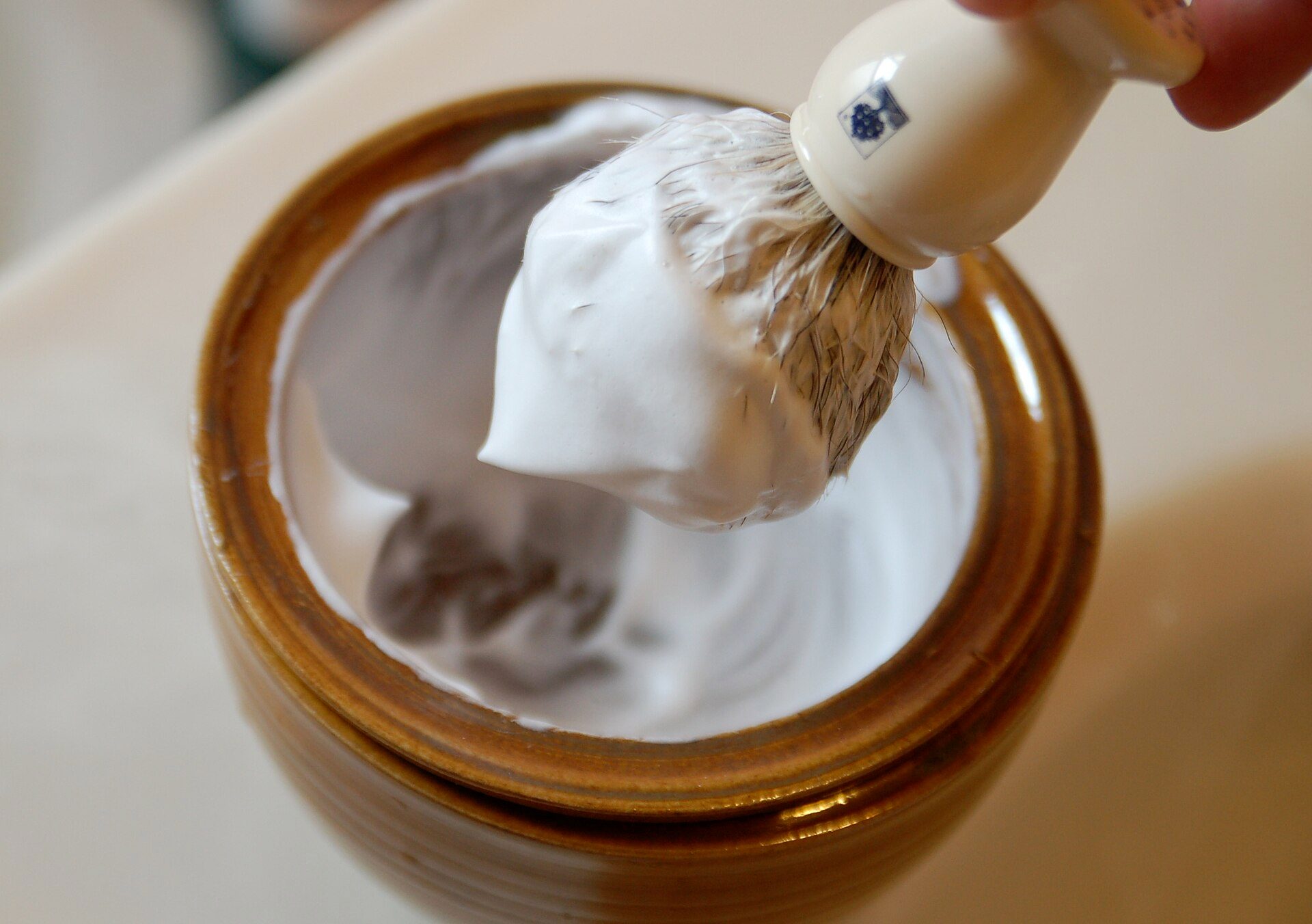
Photo: scottfeldstein / Wikimedia Commons, CC BY 2.0
Softening times
| Beard type | Warm towel | Lather before shaving | Notes |
|---|---|---|---|
| Soft, 1–2 days' growth | About 2 minutes | 1–2 minutes | One pass is usually enough |
| Coarse, thick, 3–5 days' growth | About 3 minutes, possibly 2 towels | 2 minutes | Trim short with clippers first |
| Beard longer than 1 cm | After trimming short | 2 minutes | Never straight-razor a long beard |
Holding the razor, stretching the skin and the shaving order
Three things decide a clean, safe stroke: blade angle, skin tension and direction. Practise on a lathered balloon, or the motion on your own arm with no blade fitted, before shaving a client.
Grip and blade angle
- Forehand: thumb under the blade joint, index and middle fingers on the back of the blade, ring finger on the tang; for the cheek and neck on your dominant side.
- Backhand: turn the wrist so the edge faces you; for the hard-to-reach side of the face and under the ear.
- Blade angle: about 30 degrees to the skin. Too upright and it scrapes and cuts; too flat and it glides over the lather without cutting.
Stretching the skin with the free hand
Fingers of your free hand pull the skin taut against the direction of the stroke, just ahead of or behind the blade. Flat, taut skin keeps the blade from catching in folds. The neck and jaw angle need the most tension; ask the client to lift the chin or turn the head slightly, never force the head yourself.
Order of zones and direction
- Map the direction of growth by running your hand over the beard before lathering: the direction where your hand glides smoothly is with the grain. Neck hair often grows in several directions, so remember each area.
- Pass 1, with the grain: dominant-side cheek, then the other cheek, both sides of the neck, chin, moustache. Short strokes of 2–4 cm, lift the blade, wipe the lather on a towel and place it again.
- Wipe clean and re-lather. Pass 2, across the grain, only if the skin is not red and the client wants it closer.
- Against the grain only sparingly, for clients with healthy skin who are used to close shaves; never against the grain on the neck for a beginner.
- Beard lines, sideburns and nape: use the tip of the blade, very short strokes, skin stretched with the other hand.
Danger zones where you slow down: the Adam's apple, the jaw angle, under the nose, the lip line and moles. In these areas shave with the grain, with a very light blade and no pressure.
Safety warning: A razor blade is extremely sharp; one sudden movement from the client is enough for a deep cut. Always warn the client before shaving the neck ("please keep still for me"), and stop the blade when the client is about to cough, sneeze or speak. Never leave an open razor on the chair, counter or in a pocket; fold it when not shaving. Drop used blades straight into a sharps container and never reuse one on another client, even after "only a little shave". Test hot towels before applying them, keep towel warmers and kettles away from sinks, and never handle them with wet hands. If a cut keeps bleeding after about 10 minutes of pressure with gauze, if a cut is deep, or if the shaved area becomes swollen, hot or pus-filled after a few days, advise the client to see a doctor.
Handling small nicks and aftercare
If you nick the client
- Stop shaving, keep the client calm and do not hide it.
- Put on gloves (if not already), and press a clean disposable gauze pad on the cut for a few minutes.
- Use a single-use styptic product (pen, powder or pad) as the packaging instructs; never rub a shared alum block or styptic stick directly on many clients' skin.
- Put bloodied gauze, gloves and paper in a separate bag; clean and disinfect any blood-stained tool before using it again.
- Note the incident and the lesson: blade angle, skin tension or which area.
After the shave
Rinse off the lather with cool water or a cool towel to calm the skin, and pat dry without rubbing. Apply a gentle aftershave balm; for sensitive skin choose one without alcohol or fragrance. Advise the client to avoid rubbing hard and strong sun for the first day; if they tend to get ingrown hairs, shave only with the grain next time.
Worked example: a 20-minute hot towel shave
Hung, 32, an office worker, has coarse three-day stubble and slightly oily skin, and wants a clean shave before a job interview. Check: no inflamed acne, one small mole under the left jaw angle, no blood thinners. The barber decides on 2 passes on the cheeks, only 1 pass with the grain on the neck, and shaving around the mole.
Time plan
| Step | Task | Time |
|---|---|---|
| 1 | Questions, skin check, new blade in front of the client | 2 minutes |
| 2 | Warm towel | 3 minutes |
| 3 | Build and apply lather | 2 minutes |
| 4 | Pass 1 with the grain: cheeks, neck, chin, moustache | 6 minutes |
| 5 | Re-lather, pass 2 across the grain on cheeks and chin | 4 minutes |
| 6 | Cool towel, pat dry, aftershave, advice | 3 minutes |
| Total | 20 minutes | |
Check: 2 + 3 + 2 + 6 + 4 + 3 = 20 minutes. Beginners usually need 30–35 minutes for the same job; do not force speed, because a fast shave that cuts the client loses the client.
Materials per shave (2026 reference prices in Vietnam, varying by region and brand)
- Half a razor blade: 2,000 VND.
- Shaving cream or soap: 3,000 VND.
- Washing and drying 2 towels: 2 × 2,000 = 4,000 VND.
- Aftershave balm: 2,000 VND.
- One pair of gloves: 1,500 VND; neck strip: 500 VND.
- Total materials: 2,000 + 3,000 + 4,000 + 2,000 + 1,500 + 500 = 13,000 VND (roughly 0.50 USD).
A hot towel shave in a Vietnamese barbershop usually costs about 50,000–150,000 VND (2026 reference, varying by region and shop). If the shop charges 80,000 VND, after materials 80,000 − 13,000 = 67,000 VND remains for the barber's pay, rent and utilities. You will need this materials figure when you build a price list at the last step of the roadmap.
Common straight razor mistakes
Cuts on the neck and jaw angle
Sign: small nicks under the jaw or beside the Adam's apple. Cause: slack skin, blade too upright, long strokes. Fix: stretch the skin well, keep about 30 degrees, short 2–4 cm strokes, ask the client to lift the chin.
Redness and burning after the shave
Sign: red, stinging skin a few hours later. Cause: beard not soft enough, going over the same spot repeatedly, shaving against the grain on the first pass, a dull blade. Fix: give the towel and lather enough time, at most one stroke per spot per pass, a new blade for every client.
Ingrown hairs and bumps
Sign: small bumps on the neck a few days later. Cause: shaving too close, against the grain on curly hair. Fix: for this client shave only with the grain or trim close with clippers; if the bumps become swollen with pus, suggest a dermatologist.
Missed patches
Sign: rough spots on the chin or lip line. Cause: not knowing the growth direction of each area, lather so thick it hides the line. Fix: map the grain by hand before lathering, use just enough lather and check by touch after pass 1.
Frequently asked questions
Does shaving with a straight razor make the beard grow thicker?
No. Shaving only cuts the hair at the skin surface and does not affect the follicle beneath. New growth has a blunt tip, so it feels coarser and is easily mistaken for thicker hair.
How soon can a trainee shave clients?
Usually after practising the motions on lathered balloons and shaving themselves many times, then shaving friends under a senior barber's supervision. Only shave real clients once you have done several dozen shaves without a nick and the senior barber agrees.
Should I use alcohol or an alum block after shaving?
Strong alcohol stings and dries the skin, and many clients cannot tolerate it. A shared alum block rubbed on many clients is unhygienic; if you use an astringent or styptic, choose single-use products or keep one per client.
How hot should the towel be?
You do not need a thermometer, but the towel must be tested on the inside of the barber's wrist and feel pleasantly hot, not stinging. For thin or red skin, use a warm rather than hot towel. Ask the client how it feels as soon as you apply it and adjust.
How many clients can one blade be used on?
One. The other half still in the wrapper is new and can be used for the next client, but any half that touched a client's skin is discarded after that client.
Practice tasks and self-assessment
- Fit and remove a blade 10 times in a row using the paper wrapper, without touching the edge.
- Practise forehand and backhand grips on lathered balloons until 5 in a row survive.
- Sketch the beard growth direction of 3 friends (cheeks, chin, neck) before shaving them.
- Shave a friend under a senior barber's supervision, timing each step against the table above.
Self-assessment criteria
- Pass: fit a new blade and disinfect the razor body in front of the client, and drop the old blade into a sharps container.
- Pass: ask and check the skin, and name at least 3 situations when you do not shave.
- Pass: the towel is tested before applying; 2 passes with no nicks and no redness or burning after 1 hour.
- Pass: the recorded times and materials add up.
- Not yet: reusing a blade, shaving against the grain on the first pass, or shaving over inflamed acne or sores.
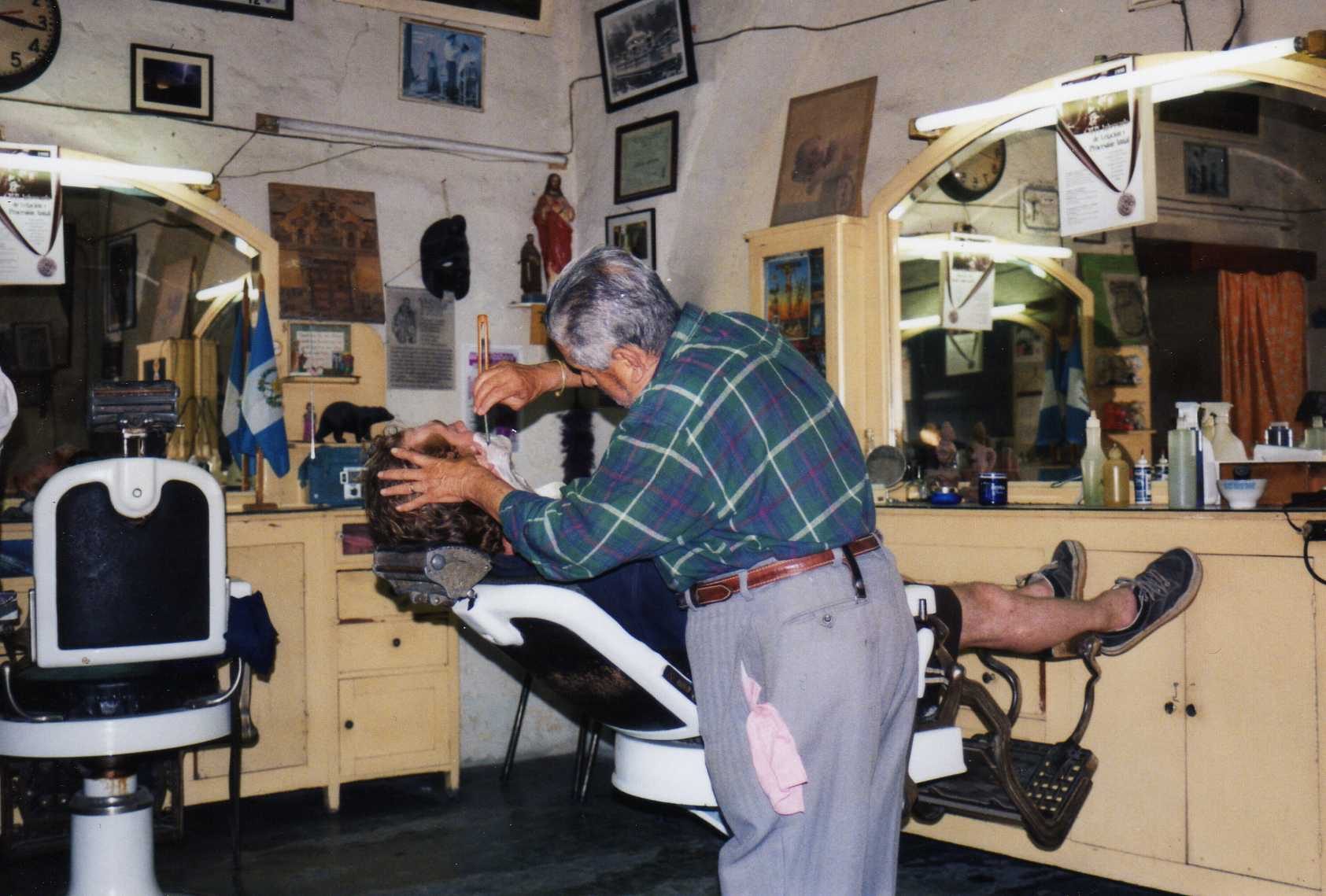
Photo: Leonora Enking / Wikimedia Commons, CC BY-SA 2.0
Once you can shave safely, cleanly and on time, move on to the next roadmap step: Project: 30 practice clients and a fade portfolio, where you cut 30 practice clients, take before-and-after photos and time each service to bring it down to about 30–40 minutes.
Keep learning barbering: after shaving and beard trimming come a 30-client project, a skills test, a price list and opening your own shop. See the 8-step barber roadmap.