Clients cannot see bacteria, but they can see a stained towel, a mask bowl with residue on it, or a bed whose sheet was never changed. Good hygiene prevents cross-infection between clients, and it is also the first thing that earns their trust. In the previous step you learned to keep your own hands and appearance clean; this step extends that to everything that touches the client: tools, linen, surfaces and the room itself.
By the end of this lesson, you will be able to:
- Tell cleaning, disinfection and sterilization apart, and choose the right level for each tool.
- Reprocess reusable tools in 6 steps, mixing and using solutions at the correct concentration for the full contact time.
- Lay out a clean zone and a dirty zone, and wipe a room in the order clean → dirty, top → bottom.
- Turn over a room between two clients in 10–15 minutes without skipping a step, then fill in the hygiene log so a manager can check it.
Why hygiene is a professional skill, not a side job
How cross-infection happens
Cross-infection is when microorganisms travel from one client (or from you) to another client through an "intermediary". In a spa, the most common intermediaries are: the therapist's hands, reused towels and sheets that were not laundered properly, extraction tools, tweezers, mask bowls and brushes, cream jars that were dipped into with fingers or used spatulas, and foot baths. After exfoliation, extraction or waxing, the client's skin has many tiny micro-injuries — open doors for bacteria and fungi. A facial that seems harmless can leave an infection behind if the tools were not processed correctly.
Hygiene and the spa's reputation
Clients judge a spa by what they can see, smell and touch: how the towels smell, how white the sheets are, whether bowls are stained, whether there is hair on the floor, whether cream jars have lids. If a client sees you pull a towel out of the dirty laundry basket and reuse it even once, that is enough for them never to come back and to tell their friends. On the other hand, when clients see you wash your hands before starting and open a sealed, date-labelled tool pack, they feel safe and relax more.
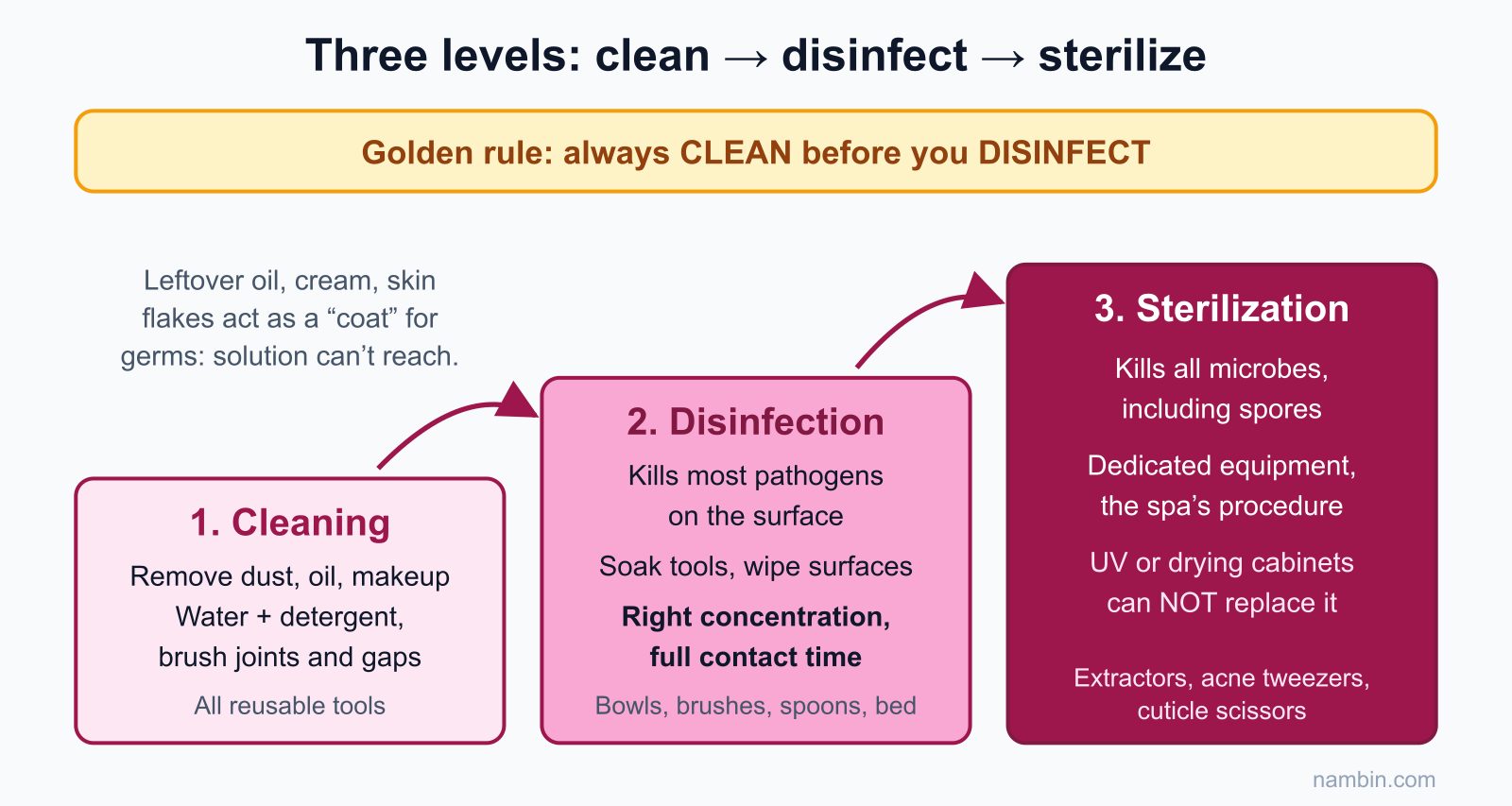
Three levels of cleanliness you must tell apart
| Level | Purpose | Example |
|---|---|---|
| Cleaning | Remove dust, oil and leftover cosmetics | Washing bowls and brushes with water and detergent |
| Disinfection | Kill most disease-causing microorganisms on a surface | Soaking in disinfectant solution, wiping with alcohol |
| Sterilization | Kill all microorganisms, including spores | A dedicated sterilizer (autoclave) for metal tools |
The golden rule: always clean before you disinfect. Disinfectant does not work well on a surface still coated with oil and cosmetics.
Why clean first?
A layer of massage oil, cream, clay mask or skin flakes on a tool acts like a coat that shields bacteria. Disinfectant only works where it touches the surface directly; if dirt is left, the bacteria underneath survive. Organic dirt also uses up some disinfectants faster, so a soaking tub full of dirty tools stops working sooner than the time printed on the label.
Contact time and concentration
Every disinfectant has two numbers you must respect: the dilution and the contact time. Wiping with alcohol and drying it off immediately, or dipping a tool for a few seconds, is not long enough to kill germs. Diluting more than the instructions say to "save money" makes the solution weaker; mixing it stronger does not clean better, but it corrodes tools and irritates your hands. Read the label, use a graduated measuring cup, and write the date and time of mixing on the soaking tub.
When is sterilization needed?
Sterilization is for reusable metal tools that may touch broken skin or body fluids, such as extractors, tweezers used during acne treatment, and cuticle scissors. It requires dedicated equipment and an operating procedure set by the spa; new therapists usually only do it after training and under supervision. "Drying cabinets" or "UV cabinets" used for storage do not replace a sterilizer — ask your spa's equipment manager which type yours is.
Sorting tools by how they are processed
- Single-use: lancets, cotton, gauze, disposable cleansing sponges, spatulas. Throw them away right after use in the right bin; sharps go into the sharps container.
- Reusable metal tools: tweezers, scissors, extractors. Clean, disinfect and sterilize them according to the spa's rules.
- Plastic and silicone tools: bowls, mask brushes, spoons. Wash, soak in disinfectant for the full time, rinse and let dry.
- Linen: towels, sheets, robes. Change after every client, wash at a high temperature, and line-dry or tumble-dry completely.
| Tool | After every client | Note |
|---|---|---|
| Lancets, blades | Into the sharps container | Never recap needles by hand, never bend them |
| Cotton, gauze, wooden sticks | Into a lidded bin | Never reuse, even if they "look clean" |
| Extractors, tweezers | Clean → disinfect → sterilize | Pack and date them after processing |
| Bowls, spoons, silicone brushes | Wash → soak in disinfectant → rinse → dry | Wash bristle brushes right down to the roots |
| Towels, sheets, robes | Replace; put used ones in a lidded laundry basket | Never shake dirty linen out inside the room |
| Massage stones, wooden tools | Follow the manufacturer's instructions | Wood absorbs moisture and is hard to disinfect; ask about spa rules |
Linen: washing, drying and storage
Towels and sheets soak up massage oil very quickly; oil that builds up over time causes a rancid smell and yellow stains. Separate heavily oiled linen, wash it on the hottest cycle the machine and fabric allow, and use a detergent that handles oil. Linen must be completely dry before it is folded and put away — damp towels in a cupboard are perfect for mould. Store clean towels in a closed cupboard away from the dirty area; never leave clean towels on a trolley next to the dirty laundry basket.
Shared products: cream jars and oil bottles
Never dip your fingers or a spatula that has touched the client's skin into a cream jar. Always use a clean spatula or spoon to take just enough into a bowl; throw away what is left in the bowl and never pour it back into the jar. Use massage oil in pump or dropper bottles, and wipe the bottle after each client because oily hands grab it many times. Write the opening date on each product and follow the "period after opening" printed on the packaging.
Reprocessing reusable tools
Prepare: disposable gloves (or thick rubber gloves for scrubbing), a face mask, a small brush, a separate sink or basin for tools, detergent, disinfectant mixed at the correct concentration in a lidded tub, a measuring cup, clean towels or disposable paper wipes, and labelled storage boxes or pouches.
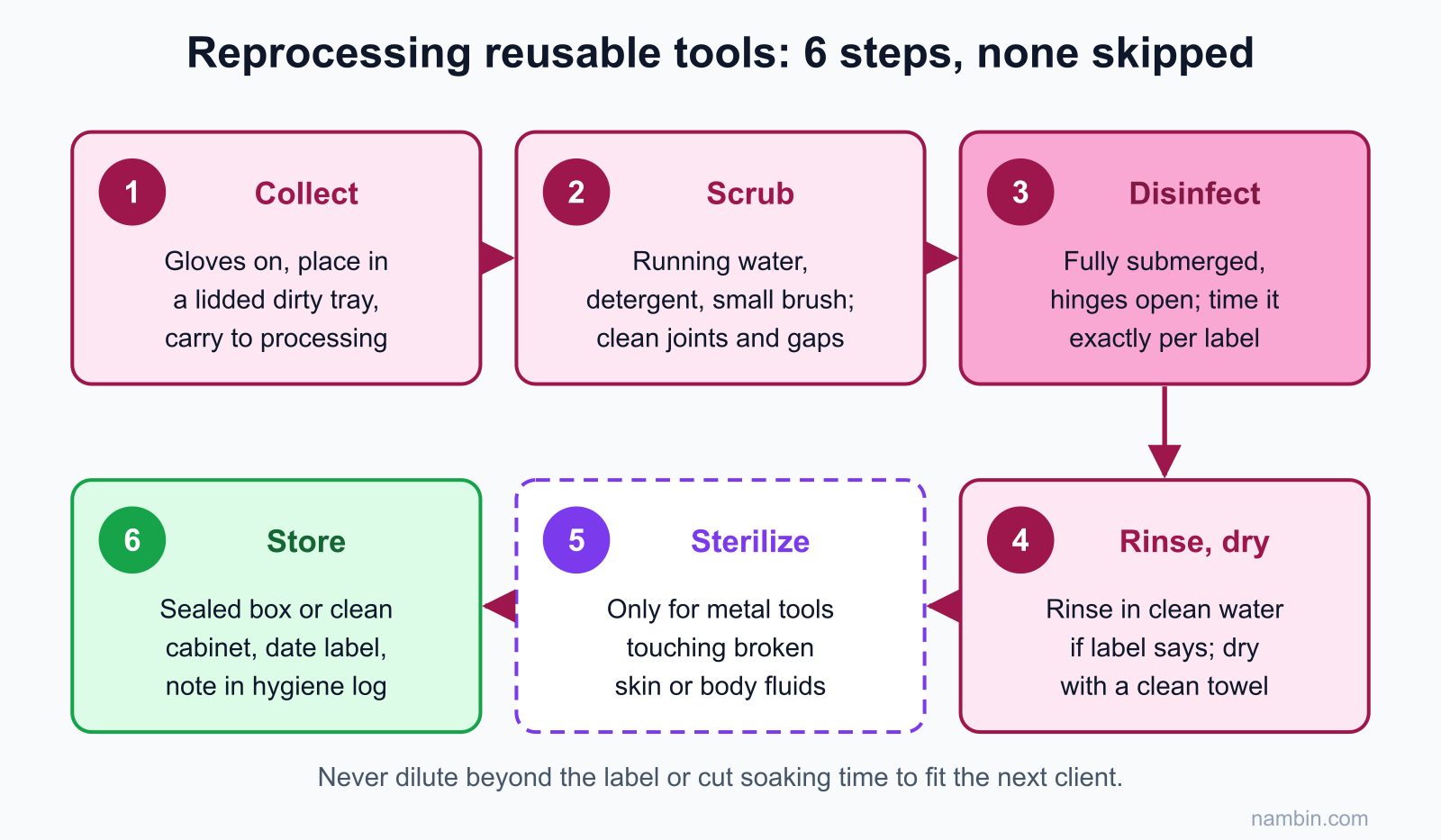
- Put on gloves and collect dirty tools in a lidded tray to carry them to the processing area.
- Wash under running water, scrubbing joints and crevices carefully with a small brush.
- Soak in disinfectant at the concentration and for the time printed on the label. Never dilute it further on your own.
- Rinse with clean water (if the label requires it) and dry with a clean towel.
- For metal tools that have touched broken skin: sterilize them following the spa's procedure.
- Store in a sealed box or a clean cabinet, labelled with the processing date.
Practical tip: when soaking, tools must be fully submerged, and hinged tools such as scissors and tweezers should be opened so the solution can reach the joint. Time it with a clock; do not guess. Change the soaking solution as the label says, or as soon as it looks cloudy or has sediment, even before it is due.
Safety note: Never mix different cleaning or disinfecting chemicals — some mixtures release toxic gas. Wear gloves, work in a well-ventilated place and read the product label carefully. If a chemical splashes into your eyes, rinse them immediately under clean running water and tell your manager; if your eye is still painful, red or your vision is blurred, see a doctor straight away. Never pour chemicals into drinking-water bottles or unlabelled bottles.
Preparing the treatment room between two clients
- Collect all used towels and sheets into a lidded laundry basket.
- Wipe the bed, bolsters and armrests with surface disinfectant.
- Put on a fresh sheet, towels and face-hole cover.
- Clean the foot bath and sink; wipe them dry.
- Reset the trolley with clean tools and products with their lids closed.
- Open the door or switch on ventilation for a few minutes; adjust the temperature, lighting and background music.
Make sure the booking schedule leaves enough time for these steps. If appointments are too close together, tell your manager instead of cutting hygiene steps.
Wiping order: clean to dirty, top to bottom
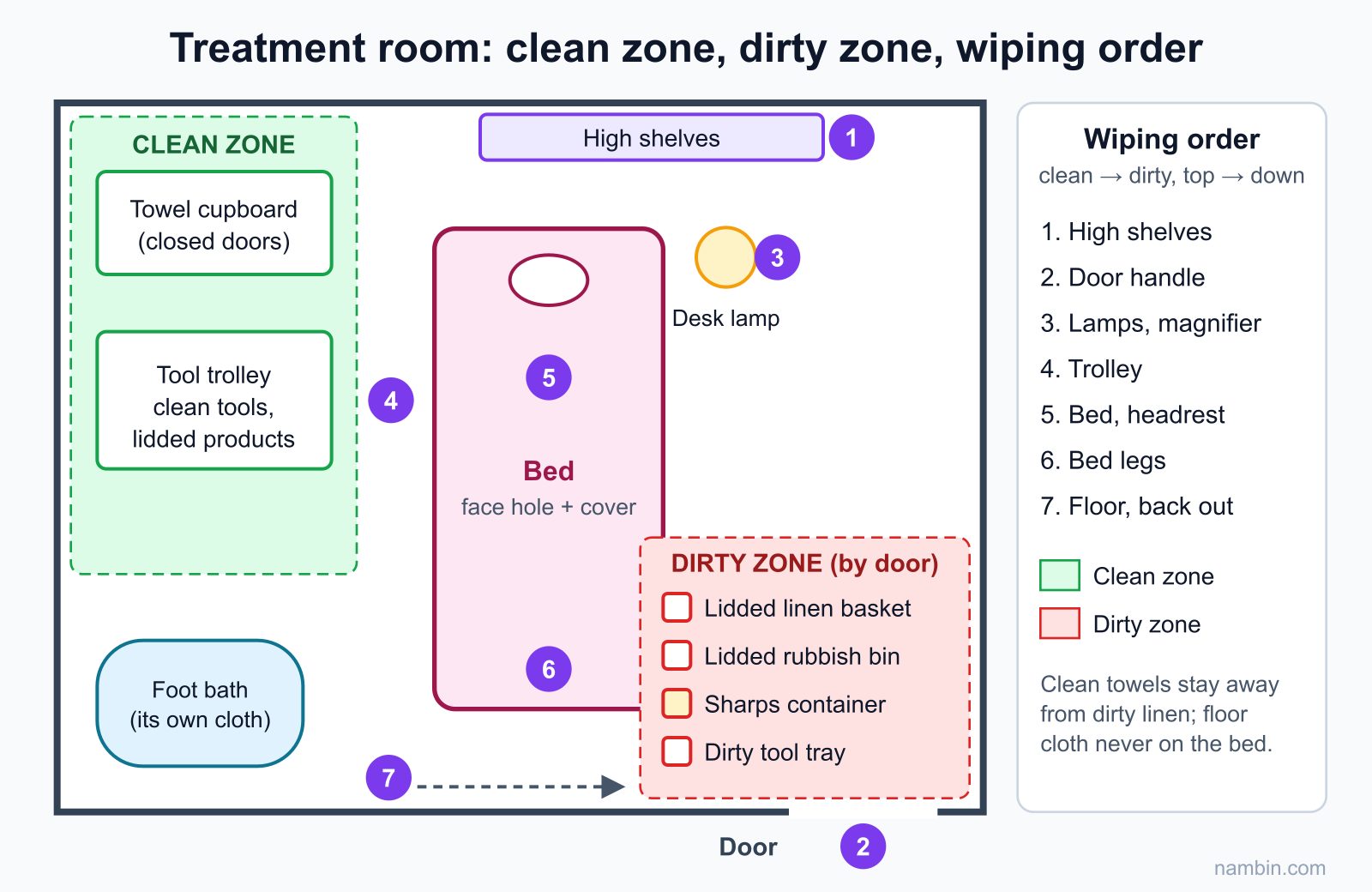
When wiping surfaces, move from less dirty to dirtier areas and from high to low: shelves, door handle, desk lamp, trolley, then the bed, the bed legs and finally the floor. If you do it the other way round, you drag dirt from dirty areas onto areas you have just cleaned. Use separate cloths by colour or by area (for example one colour for room surfaces, another for the foot bath and toilet) if your spa has such a rule, and never use the floor cloth on the bed.
The room layout also decides how easy cleaning is: put the clean zone (towel cupboard, tool trolley) away from the door, and the dirty zone (laundry basket, rubbish bin, sharps container, dirty tool tray) near the door, so dirty items leave the room without crossing the clean zone.
Foot baths: an often-neglected spot
Foot baths, especially whirlpool models, trap water and residue in their pipes — a place where bacteria and fungi thrive. After each client, drain all the water, scrub the walls to remove residue and skin flakes, rinse, then disinfect exactly as the foot bath manufacturer instructs; at the end of the day, clean more thoroughly, including the jets and filter screen if there is one. Never leave standing water overnight. Do not give a foot soak to a client with an open wound or suspected fungal infection on the foot.
Worked example: a facial room between two appointments
Two clients have booked facials in the same room: the first finishes at 14:00 and the next is booked for 14:15. The first client had extractions. You have about 15 minutes, split into six stages as in Figure 4:
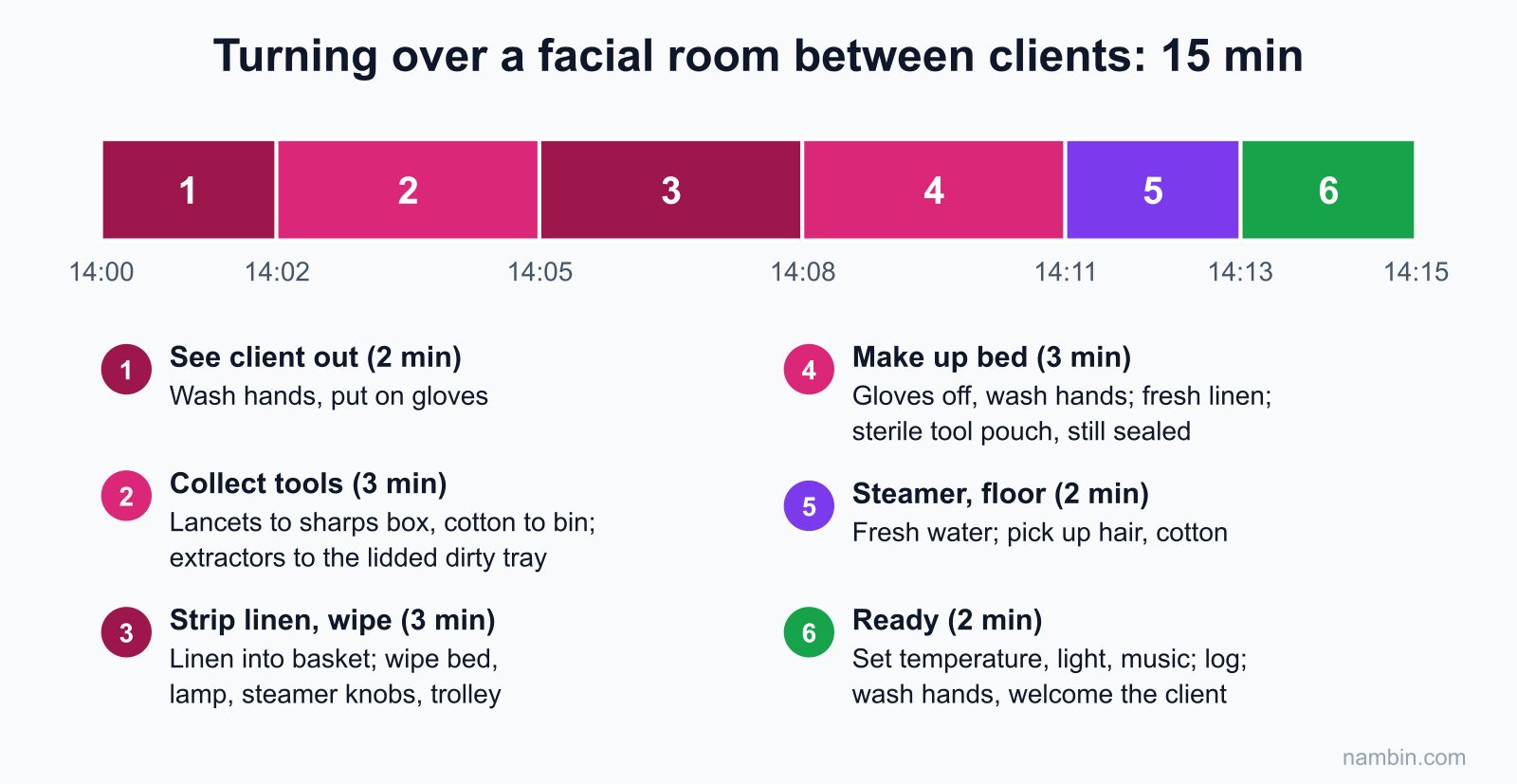
- 14:00–14:02: see the client out, wash your hands, put on gloves.
- 14:02–14:05: drop lancets into the sharps container and cotton and gauze into the lidded bin; put extractors into the lidded dirty tool tray to take to the processing area; put bowls and brushes into the separate wash basin.
- 14:05–14:08: strip the sheet, towels and hair wrap into the laundry basket; wipe and disinfect the bed, headrest, magnifying lamp, steamer knobs and trolley handle.
- 14:08–14:11: remove gloves and wash your hands; lay a fresh sheet and towels; place a sterilized tool kit, still in its labelled pouch, on the trolley without opening it.
- 14:11–14:13: empty the old water from the steamer and refill with clean water as the machine instructs; check the floor and pick up hair and cotton.
- 14:13–14:15: adjust temperature, lighting and music; fill in the hygiene log; wash your hands and welcome the client.
Washing, soaking and sterilizing the first client's tools is then done by you or the person in charge in the processing area right afterwards; this is why the spa needs enough tool sets to rotate. If there is only one set of extractors, tell your manager: you cannot shorten the soaking time or skip sterilization to be ready for the next client.
Correct hand hygiene
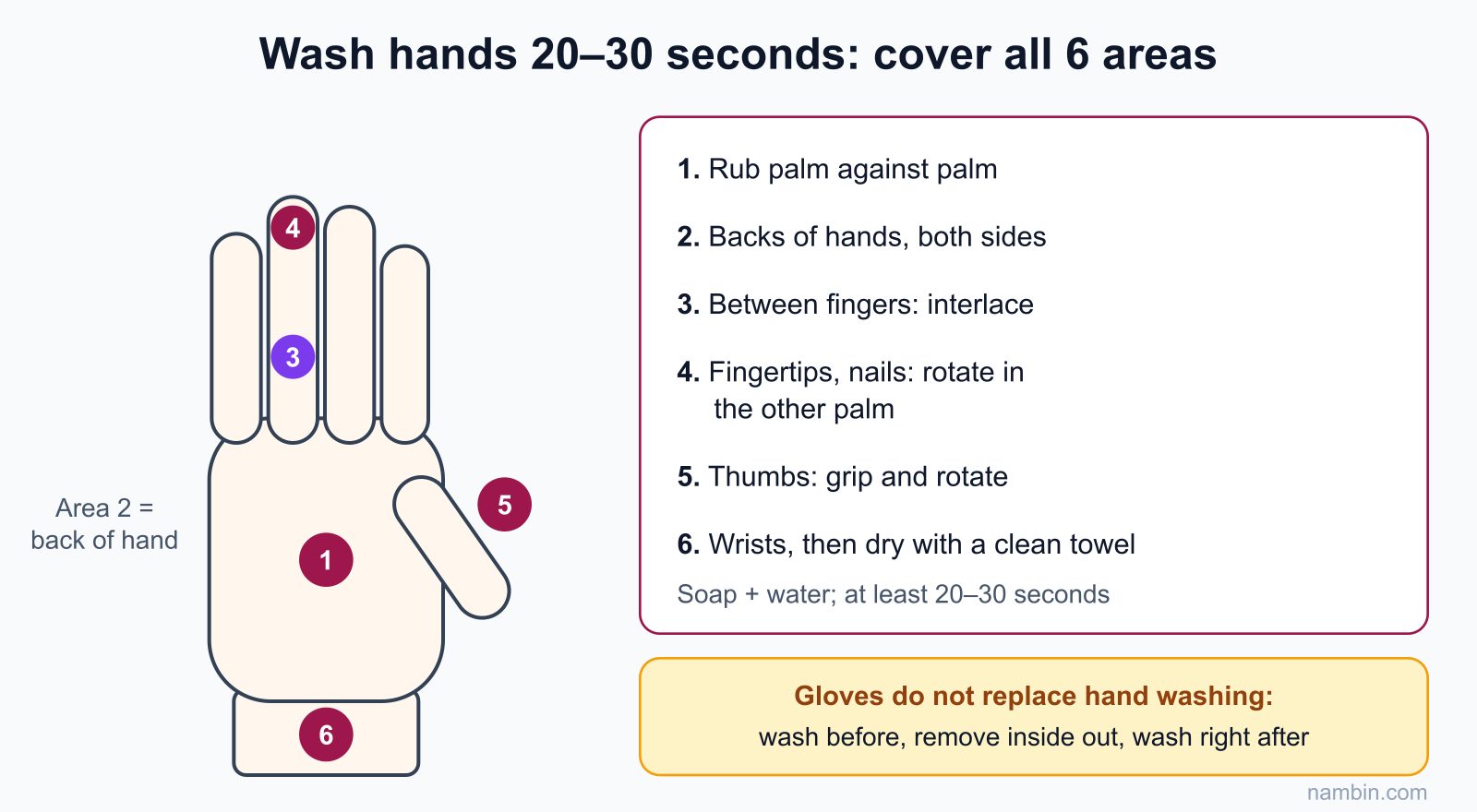
Wash your hands with soap and water for 20–30 seconds, rubbing all six areas: palms, backs of the hands, between the fingers, fingertips and nails, thumbs, and wrists. Thumbs and fingertips are the two most often missed areas — and the two that touch clients the most. Use alcohol hand rub when there is no sink but your hands are not visibly dirty. Wash your hands before touching a client, after finishing a treatment and after handling dirty items.
Gloves do not replace hand washing
Gloves protect you during extractions, when handling dirty items and when mixing chemicals. But gloves can have tiny holes, and your hands can still get contaminated when you take them off. So: wash your hands before putting gloves on, change gloves between clients and whenever they tear, remove them by turning them inside out so the dirty side is inside, throw them in the bin and wash your hands immediately. Never wear used gloves to open doors, hold your phone or take products from the cupboard.
Moments when people forget to wash their hands
- After touching your hair or face, sneezing or coughing.
- After handling money, a phone or the till.
- After emptying the bin or taking the laundry basket to be washed.
- Between two different areas on the same client, if you have just touched inflamed acne or the feet.
Common mistakes and how to fix them
Soaking tools that are still dirty
Sign: the soaking solution turns cloudy quickly and tools have stains at the joints. Cause: skipping the scrubbing step because you were in a hurry. Fix: always scrub first, especially at joints and crevices; change the solution on time.
Towels smell even after washing
Sign: clean towels still smell damp or of rancid oil. Cause: built-up oil was not washed out, or towels were folded before they were dry. Fix: separate oily towels, use a suitable wash cycle, dry them completely; ask your manager to replace towels that are stained and stiff.
Using one cloth for every surface
Sign: the same cloth goes from the foot bath to the bed. Cause: not enough cloths, or no zoning rule. Fix: assign cloths by area, wash them separately, and suggest the spa use different colours so they are easy to tell apart.
Frequently asked questions
Can wiping with alcohol replace soaking in disinfectant?
For large surfaces such as beds and handles, wiping with a suitable surface disinfectant is enough if it stays wet on the surface for the time on the label. For small tools with crevices and joints, soaking so the solution reaches every part is more reliable. Follow your spa's rules for each type of tool.
Can a UV cabinet replace sterilization?
It should not be treated as sterilization. Light only affects surfaces it shines on directly; it does not reach joints or hidden sides. If you have this type of cabinet, use it only to store tools that have already been processed correctly.
Can bristle mask brushes be reused?
Yes, if you wash them thoroughly down to the roots right after use, disinfect them as instructed and let them dry completely with the head pointing down or lying flat. Replace brushes that shed, smell or change colour. Silicone brushes are easier to clean.
What should I do if I prick myself with a used lancet?
Let it bleed naturally for a few seconds, wash it immediately under running water with soap, do not squeeze hard or suck the wound, tell your manager and record the incident. Go to a clinic soon for advice, because a lancet used on a client may carry blood-borne disease.
Does a small spa need a hygiene log?
It should have one. The log shows who processed which tools, when, and on what date the solution was mixed. If a client complains or an inspection team visits, the log is your proof that you did things properly.
End-of-shift checklist and practice exercise
- All tools have been cleaned, disinfected and stored in the right place.
- Rubbish bins and the sharps container have been emptied.
- Chemicals are tightly closed, labelled and kept out of reach of children.
- The hygiene log is filled in: who, when, and any unusual notes.
- The foot bath and steamer have been drained and wiped dry; dirty linen has gone to the laundry.
Exercise
- Draw a plan of the treatment room where you are training, marking the clean zone, the dirty zone and the wiping order.
- Read the label of the disinfectant you use and write down the dilution, contact time, shelf life after mixing and the protective equipment required.
- Time yourself turning over a room between two clients using all six steps; do it three times and compare your times.
Self-assessment criteria:
- You turn over the room in about 10–15 minutes without skipping any step; if you are faster, check again for anything you missed.
- You can explain why you must clean before disinfecting and why chemicals must never be mixed.
- No clean towel is placed next to dirty items; no cream jar is left open after the turnover.
- Your hygiene log records the person, time and tasks done, and can be handed to a manager for checking at any moment.
Once hygiene has become a reflex, you are ready for the next two skill steps in the roadmap: 60-minute relaxing body massage and Basic facial care. In both lessons, room preparation and end-of-session cleanup reuse exactly the six turnover steps from this lesson; at the safety assessment at the end of the roadmap, your instructor will score hygiene before and after the client as a separate item.