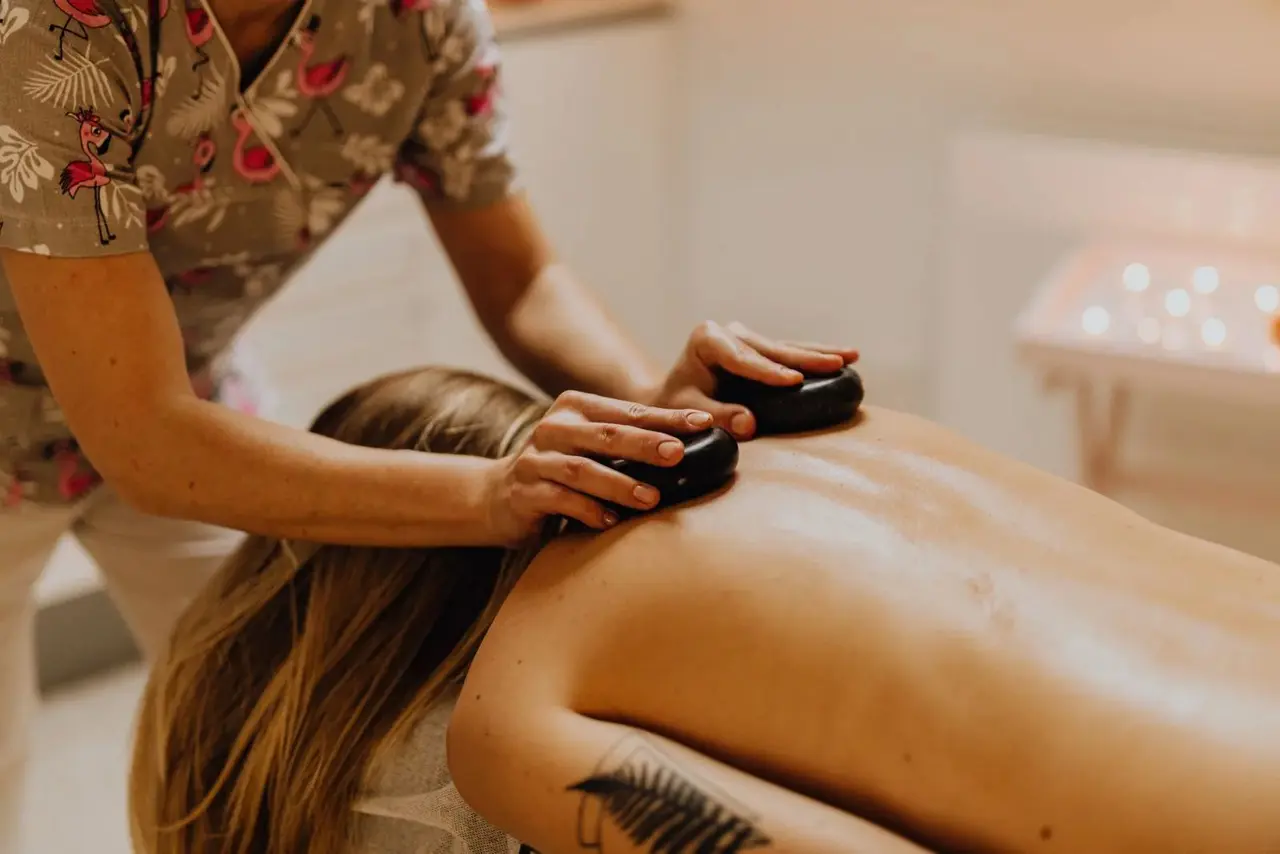
“Oh, the stones are lovely and warm, that feels great.” “My left shoulder is stinging a little.” These two sentences can come up in the same hot stone massage, just a few minutes apart. Hot stone massage appears on the price list of many spas because clients love the feeling of deep warmth. But it is also the service in which new therapists are most likely to burn a client: stones hold heat for a long time, heat concentrates in one spot, and a relaxed client is often reluctant to speak up.
This lesson extends the “60-minute relaxing body massage” step and reuses the positioning, hand pressure and health intake form from the client consultation step. By the end of this lesson, you will be able to: (1) prepare the stone set, heater and thermometer correctly; (2) test stone temperature in three layers before touching the client; (3) screen out clients at high risk of burns; (4) perform a treatment of about 60 minutes; (5) recognise the signs of a burn and give first aid.
Why hot stone massage can easily cause burns
Stones hold heat in their core, not just on the surface
Massage stones are usually black basalt, heavy and dense, so they hold heat for a long time. Soaked long enough, the whole stone is hot from the inside out. If a stone is too hot and you dip it quickly in cool water, only the outer layer cools; shortly afterwards heat from the core travels back to the surface. That is why safety guidance for massage practice says: if a stone is too hot, set it aside and take another stone at the right temperature — never “cool it down quickly and use it”.
Three common situations that cause burns
The heating water is too hot, or the wrong heating device is used. Rice cookers, hot-pot cookers, microwaves, frying pans and the like cannot control the temperature; stones may heat unevenly or become far too hot.
A stone is left stationary in one place for too long. When a stone does not move, heat concentrates on a small area of skin. The most dangerous case is when the client lies on top of a stone: body weight presses the stone against the skin and the client cannot lift it away.
The client cannot feel the heat, or does not say so. People with diabetes and nerve damage, older people, and people taking certain medications may have reduced heat sensation. Some clients feel the heat but think “it has to be hot to work” and put up with it.
Relaxation, not treatment
Hot stone massage is a relaxation service. The therapist does not promise to cure back pain or a herniated disc, to help with weight loss or to “detox”. When a client asks, be honest: “Many clients find their muscles feel more relaxed, but if the pain is long-lasting you should see a doctor.”
Preparing equipment before the client arrives
The stone set
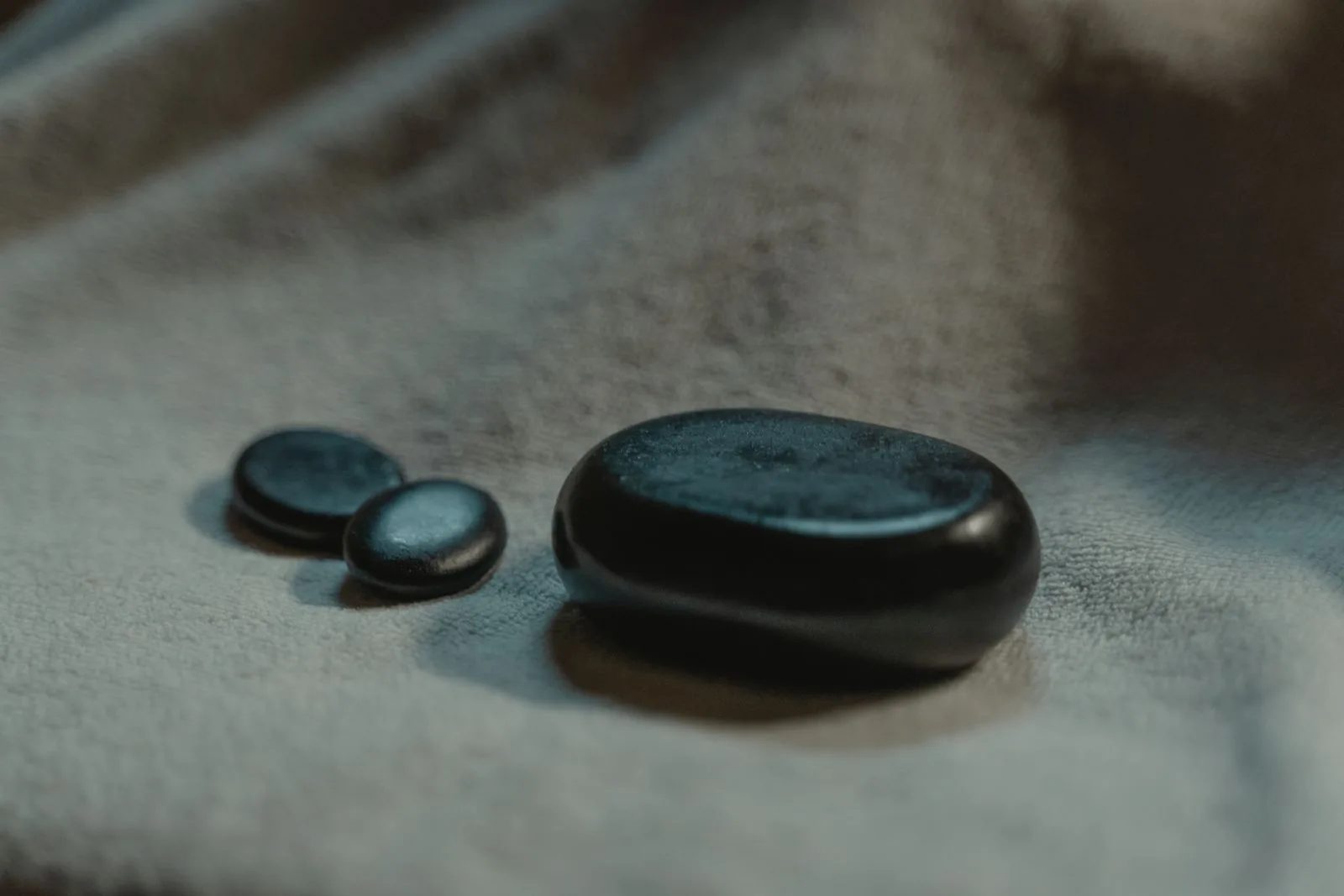
A set usually includes large flat stones for the back and thighs, medium stones for the calves and arms, and small stones for the hands; the number depends on the set. Choose smooth, non-porous stones bought from a spa equipment supplier — do not use pebbles picked up from a stream or decorative stones. Check every stone before each session and discard any that are cracked, chipped or sharp-edged. Sort the stones by size so you can pick the right one without fishing around in hot water.
A dedicated stone heater and a thermometer
Only heat stones in a dedicated stone heater with temperature control, with the stones fully submerged in water, because water heats the stones evenly and makes them easier to control. Do not heat stones in a microwave, oven, frying pan, gas stove or rice cooker. Do not rely entirely on the control dial: use a digital thermometer to read the water temperature before the client comes in and several times during the session.
Place a thin towel on the bottom of the heater so the stones do not sit directly on the base, fill with water to cover the stones and switch the heater on in advance. The time needed for the whole set to heat evenly depends on the device and the number of stones and can be up to about an hour (for reference), so switch it on early according to the manufacturer's instructions.
Electrical safety around the heater
The heater is an electrical appliance full of hot water placed next to the treatment bed. Plug it into a fixed socket with residual current protection (RCD/RCBO) installed by an electrician; do not use an extension lead lying on the floor. Place the heater on a stable table, away from walkways. Unplug it before filling, emptying or cleaning it; if the cable or plug is cracked or scorched, stop using it and report to your manager.
Other supplies
A slotted spoon or perforated basket (never put your hand into the hot water), a towel-lined tray to lay out the stones, a bowl of cool water to cool your hands between rounds, thin towels to place under stationary stones, massage oil (ask about allergies first), and a health intake form with a specific section for hot stones.
Temperature table and how to test the stones
Guidance from the American Massage Therapy Association (AMTA) states that heating water of about 110–130 °F, i.e. about 43–54 °C, is enough for the stones to reach a usable temperature; some other safety guidelines advise never using stones heated above 130 °F (about 54 °C). This lesson adopts that cautious limit. The figures below are for reference; always give priority to the heater manufacturer's instructions and the rules of the spa where you work.
Item | Reference level | Notes |
|---|---|---|
Water in the heater for gliding stones | About 43–54 °C | Read it with a thermometer, not just from the dial |
Do-not-exceed limit | About 54 °C | If the water is above the limit: lower the heater temperature and wait until the whole set returns to the right temperature; do not take overheated stones out to cool them |
Stationary stones (placed in one spot) | Warmer than skin but cooler than gliding stones | Place a thin towel underneath; lift and check the skin after about 1–2 minutes |
Older clients, thin skin, first-time clients | Use the low end of the range | Test on a small area and ask more often |
Testing with the therapist's hand | Grip the stone firmly for about 5 seconds | If you cannot hold it for 5 seconds, it is too hot for the client |
Testing stones in three layers
Thermometer: the water temperature is within the range the spa allows.
Your hand: lift the stone onto the tray, wipe off some of the water, grip it firmly for about 5 seconds and then press it against the inside of your own forearm. The inner forearm is more sensitive than the palm, which is already used to heat.
The client's skin: touch the edge of the stone lightly to a small area, for example the calf, and ask: “How does this warmth feel to you?” If the client says it is hot, switch to another stone — do not push on.
Your hands gradually get used to the heat after handling stones many times, so your sense of temperature is less reliable towards the end of the session. Cool your hands between rounds and always ask the client.
Screening clients before a hot stone treatment
Go through the full health intake form as for any massage service, then ask additional questions specific to heat. The table below reflects common practice for reference and does not replace a doctor's advice. When in doubt, choose the more cautious option: a massage with bare hands is still a good service.
Client's condition | Level | How to handle it |
|---|---|---|
Fever, illness, recently drunk alcohol | No hot stones | Rebook when the client is well |
Open wounds, rash, dermatitis or sunburn on the area to be treated | Do not treat that area | Avoid the area or switch services |
Recent surgery, currently undergoing chemotherapy or radiotherapy | Do not treat without a doctor's approval | Suggest the client ask their treating doctor |
Diabetes, numbness in hands or feet, reduced sensation | High risk of burns | Do not place stones on areas with reduced sensation; advise asking a doctor; suggest a bare-hand massage |
Heart disease, unstable high or low blood pressure | Caution | Do not treat while the client feels dizzy or tired; ask a doctor if unsure |
Pregnancy | Do not treat without a doctor's approval | Spas usually have a separate prenatal service |
Varicose veins, history of blood clots | Do not treat that area | No firm strokes, no stones placed on varicose veins |
Recent injury, hot swelling (sprain, bruise) | No heat on that area | Advise the client to see a doctor if the pain is severe |
Older people with thin skin; people on medication or with heat-sensitive skin | Caution | Gently warm stones, short duration, test a small area, check the skin frequently |
Three extra questions to ask: “Do you have any numbness or reduced feeling in your hands or feet?”, “Have you had hot stones before, and did they ever sting?”, “Is there anywhere that is painful, swollen or recently bumped today?”. Then tell the client: “If the stones feel too hot, tell me straight away and I'll change them,” so the client understands that speaking up is normal.
A hot stone massage routine of about 60 minutes
The timings below are suggestions to help you practise keeping a rhythm; your spa may have its own sequence.
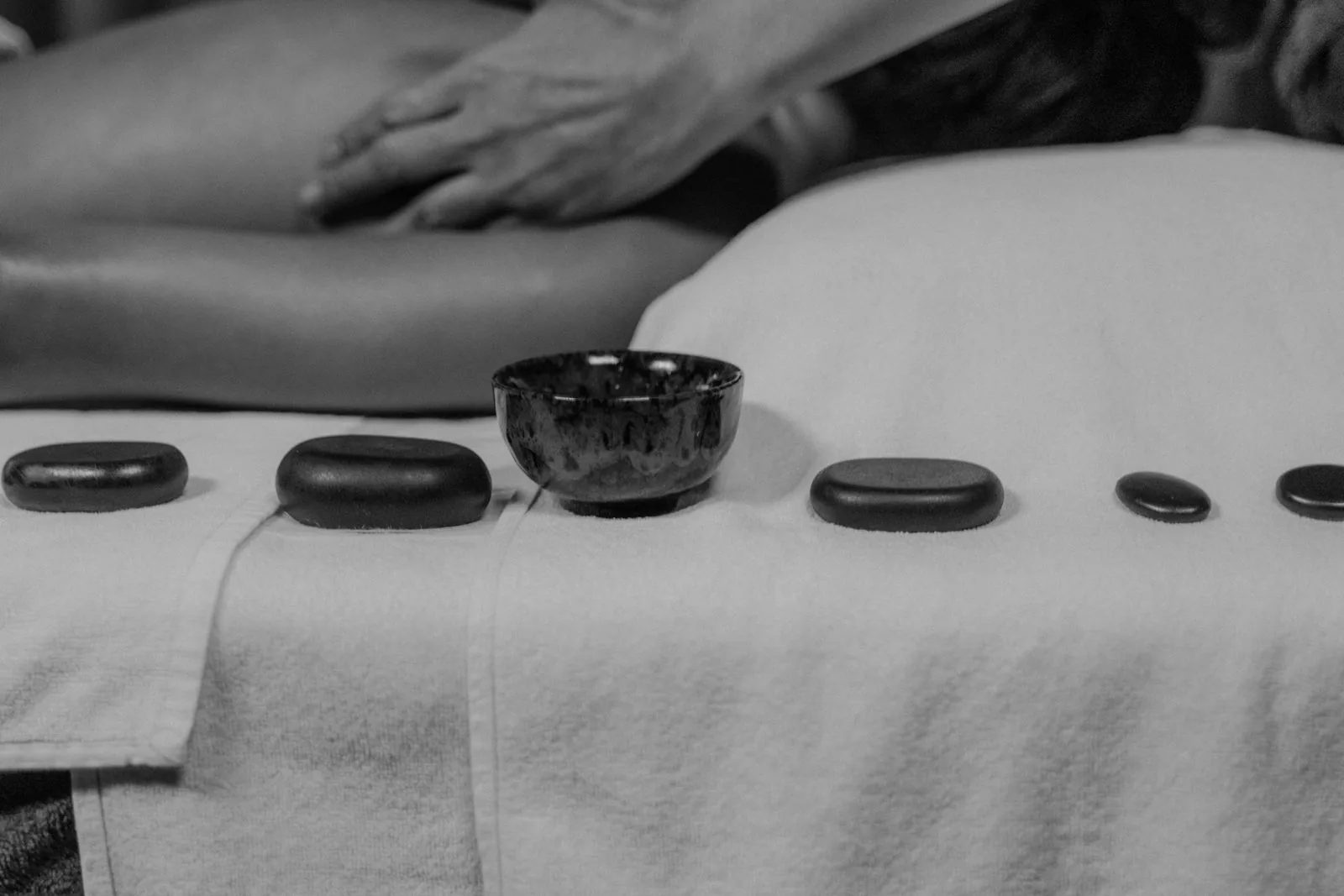
Before the client comes in (not counted in the 60 minutes). Switch the heater on early, read the thermometer, check the stones, set out the towel-lined tray, the bowl of cool water, oil and enough towels. Check the heater's power cable.
Welcome and screening (about 5 minutes). Go through the health form and the heat-specific questions, explain how the hot stones will feel, and agree on how the client will signal “too hot”. If there is a contraindication, suggest another service or rebook.
Warm-up with bare hands (about 5 minutes). The client lies face down, draped correctly. Apply oil and stroke the back by hand as in the body massage lesson so the client gets used to your pressure and the skin has a layer of oil to help the stones glide smoothly.
Test the stone on a small area (about 2 minutes). Apply the three testing layers above. Start with the flat face of the stone, touch lightly, lift, and ask the client.
Back and shoulders with gliding stones (about 15 minutes). Hold the stone in your palm, flat face against the skin, and make long strokes along the muscles on both sides of the spine and circular strokes around the shoulder blades. Keep the stone moving at all times. When a stone cools, return it to the heater and take a new, tested one.
Backs of the legs (about 8 minutes). Stroke along the calves and backs of the thighs, with lighter pressure behind the knee. Do not use firm strokes over varicose veins.
Stationary stones if included in the treatment (combined with steps 5–6). Place stones on the back over a thin towel; they should be more gently warm than gliding stones. Lift and check the skin after about 1–2 minutes (for reference) and ask the client. Never let the client lie on top of stones, and do not cover stationary stones with a thick blanket that traps too much heat.
Turn the client over; fronts of the legs and arms (about 12 minutes). Remove all stones from the back before turning. Stroke the fronts of the lower legs, thighs and arms; you may place a small, gently warm stone in the client's palm if they like it — and still ask.
Shoulders and back of the neck from the head end (about 8 minutes). Use small stones and stroke gently over the shoulders and the back of the neck; do not press on the front or sides of the neck and do not twist or crack the neck. The skin of the face is thin: this lesson does not cover hot stones on the face — only do it after specific training and according to your spa's rules.
Finishing (about 5 minutes). Wipe off excess oil with a warm towel, look over every treated area again, invite the client to sit up slowly and offer water. Ask how they feel and tell them to let you know if any area of skin becomes red, stinging or blistered after they get home.
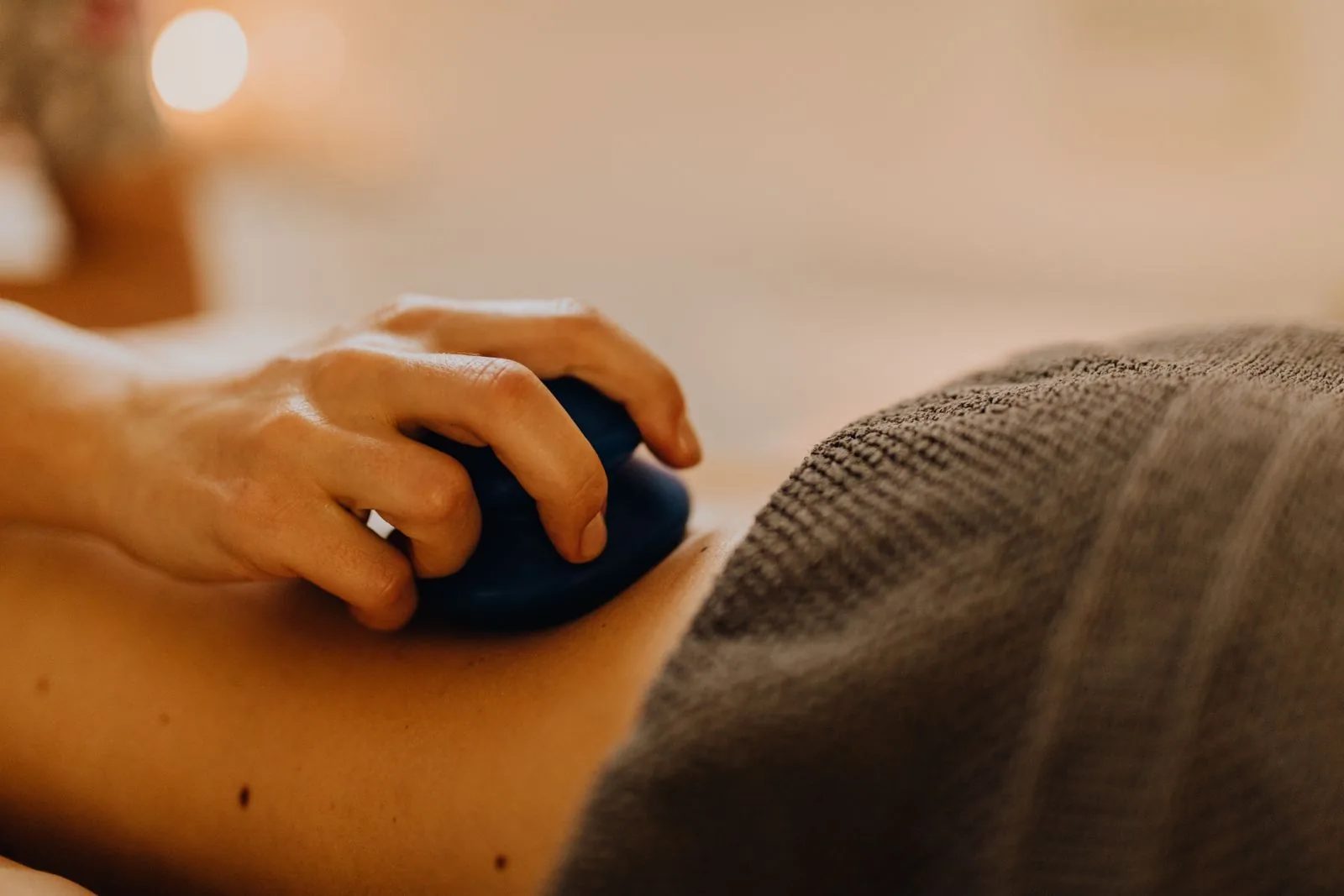
The “stones always move” rule
A stone in direct contact with the skin is always moving; if you need to pause on a spot, lift the stone off.
Alternate two sets of stones: one in use, one heating. Cool stones glide poorly, which tempts you to press harder to “make up for it”.
On the first pass, let the backs of your fingers touch the skin first and the stone second, so the client can get used to the heat.
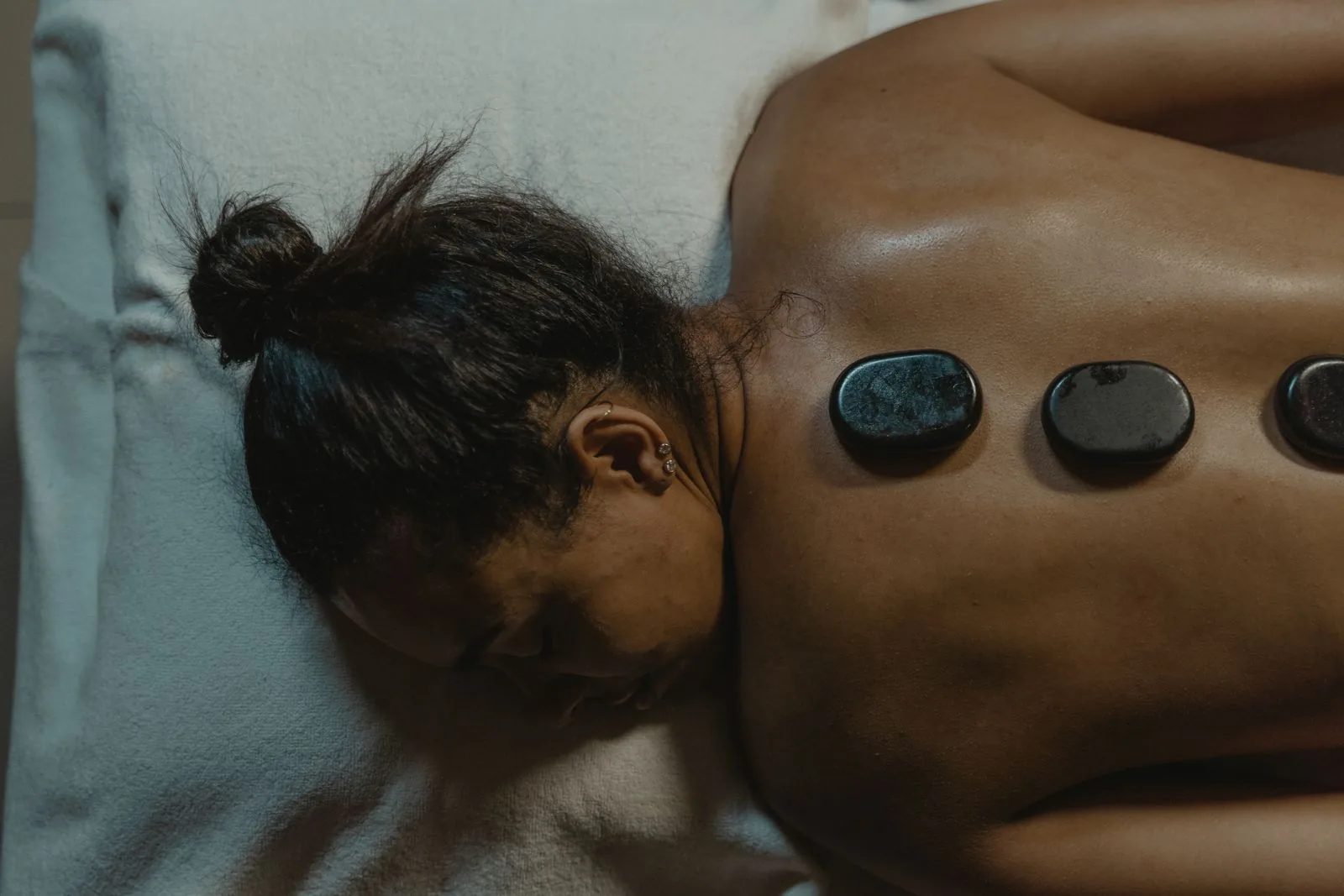
Recognising normal skin and signs of a burn
After stone strokes, skin that is slightly and evenly pink across the area and fades within a few minutes is a normal response to warmth. Stop immediately and check carefully if you see:
A dark red mark with a clear edge in the exact shape of a stone.
The client complains of stinging or prickling, or still feels a burning heat after the stone has been lifted.
Skin that is pale white, shiny or blistering.
A red area that does not fade after a few minutes.
First aid for a suspected burn
Stop immediately, remove all stones from the area, and switch off or turn down the heater.
Cool the skin with clean cool water (not ice water or ice applied directly) for about 20 minutes, in line with common burn first-aid advice. If there is no tap near the bed, use clean towels soaked in cool water and change them continuously.
Do not apply toothpaste, grease, massage oil, fish sauce or any folk remedy. Do not pop blisters.
Cover loosely with clean, dry gauze or a towel.
Inform the shift manager. Advise the client to see a doctor if there are blisters, if the burned area is large, or on the face, hands or joints, or if the client has diabetes or is elderly.
Record the incident: time, skin area, water temperature at that moment, which stone, and what was done. This information helps the spa review its procedure.
Worked case: a client wants hot stones but has diabetes
The situation
Ms Hanh, 52, books a 60-minute hot stone treatment because her “neck and shoulders are always tired”. Her health form says she is being treated for diabetes; when asked further, she says her feet are often numb and she once soaked her feet in hot water without realising it was too hot.
Identifying the risks
Diabetes with numb feet is a sign of reduced sensation: she may not notice that a stone is too hot on her legs.
She says she still feels heat normally on her neck and shoulders, but you cannot be sure from her description alone.
The spa where you work has a rule: clients with diabetes need a doctor's approval before heat treatments.
Plan and follow-up
You explain: “For clients being treated for diabetes, we need you to check with your doctor before hot stones, because you may not feel heat clearly and could get burned without knowing.” Today you suggest a bare-hand massage focusing on the neck and shoulders, avoiding heat on the feet and lower legs, and you record the reason on the form. When she comes back with her doctor's approval, the hot stone session covers only the back and shoulders, using stones at the low end of the temperature range, with no stationary stones, and checking the skin every few strokes.
The key point: you do not turn the client away; you choose a safer service and explain the reason clearly.
Cleaning stones and the heater after each client
Take out the used stones and wash them with soap and water to remove the oil, then disinfect them with a solution suitable for stone according to the manufacturer's instructions and the spa's procedure. Rinse thoroughly and let them air-dry or wipe them dry.
Do not put oily stones back into the shared heater: oil dirties the water and sticks to the sides of the heater.
Change the water and clean the heater according to the manufacturer's instructions and the spa's rules (many places change it at least daily). Unplug the heater and let it cool before emptying it.
Change the towel at the bottom of the heater, the towels under the stones and the bed linen after each client.
Details on disinfectant solutions and organising clean and dirty zones are covered in the lesson on cleaning and disinfecting tools and the treatment room.
Safety checklist
Before the client comes in
Dedicated heater, plugged into a socket with residual current protection, cable tidy and out of walkways.
Water temperature read with a thermometer and within the range the spa allows.
Stones checked for cracks and chips; stones clean and sorted by size.
Slotted spoon, towel-lined tray, bowl of cool water and thin towels for stationary stones are ready.
During the session
Health form and heat-specific questions completed; the client knows how to signal “too hot”.
Every stone tested through all three layers before touching the client.
Stones in direct contact with the skin always moving; stationary stones on a towel and lifted for checks.
The client never lies on stones; all stones removed before turning the client over.
Thermometer re-read several times during the session.
After the session
Look over all treated skin again and tell the client to report any redness or stinging.
Complete the form: areas treated, client feedback, any incident.
Wash and disinfect the stones; change towels; clean the heater as required.
Frequently asked questions
What temperature should hot stones be?
The reference level from US massage practice guidance is heating water of about 43–54 °C, not exceeding about 54 °C. In practice, read the thermometer, grip the stone for 5 seconds, press it on your forearm, then test on a small area and ask the client. Older clients and those with thin skin need gentler, less hot stones.
Can I heat stones in a rice cooker or a microwave?
You should not. These appliances are not designed to keep water at a stable temperature for massage stones, so stones may heat unevenly or become too hot. Use a dedicated stone heater with temperature control, with the stones submerged in water, and check with a thermometer.
Can pregnant women have a hot stone massage?
Not without a doctor's approval. Many professional sources list pregnancy among the conditions where heat treatments should be avoided or adapted. Spas usually offer a separate prenatal treatment with more suitable positioning and techniques.
What should I do if the client says “make it hotter”?
Keep to the spa's safety limit and explain: “Stones hold heat for a long time; hotter than this can easily burn you without you noticing at first.” If you want the client to feel warmer, change stones more often and cover the parts of the body not being worked on with towels to keep them warm, rather than raising the water temperature.
Does hot stone massage help with weight loss or detox?
Do not make such promises. This is a relaxation service; describe only the warm, pleasant sensation and do not promise weight loss, detox or a cure for any illness.
Practice exercises
Read the heater thermometer five times during a practice session; each time, grip a stone for 5 seconds and note how it feels next to the reading, so you learn how quickly your hands get used to the heat.
Role-play with a classmate: go through the health form and the three heat-specific questions, and decide whether to do hot stones for three scenarios given by the instructor (for example: diabetes, sunburned shoulders, a recently sprained ankle).
Practise gliding stones on a classmate's arm for 10 minutes, keeping the stones moving at all times and alternating two sets without ever letting a stone rest still on the skin.
First-aid drill: assume a client complains of stinging on the shoulder; carry out all six first-aid steps and fill in the incident form.
Perform the full routine of about 60 minutes with someone timing you, then wash and disinfect the stones and clean the heater.
Self-assessment criteria — you pass when:
No stone touches the client before it has been tested through all three layers.
You correctly identify the contraindications in the sample scenarios and can suggest an alternative service.
Stones in direct contact with the skin are always moving; at no point does the client lie on a stone.
You can read the signs of a burn and recite all the first-aid steps without looking at notes.
You finish within about 60 minutes and complete the form and the equipment cleaning in full.
After this lesson, you can add hot stone massage to the “Delivering a complete client treatment” step, and review the questions on heat and first aid when preparing for the “Safety & service skills assessment” step.