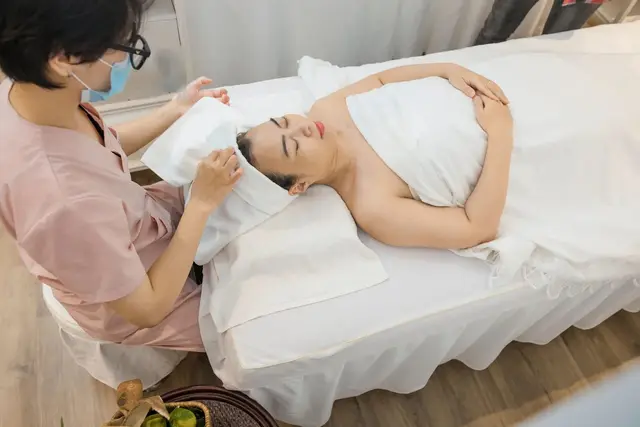
A client calls to book: “I’m seven months pregnant and my back aches so much. Do you offer pregnancy massage?” Should you accept her, what do you need to ask, how should she lie, which areas should you avoid, and when must you stop immediately?
The short answer: accept only when the client confirms she has asked her prenatal doctor, the health form shows no warning signs, and the spa has a policy and a therapist trained in prenatal massage. The client lies on her side supported by pillows, pressure is light to medium, there is no abdominal massage and no deep pressure on the legs, the room is pleasantly cool and no heat is used. If you notice anything unusual, stop, help the client lie on her left side, inform the manager and call 115 (Vietnam’s emergency number) if it is serious.
This lesson is written for spa therapists. By the end of this lesson, you will be able to decide whether to accept, postpone or decline a pregnant client, ask the right health questions, set up a safe side-lying position with pillows, apply suitable pressure while avoiding the areas of concern, and recognize and respond to the signs that mean you must stop. Prenatal massage at a spa is relaxation massage, not treatment: do not promise “no more swollen feet”, “less labour pain”, “an easier birth” or “turning the baby”. For any question about the health of the mother or baby, the therapist directs the client to her prenatal doctor.
How prenatal massage differs from regular body massage
The table below is a general reference; the final decision follows the client’s doctor’s opinion and the spa’s rules.
Item | Regular body massage | When the client is pregnant (reference, per spa rules) |
|---|---|---|
Acceptance criteria | Read the health form, ask about contraindications | Additionally: the client confirms she has asked her prenatal doctor; many spas do not accept the first trimester or high-risk pregnancies |
Position | Face down, face up | Side-lying with pillow support (usually left side); semi-reclined instead of lying flat on the back; never face down |
Pressure | Light, medium or strong on request | Light to medium; no deep pressure, no deep tissue, no hard tapping, no strong stretching |
Abdomen | May be stroked lightly according to the routine | No massage |
Legs, calves | Gliding, kneading, pressing according to the routine | Light strokes only; no deep pressure on the inner calves or inner thighs; if one side is swollen and painful, do not work on the legs |
Oils, essential oils | According to the spa’s products | Prefer unscented carrier oil; use essential oils only when spa policy and the product instructions allow |
Heat | May include sauna, hot stones, hot packs | No sauna, hot stones, hot tubs or hot packs |
Duration | 60–90 minutes | Usually 45–60 minutes (reference); the first session should be shorter |
Acceptance criteria: accept, postpone or decline
General principle
The spa should have a written prenatal massage policy; therapists follow it and do not make their own decision because a client insists.
Three minimum conditions before accepting:
The client confirms she has asked her prenatal doctor and the doctor has not advised against massage. The therapist does not replace the doctor in assessing the pregnancy.
The health form is fully completed, with none of the warning signs listed below.
A therapist trained in prenatal massage is available and the room has enough support pillows.
First trimester
Many spas have a policy of not offering body massage during the first trimester, or only accepting the client with her doctor’s approval. This is a common precautionary spa policy, not a medical conclusion. Sample wording: “We only offer pregnancy massage after the first three months. Please check with your doctor and we can book you in later.”
Do not accept until a doctor has given an opinion
If the client reports any of the following, do not accept and advise her to ask her prenatal doctor first:
The doctor has said this is a high-risk pregnancy, or advised limiting activity or plenty of bed rest.
She has had or is having bleeding or vaginal fluid leakage during this pregnancy.
The doctor has mentioned a placental problem, threatened preterm labour, a previous preterm birth, or early contractions.
High blood pressure, pre-eclampsia, or the doctor is monitoring her blood pressure.
History of blood clots (thrombosis), or currently taking anticoagulants.
A chronic illness under treatment (heart disease, diabetes, kidney disease…); a multiple pregnancy.
Postpone for the day
If on the day the client has any of the following, postpone:
Fever, cold or flu, vomiting, diarrhoea, exhaustion, dizziness.
Abdominal pain, tightening of the belly, a recent fall or blow to the abdomen: no massage, advise the client to contact her doctor immediately.
Scratched or red, rashy skin in the treatment area; she has just eaten a heavy meal or is very hungry.
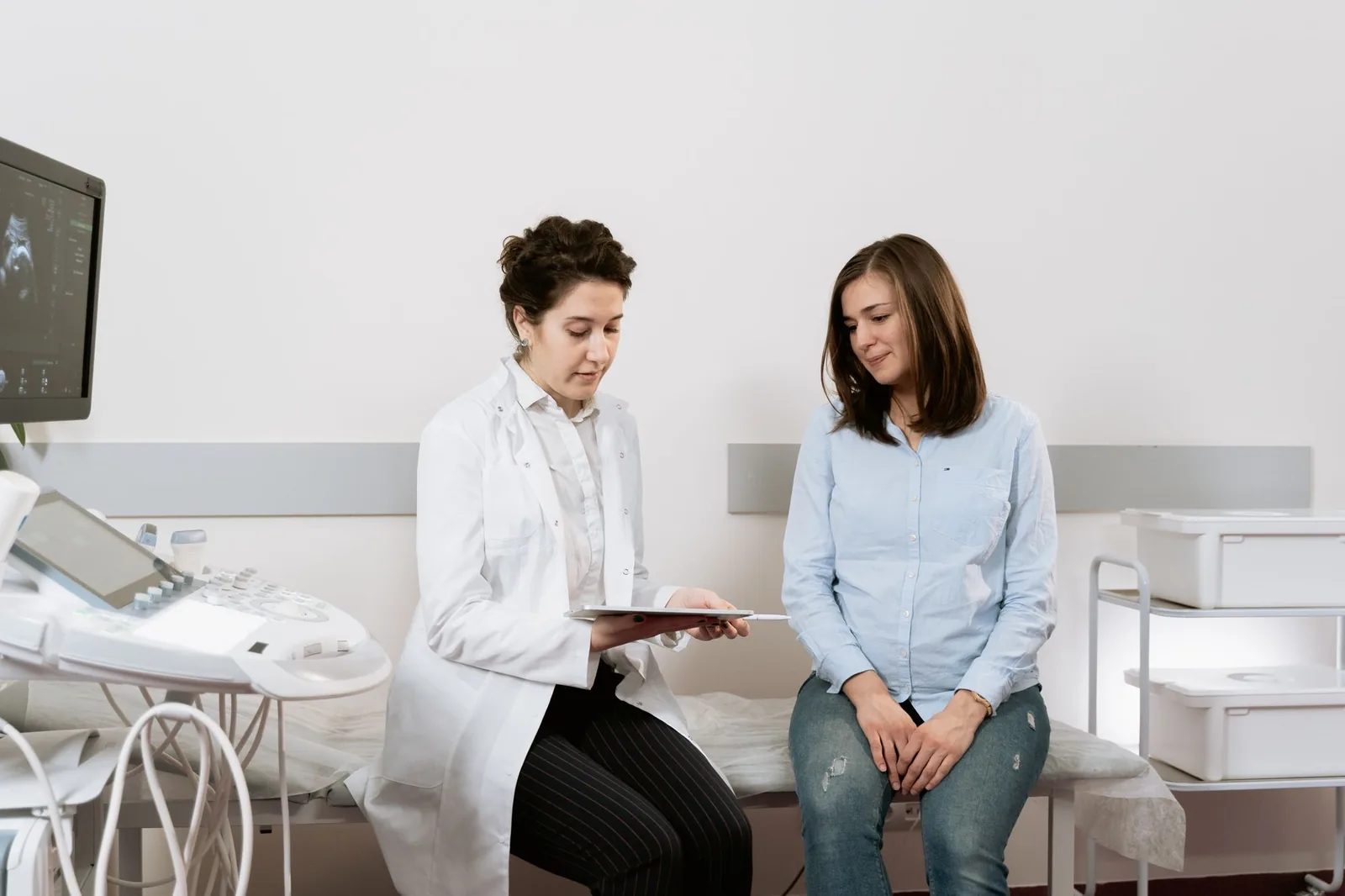
Figure 1. A doctor in a white coat talks with a woman sitting on an examination bed next to an ultrasound machine. Pregnant clients should ask their prenatal doctor before having a massage. (Photo: MART PRODUCTION, Pexels)
Health information form: questions to ask
Use the spa’s general health form and add these specific questions; ask in a private place and record exactly what the client says:
How many weeks pregnant are you? When was your last prenatal check-up?
Has your prenatal doctor agreed that you can have a massage? Did the doctor tell you to avoid anything?
During this pregnancy, have you had any bleeding, fluid leakage, abdominal pain or tightening?
Do you have high blood pressure, diabetes, heart disease, kidney disease or a history of blood clots? Are you taking any medication?
Recently, have you had severe headaches, blurred vision, or sudden swelling of the face or hands?
Is there any pain, swelling, redness or warmth in one of your calves? Do you have visible veins on your legs?
Are you allergic to any oils or creams? Are there any smells you can’t stand at the moment?
Which side do you find more comfortable to lie on? Is there anywhere that hurts, or anywhere you don’t want touched?
A relative’s phone number so the spa can contact them if needed.
At the bottom of the form, the client signs to confirm she has asked her doctor and that the information given is correct. Each time the client returns, ask questions 2, 3, 5 and 6 again.
Sample consultation phrases:
“We don’t massage the abdomen, so don’t worry when I skip that area.”
“During the session, if you feel dizzy, short of breath, have abdominal pain or anything unusual, tell me right away and I’ll stop immediately.”
Preparing the room, pillows and oil
Room: pleasantly cool, well ventilated, close to a toilet.
Table: sturdy and stable; set low or with a step stool and handrail; the floor dry and not slippery.
Pillows: a body pillow or pregnancy pillow and a few loose pillows with clean covers, one set per client.
Oil: prefer an unscented carrier oil that has been patch-tested according to the spa’s procedure. Do not blend essential oils yourself; use them only when spa policy and the product instructions allow use for pregnant women and the client is not sensitive to smells.
Safe positions for pregnant clients
Side-lying with pillow support: the main position
Many guidelines favour lying on the left side, especially in the later stages of pregnancy; halfway through, switch to the right side to work on the other half, if the client is comfortable.
How to place the pillows:
Pillow under the head: high enough to keep the neck in line with the spine.
Pillow between the knees and lower legs: the upper leg is slightly bent and rests on the pillow so the knee is level with the hip; the lower leg is fairly straight.
Small pillow or folded towel under the belly: just enough support so the belly does not sag, without pressing into it.
Body pillow in front of the chest: for the upper arm to rest on, so the shoulder does not roll forward.
Once set up, ask: “Are you comfortable lying like this? Is anything pressing on your belly?” and only then begin.

Figure 2. A pregnant woman lies on her side on a bed with her head on a pillow and a pink pillow placed close in front of her belly and arm. Side-lying with pillow support is the main position for prenatal massage. (Photo: cottonbro studio, Pexels)
If you have no pregnancy pillow, use three or four loose pillows, as long as every area has support.
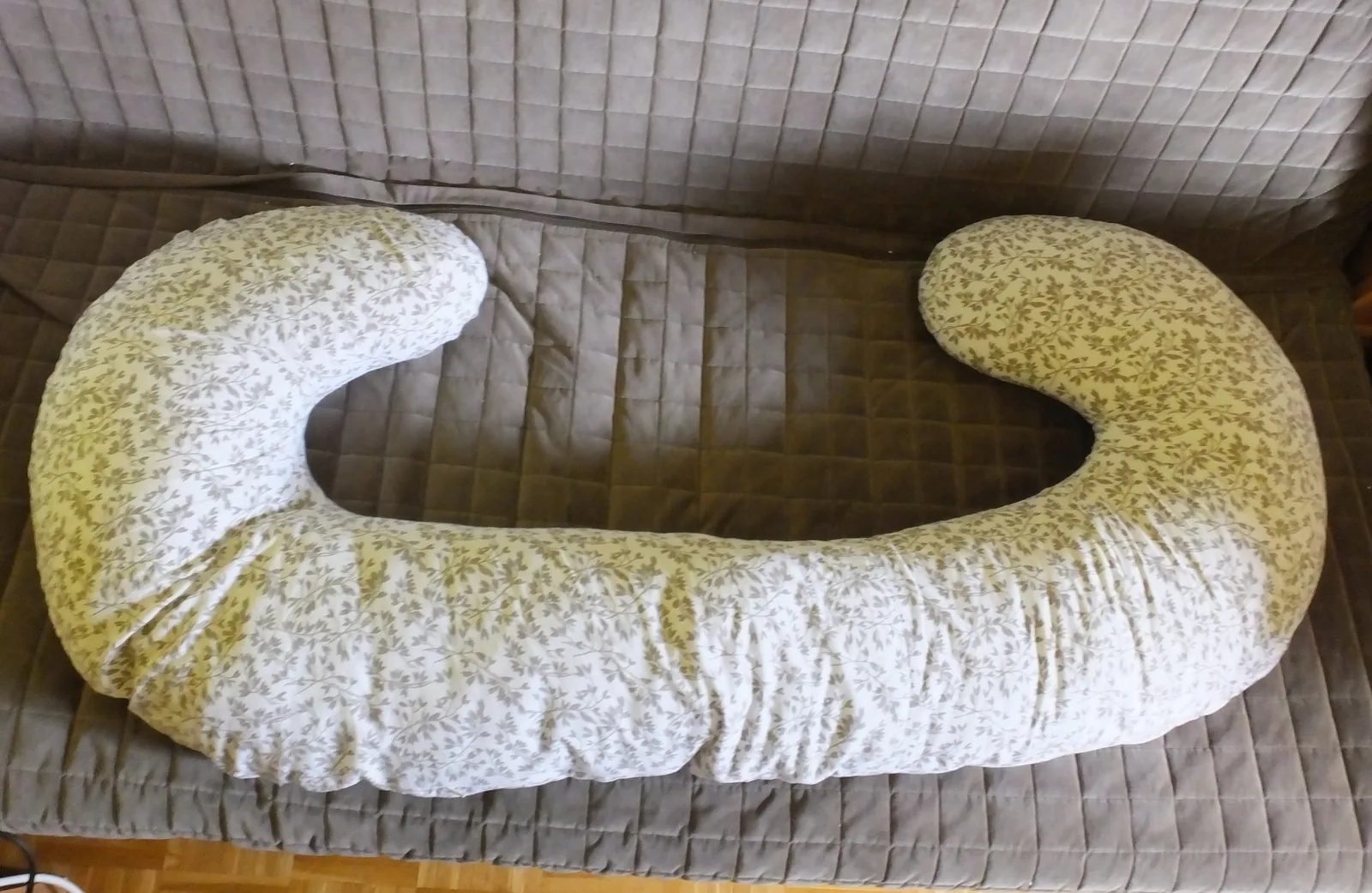
Figure 3. A long C-shaped pillow with a leaf-print cover on a sofa. This type of pillow supports the head, is hugged in front of the body and is held between the legs when lying on the side. (Photo: Panek, Wikimedia Commons, CC BY-SA 4.0)
Semi-reclined instead of lying on the back
When you need to work on the face, head, front of the shoulders, arms or feet, have the client recline with her back raised (raise the head of the table or place pillows behind her back), with a pillow under the knees so they are slightly bent.

Figure 4. A pregnant woman reclines against several pillows on a bed, with her head and shoulders raised and her hand on her belly. This position replaces lying flat on the back. (Photo: Yan Krukau, Pexels)
Avoid lying flat on the back for long in later pregnancy
Once the belly is large, lying flat on the back for a long time can cause the uterus to press on the large blood vessels in the abdomen; some clients feel dizzy, nauseous, sweaty or short of breath. If these signs appear, help the client turn onto her left side immediately.
Do not let the client lie face down
Do not let a pregnant client lie face down with weight on her belly. Tables and cushions with a belly cut-out should only be used when the spa has specialist equipment and its own rules; side-lying is still the safest.
Getting onto the table, turning over and sitting up
Getting on: the client sits on the edge of the table and leans over to lie down while you support and lift her legs.
Turning over: hold the drape in place and let the client roll slowly to the other side, with no sudden twisting; rearrange the pillows.
Sitting up: the client rolls onto one side, pushes herself up with her arms, sits on the edge of the table and rests for a few breaths before standing; you stand beside her to support her.
Pressure and areas to avoid
Light to medium pressure
Use mainly long gliding strokes, gentle circular rubbing and light strokes along the muscles. Do not do deep tissue work, deep point pressure, hard tapping or chopping, joint cracking or strong stretching. If the client asks you to “press harder”, explain: “While you’re pregnant, we only use medium pressure. I’ll focus on the tired areas for you.”
Abdomen: no massage
The therapist does not massage the abdomen in any form. Keep the belly fully draped; if the client wants cream on her belly, let her apply it herself.
Legs and calves: light strokes only
Use only light strokes; no kneading or deep pressure on the inner calves and inner thighs.
Do not rub directly over bulging, twisted veins.
One calf painful, swollen, red or warmer than the other: this may be a sign of a blood clot. Do not massage the legs, do not “rub it away”, and advise the client to see a doctor the same day. If there is also shortness of breath or chest pain, call 115.
Rapidly increasing swelling, or swelling with headache or blurred vision: no massage, advise the client to see a doctor immediately.
Acupressure points commonly advised to avoid
Many sources advise avoiding deep pressure on certain points during pregnancy:
The area between the thumb and index finger (the web of the hand) on the back of the hand.
The area about four finger-widths above the inner ankle bone, on the inside of the lower leg.
The area around the ankles and heels.
The point in the middle of the top of the shoulder, at the highest part of the shoulder muscle.
The evidence for these points is unclear, but as a precaution, spas usually require only light strokes over them, with no sustained or deep pressure. Never tell a client that a point “induces labour” or is “good for the baby”.
In addition: the lower back and sacrum get only light to medium rubbing, with no hard pressure on the bones; no breast massage and no pressure on the front of the neck.
Room temperature and drinking water
Keep the room pleasantly cool, use a light drape, and ask “Are you too warm or too cold?” a few times during the session. Do not combine a dry sauna, steam room, hot stones, hot tub or hot wrap with the prenatal massage package.
Offer the client water before and after the session, and let her go to the toilet partway through if needed.

Figure 5. A pregnant woman sits on the edge of a bed drinking water; the bedside table holds a jug of water. Offer the client water before and after the massage. (Photo: Yan Krukau, Pexels)
Sequence of a prenatal massage session of about 60 minutes (reference)
Timings are for reference only; the first session should be shorter, about 45 minutes.
Welcome the client and read the form (about 10 minutes): re-ask the warning questions, explain the position and the areas you will not work on; invite the client to use the toilet and drink water.
Place pillows, first side-lying position (about 5 minutes): usually the left side; drape fully and uncover only the area being worked on.
Upper back, shoulders and neck (about 12 minutes): long strokes along both sides of the spine, gentle rubbing of the shoulders and back of the neck, light strokes on the lower back. No deep pressure on the top of the shoulder.
Hip and upper leg (about 5 minutes): gentle rubbing of the buttock and outer hip; legs get light strokes only, no kneading of the inner calf.
Turning over (about 3 minutes): slowly, with assistance, rearranging the pillows.
Back, shoulders, neck, hip and leg on the other side (about 15 minutes).
Semi-reclined: arms, head, face (about 7 minutes): rub the arms and hands (no deep pressure on the web of the hand), gently massage the scalp.
Closing (about 3 minutes): wipe off excess oil, help the client sit up slowly, offer water, ask how she feels and give aftercare advice.
Signs you must stop immediately
Stop the massage immediately if the client shows any of the following:
Vaginal bleeding, however slight.
Leaking or gushing vaginal fluid that wets the towel.
Abdominal pain, the belly tightening hard in waves or at regular intervals.
Severe headache, blurred vision, seeing spots of light or flashing.
Sudden swelling of the face or hands.
One calf painful, swollen, red or warm.
Dizziness, nausea, sweating, faintness, shortness of breath, chest pain.
The client says the baby is moving much less than usual.
The client simply feels unwell and wants to stop.
What to do when abnormal signs appear
Stop immediately; do not carry on “to finish the back”.
Help the client lie on her left side with pillow support, or in whatever position she finds most comfortable. Do not let her stand up suddenly.
Do not leave the client alone; call the manager or a colleague for help.
Call emergency services on 115 immediately if the client has heavy bleeding, fluid leakage, severe abdominal pain or regular contractions, a severe headache with blurred vision, shortness of breath, chest pain, fainting or seizures, or whenever you are unsure. State the spa’s address clearly and say how many weeks pregnant the client is.
Contact the client’s relative using the number on the form, and remind the client or relative to call her doctor or prenatal clinic.
Do not give the client any medication and do not diagnose. In mild cases where she recovers fully after resting: end the session, advise her to tell her doctor, and do not let her go home alone while she is still tired.
Write an incident report: the time it happened, the signs, what was done and who was informed.
Record-keeping after each session
Record on the form: the week of pregnancy the client reported and her confirmation that she asked her doctor; the position, side and pillow arrangement; the oil used; the areas worked, the areas skipped and why; any unusual signs and how they were handled; the therapist’s name and the start and end times.
Real-life scenarios
Scenario 1: A client 10 weeks pregnant who has not asked her doctor. She has back ache and wants a full-body massage. The spa does not offer body massage in the first trimester. Explain gently, advise her to ask her doctor, offer to rebook later if the doctor agrees, and record the consultation.
Scenario 2: During the session the client complains of pain in her left calf. A client at 32 weeks says her left calf has hurt for a few days and looks bigger than the right one. Do not massage the legs and do not rub the painful area; end early or only work lightly on the back and shoulders if she wishes. Advise her to see a doctor the same day; if she is short of breath or has chest pain, call 115. Record it on the form.
Scenario 3: The client feels dizzy while lying on her back for facial work. A client at 30 weeks lies flat on her back for a few minutes and then says she feels dizzy and nauseous. Stop, help her onto her left side and stay with her to monitor; next time, do facial work in the semi-reclined position. If she does not improve or other signs appear, call 115.
Prenatal massage safety checklist
The spa has a prenatal massage policy and you have been trained.
The client has signed to confirm she asked her doctor and does not fall into a “do not accept” or “postpone” category.
You have re-asked about bleeding, fluid leakage, abdominal pain, headache, blurred vision, swelling of the face or hands, and pain or swelling in one calf.
The room is pleasantly cool, no heat is used, drinking water is ready and the floor is dry.
There are enough pillows; the client is side-lying and you have asked “are you comfortable?”; no face-down position, no lying flat on the back for long.
Unscented oil; no self-blended essential oils.
Light to medium pressure; no abdominal massage; light strokes only on the legs; no deep pressure on the web of the hand, above the inner ankle, around the ankles or on the top of the shoulder.
You know the stop signs and the 115 emergency number.
The client sits up slowly, drinks water and rests before standing; the record has been completed.
Frequently asked questions
Does prenatal massage reduce swollen feet or make birth easier?
Make no promises. Spa massage is for relaxation; the therapist never says massage “gets rid of swelling”, “reduces labour pain” or “makes birth easier”. If foot swelling is severe or increasing quickly, advise the client to ask her prenatal doctor.
At how many months of pregnancy can a client have a massage?
There is no single milestone for everyone. It depends on each client’s prenatal doctor and the spa’s policy; many spas only offer body massage after the first trimester and do not accept high-risk pregnancies.
Can the client lie face down on a cushion with a belly cut-out?
Only when the spa has specialist equipment and its own rules, and you have been trained to use it. Otherwise, use the side-lying position with pillow support.
Can essential oils be used for pregnant clients?
Do not blend them yourself. Prefer unscented carrier oil; use essential oils only when spa policy and the product instructions allow.
Practice exercises
Groups of three: a “client” (fully clothed), a therapist and an assessor using the checklist; with an instructor supervising.
Scenario cards: 6 cards (12 weeks, has not asked the doctor; 24 weeks with doctor’s confirmation; high blood pressure; bleeding last week; right calf swollen and painful; severe sensitivity to smells). For each card, decide whether to accept, postpone or decline, and say your explanation.
Completing the form: ask all 9 questions and invite the client to sign the confirmation.
Setting up side-lying pillows: within 5 minutes, place the head pillow, the pillow between the legs, the belly support and the body pillow; ask “are you comfortable?” and adjust.
Turning over and sitting up: help the client turn over, roll onto her side and push herself up to sitting.
Responding to warning signs: partway through, the “client” reports dizziness while lying on her back, or says she is bleeding. The therapist stops, helps her onto her left side, calls the manager, states the correct information when calling 115 and writes the incident report.
You pass when you: get all 6 cards right, place pillows in all four positions, do not touch the abdomen, do not apply deep pressure on the legs or the points to avoid, and respond correctly when warning signs appear.
This lesson belongs to the “60-minute relaxing body massage” step, because prenatal massage is body massage adapted in position, pressure and treatment areas; you will reuse the acceptance criteria, stop signs and emergency response in the “Safety checks & service skills” step.