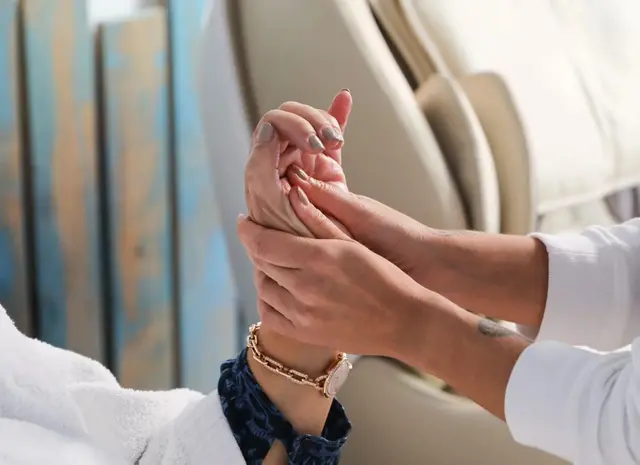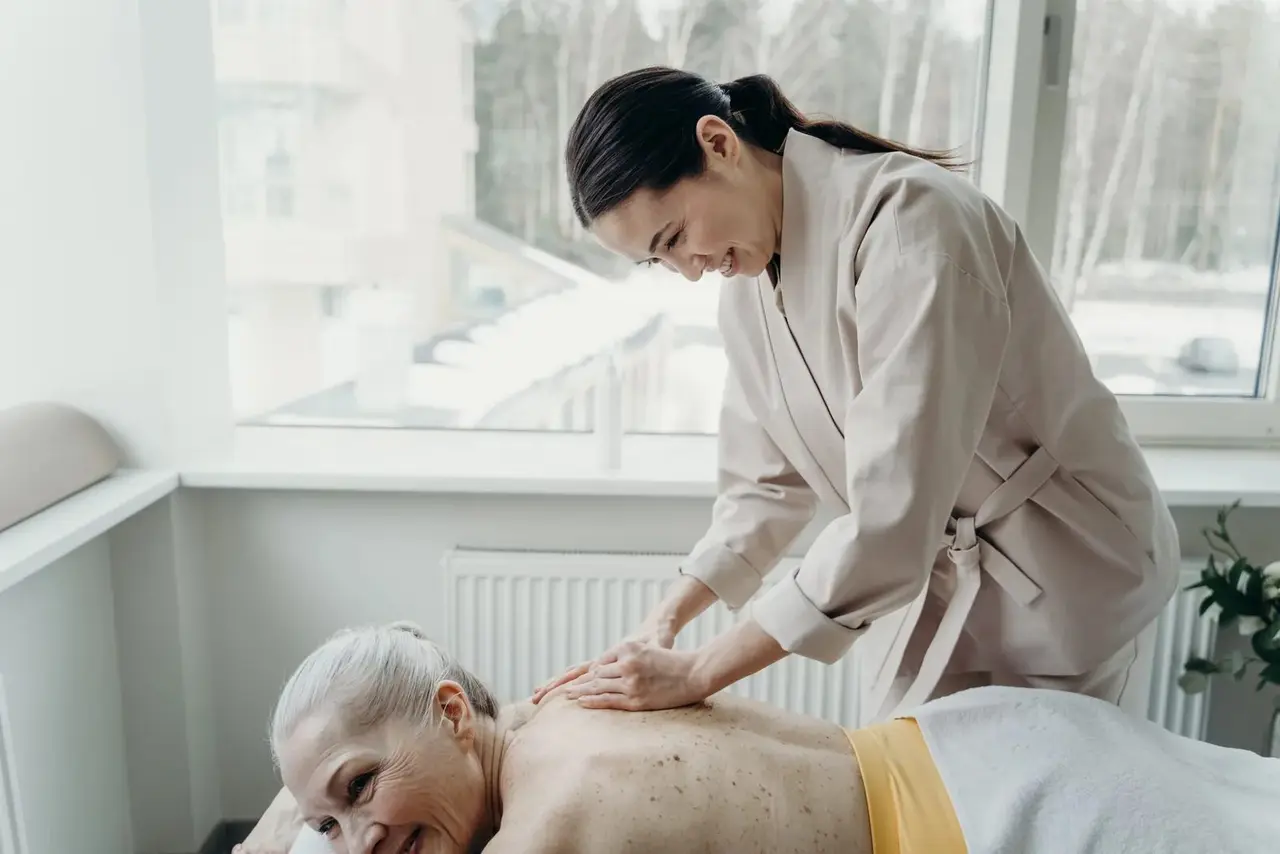
Mrs Lan is 72. Her daughter has booked her a 60-minute body massage as a birthday present. The health form says: high blood pressure on medication, “taking blood thinners prescribed by a cardiologist”, pain in the right knee when climbing stairs, and frequent dizziness when standing up quickly. She tells the receptionist quietly: “I've never had a massage before, I'm afraid it will hurt.” What should the therapist do so that she can relax and still be safe?
The short answer: massage for older clients at a spa is relaxation massage with light pressure, a shorter duration, more support and more checking in than for younger clients. For Mrs Lan: ask the exact names of her medicines and whether the doctor has said anything about massage; use only gentle stroking and light rubbing, no deep kneading, no pressure-point work, no joint cracking; avoid the painful knee; use no strong heat; help her on and off the table; when finished, let her sit on the edge of the table for a while before standing up; and wipe the oil off the soles of her feet before she steps onto the floor.
This lesson focuses on how to adapt a massage session for older clients; basic body massage, draping and the health intake form have their own lessons on NAMBIN. Spa massage is a relaxation service; it does not treat illness and does not replace a doctor's advice. By the end of this lesson, you will be able to run a more thorough health check with older clients, decide whether to proceed, adapt or postpone, prepare the room to prevent falls, help clients on and off the table safely, choose suitable pressure and positions, and recognise the signs that mean you must stop.
How massage for older clients differs from a standard body massage
Vietnam's Law on the Elderly defines older people as those aged 60 and over, but some 75-year-old clients are still very fit while some 62-year-olds already have many underlying conditions. You adapt to each client's actual condition, not their year of birth. Common changes with age:
Thin, dry, less elastic skin: bruises and scrapes easily, and can sometimes tear just from firm rubbing.
Bones may be more brittle (osteoporosis), and many people do not know they have it.
Several underlying conditions and several medications: blood pressure, diabetes, heart disease, anticoagulants, diuretics.
Dizziness when changing position, especially when going from lying down to standing.
Reduced sensitivity to heat and pain, especially in the feet of people with diabetes.
Poorer hearing and eyesight, slower walking, feeling cold easily, and a greater risk of slipping on wet floors or with oily feet.
For these reasons, a massage for an older client is usually shorter (about 30–45 minutes is reasonable for a first session, for reference), uses lighter pressure and fewer changes of position, and you check in with the client more often.
Before the session: a more thorough health intake
Who booked and who consents
Older clients are often booked by their children or grandchildren. The person who made the booking cannot answer everything on the client's behalf. You still ask the client directly, speaking slowly and clearly and making eye contact.
If the client is forgetful and cannot remember what medicines they take: invite a family member to fill in the form together.
If the client does not seem to understand what is about to be done, or appears unwilling: do not proceed, even if the family has already paid.
If the client wants a family member in the room: agree if it is consistent with spa rules.
Questions to ask
In addition to the general health form, ask older clients these extra questions:
“Are you being treated for any condition? Blood pressure, heart, diabetes, bones and joints?”
“What medicines are you taking? Any anticoagulants or blood thinners? Do you bruise easily?”
“Do you have osteoporosis, have you ever broken a bone, or had a hip or knee replacement?”
“Have you recently had surgery, been in hospital or had a fall?”
“Do you often feel dizzy when standing up, have numb feet, or unusual swelling or pain in your legs?”
“Do you have a pacemaker or any other implanted device?”
“Which position do you prefer to lie in, and do you like light or medium pressure? Is there anywhere you would prefer me not to touch?”
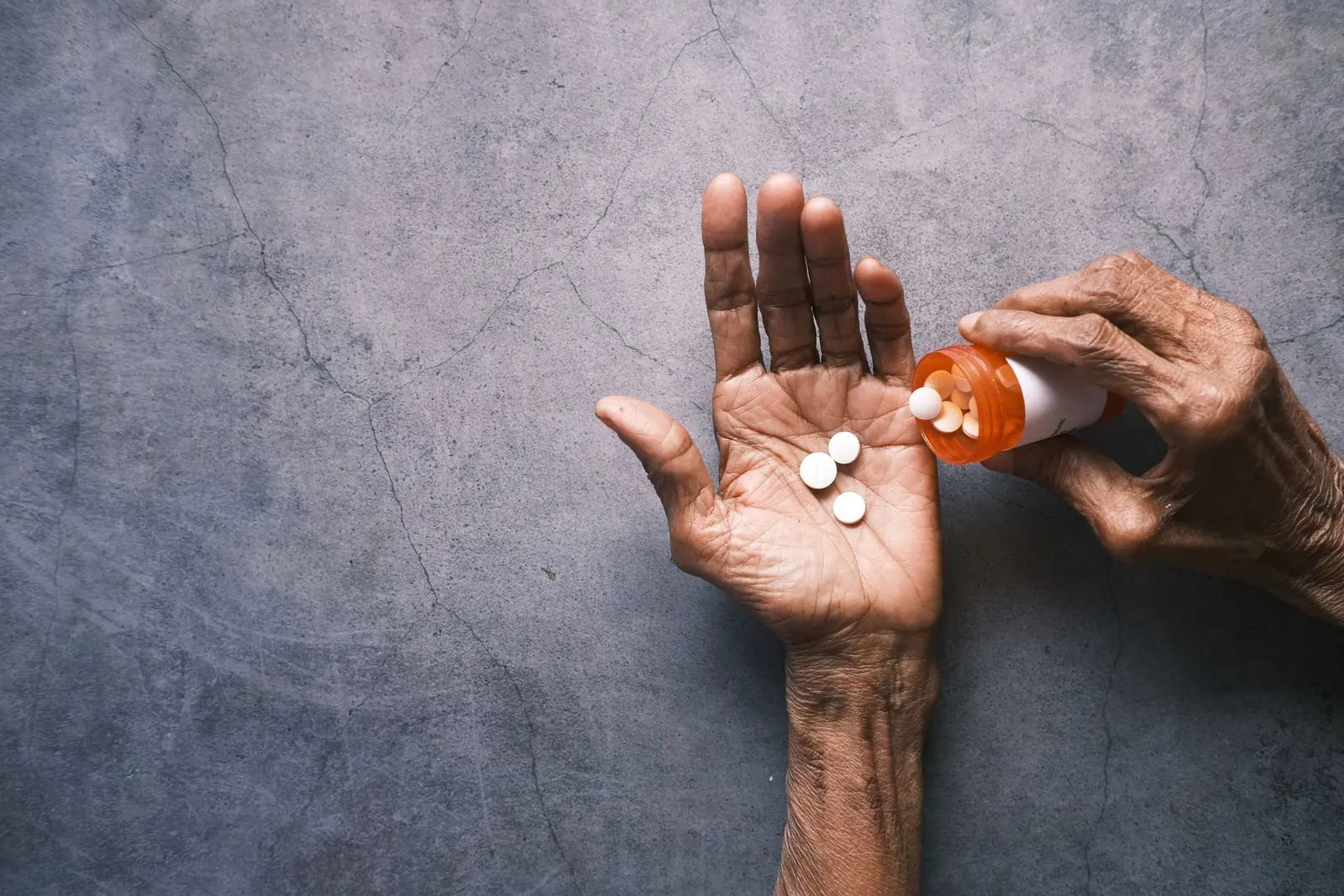
If the client cannot remember the names of their medicines, ask them to bring the prescription or the medicine boxes to the next session, and use only very light pressure today. You do not judge for yourself how “strong” a medicine is and you never advise a client to stop taking medication in order to have a massage.
Decision table: proceed, adapt or postpone (for reference)
Client's condition | Massage | How to handle it (for reference) |
|---|---|---|
High blood pressure that is well controlled, not feeling tired today | Adapt | Do not keep the client face down for too long, no steam, sit up slowly; postpone if there is a headache or dizziness today |
Taking anticoagulants, bruises easily | Adapt | Only gentle stroking and rubbing; no deep kneading, no pressure points, no cupping, no coin scraping (gua sha) |
Known osteoporosis, previous fracture from a minor fall | Adapt | Light pressure, no pressing on the spine or ribs; no twisting, no strong stretching |
Hip or knee replacement | Adapt | Ask which positions the doctor said to avoid; do not bend, rotate or cross the leg on that side; do not massage over the scar |
Diabetes, numbness, reduced sensation in the feet | Adapt | Light pressure, no heat, check the skin of the feet before and after |
Recent surgery, recent hospital stay, recent fall | Postpone | Wait for the treating doctor's opinion |
One calf unusually swollen, painful, hot and red | Do not proceed / stop | Suspected blood clot: advise seeing a doctor immediately, do not massage the legs |
Fever, very tired, shortness of breath or chest pain today | Do not proceed | Advise seeing a doctor; for chest pain or shortness of breath, call an ambulance |
Undergoing cancer treatment, severe heart disease, kidney failure | Postpone | Only proceed with the treating doctor's approval and exactly as instructed |
Pacemaker | Adapt | Do not press over the device; do not use electrical or wave-based spa machines without clear guidance from the manufacturer and the doctor |
The table reflects cautious professional practice, not a diagnosis. When in doubt, choose the safer option: reduce pressure, skip the area, shorten the session, or postpone and advise the client to ask their doctor.
Preparing the room, table and walkway to prevent falls
With older clients, falls tend to happen outside the massage itself: when entering the room, climbing onto the table, or standing up after the session.
The table and step
Lower the table (if adjustable) so the client can sit on the edge with their feet on the floor; raise it while you work and lower it again before the client sits up.
If the table cannot be adjusted, use a sturdy, non-slip step; always stand beside the client as they step up and down.
Lock the table's wheels (if any) and check that the table does not wobble.
Floor, slippers and lighting
Keep the floor dry, with no cables or small slippery rugs in the walkway.
Provide slippers with non-slip soles, not thin, slippery ones.
Lighting should be soft but bright enough to see the floor clearly when the client comes in and goes out.
Wipe the oil off the soles of the client's feet before they step down.
Temperature, blankets and drinking water
Older people feel the cold easily. Keep the room comfortably warm and have an extra light blanket ready to cover the parts of the body already finished.
A table warmer (if available) should be set only to a mild level, checked with your own hand first, and not used with clients who have numbness or reduced sensation.
Invite the client to use the toilet before the session and tell them beforehand that you can pause mid-session if needed.
Have warm water ready for the client to drink after the session.
Helping the client onto the table, changing position and sitting up safely
Getting onto the table
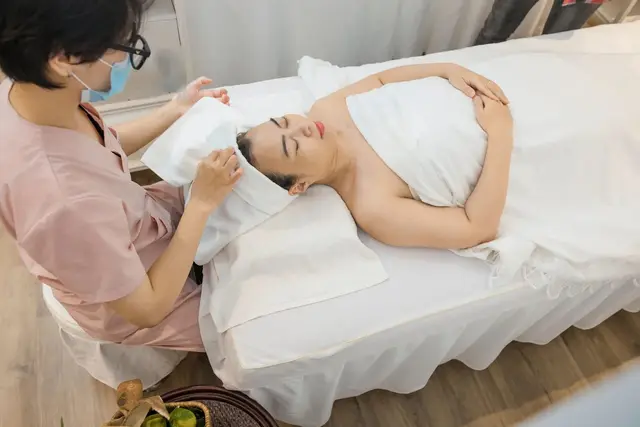
The client sits on the edge of the table with both feet on the floor or on the step.
Stand slightly to one side, one hand supporting the back and the other under the client's forearm. Do not pull the client's arm or lift the client with your own strength.
The client lowers themselves onto their side, brings both legs up onto the table, and only then rolls into the required position. Drape immediately.
Choosing a position: on the back, on the side or face down
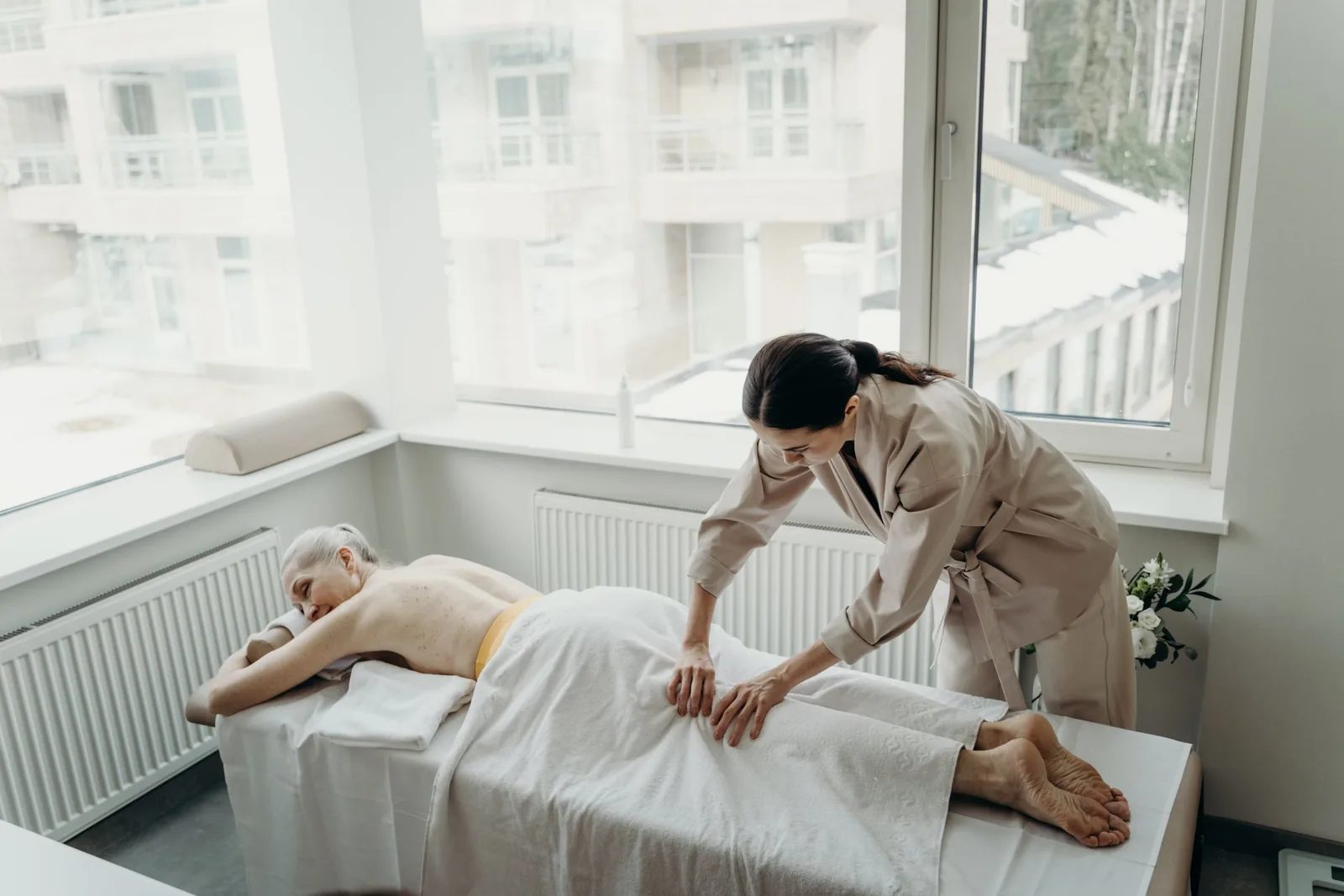
Lying on the back with bolsters: a thin pillow under the head and a round bolster under the knees. For many older clients this is the most comfortable position.
Side-lying with pillows: a pillow under the head, a pillow to hug in front of the chest and a pillow between the knees. Use this when the client finds lying face down difficult, has a stooped back, or has had a hip replacement (following the doctor's instructions).
Face down: only if the client is comfortable, for a short time, with a thin cushion under the ankles; if the client has trouble breathing or a stiff neck, switch to side-lying.
Turning over
Hold the drape secure on both sides and say beforehand: “Please roll slowly towards me, there's no hurry.” Do not rush the client, and do not pull on their shoulder or hip. If turning is difficult for the client, work in fewer positions (for example on the back and then on the side) instead of insisting on face down and face up.
Sitting up and standing
This is when dizziness and falls are most likely:
Lower the table (if possible) and turn the lights up.
The client lies on their side, bends the knees and pushes up with the arms to sit on the edge of the table; you support the shoulders and back.
Let the client sit still on the edge of the table for a while (about one to two minutes, for reference) with both feet on the floor, breathing steadily. Ask: “Do you feel dizzy or is your vision blurry?”
Wipe the oil off the feet and put non-slip slippers on the client.
The client stands up when they feel fine, with you right beside them. If they still feel dizzy, let them keep sitting — do not let them stand.
Walk with the client to the waiting area and offer a glass of warm water.
Pressure and techniques suited to thin skin and brittle bones
Thin skin that bruises and tears easily
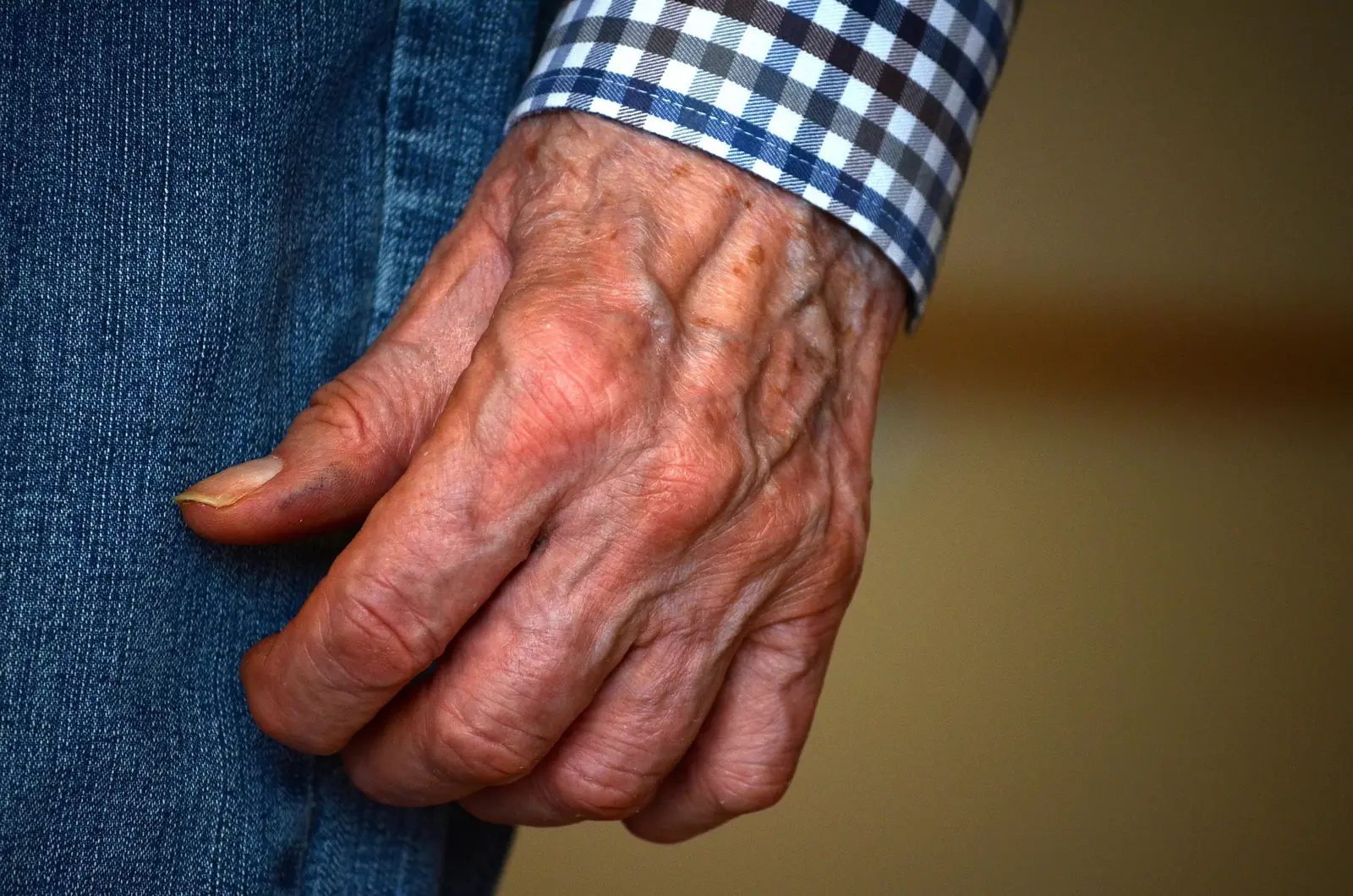
Use enough oil or cream so your hands glide smoothly without stretching the skin. If the skin is very dry, add more rather than rubbing harder.
Use the whole hand to spread the pressure widely; do not use your elbows or fingertips on pressure points.
No deep kneading, no pinching the skin, and no coin scraping or cupping for clients on anticoagulants or with thin skin.
Keep your nails short and smooth; remove rings and your watch.
Skip areas with bruises, scrapes, ulcers or very thin skin and simply keep them covered.
After the session, look over the treated skin again; if you see any scrape or bruise, tell the client, record it and report to your manager.
Bones and joints
Do not press on the spine, ribs, shoulder blades or pelvis; apply pressure to the muscles on either side.
Do not twist the body, crack joints or forcefully stretch the arms and legs, even if the client asks.
Skip any joint that is swollen, hot, red or painful.
Clients with joint replacements: do not massage over the scar and do not move that joint into positions the doctor has said to avoid (usually deep bending, inward rotation or crossing the legs for a hip; ask the client specifically).
Legs, veins and swelling
Swelling in both legs: ask whether a doctor has examined it; only stroke gently upwards, without deep pressure.
Prominent varicose veins: do not press or knead over that section.
One calf unusually swollen, painful, hot and red: do not massage the legs; advise the client to see a doctor immediately because it may be a blood clot.
Clients with diabetes: look carefully at the feet before starting; if there is an ulcer, do not work on the feet and advise the client to tell their doctor.
Head and neck
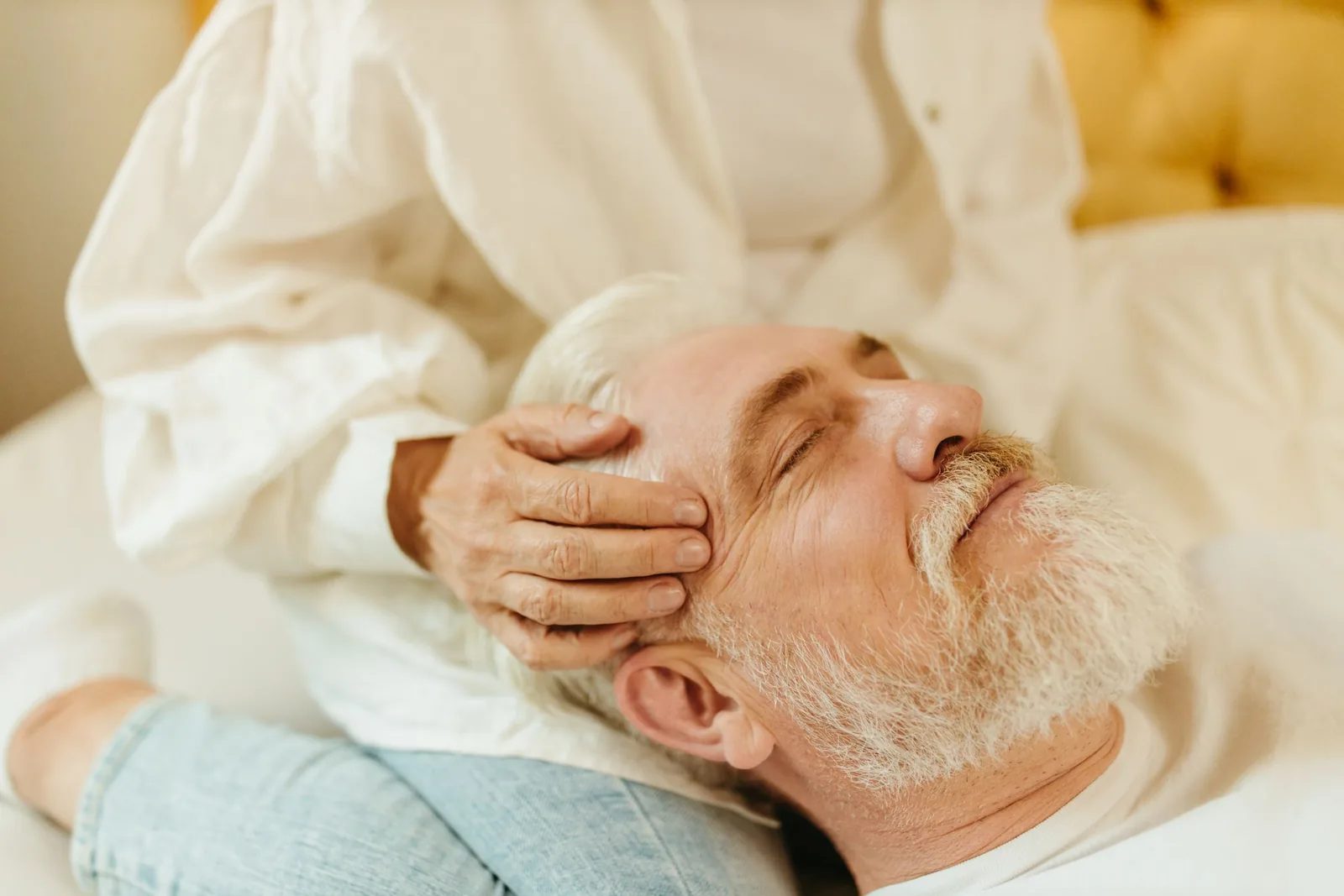
On the neck, only stroke and rub gently at the back and the sides of the nape; never press on the front of the neck, and do not rotate or crack the neck. On the head and temples, make small gentle circles with the fingertips; if the client has an unusual headache today, skip the head and advise them to see a doctor.
Heat: hot stones, hot packs, steam
Older clients, especially those with diabetes, heart disease or blood pressure problems, may feel heat poorly and become dizzy easily when hot:
Do not use hot stones or hot packs if the client has numbness, reduced sensation or heart disease, or if you have not yet checked their health thoroughly.
Warm towels should be just warm; test them on the inside of your own wrist first, then place them on the client and ask straight away.
Steam: do not combine it with a first massage session; clients with heart disease or blood pressure problems need a doctor's opinion (see the steam lesson on NAMBIN).
Sequence of a relaxing massage of about 45 minutes for an older client (for reference)
Part | What to do | Time (for reference) | Notes |
|---|---|---|---|
Welcome and health form | Ask about conditions, medicines, position and preferred pressure | 5–10 minutes | Not counted in massage time; speak slowly and clearly |
Getting onto the table | Help the client lie on their back with bolsters, drape | 2–3 minutes | Low table, non-slip step |
Legs (on the back) | Gentle strokes from ankle to thigh, rub the feet | 10 minutes | Avoid varicose veins and a painful knee |
Arms | Stroke the arms, rub the hands | 8 minutes | Skin on the back of the hand is thin; no firm rubbing |
Back (side-lying or briefly face down) | Stroke along the muscles on both sides of the spine, rub the shoulders | 12 minutes | Do not press on the spine or ribs |
Neck, shoulders, head (on the back) | Stroke the nape, rub the shoulders, gently rub the scalp | 8 minutes | No rotating or cracking the neck |
Finishing, sitting up | Wipe oil off the feet, sit on the edge of the table | 3–5 minutes | Ask about dizziness, walk out with the client |
The times are for reference only. If the client is tired, cold, needs the toilet or wants to stop early, shorten the session; quality and safety matter more than completing every minute.
Communicating with older clients
Address the client politely in the way they prefer; do not speak curtly or talk to them as if they were a child.
Speak slowly and clearly, and stand where the client can see you before touching them; if the client is hard of hearing, move closer rather than shouting.
Announce each step: “I'm going to move on to your left arm now.”
Ask about pressure several times during the session. Older people are often reluctant to complain, so watch their facial expression, breathing and clenched hands.
Do not promise to cure anything (“cure joint pain”, “lower blood pressure”, “unblock blood vessels”); only say that the massage helps the client relax and feel comfortable.
Signs that you must stop and what to do
Stop the massage immediately if the client shows any of the following:
Dizziness, blurred vision, nausea, sweating, pale skin.
Chest pain or tightness, shortness of breath, an unusually fast heartbeat.
A sudden severe headache; a drooping mouth, difficulty speaking, weakness or numbness on one side of the body; unusual confusion.
A sharp pain at one point on a bone when you place your hand there (especially the ribs or back).
The client says it hurts, feels uncomfortable or wants to stop.
What to do:
Stop, cover the client with a warm towel. If the client is dizzy: keep them lying still and do not let them stand up. If the client is short of breath: help them into a half-sitting position if that makes breathing easier.
Call the manager or the spa's certified first-aider. Do not leave the client alone.
Chest pain, shortness of breath, a drooping mouth, weakness on one side of the body, or fainting: call emergency services on 115 immediately (the ambulance number in Vietnam) and inform the client's family.
Mild dizziness that passes after resting: let the client sit up very slowly, rest in the waiting area, and advise them to tell their treating doctor; do not continue the massage today.
Record the time, the signs and what was done in the client's file.
You do not measure the client's blood pressure yourself to decide whether to continue, and you never give the client any medication.
Real-life situations
Situation 1 – Mrs Lan from the start of the lesson. She takes anticoagulants, has high blood pressure and a painful right knee, and often feels dizzy when standing up. You suggest a 45-minute session instead of 60 minutes, lying on her back and on her side instead of face down, only gentle stroking and rubbing, skipping the right knee and using no hot towels. To finish: she lies on her side, sits up on the edge of the lowered table, rests, you wipe the oil off her feet, put on non-slip slippers and walk her to the waiting area. Record: “Light pressure, client prefers lying on her back, right knee skipped.”
Situation 2 – Mr Hung, 80, booked by a family member. He is forgetful and gives inconsistent answers about his medicines; his son says, “My dad is very strong, just go hard.” You invite the son to look at the prescription with you. During the session, Mr Hung says several times “That's enough, let's go home”: you stop, gently tell the family that he does not want to continue today, and arrange a shorter session another time.
Recording notes after the session
Write brief notes so that the therapist at the next session can read them at a glance: notable underlying conditions and medicines; the client's preferred positions, positions to avoid, and whether the client needs help getting up; the pressure used, areas skipped and why; reactions after the session (dizziness, bruising if any); and the advice given.
Safety checklist for massaging older clients
☐ Asked the client directly about underlying conditions, medicines (anticoagulants, blood pressure, diabetes), osteoporosis, joint replacements, falls and recent surgery
☐ The client understands and consents; checked against the proceed – adapt – postpone table
☐ Low table or non-slip step; dry, well-lit floor; non-slip slippers
☐ Warm room with an extra blanket; positions supported with pillows, face down only if the client is comfortable
☐ Light pressure, enough oil; no pressing on bones, no twisting, no joint cracking
☐ No strong heat, no hot stones for clients with numbness or heart disease
☐ Asked about pressure and comfort several times during the session
☐ Client sat on the edge of the table for a while before standing; oil wiped off the feet; walked out with the client
☐ Know the signs that mean you must stop, and the emergency number 115
☐ Notes recorded
Frequently asked questions
Should older people have massages?
Many older people can still enjoy relaxation massage if the therapist checks their health carefully, uses light pressure and supports them carefully; clients with heart disease, those undergoing treatment for a serious illness, or those who have recently had surgery or a fall should ask their treating doctor first.
What if an older client insists on firm pressure?
Explain gently that skin and bones at this age are more easily injured, then use medium pressure on thick muscles such as the thighs, calves and shoulders, but still do not press on bones, twist the body or crack joints; for clients on anticoagulants or with known osteoporosis, keep the pressure light even if they ask for more.
Can massage lower blood pressure or cure joint pain in older people?
Spa therapists must not promise this; spa massage is a relaxation service that may help the client feel more comfortable, but it does not replace medication or a doctor's treatment, and you must never advise a client to stop their medication.
How long can an older client lie face down?
There is no single figure for everyone; ask the client first, watch their breathing, neck and back, and switch to side-lying as soon as they have trouble breathing, a stiff neck or back pain — or do the whole back in side-lying if the client prefers.
Practice exercises
Role-play the health intake: in pairs, one person plays a 75-year-old client on anticoagulants with a left knee replacement. The other asks all 7 questions above, then uses the decision table to decide on pressure, positions and areas to skip. Swap roles.
Practise helping on and off the table: the person playing the client walks slowly and pretends to have a painful knee. The other practises supporting the back and forearm when getting onto the table, then practises sitting up from side-lying, sitting on the edge of the table, wiping the feet and putting on slippers.
Practise light pressure: stroke the back of your partner's hand with your whole oiled hand so that it glides smoothly without stretching the skin; your partner says when they feel the skin being pulled.
A situation where you must stop: the person playing the client suddenly says, “Oh dear, I feel very dizzy.” The other carries out all the steps: stop, keep the client lying down, call the manager, decide whether to call 115, and record it in the file.