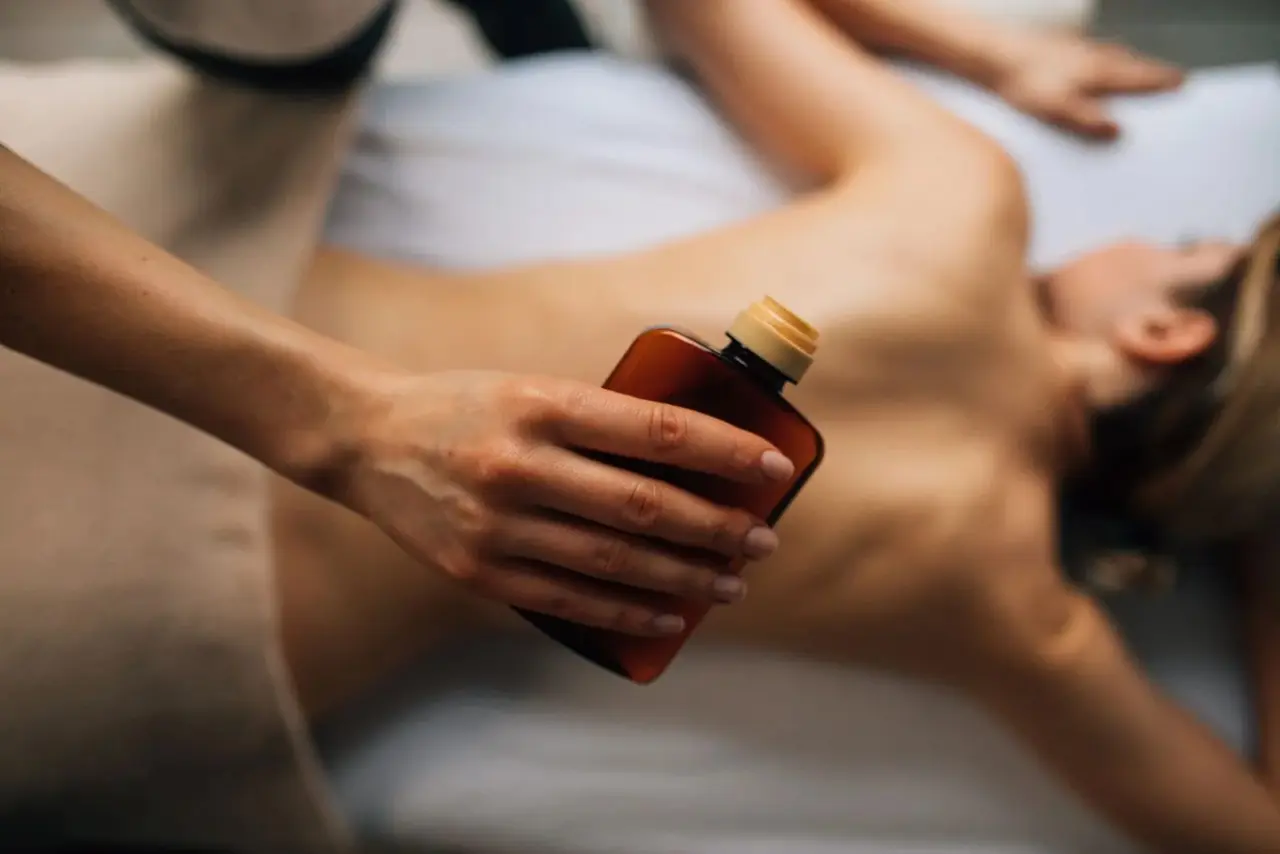
A female client books a body massage with essential oils. Her health form says “allergic to almonds”, and she is going to the beach this afternoon. On the shelf there is a bottle of sweet almond oil blended with bergamot from last week, with a faded label and no date. Do you use that bottle?
No. The carrier oil is made from nuts, cold-pressed bergamot can make the skin sensitive to sunlight, and with a bottle whose blending date and ratio are unknown, nobody knows what is in it. Oil stays on the client’s skin for the whole massage, so choosing the wrong oil, blending it wrongly or storing it carelessly can all cause irritation.
This lesson does not teach massage strokes; it is only about oil. By the end of this lesson, you will be able to: tell carrier oils and essential oils apart, choose a carrier oil, calculate dilution ratios and drop counts, carry out a skin patch test, recognise who needs unscented oil, follow hygiene when dispensing oil, label and store oils, recognise rancid oil and handle a client’s skin reaction.
How carrier oils and essential oils differ
Carrier oil is oil pressed from seeds, fruits or kernels, such as jojoba, sweet almond or grapeseed. Carrier oils hardly evaporate, have a mild scent and are the main ingredient that lets your hands glide smoothly over the skin.
Essential oil is an aromatic substance extracted from flowers, leaves, peel or wood by distillation or cold pressing. Essential oils evaporate quickly and are highly concentrated: a few drops are enough to scent a whole bottle of carrier oil, and misuse easily causes skin irritation or allergy.
Three rules with no exceptions:
Never apply undiluted essential oil to a client’s skin; always dilute it in a carrier oil or use a pre-blended product.
Never let anyone drink or taste essential oil; in the spa, essential oils are only for external use on the skin and for scent.
Keep essential oils away from the eyes, mouth and mucous membranes; after blending, wash your hands before touching your own face or the client’s.
In the spa, oils and essential oils are used for relaxation massage and to create a pleasant scent. Therapists do not present essential oils as medicine and do not promise to “cure pain”, “treat insomnia” or “detox”.
Choosing a carrier oil: understand each type before using it
You must know the carrier oils your spa uses well: what they are made from, whether they go rancid easily and which clients should not use them.
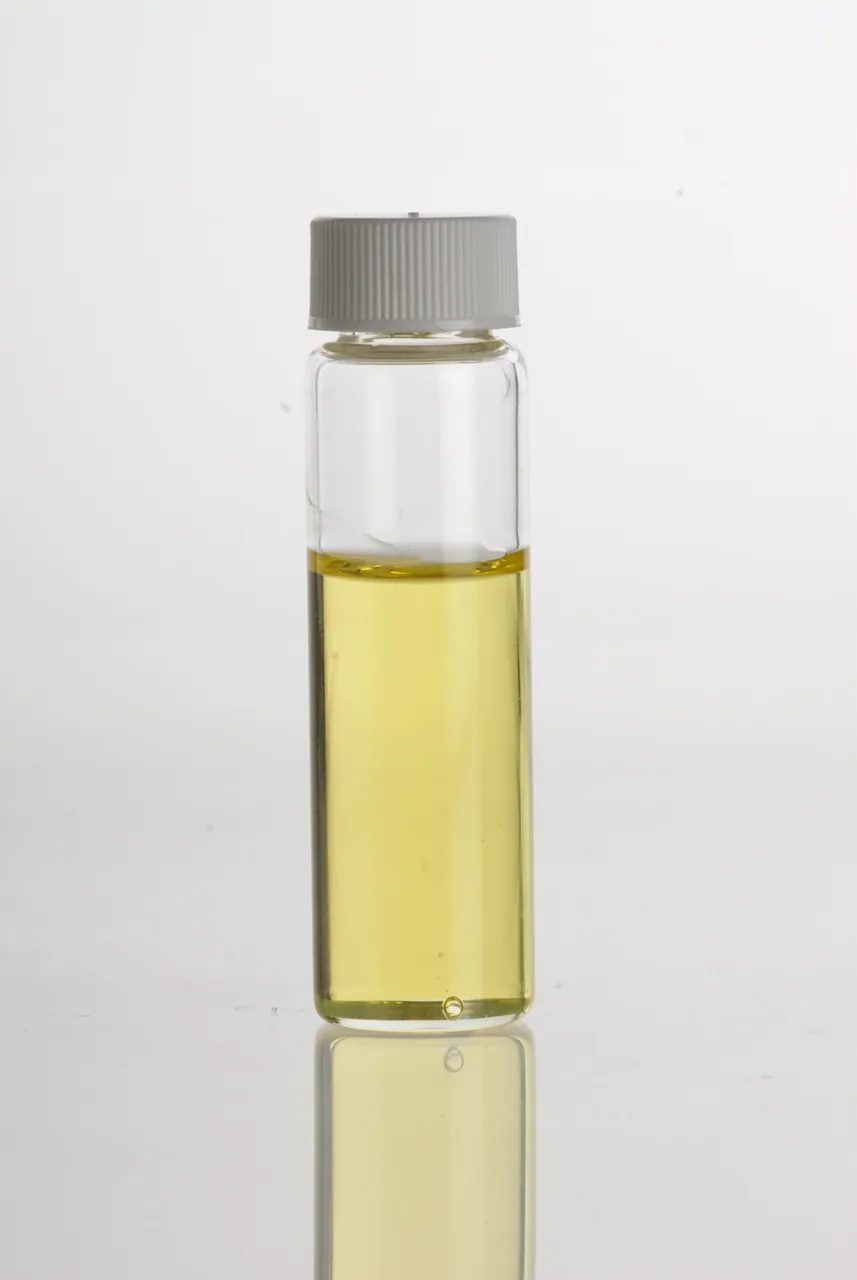
Figure 1. A small glass vial of pale yellow jojoba oil. The clear vial is only for the photo to show the oil’s colour; in the spa, oils should be kept in dark bottles. (Photo: Itineranttrader, Wikimedia Commons, public domain)
Comparison of some common carrier oils (for reference)
Actual properties depend on the type of oil and the manufacturer; always read the label of the product your spa uses.
Carrier oil | Origin | Characteristics in massage | Points to note |
|---|---|---|---|
Jojoba | Seeds of the jojoba plant (actually a liquid wax) | Not very greasy, absorbs fairly quickly, quite stable, rarely goes rancid | May thicken slightly in cold weather |
Sweet almond | Almond kernels | Slippery, smooth under the hands, good for body massage | Made from nuts: ask the client carefully about nut allergies |
Macadamia | Macadamia nuts | Silky, fairly thick | Made from nuts: ask the client carefully about nut allergies |
Grapeseed | Grape seeds | Light, not very greasy | Goes rancid more easily; buy small quantities and use them quickly |
Sunflower | Sunflower seeds | Light, easy to find | Goes rancid more easily; some people are allergic to sunflower seeds |
Fractionated coconut oil | Coconut oil with the solid fraction removed | Liquid at room temperature, almost odourless, rarely leaves stains | Some people are allergic to coconut; ask the client |
Nut-based oils and clients with nut allergies
Sweet almond and macadamia oils are pressed from nuts. A therapist cannot test on the spot whether an oil will cause a reaction in someone with a nut allergy, so:
Always ask: “Are you allergic to any nuts, beans, coconut or cosmetics?”
Nut allergy (even mild): do not use nut-based oils; choose another carrier oil such as jojoba or the type your spa specifies. If the client has ever had a severe reaction, ask the manager to decide with you.
Record the allergy on the form; read the ingredients of pre-blended products too (massage oils, creams, balms), as they may contain nut oils.
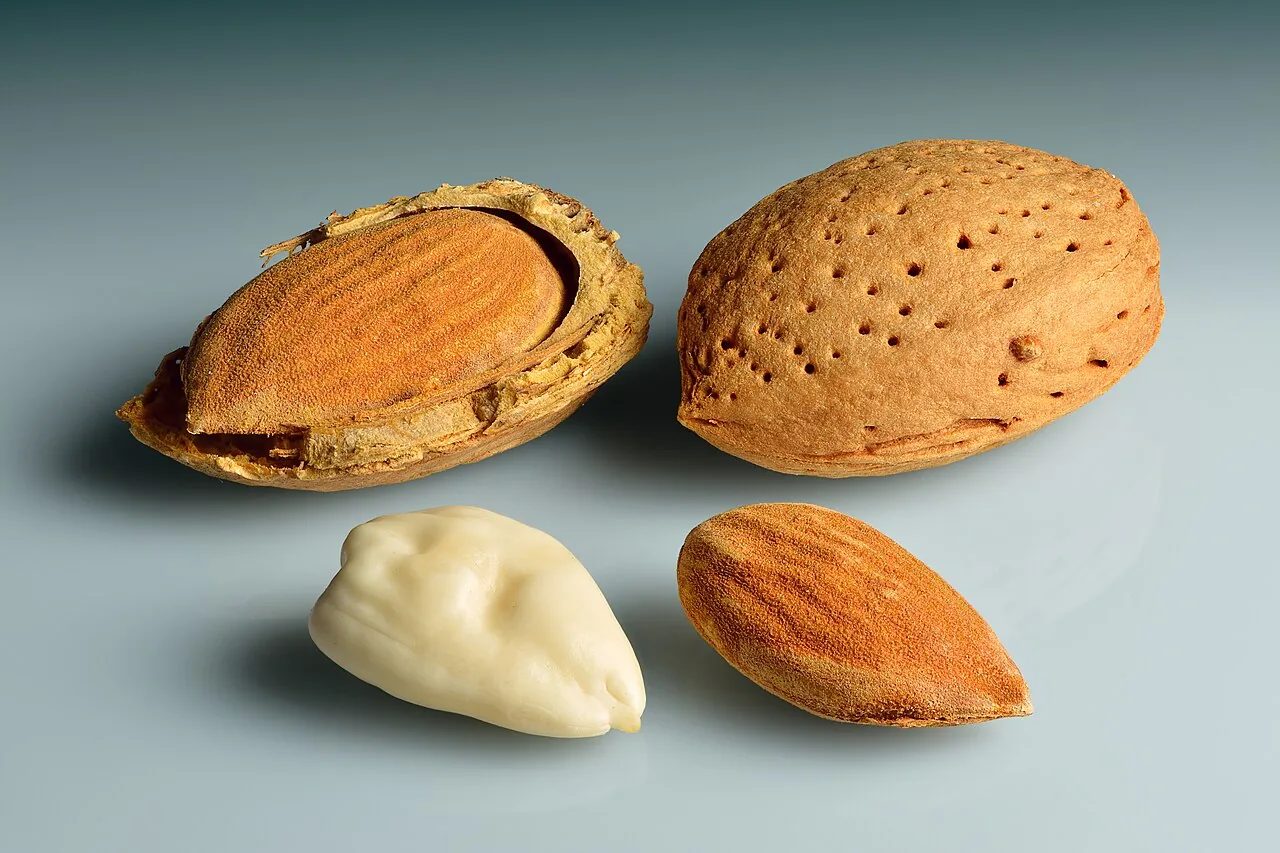
Figure 2. Almonds: in the shell, with a cracked shell, kernel with its skin and blanched kernel. Sweet almond oil is pressed from these very kernels, so clients with nut allergies must not use almond oil. (Photo: Ivar Leidus, Wikimedia Commons, CC BY-SA 4.0)
Choosing a carrier oil for each client
Dry skin, long body massage: a slippery oil such as sweet almond (if there is no nut allergy).
Dislikes greasiness, going back to work afterwards: jojoba, grapeseed or fractionated coconut oil, used sparingly.
Sensitive skin, history of allergy, groups needing caution: carrier oil without any essential oil.
Face: use the facial product your spa specifies, not blended body oil.
Diluting essential oils: percentages and drop counts
What a dilution ratio means
A 1% dilution means 100 ml of massage oil contains about 1 ml of essential oil. The ranges below are common in training materials and are not mandatory standards; some essential oils have lower limits, so always read the label of each type.
Body massage for healthy adults: about 1–3% (for reference, following the manufacturer’s instructions and spa rules).
Face, sensitive skin, older people: lower, about 0.5–1% (for reference, following the manufacturer’s instructions and spa rules).
Pregnancy, children, clients with medical conditions or taking medication: do not blend for them yourself; the client should ask a doctor first, and in the spa use unscented carrier oil.
A stronger blend is not “better”; it only increases the risk of irritation. When in doubt, choose the lower level.
Drop count table (for reference)
The table uses the common assumption that 1 ml is about 20 drops. Actual drop size varies with the dropper and the thickness of the essential oil, so this is only an estimate; if your spa has measuring cylinders or scales, measure as the spa does.
Calculation: number of essential oil drops = volume of carrier oil (ml) × 20 × percentage. For example, 10 ml × 20 = 200 drops; 1% of 200 drops is 2 drops.
Dilution (for reference) | 10 ml carrier oil | 30 ml carrier oil | 50 ml carrier oil |
|---|---|---|---|
0.5% | 1 drop | 3 drops | 5 drops |
1% | 2 drops | 6 drops | 10 drops |
2% | 4 drops | 12 drops | 20 drops |
3% | 6 drops | 18 drops | 30 drops |
Reference table, assuming about 20 drops/ml; actual drop sizes vary. Apply dilution ratios according to the manufacturer’s instructions and spa rules.
When blending several types, the total number of drops of all types is the figure in the table: 2% in 10 ml with two oils means 4 drops in total (for example 2 + 2), not 4 drops of each.
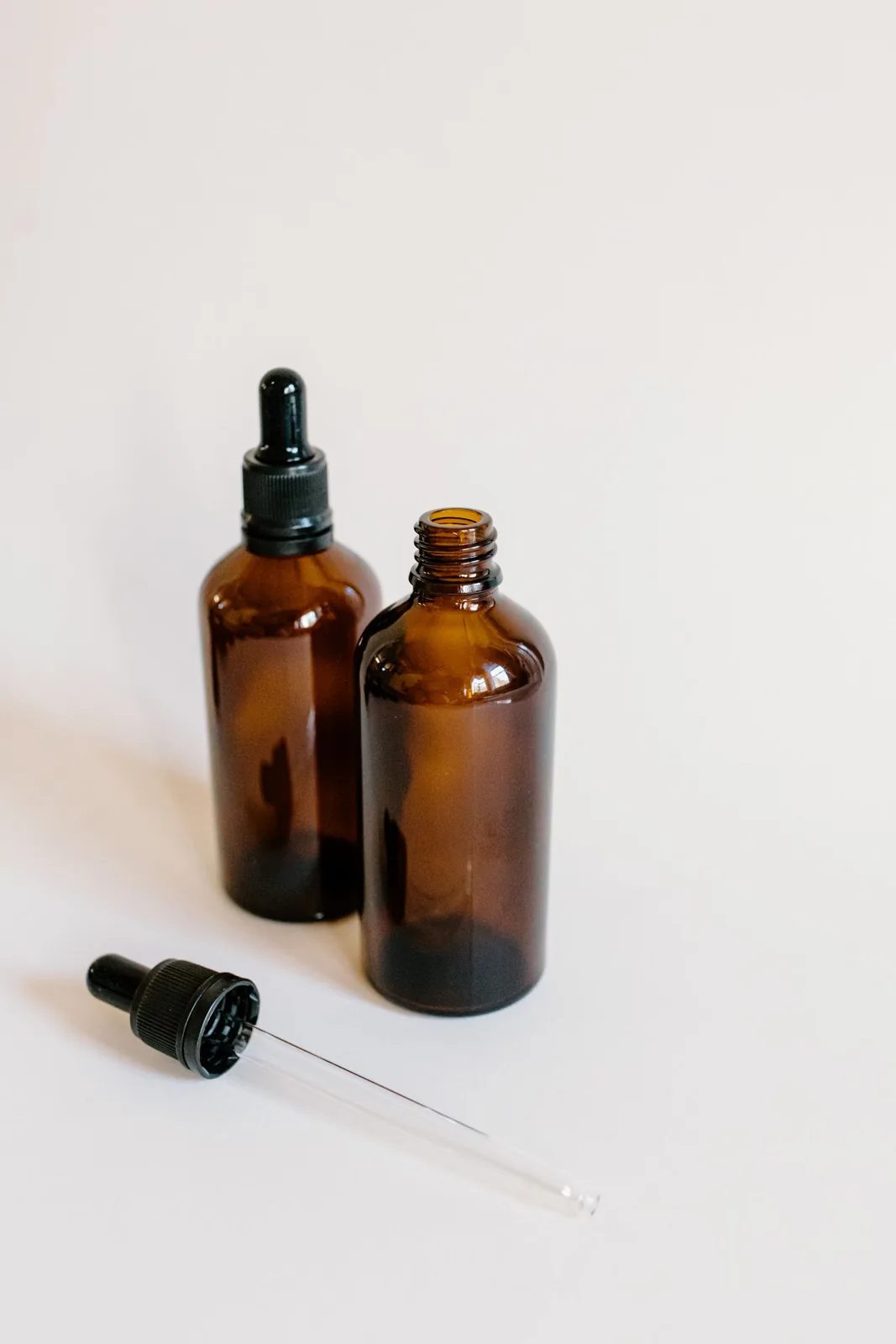
Figure 3. Two amber glass bottles and a dropper cap with a glass pipette. Dark bottles help limit light damage to the oil. Every type of dropper gives a different drop size, so drop counts are only an estimate. (Photo: Tara Winstead, Pexels)
Procedure for blending a bottle of massage oil
Wash your hands; work at a clean, dry table away from heat sources.
Use a clean, dry bottle, ideally dark glass with a tight cap or pump; never use a bottle with old oil left in it.
Measure the carrier oil first to the exact volume.
Add the essential oil afterwards, counting each drop and not getting it on your hands.
Close the cap and shake gently.
Label it immediately; an unlabelled bottle never goes on the shelf.
Close the original essential oil bottle tightly and put it away; wipe the table and wash your hands.
Trade tip: blend small amounts and use them up quickly; the oil is less likely to go rancid.
Skin patch test
When to do it
The client is using essential oils at the spa for the first time, has sensitive skin, or a history of cosmetic allergy, eczema or hives.
The spa has just switched to a new product, or the product label requires a test first.
Steps (for reference)
Use exactly the oil and the ratio you will use in the session; never test with undiluted essential oil.
Apply a very small amount to a small area of healthy skin on the inner forearm.
Leave it, do not wash it off, and observe.
The waiting time follows the product label and spa rules; many manufacturers state about 24–48 hours (for reference). That is why it is best to have the client come in for the test before the session.
If the skin becomes red, itchy, burning, develops a rash, swells or blisters: do not use that oil; wipe it off, wash gently with mild soap and water, and record it on the form.
No reaction: record the name of the oil, the ratio, the test date and the result.
A patch test is not an absolute guarantee; during the session you must still watch the skin and ask the client. If there is no time for a test and the client has sensitive skin or a history of allergy: use unscented carrier oil and book essential oils for another day.
Who needs caution: contraindications and special cases
You do not diagnose illness; your job is to ask, record, choose the safe option and call the manager when needed.
Client’s condition | How to handle oils and essential oils |
|---|---|
Pregnant or possibly pregnant, breastfeeding | No essential oils without a doctor’s advice; use unscented carrier oil according to spa rules |
Children | Follow spa rules; no essential oils without a doctor’s guidance; use unscented carrier oil |
Allergy to nuts, coconut, cosmetics or essential oils | Do not use oils from the source the client is allergic to; use another carrier oil with no essential oil; record it on the form |
Sensitive skin, eczema, dermatitis, hives | Do not apply to inflamed areas; skin conditions — ask a doctor; use only unscented carrier oil |
Open wounds, sunburn, recent waxing, peel or laser | Do not apply oil to that area; postpone according to the rules |
Asthma, respiratory disease, sensitivity to smells | Ask a doctor; prefer unscented oil and a well-ventilated room |
Epilepsy | Ask a doctor first; some strong-smelling essential oils such as rosemary and eucalyptus are commonly advised against; use unscented oil |
Chronic illness, taking medication | Suggest asking a doctor or pharmacist before using essential oils |
Going out in the sun or to the beach soon | Do not use phototoxic citrus essential oils (see below) |
Sample phrase when switching to unscented oil:
“Since you are pregnant, today I will use oil without essential oils to be safe.”
Citrus essential oils and sunlight (phototoxicity)
Some cold-pressed citrus essential oils make the skin more sensitive to UV rays: if the client then goes into the sun or uses a tanning bed, they may get redness, burning, blistering or dark patches on the skin. This is called phototoxicity.
A common example is cold-pressed bergamot; some cold-pressed lemon, lime and grapefruit oils carry similar warnings. There are types of bergamot with the phototoxic compounds removed, usually labelled “FCF” or “bergapten-free”; always check the label.
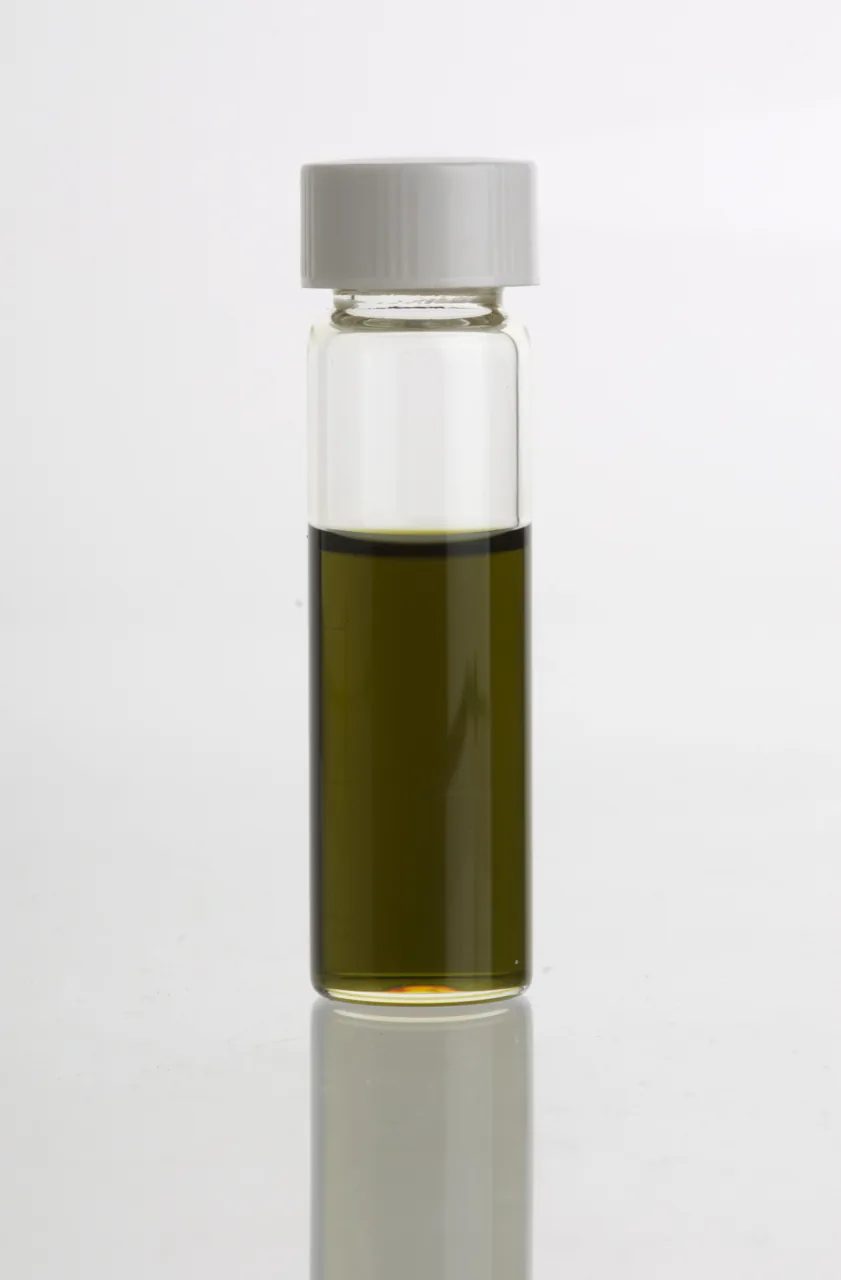
Figure 4. A glass vial of olive-green bergamot essential oil. Cold-pressed bergamot can make the skin burn more easily in the sun, so do not use it for clients about to go out in the sun. The clear vial is only for photographing the oil’s colour; use dark bottles for storage. (Photo: Itineranttrader, Wikimedia Commons, public domain)
Safe practice:
Ask about the client’s plans after the session: going to the beach, swimming outdoors, riding a motorbike in the sun for a long time? If so, choose a non-phototoxic essential oil or unscented oil.
If a phototoxic type has already been used: advise the client to cover up and avoid direct sun and tanning beds for the period stated on the product label (many references mention about 12 hours).
Hygiene when dispensing oil: no double-dipping
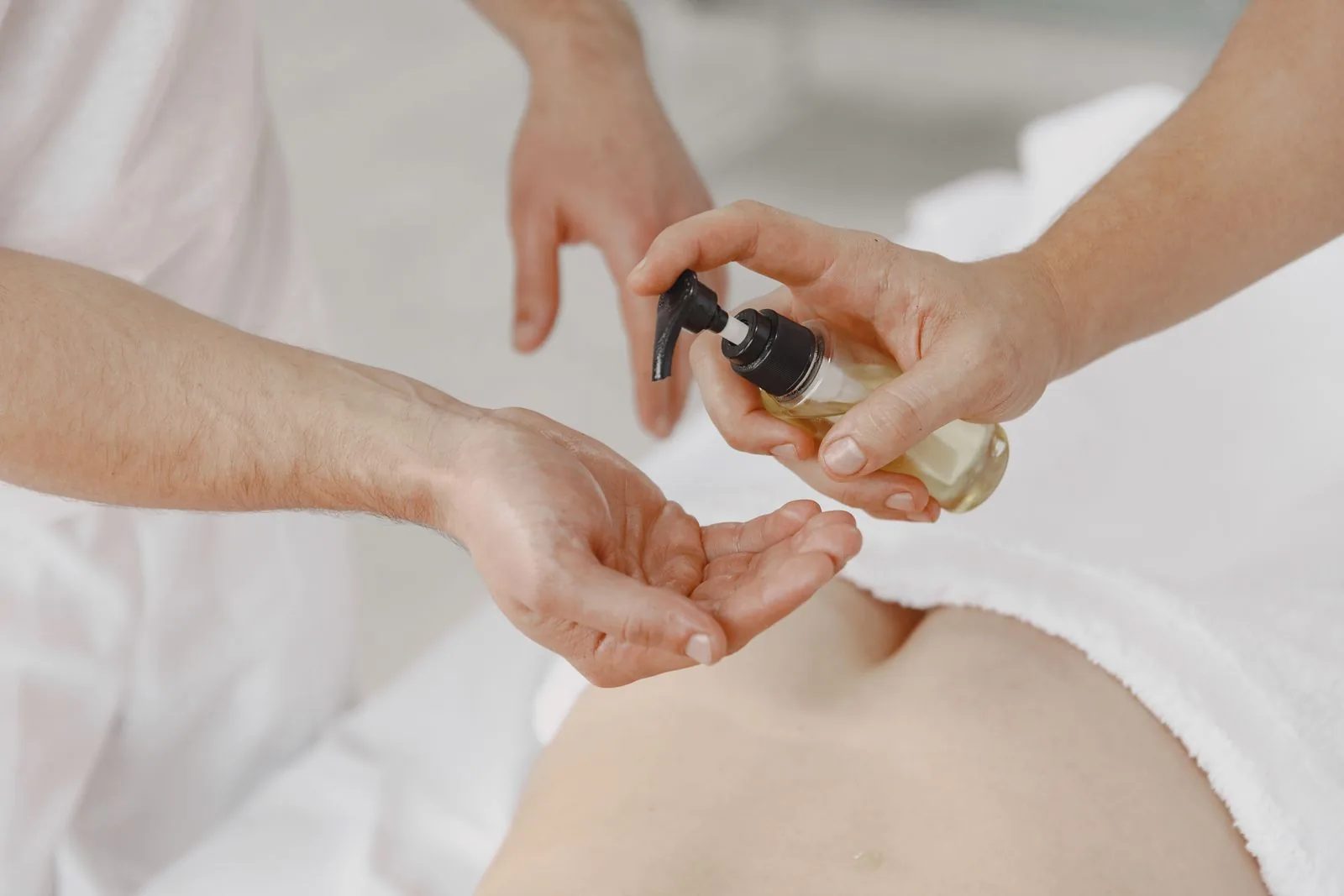
Figure 5. The therapist presses a pump bottle to dispense oil into the palm, warms it by rubbing, and only then places the hands on the client’s skin. A pump dispenses the right amount without the hand touching the oil left in the bottle. (Photo: Gustavo Fring, Pexels)
Use a pump bottle or squeeze cap, dispense the oil into your palm, warm it and then apply.
If you use a bowl, one clean bowl per client; discard leftover oil and never pour it back into the bottle.
Never dip hands, fingers or any tool that has touched a client’s skin into a shared oil bottle.
The pump must not touch your hands or the client’s skin; wipe the bottle and pump after each client according to spa procedure.
Do not “top up” a half-used bottle with new oil; use it up, wash it, let it dry and only then blend a new batch.
Labelling and storage
Minimum label on every blended oil bottle
Name of the carrier oil, name of each essential oil and the dilution ratio (for example “Jojoba + lavender 1%”); whether it is for body or face.
Blending date, who blended it, and the use-by date according to spa rules.
Warnings if applicable: “Contains citrus – avoid sun”, “Contains almond oil – not for clients with nut allergies”.
Bottles without a label or with a faded label are not used on clients; report them to the manager.
Where and how to store
Dark glass bottles, closed tightly immediately after use: air, light and heat make oil spoil quickly.
Store in a cool, dry place out of direct sunlight, away from towel warmers, steamers, stoves and flames.
Keep original essential oils in a separate compartment, out of reach of children, not mixed with food and drink; use older stock first and check the expiry date on the label.
Recognising rancid oil
Oil kept for a long time or exposed to heat, light and air oxidises (goes rancid). Signs: a sharp smell like old cooking oil, a change in colour or cloudiness, unusual sediment (unless the label says the oil thickens when cold), stickier than normal. Rancid oils and old, oxidised essential oils are both more likely to cause irritation. If there are signs of rancidity, discard it following spa instructions; do not pour it down the sink.
Oil and fire risk: oily towels
Massage oil is flammable. Towels and sheets soaked with oil can heat up on their own if they are piled up while still warm from the dryer, creating a fire risk; many fire safety guides warn about this.
Wash oily towels according to spa procedure and do not leave them piled up for long; after drying, take them out to cool and do not stack them while hot.
Do not leave oily towels on or next to towel warmers, hot towel cabinets, heaters or lamps.
Do not warm oil over an open flame; use an oil warmer according to the manufacturer’s instructions, and test the warmth on your own wrist first.
Keep candles and oil burners (if used) away from towels, curtains and oil bottles; never leave them burning unattended.
When a client has a skin reaction or oil gets into the eyes
The client has a skin reaction
Signs: redness, itching, burning, rash or swelling where the oil was applied.
Stop immediately and do not apply any more of that oil.
Remove the oil: use cotton wool or a clean towel moistened with unscented carrier oil to wipe off the essential oil, then wash gently with mild soap and cool water and pat dry. Do not scrub.
Monitor the client and ask whether they have any difficulty breathing, dizziness or facial swelling.
Inform the manager and record on the form: oil name, ratio, skin area, time and what was done.
Advise the client to see a doctor if it does not improve, spreads or is severe; do not apply medication to the client yourself.
When to call emergency services (115)
Call 115 (the emergency number in Vietnam) immediately, or ask a colleague to call, if the client has:
Difficulty breathing, wheezing or chest tightness.
Swelling of the face, lips, tongue or throat.
A rash spreading quickly over the body together with dizziness, faintness, nausea or drowsiness.
While waiting, stay with the client, keep them in a position that makes breathing easier and follow the dispatcher’s instructions.
Oil or essential oil in the eyes
Do not rub the eyes, and do not let the client rub them.
Rinse the eye with clean, gently running water for several minutes, holding the eyelids open; if the client wears contact lenses, ask them to remove them if this is easy.
If burning, redness or blurred vision persists: take the client to a doctor or call for medical help.
Record it and inform the manager.
Someone accidentally swallows essential oil
Do not try to induce vomiting. Call 115 or take them to a medical facility immediately, bringing the essential oil bottle so that medical staff know what the substance is.
Oil and essential oil safety checklist
Before the shift:
Every bottle is labelled (oil name, ratio, blending date, who blended it); no rancid or expired oil.
Pumps work and bottles are clean; unscented carrier oil is available.
Original essential oils are tightly closed and kept away from heat sources and children.
Before each client:
Health form read: allergies (nuts, coconut, cosmetics, essential oils), pregnancy, medical conditions, medication, sensitive skin, wounds, recent waxing/peel/laser.
Sun exposure plans asked; patch test done or unscented oil chosen.
Essential oil diluted to the correct ratio and the correct type for body or face.
During and after the session:
Dispense oil with a pump or a separate bowl; never dip your hand back into the bottle.
Watch the skin and ask the client; stop immediately if there is a reaction; avoid the eye area.
Advise sun avoidance if a phototoxic oil was used; put oily towels in a lidded bin away from heat sources.
Frequently asked questions
The client wants me to make the essential oil blend stronger so the scent lasts longer. Can I?
No. Explain politely that the spa blends at safe ratios and that a strong blend easily causes irritation. If the client wants a stronger scent, you can diffuse fragrance in the room according to spa rules, rather than increasing the essential oil on the skin.
Are natural essential oils completely safe?
No. Natural essential oils are still concentrated and can cause irritation, allergy or make the skin sensitive to sunlight; that is exactly why dilution and patch tests are needed.
A client asks whether essential oils cure insomnia or back pain, or detox the body. What do I say?
Do not claim or promise anything. You can say essential oils help create a pleasant scent for the relaxation session. If the client has a health problem, suggest they ask a doctor.
How long can blended oil be used?
According to the expiry date on the manufacturer’s label and spa rules. Blend small amounts, use them quickly, and discard them as soon as there are signs of rancidity, even before the expiry date.
Practice exercises
Work in groups of three: one person plays the client, one is the therapist, and one observes and scores using the checklist.
Calculate drops: without looking at the table, calculate for 20 ml at 1% and 2% (20 drops/ml), then 30 ml at 2% split equally between two essential oils.
Blend and label: blend 30 ml of 1% massage oil and write a complete label; the observer scores the label and the hygiene during blending.
Screening: the “client” takes turns being allergic to nuts, pregnant, going to the beach this afternoon, having a history of asthma, and being healthy and using essential oils for the first time. You choose the carrier oil, decide whether to use essential oil and explain politely.
Patch test: guide the “client” in 1 minute: which oil, where to apply it, how long to wait and which signs mean the oil must not be used.
Handling a reaction: the “client” complains of an itchy, burning back, then of “difficulty breathing, swollen lips”; you handle it step by step and call 115 at the right moment.
Inspect the oil shelf: find three faults the observer has set up (an unlabelled bottle, rancid oil, an oily towel next to the towel warmer).
You pass when: you calculate drops correctly, the label is complete, you never suggest applying undiluted essential oil, you recognise all the cases needing unscented oil without diagnosing, you dispense oil hygienically and you handle a reaction in the correct order.
This lesson belongs to the “60-minute relaxing body massage” step, because oil is what you prepare before every massage; you will use these skills again in the “Safety and service skills assessment” step when practising screening and handling situations.