A great spa therapist is not the one with the most beautiful moves, but the one who knows when not to work. Understanding skin structure helps you choose the right products and pressure; knowing the contraindications by heart protects your client, yourself and the reputation of the spa.
This is the first step of the Spa Therapist roadmap on nambin. By the end of this lesson, you will be able to:
- Point out which skin layer each spa technique (exfoliation, massage, moisturizing) works on, and why pressure must change by area.
- Examine and record the five basic skin types, keeping "skin type" separate from "skin condition".
- Ask three screening questions to tell absolute contraindications (stop) from relative ones (adjust).
- Stop a treatment politely, advise the client to see a doctor and record it when you notice abnormal signs.
- Check your own personal hygiene and professional conduct before every shift.
What layers make up the skin?
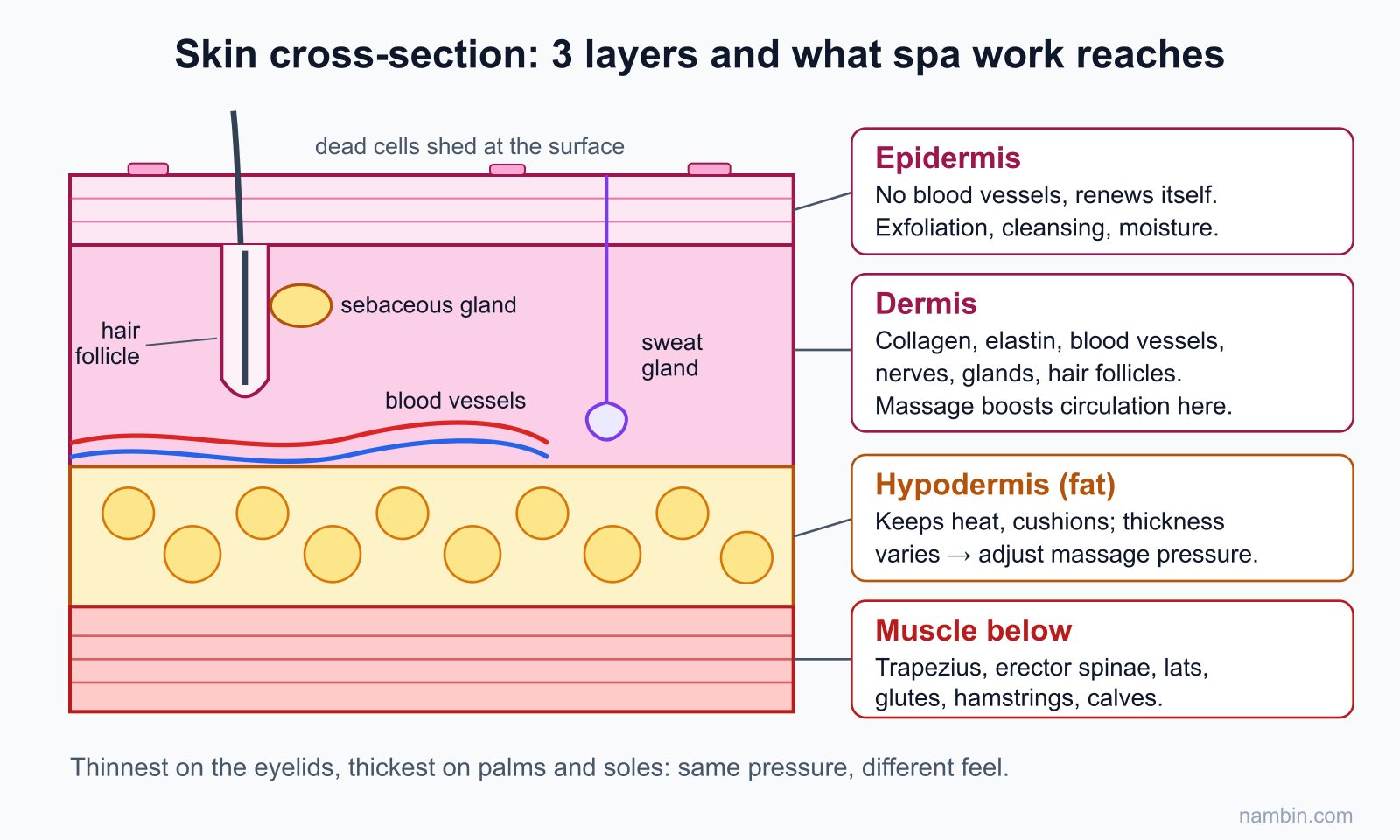
Skin is the largest organ of the body, and its thickness varies by area: thinnest on the eyelids, thickest on the soles and palms. That is why the same pressure feels pleasant on the heel but stings around the eyes. Skin has three main layers, with muscle underneath:
| Layer | Characteristics | Relevance to spa work |
|---|---|---|
| Epidermis | Outermost layer, thin, constantly shedding dead cells and renewing | Exfoliation, cleansing and moisturizing act mainly here |
| Dermis | Contains collagen, elastin, blood vessels, sweat glands, sebaceous glands, hair follicles | Determines elasticity; massage increases circulation in this layer |
| Hypodermis (subcutaneous tissue) | Fat layer that keeps heat in and cushions the body | Affects how pressure feels during body massage |
The epidermis and the skin barrier
The epidermis has no blood vessels. New cells form at the base of this layer, gradually move up, dry out and shed at the surface as dead cells. In young, healthy people this cycle takes about four weeks; in older people it slows down, so the skin looks duller and rougher. That is why exfoliation can make skin brighter, and also why you should not over-exfoliate: you are only supporting a natural process, not replacing it.
The epidermis also maintains a "protective barrier" of natural oils and moisture. Rubbing too hard, using harsh exfoliants or exfoliating too often damages this barrier: the skin becomes red, stinging, dry or breaks out more. An easy sign to spot is when a client says a toner or serum they normally use now "stings" — record it and tell the manager so later sessions use less exfoliation and more repair.
The dermis: where elasticity is decided
The dermis is many times thicker than the epidermis and contains collagen fibers (which keep skin firm), elastin (which keeps it elastic), blood vessels, nerve endings, sweat glands, sebaceous glands and hair follicles. Massage increases blood flow in this layer, so the skin turns pink and warm after a treatment. Sebaceous glands sit deep here, which is why oily skin cannot be "cured" by washing the face a lot: over-washing only strips surface oil, leaving the skin tight yet still shiny.
Nerve endings in the dermis let the client feel very clearly the temperature of your hands, the heat of the towel and the pressure you apply. Cold hands on the back make the muscles tense instantly, breaking the sense of relaxation from the very first second.
The hypodermis and the muscle groups below
The hypodermis is mostly fat tissue, and its thickness varies by person and by area. On a client with a thick fat layer you need deeper pressure to feel the muscle; on a slim client, the same pressure can push straight onto bone and hurt. Below the hypodermis is muscle. For body massage, learn a few main muscle groups first: the trapezius (from the nape down to the shoulders and mid-back), the erector spinae (two bands running along both sides of the spine), the latissimus dorsi (both sides of the back), the glutes, the hamstrings and the calves. These are the areas office workers complain about most, and you will use them again in the 60-minute body massage lesson.
Recognizing basic skin types
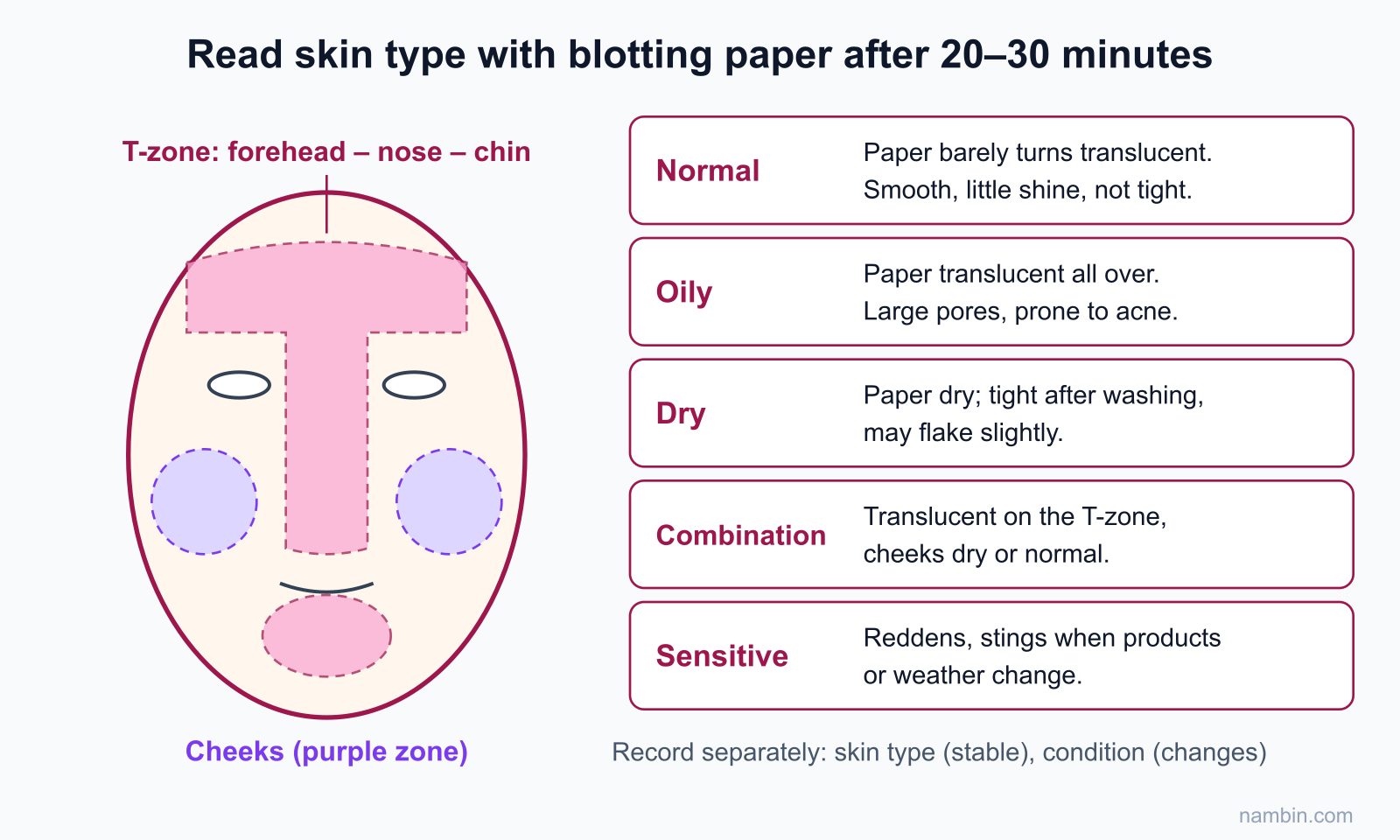
Skin typing is a daily task for a therapist, because it decides the cleanser, the level of exfoliation, the mask and the moisturizer you use. There are five common groups:
- Normal skin: small pores, little shine, rarely feels tight.
- Oily skin: shiny in the T-zone or across the whole face, large pores, prone to acne.
- Dry skin: feels tight after washing, may flake slightly, fine lines are more visible.
- Combination skin: oily in the T-zone, dry or normal on the cheeks.
- Sensitive skin: reddens easily, stings when products or weather change.
Observing in the right order
The principle: cleanse the skin, wait 20–30 minutes for it to return to its natural state, then observe under good light. Step by step:
- Ask the client what they put on their skin this morning (sunscreen, foundation, facial oil). Leftover product distorts your assessment.
- Remove makeup and wash with a gentle cleanser, then pat dry with a clean towel without rubbing.
- Wait 20–30 minutes in a room with a stable temperature; do not seat the client right under a fan or air conditioner.
- Observe under bright white light: the shine on the forehead, nose, chin and cheeks; pore size; areas of flaking, redness or acne.
- Press a sheet of blotting paper lightly on the forehead, nose and cheeks. Paper that turns very translucent on the T-zone but not on the cheeks usually means combination skin; translucent all over leans toward oily skin.
- Touch lightly with the back of your fingers to feel smoothness, dryness, roughness and elasticity.
- Record the result on the client card, with the date and conditions (season, whether the client slept little or just came in from the sun).
Skin type is not the same as skin condition
Beginners often confuse these two ideas. Skin type is fairly stable and tied to the person's constitution (oily, dry, combination). Skin condition changes over time and with external factors: dehydration, sunburn, irritation, inflamed acne, pigmentation. An oily-skinned client can still be dehydrated — the surface is shiny but feels rough and shows fine lines when gently pinched. If you only write "oily skin" and use nothing but oil-control products, the dehydration gets worse. So on the card, write two separate lines: skin type and current condition.
| Skin type | Quick signs | Care notes |
|---|---|---|
| Normal | Smooth, little shine, not tight | Maintain: gentle cleansing, moderate moisturizing |
| Oily | Shiny all over, large pores | Cleanse thoroughly but do not scrub hard; still needs a light moisturizer |
| Dry | Tight, flaky, dull | Limit exfoliation, prefer hydrating masks; avoid very hot water |
| Combination | Oily T-zone, dry cheeks | Treat each zone separately; do not use one product on the whole face |
| Sensitive | Reddens easily, stings | Patch-test products, light pressure, avoid long exposure to steam |
Contraindications: when must you stop or adjust?
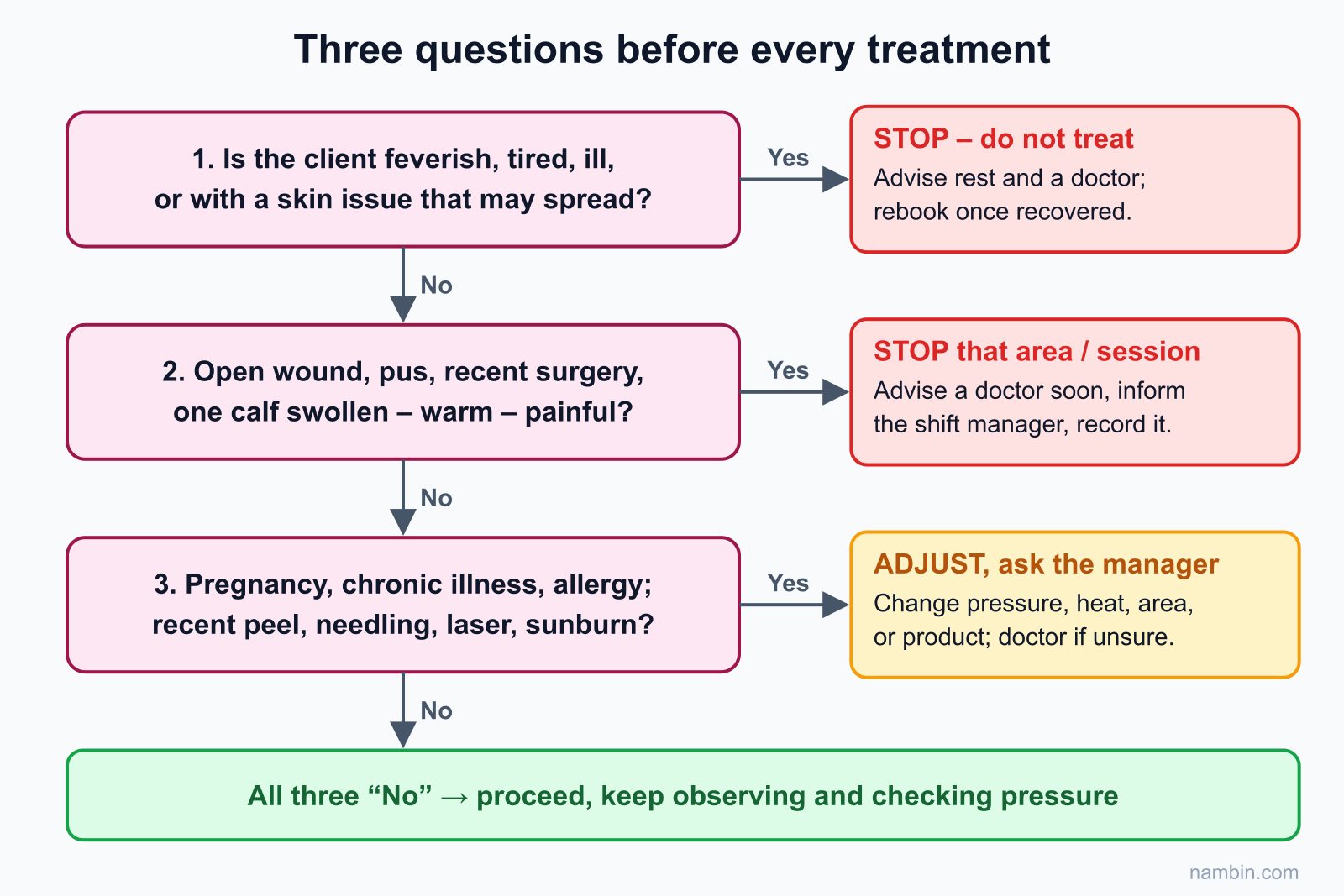
A contraindication is a condition that makes a treatment potentially harmful. There are two groups: absolute (do not treat) and relative (adjust, or a doctor's opinion is needed). You do not need to know the exact name of a disease — you only need to recognize abnormal signs and know the next step. Figure 3 condenses this whole section into three questions you answer for yourself before every treatment.
Absolute contraindications — do not treat, advise the client to see a doctor
- Fever, a current infectious disease, or a skin condition that may be contagious.
- Open wounds, or skin that is inflamed, infected or has pus.
- Suspected deep vein thrombosis (one calf swollen, warm and painful) — never massage the legs.
- Recent surgery without the doctor's permission.
Why: when the client has a fever or infection, massage boosts circulation, the client may feel worse, and you and the next client risk catching it. With open wounds, your hands and products can introduce bacteria. With deep vein thrombosis, the blood clot can be pushed along the bloodstream — a dangerous situation that needs a doctor right away, not "next session".
Relative contraindications — adjust, or a doctor's opinion is needed
- Pregnancy: requires a separate protocol, avoiding certain areas, positions and essential oils.
- High or low blood pressure, heart disease, diabetes: reduce pressure and heat, ask carefully about the condition.
- Varicose veins: never press hard on visible veins.
- Sunburned skin, or recent microneedling, peels or laser treatment: postpone exfoliation and vigorous facial massage.
- Allergies to cosmetic ingredients or essential oils: always ask and patch-test on a small area.
For this group, "adjust" means a specific change, not doing the usual treatment just a little more gently. For example: diabetic clients may have reduced sensation in their feet, so do not use hot foot-soak water and do not rely on asking "is it too hot?" — test the temperature yourself with your wrist. Clients with low blood pressure can feel dizzy when they sit up suddenly after lying down for a long time, so at the end of the session help them sit up slowly and rest a moment before standing. Pregnant clients need a spa with a dedicated protocol and trained therapists; if you have not been trained, hand them over to the person in charge.
How to ask clients to detect contraindications
Clients often do not mention health issues on their own because they think "it's just a massage". Ask short, specific questions in a natural tone, for example:
- "Do you have a fever or feel unwell today, or are you taking any medication?"
- "Have you recently had surgery, injections, microneedling or laser treatment anywhere?"
- "Are you pregnant, or do you have any blood pressure, heart or diabetes issues?"
- "Are you allergic to any cosmetics, essential oils or fragrances?"
- "Is there any area that hurts, is bruised, or that you would prefer I not touch?"
The answers must be recorded on the health information form and signed by the client according to the spa's rules. How to build the form and consult in detail is covered in the step "Client consultation & health information form".
Important: A spa therapist does not diagnose illness. When you notice abnormal signs, stop, explain gently and advise the client to see a doctor. Record it on the client card and inform the shift manager. Never tell a client "you have disease X" and never recommend medication — that is the doctor's job.
Worked scenarios: handling it from start to finish
This section walks through two real situations that often happen in the salon, so you can see how the knowledge above is used.
Scenario 1: a 52-year-old female client books a 60-minute body massage
When filling in the form, the client says she has high blood pressure, takes her medication regularly and feels normal today. When she lies face down and you move to her legs, you notice the left calf is more swollen than the right, feels warmer, and she says "this spot has been a bit sore for a few days". This is exactly the suspected deep vein thrombosis sign in question 2 — an absolute contraindication for the legs.
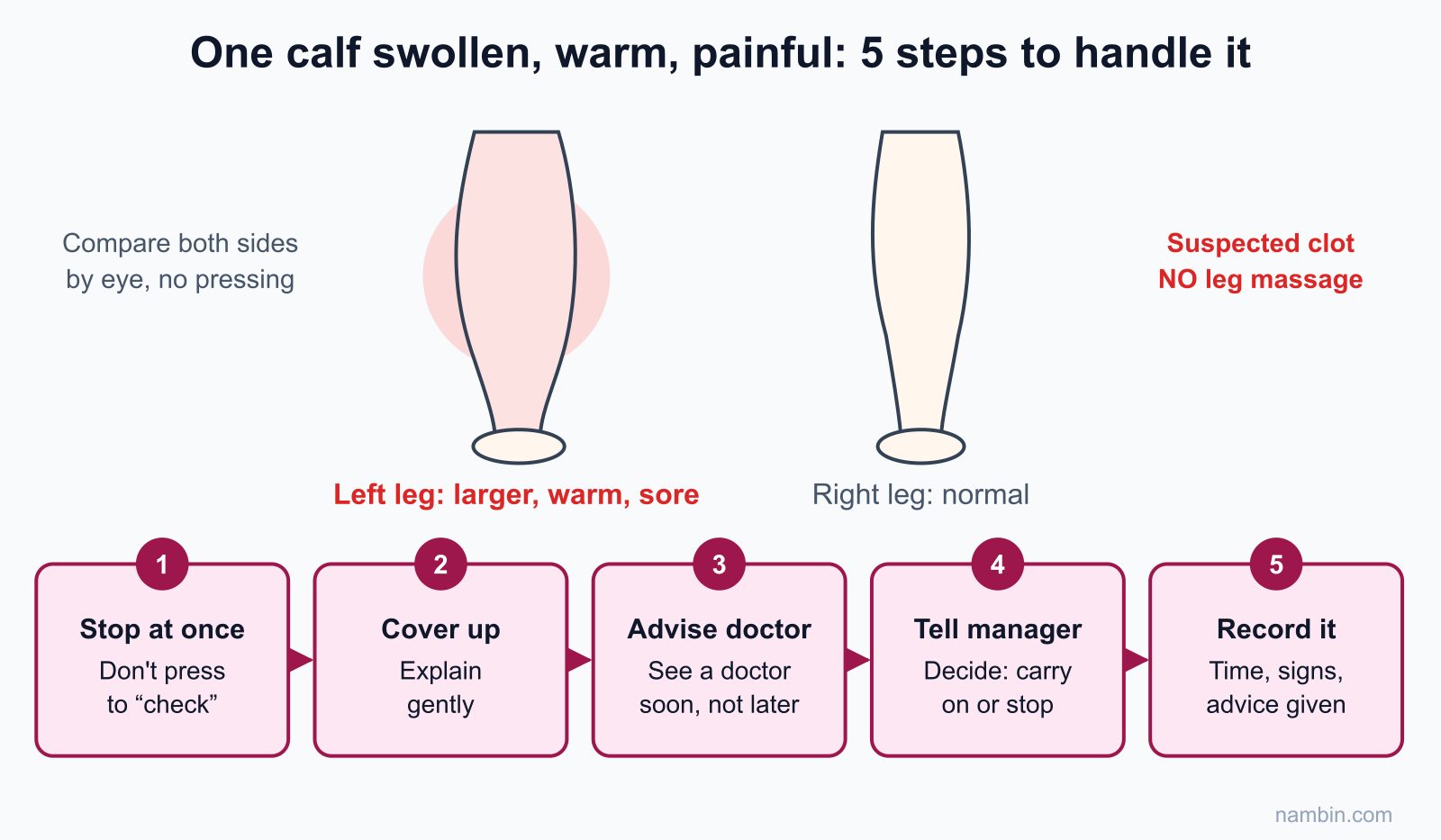
- Stop immediately working on the legs; do not press any further to "check".
- Cover her with the towel again and say gently: "Your left calf is swollen and warmer than the other one. I am not allowed to massage this area until we know the cause. You should see a doctor soon so they can check it for you."
- Ask whether she would like to continue with the back, shoulders and head using light pressure, and inform the shift manager to decide according to spa policy. Many spas choose to end the session completely for safety.
- Record on the card: the time, the signs observed, the advice given and the manager's decision.
- Do not charge for the part not performed, following spa policy; offer to rebook after she has seen a doctor.
The desired result: the client feels cared for rather than turned away, the spa has a clear record, and you have not put the client at risk.
Scenario 2: a 28-year-old male client with oily skin wants a facial
The client mentions he had a peel at a dermatology clinic last week. When examining his skin, you see his cheeks are slightly red and flaking. This is a relative contraindication: no exfoliation, no extractions, no long hot steaming. You explain why and suggest replacing it with gentle cleansing, a soothing mask and moisturizer from the spa's products, or rebooking when the skin has recovered and the clinic allows it. Note this on the card so the therapist at the next session can read it.
Personal hygiene and professional conduct
Clients judge you within the first few seconds by your hands, your hair and the smell of your uniform. The five rules below are about both hygiene and the safety of the client's skin.
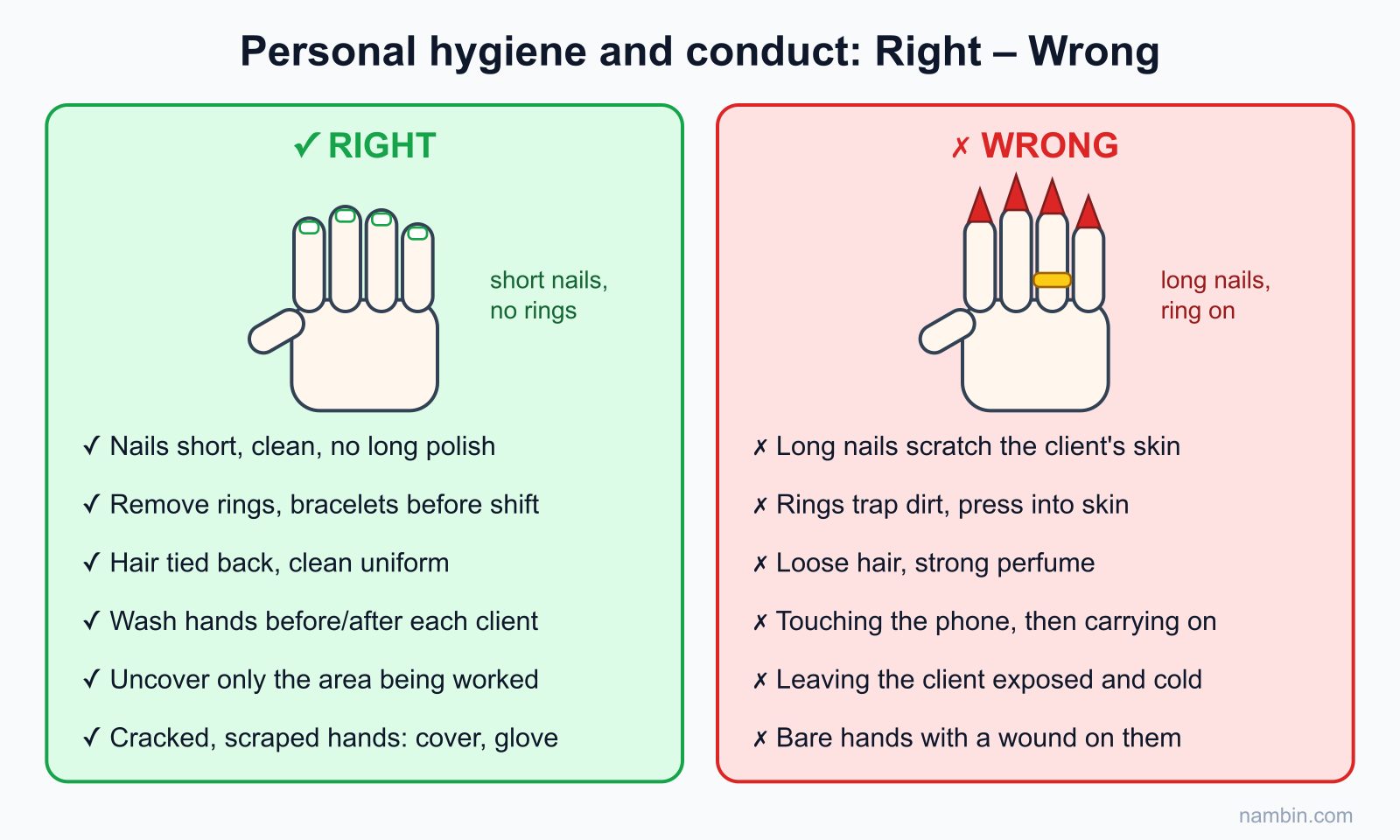
- Nails cut short and clean, no long painted nails — nails can scratch the client's skin.
- Wash your hands properly before and after each client, and after touching your hair, your face or your phone.
- Hair tied back neatly, clean uniform, no strong perfume.
- No rings or bracelets while working, to avoid scratches and the buildup of bacteria.
- Keep your voice soft and respect the client's privacy throughout the treatment.
Caring for your own hands
Washing and handling chemicals many times a day easily leaves your hands dry and cracked — painful, a place for bacteria to cling, and unpleasant for clients because your hands feel rough. Apply hand cream during breaks and at the end of each shift, and wear gloves when mixing chemicals. If you have an open wound or dermatitis on your hands, cover it, wear gloves and tell the manager; do not work directly on the client's skin.
Conduct in the treatment room
- Knock and wait for the client's permission before entering while they are changing.
- Always keep areas you are not working on covered with a towel; uncover only the area being massaged.
- Explain before touching sensitive areas such as the abdomen, upper chest and inner thighs — or skip them if the client does not agree.
- Do not use your phone in the room, and do not chat about personal matters with colleagues in front of the client.
- Never comment on the client's body, weight or skin in a way that causes embarrassment; any observation should come with a care suggestion.
Common beginner mistakes and how to avoid them
Skipping the questions because the client is a "regular"
Sign: not updating the card for returning clients. Cause: assuming their condition has not changed. Fix: at every session, ask at least three short questions about today's health, new medication and recent procedures. Health can change within just a few weeks.
Exfoliating out of habit
Sign: exfoliating every session, and the client starts complaining that the skin stings. Cause: following a fixed routine without assessing skin condition. Fix: decide whether to exfoliate after examining the skin; skip this step for sensitive skin, thin red skin or after a recent procedure.
Pushing through because you are reluctant to refuse a client
Sign: you see abnormal skin but still work on it "gently". Cause: fear of upsetting the client or losing revenue. Fix: have a polite explanation ready and inform the manager immediately. Refusing at the right moment is a sign of professionalism, not poor service.
Frequently asked questions
What if the client says "it's fine, just go ahead" despite a contraindication?
With an absolute contraindication, you still do not treat, even if the client agrees to take responsibility. Explain that this is a safety rule of the profession and the spa, then invite the shift manager to talk to the client if needed.
Can a client with mild inflamed acne have a facial?
Usually you can still cleanse and soothe, avoiding scrubbing and extractions on red, inflamed areas. If the acne is large, painful, with spreading pus or lasts a long time, advise the client to see a dermatologist before an intensive treatment.
Do I need to patch-test products on the client every time?
You should test when using a new product or a new essential oil, or when the client has a history of allergies or sensitive skin. Apply a small amount to a less visible area such as the inner forearm and watch for a few minutes; if it turns red, itches or stings, do not use it and record it on the card.
How can I remember the whole list of contraindications?
Do not memorize the list — remember the three questions in Figure 3: is the client ill or carrying a possibly contagious condition; does the treatment area have an injury, recent surgery or signs of thrombosis; does the client have a chronic condition, pregnancy, allergies or a recent procedure. A "yes" to any question means you must stop, think and ask the manager.
What should I do if the client feels faint or short of breath mid-session?
Stop immediately, help the client lie or sit in a comfortable position, ventilate the room and call the manager. If the client has difficulty breathing, chest pain, faints or is not fully conscious, call emergency services on 115 (the ambulance number in Vietnam) right away. Every spa should have an incident procedure, and you need to read it before working on real clients.
Practice exercises and self-check
- Name the three layers of the skin and which layer is mainly affected by exfoliation.
- A client has one calf swollen and warm: how do you handle it?
- Practice: examine and record the skin type of three people you know.
- Write down the five health questions you will ask before every session, and read them aloud until they sound natural and smooth.
- Role-play with a classmate: one plays a client who had microneedling last week, the other consults and changes the treatment.
Self-assessment criteria:
- Pass: the skin cards for the three people record skin type and skin condition separately, with date and observation conditions.
- Pass: you can explain why each absolute contraindication can cause harm, not just recite the list.
- Pass: in the role-play, you refuse or adjust the treatment while the client still feels respected, and you mention recording the card and informing the manager.
- Pass: your nails, hair and uniform meet the standard when you check yourself in the mirror before a shift.
- Not yet: you confuse skin type with skin condition, or you cannot say what to do with a swollen, warm calf.
The next step in the roadmap is Hygiene, disinfection of tools & treatment room: this lesson helps you keep your hands and conduct clean, and the next one extends that to everything that touches the client — tools, towels, beds and foot-soak basins. The three screening questions in Figure 3 will be used again in the 60-minute body massage step, the health form consultation and the final safety test of the roadmap.