Under the IEC 60445 color code (the system that Vietnam's national installation standards, TCVN, are harmonised with), the live (phase) conductor is brown (three-phase: brown – black – grey), the neutral is blue and the protective earth is green-and-yellow. In Vietnamese homes, however, red is still very commonly used for the live conductor. And a wire color is only a promise made by the previous electrician — wrongly colored wiring is extremely common in older houses, so before touching any conductor you must still test it with a voltage tester pen and a multimeter.
By the end of this lesson, you will be able to:
- State the standard colors of live, neutral and earth conductors for single-phase and three-phase supplies, including the PEN conductor.
- Recognise the "old-style" colors often found in Vietnamese homes and distribution boards, and know which colors can cause deadly mistakes.
- Identify every conductor in a junction box with a tester pen and multimeter in 5 steps, recording actual readings.
- Re-mark wrongly colored conductors correctly and explain why a green-and-yellow wire must never be used for anything else.
Learn it properly from the start: this lesson belongs to step 1 of the electrician roadmap. If you want a structured course — electrical safety, tools, meters, cables and wiring light and earthed socket circuits with your own hands — see the Residential Electrician Level 1 – Helper course.
Wire color chart for live, neutral and earth: the quick answer
If you only need one table to remember, this is it. Colors follow IEC 60445, the international standard for identifying conductors by color; Vietnam's low-voltage installation standards (TCVN, the Vietnamese national standards) are written in harmony with this IEC system. Cable sold in Vietnamese electrical supply shops today is available in all these colors. See Figure 1 for the actual color of each conductor.
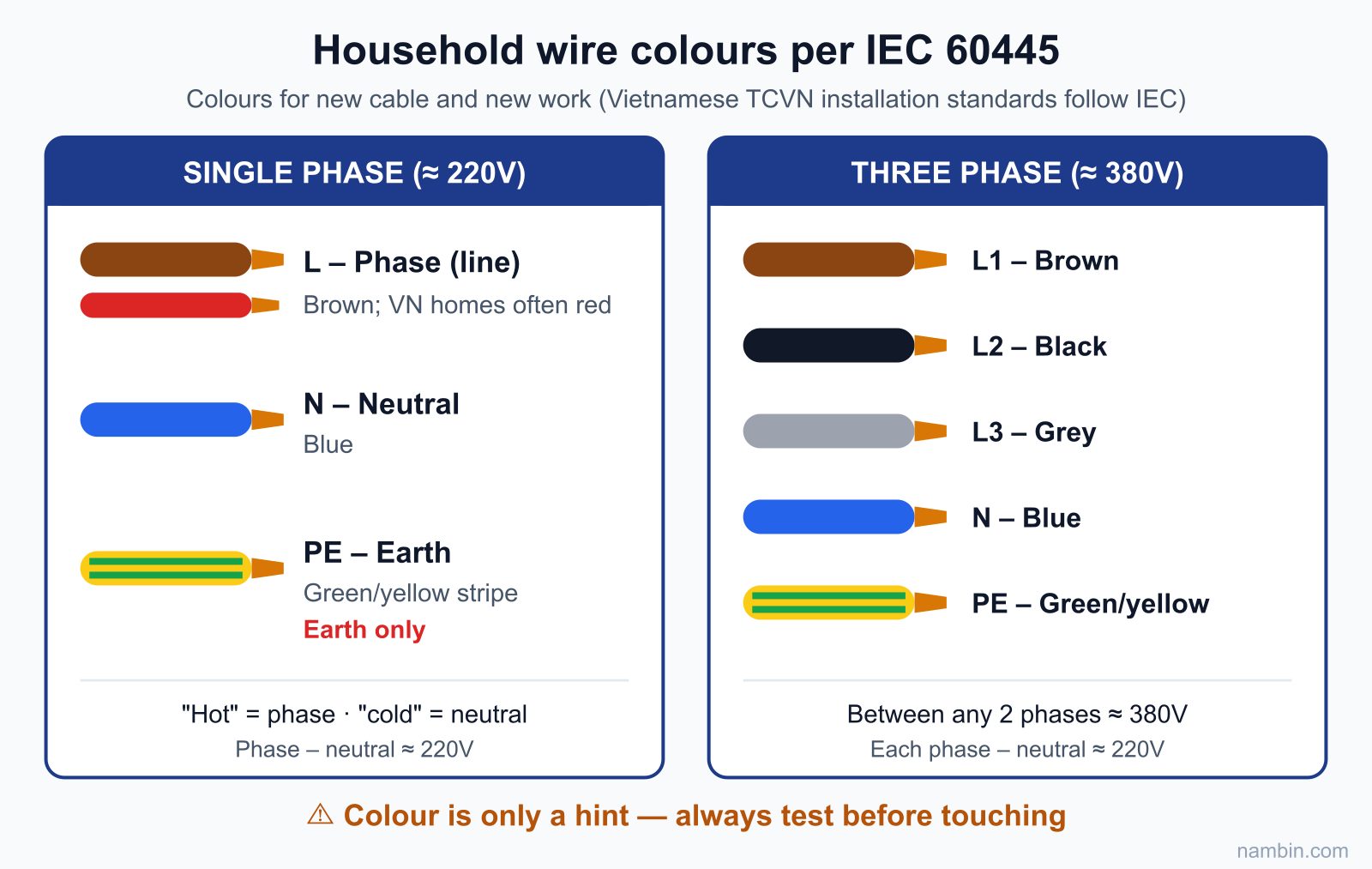
| Conductor | Symbol | Standard color (new cable) | Common in older homes |
|---|---|---|---|
| Live (phase, "hot"), single-phase | L | Brown | Red; sometimes yellow, black, even blue |
| Live, three-phase | L1 – L2 – L3 | Brown – Black – Grey | Yellow – Green – Red |
| Neutral | N | Blue | Black or blue; sometimes the same color as the live |
| Protective earth | PE | Green-and-yellow | Often missing; sometimes plain green |
| PEN (combined PE and N) | PEN | Green-and-yellow with blue marking at the ends (or the reverse) | Almost never seen inside homes |
Single-phase supply in homes
Most Vietnamese homes use a single-phase 220V/50Hz supply with three conductors: live, neutral and earth. By the standard, the live is brown. In practice, many residential electricians still habitually use red for live, and this is acceptable within one installation as long as the whole house follows one consistent convention and it is recorded for the homeowner. The two colors that are never flexible are blue for neutral and green-and-yellow for earth.
Three-phase supply
In small workshops, houses with a three-phase pump or buildings on a 380V three-phase supply, the three live conductors L1 – L2 – L3 are by standard brown – black – grey. Neutral is still blue and earth still green-and-yellow. Between any two phases there is about 380V, and between each phase and neutral about 220V — so a three-phase junction box is far more dangerous than a single-phase one.
What is a PEN conductor, and will you see one at home?
A PEN conductor serves as both neutral and earth. It exists only in a TN-C earthing system, usually before the separation point in the main board. Under IEC, a PEN conductor is green-and-yellow with blue marking at both ends, or the reverse. You will not meet it in junction boxes or sockets in a home; if you see one in a board, that is a job for a qualified electrician and the power utility.
Why each conductor has its own color: what live, neutral and earth do
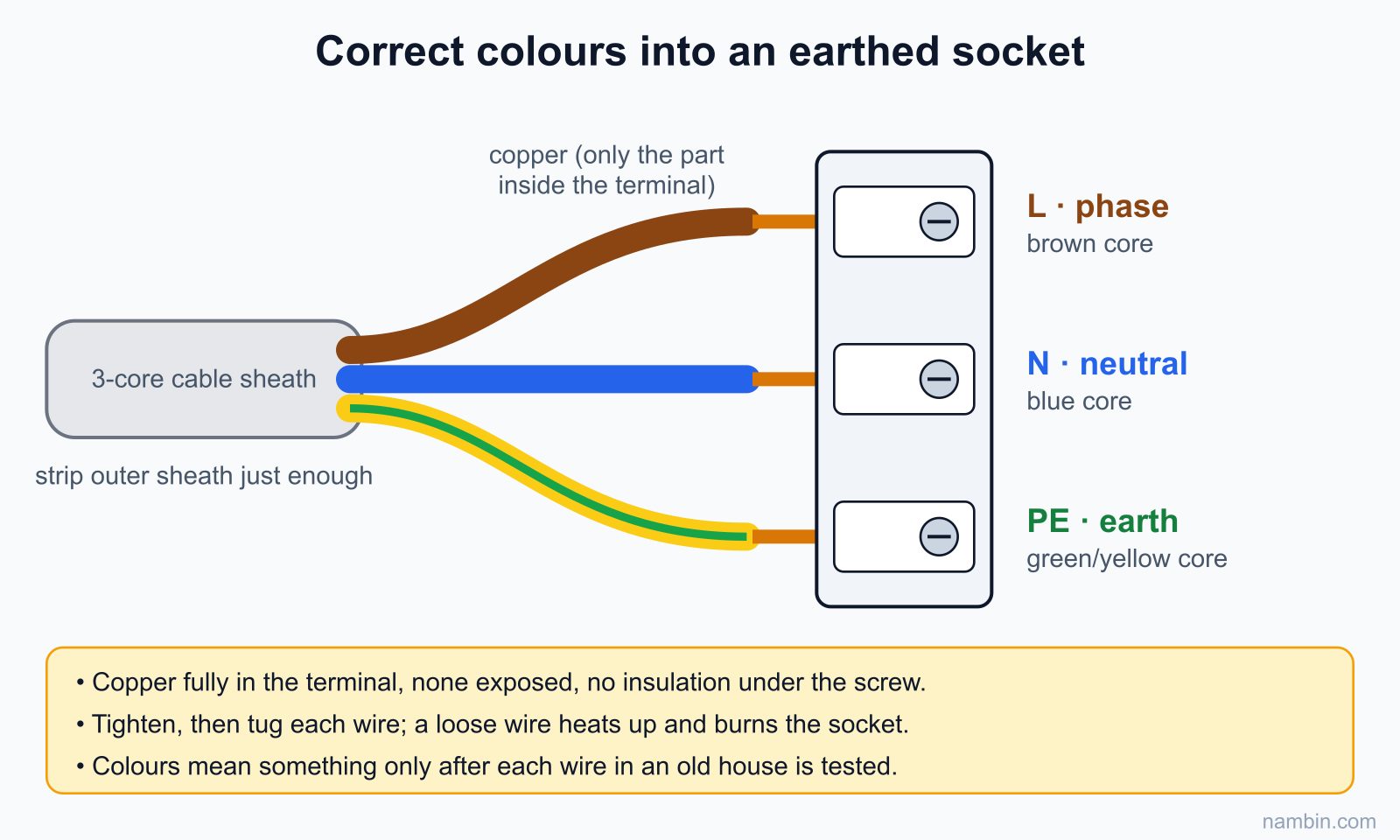
Wire colors exist so that the next electrician — possibly you, ten years later — can tell at a glance which conductor carries voltage, which returns current and which protects people. Understanding each conductor's role helps you understand why mixing them up is dangerous. Figure 2 shows three correctly colored cores going to the correct terminals of an earthed socket.
Live — the "hot" wire
The live conductor carries about 220V relative to earth. Touching a live wire while standing on the ground sends current through your body — as calculated in the lesson 5 safety rules before touching any wire, just a few tens of milliamps can endanger the heart. Switches, single-pole breakers and fuses must always be placed on the live conductor, so that everything after them is dead when switched off.
Neutral — the "cold" wire that is not always cold
The neutral carries current from the appliance back to the source. In a healthy circuit, the voltage between neutral and earth is only a few volts, which is why Vietnamese people call it the "cold wire". But if the neutral breaks on the supply side while an appliance is still plugged in, the neutral on the appliance side will carry almost full phase voltage through that appliance. That is why electricians treat neutral as live until a measurement proves otherwise.
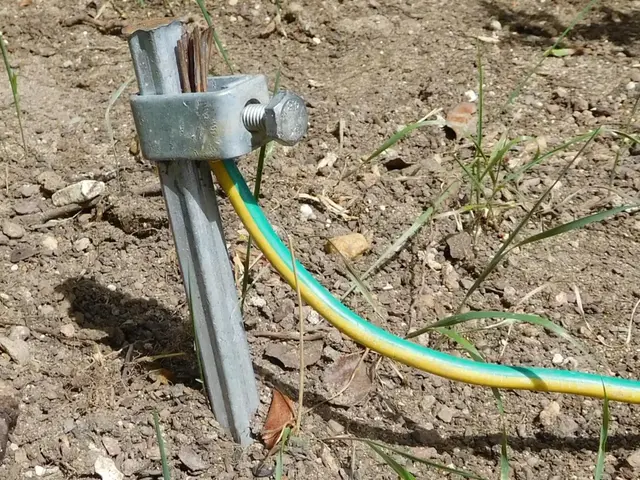
Earth — the green-and-yellow wire that protects people
The protective earth (PE) connects the metal casings of water heaters, washing machines and refrigerators to the earth electrode. Normally it carries no current. When an appliance leaks current to its casing, the fault current flows along the PE conductor to earth, the residual current device (RCD) detects it and disconnects the supply, and a person touching the casing is much less at risk. Connecting a live wire to the earth terminal turns the appliance casing into a 220V terminal — which is why green-and-yellow is the most strictly protected color of all.
Old Vietnamese color conventions and colors that cause confusion
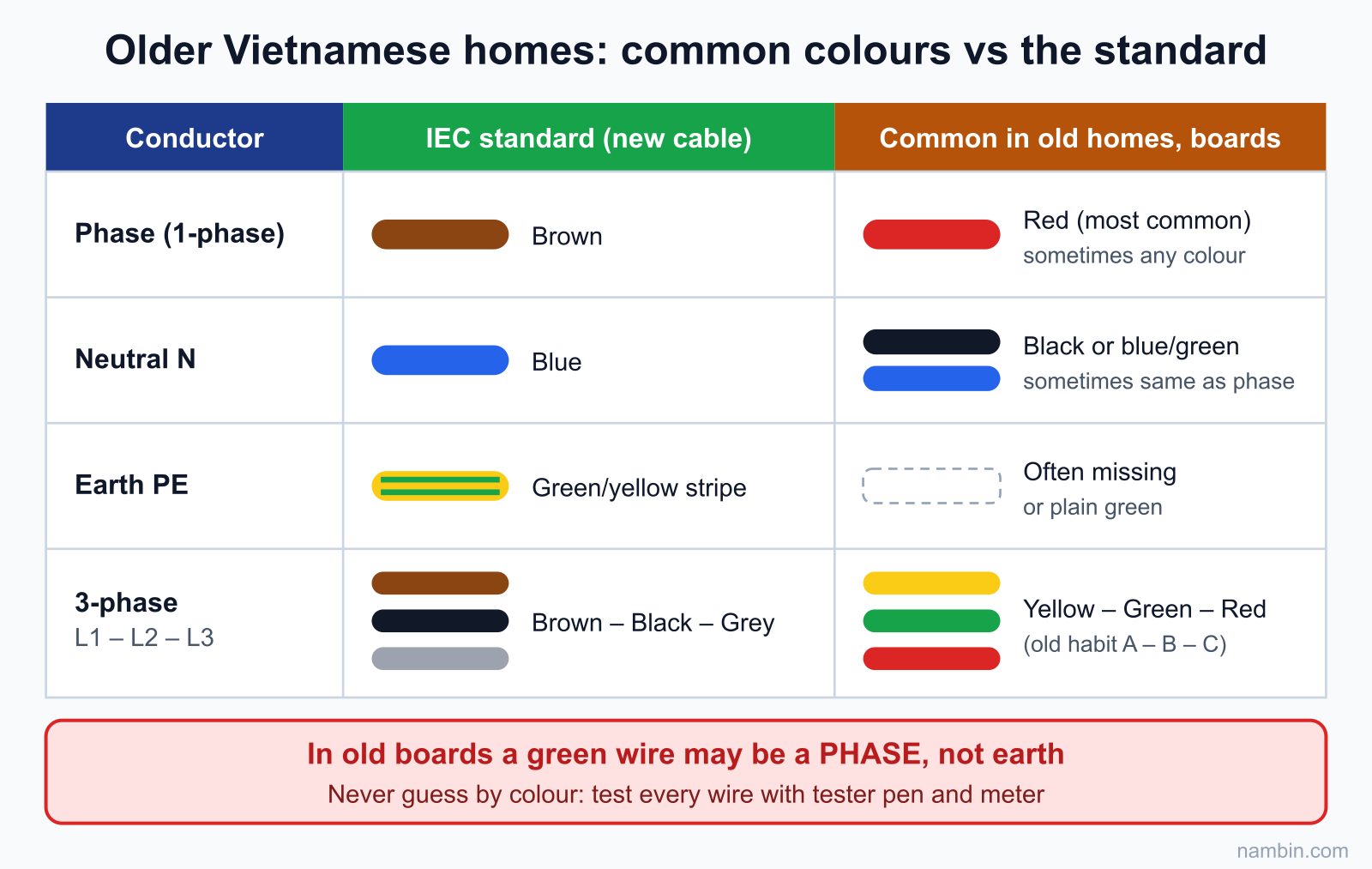
Before the IEC color system became widespread, electricians in Vietnam wired according to their own habits, their region and whatever cable the shop had that day. As a result, houses built 15–20 years ago, or houses worked on by several generations of electricians, can contain every color imaginable. Figure 3 compares the standard colors with what you often find when you open an old junction box.
Old single-phase homes: red – black, and often no earth
The most common pattern is red for live, black or blue for neutral, and no earth conductor at all. Some houses use flexible twin cable with two cores of the same color for the whole circuit; others run one red and one yellow simply because "there was some left on the reel". In such cases you cannot rely on color to tell which conductor is live. A house with no earth conductor should also be noted for the homeowner, with advice to add one.
Old three-phase boards and cables: yellow – green – red
On busbars and three-phase cables in older boards you will often see the trio yellow – green – red, usually corresponding to phases A – B – C under the old convention. The danger: someone used to the IEC system who sees a green or yellow wire may immediately think "earth". In an old board, a green wire can be a live phase at 220V to earth. This is one of the most dangerous color mix-ups, and every helper must know it by heart.
Imported appliances and appliance leads
Most appliance power leads sold in Vietnam follow the European convention: brown is live, blue is neutral, green-and-yellow is earth. Appliances from North America may differ — there, white is usually neutral and black or red is live. Read the terminal labels and the instructions on the appliance; do not assume from familiar colors.
How to identify conductors with a tester pen and multimeter before touching
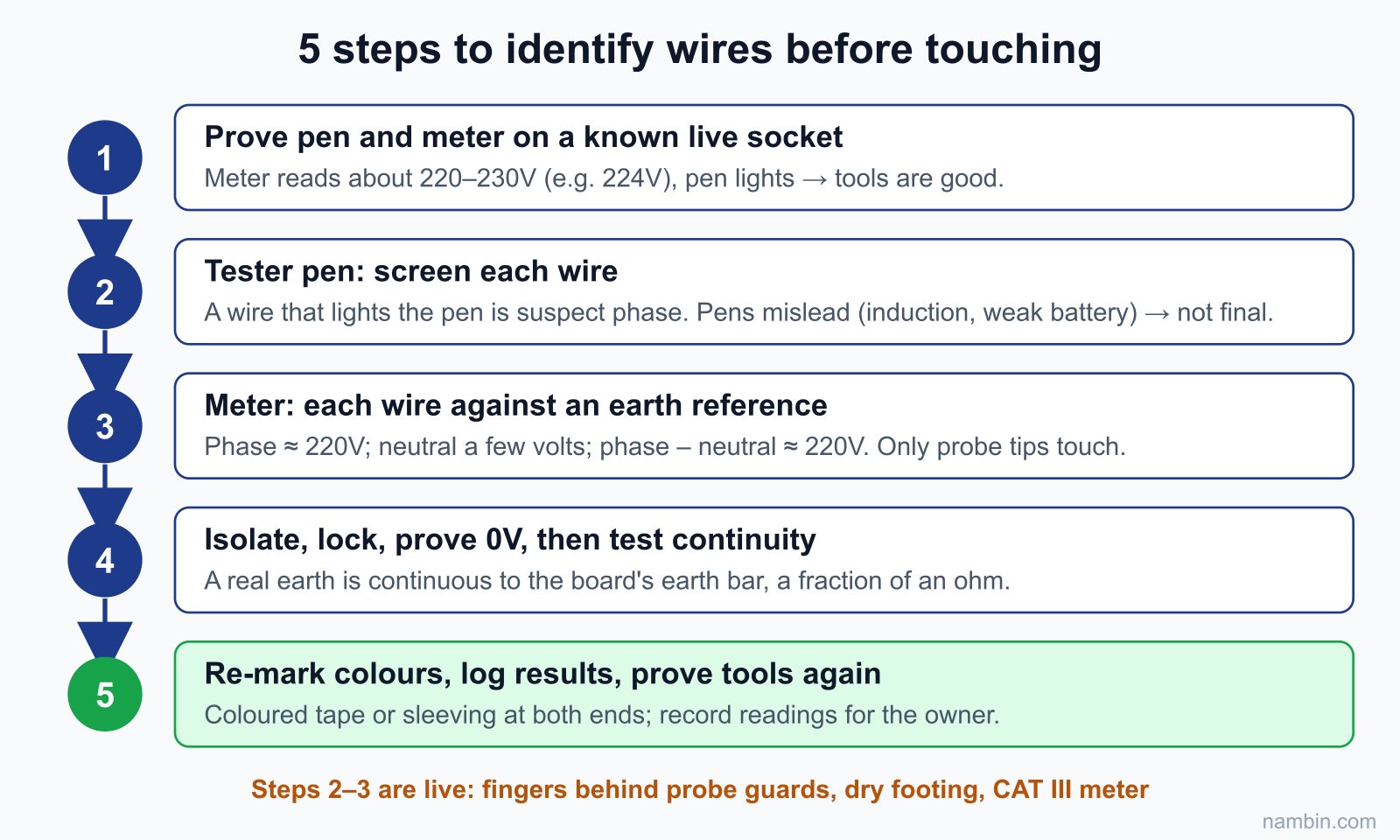
Because colors can be wrong, every time you open an old junction box, socket or board you must re-identify each conductor by measurement. Detailed multimeter use is covered in the lesson Using a multimeter for electricians; here is a short sequence specifically for identifying conductors. Figure 4 summarises the 5 steps.
Tools to prepare
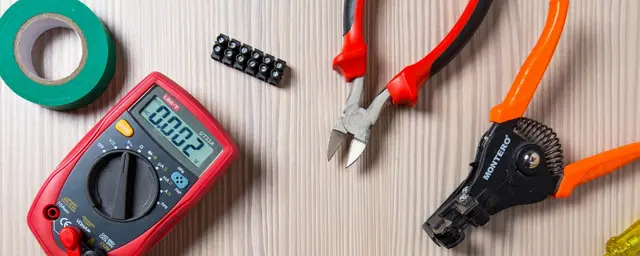
- A voltage tester pen with a working battery; a multimeter rated CAT III 600V or higher, with probes whose insulation is intact.
- Insulating gloves, dry rubber-soled shoes, a head torch.
- Brown (or red) and blue insulating tape; a notebook; a test lead about 15–20 m long to bring an earth reference up from the board.
The steps
- Prove your tools on a known live source. Put the multimeter probes into a working socket: it should read about 220–230V. Touch the tester pen to the live hole of that socket: it must light. A faulty tool that says "no voltage" is a deadly trap.
- Screen with the tester pen. Touch each conductor in turn (only the tip of the pen on bare copper or the joint). A conductor that lights the pen clearly is suspected live. The pen may glow faintly from induced voltage on long cables, or not light because of a weak battery, so this is not yet a conclusion.
- Measure with the multimeter against an earth reference. The reference can be the green-and-yellow conductor in the box (to be checked again in step 4) or the earth terminal of a socket you have already verified. Live reads about 220V; neutral only a few volts; live to neutral about 220V. A floating reading of a few tens of volts that keeps jumping is usually induced voltage on a disconnected wire.
- Isolate, lock off, re-test, then test continuity. Switch off the circuit breaker, tape it off as a lock, confirm all conductors now read close to 0V, then prove the multimeter on a live source again. Then use the continuity (Ω) range to measure the suspected earth conductor against the earth bar in the board via the test lead: a genuine PE conductor reads a very low resistance, just a fraction of an ohm.
- Mark and record. Re-mark any wrongly colored conductor at both ends (see the section below), write the readings in the handover notebook, and only then start making connections.
Safety warning: Steps 2 and 3 are done with the circuit still live, so only the probe tips may touch the conductors; keep your fingers behind the probe guards at all times, stand on a dry floor and do not lean on a metal board casing or water pipe. Apprentices may only take measurements with a qualified electrician beside them. Every disconnection or connection must be made after isolating, locking off the breaker and re-testing for 0V as in step 4. Never use wire color in place of measurement, even in a newly built house.
Worked example: a 5-wire junction box in the kitchen of a 3-storey tube house
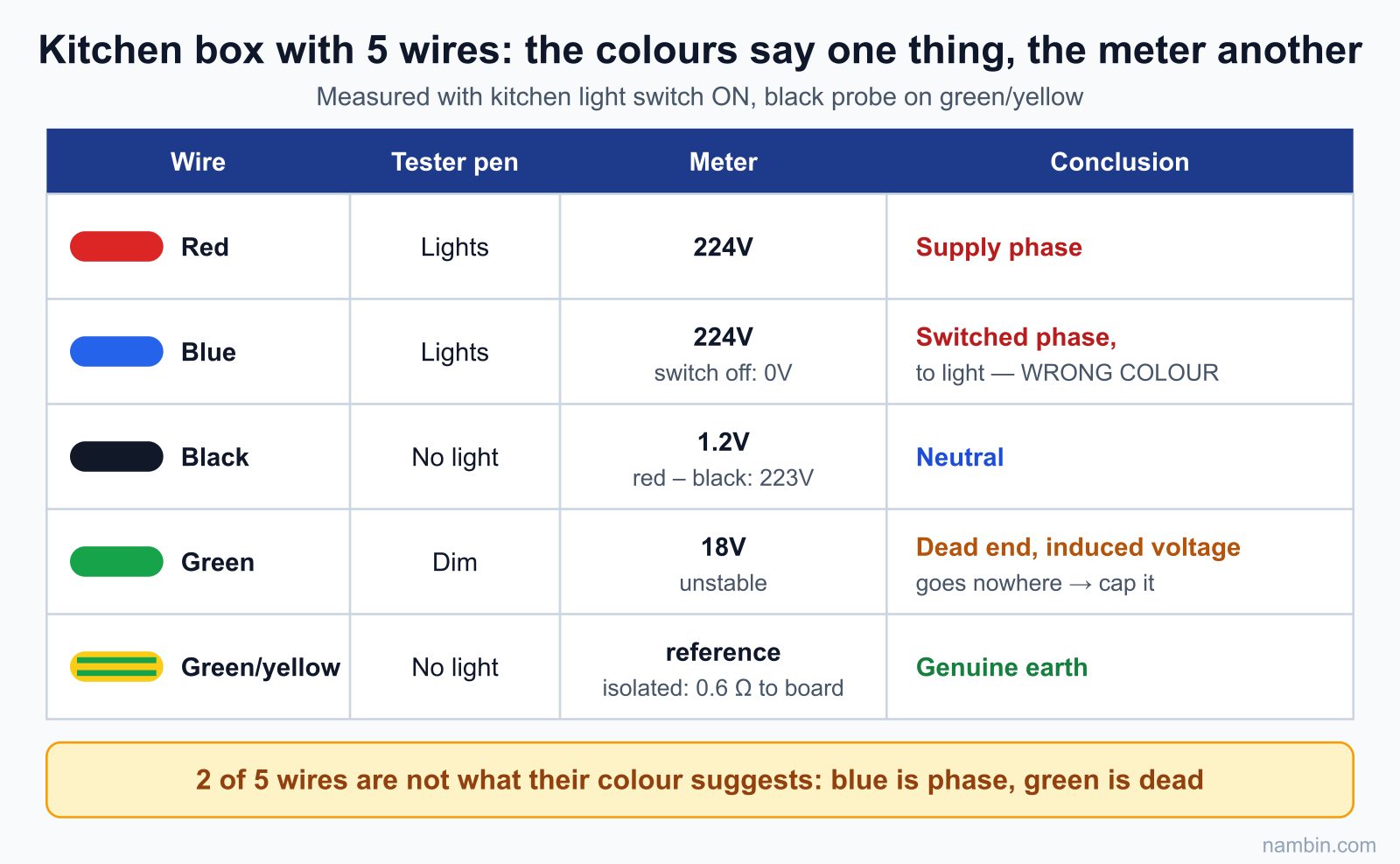
The client lives in a 3-storey tube house (a narrow terraced house typical of Vietnamese cities) built around 2007; the kitchen was rewired by another electrician in 2019. The client wants to install a wall-mounted cooker hood of about 40W, supplied from a junction box on the kitchen wall next to the light switch. Opening the lid, you find 5 wires: red, blue, black, plain green and green-and-yellow. Going by color, a beginner would guess: red is live, blue and black are neutral, green and green-and-yellow are earth. The measurements show that guess is wrong for two of the five wires — see Figure 5.
Measuring with the power on
You prove the multimeter on a kitchen socket: 224V, and the tester pen lights — tools are good. You switch the kitchen light on, place the black probe on the green-and-yellow wire and measure each conductor:
| Wire | Tester pen | Multimeter | Provisional conclusion |
|---|---|---|---|
| Red | Lights | 224V | Supply live |
| Blue | Lights | 224V with switch on, 0V with switch off | Switched live going to the light |
| Black | Does not light | 1.2V; red to black reads 223V | Neutral |
| Green | Faint glow | 18V, reading jumps | Suspected dead wire with induced voltage |
| Green-and-yellow | Does not light | Reference | Awaiting continuity test |
The blue wire is exactly where the danger lies: the 2019 electrician used a blue wire as the live running from the switch up to the light. The next person to change the light switches it off, sees the blue wire as "neutral" and feels safe — until one day someone flicks the switch while they are holding the wire.
Isolating and testing continuity
You go to the board, switch off the kitchen circuit breaker and tape it with a "Work in progress – do not switch on" label. Back at the box, all 5 wires read 0V against green-and-yellow and against each other; proving the meter at a living-room socket (a different circuit) still gives 224V. You run the test lead up from the earth bar in the board and measure the green-and-yellow wire: 0.6 Ω — a genuine earth. Measuring the green wire against the earth bar, the neutral bar and every other wire: no continuity anywhere. It is a cut-off leftover wire running alongside a live conductor, picking up 18V of induced voltage.
Marking, connecting and handing over
You wrap red tape (following this house's red-for-live convention) around the end of the blue wire in the junction box and at the switch. The green wire is taped over at its end, folded neatly into the box and noted. The cooker hood lead has brown, blue and green-and-yellow cores: brown goes to red (supply live, since the hood has its own pull switch), blue to black (neutral), green-and-yellow to green-and-yellow. You restore power and measure at the hood: live to neutral 223V, live to earth 223V, neutral to earth 1.2V; the hood runs smoothly. In the handover notebook you write: "Kitchen junction box: blue = switched live to light (taped red); green = dead wire, insulated".
Re-marking wrongly colored conductors correctly
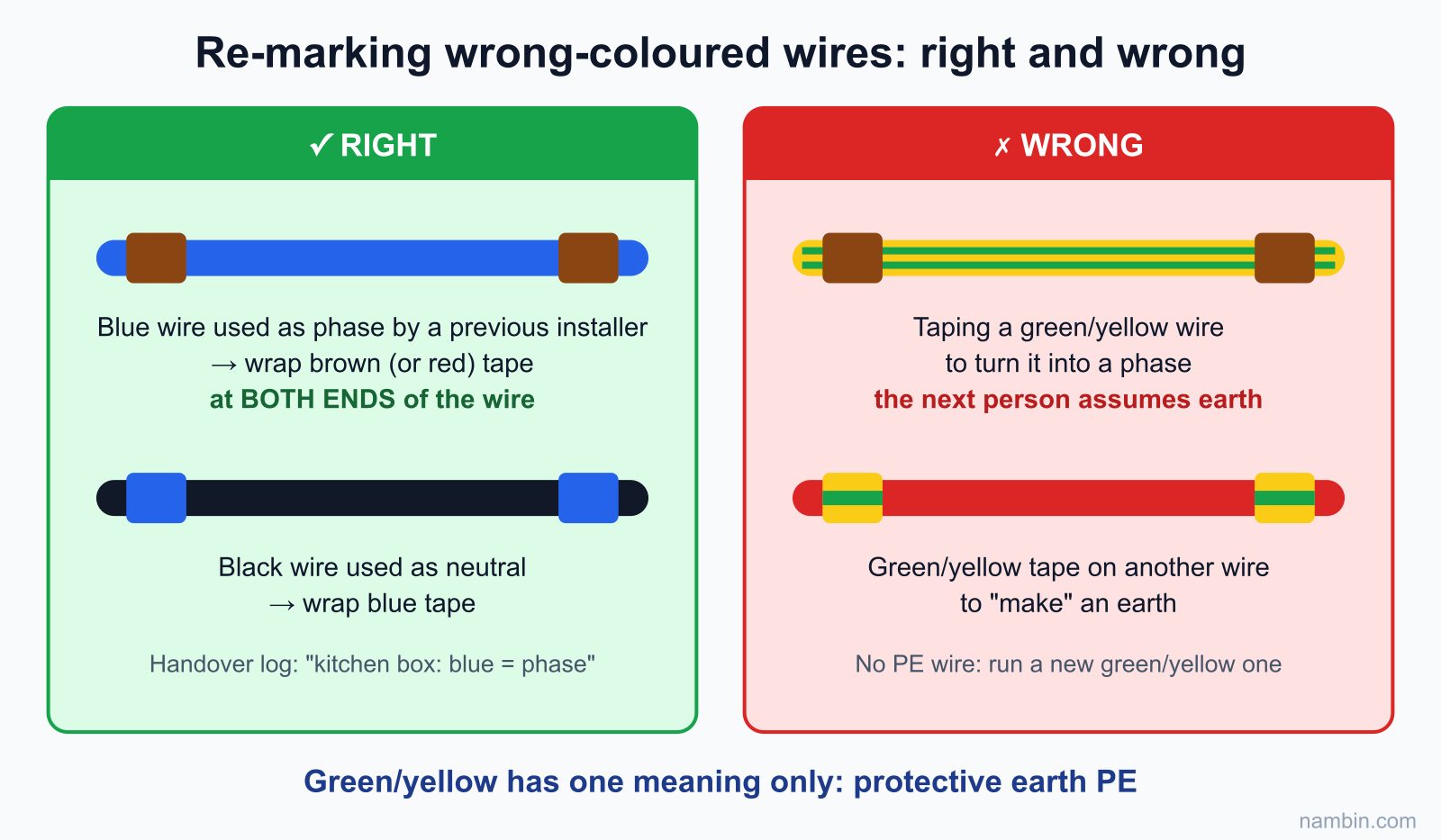
You cannot always replace a wrongly colored wire, especially if it is buried in the wall. The professional approach is to re-mark it at both ends with insulating tape or heat-shrink sleeving in the color matching its function. Figure 6 shows the correct method and two common wrong ones.
Marking rules
- A wrongly colored conductor used as live: wrap brown tape (or red if the whole house uses red for live) at every exposed end — junction boxes, switches, sockets, boards.
- A wrongly colored conductor used as neutral: wrap blue tape at its ends.
- Use several wide turns, do not let the terminal hide the marking, and record it in the handover notebook.
Green-and-yellow: one color, one meaning
A green-and-yellow wire is used only for protective earth (or for a PEN conductor with its own marking, as above). Never tape a green-and-yellow wire to turn it into a live or neutral, and never put green-and-yellow tape on another wire to "make" an earth. If an earth conductor is missing, run a new green-and-yellow wire back to the earth bar. Every electrician is trained to trust that a green-and-yellow wire is not live — breaking that trust sets a trap for the next person.
Common wire color mistakes and how to avoid them
Trusting color without measuring
Symptom: getting a shock from a blue "neutral" after switching the light off. Cause: the previous electrician used a blue wire as the switched live, or put the switch on the neutral. Fix: isolate at the circuit breaker, not at the switch, test every wire in 5 steps, re-mark and move the switch onto the live conductor.
Mistaking plain green for earth
Symptom: you connect an appliance casing to the green wire, switch on, and the casing is live or the breaker trips. Cause: in older homes and boards, green may be a live phase or a dead wire connected to nothing. Fix: only accept a conductor as earth when continuity to the earth bar shows a very low resistance and the live-to-earth reading roughly equals live-to-neutral.
Live and neutral swapped at a socket
Symptom: appliances still work, but the tester pen lights in the "neutral" hole of the socket; a light switched off still has voltage at the lampholder. Cause: wiring by color at an intermediate junction box where colors were already swapped. Fix: measure at every connection point working back to the board, fix it where the swap occurred, and do not just "correct" it at the socket.
Using green-and-yellow as live because "there was some left on the reel"
Symptom: a green-and-yellow wire reads 220V. Cause: the previous electrician saved cable. Fix: the wire must be replaced, not just marked; until it is, write a warning on the junction box lid and inform the homeowner.
Frequently asked questions
What color are the hot and cold wires?
The "hot" wire is the live (phase) conductor, brown by standard; Vietnamese homes very often use red. The "cold" wire is the neutral, blue by standard; older homes often use black. Both are only hints — identify them with a tester pen and multimeter before working.
What is the green-and-yellow wire?
The green-and-yellow wire is the protective earth (PE), connecting metal appliance casings to the earth electrode. It must not be used as live or neutral. A green-and-yellow wire with blue marking at the ends is a PEN conductor in the main board and is not found at household sockets.
What are the color rules for three-phase wiring?
Under IEC 60445: L1 brown, L2 black, L3 grey, neutral blue, earth green-and-yellow. In older Vietnamese boards and busbars the yellow – green – red set is still common. When you need to cite a standard in design or commissioning documents, look up the TCVN version currently in force on the official portal, rather than relying on copied material.
Can the neutral give you a shock?
Yes, if the neutral is broken on the supply side or wired incorrectly. Treat every conductor as live until you have measured that it is not.
Which colors should I use when wiring a new house?
Follow IEC: brown for live (or red if the homeowner and the crew have agreed), blue for neutral, and green-and-yellow for earth on every circuit with sockets and metal-cased appliances.
Practice exercises and self-assessment
Exercises
- Without looking at the lesson, write out the wire color chart for single-phase and three-phase supplies (L, L1, L2, L3, N, PE, PEN).
- Under the guidance of a qualified electrician, choose a junction box or socket in your home, carry out all 5 steps as in Figure 4 and record the reading for each wire in a table like the worked example.
- On a practice board, re-mark a blue wire used as live and a black wire used as neutral with tape at both ends.
Self-assessment criteria
- Pass: the color chart is 100% correct, including the facts that Vietnamese homes often use red for live and old boards often use yellow – green – red.
- Pass: the measurement table has actual readings for every wire (for example 224V, 1.2V, 0.6 Ω), the tools were proved before and after, and power was isolated before the continuity test.
- Pass: tape marking at both ends, in the correct functional color, with no tape on any green-and-yellow wire.
- Not yet, redo: concluding a wire's function from its color alone or from the tester pen alone; touching a wire before measuring 0V.
Continue with guidance: the Residential Electrician Level 1 – Helper course has a dedicated lesson on cables and color conventions and on joining wires, followed by hands-on practice wiring light and earthed socket circuits and checking them before switching on.
Next step in the roadmap (step 2 — Multimeter & voltage tester pen): this lesson relies heavily on measurement. In the next step you will learn to use a multimeter and tester pen confidently — measuring voltage, continuity and resistance, and recognising induced voltage like the 18V green wire above — so that every conclusion about wire colors rests on numbers you can trust.