The six earlier steps of this roadmap gave you the full toolkit: safety rules, the multimeter, choosing cables and circuit breakers, wiring lighting and socket circuits, installing a distribution board with earthing, and diagnosing breakers that keep tripping. Step 7 is where you prove it: can you build a complete circuit that is safe, and test it with real measurements, without anyone standing next to you giving reminders?
This lesson is a complete exam pack you can sit on your own or have an instructor mark for you. By the end of this lesson, you will be able to:
- Answer 15 core electrical safety questions and understand why each correct answer is correct.
- Build a complete practice board in 150 minutes: a small distribution board, a lighting circuit with two-way switches and a socket circuit with earthing.
- Test the installation before power-up in 6 steps — continuity, polarity, insulation resistance, voltage and an RCBO test — and fill in a test record like a real handover inspection.
- Recognise the mistakes that fail you on the spot, and find the fault logically when the RCBO trips at power-up.
The practical exam involves switching on 220V mains. Only do it under the supervision of an experienced instructor, with the board supplied through its own circuit breaker and a 30 mA RCBO, and make every connection with the power switched off.
What the step 7 assessment contains
The assessment has two parts worth 100 points in total. The theory part checks that you understand why things must be done a certain way; the practical part checks that you do them correctly and safely. A high score in one part cannot make up for a dangerous mistake in the other.
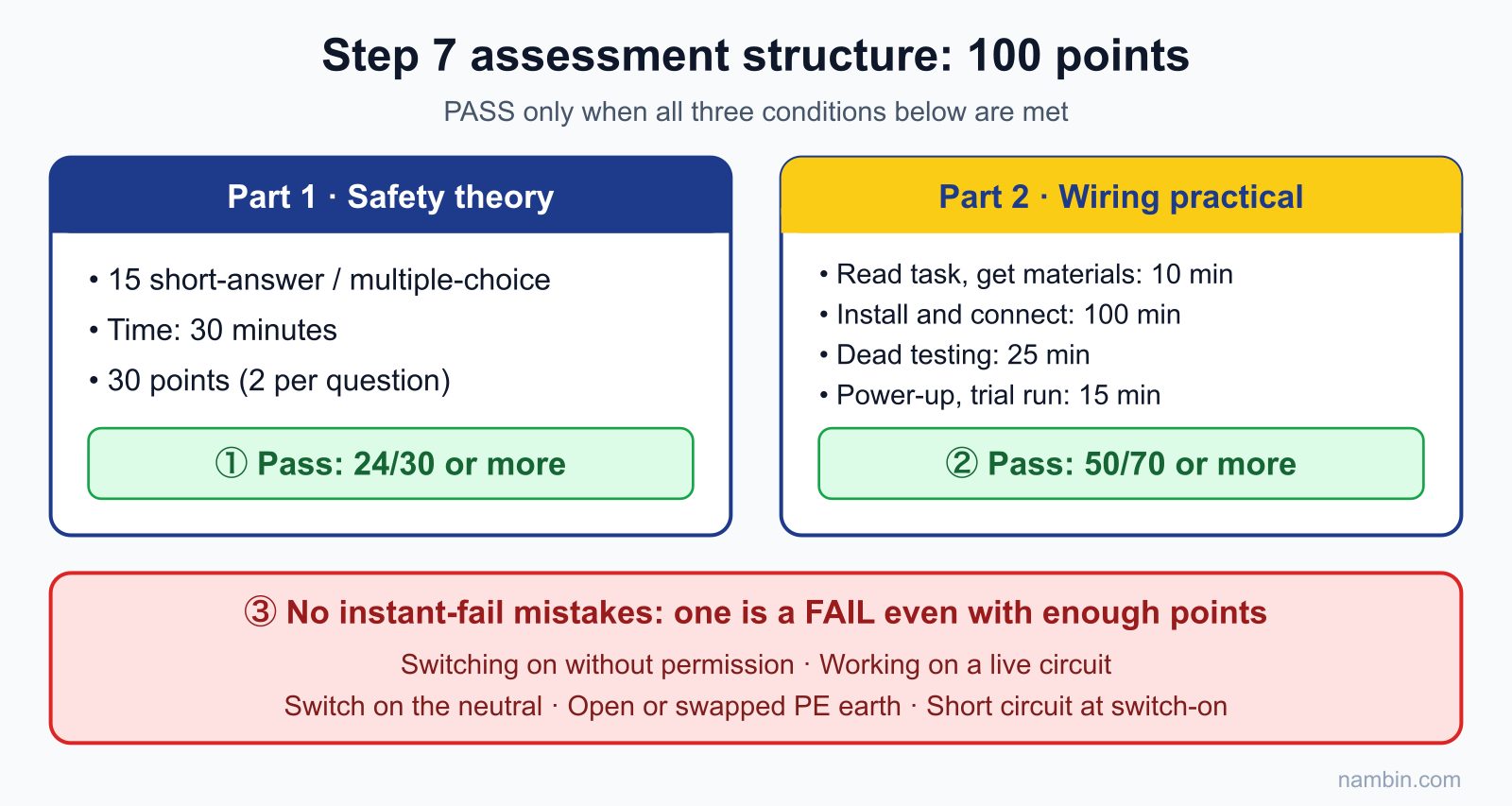
The theory pass mark is set high (80%) because this is safety knowledge. The practical pass mark is 50 out of 70, but there is a group of instant-fail mistakes: make one of them and you fail, whatever your total. If you sit the exam on your own, ask someone else to keep time and mark against the scheme; marking yourself is usually more lenient than you think.
Part 1: The safety theory self-test
Allow 30 minutes, keep your notes closed, and write your answers on paper before you compare them with the model answers. Each question is worth 2 points; a correct main idea with an incomplete explanation earns 1 point.
Questions on hazards and the isolation procedure
Question 1. A person standing barefoot on a damp floor touches a 220V live conductor. Assuming a body resistance of about 1,000 Ω, how much current flows through them and how dangerous is it?
Answer: I = U / R ≈ 220 / 1,000 = 0.22 A, or about 220 mA. From about 30 mA the muscles can lock so the person cannot let go; above about 50 mA through the heart there is a risk of fatal ventricular fibrillation. 220 mA is far above the lethal threshold — household 220V can absolutely kill.
Question 2. List the 5 mandatory steps before touching a conductor.
Answer: (1) Identify the correct circuit; (2) switch it off at the circuit breaker; (3) lock off and hang a warning tag; (4) prove – test – prove: check the tester on a known live source, test the conductor you will work on, then check the tester again; (5) do the work and inspect it carefully before switching back on. Skipping step 4 is the most common mistake.
Question 3. Is it safe to replace a lamp holder after turning off the light switch?
Answer: No. A switch breaks only one conductor, and if the previous electrician put the switch on the neutral, the lamp holder is still at 220V to earth even with the light off. Always isolate at the circuit breaker and test.
Question 4. A test screwdriver does not light up when touched to a conductor. Can you be sure it is dead?
Answer: No. The tester may have a flat battery or be faulty, or you may be standing on an insulating floor so it cannot light. Prove the tester on a live source before and after the test; better still, use a multimeter and measure all three pairs: L–N, L–PE and N–PE.
Question 5. You find someone receiving an electric shock and stuck to a conductor. What do you do first?
Answer: Cut the supply immediately (circuit breaker, unplug). If you cannot, separate the victim with a dry insulating object such as a wooden stick while standing on a dry board; never pull them with your bare hands. Then call 115 (the emergency medical number in Vietnam), check their breathing and start cardiopulmonary resuscitation (CPR) if they are not breathing.
Questions on protective devices and cables
Question 6. What does a 30 mA RCBO protect against that an ordinary MCB does not?
Answer: An MCB trips only on overload or short circuit. An RCBO also compares the current going out on the live conductor with the current returning on the neutral; an imbalance of about 30 mA (leakage through a person or an appliance casing) makes it trip within 0.3 seconds, and within 0.04 seconds when the leakage is five times higher.
Question 7. What does the TEST button on an RCBO check, and what does it not check?
Answer: The TEST button creates an artificial internal leakage to check that the trip mechanism still works. It cannot measure the trip time and does not prove that the PE conductor in the circuit is continuous. To know the trip time you need a dedicated RCD tester.
Question 8. State the cable–breaker coordination rule and apply it: a socket circuit wired in 2.5 mm² cable — do you choose a 16A, 20A or 32A breaker?
Answer: Ib ≤ In ≤ Iz: design load current ≤ breaker rated current ≤ continuous current-carrying capacity of the cable. 2.5 mm² copper in conduit carries about 21–24A, so choose 16A or 20A. 32A is wrong: the cable can overheat for a long time before the breaker trips.
Question 9. Roughly how much current does a 2,500W water heater draw at 220V?
Answer: It is a purely resistive load, so I = P / U = 2,500 / 220 ≈ 11.4 A. Give it its own circuit, 2.5 mm² cable or larger, and a 16A or 20A RCBO rated 30 mA, because it is an appliance in a wet area.
Question 10. A socket run is 30 m long, in 2.5 mm² cable, carrying 16A. Is the voltage drop acceptable?
Answer: ΔU ≈ 2 × L × I × ρ / S = 2 × 30 × 16 × 0.0175 / 2.5 ≈ 6.7 V, about 3% of 220V. That passes the roughly 5% limit for socket circuits; for a lighting circuit (about 3%) it would already be at the limit.
Question 11. State the common cable colour convention and the most serious colour mistake.
Answer: Green with a yellow stripe is used only for the protective earth (PE); blue for neutral (N); the live conductor uses brown, red, black or grey. The most serious mistake is using green-yellow cable as a live conductor: the next person trusts it is the earth and touches it.
Questions on testing and real situations
Question 12. What test voltage do you use for insulation resistance, what is the pass value, and what must you prepare before testing?
Answer: For 220V circuits use 500V DC; the pass value is 1 MΩ or more between L–N, L–PE and N–PE (according to TCVN 7447, the Vietnamese standard equivalent to IEC 60364-6). Before testing: isolate the supply, remove the lamps, unplug all appliances, and tell everyone nearby not to touch the cable ends.
Question 13. Your multimeter is set to the resistance range and you put the probes into a live socket. What happens?
Answer: The meter may blow its fuse, damage its measuring circuit or even throw an arc at your hand. Always look at the selector dial before applying the probes, and use a meter rated CAT III 600V or higher for household installations.
Question 14. The 16A breaker for the kitchen socket circuit trips every evening. The owner asks you to replace it with a 32A one. What do you do?
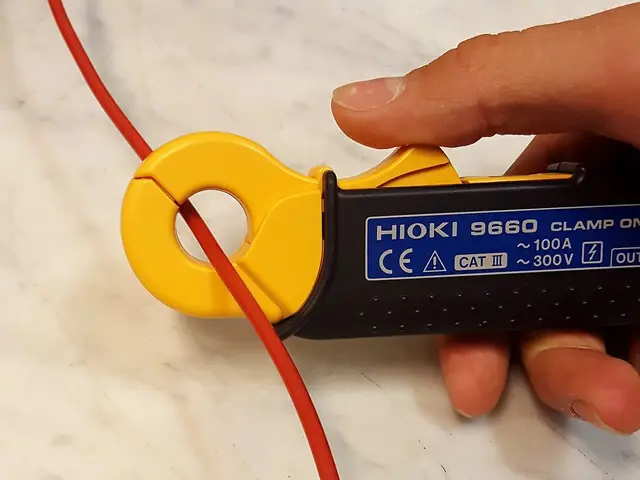
Answer: Refuse to upsize the breaker while the cable is still 2.5 mm². Use a clamp meter to measure the current at peak time and decide whether it is an overload or a fault; if it is an overload, move the large loads onto a separate circuit with a suitable cable and breaker.
Question 15. Inside the board, can the neutral of a socket circuit protected by an RCBO be connected to the common neutral bar?
Answer: No. The neutral of a circuit after an RCBO must come from the N output terminal of that same RCBO. If it goes to the common neutral bar, the return current bypasses the RCBO, so the RCBO sees an imbalance and trips — or current from another circuit flows through it and makes it trip for no apparent reason.
Self-marking: 24/30 or more is a pass. For each wrong answer, go back to the matching lesson: questions 1–5 the safety rules lesson, 12–13 the multimeter lesson, 8–10 the cable and breaker selection lesson, 6–7 and 15 the distribution board lesson.
Part 2: The wiring practical
The task
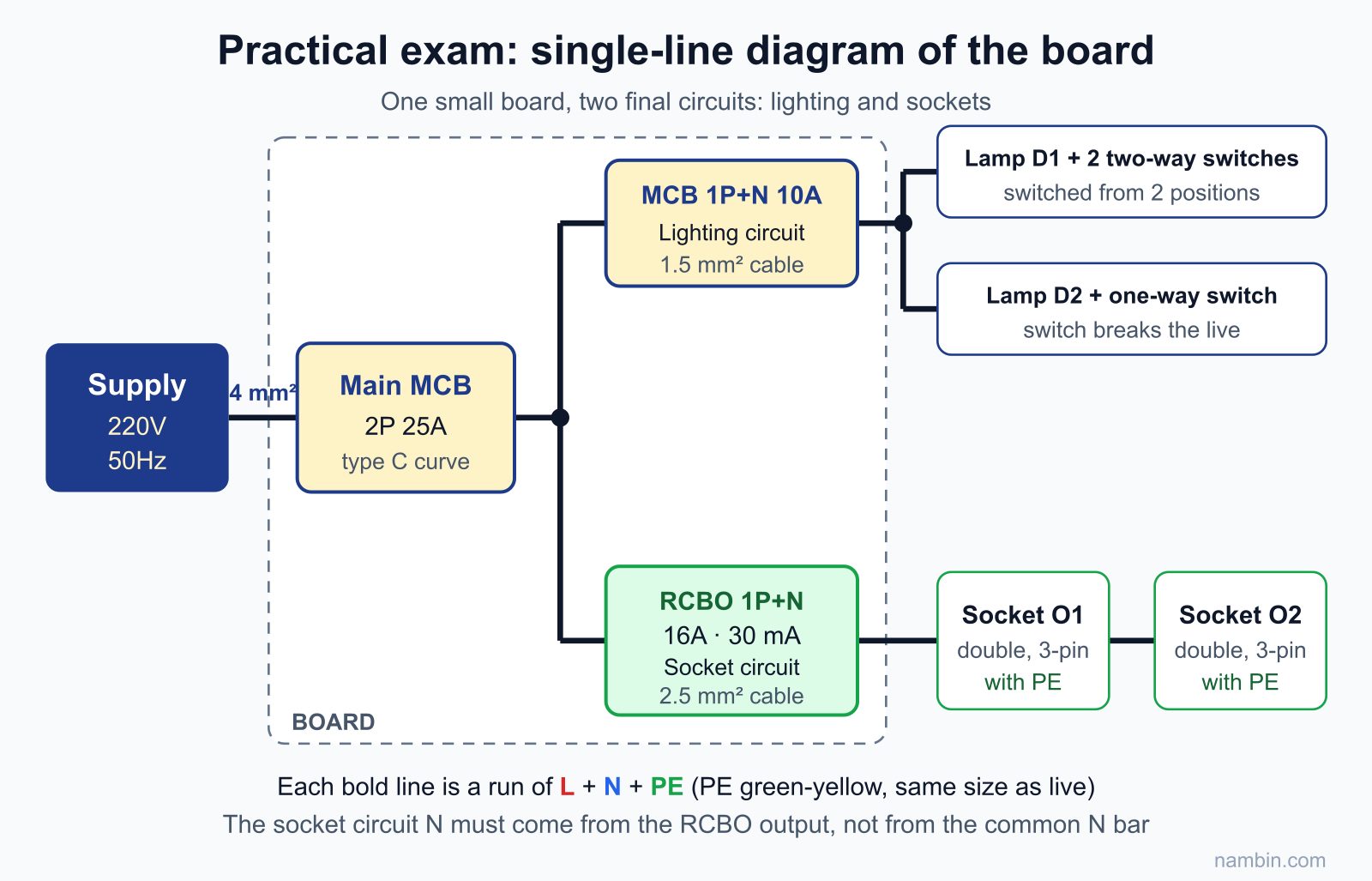
On a wooden board or practice wall of about 1.2 × 0.8 m, install the complete electrical system for one room, consisting of a small distribution board and two final circuits:
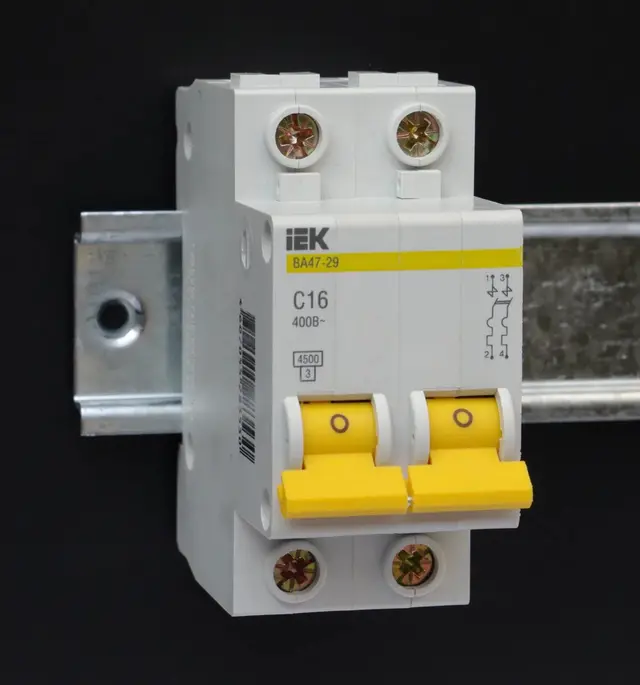
- Distribution board: a 2P 25A main MCB; a 1P+N 10A MCB for the lighting circuit; a 1P+N 16A 30 mA RCBO for the socket circuit; separate N and PE bars; every circuit labelled.
- Lighting circuit (1.5 mm² cable): lamp D1 switched on and off from two positions with two two-way switches; lamp D2 controlled by one one-way switch. The switches must be on the live conductor.
- Socket circuit (2.5 mm² cable): two 3-pin double sockets, O1 and O2, with a PE conductor run to each socket.
- All cables run in conduit or trunking, firmly fixed, with crimped ferrules or correctly made terminal connections.
- Complete all 6 test steps and fill in the test record before asking the examiner for permission to switch on.
Materials supplied to the candidate
| Item | Specification | Quantity |
|---|---|---|
| Main MCB | 2P 25A, type C curve, 6 kA | 1 |
| Lighting circuit MCB | 1P+N 10A, type C curve | 1 |
| Socket circuit RCBO | 1P+N 16A, 30 mA | 1 |
| Plastic consumer unit | 6–8 modules, with N bar and PE bar | 1 |
| Switches | 2 two-way switches, 1 one-way switch | 3 |
| Lamps | LED lamp with holder, or ceiling-mounted light | 2 |
| Sockets | 3-pin double socket, 16A | 2 |
| 1.5 mm² cable | Brown/red, blue, green-yellow | About 10 m of each colour |
| 2.5 mm² cable | Brown/red, blue, green-yellow | About 6 m of each colour |
| Supply cable | 4 mm², live – neutral – PE | 2 m of each colour |
| Conduit and fittings | PVC conduit D16/D20, saddles, junction boxes, switch back boxes | As per board |
| Connectors | Pin ferrules, connectors, coloured marking tape | As needed |
Candidates bring their own wire strippers, crimping pliers, insulated screwdrivers, a CAT III multimeter, a test screwdriver, a drill, and insulating gloves and shoes. The examiner provides the insulation tester and RCD tester if needed.
Timing
150 minutes in total: 10 minutes to read the task and check materials; 100 minutes of installation; 25 minutes of dead testing and filling in the record; 15 minutes of power-up and trial operation with the examiner. Do not cut the testing time to make up for slow installation. Running over by less than 15 minutes costs points; more than 15 minutes and the examiner stops the exam. Tip: use the first 10 minutes to draw a detailed wiring diagram and count the conductors in each length of conduit — people who draw first almost never have to strip anything out and redo it.
Marking scheme for the practical
The scheme works for both instructor marking and self-marking; each item has specific criteria to avoid judging by feel.
| Item | Criteria for full marks | Points |
|---|---|---|
| Safety and preparation | Isolates and tags before working; insulated tools; full protective equipment throughout | 8 |
| Distribution board | Correct devices in the correct positions; N after the RCBO taken from the RCBO output; separate N and PE bars; circuit labels | 12 |
| Lighting circuit | Two two-way switches control D1 correctly in every combination; D2 works; switches on the live conductor | 12 |
| Socket circuit | Correct 2.5 mm² cable; PE to every socket; consistent polarity on both sockets | 10 |
| Workmanship and neatness | Straight, fixed conduit and trunking; tight ferrules; no exposed copper; tidy cables in the board, long enough to replace devices | 8 |
| Testing and record | All 6 steps, plausible readings, clearly recorded; faults found and fixed before asking to power up | 12 |
| Trial operation | Powers up in the correct order; measures voltage; RCBO trips on TEST and with the tester | 5 |
| Time and housekeeping | On time; tools and wire offcuts cleared away | 3 |
| Total | Pass at 50/70 or more with no instant-fail mistakes | 70 |
Suggested deductions: 1 point for each cable end with exposed copper or a loose screw; 1 point for each missing circuit label; 2 points for each missing reading in the record; 6 points if the two-way switching is wrong in some combinations. The examiner may ask about any connection — failing to explain it is marked the same as getting it wrong.
The test procedure before power-up
This is where most candidates lose points because they rush. Remember the order: every test that needs no power comes first; switching on is only the final confirmation.
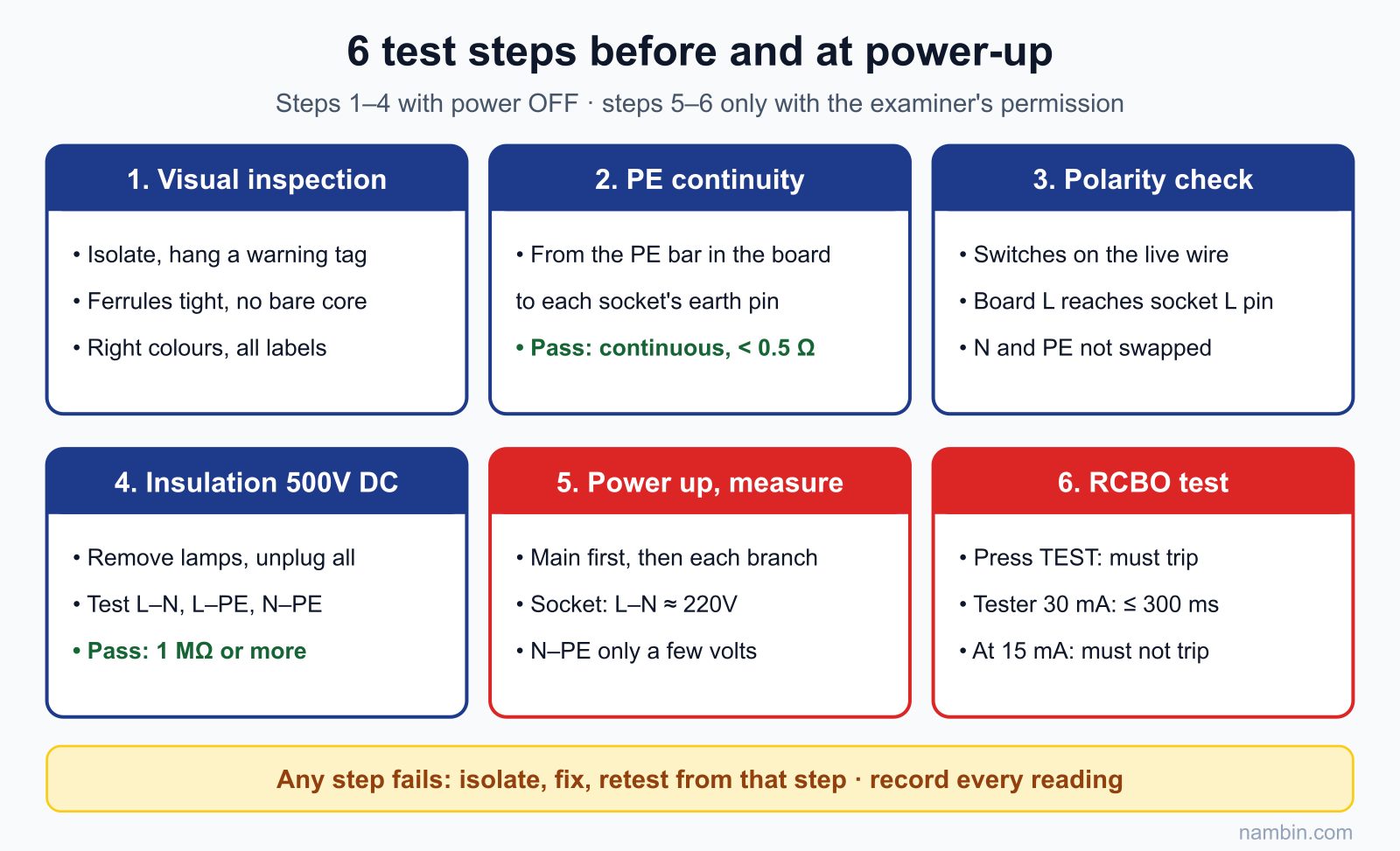
Steps 1–2: visual inspection and PE continuity
Open the board cover and every box: ferrules tight, no copper showing, correct cable colours, all labels present; tug each conductor gently to find loose connections. Then set the meter to Ω, put one probe on the PE bar in the board and touch the other in turn to the earth pins of O1 and O2 and to any metal lamp body. Short cables on an exam board usually read below 0.5 Ω; remember to touch the probes together first to subtract the test lead resistance.
Step 3: polarity check
Put one probe on the L output of the 10A MCB and the other on the lamp holder contact: there should be continuity only when the switch is "on". If there is continuity with the switch off, the switch is on the neutral — an instant-fail mistake. For the sockets, confirm that the RCBO L connects to the L terminal of both sockets, and that N has no continuity to PE.
Step 4: insulation resistance test
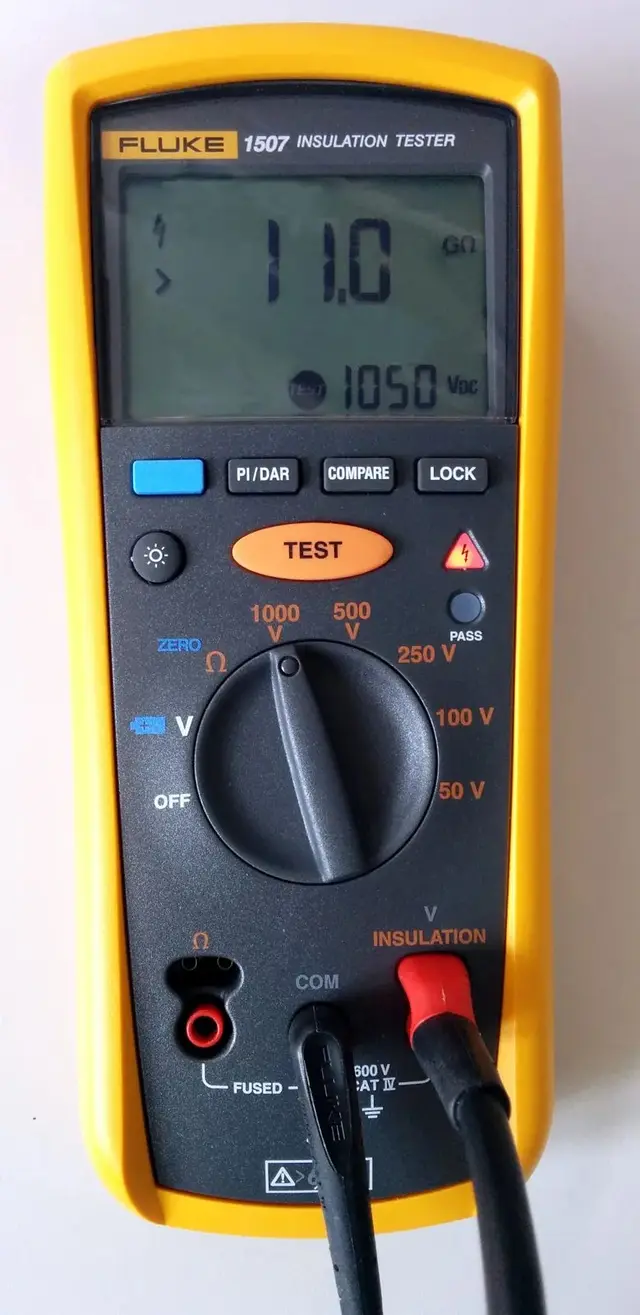
Remove the lamps, leave nothing plugged in, and close the branch breakers so that you test the whole run (the supply is still isolated). Test at 500V DC across L–N, L–PE and N–PE for each circuit: the pass value is 1 MΩ or more, and new circuits usually read hundreds of MΩ. Below 1 MΩ, split the circuit into sections to narrow down the fault — the most common causes are a conductor trapped under a screw or insulation scraped while pulling cable through conduit.
Steps 5–6: power up, measure voltage and test the RCBO
Only with the examiner's permission switch on the main MCB, then each branch in turn. Measure at the sockets: L–N about 220V (usually 209–231V), L–PE roughly equal to L–N, N–PE only a few volts. Check D1 in all four switch combinations. Press TEST on the RCBO: it must trip. With an RCD tester: at 30 mA it must trip within 300 ms, at 150 mA within 40 ms, and at 15 mA it must not trip. Never improvise a resistor to create leakage current — it is dangerous and cannot measure trip time.
Sample test record
| Item | Lighting circuit | Socket circuit | Pass value |
|---|---|---|---|
| PE continuity (Ω) | … | … | Continuous, usually below 0.5 Ω |
| Insulation L–N / L–PE / N–PE (MΩ) | … | … | 1 MΩ or more |
| Voltage L–N / N–PE (V) | … | … | About 220V / a few volts |
| RCBO: TEST / 30 mA (ms) / 15 mA | — | … | Trips / ≤ 300 ms / does not trip |
Common mistakes that fail you
Instant-fail mistakes are the ones that, on a real job, could kill someone or burn a house down. They do not just "cost points" — they stop the exam.
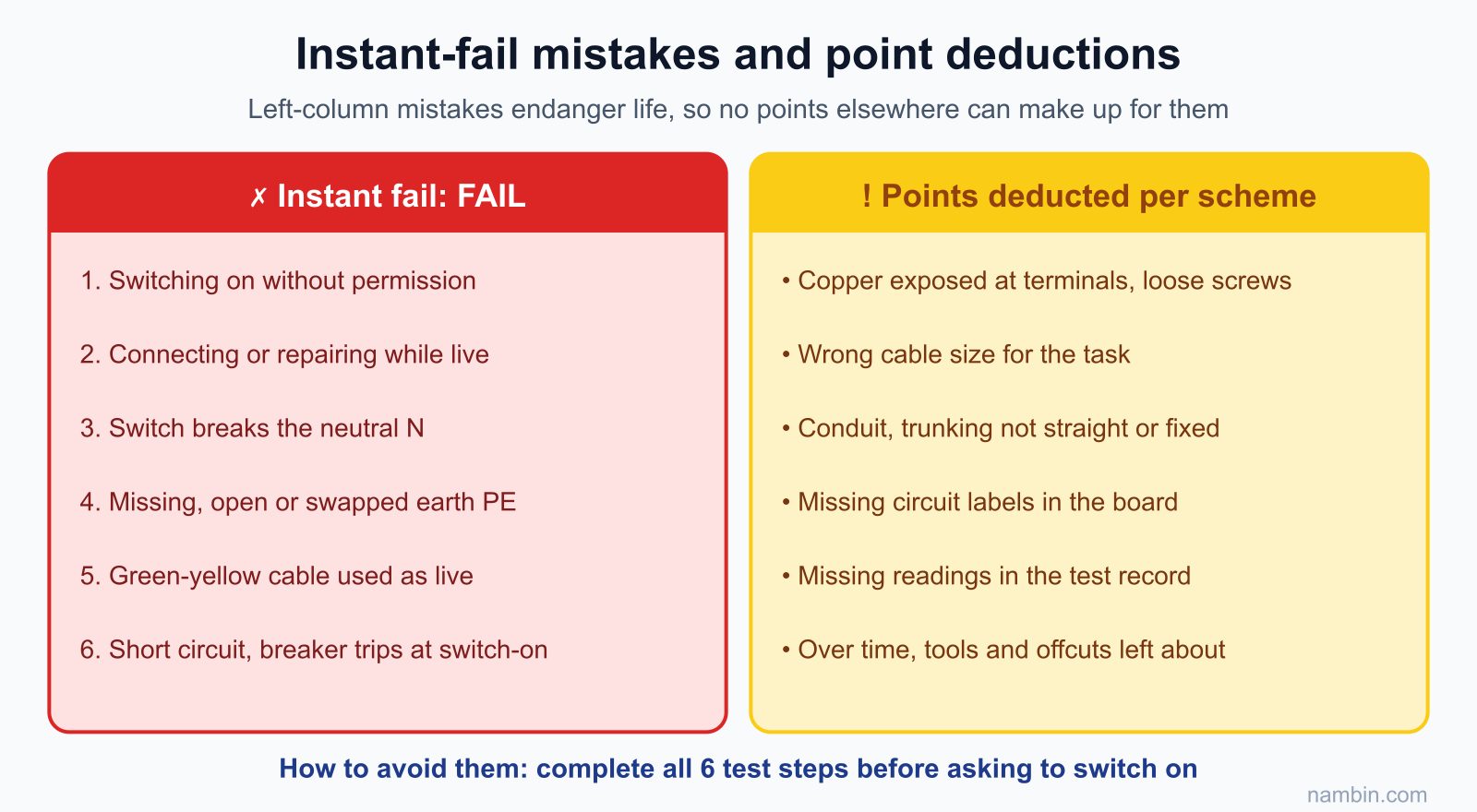
- Switching on yourself or connecting while live: usually from rushing to "quickly see if the lamp lights" — the leading cause of accidents among young electricians. If your hands touch a conductor, the breaker must be off and tagged.
- Switch on the neutral: the lamp still switches normally, but the holder is at 220V when it is off; step 3 exists to catch exactly this.
- Open, swapped or missing PE: forgetting to connect PE to the second socket, or putting the blue conductor on the earth pin. The appliance still works; it has just lost its protection against a live casing.
- Short circuit at power-up: almost always caused by skipping the step 4 insulation test.
When the RCBO trips during the trial power-up
An RCBO trip is not necessarily an instant fail, but you must find the cause by reasoning — not by guessing or swapping devices.
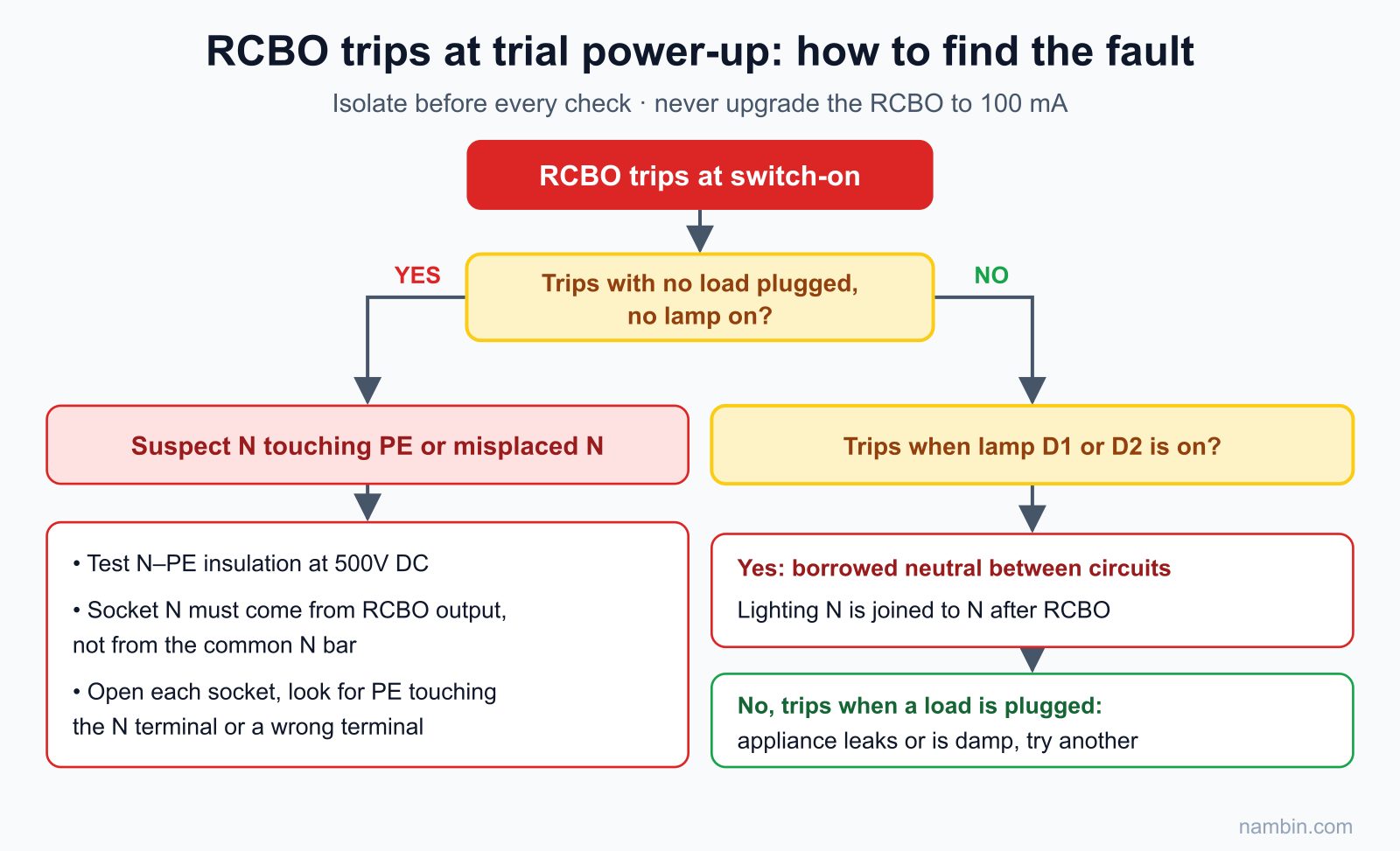
The most common cause in the exam room is borrowed neutral: the lighting neutral shares a terminal with the neutral after the RCBO. When the lamp is switched on, the return current passes through the RCBO but the outgoing current does not, so the RCBO sees an imbalance of hundreds of mA and trips. The fix: keep each circuit's neutral separate.
Frequently asked questions
Can I sit the exam on my own without an insulation tester?
You can practise the installation, but your testing will be incomplete: the Ω range of a multimeter uses a very low voltage and cannot detect scraped or damp insulation. Borrow a tester or ask your instructor to bring one.
After an instant-fail mistake, how soon can I resit?
There is no fixed rule. Practise the part you got wrong until you do it correctly three times in a row, then resit the whole exam. If you failed the theory, revise and resit the theory before going on to the practical.
Should the live be on the left or the right of a socket?
Homes in Vietnam have no fixed rule for one side, unlike some countries. The exam task may set a convention; if not, you choose, but you must be consistent across every socket and note it on the diagram.
Once I pass step 7, can I take on whole jobs?
You have enough foundation to work as an electrician's assistant or take small jobs such as replacing sockets, fitting lights or adding a circuit. Wiring a whole house needs more experience under the guidance of a master electrician.
Checklist before asking the examiner to switch on
- All 15 theory questions answered, with a score of 24/30 or more.
- Every device in the board matches the task specification and is labelled.
- The socket circuit neutral comes from the RCBO output; the lighting neutral is not shared with the neutral after the RCBO.
- Both the one-way and two-way switches are on the live conductor.
- A green-yellow PE conductor reaches both sockets, the same size as the live conductor.
- No cable end shows copper, no screw is loose, and conduit and trunking are firmly fixed.
- PE continuity, polarity and insulation of 1 MΩ or more have been measured and recorded.
- Lamps refitted after the insulation test; all tools removed from the board.
- The examiner has been informed and has given permission before the main MCB is switched on.
Completing step 7 means you have finished the foundation roadmap of the household electrician trade: safety, measurement, choosing cables and breakers, wiring circuits, distribution boards and fault diagnosis. Keep your test record and exam diagram as a template for the handover documents of your first jobs. Wherever you are still weak, go back to the matching lesson in the roadmap and resit the whole exam; passing consistently on two attempts is the real sign that you are ready.