Good hand skills are not enough to make a living as an electrician. Many skilled electricians lose clients because they give a verbal quote of "around twenty million" and the bill ends up half as much again, or because they finish without a signed record and then argue over the warranty.
This is the final step of the Residential Electrician roadmap. By the end of this lesson, you will be able to:
- Survey a house with a checklist and record all the data you need for a quote.
- Prepare a quote that separates materials, labour and contingency, with payment and warranty terms.
- Run the whole job cycle — intake, installation, inspection, warranty — with paperwork at every stage.
- Talk to clients so you win the job without over-promising.
- Know which certificates and safety training you need before taking on jobs independently.
The job process from start to finish
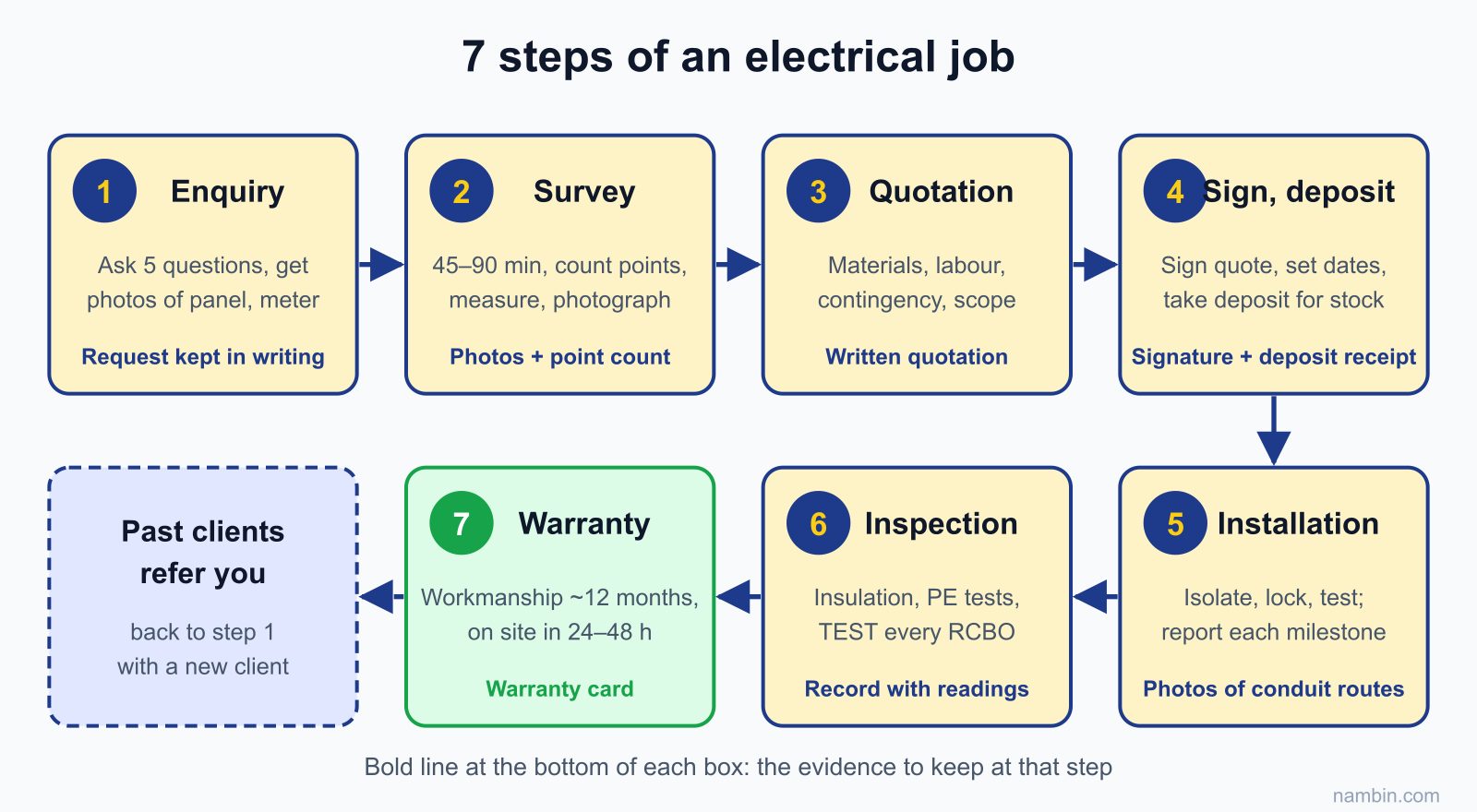
Every job, from replacing one socket to wiring a whole house, goes through the same chain of steps; small jobs make the steps shorter but skip none of them. Each step leaves a piece of evidence — photos, a quotation, a signed record — that protects you if there is a dispute.
Taking the enquiry by phone
The first call decides whether you bring the right gear. Ask five things: how many storeys and the floor area of each; new installation or repair; is the house occupied or still a shell; is there an electrical drawing; and the deadline. Ask the client to send photos of the consumer unit (the electrical panel), the meter and the work area. For repairs, also ask about the symptoms, as covered in the lesson on diagnosing tripping breakers.
Classify the job before booking a visit
Split jobs into three groups so you quote the right way: small jobs (replace a socket or light, fix one point) — quote per point on the spot; repairs and upgrades (add circuits, replace the panel, install earthing) — survey first, then give a written quote; whole-house new installations — detailed survey, itemised quote and a contract. Never give a total figure over the phone for groups two and three; give a price range and book a survey.
Record every agreement
A text message or a handwritten note is fine, as long as it has a date and the content. A spoken "while you're at it, do the gate light" in the middle of a job is the root of most money arguments. When the client asks for more, reply in writing: "Confirming 1 extra gate light, materials + labour about 650,000 VND (roughly 25 US dollars); I'll go ahead once you agree."
Surveying the house before quoting
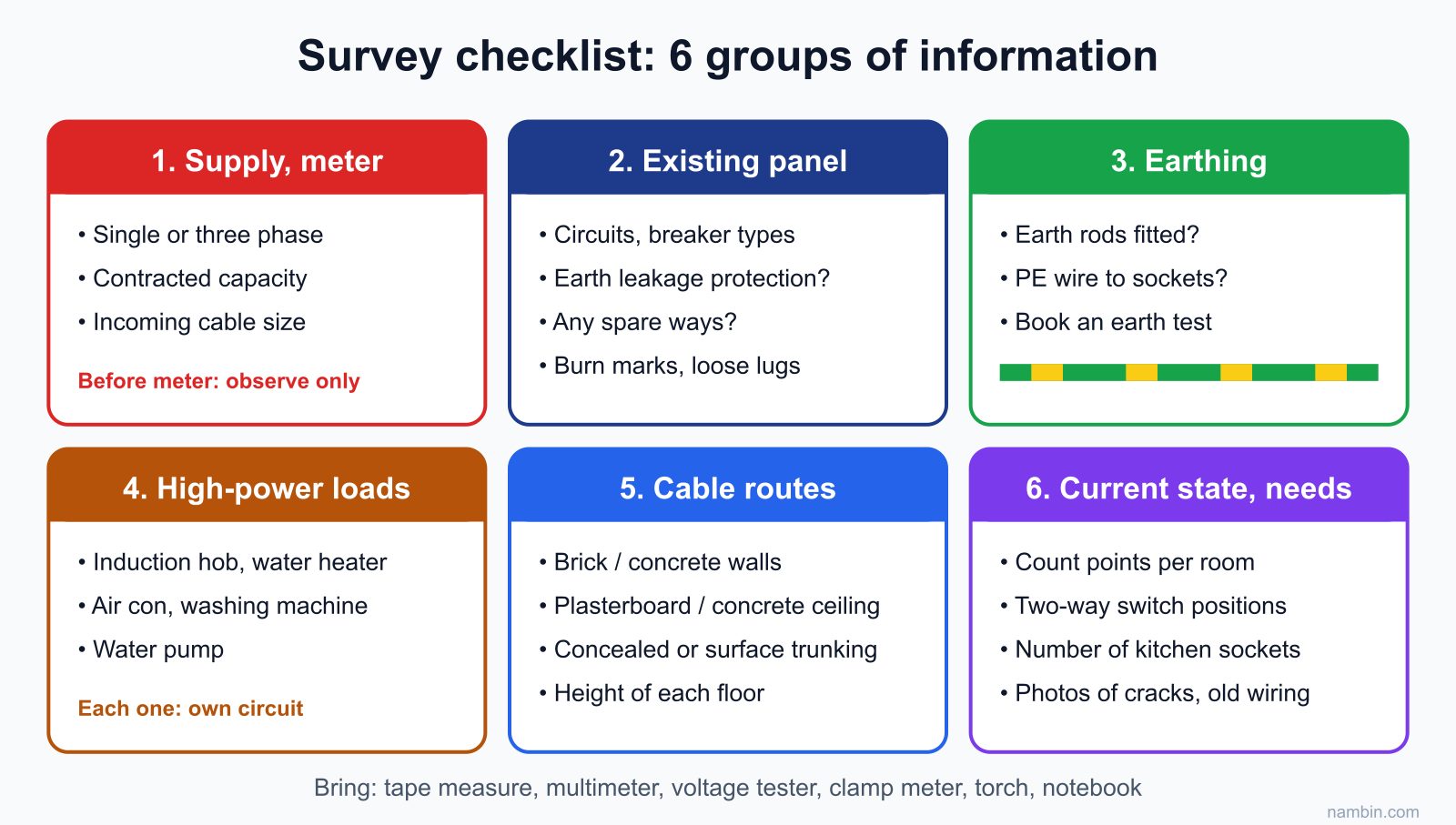
A careful survey is the only way to quote accurately and avoid extras. Surveying a tube house (the narrow, deep townhouse typical of Vietnamese cities) usually takes 45–90 minutes. Bring a tape measure, a multimeter, a voltage tester, a clamp meter, a torch, a notebook and your phone for photos.
What to look at and measure
- Supply and meter: single phase or three phase, contracted capacity, size of the cable from the meter into the house. Everything before the meter belongs to the power company — observe only, never touch.
- Existing panel: number of circuits, type of protective devices, whether there is earth leakage protection, spare ways, any burn marks or loose cable lugs.
- Earthing: are there earth rods, is there a PE (protective earth) wire to the sockets; if so, book an earth resistance test.
- High-power appliances: induction hob, water heater, air conditioners, washing machine, water pump — each usually needs its own circuit (see the lesson on load calculation and breaker sizing).
- Cable routes: brick or concrete walls, plasterboard or concrete ceilings, concealed in the wall or surface-mounted in trunking; storey height to estimate cable length.
- Current condition and needs: number of lights, switches and sockets per room; where the client wants two-way switches and how many kitchen sockets.
Counting points and estimating cable length
Go room by room and count the "points": each light, switch and socket is one point. Record them in a table by floor. Estimate cable length with a rule of thumb: the distance from the panel to the furthest point of the circuit, plus the drops up and down the walls (about 2–3 m per point), plus 10–15% for wastage. For a 4 × 15 m tube house, each floor typically needs 1–1.5 rolls of 1.5 mm² cable and 1.5–2.5 rolls of 2.5 mm² cable (100 m rolls) depending on the number of points — use this figure to cross-check, not instead of a real count.
Take photos as evidence
Photograph the panel, the meter, cracks, damp marks and scorched old wiring before you start — "before" photos prove that damage already existed, especially when chasing walls in an occupied house.
Preparing the quote: materials, labour and contingency
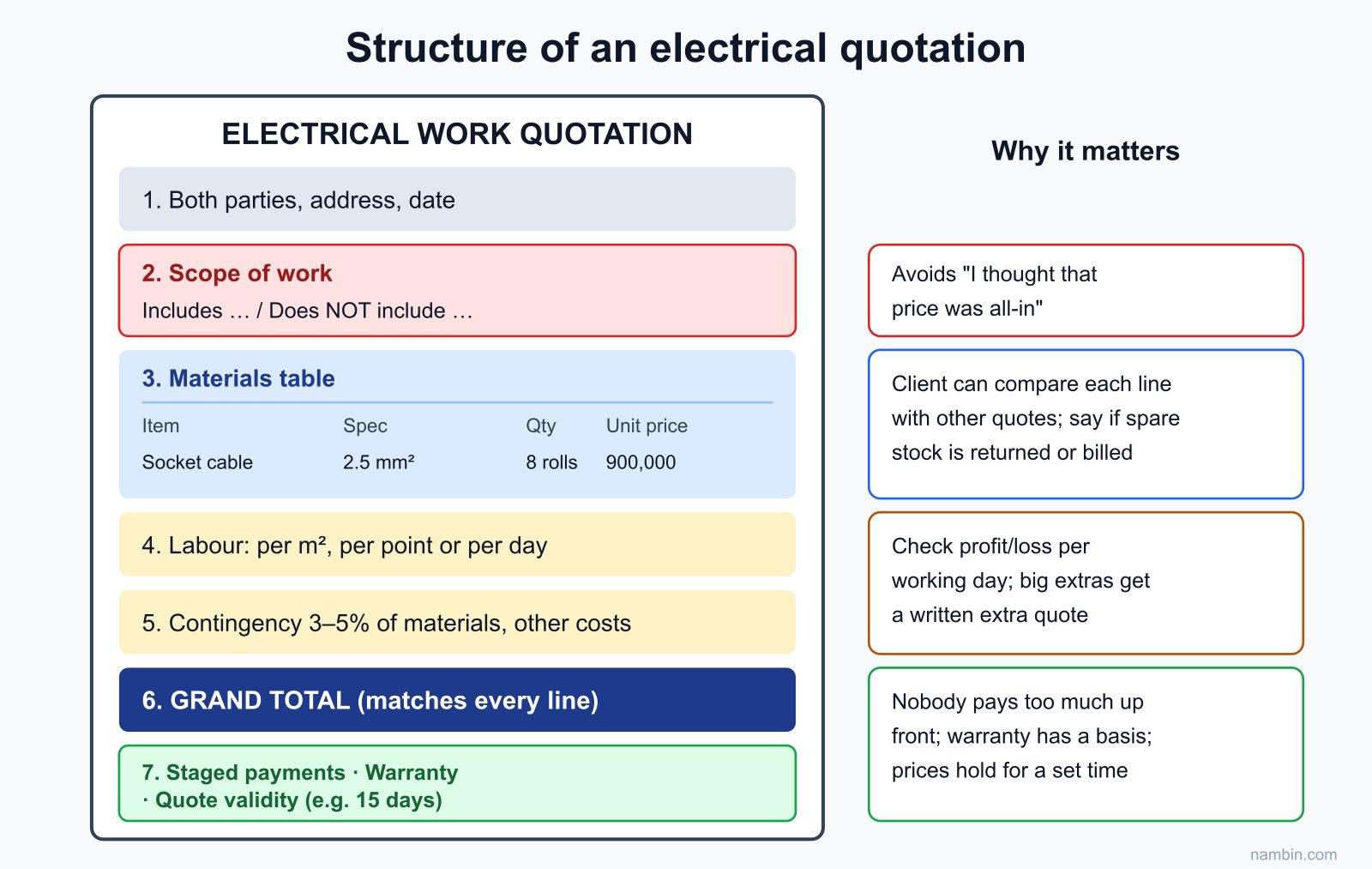
A professional quote does not need to look fancy, but it must be clear enough for the client to compare it with other electricians. What clients distrust most is a total figure with no details. Split the quote into fixed blocks as in the figure below.
Scope of work: also write what is NOT included
This is the most important line. For example: "Includes conduit, concealed cabling for 4 storeys, panels, switches, sockets and a 3-rod earthing system. Does not include: decorative lights, ceiling fans, air conditioners, water heaters (bought by the owner; fitting charged separately); patching walls after chasing; connections before the meter (done by the power company)." Writing down what you will not do avoids the line "I thought that price was all-in".
Materials: write the specification, not just the price
Each material line has a name, a specification (cable cross-section, breaker rated current), unit, quantity and unit price. If the client wants to choose brands, offer two price options. State clearly either "leftover materials are handed back to the owner" or "billed on actual use" — pick one and say it up front.
Labour: per square metre, per point or per day
Whole-house new installations are usually priced per m² of floor area; small upgrades per point (each socket, each light); unpredictable repairs as a call-out fee plus an hourly or daily rate. Whichever method you use, estimate the number of working days first to check yourself: if the per-m² price works out lower than the daily wage for you and your helper, you are working at a loss.
Contingency and extras
Add a contingency line of 3–5% of materials for wastage and small unforeseen items. Large extras (the client changes the design, adds a room) get a written additional quote before the work — never "do it now, price it later".
Sample quote: new wiring for a 4-storey tube house
Project details
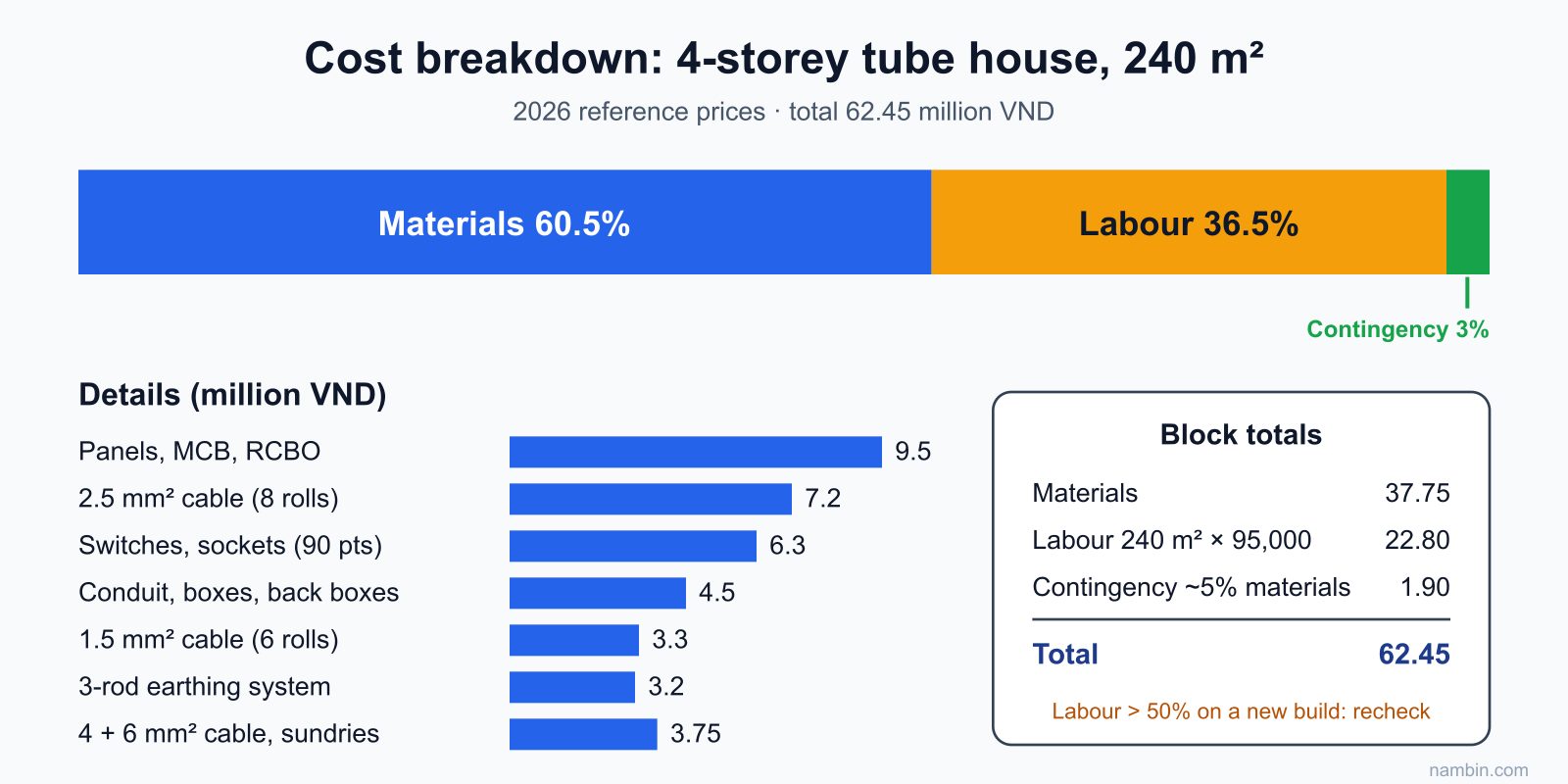
A 4-storey tube house, each floor 4 × 15 m (about 240 m² of floor area in total), still a shell, single-phase 220V/50Hz supply. About 90 switch and socket points, one sub-panel per floor and the main panel on the ground floor. There is an induction hob, 4 air conditioners, 2 water heaters and a washing machine. Prices below are 2026 reference prices in Vietnamese dong (VND) to illustrate the method; they vary by region, brand and time of purchase.
| Item | Specification | Quantity | Unit price (VND) | Amount (VND) |
|---|---|---|---|---|
| Lighting cable | 1.5 mm², 100 m roll | 6 rolls | 550,000 | 3,300,000 |
| Socket cable | 2.5 mm², 100 m roll | 8 rolls | 900,000 | 7,200,000 |
| Induction hob circuit cable | 4 mm², 100 m roll | 1 roll | 1,450,000 | 1,450,000 |
| Riser cable between floors | 6 mm² | 60 m | 25,000 | 1,500,000 |
| Conduit, flexible conduit, junction boxes, back boxes | Full set per drawing | 1 set | 4,500,000 | 4,500,000 |
| Switches, sockets, face plates | Standard range | 90 points | 70,000 | 6,300,000 |
| Panels, MCB, RCBO | Main panel + 4 floor panels | 1 set | 9,500,000 | 9,500,000 |
| Earthing system | 3 rods, copper cable, inspection pit | 1 set | 3,200,000 | 3,200,000 |
| Sundries | Connectors, lugs, labels, tape | 1 pack | 800,000 | 800,000 |
| Materials subtotal | 37,750,000 | |||
| All-in labour | Conduit, cabling, panels, devices, earthing, testing | 240 m² | 95,000 | 22,800,000 |
| Wastage contingency | About 5% of materials | 1 | 1,900,000 | 1,900,000 |
| Grand total | 62,450,000 |
Check: 37,750,000 + 22,800,000 + 1,900,000 = 62,450,000 VND (about 62.45 million VND). Materials are about 60.5%, labour 36.5% and contingency 3%. If your quote for a new build has labour above half the total, review it — you may be double-counting, or under-quoting materials. MCB means miniature circuit breaker; RCBO is a breaker with built-in residual current (anti-shock) protection.
Reference price table by type of job
The ranges below are typical for large Vietnamese cities in 2026 and are only for your own comparison; other regions may be significantly lower or higher. Build your own price list from your real costs.
| Type of job | Pricing method | Reference range 2026 |
|---|---|---|
| Labour for new-build wiring (concealed) | Per m² of floor | 70,000–130,000 VND/m² |
| Replacing or adding sockets and switches on existing wiring | Per point | 30,000–80,000 VND/point |
| Survey or fault-finding visit | Per visit | 100,000–300,000 VND/visit |
| Replacing a household panel (labour) | Per panel | 300,000–800,000 VND/panel |
| 3-rod earthing system, all-in | Per set | 2,500,000–5,000,000 VND |
Confirming the job, installing and inspecting
Confirmation and payment schedule
When the client agrees, sign the quote or a short contract and note the expected start and finish dates. For large jobs, split payment into milestones tied to work completed, so neither side advances too much money.
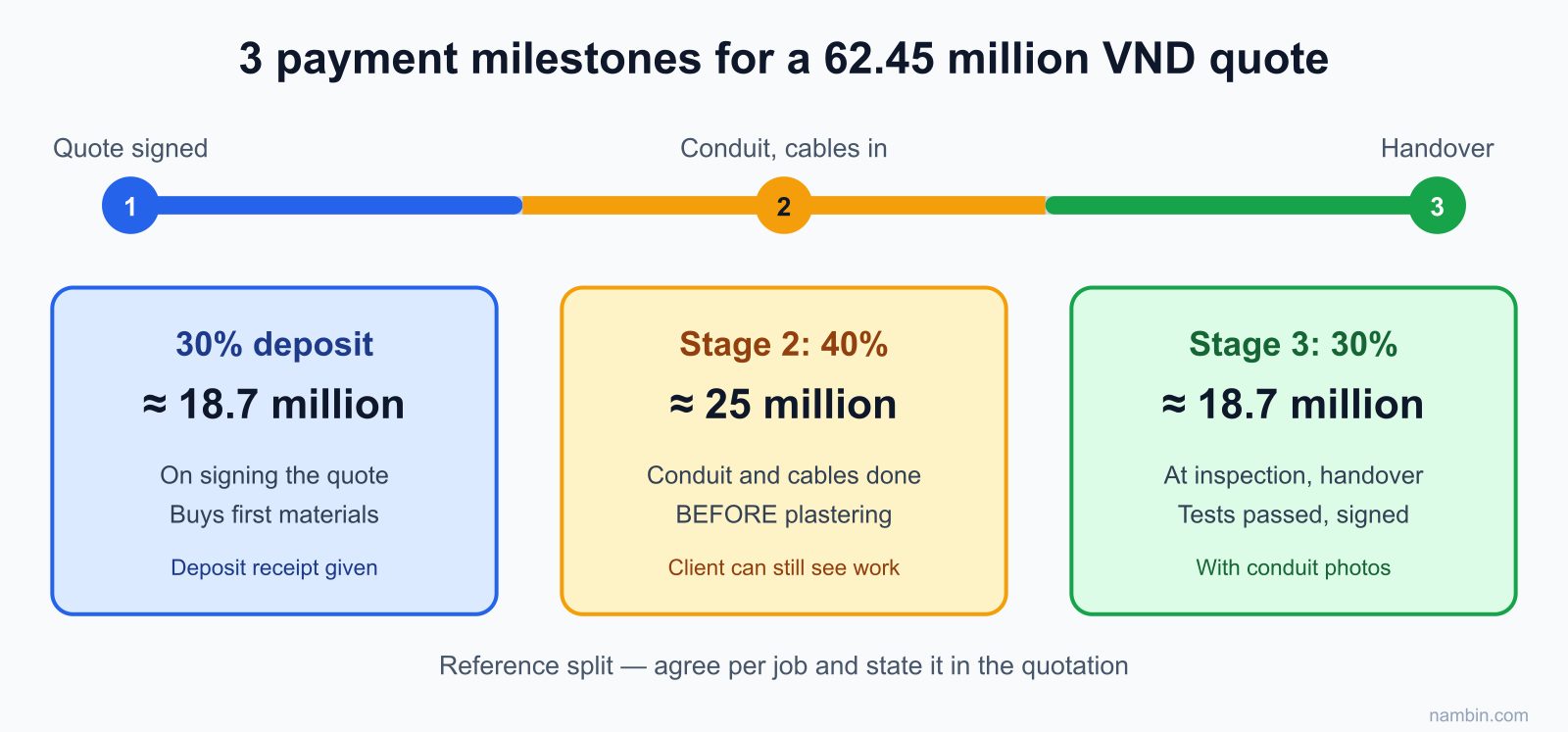
For the sample quote: a 30% deposit (about 18.7 million VND) on signing to buy materials; 40% (about 25 million VND) when the conduit and concealed cabling are finished, before the plasterers start; the remaining 30% (about 18.7 million VND) at inspection and handover. The second milestone sits before plastering for a reason: once the walls are plastered, the client can no longer see the biggest part of your work.
During installation
- Keep to the safety rules you have learned: isolate, lock off, tag, and test again before touching any conductor.
- Photograph the conduit routes before plastering — this is your real "as-built drawing" and helps the client avoid drilling into cables later.
- Give short progress updates every day or at every milestone. Clients who live elsewhere especially value this.
- Clean up at the end of each day, especially in an occupied house: dust from chasing walls is complaint number one.
Inspection with measurements
Inspection is not "switch it on and see it light up". Bring the test sheet from earlier steps: insulation resistance of each circuit (≥ 1 MΩ when tested at 500V DC), continuity of two-way switches in all four combinations, L–N, L–PE and N–PE voltage at each socket (L = line, N = neutral), the TEST button on every RCBO, and earth resistance. Switch off each breaker with the client to confirm the circuit labels match the rooms. Both sides sign the record and each keeps a copy, together with conduit photos and the panel diagram.
Warranty and after-handover care
Warranty terms to include
Common practice is a workmanship warranty (joints, connections, installation) of about 12 months, with devices covered by the manufacturer. State the cases not covered: the client's own repairs, plugging in appliances beyond the circuit's rating, natural disasters, rodent damage and other electricians' work. Write your phone number and a committed response time, for example "on site within 24–48 hours for a power outage".
Handling a warranty call
Arrive on time and compare against the inspection record. If the fault comes from your installation, fix it free and do not blame anyone. If it is outside your scope, explain using readings and photos, then quote for the repair. Your attitude on warranty calls decides whether the client recommends you to others.
Communicating with clients
Speak the client's language
The client does not need to know "RCBO C16 30 mA"; they need to know "this breaker protects the bathroom sockets from electric shock; if current leaks it cuts off before anyone gets a serious shock". Explain in terms of consequences and benefits, and use technical terms only when the client wants detail.
Saying no the right way
Clients may suggest "drop the shock protection to save money", "just use thinner cable, we don't use much power" or "connect straight in before the meter, it's quicker". Do not argue, and do not give in. Explain the risk clearly, offer a cheaper alternative that is still safe, and if the client still wants something that breaks safety rules, refuse that part. Losing one job is better than losing your whole career after an accident.
Safety and scope: Do not take on work beyond your certificates and abilities — medium-voltage lines, transformer stations, anything before the meter and high-rise building systems are handled by authorised organisations. Never write technical promises into a quote or contract that you cannot verify.
Professional certificates and electrical safety training
Vocational training certificates
In Vietnam, residential electricians usually hold an elementary vocational certificate or an intermediate or college vocational diploma, issued by vocational education institutions after a course and an exam. Some trades also have national occupational skills assessments. When choosing a course, ask exactly which qualification is issued, whether the institution is licensed to train in that trade, and how many hours of practical work it includes.
Safety training and the electrical safety card
Electrical work belongs to the group of jobs with strict occupational safety requirements. Workers usually need electrical safety training, a passed test and a card or certificate showing a safety grade suited to their work; the training is repeated periodically. Specific rules (who issues it, how long it is valid, what it covers) can change over time — ask an occupational safety training organisation or the local labour authority directly for the current requirements, and do not rely on word of mouth.
Personal portfolio
Prepare a compact portfolio: copies of your certificates, your safety card, and 5–10 completed jobs with before-and-after photos and test records. When working for a contractor, this portfolio is more convincing than a verbal recommendation.
Building a reputation and long-term clients
Past clients are your best source of work
Most of an electrician's work comes from past clients and the people they recommend. After each job, send the client a thank-you message with a photo of the panel diagram and your warranty phone number. Six months later, remind them to press TEST on their RCBOs — a small message that keeps you in their mind.
An honest online presence
A simple service page with photos of real jobs (with the client's house details hidden) and the areas you cover is enough. Do not use stock photos, and do not promise "the cheapest price".
Working with other trades
Keep good relations with plumbers, masons and plasterboard installers — they often meet clients who need an electrician before you do. If you want to offer combined electrical and plumbing packages, study the nambin Plumber roadmap as well.
Common mistakes when quoting and taking on jobs
- Verbal total-only quotes: sign — the client compares you with others and suspects you of overcharging. Cause — there are no details to compare. Fix — always send a quote with materials and labour tables.
- No "not included" scope: sign — at the end of the job the client demands extra lights or wall patching "because I thought it was in the price". Fix — list what is not included in the quote itself.
- Too small a deposit, or none: sign — you advance money for materials and then the client changes their mind. Fix — take a deposit large enough to buy the first batch of materials.
- Cutting the price by cutting protective devices: sign — the client is happy when signing, but any later accident carries your name. Fix — cut costs on decorative items, never on safety.
- No inspection record: sign — warranty arguments with nothing to base them on. Fix — a record with readings, signatures and photos.
Frequently asked questions
The client says another electrician quoted 20% less. Should I lower my price?
Ask the client to put the two quotes side by side and compare line by line: cable types, whether there are RCBOs, whether there is earthing, whether there is inspection testing. That is usually where the difference lies. If the scope is the same and you are still higher, review your costs; if not, hold your price and explain.
Should I supply the materials or let the client buy them?
Supplying materials lets you control quality and schedule, but you have to advance the money and take responsibility for faulty goods. If the client buys them, give a list with exact specifications and write in the record that materials were supplied by the owner.
Can I take on jobs before I have an electrical safety card?
Complete the safety training before taking on independent work. While you wait, work as a helper for a master electrician or a company that has a safety officer, so you learn and build up a record of jobs at the same time.
What if the client refuses to sign the inspection record?
Explain that the record protects the client too: the readings are the basis for the warranty. If they still hesitate, send the record and photos by message and ask them to reply "received" — that is also dated, time-stamped evidence.
Checklist and practice exercise
Checklist before taking on a job:
- All 6 groups of survey information collected, with photos of the current condition.
- The quote has a scope (included and not included), a materials table with specifications, labour, contingency, and a total that matches every line.
- Staged payment terms, warranty and quote validity (for example 15 days) are written in.
- The job is within your certificates and abilities.
- An inspection record template and a test sheet are ready.
Exercise: choose a real house (yours or a friend's), survey it with the checklist, prepare a full quote using the sample above with material prices you ask for at a local shop, then role-play presenting the quote for 15 minutes to a friend playing a difficult client.
Self-assessment criteria:
- Pass: the quote has at least 8 material lines with specifications and the total adds up correctly.
- Pass: the "not included" scope lists at least 3 items.
- Pass: you can explain in plain words, without jargon, why an RCBO and earthing are needed.
- Pass: you handle the "drop the shock protection to save money" request without arguing and without giving in.
- Pass: you have an inspection record template covering all the tests learned in steps 4, 5 and 6.
Completing this step means you have finished the Residential Electrician roadmap: from electrical safety, testing, load calculation, circuit installation and panels to fault-finding and working independently. Keep the habit of measuring, recording and photographing on every job — that is what turns hand skill into reputation.