A customer calls: “My hands were still wet and when I touched the lid of the washing machine I felt a tingling. Our fridge does it sometimes too – the handle feels prickly. Is that a problem?” Residential electricians get this call very often, and it is very easy to underestimate. A “slight tingle” may just be a tiny leakage current from the interference filter inside the appliance, but it can also be a sign that the metal casing is carrying a dangerous voltage, just waiting for the day the user walks barefoot on a wet floor.
An electrician's job is not to guess but to measure to know for sure, and then fix the right thing: if the appliance is faulty, isolate the appliance; if the house wiring is wrong, fix the house wiring; if earthing is missing, install earthing; if earth-leakage protection is missing, install it. This lesson follows the on-site sequence: instructing the customer, understanding the causes, testing, fixing, knowing when to hand over to an appliance repairer, and how to explain it to the customer. By the end of this lesson, you will be able to tell whether the fault is in the appliance or in the house wiring, test the casing, the socket and the earthing correctly, and fix or escalate the problem safely.
Safety first: any work that involves touching conductors, sockets or terminals is only done after switching off and confirming the circuit is dead according to the 5 mandatory safety rules. The figures in this lesson (voltage measured on the casing, insulation resistance, earth conductor resistance) are reference values for guidance only; they do not replace the instructions of the appliance manufacturer, the test instrument, or the regulations that apply to the site.
What to tell the customer as soon as they call
Before you set off, give the customer a few short, clear instructions:
Stop using that appliance; do not open the fridge or take things out of the washing machine with wet hands.
Disconnect the power safely. If the plug is dry, easy to reach and the customer is standing on a dry floor, they can unplug it (holding the plug body, not pulling the cord). If there is water around the appliance, the socket is wet or there is a burning smell, stay away: switch off the circuit breaker for that circuit or the main breaker.
Dry your hands and wear sandals before touching any electrical appliance.
Do not “test it again” by touching the casing, and do not let children or anyone else touch it to check.
If someone has already had a strong shock, fallen, is short of breath or has an irregular heartbeat: call emergency services on 115 immediately.
Many accidents happen precisely while waiting for the electrician, when a family member wants to touch it again “to see if it still tingles”.
Why the casing of a washing machine or fridge becomes live
Washing machines, fridges and microwaves with metal casings are usually Class I appliances: their safety relies on two layers, the insulation inside the appliance and the protective earth conductor (PE) connecting the metal casing to the earthing system. If either layer has a problem, the casing may become live. There are six common groups of causes.
1. Insulation failure inside the appliance
Internal wires rubbing against the frame from vibration (washing machines vibrate violently during spin), wires chewed by rats or cockroaches, ageing motor or compressor windings, or a heating element (a washing machine with hot wash, a fridge's defrost heater) with a cracked sheath. The live conductor then touches the casing. This is a genuinely dangerous fault: if the casing is not earthed, it can carry almost the full mains voltage.
2. Moisture and water
A washing machine next to a sink, on a balcony exposed to rain, or in a bathroom; a leaking drain hose leaving water under the machine; a fridge with pooled defrost water or in a humid location. Water on the circuit board or terminal block creates a leakage path to the casing. Signs: tingling that comes and goes, worse on humid days or after a wash.
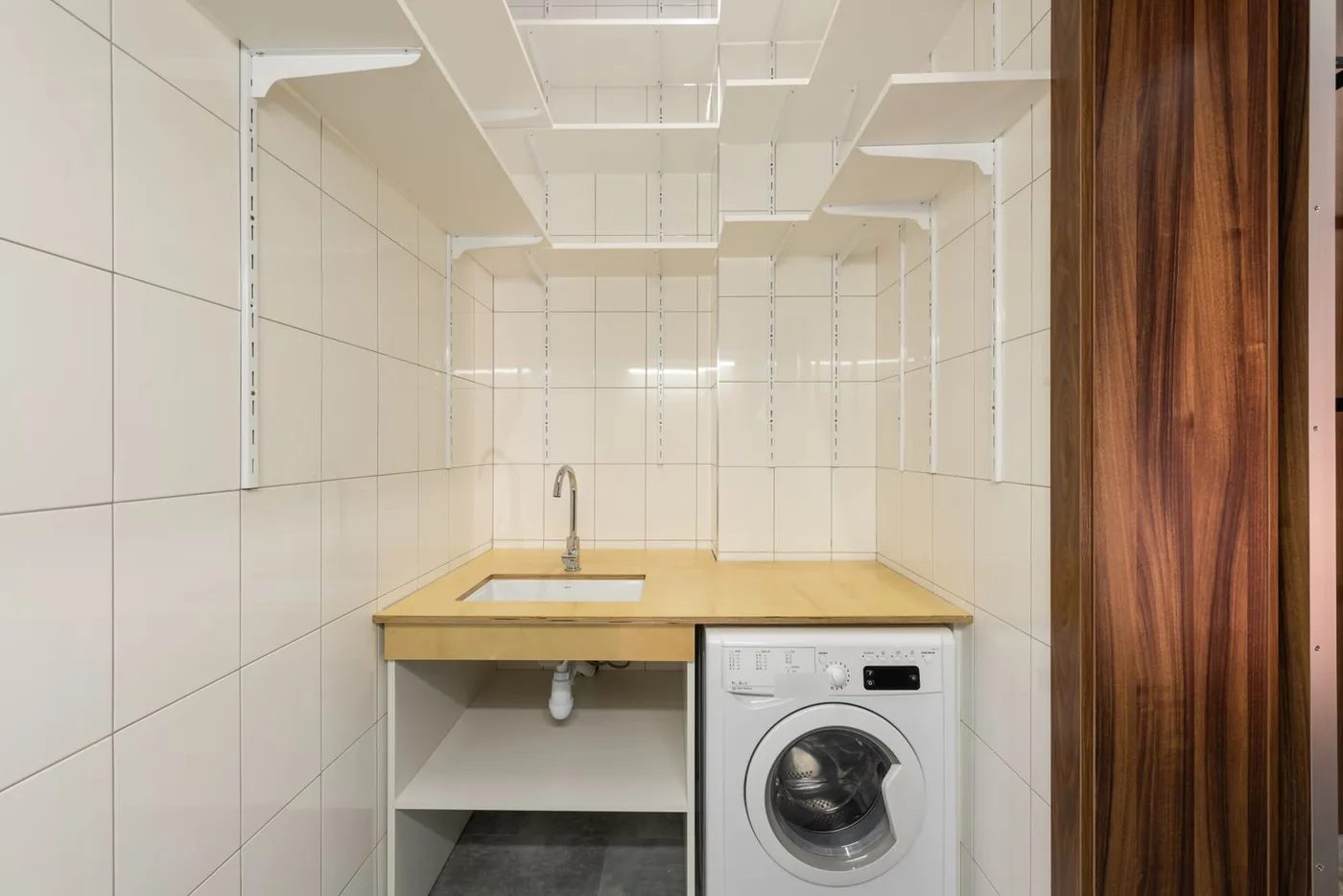
Figure 1. A front-loading washing machine under a wooden worktop, right next to a sink with a tap, with white tiled walls and several shelves above. In wet areas like this, the appliance's socket, power cord and earth wire must be positioned away from moisture and splashes. The manufacturer's logo has been blurred. (Photo: Max Vakhtbovych, Pexels, Pexels License)
3. No earth, or a broken earth
Very common: a 3-pin socket whose earth terminal is not connected to anything; a washing machine with a separate earth wire at the back that the installer left dangling; a 3-pin plug used in a 2-hole socket via an adaptor; an earth wire that was once installed but is now broken, loose or corroded at the terminal. If the casing is not earthed, any leakage current in the appliance, however small, flows through the person who touches it.
4. Leakage current from interference-suppression capacitors (Y capacitors)
Almost all washing machines, inverter fridges and appliances with circuit boards have an interference filter (EMI filter) at the power input: an X capacitor connected between live and neutral, and Y capacitors connected from live and neutral to the appliance casing. The Y capacitors conduct high-frequency interference to earth via the PE conductor, and at 50 Hz they still let a very small current through.
If the casing is earthed: this small current goes to earth and nobody feels it. If the casing is not earthed: the casing “floats” at a voltage set by the capacitor divider, and a person who touches it becomes the path for current to earth, feeling a prickling sensation that is stronger with wet hands. You can estimate the current through the capacitor with I ≈ 2π × f × C × U. Illustrative example (reference): a 4.7 nF capacitor at 230 V, 50 Hz gives a current of about 0.34 mA. Capacitor values vary between appliances.
Two things to remember: this kind of slight tingling is still a sign that the appliance lacks earthing, not “normal, just ignore it”, because if that appliance develops a real insulation fault, nothing will protect the user. And the EMI filter itself can fail: a damp or punctured capacitor increases leakage current, makes the RCD trip, and can even explode, as in the picture below.
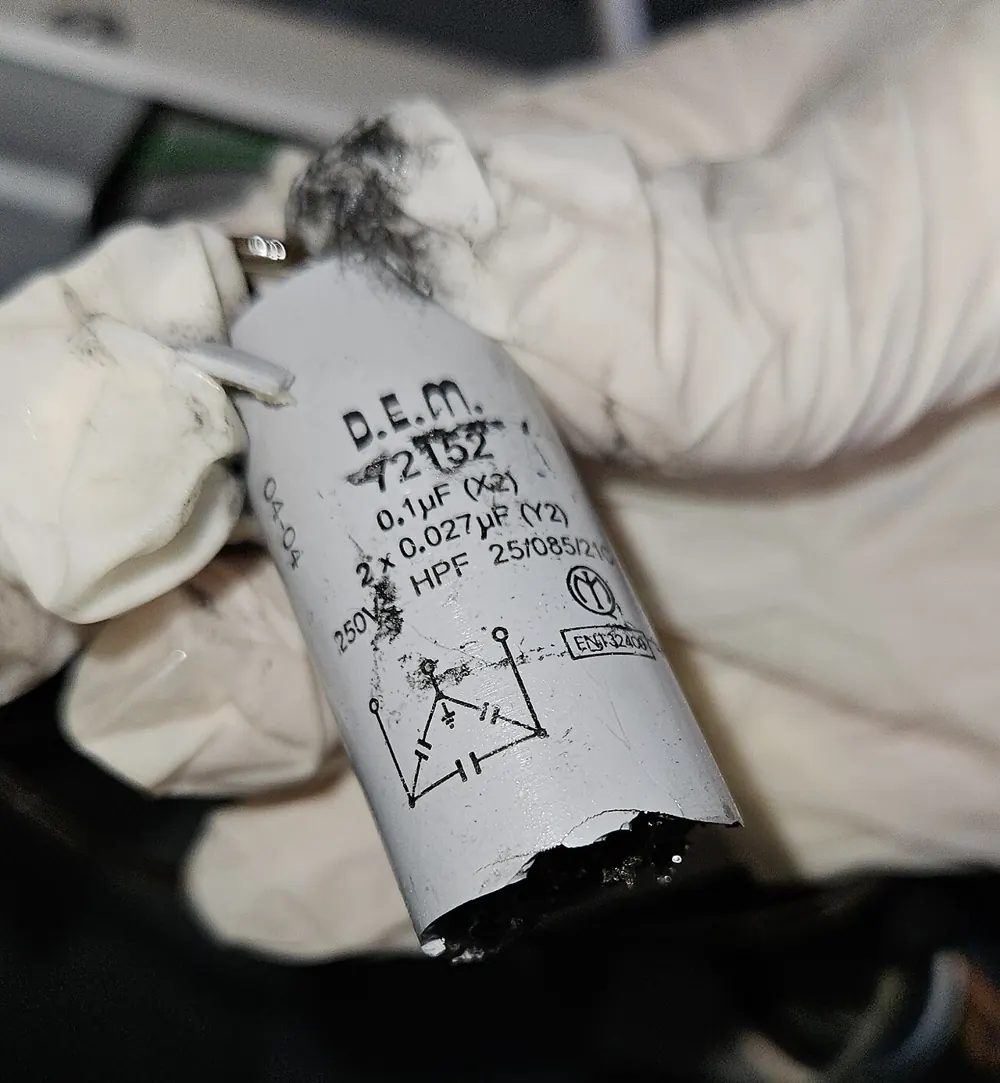
Figure 2. A cylindrical interference filter (EMI filter) removed from a washing machine, with one end of its casing blown out and charred black. The label reads 0.1 µF (X2), 2 × 0.027 µF (Y2), 250 V, with a diagram: one X capacitor between the two supply wires and two Y capacitors from each wire to the earth symbol. According to the photographer, this filter tripped the RCD many times before it exploded. (Photo: Mnalis, Wikimedia Commons, CC BY-SA 4.0)
5. Incorrectly wired socket
Live wire connected to the earth terminal: the appliance casing carries full mains voltage. A deadly fault, found when wiring by the wrong colours or when the house wiring doesn't follow the colour convention (see the lesson installing earthed sockets correctly).
Earth terminal bridged to the neutral terminal at the socket to “make it three-pin”: it measures fine under normal conditions, but when the neutral upstream becomes loose or broken, the neutral at the socket is pulled up close to phase voltage through the appliances that are plugged in, and the appliance casing becomes live with it.
Live and neutral reversed (L/N): on its own this usually doesn't make the casing live if the earth is good, but it means the appliance's single-pole switch only breaks the neutral, so the inside is still live when switched off. It still has to be corrected.
6. Whole-house neutral and earth problems
When the washing machine, the fridge, iron door frames and so on all “tingle slightly”, think of a house-level problem: a loose common neutral, earth bonded to neutral incorrectly, a damaged earth electrode, or leakage from another circuit transferring onto the earthing system. The fix depends on the building's earthing arrangement, so this lesson only explains how to recognise it. For measuring whole-house leakage, see the lesson unusually high electricity bills: checking the meter and measuring leakage; for redoing the consumer unit and earthing, see the lesson installing a home consumer unit: arranging MCBs, RCBOs and earthing.
Tools to bring
A multimeter that can measure AC voltage and resistance, with undamaged test leads; ideally with a low-impedance mode (usually marked LoZ).
A voltage tester pen (for screening only).
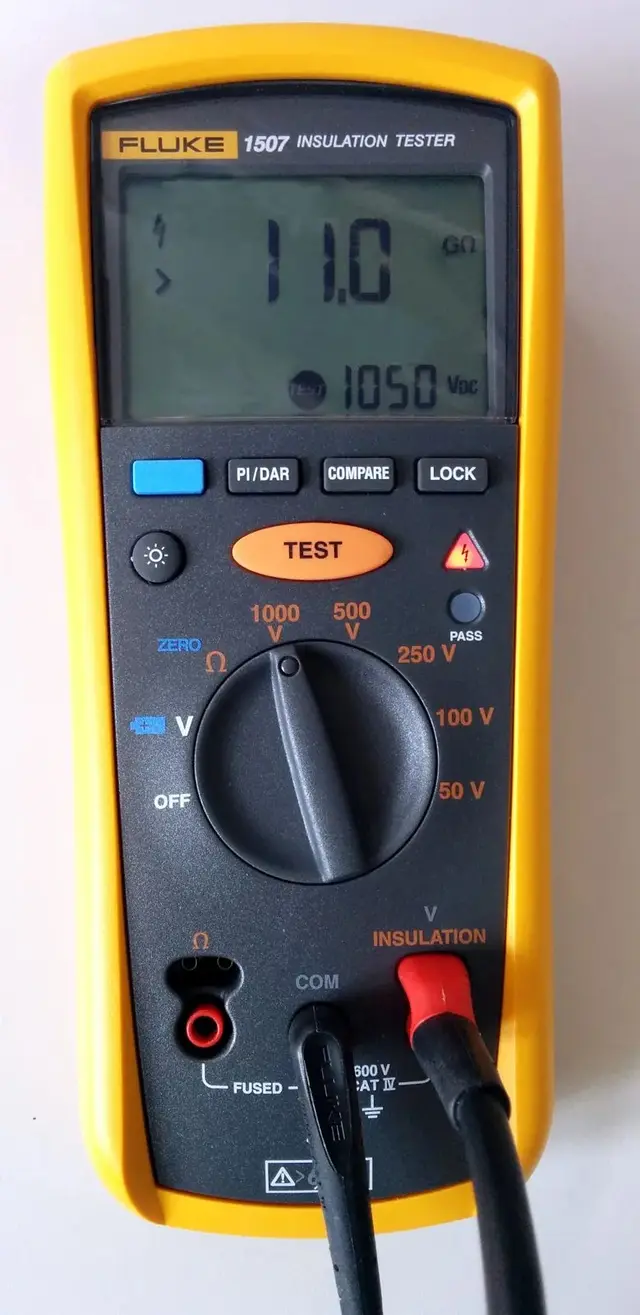
An insulation resistance tester (megger) if you have one and have been trained to use it.
A test extension lead with a genuine earth and a 30 mA RCD, which you have checked yourself.
Suitable insulating gloves, insulated-sole footwear, a torch, insulated screwdrivers, a dry cloth; replacement materials: plugs, sockets, green-yellow PE wire.
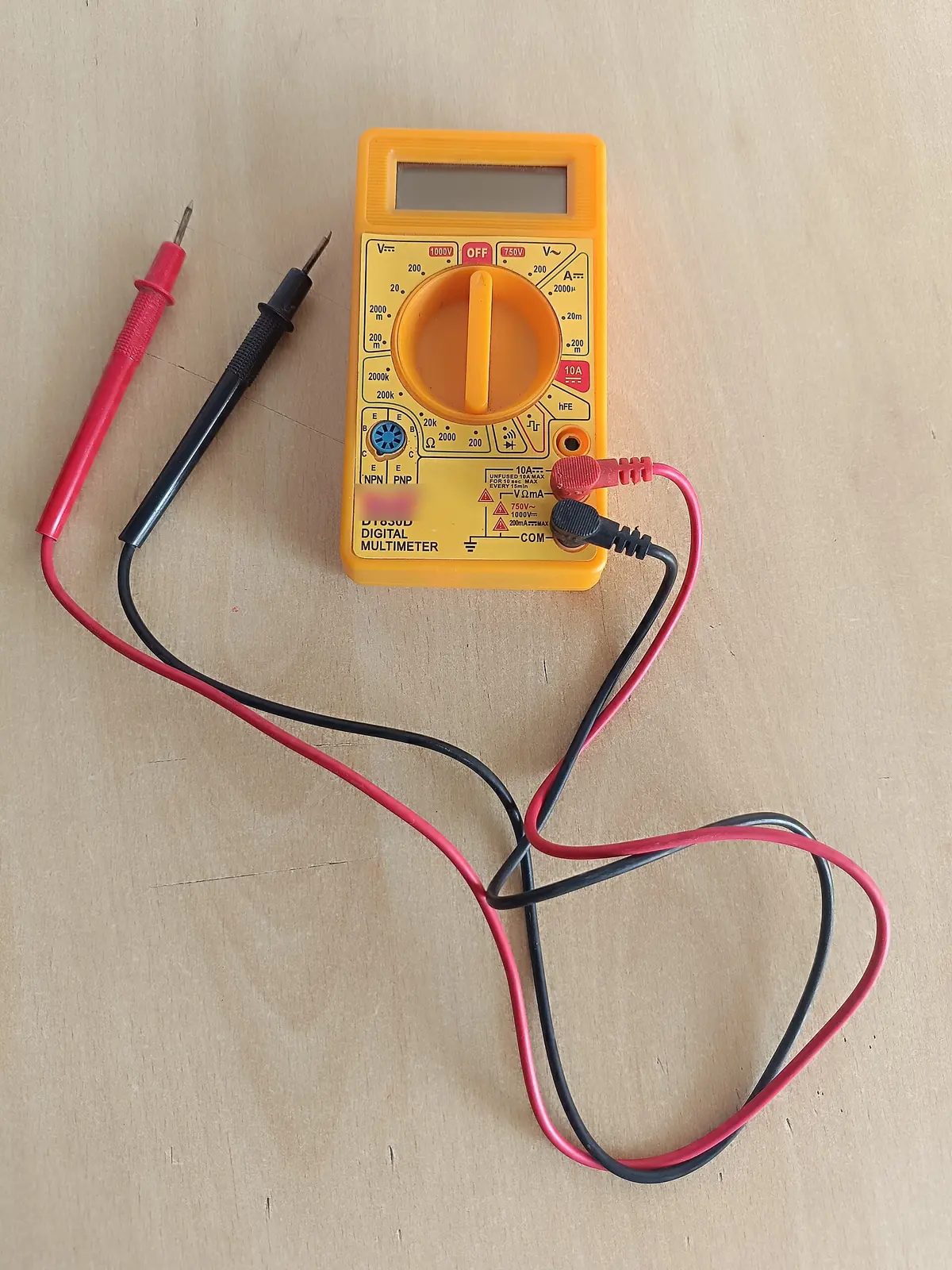
Figure 3. A yellow handheld digital multimeter: the rotary dial selects voltage, current and resistance ranges; the red lead is in the VΩmA port and the black lead in the COM port, on a wooden table. The brand name on the meter has been blurred. (Photo: K.Venkataramana, Wikimedia Commons, CC0)
On-site testing steps
Step 1: Observe and ask before touching
Is there water on the floor? Are the washing machine's inlet or drain hoses leaking? Is the power cord crushed, kinked, chewed by rats, or does it have a section temporarily joined with tape? Do the plug and socket have burn marks or discoloured plastic (if so, see the lesson hot and melted sockets and plugs)? Is the appliance plugged in through a 3-pin to 2-pin adaptor?
Ask the customer: when does it tingle (when the machine is running, when it is heating, or even when it is off but still plugged in)? Is it new or has it been going on a long time? Has there been recent electrical work, has the appliance been moved, or the socket replaced? Does the house have earth-leakage protection (RCD/RCBO), and does it trip often? The answers often point you in the right direction before you even pick up the meter.
Step 2: Understand the limits of a voltage tester pen
Neon or non-contact voltage tester pens are very sensitive to induced voltage and voltage through capacitors. Touch the pen to an unearthed casing and it may glow faintly even though it is only Y-capacitor leakage; conversely, the pen may not light clearly when you are standing on an insulating floor. So: if the pen lights, you need to measure further; if it doesn't light, it is not necessarily safe. Always prove the pen on a known live point before and after use.
Step 3: Measure the voltage from the casing to earth
First prove your meter on a live socket to make sure it is working (for safe use, see the lesson using a multimeter for electricians). Set the AC voltage range, place one probe on an earth point known to be good (the PE contact of the test lead, the earth bar in the consumer unit) and touch the other probe to bare metal on the casing, for example a casing screw. Do not use water pipes or iron door frames as a reference point, because you don't know whether they are earthed.
Reading the results (reference):
Close to mains voltage: the casing is in direct contact with live. Cut the power immediately and do not work on the appliance until it is isolated.
Tens of volts to over a hundred volts in normal mode, but dropping to almost 0 in LoZ mode: most likely voltage through the Y capacitors on an unearthed appliance (often called “ghost voltage”). It is still an earthing fault.
Significant voltage remains in LoZ mode: there is a real leakage path; suspect insulation failure or severe moisture.
Close to 0 V while the appliance is running: the casing is well earthed or there is no leakage. If the customer still reports tingling, check the surrounding metal objects and the whole-house earthing.
Step 4: Separate the appliance from the house wiring
This step decides whether the fault is in the appliance or the wiring. First check the test extension lead (L–N, L–PE, N–PE, press the RCD Test button), plug it into a socket confirmed to have a good PE, then plug the appliance into it and measure the casing again:
Casing voltage and tingling gone: the appliance is probably fine; the fault is in the original socket or the house wiring. Go to Step 6.
Casing voltage still present, or the test lead's RCD trips: the appliance has an internal fault. Go to Step 5. An RCD tripping here is very valuable information, not “the RCD is too sensitive”.
Step 5: Check the appliance with the plug removed
Unplug it and keep the plug where you can see it. For a residential electrician, work on the appliance should stop at external checks:
Continuity of the appliance's PE conductor: on the resistance range, place one probe on the plug's earth pin and the other on bare metal on the casing. The result must be very low, around less than 1 Ω for a short power cord (reference). An open circuit means the PE conductor is broken or the appliance's PE is not connected to the plug.
Power cord and plug: gently flex each section while measuring continuity to find hidden breaks; look for cracked insulation, crushing or temporary joints.
Insulation resistance (if you have a megger): short the plug's L and N pins together and measure between that L+N pair and the PE pin. Do not measure between L and N on appliances with circuit boards. The test voltage commonly used for 230 V appliances is 500 V DC; some electronic appliances should be tested at 250 V or as the manufacturer instructs. The reference threshold often used in practice is 1 MΩ or more for Class I appliances; the specific result must be compared with the manufacturer's documentation.
Low insulation (still low after drying out) or a problem with the PE inside the appliance: appliance fault; hand over to an appliance repairer or the warranty service centre.
Step 6: Check the socket and the house earth conductor
Switch off the circuit breaker and confirm the circuit is dead before opening the socket. Which wire goes to which terminal – are L, N and PE correct? Is there a bridging wire from the PE terminal to the N terminal? Does the PE terminal have a wire or is it empty? Measure continuity from the PE terminal back to the earth bar in the consumer unit (with the power off, using a temporary long test lead). After rewiring and restoring power, measure L–N, L–PE and N–PE: L–PE must be approximately equal to L–N; N–PE is usually only a few volts or less (reference, depending on the earthing arrangement and the load running). An abnormally high N–PE, or one that changes sharply when loads are switched on, is a sign of a house-level fault.
Step 7: Check the earth-leakage breaker (RCD/RCBO)
Does the circuit have an RCD or RCBO, and of what mA rating? A device with a rated residual operating current of 30 mA is the type used for additional protection against electric shock to people. With the power on, press the Test button (T): the device must trip; if it doesn't, it is faulty or wrongly wired and must be replaced or rewired. The Test button only checks the internal mechanism; to know whether the RCD trips at the correct current and time you need a dedicated RCD tester – if you don't have one, record clearly that it has not been measured. Ask the customer whether anyone has ever “removed the earth-leakage breaker because it kept tripping”. For finding the cause of tripping, see the lesson circuit breaker keeps tripping: a 6-step procedure.
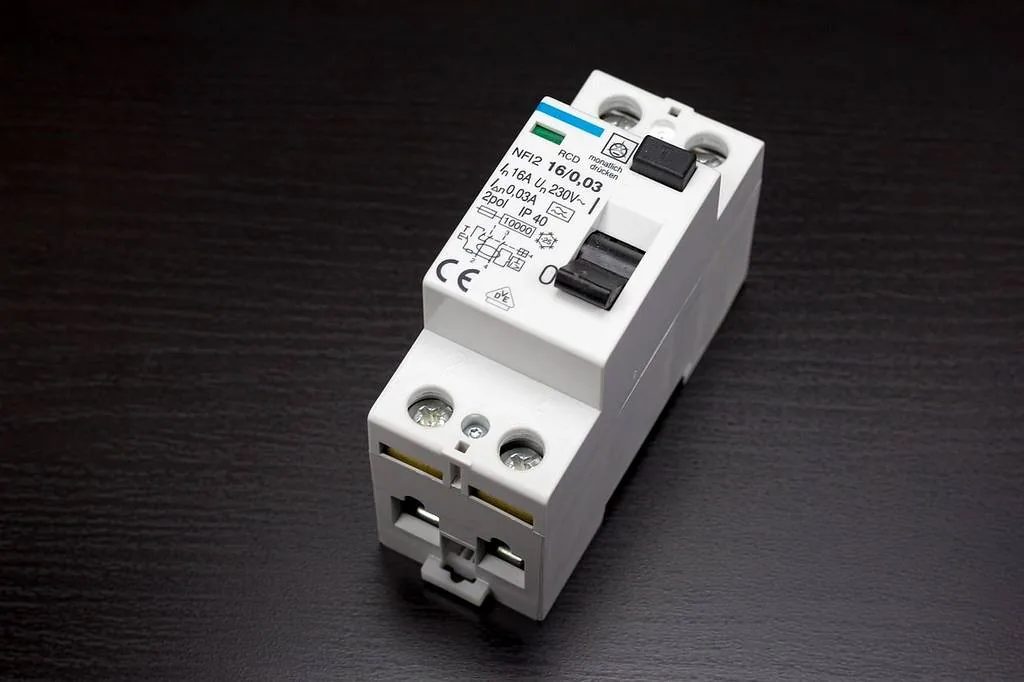
Figure 4. A 2-pole DIN-rail residual current device (RCD) on a dark table. The label shows a rated current of 16 A, a residual operating current of 0.03 A (i.e. 30 mA) and 230 V; the black test button is in the top corner (the text beside it is in German and means “press monthly”), and the black switching lever is in the middle. (Photo: Diermaier, Wikimedia Commons, CC0)
Reference table: tests, results and actions
Test | Method | Result (reference) | Meaning and action |
|---|---|---|---|
Voltage tester pen on the casing | Touch the pen to the casing while the appliance is plugged in | Lamp glows faintly or brightly | For screening only; must be measured with a meter |
Casing – earth (normal mode) | One probe on a good earth point, the other on the casing | Close to mains voltage | Casing live: cut the power, isolate the appliance |
Casing – earth (LoZ mode) | As above, switched to LoZ | Drops to almost 0 | Voltage through Y capacitors, appliance not earthed: install earthing |
Casing – earth (LoZ mode) | As above | Significant voltage remains | Real leakage: check the appliance insulation |
Appliance PE continuity | Unplugged, measure PE pin – casing | Around less than 1 Ω (short cord) | Open circuit: PE broken, repair the cord or hand over to an appliance repairer |
Insulation resistance | Megger, L+N shorted – PE | 1 MΩ or more (Class I) | Lower: moisture or insulation failure |
Socket L–N and L–PE | Measure with power on | The two values are approximately equal | L–PE low or fluctuating: PE open or wrongly wired |
Socket N–PE | Measure with power on | A few volts or less | Abnormally high: check the house-level neutral and earth |
PE continuity socket – consumer unit | Power off, long test lead | Continuous, low resistance | Open: broken wire or socket has no PE |
RCD/RCBO Test button | Press with power on | Must trip | Doesn't trip: replace or check the wiring |
The values are for guidance only. Conclusions are based on the full set of measurements and the manufacturer's documentation.
Fixes for each cause
Missing or broken earth
Run a continuous green-yellow PE wire from the earth bar in the consumer unit to the socket's PE terminal, with a cross-section matching the circuit's live conductor (see the lesson choosing the cable size and circuit breaker for each circuit). If the appliance has a separate earth wire, connect it according to the manufacturer's installation instructions. Do not bridge the PE terminal to N, and do not use water pipes, gas pipes or iron door frames as an earth.
Missing earth-leakage protection
Install a 30 mA RCBO or RCD for the circuit supplying the washing machine, for wet areas, or for groups of sockets according to the consumer unit design. Earthing and earth-leakage protection complement each other; neither replaces the other: earthing keeps the casing from rising to a high voltage and provides a path for fault current; the RCD cuts the power when it detects leakage current. In many houses the earth resistance is not low enough for an ordinary breaker to trip when the casing becomes live, so the RCD is the device that actually cuts the power.
Damaged power cord or plug
Replace with a type suitable for the power rating, with an earth core; for many appliances, the power cord should be replaced with the manufacturer's part. Do not join it with tape, do not break off the earth pin, and do not use a 3-pin to 2-pin adaptor.
Incorrectly wired socket
Rewire to the correct terminals and colours and tighten firmly; if the socket is loose, cracked or burnt, replace it with an earthed socket. Also check the other sockets on the same circuit.
Faults inside the appliance
This is the boundary of the trade. A residential electrician does not open up and repair the EMI filter, circuit board, heating element, motor or compressor without proper training. With fridges, never cut, drill or braze the copper pipes or the sealed refrigerant system; that is the job of a refrigeration technician. Your job: record the measurements, put on a “Do not use – awaiting repair” label, and tell the customer to call the warranty service.
Moisture and water
Deal with the water source first: if the washing machine hose is leaking, refer it to a plumber (see the lesson installing a washing machine correctly in the plumbing section). The washing machine socket should be mounted high, away from taps, with a cover in wet areas. Measure again once dry; if it still leaks, the fault is not just moisture.
Real-life scenarios
Scenario 1 – Slight tingling, no earth in the house. An old apartment with a newly bought front-loading washing machine; the customer only feels a prickle when running a hand over the lid. Measuring casing – earth (the PE contact of the test lead connected back to the consumer unit) with the meter in normal mode gives a few tens of volts; switching to LoZ drops it to almost 0. The socket is 3-pin but the PE terminal is empty. Conclusion: leakage current from the filter capacitors on an unearthed appliance. Fix: run a PE wire from the consumer unit to the socket, install a 30 mA RCBO for the circuit, and measure the casing again: close to 0 V. The appliance needs no repair.
Scenario 2 – A fridge trips the RCD in the middle of the night. For the past few days the main RCD has been tripping at night, and in the morning the fridge tingles when touched. Plug the fridge into the test lead with its own RCD: after a while the RCD trips, exactly when the fridge enters its defrost cycle. Unplug it and measure insulation L+N – PE: the result is low. Conclusion: a suspected fault in the fridge's internal defrost circuit. Action: do not open the fridge, label it, tell the customer to call the warranty service, and explain that the RCD tripping means it is doing its job correctly.
Scenario 3 – “It's earthed”, but bridged to neutral. Measuring the washing machine casing shows close to 0 V, so it looks fine. Only on opening the socket (with the power off) do you see the PE terminal connected to the N terminal with a short piece of wire. Under normal conditions there is no problem, but if the neutral upstream becomes loose or broken, the appliance casing will become live. Fix: remove the bridging wire, run a genuine PE back to the consumer unit, and check the other sockets installed by the same previous electrician.
When to refuse or escalate
The casing reads close to mains voltage, the floor is wet, and that circuit cannot be switched off on its own: switch off the main breaker, and do not work near the appliance until it is dry and the power is cut.
A clear fault inside the appliance, especially if it is still under warranty: hand over to the warranty service centre.
Work needed on the compressor or refrigerant system: hand over to a refrigeration technician.
The customer insists on removing the RCD, breaking off the earth pin, or bridging PE to N “so it stops tripping”: refuse and explain why.
A suspected neutral or earthing problem affecting a whole building, apartment block or multi-unit rental house, or involving the supply before the meter: report it to the building management or the power company (EVN), and do not interfere with parts that are not under the customer's control.
You don't have suitable instruments to reach a conclusion: be honest with the customer, and record clearly what has and has not been done.
How to explain it to the customer
Customers often ask: “Is it dangerous?”, “Is the appliance faulty or the house wiring?”, “How much will it cost?”. Answer based on your measurements, using everyday examples:
“The earth wire is like the insulated handle on a pot: if electricity leaks onto the casing, it carries it away somewhere else instead of through your hand. Your house is missing that.”
“This time the slight tingling is caused by the interference-filter components inside the machine; the machine isn't broken yet. But if one day it does develop a real fault, nothing will protect you, so we need to install an earth and earth-leakage protection.”
“When the earth-leakage breaker trips, it is protecting your home. If you remove it, it stops tripping, but next time a person takes the shock.”
For an appliance fault: “I've checked your house wiring, and the socket and earthing both pass. The fault is inside the appliance; I've written down the measurements for you to give to the warranty service.”
Itemise the quotation: inspection, running the PE wire, installing an RCBO, replacing the socket, replacing the power cord; do not promise “guaranteed no more tingling” when the fault is inside the appliance (see the lesson quoting, taking on jobs and working with customers). If the tingling is on a water heater in the bathroom, see the separate lesson on wiring a water heater safely with shock protection.
Safety checklist before handover
☐ Told the customer to stop using the appliance and disconnect the power safely during the first call.
☐ Proved the meter on a live source before and after measuring.
☐ Conclusions are based on the meter, not just the voltage tester pen.
☐ Determined whether the fault is in the appliance or the wiring using a test lead with a good PE.
☐ The socket has correct L, N, PE; no bridge from PE to N.
☐ PE continuity from the socket to the consumer unit's earth bar.
☐ The circuit has a 30 mA RCD/RCBO that trips correctly when Test is pressed.
☐ Casing voltage after the fix is close to 0 V with the appliance running.
☐ An appliance with an internal fault has a do-not-use label, and the customer knows to call the warranty service.
☐ The measurement results have been recorded and given to the customer.
Frequently asked questions
It's only a slight tingle – do I need to do anything?
Yes. A slight tingle usually shows that the appliance casing is not earthed. Even if the cause is only leakage current from the filter capacitors, the appliance is still missing its most important layer of protection.
Turning the plug round stops the tingling – is that the end of it?
No. Reversing the plug may change the sensation with some appliances, but it does not solve missing earthing or an insulation fault.
If there is earth-leakage protection, is earthing still needed?
Yes. An RCD only trips when the leakage current reaches its threshold; smaller currents can still cause tingling. With earthing, leakage current goes to earth instead of through a person, and when the casing becomes live the RCD detects it and trips immediately, without waiting for someone to touch it.
If there is earthing, is earth-leakage protection needed?
It should be fitted. Earth wires can break or corrode over time, and in many houses the earth resistance is not low enough for an ordinary breaker to trip when the casing becomes live. A 30 mA RCD is an additional layer of protection for people.
Why does a newly bought appliance also tingle?
Usually it is not that the appliance is faulty, but that the socket has no genuine earth, or the appliance's separate earth wire has not been connected. If the socket passes but the new appliance still leaks, contact the seller or the warranty service.
Practice exercises
Exercise 1 – Interpreting measurements: You are given four sets of data: (a) casing – earth 90 V in normal mode, 2 V in LoZ mode; (b) casing – earth 220 V in both modes; (c) casing – earth 0 V, but the customer still reports tingling; (d) socket L–N 225 V, L–PE close to 0 V. State the possible cause and the next step for each case.
Pass criteria:
(a) recognise voltage through the capacitors on an unearthed appliance, and propose installing earthing and an RCD.
(b) recognise a live casing, cut the power immediately and isolate the appliance.
(c) know to check the surrounding metal objects and the whole-house earthing, and ask again about the circumstances of the tingling.
(d) recognise an open PE terminal or a missing PE wire.
Exercise 2 – Making a test lead: Make an extension lead with an earth and a 30 mA RCD to take with you on jobs, and write a self-check procedure to follow before each use.
Pass criteria:
The cable has the correct cross-section, the plug and socket are earthed, and the casing is not cracked.
The procedure includes measuring L–N, L–PE, N–PE, PE continuity and pressing Test.
State clearly: if the test lead is faulty, do not use it, even when you are in a hurry.
Exercise 3 – Fault-finding on a model: On a practice bench (with a supply prepared by the instructor, protected by an RCD), the instructor creates one fault: an empty PE terminal, PE bridged to N, or L/N reversed. The trainee uses a meter to find the fault and explains it to the “customer” (a classmate).
Pass criteria:
Correctly identify the fault by measurement, not by guessing.
Cut the power and confirm the circuit is dead before opening the socket.
The explanation is short and easy to understand.