Choosing the wrong type of pipe is the most expensive mistake a plumber can make: the pipe is already buried in the wall and the tiles are laid, and only months later does it leak or burst because it could not handle the heat or pressure. By then, the repair costs many times the original materials, not to mention the damage to your reputation with the customer.
By the end of this lesson, you will be able to:
- Instantly recognize the three most common pipe types in Vietnamese homes — PPR, uPVC, HDPE — and know which one is used for hot supply, cold supply, drainage and buried runs.
- Read the specification line printed on a pipe, work out its inner diameter and choose the right PN class.
- Split a 4-story tube house into runs and draw up a pipe list, including the thermal expansion of an exposed hot-water section.
- Prepare a basic toolkit and keep the job site clean from your very first day working with a master plumber.
Why you must understand materials before picking up the welder
A good master plumber looks at a drawing and knows which pipe goes where, what size and what wall thickness. Understanding materials helps you avoid the three most common failures.
Pipes with poor heat resistance soften, swell and burst
Every plastic pipe gets weaker when hot. A pipe rated for 10 bar at 20°C may only handle a few bar at 70°C over the long term. Water after an electric water heater is usually 50–75°C, and water from a solar heater in summer can be even hotter. If the pipe on this section is not rated for the temperature, it slowly swells, joints loosen, and it leaks after one or two hot seasons.
Pipes that cannot handle outdoor UV
Sunlight (UV rays) makes many plastics brittle, faded and covered in fine cracks over time. Exposed pipes on rooftops, along outside walls and up to the roof tank are where this happens most. An experienced plumber always asks, "Will this section be in the sun?" before choosing the pipe.
Joints that do not suit the installation
Each pipe type has its own "standard" joint: PPR is heat-fused, uPVC is solvent-cemented or gasketed, and HDPE uses compression fittings or welding. If you use a removable joint that can loosen over time (a union or compression fitting) inside a wall, you are planting a "water bomb" there. The general rule: only permanent joints inside walls and floors (heat fusion or solvent cement); removable joints must stay where they can be opened and inspected.
The three pipe types you will meet every day
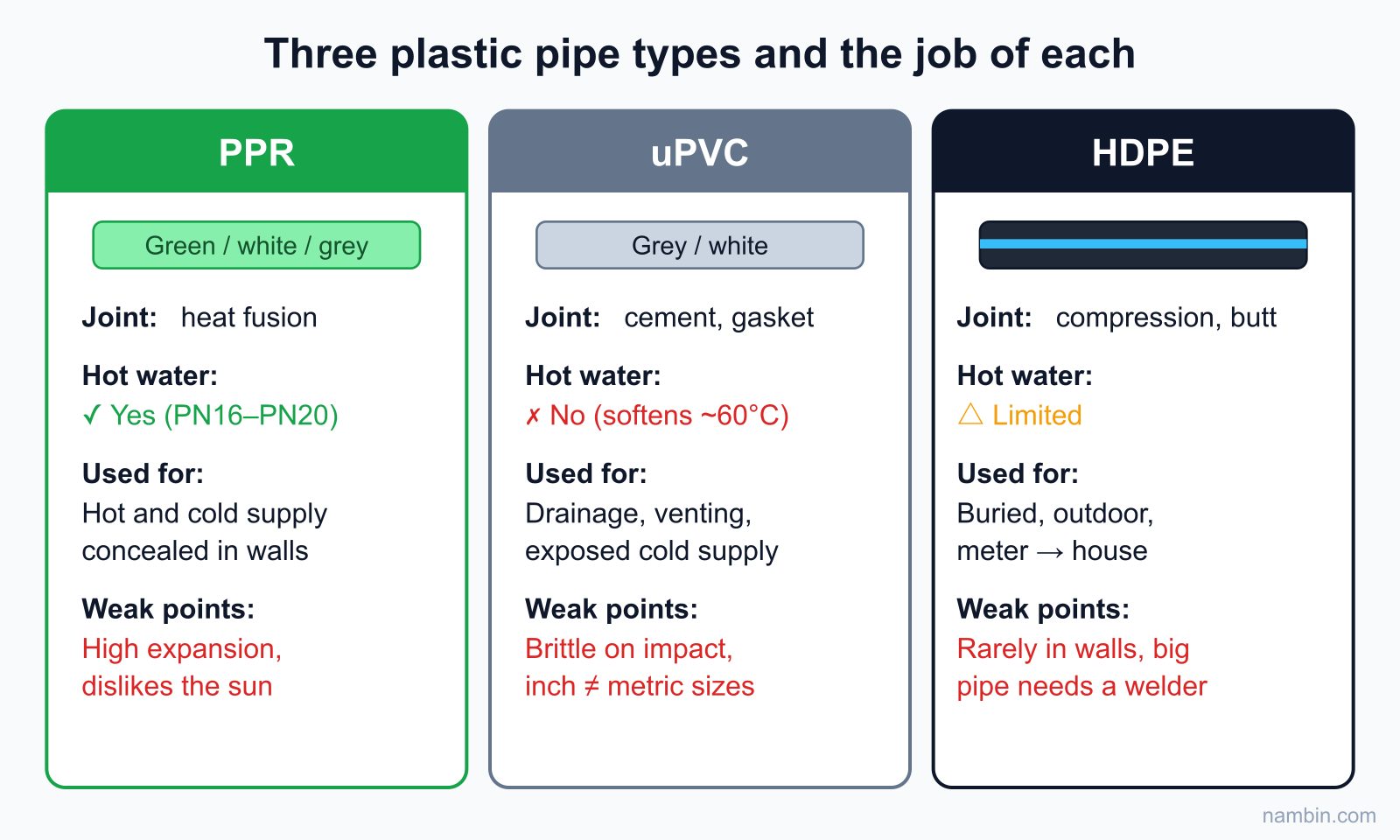
Before going into detail, remember the "main job" of each type: PPR handles concealed supply lines (both hot and cold), uPVC handles drainage, and HDPE handles buried and outdoor sections.
PPR pipe (heat-resistant plastic)
PPR is polypropylene random copolymer, usually green, white or grey, joined by heat fusion: the pipe and fitting are melted and pressed together into one piece. A properly made fusion joint almost never leaks, which is why PPR is the popular choice for hot and cold supply lines concealed in walls.
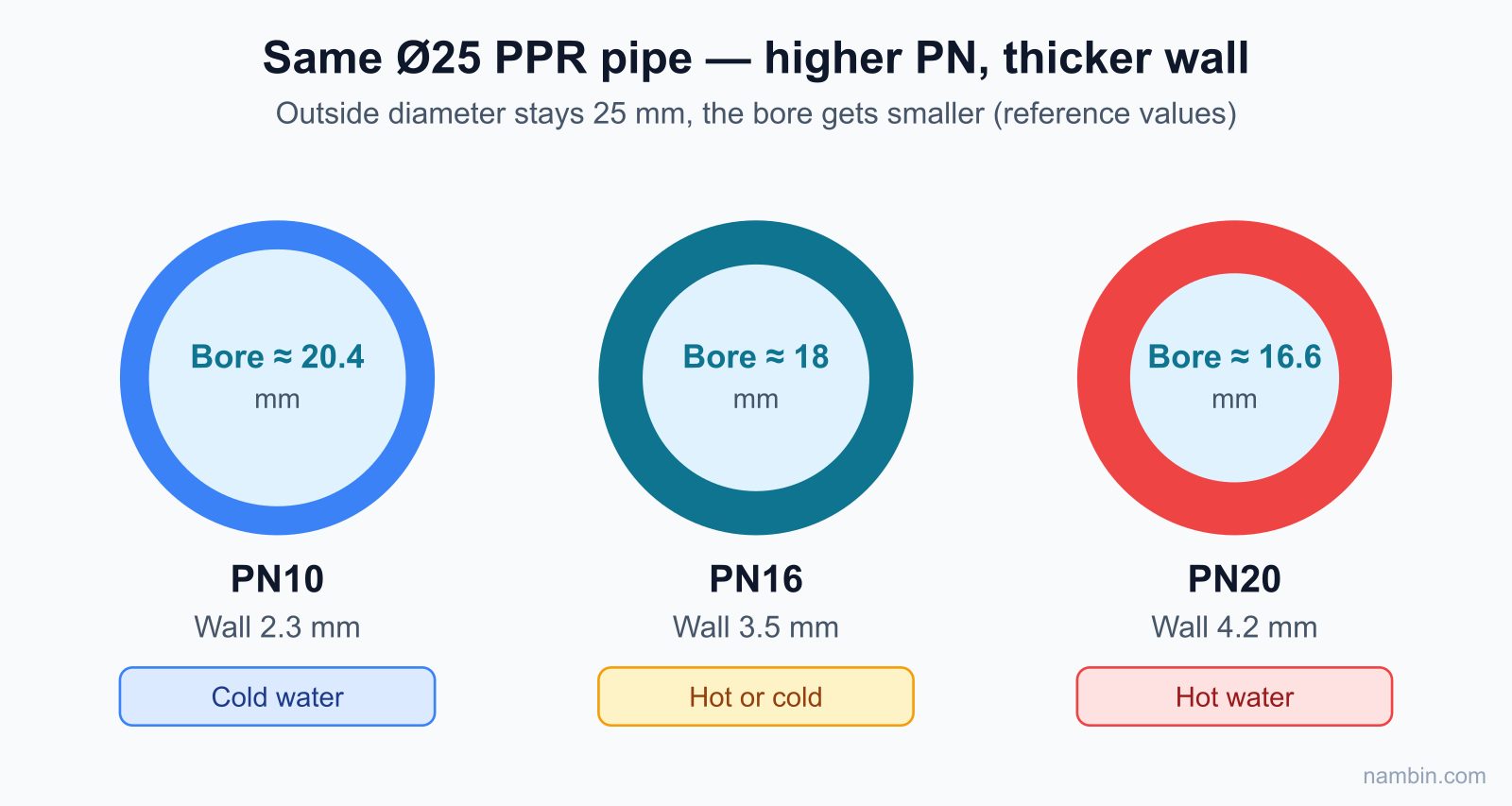
The pipe is printed with its nominal pressure class (PN). PN10 pipe is usually for cold water; for hot water, use PN16 or PN20, because high temperature reduces the plastic's pressure capacity. For the same outside diameter, the higher the PN, the thicker the wall and the smaller the bore. Reference example for 25 mm pipe: PN10 has a wall of about 2.3 mm, PN16 about 3.5 mm, PN20 about 4.2 mm — read the exact numbers on each manufacturer's pipe.
Besides single-layer PPR, the market also has multilayer PPR pipe (with a middle layer reinforced by glass fiber or aluminum). It expands much less with heat, making it suitable for exposed hot lines or long runs. Pipe with an aluminum layer needs a shaving tool to remove the outer layer before fusing; glass-fiber reinforced pipe is fused like normal pipe. When you meet an unfamiliar type, read the instructions that come with it before you start.
uPVC pipe (rigid plastic)
uPVC is unplasticized PVC, grey or white, joined with solvent cement or rubber gaskets. It is stiff, cheap and easy to install, ideal for drainage: floor drains, basins, toilets, stacks and roof drains. uPVC is not used for hot water because the plastic softens and deforms when hot (it starts to soften from around 60°C).
Pressure-rated uPVC (thick wall, marked with a pressure class) is still used for cold supply on many projects, especially exposed runs, runs inside service shafts, or long runs outside the house. However, for supply lines concealed in residential walls, plumbers today prefer PPR because the fused joint is homogeneous and depends less on the skill of applying cement. uPVC is more brittle under heavy impact and gets more brittle after long sun exposure, so outdoor sections need painting or shielding.
In Vietnam, uPVC comes in two parallel size systems: the inch-based system, commonly called by numbers such as 21, 27, 34, 42, 49, 60, 90, 114, and the metric system such as 110, 140, 160. Inch-system fittings do not fit metric pipe even when the numbers look close (for example 114 and 110), so always state the system when buying.
HDPE pipe (flexible plastic)
HDPE is high-density polyethylene, usually black with blue stripes. The carbon black in the plastic gives it good UV resistance. The pipe is flexible, comes in long coils, and handles impact and ground settlement well; it is joined with compression fittings or butt fusion. It suits outdoor and buried supply lines, carrying water from the meter into the house or up to the roof tank.
On HDPE pipe you will see the material grade (PE80, PE100 — the higher the number, the stronger the material), the SDR (ratio of outside diameter to wall thickness — the smaller the SDR, the thicker the wall) and the PN. Small sizes (20–63 mm) in homes are usually joined with removable compression fittings; large pipes in infrastructure work use butt fusion or electrofusion, which require machines and specialist welders.
Reading the specifications printed on the pipe
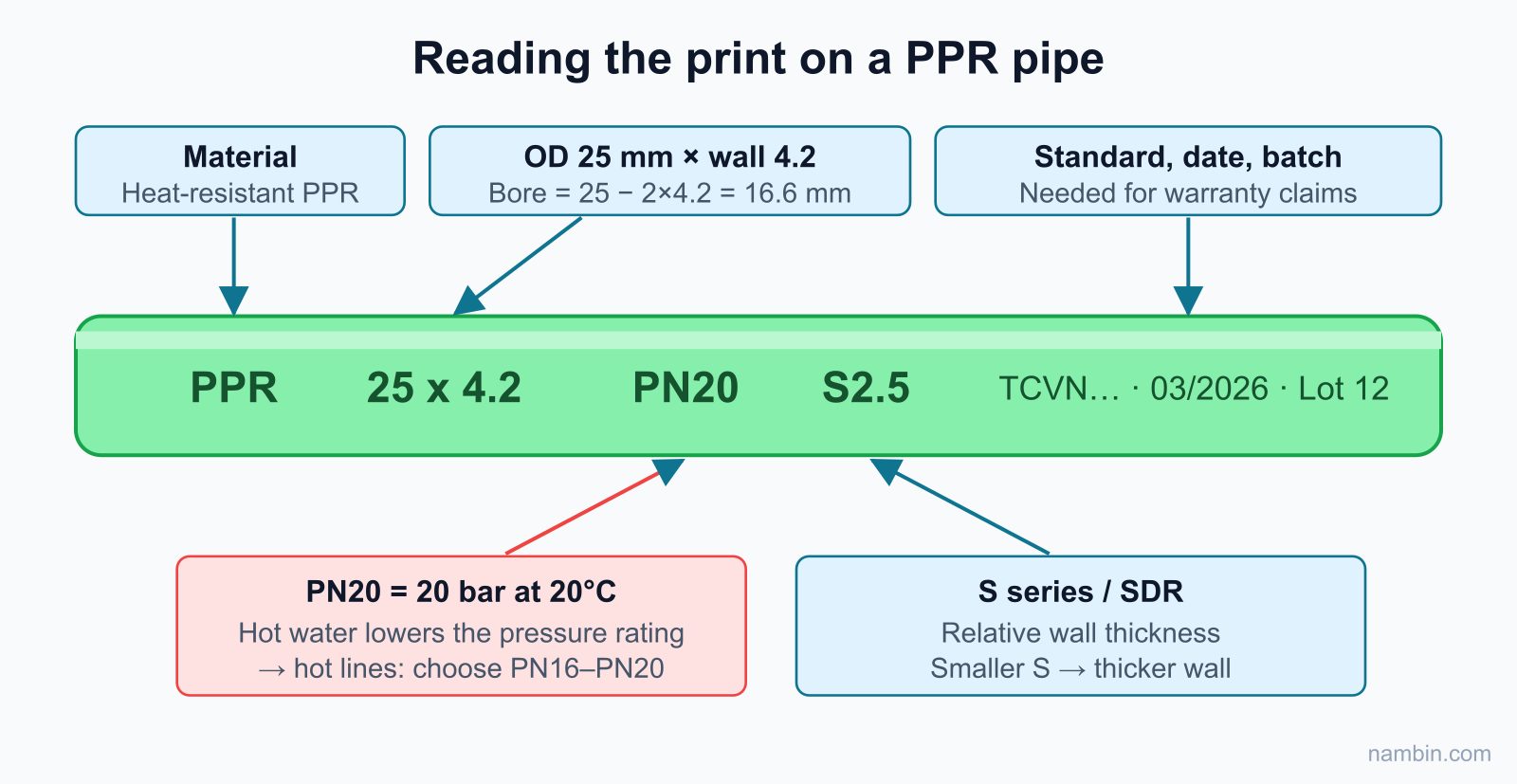
The specification printed along the pipe is its "birth certificate". A plumber who can read it will not be sold the wrong product and can explain to the homeowner why the more expensive pipe was chosen.
What each marking means
- Material name: PPR, PVC-U (uPVC), PE100/PE80 (HDPE).
- Outside diameter × wall thickness (mm): for example 25 × 4.2.
- PN (nominal pressure, bar) at 20°C: PN10, PN16, PN20… Note that PN is rated for water at 20°C, not hot water.
- SDR or S series (for HDPE, PPR): indicates the relative wall thickness.
- Manufacturing standard: the TCVN (Vietnamese national standard), ISO or DIN number the manufacturer declares — for example, uPVC water supply pipe is often marked TCVN 8491, and HDPE water supply pipe TCVN 7305.
- Production date and batch number: needed for warranty claims.
Example: reading a piece of pipe
Suppose the pipe reads: PPR 25 x 4.2 PN20 S2.5 plus a standard number and production date. You understand: PPR pipe, 25 mm outside diameter, 4.2 mm wall, so the bore is about 25 − 2 × 4.2 = 16.6 mm; nominal pressure 20 bar at 20°C; suitable for hot-water lines in homes. If the same section were PPR 25 x 2.3 PN10, the bore would be wider (about 20.4 mm) but it should only be used for cold water.
Spotting poor-quality pipe
- Faint printing, missing specifications, no standard or production date.
- Uneven wall thickness when you look at the cut end; a caliper shows a clear difference.
- Rough inner surface with air-bubble streaks; PPR pipe that feels unusually soft when squeezed.
- A price far below the market for the same specification. For concealed lines, saving a few hundred thousand VND (a few US dollars) is not worth the risk of breaking open a wall.
Quick comparison table
| Criterion | PPR | uPVC | HDPE |
|---|---|---|---|
| Joining | Heat fusion | Solvent cement / gasket | Compression / butt fusion |
| Hot water | Yes (choose high PN) | No | Limited |
| Concealed in walls | Very suitable | Mainly for drainage | Rarely used |
| Buried, outdoor | Needs sun protection | OK, avoid impact | Very suitable |
| Flexibility, settlement | Medium | Stiff, brittle under heavy impact | Very flexible |
| Thermal expansion | Fairly high (single-layer) | Lower than PPR | High |
| Tools needed | Fusion welder, pipe cutter | Saw, cement, sandpaper | Wrench, butt-fusion machine (large pipe) |
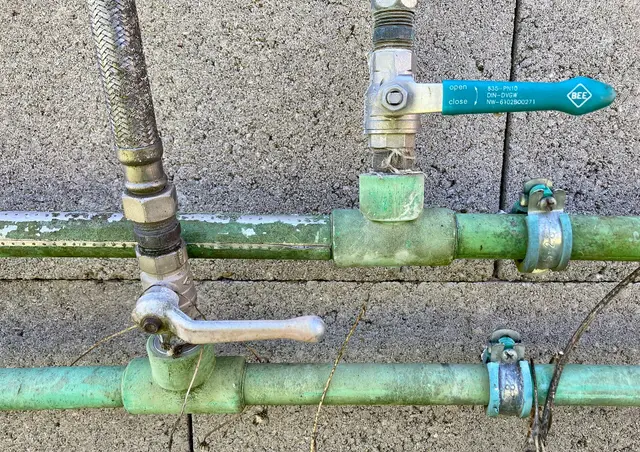
Besides these three, you will also meet copper pipe (premium hot-water lines, gas lines, air-conditioner lines — needs brazing, usually done by specialists), galvanized steel pipe (common in old houses; it rusts inside, turning water yellow and reducing flow) and braided stainless flexible hoses (connectors from angle valves to taps and water heaters). When renovating old houses, replacing rusty galvanized sections with PPR is a very common job.
Choosing pipe for each part of the house
Supply lines
- Cold supply inside the house, concealed: PPR PN10 or higher.
- Hot supply (after an electric water heater or solar heater): PPR PN16–PN20.
- From the water meter into the house, buried: HDPE.
- Riser down from the roof tank: PPR, usually 32 mm or larger depending on the number of floors and fixtures; branches into each room 25 mm, to each fixture 20 mm.
Drain lines
- Basin and floor drains: uPVC of suitable diameter (usually 42–60 mm).
- Toilet drains, stacks: uPVC 90–110 mm.
- Roof and balcony drains: uPVC 90–114 mm, with the number of roof outlets based on roof area.
- Vent pipes: uPVC, usually 42–60 mm for townhouses.
Common fittings
You need to know fitting names to read material lists and buy without mistakes:
- Couplings (join two pipes of the same size) and reducers / reducing couplings (join two different sizes).
- 90° elbows and 45° elbows to change direction; for drainage, prefer 45° elbows or long-radius bends.
- Equal tees and reducing tees to split branches; for drainage use Y-junctions or swept tees so the flows merge smoothly.
- Female / male threaded adapters (PPR with brass inserts) to connect to valves, taps and meters.
- Unions to remove and refit equipment such as pumps and water heaters — only in exposed places, never buried in walls.
- Stop valves, check valves, end caps; for drainage, cleanout fittings for clearing blockages later.
Note: Do not mix fittings from different brands in the same PPR fusion joint unless you are sure their dimensions are compatible. Even a small mismatch can stop the joint from fusing fully and cause a leak after a while.
Worked example: choosing pipe for a 4-story tube house
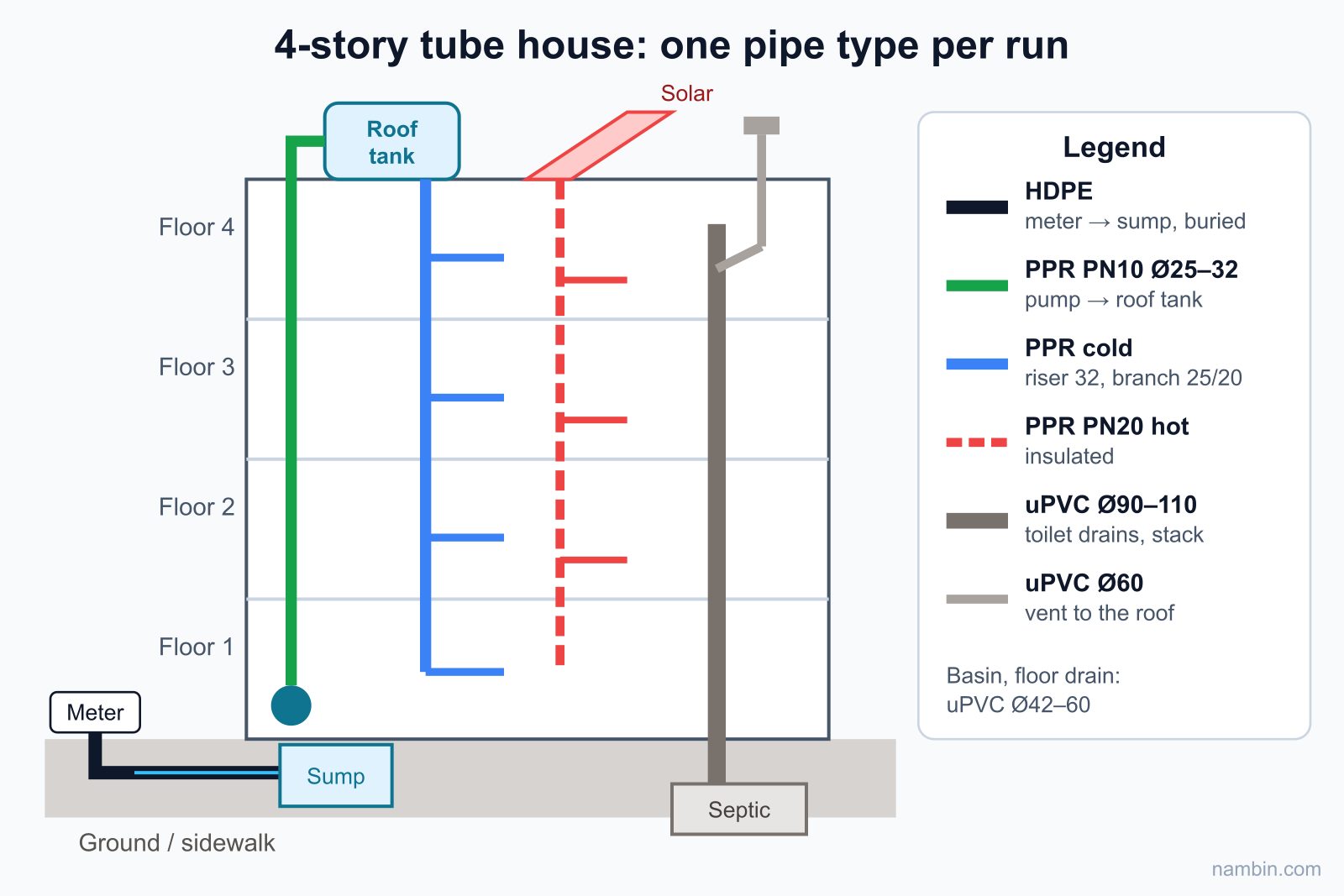
Situation: a 4-story tube house (the narrow, deep townhouse common in Vietnam), 4 m wide and 16 m deep. Floors 2–4 each have one bathroom (toilet, basin, shower, floor drain) with its own electric water heater. The ground floor has the kitchen and one bathroom. A water tank sits on the roof, and the roof terrace has a solar water heater for extra hot water. The water meter is on the sidewalk, about 3 m from the base of the wall.
Step 1: split the runs and choose materials
- Meter → underground tank/pump: buried under the sidewalk and floor, subject to settlement and vehicles → HDPE, with a compression fitting at the meter end (exposed, removable).
- Pump → roof tank: riser inside the service shaft → PPR PN10, 25–32 mm. The section lying on the sunny roof terrace must be wrapped in insulation or run in a covered channel.
- Roof tank → floors (cold water): PPR riser 32 mm, room branches 25 mm, fixture connections 20 mm.
- Hot water: from the water heater to the shower and basin use PPR PN20. The hot line down from the solar heater also uses PPR PN20 with insulation, because in summer the water can be very hot.
- Drainage: toilets in uPVC 110 (or 90 per the design) to the septic tank; basins and floor drains in uPVC 42–60 collected into a 90 grey-water stack; venting in uPVC 60 up to the roof.
Step 2: calculate expansion for the exposed hot section
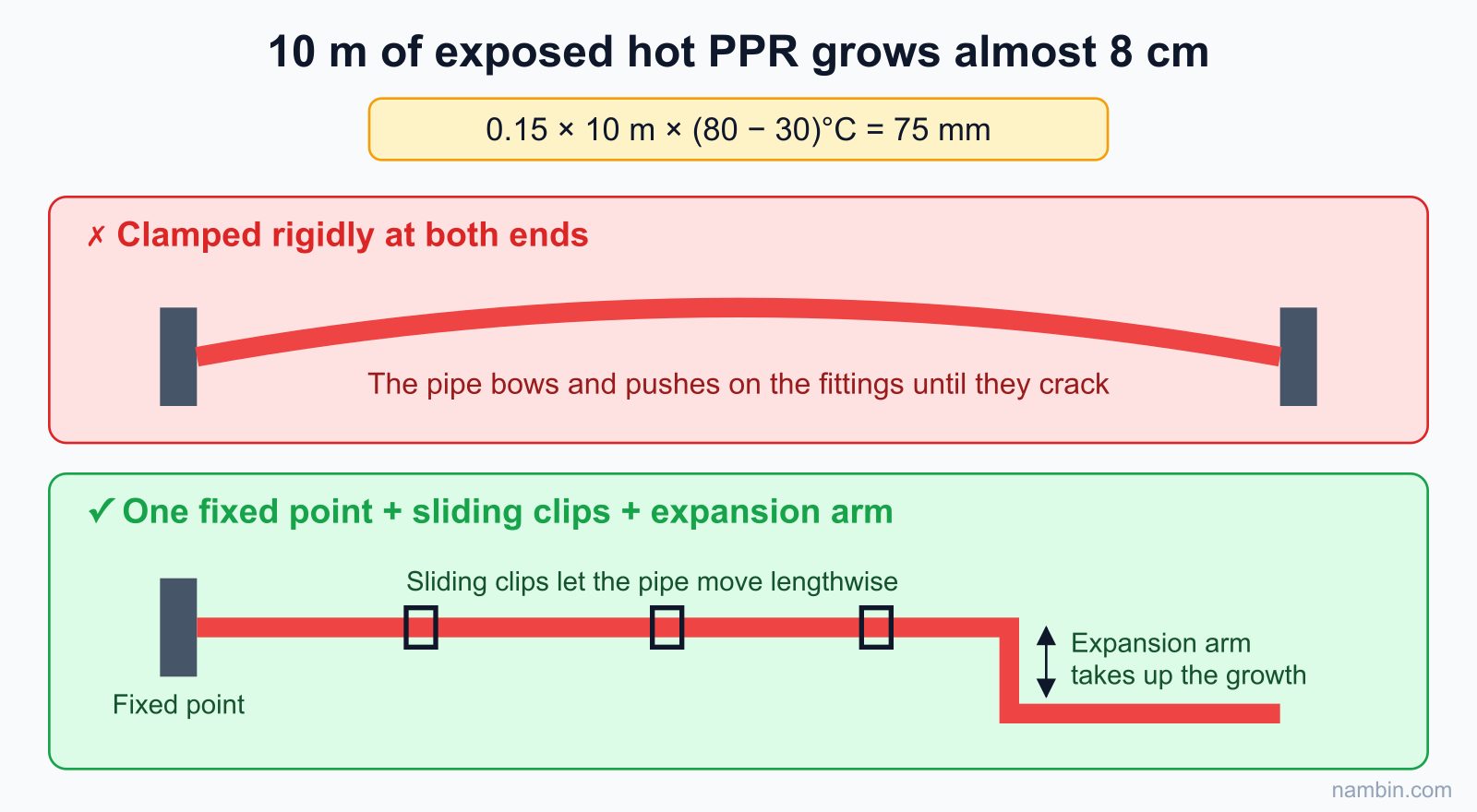
Single-layer PPR expands about 0.15 mm per meter of length per degree of temperature rise (a typical reference value in catalogues). The exposed hot pipe on the roof terrace is 10 m long, installed at 30°C, and reaches 80°C when hot water runs (a difference of 50°C):
Expansion = 0.15 × 10 × 50 = 75 mm
Almost 8 cm! If both ends are clamped rigidly, the pipe will bow or push its force into the fittings until they crack. How to handle it: use multilayer PPR (much lower expansion), place changes of direction with an expansion arm, use sliding clips that let the pipe move lengthwise, and fix it rigidly at only a few points.
For sections concealed in walls, the plaster holds the pipe in place so problems are rarer, but it is still worth insulating hot pipes to reduce stress and save heat.
Step 3: review with the homeowner
List the materials by run, stating the pipe type, size and PN for each section, and explain to the homeowner why the hot line uses PN20 even though it costs more: breaking open a wall to repair it costs far more than the difference in materials.
The basic plumber's toolkit
Cutting and joining tools
- PPR fusion welder with heads for 20–32 mm (larger jobs need 40–63 mm too).
- Plastic pipe cutter and hacksaw; deburring knife.
- Pipe wrench, adjustable wrench, PTFE tape, uPVC solvent cement, sandpaper.
Measuring and testing tools
- Tape measure, marker, spirit level to check slopes; a laser level if available.
- Caliper to measure pipe diameter and wall thickness when needed.
- Pressure test pump with a gauge.
Protective gear and site protection
- Heat-resistant gloves, safety glasses when cutting and chiseling.
- Tarps and cardboard to cover floors and fixtures during work.
- Temporary end caps in various sizes, tape, garbage bags.
Safety: PPR welders, drills and cutters all run on 220V in wet conditions. Only plug into sockets protected by a residual-current breaker (RCD/RCBO), use extension cords with intact insulation, and never let cords sit in water or touch the hot welding head. Before chiseling a wall, ask the homeowner where the concealed electrical wires are; if unsure, use a detector or ask an electrician to check.
Keeping the site clean: a big plus with customers
Customers remember a plumber not only because the pipes do not leak, but also because their house is clean after the plumber leaves. Build these habits:
During the work
- Lay tarps before cutting and chiseling; cover drain openings so mortar and sand do not fall in and cause blockages.
- Cap supply pipe ends with temporary caps until fixtures are fitted — sand in supply pipes will jam valves and clog shower filters later.
- Cover installed toilets and basins with cardboard so a dropped tool does not crack the porcelain.
At the end of each session
- Collect pipe offcuts, empty cement cans and packaging in a separate garbage bag.
- Wipe cement off floors and walls while it is still wet — dried uPVC cement is very hard to remove.
- Stack pipes and fittings neatly in a corner, and do not leave pipes in the sun on the roof terrace for days.
Common material selection mistakes
- Using PPR PN10 for hot lines. Sign: after one or two years the pipe swells and joints weep near the water heater. Cause: high temperature reduces pressure capacity. Fix: replace the hot section with PN20, and choose correctly from the start next time.
- A riser too small for a multi-story house. Sign: on the top floor, opening two taps at once makes the shower much weaker. Cause: thick-walled PPR PN20 used for the cold riser without increasing the size, so the bore is small. Fix: use PN10 Ø32 or larger for the cold riser, or go up one size if you want PN20.
- Running PPR or uPVC exposed to the sun without cover. Sign: faded pipe, fine cracks, sounds brittle when tapped. Fix: replace the damaged section and insulate it or run it in a channel; for long-term outdoor use, prefer HDPE.
- Fitting inch-system pipe with metric fittings. Sign: the pipe is loose or will not go into the fitting, and you are tempted to "pack" it with cement. Fix: check the system when buying, and never force a joint with a big gap.
- Burying unions or compression fittings in walls. Sign: a leak exactly at the fitting after a few months. Fix: only permanent joints inside walls; removable fittings go in service shafts with an access panel.
Frequently asked questions
What is the difference between green and white PPR pipe?
Color is mostly the manufacturer's choice and does not decide quality. What matters is the PN class, wall thickness and standard printed on the pipe. Some brands use colored stripes to distinguish hot and cold, but you still have to read the print to be sure.
Can I use PPR PN20 for everything, hot and cold?
Yes, many plumbers do this to avoid mix-ups on site. The trade-off is higher cost and a smaller bore, so for risers and main cold branches you must size them properly so the flow is not weak on the upper floors.
Can the line from the meter into the house be PPR?
It can, but for long-term burial under settling ground and vehicle traffic, HDPE lasts longer because it is flexible and rarely cracks. If you must use PPR or uPVC under a floor, put it inside a protective sleeve and bed it in fine sand, never in rubble.
Can uPVC pipe be used for drinking water?
uPVC made for domestic water supply (with a declared water supply standard) can be used for cold water. uPVC made only for drainage should not be used for supply, because its wall is thin and it is not controlled for drinking water.
Practice exercises and self-check
Exercises
- Read and explain the specifications printed on three pieces of pipe: one PPR, one uPVC, one HDPE. Calculate the bore of the PPR piece.
- Draw the water system of the house you live in (or the example house in this lesson), marking which pipe type, size and PN each section should use.
- Calculate the expansion of a 6 m exposed hot-water PPR section with a 45°C temperature difference, and propose how to fix it in place.
- Go to a plumbing supply store and write down the correct names of 8 common fittings with reference prices (state the year, 2026).
Self-assessment criteria
- Pass: you read every specification on the pipes correctly, without confusing PN with diameter.
- Pass: your diagram has no hot-water section in uPVC or PPR PN10; buried and sun-exposed sections have their own solution.
- Pass: your answer to exercise 3 is 0.15 × 6 × 45 ≈ 40 mm, with at least one suitable fixing solution.
- Pass: you name fittings correctly and can tell a standard tee from a Y-junction used for drainage.
- Not yet: you cannot answer why uPVC is not used for hot water, or which pipe should run from the meter in the alley into the house.
Next step in the roadmap (step 2 — Cutting and fusing PPR & cementing uPVC): choosing the right pipe is only half the job. The other half is the joint: in the next lesson you will learn the fusion temperature, timing and depth for each PPR size, how to calculate the cut length between two fittings, and how to cement uPVC for drain lines — so the very pipes you just chose last as long as the house.